Learning Competencies:
a.Identify the distinguishing features
of Anglo-American one-act-play
b.Analyze a one-act-play
c.Explain how the elements specific
to a one-act play contribute to the
development of its theme
Ms. Shyrey Mae D. Macabitas
SORRY, WRONG
NUMBER
(A Radio Play) by Lucille Fletcher
Topic 3
DIRECTION: Give the meaning of the underlined words in
these sentences. Choose your answers from the synonyms in the
box.
1. Mrs. Stevenson is identified as a querulous and self-
centered neurotic.
2. She became imperious when she could not connect to the
number she dialed.
3. When she dialed again, she only got bland buzzing signal
and heard the conversation on the cross line
4. The telephone operator’s failed attempts to
connect to her husband’s office number unnerved
her.
5. She gave a highhanded reply when she sensed
Sgt. Duffy did not take action on her complaint.
a.Uninteresting
b.Authoritative
c.Complaining
d.Overbearing
e.Upset
ANSWERS:
1.Querulous - complaining
2.Imperious – authoritative
3.Bland – uninteresting
4.Unnerved – upset
5.Highhanded - overbearing
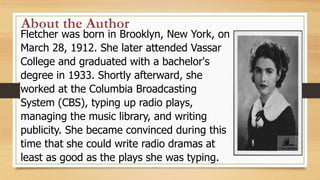
Fletcher was born in Brooklyn, New York, on
March 28, 1912. She later attended Vassar
College and graduated with a bachelor's
degree in 1933. Shortly afterward, she
worked at the Columbia Broadcasting
System (CBS), typing up radio plays,
managing the music library, and writing
publicity. She became convinced during this
time that she could write radio dramas at
least as good as the plays she was typing.
Fletcher is best known for the thrillers she
would go on to write for radio. Her most
notable play is Sorry, Wrong Number, which
first aired in 1943. She later adapted the
radio play into a screenplay, which was
produced in 1948.
SUSPENSE -- _SORRY, WRONG NUMBER_
(1948).mp4
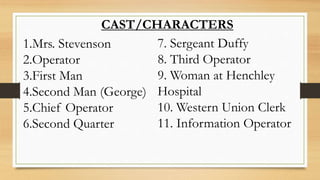
CAST/CHARACTERS
1.Mrs. Stevenson
2.Operator
3.First Man
4.Second Man (George)
5.Chief Operator
6.Second Quarter
7. Sergeant Duffy
8. Third Operator
9. Woman at Henchley
Hospital
10. Western Union Clerk
11. Information Operator
A dramatized and lively acoustic
performance broadcast on a radio
With no visual component
This is a play that takes place,
from beginning to end, in a singe
act. It can range from one minute
to one hour long.
FEATURES of a ONE-ACT-PLAY
1.THEME
Theme necessary
Ask yourself: What is the play about? (Revenge? Self-
discovery?)
Mind needs to be clear about the theme
Characters, plots, and sub- plots need to point to and
support the theme
Sub- plots might be missing in one- act plays
2. PLOT
Different in one- act play from a full length play
In a one- act play, there is only time for one significant
event
Determining place for hero, where all can be won or lost
Events leading to this, can be included without being
shown to audience
The events that follow must be inferred or understood
by the audience
3. CHARACTER
 There is not much area to develop all the
characters
 The hero or the protagonist’s character needs to
be more developed and focused on
 The antagonist can be developed to show conflict
 Some other characters can also be a little bit
developed to move the story forward
4. DIALOGUE
 Each line must be crafted carefully to focus on
the theme, the incident and the character of the
protagonist
 The dialogues need not be terse, but concise and
full of meaning
 Dialogues irrelevant to the plot, must be altered
or omitted immediately

Sorry, Wrong number by Lucille Fletcher

  • 1.
    Learning Competencies: a.Identify thedistinguishing features of Anglo-American one-act-play b.Analyze a one-act-play c.Explain how the elements specific to a one-act play contribute to the development of its theme Ms. Shyrey Mae D. Macabitas
  • 2.
    SORRY, WRONG NUMBER (A RadioPlay) by Lucille Fletcher Topic 3
  • 3.
    DIRECTION: Give themeaning of the underlined words in these sentences. Choose your answers from the synonyms in the box. 1. Mrs. Stevenson is identified as a querulous and self- centered neurotic. 2. She became imperious when she could not connect to the number she dialed. 3. When she dialed again, she only got bland buzzing signal and heard the conversation on the cross line
  • 4.
    4. The telephoneoperator’s failed attempts to connect to her husband’s office number unnerved her. 5. She gave a highhanded reply when she sensed Sgt. Duffy did not take action on her complaint.
  • 5.
    a.Uninteresting b.Authoritative c.Complaining d.Overbearing e.Upset ANSWERS: 1.Querulous - complaining 2.Imperious– authoritative 3.Bland – uninteresting 4.Unnerved – upset 5.Highhanded - overbearing
  • 6.
    Fletcher was bornin Brooklyn, New York, on March 28, 1912. She later attended Vassar College and graduated with a bachelor's degree in 1933. Shortly afterward, she worked at the Columbia Broadcasting System (CBS), typing up radio plays, managing the music library, and writing publicity. She became convinced during this time that she could write radio dramas at least as good as the plays she was typing.
  • 7.
    Fletcher is bestknown for the thrillers she would go on to write for radio. Her most notable play is Sorry, Wrong Number, which first aired in 1943. She later adapted the radio play into a screenplay, which was produced in 1948.
  • 8.
    SUSPENSE -- _SORRY,WRONG NUMBER_ (1948).mp4
  • 9.
    CAST/CHARACTERS 1.Mrs. Stevenson 2.Operator 3.First Man 4.SecondMan (George) 5.Chief Operator 6.Second Quarter 7. Sergeant Duffy 8. Third Operator 9. Woman at Henchley Hospital 10. Western Union Clerk 11. Information Operator
  • 10.
    A dramatized andlively acoustic performance broadcast on a radio With no visual component
  • 11.
    This is aplay that takes place, from beginning to end, in a singe act. It can range from one minute to one hour long.
  • 12.
    FEATURES of aONE-ACT-PLAY 1.THEME Theme necessary Ask yourself: What is the play about? (Revenge? Self- discovery?) Mind needs to be clear about the theme Characters, plots, and sub- plots need to point to and support the theme Sub- plots might be missing in one- act plays
  • 13.
    2. PLOT Different inone- act play from a full length play In a one- act play, there is only time for one significant event Determining place for hero, where all can be won or lost Events leading to this, can be included without being shown to audience The events that follow must be inferred or understood by the audience
  • 14.
    3. CHARACTER  Thereis not much area to develop all the characters  The hero or the protagonist’s character needs to be more developed and focused on  The antagonist can be developed to show conflict  Some other characters can also be a little bit developed to move the story forward
  • 15.
    4. DIALOGUE  Eachline must be crafted carefully to focus on the theme, the incident and the character of the protagonist  The dialogues need not be terse, but concise and full of meaning  Dialogues irrelevant to the plot, must be altered or omitted immediately