Hello there!
How have you been?
Doc, can I ask for some
advice from you?
Honey, can you comb
my hair?
Good evening people of the Philippines!
The following are the headlines
for our news tonight:
COMMUNICATIVE STYLES
- A PERSON'S APPROACH TO
COMMUNICATION IN A SPECIFIC
CIRCUMSTANCE.
COMMUNICATIVE STYLES
1. INTIMATE COMMUNICATIVE STYLE
2. CASUAL COMMUNICATIVE STYLE
3. CONSULTATIVE COMMUNICATIVE STYLE
4. FORMAL COMMUNICATIVE STYLE
5. FROZEN COMMUNICATIVE STYLE
1.INTIMATE
LET'S GET STARTED!
This style is used by participants who know each other
well or share a very close
relationship, such as between close friends, siblings,
husband and wife, parents and
children, and boyfriend and girlfriend.
The participants in this style do not need for clear
articulation of words or additional
explanations. They may use words of endearment such as
babe, love, dear, honey as
a sign of intimacy.
1.INTIMATE
LET'S GET STARTED!
EXAMPLE:
Husband: Hon, have you seen my red cap?
Wife: Uhmm, I guess it is in the closet.
Husband: Thanks, hon, I’ll check it.
Wife: Okay, hon.
2. CASUAL
LET'S GET STARTED!
The casual communicative style uses a
language used between friends, peers,
colleagues, or family. Most of the
ambience with this style is relaxed and
very light.
2. CASUAL
LET'S GET STARTED!
EXAMPLE:
Classmate 1: Hey! What’s up? You seem so very busy.
Classmate 2: Yes, I have to finish some things up.
Classmate 1: Oh, I see.. Wanna come for a milktea at the
canteen?
Classmate 2: That’s interesting! I wish I could but I need to
do this ASAP.
Classmate 1: Okay, just catch up when you’re done!
3. CONSULTATIVE
LET'S GET STARTED!
The consultative speech style happens in a two-
way participation. It is used in semi-formal
situations in which a speaker needs to provide
background information.
Take note that this style is often used in
business or in other professional situations, such
as conversations between a doctor and a
patient, or a teacher and a student.
3. CONSULTATIVE
LET'S GET STARTED!
EXAMPLE:
Situation: A patient is consulting a doctor.
Patient: Good morning, Dr. Garcia.
Dr. Garcia: Hi, how have you been feeling?
Patient: I have stomachache and LBM since last night.
Dr. Garcia: What did you eat yesterday?
Patient: I ate some “kwek-kwek” and siomai with my friends after the class.
Dr. Garcia: Likely, you ate contaminated food. I am prescribing some
medicine to control the diarrhea. . .
Patient: Thank you, Doc.
4. FORMAL
LET'S GET STARTED!
The formal communicative style is also
considered to be a straightforward
speech. There is no participation from the
listener. This style is often used in the
following formal situations where there is
only oneway communication:
4. FORMAL
LET'S GET STARTED!
EXAMPLE:
Speeches
School lessons
Graduation ceremony
A television newscast
Giving announcements
A business meeting
An interview or in a classroom
Used for academic and business writing
5. FROZEN
LET'S GET STARTED!
The frozen communicative style, also called the
oratorical style, is the most formal style and is
reserved for very formal situations such as
during weddings, other religious services or
rituals, court proceedings, and other formal
ceremonies. This style is used to address or is
given before an audience of absolute strangers.
It uses prescribed and highly formal language.
5. FROZEN
LET'S GET STARTED!
In this style, statements are learned by
heart. Examples are the Pledge of
Allegiance and the National Anthem. It
is typically prescribed by law, or it is a
ritual that involves certain fixed
statements (verbatim) that are never
changed.
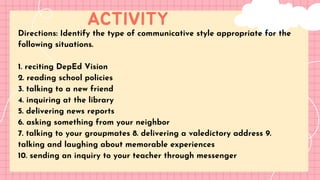
ACTIVITY
LET'S GET STARTED!
Directions: Identify the type of communicative style appropriate for the
following situations.
1. reciting DepEd Vision
2. reading school policies
3. talking to a new friend
4. inquiring at the library
5. delivering news reports
6. asking something from your neighbor
7. talking to your groupmates 8. delivering a valedictory address 9.
talking and laughing about memorable experiences
10. sending an inquiry to your teacher through messenger
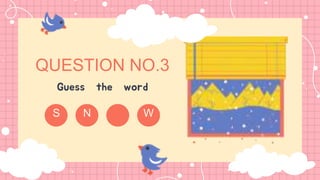
N W
S
Guess the word
QUESTION NO.3
N O W
S
Guess the word
THE ANSWER IS...
THANK YOU
for
playing

grade 9 ENG. M3 communicative styles.pptx

  • 1.
    Hello there! How haveyou been? Doc, can I ask for some advice from you? Honey, can you comb my hair? Good evening people of the Philippines! The following are the headlines for our news tonight:
  • 2.
    COMMUNICATIVE STYLES - APERSON'S APPROACH TO COMMUNICATION IN A SPECIFIC CIRCUMSTANCE.
  • 3.
    COMMUNICATIVE STYLES 1. INTIMATECOMMUNICATIVE STYLE 2. CASUAL COMMUNICATIVE STYLE 3. CONSULTATIVE COMMUNICATIVE STYLE 4. FORMAL COMMUNICATIVE STYLE 5. FROZEN COMMUNICATIVE STYLE
  • 4.
    1.INTIMATE LET'S GET STARTED! Thisstyle is used by participants who know each other well or share a very close relationship, such as between close friends, siblings, husband and wife, parents and children, and boyfriend and girlfriend. The participants in this style do not need for clear articulation of words or additional explanations. They may use words of endearment such as babe, love, dear, honey as a sign of intimacy.
  • 5.
    1.INTIMATE LET'S GET STARTED! EXAMPLE: Husband:Hon, have you seen my red cap? Wife: Uhmm, I guess it is in the closet. Husband: Thanks, hon, I’ll check it. Wife: Okay, hon.
  • 6.
    2. CASUAL LET'S GETSTARTED! The casual communicative style uses a language used between friends, peers, colleagues, or family. Most of the ambience with this style is relaxed and very light.
  • 7.
    2. CASUAL LET'S GETSTARTED! EXAMPLE: Classmate 1: Hey! What’s up? You seem so very busy. Classmate 2: Yes, I have to finish some things up. Classmate 1: Oh, I see.. Wanna come for a milktea at the canteen? Classmate 2: That’s interesting! I wish I could but I need to do this ASAP. Classmate 1: Okay, just catch up when you’re done!
  • 8.
    3. CONSULTATIVE LET'S GETSTARTED! The consultative speech style happens in a two- way participation. It is used in semi-formal situations in which a speaker needs to provide background information. Take note that this style is often used in business or in other professional situations, such as conversations between a doctor and a patient, or a teacher and a student.
  • 9.
    3. CONSULTATIVE LET'S GETSTARTED! EXAMPLE: Situation: A patient is consulting a doctor. Patient: Good morning, Dr. Garcia. Dr. Garcia: Hi, how have you been feeling? Patient: I have stomachache and LBM since last night. Dr. Garcia: What did you eat yesterday? Patient: I ate some “kwek-kwek” and siomai with my friends after the class. Dr. Garcia: Likely, you ate contaminated food. I am prescribing some medicine to control the diarrhea. . . Patient: Thank you, Doc.
  • 10.
    4. FORMAL LET'S GETSTARTED! The formal communicative style is also considered to be a straightforward speech. There is no participation from the listener. This style is often used in the following formal situations where there is only oneway communication:
  • 11.
    4. FORMAL LET'S GETSTARTED! EXAMPLE: Speeches School lessons Graduation ceremony A television newscast Giving announcements A business meeting An interview or in a classroom Used for academic and business writing
  • 12.
    5. FROZEN LET'S GETSTARTED! The frozen communicative style, also called the oratorical style, is the most formal style and is reserved for very formal situations such as during weddings, other religious services or rituals, court proceedings, and other formal ceremonies. This style is used to address or is given before an audience of absolute strangers. It uses prescribed and highly formal language.
  • 13.
    5. FROZEN LET'S GETSTARTED! In this style, statements are learned by heart. Examples are the Pledge of Allegiance and the National Anthem. It is typically prescribed by law, or it is a ritual that involves certain fixed statements (verbatim) that are never changed.
  • 14.
    ACTIVITY LET'S GET STARTED! Directions:Identify the type of communicative style appropriate for the following situations. 1. reciting DepEd Vision 2. reading school policies 3. talking to a new friend 4. inquiring at the library 5. delivering news reports 6. asking something from your neighbor 7. talking to your groupmates 8. delivering a valedictory address 9. talking and laughing about memorable experiences 10. sending an inquiry to your teacher through messenger
  • 15.
    N W S Guess theword QUESTION NO.3
  • 16.
    N O W S Guessthe word THE ANSWER IS...
  • 17.