English
English
Quarter 1
Expressing Permission, Obligation,
and Prohibition Using Modals
EN9G-IVc-23
G
O
V
E
R
N
M
E
N
T
P
R
O
P
E
R
T
Y
N
O
T
F
O
R
S
A
L
E
9
9
1
1
English – Grade 9
Quarter 1
Expressing Permission, Obligation, and Prohibition
Using Modals
First Edition, 2020
Republic Act 8293, section 176 states that: No copyright shall subsist in
any work of the Government of the Philippines. However, prior approval of the
government agency or office wherein the work is created shall be necessary
for exploitation of such work for profit. Such agency or office may, among other
things, impose as a condition the payment of royalties.
Borrowed materials (i.e., songs, stories, poems, pictures, photos, brand
names, trademarks, etc.) included in this book are owned by their respective
copyright holders. Every effort has been exerted to locate and seek permission
to use these materials from their respective copyright owners. The publisher
and authors do not represent nor claim ownership over them.
Published by the Department of Education - Region III
Secretary : Leonor M Briones
Undersecretary : Diosdado M. San Antonio
Development Team of the Module
Author : Ma. Jhoanna Vi G. Berdol
Language Reviewer : Mary Joyce Camille P. Maclang
Content Editor : Rush Jet R. Peñaranda
Illustrator : Ma. Jhoanna Vi G. Berdol
Layout Artist : John Christopher D. Berdol
Management Team
Gregorio C. Quinto, Jr., EdD
Chief, Curriculum Implementation Division
Rainelda M. Blanco, PhD
Education Program Supervisor - LRMDS
Agnes R. Bernardo, PhD
EPS-Division ADM Coordinator
Jay Arr V. Sangoyo, PhD
EPS – English
Glenda S. Constantino
Project Development Officer II
Joannarie C. Garcia
Librarian II
Department of Education, Schools Division of Bulacan
Curriculum Implementation Division
Learning Resource Management and Development System (LRMDS)
Capitol Compound, Guinhawa St., City of Malolos, Bulacan
Email address: lrmdsbulacan@deped.gov.ph
2
2
9
9
English
English
Quarter 1
Expressing Permission, Obligation,
and Prohibition Using Modals
EN9G-IVc-23
Introductory Message
For the facilitator:
Welcome to English 9 Alternative Delivery Mode (ADM) Module on Expressing Permission,
Obligation, and Prohibition Using Modals.
This module was collaboratively designed, developed and reviewed by educators from public
institutions to assist you, the teacher or facilitator, in helping the learners meet the standards
set by the K to 12 Curriculum while overcoming their personal, social, and economic constraints
in schooling.
This learning resource hopes to engage the learners into guided and independent learning
activities at their own pace and time. Furthermore, this also aims to help learners acquire the
needed 21st century skills while taking into consideration their needs and circumstances.
In addition to the material in the main text, you will also see this box in the body of the module:
Notes to the Teacher
This contains helpful tips or strategies that
will help you in guiding the learners.
As a facilitator, you are expected to orient the learners on how to use this module.
You also need to keep track of the learners’ progress while allowing them to manage their own
learning. Furthermore, you are expected to encourage and assist the learners as they do the
tasks included in the module.
For the learner:
For the learner:
Welcome to English 9 Alternative Delivery Mode (ADM) Module on Expressing Permission,
Obligation, and Prohibition Using Modals.
This module was designed to provide you with fun and meaningful opportunities for guided
and independent learning at your own pace and time. You will be enabled to process the
contents of the learning resource while being an active learner.
This module has the following parts and corresponding icons:
What I Need to Know
This will give you an idea of the skills or competencies
you are expected to learn in the module.
What I Know
This part includes an activity that aims to check what
you already know about the lesson to take. If you get
all the answers correct (100%), you may decide to skip
this module.
1
1
What’s In
This is a brief drill or review to help you link the current
lesson with the previous one.
What’s New
In this portion, the new lesson will be introduced to you
in various ways; a story, a song, a poem, a problem
opener, an activity or a situation.
What is It
This section provides a brief discussion of the lesson.
This aims to help you discover and understand new
concepts and skills.
What’s More
This comprises activities for independent practice to
solidify your understanding and skills of the topic. You
may check the answers to the exercises using the
Answer Key at the end of the module.
What I Have Learned
This includes questions or blank sentence/paragraph
to be filled in to process what you learned from the
lesson.
What I Can Do
This section provides an activity which will help you
transfer your new knowledge or skill into real life
situations or concerns.
Assessment
This is a task which aims to evaluate your level of
mastery in achieving the learning competency.
Additional Activities
In this portion, another activity will be given to you to
enrich your knowledge or skill of the lesson learned.
Answer Key This contains answers to all activities in the module.
At the end of this module you will also find:
References This is a list of all sources used in developing this module.
The following are some reminders in using this module:
1. Use the module with care. Do not put unnecessary mark/s on any part of the module.
Use a separate sheet of paper in answering the exercises.
2. Don’t forget to answer What I Know before moving on to the other activities included
in the module.
3. Read the instruction carefully before doing each task.
4. Observe honesty and integrity in doing the tasks and checking your answers.
5. Finish the task at hand before proceeding to the next.
6. Return this module to your teacher/facilitator once you are through with it.
If you encounter any difficulty in answering the tasks in this module, do not hesitate to consult
your teacher or facilitator. Always bear in mind that you are not alone.
We hope that through this material, you will experience meaningful learning and gain deep
understanding of the relevant competencies. You can do it!
2
2
3
3
This module encourages you to use appropriately different types of modal verbs in
expressing permission, obligation, and prohibition. Various activities are provided for you
to meet the target skills.
At the end of this module, you are expected to:
• identify different modals that are used to express permission, obligation,
and prohibition;
• use appropriate modals to express permission, obligation, and prohibition; and
• express appreciation of different family values.
What I Need to Know
What I Need to Know
What I Know
What I Know
Directions: A. Read the short prayer below and answer the questions that follow. Circle the
letter of your choice.
COVID-19 Family Prayer
Dear God,
During this time of difficulty, we thank You
for our family’s safety.
We also extend our gratitude to You for our nation’s security.
As we bend our knees, please remind us, Your children
that we can always look up to You when things get worsen.
Please, teach us humility as we mustn’t
brag even our tiniest triumph,
for we should know that everything
has to come from and before You.
Please, instruct us that aside from humility,
love within our family must always come
since it is Your Word that teaches us that it is with love
that we may find You.
Protect all frontliners as they have to endure
all the fears and negativity of this life.
Embrace all the sick and bereaved families,
so they may discover peace amidst this adversary.
Make everyone an instrument of Your charity,
and that we should not strive for any strife.
Lastly, touch all the leaders’ hearts,
so they may always make the right decisions for us.
This, we humbly pray, in the name of God.
Amen.
4
4
1. “We can always look up to You when things get worsen.” The highlighted word
suggests…
a. permission b. possibility c. prohibition d. obligation
2. “We mustn’t brag even our tiniest triumph.” The highlighted word suggests…
a. permission b. prohibition c. obligation d. possibility
3. “We should know that everything has to come from and before You.”
The highlighted word suggests…
a. possibility b. permission c. prohibition d. obligation
4. “They have to endure all the fears and negativity of this life.”
The highlighted word suggests…
a. permission b. prohibition c. possibility d. obligation
5. “Love within our family must always come.” The highlighted word suggests…
a. permission b. prohibition c. obligation d. possibility
B. Complete the following statements using appropriate modal. Circle the letter
of your choice.
6. I’d love to come with my friends to the park, but I ______ join my family during
this difficult time.
a. must b. may c. can d. can’t
7. You _____ hit your sister again! Do you understand?
a. mustn’t b. can c. have to d. should
8. You _____ carry all the burden. Just try to reach out to your parents.
a. have to b. mustn’t c. must d. can
9. My mother is totally vegetarian. You _____ cook or eat meat in our house.
That’s how we show respect.
a. can’t b. must c. may d. should
10. I did this yesterday – I can help you! You _____ stop blaming yourself even
for small inconvenient things.
a. must b. should c. can d. can’t
11. Cellphones _____ be kept silent or turned off during COVID-19 evening family
Oratio Imperata.
a. have to b. should c. can d. can’t
12. You _____ always count on me as your older bro if you are feeling lonely.
a. have to b. mustn’t c. can d. can’t
13. ______ I call you whenever I feel sad, so we can have a strong family
communication?
a. Can b. Must c. Mustn’t d. Should
5
5
What’s In
What’s In
Directions: Complete the table below by writing your own house rules. The first part and
examples are already given as your guide.
My Family Rules!
IN OUR FAMILY…
we can / may we have to / should can’t / mustn’t
• We can always share
our feelings.
• We have to be home
before 8:00 p.m.
• We can’t have
a sleepover.
Does it feel good to have household rules to be followed by every family member? Do
you also have specific household rules set in your family? Do you feel bad adhering
to those rules because they limit your freedom?
Household rules are important, for they help develop well-disciplined
family members. There are times that we may feel bad about following those rules
but we should think that they help in keeping us from danger. The simple rule like,
“Always unplug unused appliances,” makes us avoid power surges that can lead to
electrical fires. Hence, by following these household rules, we also develop sense of
responsibility with our own actions.
As you keep on reading, you will learn more about the importance of household
rules and having family values.
14. You ___ come to dad’s birthday, it would help us all if you’re there.
a. mustn’t b. should c. can d. can’t
15. Did mother and father tell you that you ___ come into this area? It’s restricted
for children like us.
a. mustn’t b. may c. can d. should
6
6
What’s New
What’s New
Directions: Read the article below. Find out what the article is about.
Our Family Values
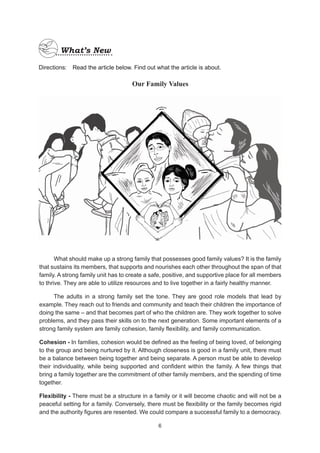
What should make up a strong family that possesses good family values? It is the family
that sustains its members, that supports and nourishes each other throughout the span of that
family. A strong family unit has to create a safe, positive, and supportive place for all members
to thrive. They are able to utilize resources and to live together in a fairly healthy manner.
The adults in a strong family set the tone. They are good role models that lead by
example. They reach out to friends and community and teach their children the importance of
doing the same – and that becomes part of who the children are. They work together to solve
problems, and they pass their skills on to the next generation. Some important elements of a
strong family system are family cohesion, family flexibility, and family communication.
Cohesion - In families, cohesion would be defined as the feeling of being loved, of belonging
to the group and being nurtured by it. Although closeness is good in a family unit, there must
be a balance between being together and being separate. A person must be able to develop
their individuality, while being supported and confident within the family. A few things that
bring a family together are the commitment of other family members, and the spending of time
together.
Flexibility - There must be a structure in a family or it will become chaotic and will not be a
peaceful setting for a family. Conversely, there must be flexibility or the family becomes rigid
and the authority figures are resented. We could compare a successful family to a democracy.
7
7
There are leaders, but the whole group is involved in the decision making process. Although
the leaders are in charge, all members develop the ability to cope with stress, and at times
lead. While the family works to avoid stressful situations, they also work together to solve
problems without blaming, criticizing, and finding fault with each other. Families that tend to
have a strong spiritual base seem to have a sense of well-being that facilitates this working
together in times of stress.
Communication - Ever hear the saying, “What we have here is a failure to communicate?”
A lack of communication can rip a family apart and destroy them. Things that facilitate
communication are the things mentioned so far— family closeness, flexibility, time spent
together, and spirituality. All members must feel a freedom within the group to express
themselves freely.
Another very important factor is the relationship between the “head” couple. In a family
that is parented by a happily married couple, people are able to express themselves more
freely. What they might say isn’t filtered through the problems of the “guardians.” A happy
marriage seems to set the tone in the house. It spills over from the family to the community,
and a healthy family will be reaching out to help others. They do not tend to isolate themselves
from the rest of the world.
A very important thing for families to teach their children is how to make good decisions.
If they have watched their parents making well thought out decisions over the years, they will
tend to be good decision makers themselves.
A healthy, happy family benefits our whole society. Among the children of strong families
there is less crime, less divorce and less emotional problems. They tend to go on and have
strong, healthy families of their own, having learned from their folk’s example.
Source: “Our Family Values .” Essay. In A Journey through
Anglo-American Literature, 1st ed., 495.
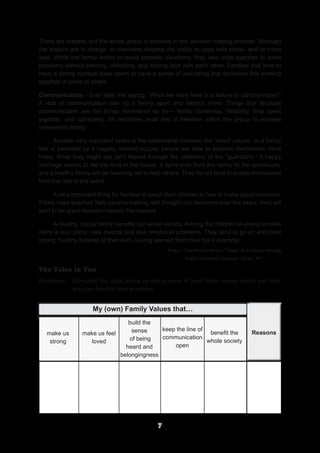
Directions: Complete the table below by listing some of your family values which you think
are your family’s best practices.
The Value in You
make us
strong
make us feel
loved
build the
sense
of being
heard and
belongingness
keep the line of
communication
open
benefit the
whole society
Reasons
My (own) Family Values that…
8
8
The activities in this module are arranged from simple to complex to help the learner
gradually master the desired learning competency. Give him/her the needed support and
guidance so that he/she will be able to perform the tasks to prepare him/her later on in
using modals in expressing permission, obligation, and prohibition.
Notes to the Teacher
What is It
Expressing Permission, Obligation,
and Prohibition Using Modals
In English grammar, a modal is a verb that combines with another verb to indicate
mood or tense. A modal, also known as a modal auxiliary or modal verb, may express
permission, obligation, or prohibition.
Permission = It’s OK!
• may
• can
What’s the difference?
Can is informal, while may is formal.
1.
• Yes, you can borrow my charger, bro!
• We may continue our annual family
tradition once this pandemic is over.
Obligation = It’s necessary!
• has to/have to/must
• ought to/should
What’s the difference?
There are two types of modal verbs of
obligation:
2.
• A strong family unit has to create a
safe, positive, and supportive place for
all members to thrive.
• The adults in a strong family have to be
good role models that lead by example.
What is It
9
9
those that primarily express a firm
obligation or necessity -must and
have to- and those that express a
recommendation or moral obligation
-should and ought to.
• A person must be able to develop their
individuality while being supported and
confident within the family.
• Love should make up a strong family
that possesses good family values.
• The family members ought to know
one’s duties and responsibilities.
Prohibition = It’s not OK!
• can not = can’t
• must not = musn’t
• should not = shouldn’t
What’s the difference?
Can’t tells us that something is
against the rules. Mustn’t is usually
used when the obligation comes from
the person who is speaking, and
shouldn’t when we think something is
a good or a bad idea.
3.
• You musn’t speak foul language to
anyone.
• It is very difficult to live without our
mothers, but we can’t stay with them
forever.
• You shouldn’t make decisions when you
are angry.
Here are more examples:
Permission:
• Can I make suggestions on how we can solve our issues at home?
• May I send this message now to Uncle Pete, so he can hear our side?
Obligation:
• I must phone my dad. It’s his birthday today.
• Seat belts have to be worn by all passengers especially when driving with children.
• Do you think I should be sorry for missing our anniversary?
Prohibition:
• I can’t just leave my dirty laundry anywhere. My mother will surely be angry.
• As children, you mustn’t disobey what your parents tell you.
• Anyone shouldn’t try to violate any quarantine rule.
10
10
What’s More
What’s More
Independent Activity 1
Directions: Study each picture and tell whether they must, mustn’t , or can do each activity.
Write your answer on the line provided below each picture.
Obligations – Prohibitions – Permission
do the homework
1.
Apol and Eve’s parents are
both frontliners in Bulacan
Medical Center and are both
in a quarantine facility. Before
their parents left for work, they
were given instructions about
what they must do, they
mustn’t do, and they can do.
drink alcohol
2. throw a party
3.
surf the net
but only a little
4. empty the trash bins
5.
11
11
Independent Assessment 1
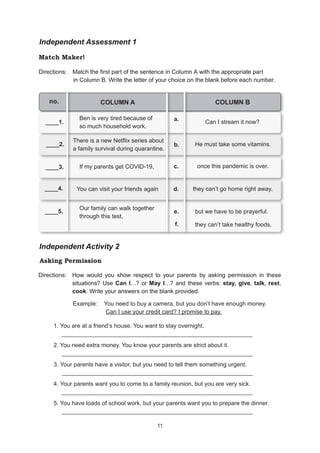
Match Maker!
Directions: Match the first part of the sentence in Column A with the appropriate part
in Column B. Write the letter of your choice on the blank before each number.
COLUMN A COLUMN B
____1.
Ben is very tired because of
so much household work.
____2.
There is a new Netflix series about
a family survival during quarantine.
____3. If my parents get COVID-19,
____4. You can visit your friends again
____5.
Our family can walk together
through this test,
a.
b.
c.
d.
e.
no.
Can I stream it now?
He must take some vitamins.
once this pandemic is over.
they can’t go home right away.
but we have to be prayerful.
Independent Activity 2
Asking Permission
Directions: How would you show respect to your parents by asking permission in these
situations? Use Can I…? or May I…? and these verbs: stay, give, talk, rest,
cook. Write your answers on the blank provided.
1. You are at a friend’s house. You want to stay overnight.
__________________________________________________________
2. You need extra money. You know your parents are strict about it.
__________________________________________________________
3. Your parents have a visitor, but you need to tell them something urgent.
__________________________________________________________
4. Your parents want you to come to a family reunion, but you are very sick.
__________________________________________________________
5. You have loads of school work, but your parents want you to prepare the dinner.
__________________________________________________________
f. they can’t take healthy foods.
Example: You need to buy a camera, but you don’t have enough money.
Can I use your credit card? I promise to pay.
12
12
Independent Assessment 2
Giving Prohibition
Directions: How do you make everyone in your family safe during this quarantine period?
List all the things that we all used to do during the normal days, but we are
all prohibited to do during the “new normal”. Use can’t or mustn’t. Write your
answer on the blank provided.
1.______________________________
2.______________________________
3.______________________________
4.______________________________
5.______________________________
Independent Activity 3
Much Obliged
Directions: Complete the following sentences by filling out the missing modal of obligation.
Choose between HAVE TO and MUST.
The use of must and have to might be confusing for students like you. Remember that:
MUST - personal obligation/ strong recommendation (from others)
HAVE TO - external obligation/necessity
1. Bulacan Medical Center, where our parents work is far from our house.
They _________________ leave very early every morning.
2. My mother says that I ________________ do my school work until eight o’ clock. It’s not fair!
3. One of our family rules is if you have a dog, you _________________ take it out for a walk
twice a day.
4. Our parents cannot support us forever. We _________________ earn our own living.
5. We _________________ cook our own meals whenever our mother is away.
Example: We can’t visit any sick relative.
13
13
Independent Assessment 3
Modal Mode
Directions: What do these sentences express? Choose among permission, obligation,
possibility, or prohibition.
1. May I use your car tonight? ______________________________________
2. We mustn’t scream especially if the baby is sleeping. _____________________________
3. Since it’s weekend, can we stay up until midnight? ________________________________
4. You should always ask our mother’s permission if you are having visitors. _____________
5. I really have to finish all these household tasks before my parents allow me
to go out. _____________________
After accomplishing all those different activities, I bet you already realized the usage
and importance of modals of permission, obligation, and prohibition. For now, write your
realization by plotting your ideas using the journal template below.
I realized that. . .
14
14
Obedience Test!
Directions: How obedient are you as a family member? Below is a Responsibility Card of
the things that most teens like you are PROHIBITED to do. For each item or
statement that you have tried/done even for once, you have to cross it out. The
more items are crossed out, the greater is the demand for you to take advan-
tage of this quarantine period to make it up to your parents. Good luck!
Your possible diligence scores are: 25- 21, 20-16, 15-11, 10-6, 5-0.
What I Can Do
What I Can Do
You can’t drink
alcohol if you’re
under 18.
You mustn’t
keep the school
fees receipt from
your parents.
You mustn’t
have a duplicate
social media
account, and
block them on
your second
account.
You mustn’t go
home past your
curfew.
You can’t smoke
if you’re under
18.
You mustn’t
keep secrets
from your
parents.
You mustn't
consider others'
advice before
your parents.
You mustn’t
have tattoos
without your
parents’
consent.
You mustn’t
use technology
to send
inappropriate
pictures or
words.
You mustn’t hide
from them some
of your posts on
social media.
You mustn’t
steal money
(even coins)
from your
parents.
You can’t drive
without any
license.
You mustn’t
make a major
decision without
your parents’
knowledge.
You can’t keep
your failing
marks from your
parents.
You mustn’t
compare what
your parents can
give you with
other parents.
You can’t try any
illegal drugs.
You mustn’t lie
to your parents.
You mustn’t
see any
pornographic
material.
You mustn’t join
any gang or
fraternity.
You mustn’t
cancel your
parents’ phone
call.
You mustn’t drop
out from school.
You mustn’t
feel rebellious
towards your
parents.
You mustn’t be
shy in showing
your love and
affection to
them.
You mustn’t
have intimate
relationship
without your
parents’
knowledge.
You can’t do any
illegal or criminal
act.
15
15
What is your Diligence Test score?
25 - 21 a
I think it’s the best time for you to grab that pen and paper of yours or
your phone and give your parents a heartfelt message and tell them
you really are sorry for everything you did in the past. Remember
that there is always a second chance and the fact that you are safe,
living under your parents’ roof, they indeed forgive and love you.
Assessment
Assessment
Directions: A. Closely read Apol’s COVID-19 journal entry below and answer the questions
that follow. Circle the letter that corresponds to your answer.
Dear Diary,
July 25, 2020
I can’t even count how many days it has been since all the
kinds of quarantines have been implemented. Days and nights have
instantly passed, and now, my sister Eve and I are just counting days
to go back to school. “New Normal”- that is how they say it would
be. I can’t imagine how school would be since everything from the
lockdown period is different from what it used to be.
20 - 16 a
Don’t let any temptation hinder you from doing good. Reflect and think of
the better opportunities and more possibilities this life offers you. You are
good and indeed, blessed.
15 - 11 a
Don’t rush growing up. Enjoy every chance that comes along your way.
You are smart and can make wise decisions.
10 - 06
a
Just keep on being a good child and a citizen! You are a step away from
achieving your dreams by knowing your priorities. Good job!
05 - 0 a
You are every parent’s dream of what a perfect child could be. Continue
doing what you think is right for you and your family. Keep it up!
16
16
I guess, like everyone else, I just miss the ordinary days
that we used to have before the pandemic. I can’t wait to see the
noisy and busy world outside. I pray for the immediate recovery of
those who are sick; for the comfort of all those who are lonely; and
for generous help given to those who are hungry.
Before, I used to go out a lot with my friends, but now, I only stay
at home due to community measures being implemented. Our family’s
get-together at different malls also turned into family evening prayer.
Now as different quarantine rules are implemented, my parents are
still allowed to go to their work. They are both working in a hospital.
Sometimes, I feel a bit sad. I miss the times when we all spent our
time here at home. But then, I understand that they are doing this
to help people who are in need. They are considered heroes in this
battle against the pandemic. All I can do now is to pray for them. I
guess, that is how we build a strong family relationship.
Life before COVID-19 was difficult, but it was a happy one.
However, I am still thankful for all the little blessings I received. I am
thankful to God for keeping my family and friends safe. I just pray that
someday, we can all go back to what used to be the “old normal.”
Moreover, I also pray that we would not be restricted anymore to
enjoy little bursts of this life. Lastly, I hope everyone feels that we
should be all thankful to the Heavens above.
xoxo,
Apolonio
1. “I used to go out a lot with my friends, but now, we are always told that we have to stay
at home.” What does the highlighted modal signify?
a. permission c. possibility
b. prohibition d. obligation
2. “As you know, both of my parents are working in a hospital, so they can’t be with us right
now.” What does the highlighted modal signify?
a. permission c. possibility
b. prohibition d. obligation
3. “I just wish that someday, we can all go back to what used to be the old normal.”
What does the highlighted modal signify?
a. permission c. possibility
b. prohibition d. obligation
Written by Ma. Jhoanna Vi. G. Berdol
17
17
4. “We should be all thankful to the Heavens above.” What does the highlighted modal signify?
a. permission c. possibility
b. prohibition d. obligation
5. “We should be all thankful to the Heavens above.” The sentence is trying to give you…
a. a piece of advice c. a strong requirement
b. a moral obligation from someone d. major possibility
B. This is a worksheet for a well-raised son/daughter like you! The following sentences show
situations that show love, concern, and care within families. Read each sentence carefully
and choose the best modal to complete the blanks. Circle the letter of the best answer.
6. Why ________ I not care about your problems? I am your mother.
a. can b. should c. may d. can’t
7. Joe and Bec kept on forgiving their daughter. They ________ let her live a hopeless life.
a. can b. must c. can’t d. should
8. We ________ eat at “Tabing Ilog Restaurant” tonight for our parents’ anniversary. People
have good feedback about their food.
a. should b. must c. have to d. can’t
9. Anyone who makes a visit to other families ________ show his/her respect.
a. must b. should c. may d. can’t
10. P1: When is Julie coming?
P2: She came far from the province. She ________ be here any minute.
a. can’t b. has to c. should d. must
11. P1: ________ my friend sleep over?
P2: Yes, but she’ll have to get permission from her parents.
a. can b. should c. must d. have to
12. ________ you always be so mean to everyone?
a. Can b. Must c. Mustn’t d. Can’t
13. ________ you please try to be nicer to your brother?
a. Must b. Can c. Can’t d. Should
14. I ________ get to my cousin’s party earlier. She is expecting me.
a. Can’t b. Have to c. Mustn’t d. May
15. S1: Which skill should I learn - cooking or baking?
S2: I think you ________ learn cooking, first.
a. should b. must c. can d. have to
18
18
Additional Activity
Additional Activity
Worksheet for the Impressive Writer in You!
Directions: Choose from the following topics and write a paragraph with at least five sentences
using appropriate modals of permission, prohibition, or obligation.
A. What should you do to help your family amidst this pandemic?
B. What should you do when you feel stressed out because of our current situation?
C. What must you do to make your loved ones proud of you?
19
19
Answer Key
Answer Key
What
I
Know
1.
a
2.
b
3.
d
4.
d
5.
c
6.
a
7.
a
8.
b
9.
a
10.
b
11.
a
12.
c
13.
a
14.
b
15.
a
Independent
Activity
1
1.
they
must
2.
they
mustn’t
3.
they
mustn’t
4.
they
can
5.
they
must
Independent
Assessment
1
1.
b
2.
a
3.
d
4.
c
5.
e
Independent
Activity
2
(Suggested
answers,
answers
may
vary.)
1.
May
I
stay
at
Rina’s
house
over
night?
2.
Can
you
give
me
extra
allowance
this
week?
3.
May
I
talk
to
you
for
a
minute?
It
is
really
urgent.
4.
Can
I
just
rest
instead
of
going
to
the
reunion?
I
really
feel
sick.
5.
Can
my
brother
cook
the
dinner
instead?
I
have
loads
of
school
work
tonight.
Independent
Assessment
2
(Answers
vary)
Independent
Activity
3
1.
have
to
2.
must
3.
have
to
4.
have
to
5.
have
to
Independent
Assessment
3
1.
permission
2.
prohibition
3.
permission
4.
obligation
5.
obligation
Assessment
1.d
2.
b
3.
a
4.
d
5.
b
6.
b
7.
c
8.
a
9.
a
10.
a
11.
a
12.
b
13.
b
14.
b
15.
a
References
Almonte, Liza. 2014. A Journey Through Anglo-American Literature – Grade 9 English Learner’s
Material. Edited by Ma. Antonette Montealegre. Department of Education.
Linguapress. Modal verbs must, should, ought to - English in use. Linguapress, February 10,
2014. http://linguapress.com/grammar/modal-obligation.htm.
“Modals – Permission and Obligation.” British Council, May 14, 2020. http://learnenglish.
britishcouncil.org/en/grammar-reference/modals-1.
22
22
For inquiries or feedback, please write or call:
Department of Education, Schools Division of Bulacan
Curriculum Implementation Division
Learning Resource Management and Development (LRMDS)
Capitol Compound, Guinhawa St., City of Malolos, Bulacan
Email address: lrmdsbulacan@deped.gov.ph

English-9-Q1-Module-1.pdf

  • 1.
    English English Quarter 1 Expressing Permission,Obligation, and Prohibition Using Modals EN9G-IVc-23 G O V E R N M E N T P R O P E R T Y N O T F O R S A L E 9 9
  • 2.
    1 1 English – Grade9 Quarter 1 Expressing Permission, Obligation, and Prohibition Using Modals First Edition, 2020 Republic Act 8293, section 176 states that: No copyright shall subsist in any work of the Government of the Philippines. However, prior approval of the government agency or office wherein the work is created shall be necessary for exploitation of such work for profit. Such agency or office may, among other things, impose as a condition the payment of royalties. Borrowed materials (i.e., songs, stories, poems, pictures, photos, brand names, trademarks, etc.) included in this book are owned by their respective copyright holders. Every effort has been exerted to locate and seek permission to use these materials from their respective copyright owners. The publisher and authors do not represent nor claim ownership over them. Published by the Department of Education - Region III Secretary : Leonor M Briones Undersecretary : Diosdado M. San Antonio Development Team of the Module Author : Ma. Jhoanna Vi G. Berdol Language Reviewer : Mary Joyce Camille P. Maclang Content Editor : Rush Jet R. Peñaranda Illustrator : Ma. Jhoanna Vi G. Berdol Layout Artist : John Christopher D. Berdol Management Team Gregorio C. Quinto, Jr., EdD Chief, Curriculum Implementation Division Rainelda M. Blanco, PhD Education Program Supervisor - LRMDS Agnes R. Bernardo, PhD EPS-Division ADM Coordinator Jay Arr V. Sangoyo, PhD EPS – English Glenda S. Constantino Project Development Officer II Joannarie C. Garcia Librarian II Department of Education, Schools Division of Bulacan Curriculum Implementation Division Learning Resource Management and Development System (LRMDS) Capitol Compound, Guinhawa St., City of Malolos, Bulacan Email address: lrmdsbulacan@deped.gov.ph
  • 3.
    2 2 9 9 English English Quarter 1 Expressing Permission,Obligation, and Prohibition Using Modals EN9G-IVc-23
  • 5.
    Introductory Message For thefacilitator: For the facilitator: Welcome to English 9 Alternative Delivery Mode (ADM) Module on Expressing Permission, Obligation, and Prohibition Using Modals. This module was collaboratively designed, developed and reviewed by educators from public institutions to assist you, the teacher or facilitator, in helping the learners meet the standards set by the K to 12 Curriculum while overcoming their personal, social, and economic constraints in schooling. This learning resource hopes to engage the learners into guided and independent learning activities at their own pace and time. Furthermore, this also aims to help learners acquire the needed 21st century skills while taking into consideration their needs and circumstances. In addition to the material in the main text, you will also see this box in the body of the module: Notes to the Teacher This contains helpful tips or strategies that will help you in guiding the learners. As a facilitator, you are expected to orient the learners on how to use this module. You also need to keep track of the learners’ progress while allowing them to manage their own learning. Furthermore, you are expected to encourage and assist the learners as they do the tasks included in the module. For the learner: For the learner: Welcome to English 9 Alternative Delivery Mode (ADM) Module on Expressing Permission, Obligation, and Prohibition Using Modals. This module was designed to provide you with fun and meaningful opportunities for guided and independent learning at your own pace and time. You will be enabled to process the contents of the learning resource while being an active learner. This module has the following parts and corresponding icons: What I Need to Know This will give you an idea of the skills or competencies you are expected to learn in the module. What I Know This part includes an activity that aims to check what you already know about the lesson to take. If you get all the answers correct (100%), you may decide to skip this module. 1 1
  • 6.
    What’s In This isa brief drill or review to help you link the current lesson with the previous one. What’s New In this portion, the new lesson will be introduced to you in various ways; a story, a song, a poem, a problem opener, an activity or a situation. What is It This section provides a brief discussion of the lesson. This aims to help you discover and understand new concepts and skills. What’s More This comprises activities for independent practice to solidify your understanding and skills of the topic. You may check the answers to the exercises using the Answer Key at the end of the module. What I Have Learned This includes questions or blank sentence/paragraph to be filled in to process what you learned from the lesson. What I Can Do This section provides an activity which will help you transfer your new knowledge or skill into real life situations or concerns. Assessment This is a task which aims to evaluate your level of mastery in achieving the learning competency. Additional Activities In this portion, another activity will be given to you to enrich your knowledge or skill of the lesson learned. Answer Key This contains answers to all activities in the module. At the end of this module you will also find: References This is a list of all sources used in developing this module. The following are some reminders in using this module: 1. Use the module with care. Do not put unnecessary mark/s on any part of the module. Use a separate sheet of paper in answering the exercises. 2. Don’t forget to answer What I Know before moving on to the other activities included in the module. 3. Read the instruction carefully before doing each task. 4. Observe honesty and integrity in doing the tasks and checking your answers. 5. Finish the task at hand before proceeding to the next. 6. Return this module to your teacher/facilitator once you are through with it. If you encounter any difficulty in answering the tasks in this module, do not hesitate to consult your teacher or facilitator. Always bear in mind that you are not alone. We hope that through this material, you will experience meaningful learning and gain deep understanding of the relevant competencies. You can do it! 2 2
  • 7.
    3 3 This module encouragesyou to use appropriately different types of modal verbs in expressing permission, obligation, and prohibition. Various activities are provided for you to meet the target skills. At the end of this module, you are expected to: • identify different modals that are used to express permission, obligation, and prohibition; • use appropriate modals to express permission, obligation, and prohibition; and • express appreciation of different family values. What I Need to Know What I Need to Know What I Know What I Know Directions: A. Read the short prayer below and answer the questions that follow. Circle the letter of your choice. COVID-19 Family Prayer Dear God, During this time of difficulty, we thank You for our family’s safety. We also extend our gratitude to You for our nation’s security. As we bend our knees, please remind us, Your children that we can always look up to You when things get worsen. Please, teach us humility as we mustn’t brag even our tiniest triumph, for we should know that everything has to come from and before You. Please, instruct us that aside from humility, love within our family must always come since it is Your Word that teaches us that it is with love that we may find You. Protect all frontliners as they have to endure all the fears and negativity of this life. Embrace all the sick and bereaved families, so they may discover peace amidst this adversary. Make everyone an instrument of Your charity, and that we should not strive for any strife. Lastly, touch all the leaders’ hearts, so they may always make the right decisions for us. This, we humbly pray, in the name of God. Amen.
  • 8.
    4 4 1. “We canalways look up to You when things get worsen.” The highlighted word suggests… a. permission b. possibility c. prohibition d. obligation 2. “We mustn’t brag even our tiniest triumph.” The highlighted word suggests… a. permission b. prohibition c. obligation d. possibility 3. “We should know that everything has to come from and before You.” The highlighted word suggests… a. possibility b. permission c. prohibition d. obligation 4. “They have to endure all the fears and negativity of this life.” The highlighted word suggests… a. permission b. prohibition c. possibility d. obligation 5. “Love within our family must always come.” The highlighted word suggests… a. permission b. prohibition c. obligation d. possibility B. Complete the following statements using appropriate modal. Circle the letter of your choice. 6. I’d love to come with my friends to the park, but I ______ join my family during this difficult time. a. must b. may c. can d. can’t 7. You _____ hit your sister again! Do you understand? a. mustn’t b. can c. have to d. should 8. You _____ carry all the burden. Just try to reach out to your parents. a. have to b. mustn’t c. must d. can 9. My mother is totally vegetarian. You _____ cook or eat meat in our house. That’s how we show respect. a. can’t b. must c. may d. should 10. I did this yesterday – I can help you! You _____ stop blaming yourself even for small inconvenient things. a. must b. should c. can d. can’t 11. Cellphones _____ be kept silent or turned off during COVID-19 evening family Oratio Imperata. a. have to b. should c. can d. can’t 12. You _____ always count on me as your older bro if you are feeling lonely. a. have to b. mustn’t c. can d. can’t 13. ______ I call you whenever I feel sad, so we can have a strong family communication? a. Can b. Must c. Mustn’t d. Should
  • 9.
    5 5 What’s In What’s In Directions:Complete the table below by writing your own house rules. The first part and examples are already given as your guide. My Family Rules! IN OUR FAMILY… we can / may we have to / should can’t / mustn’t • We can always share our feelings. • We have to be home before 8:00 p.m. • We can’t have a sleepover. Does it feel good to have household rules to be followed by every family member? Do you also have specific household rules set in your family? Do you feel bad adhering to those rules because they limit your freedom? Household rules are important, for they help develop well-disciplined family members. There are times that we may feel bad about following those rules but we should think that they help in keeping us from danger. The simple rule like, “Always unplug unused appliances,” makes us avoid power surges that can lead to electrical fires. Hence, by following these household rules, we also develop sense of responsibility with our own actions. As you keep on reading, you will learn more about the importance of household rules and having family values. 14. You ___ come to dad’s birthday, it would help us all if you’re there. a. mustn’t b. should c. can d. can’t 15. Did mother and father tell you that you ___ come into this area? It’s restricted for children like us. a. mustn’t b. may c. can d. should
  • 10.
    6 6 What’s New What’s New Directions:Read the article below. Find out what the article is about. Our Family Values What should make up a strong family that possesses good family values? It is the family that sustains its members, that supports and nourishes each other throughout the span of that family. A strong family unit has to create a safe, positive, and supportive place for all members to thrive. They are able to utilize resources and to live together in a fairly healthy manner. The adults in a strong family set the tone. They are good role models that lead by example. They reach out to friends and community and teach their children the importance of doing the same – and that becomes part of who the children are. They work together to solve problems, and they pass their skills on to the next generation. Some important elements of a strong family system are family cohesion, family flexibility, and family communication. Cohesion - In families, cohesion would be defined as the feeling of being loved, of belonging to the group and being nurtured by it. Although closeness is good in a family unit, there must be a balance between being together and being separate. A person must be able to develop their individuality, while being supported and confident within the family. A few things that bring a family together are the commitment of other family members, and the spending of time together. Flexibility - There must be a structure in a family or it will become chaotic and will not be a peaceful setting for a family. Conversely, there must be flexibility or the family becomes rigid and the authority figures are resented. We could compare a successful family to a democracy.
  • 11.
    7 7 There are leaders,but the whole group is involved in the decision making process. Although the leaders are in charge, all members develop the ability to cope with stress, and at times lead. While the family works to avoid stressful situations, they also work together to solve problems without blaming, criticizing, and finding fault with each other. Families that tend to have a strong spiritual base seem to have a sense of well-being that facilitates this working together in times of stress. Communication - Ever hear the saying, “What we have here is a failure to communicate?” A lack of communication can rip a family apart and destroy them. Things that facilitate communication are the things mentioned so far— family closeness, flexibility, time spent together, and spirituality. All members must feel a freedom within the group to express themselves freely. Another very important factor is the relationship between the “head” couple. In a family that is parented by a happily married couple, people are able to express themselves more freely. What they might say isn’t filtered through the problems of the “guardians.” A happy marriage seems to set the tone in the house. It spills over from the family to the community, and a healthy family will be reaching out to help others. They do not tend to isolate themselves from the rest of the world. A very important thing for families to teach their children is how to make good decisions. If they have watched their parents making well thought out decisions over the years, they will tend to be good decision makers themselves. A healthy, happy family benefits our whole society. Among the children of strong families there is less crime, less divorce and less emotional problems. They tend to go on and have strong, healthy families of their own, having learned from their folk’s example. Source: “Our Family Values .” Essay. In A Journey through Anglo-American Literature, 1st ed., 495. Directions: Complete the table below by listing some of your family values which you think are your family’s best practices. The Value in You make us strong make us feel loved build the sense of being heard and belongingness keep the line of communication open benefit the whole society Reasons My (own) Family Values that…
  • 12.
    8 8 The activities inthis module are arranged from simple to complex to help the learner gradually master the desired learning competency. Give him/her the needed support and guidance so that he/she will be able to perform the tasks to prepare him/her later on in using modals in expressing permission, obligation, and prohibition. Notes to the Teacher Notes to the Teacher What is It Expressing Permission, Obligation, and Prohibition Using Modals In English grammar, a modal is a verb that combines with another verb to indicate mood or tense. A modal, also known as a modal auxiliary or modal verb, may express permission, obligation, or prohibition. Permission = It’s OK! • may • can What’s the difference? Can is informal, while may is formal. 1. • Yes, you can borrow my charger, bro! • We may continue our annual family tradition once this pandemic is over. Obligation = It’s necessary! • has to/have to/must • ought to/should What’s the difference? There are two types of modal verbs of obligation: 2. • A strong family unit has to create a safe, positive, and supportive place for all members to thrive. • The adults in a strong family have to be good role models that lead by example. What is It
  • 13.
    9 9 those that primarilyexpress a firm obligation or necessity -must and have to- and those that express a recommendation or moral obligation -should and ought to. • A person must be able to develop their individuality while being supported and confident within the family. • Love should make up a strong family that possesses good family values. • The family members ought to know one’s duties and responsibilities. Prohibition = It’s not OK! • can not = can’t • must not = musn’t • should not = shouldn’t What’s the difference? Can’t tells us that something is against the rules. Mustn’t is usually used when the obligation comes from the person who is speaking, and shouldn’t when we think something is a good or a bad idea. 3. • You musn’t speak foul language to anyone. • It is very difficult to live without our mothers, but we can’t stay with them forever. • You shouldn’t make decisions when you are angry. Here are more examples: Permission: • Can I make suggestions on how we can solve our issues at home? • May I send this message now to Uncle Pete, so he can hear our side? Obligation: • I must phone my dad. It’s his birthday today. • Seat belts have to be worn by all passengers especially when driving with children. • Do you think I should be sorry for missing our anniversary? Prohibition: • I can’t just leave my dirty laundry anywhere. My mother will surely be angry. • As children, you mustn’t disobey what your parents tell you. • Anyone shouldn’t try to violate any quarantine rule.
  • 14.
    10 10 What’s More What’s More IndependentActivity 1 Directions: Study each picture and tell whether they must, mustn’t , or can do each activity. Write your answer on the line provided below each picture. Obligations – Prohibitions – Permission do the homework 1. Apol and Eve’s parents are both frontliners in Bulacan Medical Center and are both in a quarantine facility. Before their parents left for work, they were given instructions about what they must do, they mustn’t do, and they can do. drink alcohol 2. throw a party 3. surf the net but only a little 4. empty the trash bins 5.
  • 15.
    11 11 Independent Assessment 1 MatchMaker! Directions: Match the first part of the sentence in Column A with the appropriate part in Column B. Write the letter of your choice on the blank before each number. COLUMN A COLUMN B ____1. Ben is very tired because of so much household work. ____2. There is a new Netflix series about a family survival during quarantine. ____3. If my parents get COVID-19, ____4. You can visit your friends again ____5. Our family can walk together through this test, a. b. c. d. e. no. Can I stream it now? He must take some vitamins. once this pandemic is over. they can’t go home right away. but we have to be prayerful. Independent Activity 2 Asking Permission Directions: How would you show respect to your parents by asking permission in these situations? Use Can I…? or May I…? and these verbs: stay, give, talk, rest, cook. Write your answers on the blank provided. 1. You are at a friend’s house. You want to stay overnight. __________________________________________________________ 2. You need extra money. You know your parents are strict about it. __________________________________________________________ 3. Your parents have a visitor, but you need to tell them something urgent. __________________________________________________________ 4. Your parents want you to come to a family reunion, but you are very sick. __________________________________________________________ 5. You have loads of school work, but your parents want you to prepare the dinner. __________________________________________________________ f. they can’t take healthy foods. Example: You need to buy a camera, but you don’t have enough money. Can I use your credit card? I promise to pay.
  • 16.
    12 12 Independent Assessment 2 GivingProhibition Directions: How do you make everyone in your family safe during this quarantine period? List all the things that we all used to do during the normal days, but we are all prohibited to do during the “new normal”. Use can’t or mustn’t. Write your answer on the blank provided. 1.______________________________ 2.______________________________ 3.______________________________ 4.______________________________ 5.______________________________ Independent Activity 3 Much Obliged Directions: Complete the following sentences by filling out the missing modal of obligation. Choose between HAVE TO and MUST. The use of must and have to might be confusing for students like you. Remember that: MUST - personal obligation/ strong recommendation (from others) HAVE TO - external obligation/necessity 1. Bulacan Medical Center, where our parents work is far from our house. They _________________ leave very early every morning. 2. My mother says that I ________________ do my school work until eight o’ clock. It’s not fair! 3. One of our family rules is if you have a dog, you _________________ take it out for a walk twice a day. 4. Our parents cannot support us forever. We _________________ earn our own living. 5. We _________________ cook our own meals whenever our mother is away. Example: We can’t visit any sick relative.
  • 17.
    13 13 Independent Assessment 3 ModalMode Directions: What do these sentences express? Choose among permission, obligation, possibility, or prohibition. 1. May I use your car tonight? ______________________________________ 2. We mustn’t scream especially if the baby is sleeping. _____________________________ 3. Since it’s weekend, can we stay up until midnight? ________________________________ 4. You should always ask our mother’s permission if you are having visitors. _____________ 5. I really have to finish all these household tasks before my parents allow me to go out. _____________________ After accomplishing all those different activities, I bet you already realized the usage and importance of modals of permission, obligation, and prohibition. For now, write your realization by plotting your ideas using the journal template below. I realized that. . .
  • 18.
    14 14 Obedience Test! Directions: Howobedient are you as a family member? Below is a Responsibility Card of the things that most teens like you are PROHIBITED to do. For each item or statement that you have tried/done even for once, you have to cross it out. The more items are crossed out, the greater is the demand for you to take advan- tage of this quarantine period to make it up to your parents. Good luck! Your possible diligence scores are: 25- 21, 20-16, 15-11, 10-6, 5-0. What I Can Do What I Can Do You can’t drink alcohol if you’re under 18. You mustn’t keep the school fees receipt from your parents. You mustn’t have a duplicate social media account, and block them on your second account. You mustn’t go home past your curfew. You can’t smoke if you’re under 18. You mustn’t keep secrets from your parents. You mustn't consider others' advice before your parents. You mustn’t have tattoos without your parents’ consent. You mustn’t use technology to send inappropriate pictures or words. You mustn’t hide from them some of your posts on social media. You mustn’t steal money (even coins) from your parents. You can’t drive without any license. You mustn’t make a major decision without your parents’ knowledge. You can’t keep your failing marks from your parents. You mustn’t compare what your parents can give you with other parents. You can’t try any illegal drugs. You mustn’t lie to your parents. You mustn’t see any pornographic material. You mustn’t join any gang or fraternity. You mustn’t cancel your parents’ phone call. You mustn’t drop out from school. You mustn’t feel rebellious towards your parents. You mustn’t be shy in showing your love and affection to them. You mustn’t have intimate relationship without your parents’ knowledge. You can’t do any illegal or criminal act.
  • 19.
    15 15 What is yourDiligence Test score? 25 - 21 a I think it’s the best time for you to grab that pen and paper of yours or your phone and give your parents a heartfelt message and tell them you really are sorry for everything you did in the past. Remember that there is always a second chance and the fact that you are safe, living under your parents’ roof, they indeed forgive and love you. Assessment Assessment Directions: A. Closely read Apol’s COVID-19 journal entry below and answer the questions that follow. Circle the letter that corresponds to your answer. Dear Diary, July 25, 2020 I can’t even count how many days it has been since all the kinds of quarantines have been implemented. Days and nights have instantly passed, and now, my sister Eve and I are just counting days to go back to school. “New Normal”- that is how they say it would be. I can’t imagine how school would be since everything from the lockdown period is different from what it used to be. 20 - 16 a Don’t let any temptation hinder you from doing good. Reflect and think of the better opportunities and more possibilities this life offers you. You are good and indeed, blessed. 15 - 11 a Don’t rush growing up. Enjoy every chance that comes along your way. You are smart and can make wise decisions. 10 - 06 a Just keep on being a good child and a citizen! You are a step away from achieving your dreams by knowing your priorities. Good job! 05 - 0 a You are every parent’s dream of what a perfect child could be. Continue doing what you think is right for you and your family. Keep it up!
  • 20.
    16 16 I guess, likeeveryone else, I just miss the ordinary days that we used to have before the pandemic. I can’t wait to see the noisy and busy world outside. I pray for the immediate recovery of those who are sick; for the comfort of all those who are lonely; and for generous help given to those who are hungry. Before, I used to go out a lot with my friends, but now, I only stay at home due to community measures being implemented. Our family’s get-together at different malls also turned into family evening prayer. Now as different quarantine rules are implemented, my parents are still allowed to go to their work. They are both working in a hospital. Sometimes, I feel a bit sad. I miss the times when we all spent our time here at home. But then, I understand that they are doing this to help people who are in need. They are considered heroes in this battle against the pandemic. All I can do now is to pray for them. I guess, that is how we build a strong family relationship. Life before COVID-19 was difficult, but it was a happy one. However, I am still thankful for all the little blessings I received. I am thankful to God for keeping my family and friends safe. I just pray that someday, we can all go back to what used to be the “old normal.” Moreover, I also pray that we would not be restricted anymore to enjoy little bursts of this life. Lastly, I hope everyone feels that we should be all thankful to the Heavens above. xoxo, Apolonio 1. “I used to go out a lot with my friends, but now, we are always told that we have to stay at home.” What does the highlighted modal signify? a. permission c. possibility b. prohibition d. obligation 2. “As you know, both of my parents are working in a hospital, so they can’t be with us right now.” What does the highlighted modal signify? a. permission c. possibility b. prohibition d. obligation 3. “I just wish that someday, we can all go back to what used to be the old normal.” What does the highlighted modal signify? a. permission c. possibility b. prohibition d. obligation Written by Ma. Jhoanna Vi. G. Berdol
  • 21.
    17 17 4. “We shouldbe all thankful to the Heavens above.” What does the highlighted modal signify? a. permission c. possibility b. prohibition d. obligation 5. “We should be all thankful to the Heavens above.” The sentence is trying to give you… a. a piece of advice c. a strong requirement b. a moral obligation from someone d. major possibility B. This is a worksheet for a well-raised son/daughter like you! The following sentences show situations that show love, concern, and care within families. Read each sentence carefully and choose the best modal to complete the blanks. Circle the letter of the best answer. 6. Why ________ I not care about your problems? I am your mother. a. can b. should c. may d. can’t 7. Joe and Bec kept on forgiving their daughter. They ________ let her live a hopeless life. a. can b. must c. can’t d. should 8. We ________ eat at “Tabing Ilog Restaurant” tonight for our parents’ anniversary. People have good feedback about their food. a. should b. must c. have to d. can’t 9. Anyone who makes a visit to other families ________ show his/her respect. a. must b. should c. may d. can’t 10. P1: When is Julie coming? P2: She came far from the province. She ________ be here any minute. a. can’t b. has to c. should d. must 11. P1: ________ my friend sleep over? P2: Yes, but she’ll have to get permission from her parents. a. can b. should c. must d. have to 12. ________ you always be so mean to everyone? a. Can b. Must c. Mustn’t d. Can’t 13. ________ you please try to be nicer to your brother? a. Must b. Can c. Can’t d. Should 14. I ________ get to my cousin’s party earlier. She is expecting me. a. Can’t b. Have to c. Mustn’t d. May 15. S1: Which skill should I learn - cooking or baking? S2: I think you ________ learn cooking, first. a. should b. must c. can d. have to
  • 22.
    18 18 Additional Activity Additional Activity Worksheetfor the Impressive Writer in You! Directions: Choose from the following topics and write a paragraph with at least five sentences using appropriate modals of permission, prohibition, or obligation. A. What should you do to help your family amidst this pandemic? B. What should you do when you feel stressed out because of our current situation? C. What must you do to make your loved ones proud of you?
  • 23.
    19 19 Answer Key Answer Key What I Know 1. a 2. b 3. d 4. d 5. c 6. a 7. a 8. b 9. a 10. b 11. a 12. c 13. a 14. b 15. a Independent Activity 1 1. they must 2. they mustn’t 3. they mustn’t 4. they can 5. they must Independent Assessment 1 1. b 2. a 3. d 4. c 5. e Independent Activity 2 (Suggested answers, answers may vary.) 1. May I stay at Rina’s house over night? 2. Can you give me extra allowance this week? 3. May I talk to you for a minute? It is really urgent. 4. Can I just rest instead of going to the reunion? I really feel sick. 5. Can my brother cook the dinner instead? I have loads of school work tonight. Independent Assessment 2 (Answers vary) Independent Activity 3 1. have to 2. must 3. have to 4. have to 5. have to Independent Assessment 3 1. permission 2. prohibition 3. permission 4. obligation 5. obligation Assessment 1.d 2. b 3. a 4. d 5. b 6. b 7. c 8. a 9. a 10. a 11. a 12. b 13. b 14. b 15. a
  • 24.
    References Almonte, Liza. 2014.A Journey Through Anglo-American Literature – Grade 9 English Learner’s Material. Edited by Ma. Antonette Montealegre. Department of Education. Linguapress. Modal verbs must, should, ought to - English in use. Linguapress, February 10, 2014. http://linguapress.com/grammar/modal-obligation.htm. “Modals – Permission and Obligation.” British Council, May 14, 2020. http://learnenglish. britishcouncil.org/en/grammar-reference/modals-1.
  • 26.
    22 22 For inquiries orfeedback, please write or call: Department of Education, Schools Division of Bulacan Curriculum Implementation Division Learning Resource Management and Development (LRMDS) Capitol Compound, Guinhawa St., City of Malolos, Bulacan Email address: lrmdsbulacan@deped.gov.ph