 NAME:NASEEM AKHTAR
 ROLL NO:508162
 ADDRESS:HOUSE NO 793 BLOCK NO 5
 SECTOR DII GREEN TOWN LAHORE
 COURSE NAME: SOCIO-LINGUISTICS
 CODE NO: 5656
 ASSIGNMENT: 02
 TUTOR NAME: MUHAMMAD AHMAD SHEIKH
•Language      is the verbal expression of culture.
•Your language can reveal many things about your

identity.
• It can disclose your nationality, culture, religion,

age, gender, level of education, socio-economic
class or your profession.
•It is the process of achieving the ability to

communicate with people of other cultures.
The Latin language has no word for the
female friend of a man (the feminine form
of amicus is amica, which means
mistress, not friend) because the Roman
culture could not imagine a male and a
female being equals, which they
considered necessary for friendship.
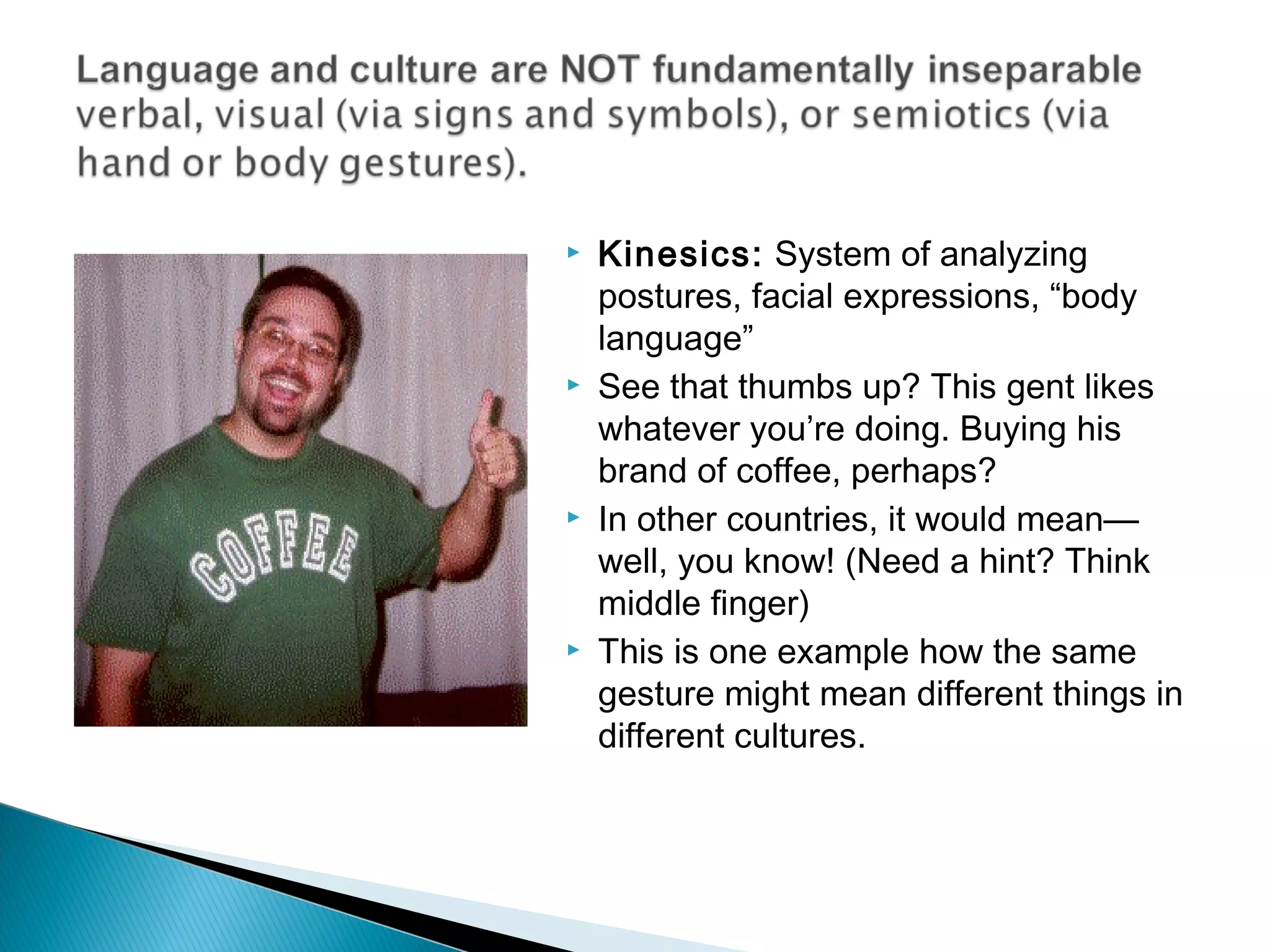
   Kinesics: System of analyzing
    postures, facial expressions, “body
    language”
   See that thumbs up? This gent likes
    whatever you’re doing. Buying his
    brand of coffee, perhaps?
   In other countries, it would mean—
    well, you know! (Need a hint? Think
    middle finger)
   This is one example how the same
    gesture might mean different things in
    different cultures.
 A culture must have at least one language
 Languages(same language used in several

  cultures)
 Language is heavily influenced by culture

  (that is, the limits of a language can prevent
  certain concepts from being part of a culture).
 Example of Sapir-Whorf
  hypothesis;
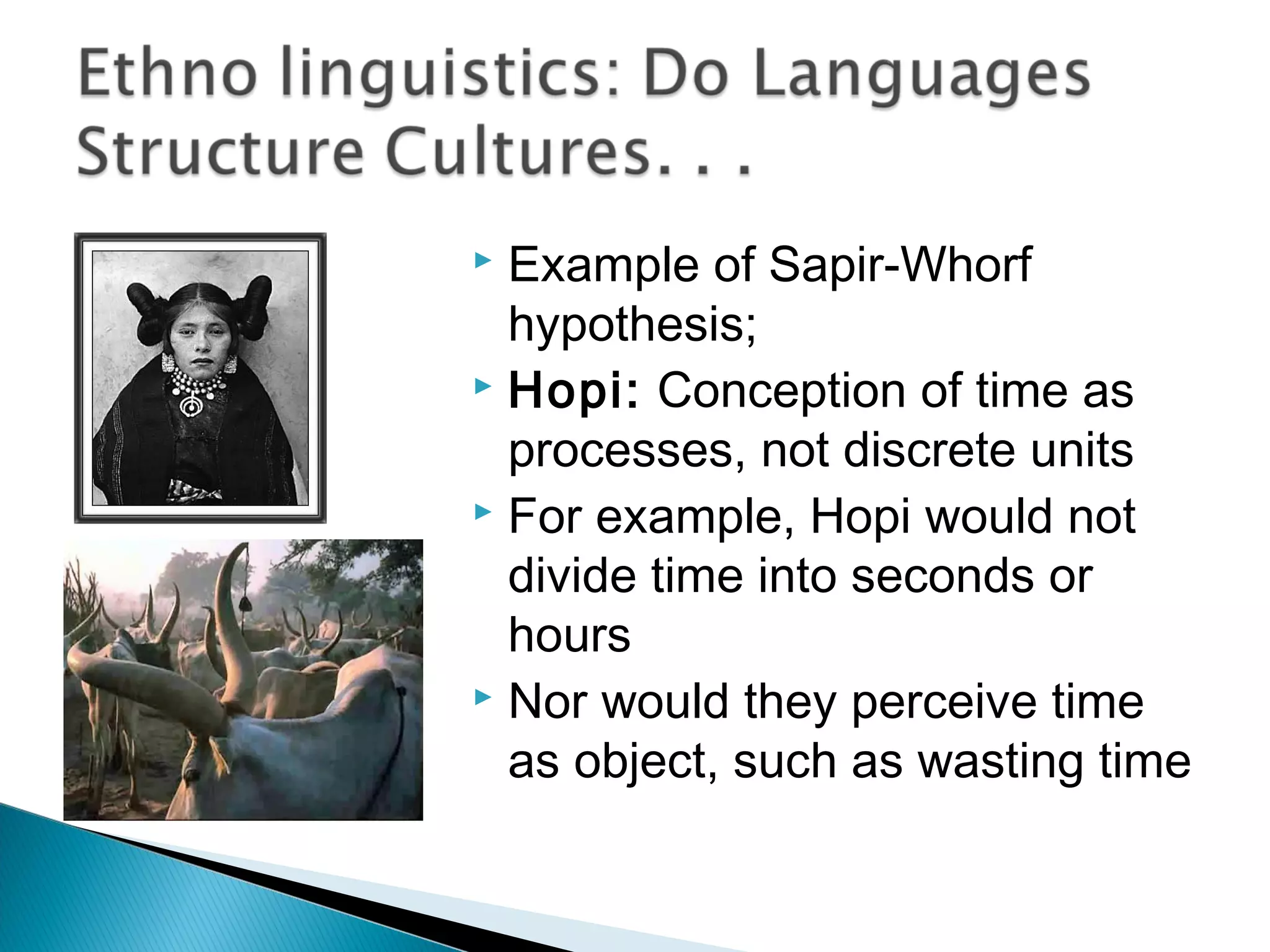
 Hopi: Conception of time as

  processes, not discrete units
 For example, Hopi would not

  divide time into seconds or
  hours
 Nor would they perceive time

  as object, such as wasting time
•   Nationality - This can be shown through your accent
    (American, British, Australia, Scottish, Irish etc. It can also be
    shown through the words you use. For example, Americans say
    sidewalk, British people say pavement and Australians say
    footpath. Americans say fall and British people say autumn.
    ETC,
•   Culture - Whether you speak with a French, Italian, Greek,
    Indian, Chinese or Jamaican accent when you speak English
    reveals maybe that English is your second language and that
    you actually grew up in another country and you spoke a
    different language. Your grammar may be a little different and
    people will think that you are speaking "bad English”
•   Age - the use of your language can reveal your age. Adults
    and elderly people use words that teenagers wouldn't usually
    use, so they would be markers of identity for adults.
•   Finally, languages are not solely defined by their developing culture(s) -
    most modern languages are amalgamations of other prior and current
    languages. That is, most languages borrow words and phrases ("loan
    words") from other existing languages to describe new ideas and
    concept. In fact, in the modern very-connected world, once one
    language manufactures a new word to describe something, there is a
    very strong tendency for other languages to "steal" that word directly,
    rather than manufacture a unique one itself. The English language is a
    stellar example of a "thief" language - by some accounts, over 60% of
    the English language is of foreign origin (i.e. those words were originally
    imported from another language). Conversely, English is currently
•    Bibliography
Sociolinguistics by P Trudgill
www. Slideshare.net

Culture and language01

  • 1.
     NAME:NASEEM AKHTAR ROLL NO:508162  ADDRESS:HOUSE NO 793 BLOCK NO 5  SECTOR DII GREEN TOWN LAHORE  COURSE NAME: SOCIO-LINGUISTICS  CODE NO: 5656  ASSIGNMENT: 02  TUTOR NAME: MUHAMMAD AHMAD SHEIKH
  • 2.
    •Language is the verbal expression of culture. •Your language can reveal many things about your identity. • It can disclose your nationality, culture, religion, age, gender, level of education, socio-economic class or your profession. •It is the process of achieving the ability to communicate with people of other cultures.
  • 3.
    The Latin languagehas no word for the female friend of a man (the feminine form of amicus is amica, which means mistress, not friend) because the Roman culture could not imagine a male and a female being equals, which they considered necessary for friendship.
  • 4.
    Kinesics: System of analyzing postures, facial expressions, “body language”  See that thumbs up? This gent likes whatever you’re doing. Buying his brand of coffee, perhaps?  In other countries, it would mean— well, you know! (Need a hint? Think middle finger)  This is one example how the same gesture might mean different things in different cultures.
  • 5.
     A culturemust have at least one language  Languages(same language used in several cultures)  Language is heavily influenced by culture (that is, the limits of a language can prevent certain concepts from being part of a culture).
  • 6.
     Example ofSapir-Whorf hypothesis;  Hopi: Conception of time as processes, not discrete units  For example, Hopi would not divide time into seconds or hours  Nor would they perceive time as object, such as wasting time
  • 7.
    Nationality - This can be shown through your accent (American, British, Australia, Scottish, Irish etc. It can also be shown through the words you use. For example, Americans say sidewalk, British people say pavement and Australians say footpath. Americans say fall and British people say autumn. ETC, • Culture - Whether you speak with a French, Italian, Greek, Indian, Chinese or Jamaican accent when you speak English reveals maybe that English is your second language and that you actually grew up in another country and you spoke a different language. Your grammar may be a little different and people will think that you are speaking "bad English” • Age - the use of your language can reveal your age. Adults and elderly people use words that teenagers wouldn't usually use, so they would be markers of identity for adults.
  • 8.
    Finally, languages are not solely defined by their developing culture(s) - most modern languages are amalgamations of other prior and current languages. That is, most languages borrow words and phrases ("loan words") from other existing languages to describe new ideas and concept. In fact, in the modern very-connected world, once one language manufactures a new word to describe something, there is a very strong tendency for other languages to "steal" that word directly, rather than manufacture a unique one itself. The English language is a stellar example of a "thief" language - by some accounts, over 60% of the English language is of foreign origin (i.e. those words were originally imported from another language). Conversely, English is currently • Bibliography Sociolinguistics by P Trudgill www. Slideshare.net