Language-Variation-A-Deep-Dive.pptx for linguistic
1.
Language Variation: A
DeepDive
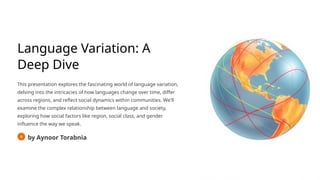
This presentation explores the fascinating world of language variation,
delving into the intricacies of how languages change over time, differ
across regions, and reflect social dynamics within communities. We'll
examine the complex relationship between language and society,
exploring how social factors like region, social class, and gender
influence the way we speak.
by Aynoor Torabnia
2.
Defining Language vs.Dialect
Language
Often considered a standardized, codified system with a
shared written form, often associated with a nation or
cultural group. May include multiple dialects.
Dialect
A regional or social variety of a language, characterized by
distinct pronunciation, vocabulary, grammar, and
sometimes even writing system.
3.
The Many Facesof Language Variation
Phonological
Variations in pronunciation, such as accents and regional
differences in sound systems. Example: the pronunciation of
'caught' and 'cot' in some dialects of American English.
Lexical
Differences in vocabulary. Example: 'pavement' in British English vs.
'sidewalk' in American English.
Syntactic
Variations in sentence structure and word order. Example: the use of
'he don't' instead of 'he doesn't' in some dialects of English.
Semantic
Differences in meaning associated with words. Example: 'wicked' in
British English meaning 'amazing' vs. its negative connotation in
American English.
4.
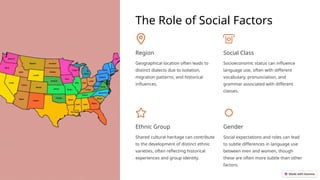
The Role ofSocial Factors
Region
Geographical location often leads to
distinct dialects due to isolation,
migration patterns, and historical
influences.
Social Class
Socioeconomic status can influence
language use, often with different
vocabulary, pronunciation, and
grammar associated with different
classes.
Ethnic Group
Shared cultural heritage can contribute
to the development of distinct ethnic
varieties, often reflecting historical
experiences and group identity.
Gender
Social expectations and roles can lead
to subtle differences in language use
between men and women, though
these are often more subtle than other
factors.
5.
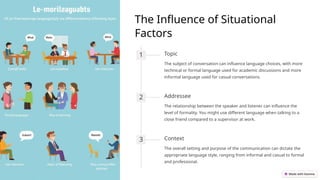
The Influence ofSituational
Factors
1 Topic
The subject of conversation can influence language choices, with more
technical or formal language used for academic discussions and more
informal language used for casual conversations.
2 Addressee
The relationship between the speaker and listener can influence the
level of formality. You might use different language when talking to a
close friend compared to a supervisor at work.
3 Context
The overall setting and purpose of the communication can dictate the
appropriate language style, ranging from informal and casual to formal
and professional.
6.
Exploring Linguistic Context
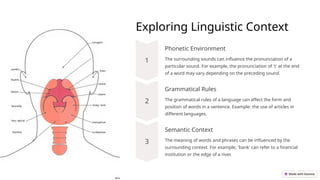
PhoneticEnvironment
The surrounding sounds can influence the pronunciation of a
particular sound. For example, the pronunciation of 't' at the end
of a word may vary depending on the preceding sound.
Grammatical Rules
The grammatical rules of a language can affect the form and
position of words in a sentence. Example: the use of articles in
different languages.
Semantic Context
The meaning of words and phrases can be influenced by the
surrounding context. For example, 'bank' can refer to a financial
institution or the edge of a river.
7.
The Social Meaningof Language
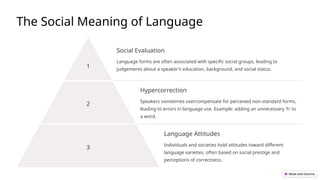
1
Social Evaluation
Language forms are often associated with specific social groups, leading to
judgements about a speaker's education, background, and social status.
2
Hypercorrection
Speakers sometimes overcompensate for perceived non-standard forms,
leading to errors in language use. Example: adding an unnecessary 'h' to
a word.
3
Language Attitudes
Individuals and societies hold attitudes toward different
language varieties, often based on social prestige and
perceptions of correctness.
8.
Covert Prestige andLanguage Change
1
Covert Prestige
Non-standard varieties can hold a certain 'coolness' or 'insider status' within a community, often
serving as a marker of group identity.
2
Language Change
The introduction of new features and variants can lead to gradual changes in a
language over time, with some features becoming more prominent while others
fade away.
3
Standardization
Through processes of formal codification and acceptance,
certain varieties of language can become more
standardized and widely accepted.
9.
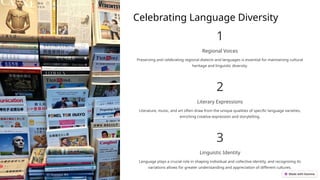
Celebrating Language Diversity
1
RegionalVoices
Preserving and celebrating regional dialects and languages is essential for maintaining cultural
heritage and linguistic diversity.
2
Literary Expressions
Literature, music, and art often draw from the unique qualities of specific language varieties,
enriching creative expression and storytelling.
3
Linguistic Identity
Language plays a crucial role in shaping individual and collective identity, and recognizing its
variations allows for greater understanding and appreciation of different cultures.
10.
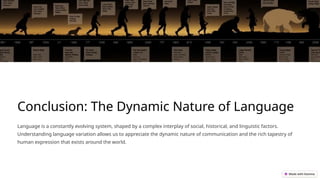
Conclusion: The DynamicNature of Language
Language is a constantly evolving system, shaped by a complex interplay of social, historical, and linguistic factors.
Understanding language variation allows us to appreciate the dynamic nature of communication and the rich tapestry of
human expression that exists around the world.