Walden University
COLLEGE OF EDUCATION
This is to certify that the dissertation by
Cheryl Murray
has been found to be complete and satisfactory in all respects,
and that any and all revisions required by
the review committee have been made.
Review Committee
Dr. Glenn Ayres, Committee Chairperson, Education Faculty
Dr. Amie Beckett, Committee Member, Education Faculty
Dr. Thomas Cavanagh, University Reviewer, Education Faculty
Chief Academic Officer
David Clinefelter, Ph.D.
Walden University
2010
Abstract
Language learning Outside of the Classroom: A Reflection on Language Learner
Complexity
by
Cheryl Ann Murray
MA, University of South Carolina, 2004
BA, University of Florida, 1974
Doctoral Study Submitted in Partial Fulfillment
of the Requirements for the Degree of
Doctor of Philosophy
Walden University
November 2010
Abstract
International students attending English language schools are routinely offered the choice
of a full-day intensive program or a semi-intensive program featuring time off to use
English in the local area. Utilizing Bensons’ theory about learning outside the classroom,
this narrative inquiry study researched the beliefs of English learners with regard to
having additional free time outside the classroom. Purposive sampling was used to select
10 adult English language students in the southeastern United States. Participants’
experiences were elicited through semi-structured interviews and constructed into
narratives, validated by member checking. The narratives were analyzed using polyvocal
analysis, followed by a cross-narrative analysis and triangulation with other interview
data. The findings showed that having additional time did not automatically enhance
language learning. Whether language learning occurred depended on the participants
themselves and their choice of living arrangements. Participants who created
opportunities for engagement with native speakers perceived their language learning to
be particularly successful. Homestay accommodations with an English-speaking host
family emerged as the option most conducive to language learning outside of the
classroom. These findings may help learners, instructors, and support staff of English
language schools to recognize and create opportunities for out-of-classroom language
learning. Augmenting formal programs of instruction for English learners with effective,
out-of-classroom language learning opportunities such as homestays with English-
speaking host families could contribute to greater student success in English language
learning. As a result these students will be better able to assimilate into American culture.
Language Learning Outside of the Classroom: A Reflection on Language Learner
Complexity
by
Cheryl Ann Murray
MA, University of South Carolina, 2004
BA, University of Florida, 1974
Doctoral Study Submitted in Partial Fulfillment
of the Requirements for the Degree of
Doctor of Philosophy
Walden University
November 2010
UMI Number: 3422367
All rights reserved
INFORMATION TO ALL USERS
The quality of this reproduction is dependent upon the quality of the copy submitted.
In the unlikely event that the author did not send a complete manuscript
and there are missing pages, these will be noted. Also, if material had to be removed,
a note will indicate the deletion.
UMI 3422367
Copyright 2010 by ProQuest LLC.
All rights reserved. This edition of the work is protected against
unauthorized copying under Title 17, United States Code.
ProQuest LLC
789 East Eisenhower Parkway
P.O. Box 1346
Ann Arbor, MI 48106-1346
Acknowledgments
I would like to thank my faculty mentor and committee chair, Dr. Glenn Ayres,
for his adept direction and support throughout my entire doctoral program. I am also
deeply grateful for the encouragement and assistance of my committee member, Dr.
Amie Beckett, both during my doctoral program and the dissertation process. I very
much appreciate as well the expert guidance provided by Dr. Tom Cavanagh, the Walden
University Research Reviewer (URR) who reviewed my proposal and dissertation. I
would also like to express my gratitude to the ELS administration who allowed me the
opportunity to conduct my study and to the ELS students who volunteered to participate.
I wish to thank a fellow doctoral student and friend, Yu Jeong Choi, who offered
an excellent peer review of my dissertation. Finally, I would like to thank my team for
the years of unwavering support during this process: my mother, Virginia Hill; my
husband, Jonathan Murray; and my daughters, Alison and Andrea Fitzgerald.
i
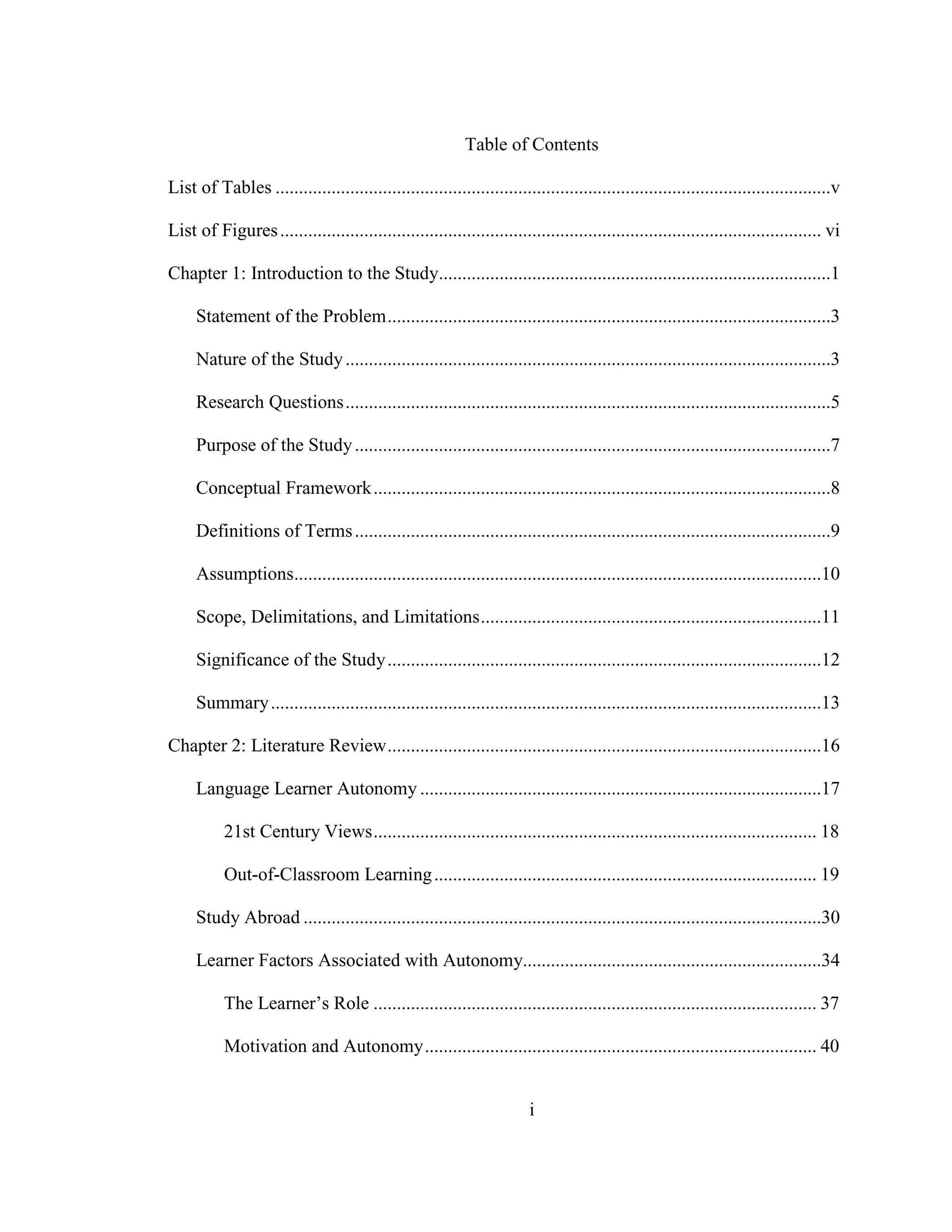
Table of Contents
List of Tables .......................................................................................................................v
List of Figures.................................................................................................................... vi
Chapter 1: Introduction to the Study....................................................................................1
Statement of the Problem...............................................................................................3
Nature of the Study........................................................................................................3
Research Questions........................................................................................................5
Purpose of the Study......................................................................................................7
Conceptual Framework..................................................................................................8
Definitions of Terms......................................................................................................9
Assumptions.................................................................................................................10
Scope, Delimitations, and Limitations.........................................................................11
Significance of the Study.............................................................................................12
Summary......................................................................................................................13
Chapter 2: Literature Review.............................................................................................16
Language Learner Autonomy ......................................................................................17
21st Century Views............................................................................................... 18
Out-of-Classroom Learning.................................................................................. 19
Study Abroad ...............................................................................................................30
Learner Factors Associated with Autonomy................................................................34
The Learner’s Role ............................................................................................... 37
Motivation and Autonomy.................................................................................... 40
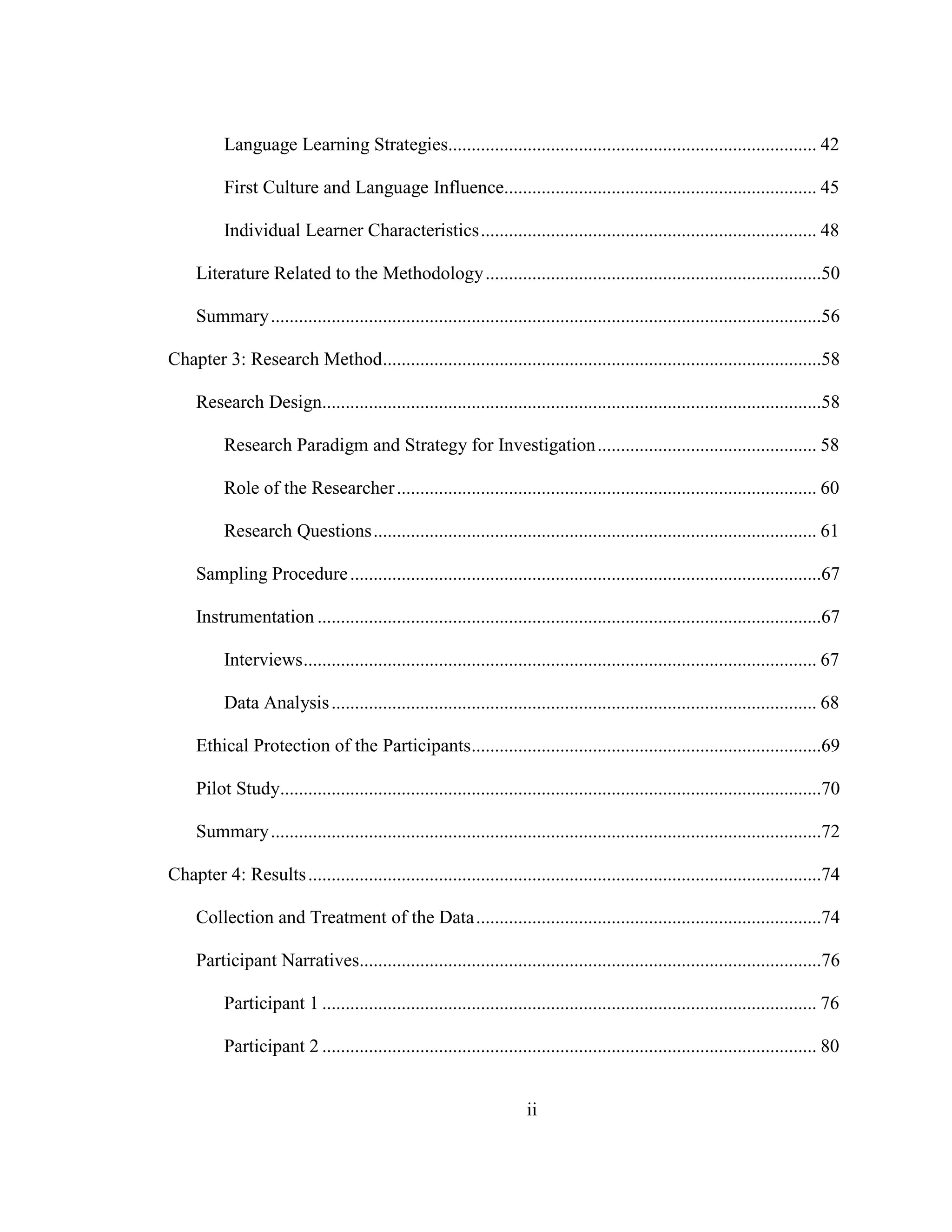
ii
Language Learning Strategies............................................................................... 42
First Culture and Language Influence................................................................... 45
Individual Learner Characteristics........................................................................ 48
Literature Related to the Methodology........................................................................50
Summary......................................................................................................................56
Chapter 3: Research Method..............................................................................................58
Research Design...........................................................................................................58
Research Paradigm and Strategy for Investigation............................................... 58
Role of the Researcher.......................................................................................... 60
Research Questions............................................................................................... 61
Sampling Procedure.....................................................................................................67
Instrumentation ............................................................................................................67
Interviews.............................................................................................................. 67
Data Analysis........................................................................................................ 68
Ethical Protection of the Participants...........................................................................69
Pilot Study....................................................................................................................70
Summary......................................................................................................................72
Chapter 4: Results..............................................................................................................74
Collection and Treatment of the Data..........................................................................74
Participant Narratives...................................................................................................76
Participant 1 .......................................................................................................... 76
Participant 2 .......................................................................................................... 80
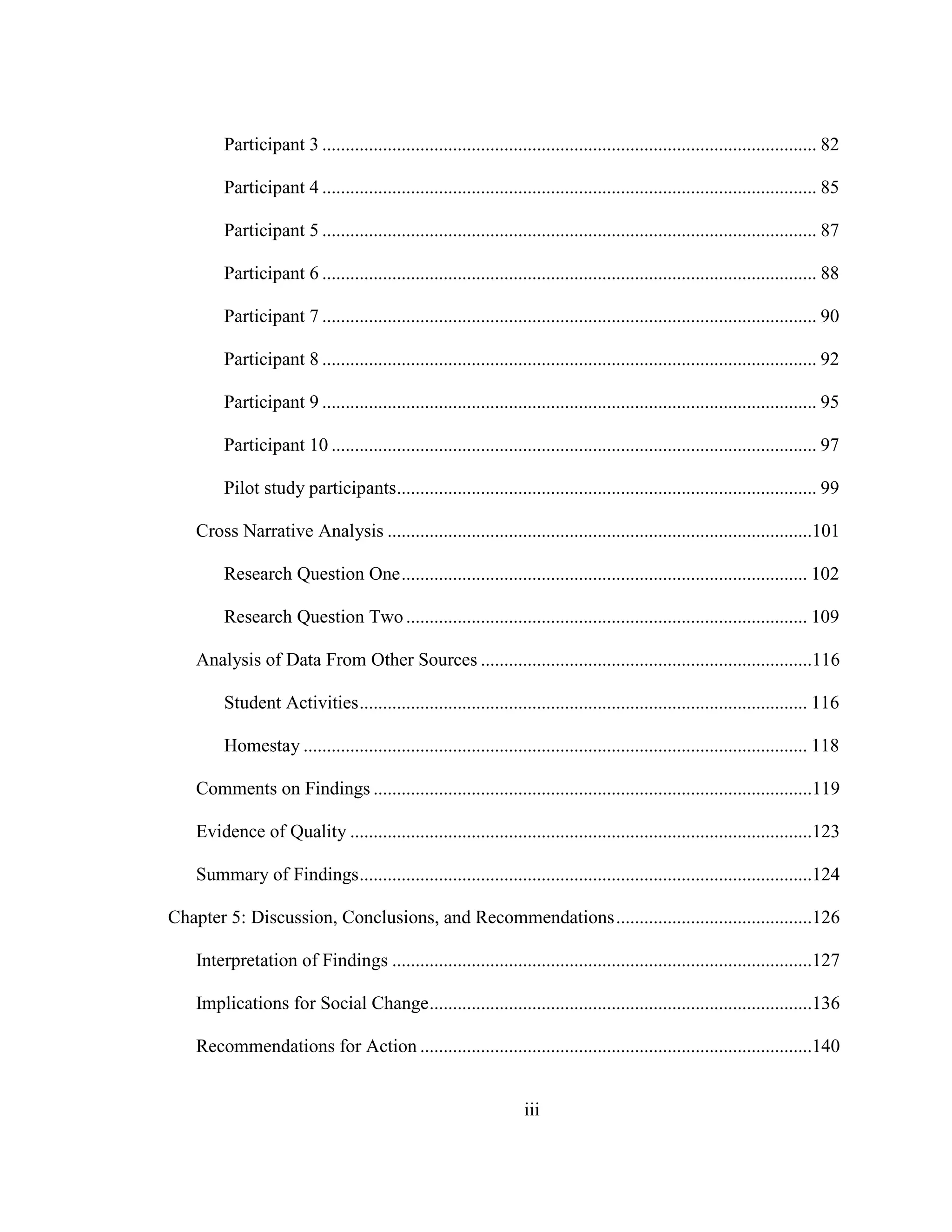
iii
Participant 3 .......................................................................................................... 82
Participant 4 .......................................................................................................... 85
Participant 5 .......................................................................................................... 87
Participant 6 .......................................................................................................... 88
Participant 7 .......................................................................................................... 90
Participant 8 .......................................................................................................... 92
Participant 9 .......................................................................................................... 95
Participant 10 ........................................................................................................ 97
Pilot study participants.......................................................................................... 99
Cross Narrative Analysis ...........................................................................................101
Research Question One....................................................................................... 102
Research Question Two...................................................................................... 109
Analysis of Data From Other Sources .......................................................................116
Student Activities................................................................................................ 116
Homestay ............................................................................................................ 118
Comments on Findings ..............................................................................................119
Evidence of Quality ...................................................................................................123
Summary of Findings.................................................................................................124
Chapter 5: Discussion, Conclusions, and Recommendations..........................................126
Interpretation of Findings ..........................................................................................127
Implications for Social Change..................................................................................136
Recommendations for Action ....................................................................................140
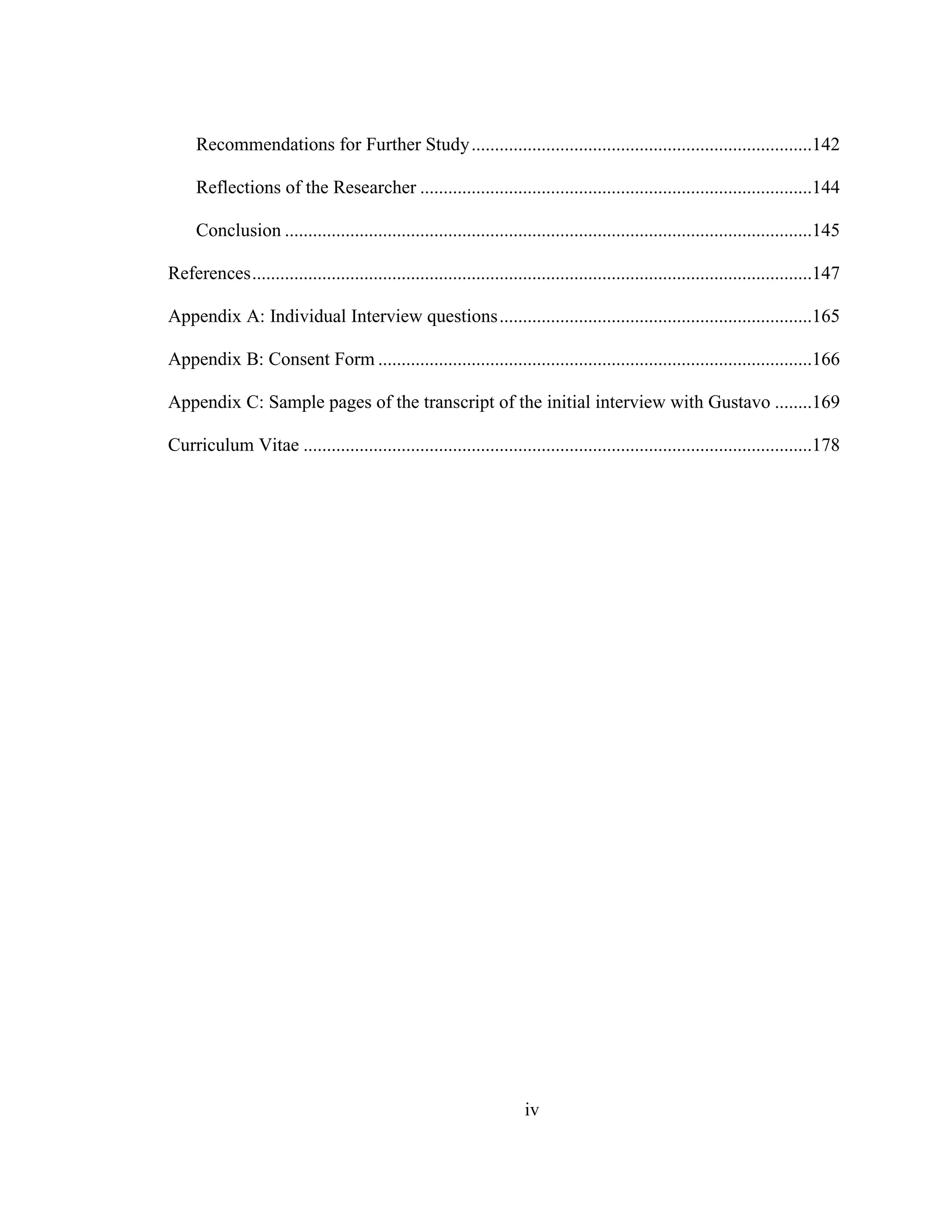
iv
Recommendations for Further Study.........................................................................142
Reflections of the Researcher ....................................................................................144
Conclusion .................................................................................................................145
References........................................................................................................................147
Appendix A: Individual Interview questions...................................................................165
Appendix B: Consent Form .............................................................................................166
Appendix C: Sample pages of the transcript of the initial interview with Gustavo ........169
Curriculum Vitae .............................................................................................................178
v
List of Tables
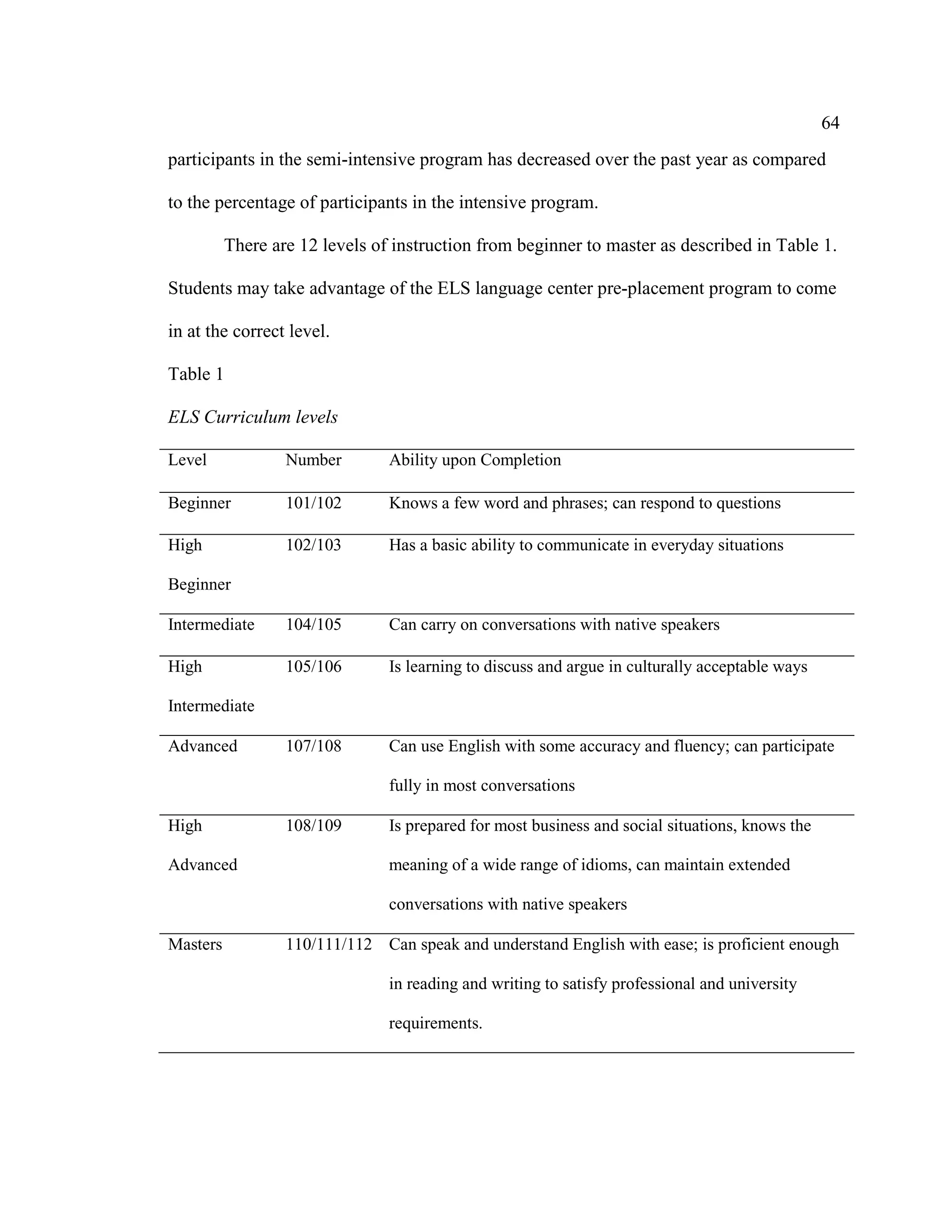
Table 1. ELS Curriculum levels........................................................................................ 63
Table 2. Demographics of participants at ELS…………………………………………..74
vi
List of Figures
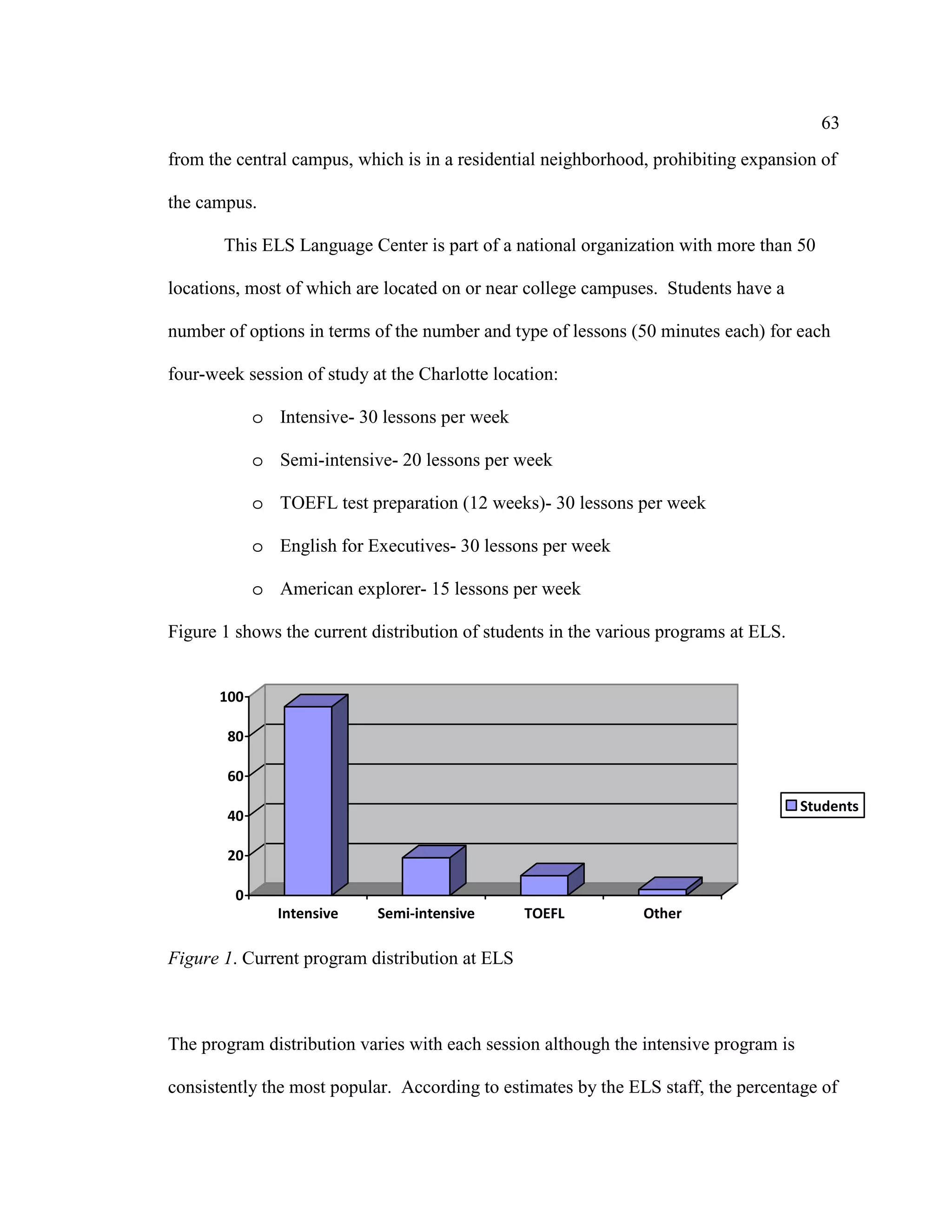
Figure 1. Current program distribution at ELS..................................................................60
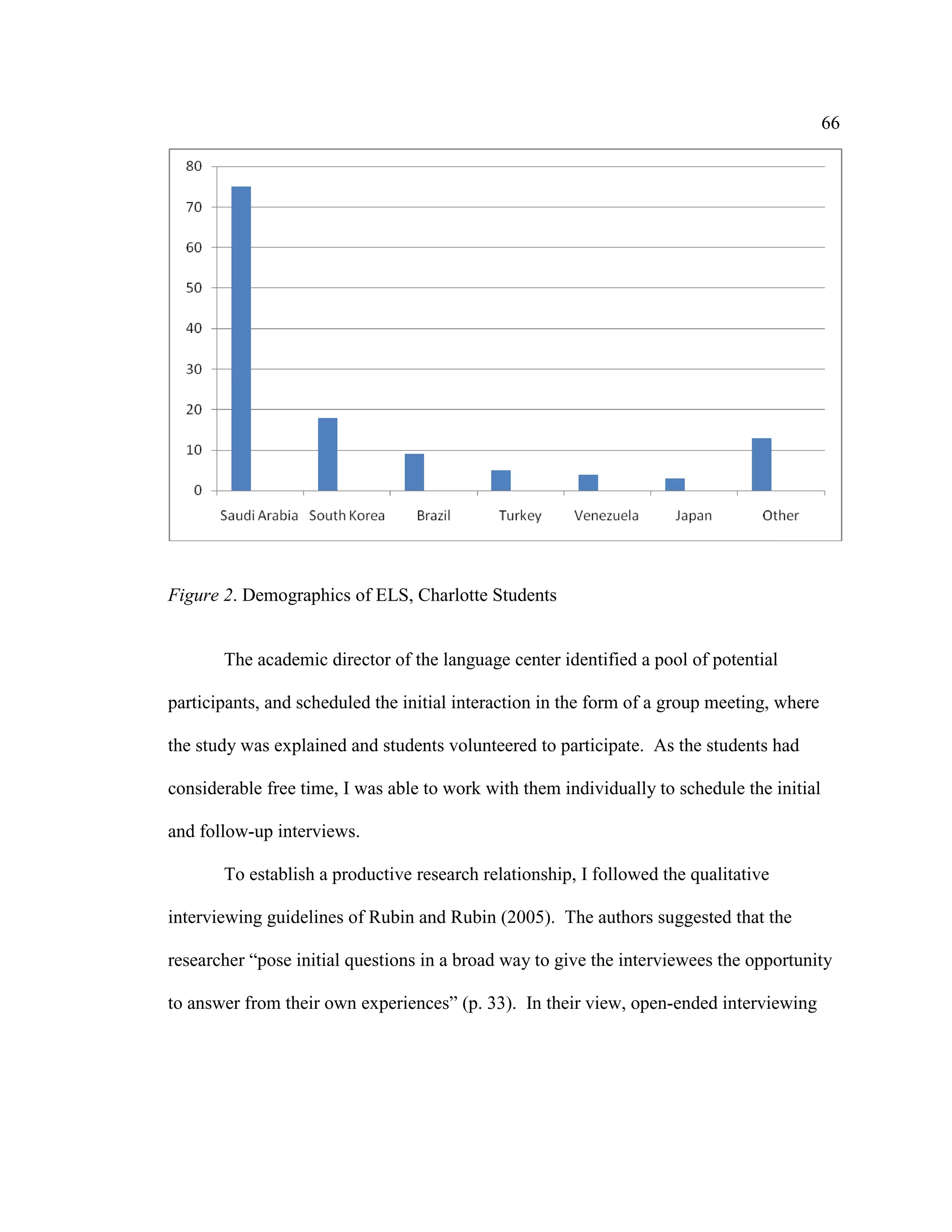
Figure 2. Demographics of ELS, Charlotte Students.........................................................62
1
Chapter 1: Introduction to the Study
English dominates the world as no language ever has, and it is likely that it will
continue to do so for some time (Graddol, 2003). Although there may be more native
speakers of other languages in sheer numbers, English is the common language of
business, science, academia, communications, aviation, the Internet, entertainment, and
diplomacy. For most English language students, the English language is crucial to a
more secure and possibly more fulfilling future (Svalberg, 2009). The expediency of
knowing English for education and employment serves as the motivation for considerable
parental pressure on children to acquire English skills (Jeon, 2010), although this stress
on learning the language may result in some learners studying English reluctantly (Cheng
& Fox, 2008).
The teaching of English has become a multibillion-dollar industry, and it is
estimated nearly one-third of the world's population will soon be studying English
(Graddol, 2006), with an estimated one billion people around the world currently learning
it (Camenson, 2007). Ellis (2008) suggested that:
English is no longer a language spoken primarily as an L1 (first language). The
375 million English as a native language (ENL) speakers are in a very definite
minority compared to the 750 million English as a foreign language (EFL) and
375 million English as a second language (ESL) speakers. (p. 239)
English language programs taught by native English speakers are widely available
worldwide, as are authentic English language materials such as on the Internet and in
print (Camenson, 2007). Although much of the English language learning worldwide is
2
occurring in nonnative English-speaking countries, many students choose to attend
English language programs abroad, including in the United States. English learners
going abroad presumably believe they will enhance their learning through immersion in
an English-speaking community.
English language schools in the U.S. offer ongoing, short (generally month-long)
programs that draw young adults and older students from all parts of the world. Students
attending some American English language schools are offered the choice of an intensive
all-day program or a semi-intensive program in which they have afternoons off to explore
the local area and practice their English through interaction. This opportunity for
freedom in learning the language entails substantive language learner autonomy, which
often presents a challenge for some students, although not for all (Benson & Gao, 2008;
Cotterall, 2008; Murray & Kojima, 2007; Palfreyman, 2003). A detailed discussion of
the literature concerning language learner autonomy as well as the many aspects of
language learning that may work in concert with it is presented in Chapter 2.
There exists limited qualitative research addressing the out-of-classroom language
learning that occurs in juxtaposition to classroom instruction. This study addresses a gap
in the knowledge regarding this facet of language learning autonomy by exploring and
describing what language learners do on their own to augment what they are learning
during a formal course of instruction. As English learning both in and out of the
classroom is expected to increase consistently as a result of globalization, understanding
the complexity of out-of-classroom language learning is especially important.
3
Statement of the Problem
In this qualitative study using narrative inquiry, I interviewed ten English
language learners who were attending programs at a private English language school on a
university campus in the southeastern United States to understand if and how their out-of-
classroom activities and interactions enhance their English language learning and
complement what they are learning in their formal course of instruction.
Both the students and administrative staff of American English language schools
need to understand what is entailed in the selection of a semi-intensive option, as opposed
to the selection of a full-day English course of instruction. Although additional time to
learn English has been assumed to enhance English language learning, the results of this
study suggested such enhancement was not guaranteed. The opportunity for language
learner autonomy presented a challenge for some participants for a variety of reasons,
such their first culture, personality, or choice of housing. At the same time, some
participants thrived in this type of situation and effectively created opportunities for
interaction with native speakers. This study explored these challenges and how the
learners addressed them. It also revealed the strategies and achievements of learners who
were successfully enhancing their English language learning through out-of-classroom
language learning.
Nature of the Study
Through narrative inquiry, I explored the complex nature of English language
learning in an immersion setting with its attendant free time component capturing the
perspectives of ten English language learners. The participants were students attending a
4
private English language school (the ELS Language Center at Queens University,
Charlotte, North Carolina), part of a national network of more than 50 private English
language schools, most of which are located on college campuses. The data collection in
this qualitative study was effected through audio-recorded, semistructured individual
interviews. While conducting the interviews, I began to analyze data on an informal
basis as suggested by Hatch (2002) as during the interview process, decisions are made
on what to probe and explore. I used what Hatch (2002) calls “polyvocal” analysis as my
data analysis strategy for the formal analysis of the data, a framework that is compatible
with narrative inquiry (pp. 201-207).
In a dissertation where the purpose is to hear and analyze participants’
experiences and to identify out-of-classroom learning issues through their stories, it was
appropriate to use a research method that employed face-to-face communication.
Narrative inquiry is a research orientation targeting narratives as a path to studying
experience or some other aspect of being human. Meaning can be present in the stories
people live and relate. Although the use of stories is not new by any means, the recent
increase in the use of narrative methodologies in the field of social sciences has
stimulated thinking about how stories of experiences influence and are influenced by our
lives (Clandinin, 2007).
Narrative inquiry can be differentiated from other methods by the focus on stories
and narratives. Narratives are appropriate for recognizing experiences, either from the
perspective of participants (emic perspective) or from the perspective of an outsider
interpreting individual, institutional, or societal narratives (etic perspective). A
5
researcher may choose narrative inquiry as a means to gain material on a topic, using in-
depth interviews and subsequently analyzing the data collected. Georgakopoulou (2007)
put forth the case for the underrepresented narrative data she called “small stories - that
is, the telling of ongoing events, future or hypothetical events, shared (common) events,
the content of which is considerably less than a full narrative” (p. 145). Similarly,
Tannen (2008) described “small-n narratives” obtained during interviews as “accounts of
specific events and interactions” that participants had revealed to her (p. 209).
This study captured language learning events and opportunities taken and missed
(most of which were reflected in small stories) as well as those aspects of language
learning life stories that were applicable. The goal was to capture the lived experiences
of English language learners during their study abroad at a language school and to
provide insight into the learning process that occurs outside of the classroom. As the
researcher, I coconstructed the narratives in the sense described by a number of scholars
writing about narrative inquiry or narrative research (Clandinin & Connelly, 2000;
Coulter & Smith, 2009; Hatch, 2002; Riessman & Speedy, 2007; Van Maanen, 1988). A
more detailed discussion of how narrative inquiry was implemented is presented in
Chapter 3.
Research Questions
Two central research questions guided this study. Each central question includes
a set of subquestions that contributed to understanding the experience and perceptions of
English language learners. The questions were as follows:
6
1. What are the experiences of English language learners in the semi-intensive program
with regard to the enhanced additional free time during the immersion experience?
• How do English language learners use this free time to develop their English
language proficiency?
• Does the individual’s linguistic or cultural background affect the extent to which
and the way in which free time is used?
• What out-of-classroom language-learning strategies do the students use? Do
students believe they are effective?
• How do the students’ perceptions of their personality affect their ability to take
advantage of out-of-class learning opportunities?
2. Do English language learners in the semi-intensive program believe that their English
language learning is enhanced by having additional free time during their immersion
experience?
• What are the perceptions of students with regard to their own roles in out-of-
classroom language learning?
• What are the impediments to out-of-classroom language learning?
• Why did the students choose the semi-intensive option? Would they choose it
again and if yes, why? Could there be other reasons students choose the semi-
intensive option such as seeking interaction with native speakers to explore the
culture or a reluctance to work as hard as is required with the intensive option?
• To what extent and in what way do the students perceive their in-class activities
prepare them for out-of-class encounters?
7
Purpose of the Study
The purpose of this study was to determine the means by and the extent to which
students believed that their English language learning was furthered by having the
additional free time during their immersion experience offered by the semi-intensive
option. The study explored how the learners used this free time to develop their English
language proficiency and how individual or cultural differences may have affected the
extent to and the way in which free time was used. The study examined how learners
made use of informal opportunities outside the formal classroom to develop their English
language ability, while considering the learning environment and other factors in this
complex system,. Looking at the problem from the perspective of English language
learners was instructive in understanding their immersion experience. Identifying and
sharing positive learner behaviors that demonstrated autonomy in English language
learning offers insight to both learners and instructors. Uncovering and conveying
tendencies that were antithetical to such productive activities will also be of value to
those reading this study. Based on the results of this study, educators could devise some
structured learning opportunities in the field to prepare students for the time they will be
on their own with native speakers. Scrutinizing the student responses from this research
will help educators and administrators better understand the types of contexts and
situations that might prove problematic outside the classroom, and they could plan
accordingly.
8
Conceptual Framework
Qualitative research as elicited through narrative inquiry reaches into the lived
experiences of the research participants, and such inquiry best fits the purpose of this
study. This study probed the essence of the students' experiences in the immersion
environment to extract the language learner behaviors and strategies that enable second
language acquisition with respect to out-of-classroom learning. Narrative inquiry was
well suited for this study because the aim was to understand how the learners in this study
understood and experienced their out-of-classroom language learning.
Benson (2001) defined out-of-classroom learning as any type of learning that
occurs outside the classroom which includes "self-instruction, naturalistic learning or
self-directed naturalistic learning" (p. 62). Out-of-classroom language learning occurs
during a learner’s free time and while engaging in non-assignment activities that learners
do when they are outside of formal classroom setting with or without the intention to
learn or practice English. Some examples include conversing with native speakers or
friends in English, watching movies or television in English, reading in English, using
English on the computer, and listening to music sung in English.
Learner autonomy and motivation and in second language learning (both in and
out of the classroom) have recently been considered to represent complex constructs that
reflect the interaction of a number of factors. Exploring the complexity of language
learning, specifically out-of-classroom learning, by considering how these factors act
separately and interrelate has enabled the research to reflect an understanding of the
9
many intricacies involved in second language learning (Bunts-Anderson, 2004;
Chusanachoti, 2009).
Definitions of Terms
Academic proficiency: Language in its primary and written form, used in an educational
context (Cummins, 2000).
Conversational proficiency: Fluency in using the language communicatively in face-to-
face interaction, supported by intonation and nonverbal clues (Cummins, 2000).
Emic perspective: The insiders perspective; includes the meanings and views of the
people being studied (Johnson & Christensen, 2004)
Etic perspective: The perspective of the objective researcher studying a group of people
(Johnson & Christensen, 2004)
ESL: English as a second language, taught in countries (such as the US, the UK, or India)
where English is a major language of commerce and education, a language that students
often hear outside the walls of their classroom (Brown, 2001).
EFL: English as a foreign language, specifically English taught in countries (such as
Japan, Egypt, or Venezuela) where English is not a major language of commerce and
education (Brown, 2001).
L1: An individual’s first language (Brown, 2001).
L2, L3: Second or subsequent languages acquired or studied by an individual (Brown,
2001).
Language-learning strategies: “Activities consciously chosen by learners for the purpose
of regulating their own language learning” (Griffiths, 2008a, p. 87).
10
Metacognition: The ability to reflect critically on and evaluate what is known, which in
language learning may enable autonomous and conscious decisions regarding the
learning process (Anderson, 2008).
Out-of-classroom language learning (also called out-of-class language learning): Any
type of learning that occurs outside the classroom (Benson, 2001).
Pragmatic awareness: Involves knowledge of the rules and conventions underlying
appropriate language use in communicative situations (Alcón & Jordà, 2008)
SLA: Second language acquisition, a field of study that focuses on how languages are
learned (De Bot, Lowie, & Verspoor, 2005a).
Study abroad: Studying in a country which is not the native country of the student,
“experienced differently for each learner as s/he co-creates his or her reality on a daily
basis with interlocutors in the host country” (Lafford, 2008, p. iii).
Target language: The language being learned; defined by Richard-Amato (2003) as “the
language of proficient second language users in whatever environment we find them”
(p.3)
Assumptions
1. The Academic Director of ELS Language Center Charlotte identified a pool of
suitable participants.
2. ELS students understood the interview questions and answered honestly and
thoroughly with sufficient self-awareness.
3. The English language proficiency of the participants was sufficient to allow
metalinguistic processing in that language.
11
Scope, Delimitations, and Limitations
The investigation was limited to the target population of English language
students enrolled in the semi-intensive English program at ELS Language Center located
on the campus Queens University, Charlotte, North Carolina. All of the study
participants were (a) enrolled at the advanced level, (b) participated voluntarily in the
research study, and (c) had attended at least one full four-week session at ELS Language
Center Charlotte.
The responses of the English language learners reflected whether they believed
their proficiency to have been enhanced by out-of-classroom language learning. The
study did not verify, however, whether there has been an actual increase in proficiency as
a consequence of out-of-classroom experiences. Yet another limitation was that no
participants from Saudi Arabia (who comprise the majority of students at the language
school) were included because they are government sponsored and are required to enroll
in the intensive program.
The narratives in the form of language learning histories and sharing of
experience were unavoidably told in English, as I did not speak most of the languages of
the participants. Not using the native language of the participants may have caused some
limitations as to the accuracy of what was told and heard. How an interview progresses
may also depend on the country of origin of the participant. Smorti et al. (2007) assert
that culture shapes narrative.
The findings of this study can reasonably be generalized to similar language
learning situations in English-speaking countries, with the recognition that language
12
learner complexity renders every situation unique. The learners who participated in this
study believed that immersion offers a significant advantage over English language study
in their homelands, and their experiences shed light on this belief. At the same time,
there most likely are English language learners who believe that study in their homelands
suffices, particularly in view of the global community available via the Internet.
Significance of the Study
Although there has been much research with respect to English language learning
in the classroom, there has been little qualitative research investigating out-of-classroom
language learning using narrative inquiry to examine its complexity. In Benson’s (2006)
view, there is a need for “learning beyond the classroom to be theorized in the same way
that classroom learning has been theorized in recent years” (p. 27). Springer and Collins
(2008) asserted that much less research attention has been devoted to understanding how
language classroom interaction experience may differ from and/or complement
experience acquired when interacting with native speakers outside the classroom.
Similarly, Chusanachoti (2009) suggested that insight regarding learners' behaviors
outside the classroom is quite limited, and that “the potential significance of out-of-class
English activities, and what learners can possibly gain from these activities is an under-
explored area in the field” (p. 5). Higgins (2008) argued that “the relationship between
instructed language learning and L2 use outside of classroom contexts is radically
undertheorized” (p. 402). Although the present study did not develop a theory, an
exploration of the topic may contribute to the growing awareness of the role played by
out-of-classroom language learning.
13
Approaching out-of-classroom language learning experiences through narrative
inquiry may lead to recognition of the many intricacies and complex interactions entailed
in that aspect of second language acquisition, providing guidance for learners and
administrators alike. Clandinin and Rosiek (2007) contended that “narrative inquirers
study an individual’s experience in the world and, through the study, seek ways of
enriching and transforming that experience for themselves and others” (p. 42).
The social impact of this study could be substantive. The results of this study
have the potential to identify some areas where language schools could provide guidance
and support to English language learners and instructors. Language educators could
devise structured learning opportunities in the field to better prepare students for the time
they will be on their own with native speakers. Student responses as evinced in the study
may help educators better understand the types of contexts and situations that might
prove problematic during off times, and they could plan accordingly. Both leaders and
learners will benefit by gaining an understanding of what opportunities may exist, how
learners may take advantage of them, and what may impede access. The results of this
study not only add to the research on language learning in general but also augment
current knowledge about out-of-classroom language learning as a subset of autonomous
language learning.
Summary
In this qualitative study using narrative inquiry, the complex nature of English
language learning in an immersion setting with its attendant free time component was
explored from the perspective of 10 participants. Although additional time available for
14
students to use English has been assumed to enhance English language learning, the
results of this study suggested such enhancement was not guaranteed. It did occur with
some participants, however. As the purpose was to hear and analyze participants’
experiences and to identify out-of-classroom learning issues through their stories, it was
appropriate to use narrative inquiry, a research method that employs narratives as a
means to study experience. Data for this qualitative study were collected through audio-
recorded, semistructured individual interviews and analyzed using polyvocal analysis.
In answering the two overarching research questions, this study revealed the beliefs and
strategies of learners who were successfully augmenting their English language learning
through out-of-classroom language learning as well as those who struggled to effect such
augmentation. The responses of the English language learners reflected whether they
believed their proficiency to have been enhanced by out-of-classroom language learning,
but there was no verification of an actual increase in proficiency as a consequence of out-
of-classroom experiences.
Looking at the problem from the perspective of English language learners has
been instructive in understanding their immersion experience, particularly the challenges
and the opportunities encountered outside the classroom. The identification of such
challenges and opportunities in this study will supplement other research that helps those
involved in teaching and learning English understand its complex nature. This research
adds to the growing amount of literature on out-of-classroom language learning.
Although language learning in the classroom has been extensively studied for decades,
15
there has been little qualitative research looking at out-of-classroom language learning
overall, particularly using narrative inquiry to look at its complexity.
The following chapter is a review of the literature that relates to the current study.
Initially, this review discusses language learner autonomy and its subset, out-of-
classroom learning. Study abroad and immersion are addressed, as are the effect and
influence of individual beliefs and characteristics. Narrative inquiry, which serves as the
paradigm for this study, is explicated in the final section of the literature review. Chapter
3 presents a detailed description of the design, methodology, and the procedures used for
the study. Chapter 4 presents the participant narratives and the results of the cross
narrative analysis. Chapter 5 presents the conclusions and recommendations of the study.
16
Chapter 2: Literature Review
The purpose of this study was to determine whether students believed that their
English language learning was furthered by having additional free time during their
immersion experience, as offered by the institution’s semi-intensive option. What
learners do with their free time and the extent to which they are able to recognize and
create opportunities for interaction with native speakers is dependent on a number of
different factors, according to the results of this study. These include the autonomy
exhibited by the learner and specifically the learner’s out-of-classroom endeavors,
expectations, and experience with regard to study abroad, the learner’s motivation and
perceived role in language learning, the influence of the learner’s first culture and
language, and other individual characteristics of the learner such as age, gender,
personality, meta-cognition, and aptitude as well as proficiency in and knowledge of the
language.
The first section of this literature review explicates the current thinking on
language learner autonomy and one aspect of it, out-of-classroom language learning. The
next section addresses study abroad and immersion from the sense of language learners’
expectations and experience. The following section reflects the effect of individual
beliefs and characteristics such as motivation, the learner’s role, first culture and
language, and personal traits on language learning. Narrative inquiry, which serves as the
paradigm for this study, constitutes the topic of the final section of the literature review.
The primary databases searched in this literature review were the EBSCO and
Sage multiple databases. The descriptors used in these searches included (a) language
17
learner autonomy, (b) out-of-class(room) language learning (c) study abroad, (d)
language learning strategies, (e) narrative research, and (f) narrative inquiry. The
searches led to many of the articles mentioned in the literature review. The reference lists
in those articles led to the accessing of other articles through the Walden Library E-
Journal list. The search revealed that very few studies about out-of-classroom language
learning have been completed. A considerable number of the references came from
chapters in edited books or books by one or more authors.
Language Learner Autonomy
In its earliest instantiations in the 1980s, the concept of learner autonomy was
predominantly associated with adult education and self-access learning systems and
seemed to be a matter of learners endeavoring on their own (Little, 2007). By the end of
the 1980s, however, there was a shift of emphasis: Learner autonomy became part of the
discussion in language teaching (Little, 2007). On the whole, for the past thirty years
there has been a steady increase in the number of academic publications addressing
learner autonomy, interpreted in various ways and named by various terms (learner
independence, self-direction, autonomous learning, and independent learning).
Although definitions have varied greatly, learner autonomy researchers have
generally concurred on a “fundamental principle of learner autonomy: learners take
charge of and become responsible for their learning” (Chang, 2007, p. 325). Both inside
and outside the classroom, learners make choices regarding their own learning and find
ways to practice their target language.
18
21st Century Views
More recently, considerable research regarding language learner autonomy has
emerged both with regard to adult language learners studying languages largely of their
own volition and classroom-guided self-directed learning (Gremmo & Riley, 1995; Little,
2007; Littlewood, 1996). Benson (2006) attributed the growing interest in autonomy in
language learning to the ongoing global growth in the language teaching industry.
Benson acknowledged that research on autonomy has moved from a specialized, self-
contained field, characterized by advocacy, toward a propensity to consider autonomy as
a challenging notion that can be characterized in a number of ways.
Autonomy in the classroom reflects trends toward cooperative decision-making
and students doing activities in groups. This trend is not the focus of this dissertation but
is integral to the overall autonomy concept. Autonomy beyond the classroom includes
self-access centers, computer assisted language learning (CALL), distance learning,
tandem learning, study abroad, out-of-classroom learning, preparation for the classroom,
and self-instruction. Of these, this study focused on out-of-classroom learning in a study
abroad context.
Little (2007) suggested that an understanding of language learner autonomy
should reveal what actions are necessary on the part of language educators to develop
autonomous language learners and at the same time provide criteria by which to evaluate
the extent to which autonomy affects the development of proficiency. In his view
“teachers must learn how to produce and manage the many varieties of target language
discourse required by the autonomous classroom” (p. 27). Even though greater learner
19
autonomy is generally thought to enhance acquisition, not all language learners are
positively predisposed to autonomous learning, as Ade-ojo (2005) found in his qualitative
study of adult ESOL students. Using both questionnaires and focus group interviews,
Ade-ojo uncovered negative reactions toward various components of autonomous
learning, leading him to suggest that instructors may need to rethink their assumptions
and approaches toward autonomy. Although not settling the issues surrounding language
learner autonomy, the present study investigated one facet of autonomous learning, out-
of-classroom learning, to appreciate how it may augment formal classroom training.
Out-of-Classroom Learning
SLA has traditionally been linked with what happens in the classroom, but out-of-
classroom learning should also be considered in SLA to form a complete representation
of the complex system of second language acquisition. Many learners find that a good
deal of their learning occurs outside of the classroom, and that it can be complementary
to their programs of instruction (Benson, 2006; Little, 2007; Pearson, 2004; Sato, 2002).
May (2007) observed that informal foreign language learning has occurred
successfully since the beginning of history. In May’s view and that of other prominent
linguists, many who are bi- or multilingual have not acquired their skills as a result of
formal education. Their position argues for the recognition of the role out-of-classroom
endeavors and experiences may play in second language learning.
As observed in Benson (2006), out-of-classroom learning has been characterized
in recent literature as “the efforts of learners who take classroom-based language courses
to find opportunities for language learning and use outside class” (p. 26). Benson
20
suggested that out-of-classroom language learning offers a new direction for research that
may have considerable significance to the theory and practice of learner autonomy.
Benson (2006) cited recent studies suggesting that “students tend to engage in out-of-
classroom learning activities far more than their teachers know” (p. 26). In their
qualitative study, Suh, Wasanasomsithi, Short, and Majid (1999) discovered that
participants used out-of-classroom learning activities to improve their English
conversation skills.
Research is beginning to suggest that out-of-classroom language learning
endeavors may be very important to target language learning. At present, out-of-
classroom language learning is underrepresented in the literature. Pearson (2004)
contended that second language classroom processes have been studied to a much greater
extent than the efforts undertaken by learners outside the classroom to improve their
proficiency and fluency in the target language. Suh et al. (1999) identified the need for
research in this area both with regard to the benefit of specific out-of-classroom activities
and in situations where there is significant diversity among the participants.
An increasing number of learners also study English by themselves outside
institutional settings, in particular, those on the Chinese mainland, although data
regarding their efforts are difficult to obtain, as the learners are normally not associated
with particular institutions (Gao, 2008). Correspondingly, English learners are present in
places and in occupations which would seem surprising, as shown in the results of a
qualitative study conducted by Wongthon and Sriwanthana (2007) on the efforts of Thai
tuk-tuk drivers to learn English outside the classroom. The present study is thus be a step
21
toward filling the gap in knowledge that exists regarding the ways in which out-of-
classroom language learning occurs, the extent to which it complements formal
classroom learning, and the manner in which it enhances second language acquisition.
Benson (2001) divided out-of-classroom learning into three categories: self
instruction, where learners purposefully use available resources to improve their skills;
naturalistic language learning, where learners indirectly learn through communication
and interaction with English speakers; and self-directed naturalistic language learning,
where learners create or seek out a situation where they would be exposed to the
language but may not concentrate directly on language learning while engaged in an
activity (p. 62). The focus of this study was primarily on the out-of-classroom learning
occurring in the third category, but it may be that considerable learning occurs via the
other two categories as well.
Regardless of the cultural learning orientation of the learners themselves, in
particular the perceived tendency of Westerners to be independent vs. the Eastern
reliance on the instructor, it would seem that many learners feel comfortable seeking
engagement beyond the classroom. Such engagement may take a number of forms,
depending to a great extent on whether the learner is immersed in an English-speaking
community or learning English as a foreign language and creating opportunities in a
nonnative English-speaking environment.
Second language learners believe that their language learning is increased by
having opportunities to interact with the target language community, according to Bunt-
Anderson (2004), who recognized the large numbers of students who chose to study
22
abroad in countries where the target language is spoken to be indicative of this belief.
Similarly, Benson (2006) suggested that even though many overseas programs involve
classroom instruction, “their main purpose is usually for students to learn independently
through interaction with native speakers” (p. 26). This suggestion would seem to validate
Freeman’s (1999) observation that English learners at a British university spent large
amounts of time on out-of-classroom learning. The results of his qualitative study, which
used surveys and interviews, led Freeman to suggest that language use outside of the
classroom was an aspect of language learning whose impact needed further investigation.
At the same time, there could be other reasons why language learners decide to
study abroad. They may be expecting to have a native speaker as an instructor in the
classroom or an instructor who might be able to give them guidance for their out-of-
classroom activities. The learners may wish to travel and perceive overseas study a
justification for such travel or a means to obtain a visa. The present study revealed
complex and varied learner motivations, experiences, and expectations.
Among study abroad students, there appears to be a natural inclination to connect
with the target language community. Such an inclination is present for language learners
seeking contact with native speakers when in their homelands as well. Csizér and
Kormos (2008) considered intercultural contact to be an pivotal issue in second language
acquisition, both because “one of the main aims of learning a second language is to be
able to converse with members of other cultures” and because “interaction with speakers
of other languages creates opportunities for developing L2 learners’ language
competence” (p.31). In quantitative research using questionnaires, the researchers found
23
that highly motivated language learners sought intercultural contact more frequently than
learners who were less motivated. In an earlier qualitative study using structured
interviews, Kormos and Csizér (2007) discovered that their participants valued engaging
in conversations with native speakers, perceiving that much can be learned about how
native speakers use the language in real life, out-of-classroom situations.
Many language learners, particularly adult immigrants who have achieved a level
of comfort in the L2, would like to be more involved in professionally and personally
rewarding experiences in their host societies (Springer & Collins, 2008). In their mixed
methods study of the effect of learning contexts on proficiency development, Yashima
and Zenuk-Nishide (2008) found that having more chances to speak increased the desire
of their study participants to communicate well and to be fluent users of English.
At the same time, accessing opportunities to engage in out-of-classroom language
learning is not an automatic occurrence even in immersion settings, especially when it
involves interaction with native speakers. In their qualitative case studies of two
successful English learners, Toohey and Norton (2003) found that effectively gaining
entry into the social networks in learning communities may depend to some extent on the
way in which learners exercise agency in forming and reforming identity. The facility of
interaction may depend not only on the learner, but also on other factors such as the
location of the community, cultural considerations, and providence. It may be difficult in
many instances for foreigners to join the established social networks and socialize with
the residents.
24
Conversely, there are learners who are not seeking to engage with native English
speakers but who wish to learn the language for other reasons such as career
advancement or study opportunities. Some learners enjoy the process of studying a
language, even one for which there is no possibility of conversation, such as Latin or
Ancient Greek.
In a qualitative study using questionnaires, interviews and learner diaries, Hyland
(2004) discovered that language learners preferred to engage in receptive activities such
as listening and reading, rather than in speaking. The participants in the study, conducted
in Hong Kong, had a tendency to focus on activities that did not involve interaction.
Hyland further suggested that the attitudes of some in the community toward speaking
English may dissuade learners from pursuing out-of-classroom language learning despite
ample opportunities to engage in such learning. Such a conflict is not normally in
evidence in English immersion programs, however, as the learner must typically use
English in all instances. At the same time, the learner immersed abroad may seek out
fellow native speakers to such an extent that it interferes with out-of-classroom English
language learning.
According to Pearson (2004), there is considerable evidence that “exposure to
authentic language and opportunities to use the language in natural settings are keys to
the out-of-classroom language learning that forms part of an in-country language learning
experience” (p. 1). In a longitudinal qualitative study employing both questionnaires and
participant interviews, Pearson established that the choices learners made regarding
opportunities for language contact outside of the classroom determined the effectiveness
25
of their out-of-classroom language learning. Errington’s (2005) action research with
English language learners in New Zealand revealed that adult learners require constant
opportunities to use their English skills in realistic, practical and authentic learning
contexts and that affording such helped them develop self-monitoring skills and move
towards greater learner autonomy. Other researchers have found evidence for these
claims. Freeman (1999), for example, indicated that learners need to utilize opportunities
effectively to derive benefit from them.
The connection of out-of-classroom with in-classroom language learning has
received little attention in the literature, although researchers are beginning to assess the
association. Not surprisingly, they are finding their conclusions reflect the complexity of
language learning and the diversity inherent in the learners themselves. In a qualitative
study analyzing online postings in connection with an English language class, Nguyen
and Kellogg (2010) showed solid evidence of the positive language learning outcomes
that can be gained from out-of-classroom efforts expended as part of classroom tasks.
They found that although the tasks were influenced by the course structure and
instruction, the learners acted autonomously as they “actively sought ways to position
themselves toward one another in coconstructed social activities” (p. 70).
Nakatani’s (2010) mixed methods study of oral communication strategies focused
on having learners develop and employ strategies in the classroom that could then be
used in interaction with speakers of the target language outside of the classroom. The
goal behind developing the strategies was to encourage learners to remain in potential
conversations longer, providing opportunities to hear more target language input and
26
produce new utterances (Nakatani, 2010). Learners whose English proficiency was high
were found to benefit more by the use of such strategies than low proficiency learners.
Nakatani discovered that “low proficiency students lacked sufficient strategic knowledge
to maintain their interaction or linguistic knowledge for spontaneous communication” (p.
127-128).
Safford and Costley (2008) described a variety of domains of learning used by
English learners in addition to their formal classroom education. They concluded from
the findings in their qualitative study using student narratives as data that out-of-
classroom endeavors and encounters “all draw from and make use of a range of different
language and literacy practices simultaneously; these literacy practices are interrelated
and not mutually exclusive” (p. 146). In the present study, English language learners
similarly found various ways to supplement their classroom endeavors.
From qualitative interviews in a mixed methods study, Chang (2007) discovered
that learners who noticed their classmates engaging in English learning activities after
class took “positive inspiration” from them; that is to say, “their classmates’ behaviors
motivate them to follow suit” (p. 332). Murray (2008) observed that all of the highly
motivated classroom learners in his study engaged in out-of-classroom learning. His life
history research project involved collecting the language learning stories of adult
Japanese English foreign language (EFL) learners who have attained intermediate to
advanced levels of fluency without having studied or lived overseas. In these stories, the
learners revealed what they did to learn the language outside of the classroom,
uncovering the prominent role played by pop culture in their language learning.
27
Conversely, Wallis (2005) used data gained from questionnaires and interviews in her
mixed methods study to determine that learners valued what they learned in the
classroom more than what they gained from outside activities and endeavors.
In a quantitative study, Cotterall (1999) analyzed data obtained from
questionnaires to conclude that the majority of her study participants believed they should
find their own opportunities to use English rather than rely on teachers or classmates for
interaction. She further established that they considered their effort outside of the
classroom to be more important for successful learning than what they did in the
classroom. Still, to foster complementation of in- and out-of-classroom language
learning, instructors could ask students to share their experiences as an in-class activity to
make out-of-class learning more prevalent and productive.
In a qualitative, multiple case study of two adult English learners, Springer and
Collins (2008) found that real-world experience may help students make better use of the
time spent in the language classroom, although the role the participants played and the
nature of interactions differed with the environment. Within the classroom, the
participants functioned as language learners, whereas in their out-of-classroom capacity
as volunteer tutors of school-aged students, they became language users (Springer &
Collins, 2008, p. 39). In classroom activities, the participants focused on the language
rather than task completion, whereas in their capacity as tutors, language was secondary
to the task. Springer and Collins found that unlike in the classroom, language became
much more of a vehicle for communication than an object of reflection in the tutoring
situation. An additional benefit that real-world interaction appeared to offer was the
28
opportunity to practice listening to and interacting with several native speakers at the
same time.
Similarly, Dudley (2007) found solid evidence in her qualitative study that
volunteering opportunities can provide linguistic and social benefits to adult immigrant
L2 learners. Using questionnaires and interviews to determine the extent of and nature of
volunteering among Canadian immigrants, she concluded that opportunities supporting
English as a medium of communication and that encourage students to use the target
language, such as volunteering, should be included in an ESL learner’s experience.
According to Schauer (2006), some ESL learners reported that opportunities to
observe everyday life interactions helped them to notice the differences between their
own speech and that of native speakers, after which they modified their language
according to the native-speaker norms. In a qualitative study using semistructured
interviews and questionnaires, Schauer found that English learners immersed abroad are
also exposed more often to everyday out-of-classroom practice and consequently increase
their pragmatic awareness.
Out-of-classroom learning is necessarily different when occurring in the target
language country as opposed to the learner’s native country, although the nontraveling
learner can create and take advantage of some opportunities. At home, the learner has to
make a much greater effort to interact with native speakers. Due to the availability of the
Internet and English language entertainment, however, receptive activities may be readily
available in a learner’s country. In his qualitative study, Pikard (1996) used interviews
and questionnaires to explore the out-of-classroom learning strategies and preferences of
29
German EFL students. He found that learners focused mostly on receptive activities such
as listening and reading, but Pikard attributed it primarily to the difficulty in creating
interactive opportunities. Üstünlüoğlu’s (2009) mixed methods study suggested that the
majority of English learners in Turkey “do, at times, engage in autonomous learning
activities both inside and outside the classroom” (p.160), which is coherent with
comparable research conducted in the field (Benson, Chik,& Lim, 2003; Malcolm, 2005;
Toohey & Norton, 2003; Umino, 2005).
Out-of-classroom learning in a target language environment is much more
available both in terms of interaction and receptive learning: Even a trip to the grocery
store could yield abundant learning opportunities. Brown (2008) suggested that the
option exists to eschew such learning: It is the use of opportunities that fosters learning.
At the same time, those learners who do not feel confident or who consider
themselves shy may find the whole experience particularly challenging. Others may put
learning the target language second to other endeavors. As a means to survive
challenging university courses, students may find themselves spending more time
networking in their native language while studying abroad than working to acquire the
target language.
Exceptions aside, White (2008) maintained that “a fundamental challenge of
independent language learning is for learners to develop the ability to engage with,
interact with, and derive benefit from learning environments which are not directly
mediated by a teacher” (p. 3). It may be that a reasonable goal for language programs
(rather than producing native-like fluency in students) should be to help learners develop
30
sufficient command of the language to be able to effect some language learning without a
teacher. Lo’s (2010) descriptive study conducted in Taiwan depicts the process of
developing a reflective portfolio as a means to guiding the language learners toward
greater autonomy.
Study Abroad
This study reflects the experiences of English learners studying abroad, and as
such, there is some value in considering the literature on study abroad in general,
although more research has been conducted on Americans studying foreign languages
abroad than on learners from other countries studying abroad. One quantitative study of
ESL students that showed study abroad in a positive light was conducted by Matsumura
(2001), who compared the pragmatic competence of two groups of English learners, both
before and after one group studied abroad in Canada while the other group remained in
Japan. From data acquired in questionnaires administered over four occasions, he found
that living and studying in the target speech community while in a study abroad program
contributed to the development of foreign language learners’ pragmatic competence.
At the same time, study abroad does not automatically ensure progress. In a
quantitative study utilizing a reaction time judgment task, Wright (2009) noticed that
“immersion helps learners process what linguistic knowledge they already have with
greater efficiency, rather than lead to acquisition of new linguistic knowledge” (p. 10). In
their mixed methods study analyzing data obtained from questionnaires, Amuzie and
Winke (2009) found that participants reported far fewer opportunities to communicate
with native speakers than expected. Learners tended to cluster with friends from the
31
same country both in and outside the classroom, speaking their native language to each
other (Amuzie & Winke, 2009). They detailed the frustration and disappointment of
foreign students regarding the limited contact with native speakers as well as their lack of
expertise in creating opportunities to interact with the community.
In a qualitative study, Kinginger (2008) compiled case histories of language
learners abroad, finding that it is common for study abroad learners, especially when
participating in short-term programs, not to integrate into the host country social
networks. This may be by choice or occur as a result of feeling like unwelcome strangers
as Wang, Singh, Bird, and Ives (2008) uncovered through semistructured interviews in
their qualitative study of Taiwanese nursing students attending universities abroad. The
participants of Gao's (2008) qualitative study of Internet postings echoed the notion that
study or immersion abroad does not automatically increase English proficiency.
Prior to conducting his multiple case study, Malarchar (2004) had assumed that
South Koreans studying abroad would identify cultural barriers that they encountered
while living and studying in the U.S. Instead, his findings “seem to downplay the
necessity of international students to adapt culturally to the host culture when studying
abroad because even those cultural differences encountered were not viewed as critical
barriers barring each informant’s achievement of his or her goals” (p. 175).
Through qualitative analysis of interviews and learner diaries, Tanaka (2007)
found that some learners from Japan studying abroad reported more contact with English
than at home, but less than they had anticipated. They reported limited interactions with
native speakers outside the classroom other than with their host family members. At the
32
same time, learners immersed abroad are more likely to access the readily available
television programs, radio stations, and printed material in the target language.
The host family experiences of study abroad participants were mixed with regard
to interaction (Tanaka, 2007). When the host family encouraged students and helped
them improve their English, the experience was seen positively. In a number of cases,
however, the host family viewed the homestay program as an economic opportunity or
the hosts were busy working and extended no extra effort to help the student with
English. In some cases, the limited English proficiency of the students and the lack of
experience of host families in helping led to a discouraging homestay. In other cases, the
shyness of the students discouraged interaction. There were opportunities to speak
English with other nonnative speakers who were not Japanese, and the participants
welcomed these (Tanaka, 2007).
With regard to length of study, Amuzie and Winke (2009) found that the longer a
learner had studied abroad, the stronger was his or her belief in learner autonomy. But it
may be argued that learners who start with strong beliefs in learner autonomy choose to
be abroad longer. The data from Llanes and Muñoz’s (2009) quantitative study
suggested that even short stays abroad (3-4 weeks) were valuable in terms of improved
second language proficiency, although no correlation between language learner autonomy
and the increase in proficiency was identified. Comparing performance on language
tasks tested both prior and subsequent to study abroad, they found that the improvement
experienced by most participants was particularly surprising given that participants did
33
not seem to have taken full advantage of the opportunities that the stay abroad context
offered (Llanes & Muñoz, 2009).
In terms of delivery of instruction while immersed, Serrano and Muñoz (2007)
used a series of tests in their quantitative study to discover that concentrating the hours of
foreign language instruction was more beneficial for the students than distributing them
across time. Their findings suggest that the approach used by the students in this study
with regard to attending either an intensive or semi-intensive course of instruction with
attendant out-of-classroom language learning should have resulted in increased
proficiency in English, as both programs offer concentrated instruction.
Learners’ perceptions can influence study abroad experiences and affect ensuing
reflection on them (Amuzie & Winke, 2009). Learners’ beliefs about language learning
while studying abroad may be relevant to aspects of the experience such as a commitment
to it, expectations of it, and success with it. It may be as well that language learners
begin their immersion with a set of language learning strategies or that they develop new
language learning strategies as a result of their experiences. Taking a grounded theory
approach in his qualitative study, Gao (2006) identified changes in learning strategies in
the case of Chinese students as a result of studying abroad in the U.K.
Study or immersion abroad is widely considered the most favorable environment
for acquisition, although some scholars question this assumption. Freed, Segalowitz, and
Dewey (2004) conducted a longitudinal mixed methods research study analyzing data
from proficiency tests, questionnaires, and interviews. They contended that “it is not the
context per se that promotes various types of learning but rather … the nature of the
34
interactions, the quality of the experiences, and the efforts made to use the L2 that render
one context superior to another with respect to language gain” (Freed et al., 2004, p. 196).
Further, Segalowitz and Freed (2004) tested the assumption by conducting a mixed
methods study analyzing data from proficiency tests, learner journals, and interviews.
The current research on study abroad appears to support the “din in the head”
hypothesis first advanced by Barber (1980). Barber suggested that hearing a language in
a natural environment such as while traveling abroad could trigger an awakening of the
target language to the exclusion of others. In an autoethnographic account, she reported
that her overall command of Russian “improved more in a single week in Russia than it
would have in a month or two of intensive reading” (Barber, 1980, p. 30). The Din in the
Head hypothesis, as revisited by Krashen (1983), contended that the din results from
stimulating the language acquisition device, indicating that language acquisition is
occurring. More recently, De Bot (2008) conceptualized the din experienced by a
language learner in a target environment as building up to a point of criticality and
subsequently turning receptive knowledge into productive knowledge of the language.
He acknowledged, however, that there is no research that supports this idea.
Nevertheless, it is generally agreed that study or immersion in a target language appears
to have the potential to impact language learning positively.
Learner Factors Associated with Autonomy
SLA researchers are reluctant to identify causes and effects with regard to second
language acquisition, as they recognize its very individual nature. Griffiths (2008a)
observed that learner variables (such as use of strategies, aptitude, learning style,
35
motivation, age, beliefs, culture, gender, personality, metacognition, or autonomy)
“interact in patterns of great complexity, unique to each individual learner, making any
attempts at cause and effect generalizations difficult to justify” (p. 94). Similarly,
Larsen-Freeman and Cameron (2008) contended that the variation inherent in the
complex system of individual language learners results from learner factors such as
learner age, experience, self-sufficiency, and motivation.
Extending the idea of complexity, Benson (2006) suggested that “there are new
and often complex understandings of the role of autonomy in language teaching and
learning” (p. 22). He described autonomy as a “contextually-variable construct”
warranting further research (Benson, 2006, p. 34). Svalberg (2009) similarly considered
her construct of engagement with language to be dynamic and complex, suggesting that it
is up to the reader to “decide whether this makes engagement too all-encompassing to be
useful or if it may be a useful construct precisely because of its complexity” (p. 256).
Learner factors are influenced by their environment. In comparing the various
contexts in their study, Freed and Segalowitz (2004) concluded that:
Different language-learning contexts can differentially lead to gains in oral
performance, but the relationship between what a context offers and the nature of
what an individual brings to the learning situation is both crucial and complex.
Contexts differ in terms of what learning opportunities they present. Learners
differ in terms of how ready they are linguistically and cognitively to seize the
opportunities provided and to benefit from them once they do. (p. 196)
36
Language learning is acknowledged as a highly complex and dynamic process
driven by many interactions as well as context. De Bot, Lowie, and Verspoor (2005a,
2005b) suggested that the characteristics of a system are exhibited in each individual
language user: The system is dynamic, the components are all directly or indirectly
connected, it is constantly changing, and it is self-organizing. Similarly, Larsen-Freeman
and Cameron (2008) contended that because “individuals interact and shape their own
environment, each individual’s experience of language is different, and each instance of
that experience is different, with an individual’s language resources reflecting this
variability” (p. 87).
The results of Larsen-Freeman’s (2006) mixed methods study of five Chinese
learners of English corroborate the concept of individuality and complexity in language
learning. Larsen-Freeman examined the speech and writing proficiency of five Chinese
learners of English, using quantitative measures to see how the system changed and
organized over time and qualitative interviews to ascertain how the use of language
changed to produce new performances. She concluded that when “group data are
disaggregated, it is clear that there are many paths to development…. as the language
resources of each individual are uniquely transformed through use” (Larsen-Freeman,
2006, p. 590).
Similarly, Gan, Humphreys and Hamp-Lyons (2004) gathered qualitative data
through, diaries, interviews, and electronic correspondence with nine thriving and nine
unsuccessful EFL learners at two Chinese mainland universities. The authors found that
“different levels of success may be explained by a complex and dynamic interplay of
37
internal cognition and emotion, external incentives, and social context” and they argued
that “the findings imply the need to take a holistic view of variation in language learning
outcomes” (Gan et al., 2004, p. 229).
The Learner’s Role
Unlike classroom instruction, which offers the benefit of guidance and
supervision, out-of-classroom language learning beyond homework and study of class
materials entails at least some resourcefulness on the part of the learner to initiate and
participate in an activity. In this way, individuals seeking out-of-classroom learning
opportunities in the target language have a proactive role to play (Kawai, 2008;
Littlewood, 1999). Amuzie and Winke (2009) found that learners often recognize the
need to take the initiative and create learning opportunities for themselves. Ushioda
(2008) argued that motivation to undertake language learning, specifically with regard to
out-of-classroom efforts, must emanate from the learner, driven by learners’ own
personal needs, goals, and interests. Gao (2008) similarly found that most participants
accepted responsibility for their own learning and actively sought to find ways to acquire
English on their own.
Learners often come to the realization that their progress in the language is in
their hands and that they have a role to play in when studying abroad. Amuzie and
Winke (2009) asserted that:
Though unfortunate, the paucity of meaningful communication in the face of an
abundance of potential opportunities seems to play a role in helping learners
realize what their own role and responsibility for learning should be, resulting in a
38
significant increase in beliefs about learner independence. (p. 375)
Murray and Kojima (2007) pointed to the vital role precommunicative activities
can play in the individual’s efforts to engage with native speakers in their qualitative
study eliciting data through a language learner history approach. Kojima, a native
Japanese speaker who is a language learner of both English and German, went to
substantial effort to prepare for scheduled encounters with native speakers, an endeavor
that she contended greatly increased the success of the encounters. She further attributed
her accomplishments in second language learning to the combination of strategies she
used to be ready for communicative opportunities such as self-talk (practicing target
language in inner speech) and shadowing (silently following along with target language
dialogues). Kawai (2008) echoed the importance of preparing for oral encounters in
advance, finding evidence for it in his qualitative study that used questionnaires to extract
the language learning histories of two adult English language learners. Both participants
described elaborate preparations for interactions as key elements of their language
learning strategies. Barber (1980), in speaking of her immersion in Russian and the
amount of input she was receiving, noted that “the constant rehearsal of these phrases of
course was making it easier and easier to speak quickly and fluently; things popped out as
prefabricated chunks” (p. 30).
Kormos and Csizér (2007) similarly discovered that the mere chance of meeting
someone with whom one can practice the L2 has a positive effect on effort in that the
student may prepare for a potential encounter in advance. Kobayashi (2007) presented
the consequences of not preparing for either study or encounters with native speakers in
39
an interpretive study that used both questionnaires and in-depth interviews with some
participants. Four accomplished professionals chose to study English abroad without
having engaged in any prior preparation for the experience and consequently were
profoundly disappointed with their own performance (Kobayashi, 2007). Preparations
for interaction outside the classroom could be initiated in the classroom, potentially
yielding positive results and enhancing learners’ confidence. Other types of preparation
could also assist language learners to achieve an understanding of the structure of
languages, language change, and discourse, thereby facilitating use of the target
language.
As suggested in the section on study abroad, learners seeking out-of-classroom
learning experiences may need to take a more active role in creating opportunities than
they had expected would be necessary. Analyzing the results of his longitudinal,
quantitative study, Taguchi (2008) found that living in the target community alone might
not facilitate pragmatic learning if learners do not actively seek opportunities for practice.
According to Nel (2008), research suggests that good language learners may be more
independent in their learning styles and better able to manage contextual variables than
poorer learners. At the same time, she allowed that “the dynamic nature of the individual
learners and the continuously changing contextual factors make the compilation of a
generic, stylistic profile of the good language learner impossible” (Nel, 2008. p. 53).
In focusing on language learner autonomy in the classroom, Little (2007)
suggested that although language learners “need to interact with input they can
understand, it is also clear that their own efforts to communicate increasingly complex
40
messages in speech and writing play an essential role” in developing proficiency (p. 21).
Even when there is a connection between the classroom and out-of-classroom interaction,
much of the onus for acquisition falls on the learner. In an action research venture,
House (2002) designed an ESL curriculum wherein English learners volunteered in the
community in various activities, sometimes as a group and sometimes individually. From
her reflection on the course as a whole, she concluded that “much of the best learning
must take place out of my control and that much of the students’ learning depends on
choices they make alone” (House, 2002, p. 88).
Recognition of the learner’s role in language learning has significantly influenced
the direction of research as the role of learning is now seen as a part of the complex
process of language teaching. Rubin (2008) considered the increased recognition and
attention to the critical role of learners in shaping their own learning to be one of the most
substantive changes occurring in the field of language research and teaching since her
earlier publication (Rubin, 1975). The current study complemented this direction of
research in that the language learner was found to be fundamental to the learning process
in out-of-classroom learning.
Motivation and Autonomy
Although the distinctions of instrumental versus integrative and extrinsic versus
intrinsic are still in play, motivation is increasingly being viewed as part of the
complexity entailed in language learning. Motivation is considered in a discussion of
out-of-classroom learning, as the autonomy inherent in such would preclude external
motivators such as an instructor or classmates. Learners must often initiate and grasp
41
opportunities to interact in the target language, actions that suggest motivation.
Conversely, a lack of motivation to learn the language can result in avoidance of
opportunities.
Learners who have put themselves in a foreign country to study and absorb a
language usually show motivation both to learn the language and to experience the
culture. Even learners who are not immersed in the target language may find their
motivation is enhanced by a desire to understand and experience some aspects of a
foreign culture. Murray (2008) found that the desire to look beyond the boundaries of
their worlds into other societies and customs was a strong motivation for the participants
in his study to acquire English. It may be the case in the present study, where an interest
in exploring the culture results in a learner’s choosing the semi-intensive option.
There may need to be an additional show of motivation for the learner to take full
advantage of the context. Ushioda (2008) maintained that learners may need to devise
ways to motivate themselves during the learning process. These might include “setting
themselves concrete short-term targets, engaging in positive self-talk, motivating
themselves with incentives and self rewards, or organizing their time effectively to cope
with multiple tasks and demands” (Ushioda, 2008, p. 26). The participants in this study
were clearly motivated, as they had gone to great lengths to study English abroad, but
from there the extent and form of motivation varied between learners.
Oxford (2003) included motivation in one of the four themes of her L2 learner
autonomy model along with context, agency, and learning strategies. She argued that
“truly rich research can emerge when we use multiple methodologies to uncover deeper
42
meanings for context, agency, motivation, and learning strategies, all of which should be
part of the tapestry of learner autonomy” (Oxford, 2003, p. 91).
Similarly, Svalberg (2009) considered her dynamic construct of ‘engagement’ to
be similar to ‘motivation’ in that both imply a degree of autonomy, although her
construct includes cognitive and social components as well as well as affective ones (p.
249). The cognitive components in her model included alertness and focused attention,
whereas the social components included interaction and agency. (She acknowledged that
motivated individuals may be alert, focused, and interactive.) In her view, the term
‘motivation’ does not imply anything about these components (Svalberg, 2009, p. 245).
Her qualitative study gathered support for the construct using data acquired through
interviews and observations of English language students in the United Kingdom.
Language Learning Strategies
Autonomous language learners most likely devise and employ language learning
strategies to achieve their objectives. Much research on language learning strategies has
been conducted since Rubin’s (1975) seminal work on what could be learned from good
language learners. In reflecting on what she might adjust from her earlier work based on
current thinking, Rubin (2008) asserted that her most basic modification is the
recognition that “although good learners use strategies, not all strategies are created
equal” (p. 11). In her view, it is not the strategy itself that leads to effective learning, but
rather how the strategy is or is not used to attain learner goals (Rubin, 2008).
Rivera-Mills and Plonsky (2007) considered learner autonomy in connection with
the use of language learning strategies, noting consensus indicates that the more students
43
self-regulate, the more learning strategies they will use. Similarly, Oxford (2008)
examined the relationship between independent language learning, autonomy, and
learning strategies. In the present study that explored the way learners autonomously
took advantage of their free time to enhance their English language acquisition, the extent
to and the way in which learners use language learning strategies was examined. Even
though this study did not address whether learning strategies can be taught, there was
some evidence of the sharing of strategies both within and outside of the classroom.
A number of recent studies advanced the notion that learners’ strategy use is
dynamic, varies across context, and is hence a temporally and contextually situated
occurrence (Carson and Longhini, 2002; Cheng & Fox, 2008; Chik, 2007; Gao, 2003;
Gao, 2006; Nakatani, 2010; Ruan, 2007; Takeuchi, 2003). Takeuchi’s (2003) qualitative
research of foreign language learners’ stories illuminated the way that learners shifted
strategy according to the stage of learning and for various learning contexts. Whatever or
wherever the context, learners make use of a variety of material and social resources to
practice English and to attempt to clarify their understanding (Palfreyman, 2006). At the
same time, White (2008) suggested that learners must know themselves well to develop
strategies that take advantage of the context.
Griffiths (2008a) employed the English Language Learning Strategy Inventory
(ELLSI) in her quantitative study followed by a longitudinal extension to the study when
considering the strategies used by English language learners at a private language school
in New Zealand. The results showed that successful language learners used the strategies
of engaging with and listening to native speakers more frequently than those struggling to
44
learn the language, but this might be because they are capable of doing so. Griffiths
acknowledged, however, that the use and effect of language learning strategies is
complex and varies with the individual.
The participants in Buttaro’s (2004) longitudinal case study embraced a variety of
language learning strategies, most of which included extensive contact with English and
with native speakers, regardless of their lack of confidence in their proficiency. Using
observation, interviews, questionnaires, and essays written by the participants, Buttaro
examined the use of strategies in various contexts both in and out of the classroom.
Cheng and Fox (2008) used semistructured interviews in a grounded theory
approach to explore the experiences of second language students studying English while
preparing to attend or attending Canadian universities. They found that their participants
developed their own learning and coping strategies not only to improve learning within
their regular academic subjects but also to increase their social effectiveness. Similarly,
Wang et al. (2008) discovered that to overcome language difficulties, Taiwanese nursing
students in Australia adopted the strategies of immersing themselves in English and
interacting with English-speaking people as often as possible.
As suggested in the preceding discussion, language strategies tend to be
individualized, and the results of their application vary as well. Using a biographical
approach to her qualitative study, Chik (2007) contrasted the language learning
experiences, strategies, and results of two English language learners in Hong Kong. She
concluded that the strategies chosen by learners reflect their personal identity with the
target language and are highly individual. In qualitative research using a case study
45
approach, Cotterall (2008) examined two of the good learner strategies offered by Rubin
(1975), applying them to two students studying foreign languages in New Zealand. She
found that learners can adopt the strategies of the “good language learner” without
achieving either their own or course goals (Cotterall, 2008, p. 118). She suggested that
strategies need to be operationalized if they are to be of use to language learners. For
example, the strategy stating that the good language learner practices (the target
language) as often as possible, “needs to be linked to meaningful instances of personal
language use if learners are to persist with it” (Cotterall, 2008, p. 118). This study
showed that the participants did persist with their learning strategies, the most prevalent
of which was to use English whenever feasible.
First Culture and Language Influence
The effect of native language and culture in language learner autonomy has not
been explicated from research conducted thus far. Schmenk (2005) argued that in the
current discussion of autonomy, issues regarding culture are not fully reflected, making
language learner autonomy a seemingly neutral global concept. In her view, simply
promoting the notion leaves it with little content. At the same time, she saw potential
value in the concept of language learner autonomy if reframed with respect to local
language learning environments or recognition of cultural contexts.
Others, such as Benson, Chik, and Lim (2003), sought to uncover the connection
in their qualitative study using a narrative inquiry approach. Examining the language
learning histories of two English language learners, they found that a learner’s efforts to
attain personal goals and desires seemingly weakened the influence of the native culture
46
with regard to language learner autonomy. The authors acknowledged, however, that the
experiences of the learners they encountered could be atypical of Asian learners. Ruan
(2007) conducted a quantitative study using questionnaires to uncover Chinese students’
beliefs about self-regulation in their English learning and their relationship to autonomy.
He construed from the results that learner beliefs and motivation are dynamic aspects of
language learning that might be linked to students’ learning situation at a particular stage
rather than with the overall development of their second language proficiency” (Ruan, p.
83).
There has been a tendency to characterize groups of learners based on their
cultural and linguistic backgrounds. Palfreyman (2003) observed that a major question
for educators is “whether autonomy is appropriate as a universal goal or whether it is less
valid, less relevant or less effective in particular national/ethnic cultures” (p. 6). A
number of researchers caution against such stereotyping, however, arguing that individual
dispositions may be quite flexible in learning situations. Lamb (2004) challenged the
view that learner autonomy is not an instinctive attribute of Asian cultures, specifically
Indonesian culture, in his qualitative study using a case study approach. In a qualitative
study using an action research approach with student reflections as data, Gieve and Clark
(2005) found that Chinese students of English studying in an abroad setting expressed as
much appreciation of autonomous learning as analogous European students and alleged
to have successfully used opportunities for such learning.
Halliday (2003) similarly argued for an approach to learner autonomy in which
individuals can learn autonomously, regardless of the culture from which they come. The
47
mixed methods research of Gan (2009) supported this view. He found that both the
mainland Chinese and Hong Kong students “demonstrated an overall positive attitude
towards self-directed learning, reflecting a desire to make their own choices and engage
actively in their own language learning, which can be taken as a rejection of the
observation commonly made about Asian learners that they are passive and teacher-
dependent” (p.52). In reviewing the research connecting culture and proficiency,
Finkbeiner (2008) concluded that learners from all cultural, ethnic, and national
backgrounds can be good language learners. She acknowledged, however, that
“individual and cultural diversity influence language learning decisions and choices”
(Finkbeiner, 2008, p. 138).
Conversely, Üstünlüoğlu (2009) saw it as given that “autonomy and motivation in
foreign language learning is context-specific and is perceived differently in different
cultures” (p. 152). Some learners may acquire the language more effectively if learning
and being instructed in a familiar way. Similarly, Smith (2003) asserted that
“individuals’ control over their own learning can only be developed in ways which are
relevant to them, and always in relation to and under the influence of particular
background and new cultures” (p. 256).
Another possibility in arguing for culture as a factor is that English and the
cultural assumptions of English-speaking countries might be relatively more difficult for
people from some linguistic and cultural backgrounds to understand and learn, thus
hindering their potential to act autonomously. People from non-European cultures may
feel less comfortable with English speakers and more inclined to seek the company of
48
their compatriots, thus limiting their interaction with native speakers and the potential
enhancement of their language skills resulting from such interaction.
Learners and educators can benefit by having some awareness of the influence of
a learner’s first culture and language. Pizziconi (2009) engaged in ethnographic
interviews and confirmed indirectness in the speech of two Japanese speakers, leading
her to suggest that stereotypical perceptions need to be acknowledged and considered
with regard to language teaching and learning. In her qualitative dissertation using a
narrative inquiry approach, Yu (2007) found that all her participants experienced
considerable shame while speaking English in various contexts. Yu suggested that
teachers and learners should be aware of the existence of shame in speaking English, but
she did not determine if this experience was culturally specific to Koreans only.
Individual Learner Characteristics
SLA research dealing with such factors as metacognition, age, personality, and
gender, in concert with autonomy is scarce, but some research approaches an association.
Anderson (2008) argued that good language learners develop metacognitive skills that
enable them to manage their own learning, making them less dependent on others or the
learning situation. In his view, language learners of all levels of proficiency can benefit
from classroom efforts promoting metacognitive behavior. Cotterall and Murray’s
(2009) three year quantitative study suggested that students’ language-related self-
concept can be enhanced by exposure to a learning structure that provides both freedom
and support, enabling students to explore and expand their metacognitive knowledge by
taking responsibility for all aspects of their learning.
49
In her qualitative study using semistructured interviews of three older learners of
English immersed abroad in New Zealand, Griffiths (2008b) found that motivation and
the use of strategies could overcome a possible disadvantage of age suggested by the
critical period hypothesis, although it can be argued that older learners are more
comfortable learning autonomously.
Although one might suppose that extroverted individuals would engage more
frequently with native speakers and thus achieve more fluency, Ehrman’s (2008) findings
contradicted both suppositions. She used data from the Foreign Service Institute to
correlate personality (as indicated on the standard Myers Briggs Type Indicator tests)
with achievement of a level four proficiency in a foreign language. The results of her
preliminary quantitative study indicated that the best language learners tended to have
introverted personalities. She acknowledged, however, that her research was limited and
that motivated individuals can become good language learners regardless of their
personalities. Ehrman suggested that future research could consider personality in
correlation with a preferred learning format, comparing formal language instruction to
language learning accomplished mainly through immersion.
With regard to gender, research shows that differences between males and
females in language learning preferences and achievement are inclined to be
insignificant, with a greater disparity between individual language learners than between
genders (Nyikos, 2008).
50
Literature Related to the Methodology
Narratives have been around since language began, but narrative methodologies
for research are just emerging. There are now journals such as Narrative Inquiry and
entire volumes devoted to the subject, such as the Handbook for narrative inquiry (2007).
Narrative inquiry is no longer limited to literary scholarship but is now cross-disciplinary,
even though there are substantive differences of opinion on the conduct and philosophy
of the field and challenges for the future (Josselson, 2006). Even though these
differences remain to be sorted out, narrative inquiry is vibrant and viable for much
research including the present study.
Narrative inquiry is increasingly a paradigm for qualitative or mixed method
second language acquisition research. It is also referred to as narrative research in the
literature; the terms can be used interchangeably (Clandinin, 2007). Narrative inquiry
includes various methods and “real differences of opinion on the epistemological,
ideological, and ontological commitments of narrative inquirers as well as real
differences with those who do not identify as narrative inquirers” (Clandinin & Rosiek,
2007, p. 37).
Clandinin and Rosiek (2007) situated the philosophical foundation of narrative
inquiry within a Deweyan theory of experience. In their view, “narratives are the form of
representation that describes human experience as it unfolds through time” (Clandinin &
Rosiek, 2007, p. 40). A second language learner’s journey can be viewed as a continuous
experience particularly well-suited for narrative inquiries. Such inquiry would be in
keeping with the way “some narrative researchers employ sociolinguistic analytic tools to
51
analyze qualitative data collected as field notes or interviews and develop a generic
narrative of experience” (Pinnegar & Daynes, 2007, p. 5).
Similarly, Bruner (2002) focused on narrative as the primary vehicle through
which people create meaning; both cultures and selves are formed during the act of
storytelling (pp. 28, 64-67, 87). Bruner (1990, 2002) claimed there is a human
predisposition to organize experience into a narrative form, that humans have core
knowledge about narrative from the start of life.
Narrative inquiry includes a wide variety of methods and results. Kramp (2004)
considered narrative inquiry to be both a process (in which the narrator informs) and a
product (the story told). Pinnegar and Daynes (2007) maintained that narrative inquiry
comprises narrative as both the method and the phenomenon of study. Benson (2006)
connected narrative with autonomy in a discussion of autonomy and the individual in a
global society. Specifically, he pointed to future avenues of research by suggesting that
“the notion of narrative identity as a ground for individual autonomy also has value for
work on the development of autonomy through long-term experiences of language
learning” (Benson, 2006, p. 32).
Smith (2007) described narrative inquiry as a field “characterized by
tensions and connections, differences and similarities, and contrasts and disparity” (p.
391). He described narrative inquiry by saying that it might be best considered “an
umbrella term for a mosaic of research efforts, with diverse theoretical musings, methods,
empirical groundings, and/or significance all revolving around an interest in narrative”
(Smith, 2007, p. 392). Recognizing that narrative research is increasingly common in
52
educational inquiry, Coulter and Smith (2009) addressed the construction of narratives
using the literary elements common to various genres of writing. Although applauding
Coulter and Smith (2009) for “adding to the dialogue,” Clandinin and Murphy (2009)
argued that although “literary considerations can inform the process of composing
research texts”, it is important to situate narrative research as a research methodology (p.
601).
Clandinin (2007) addressed many existent and potential debates in the field. One
such consideration is whether narrative inquiry is descriptive or interventionist. Some
narrative inquirers have the intent to generate social change, while others describe
experience. At issue as well is the complex concept of experience, which may not hold
the same meaning for individual researchers. With narrative research being conducted in
a wide variety of disciplines all over the world, there is almost necessarily a divergence in
positions regarding narrative inquiry. The efforts of Clandinin (2007) and the narrative
inquirers who participated in publishing the first handbook on narrative inquiry will be
fundamental to the field further defining itself and strengthening its potential for valuable
research.
Apropos this study, a narrative inquiry design can promote an open discussion by
participants of their perceptions and beliefs regarding the issue at hand. The interviewer
and study participant(s) jointly create the narrative framework. Narratives capture and
present both the story of an individual’s experience and the context of the story (Moen,
2006), an idea that was fundamental to the present research. Similarly, Tannen (2008)
contended that the “small-n narratives” revealed by participants in her study afforded a
53
greater degree of understanding of the experience (relationships between sisters) than
could be communicated by general description (p. 223).
Some reported narrative inquiry research has been specific to second language
acquisition. Cotterall (2008) considered individual learners’ language learning histories,
a type of narrative inquiry, to be the most recent addition to the strands of research on
learner autonomy. Recently, a number of researchers have used the experience of
language learners as stated by them as data (Carson & Longhini, 2002; Chik, 2007; Gao,
2006; Huang, 2005; Hyland, 2004; Llanes & Muñoz, 2009; Ros i Solé, 2007; Safford &
Costley, 2008; Tanaka, 2007; Umion, 2005; Yu, 2007). Takeuchi (2003) suggested that
reading the published memoirs of particularly effective language learners may be helpful
to other learners in formulating their language learning strategies. Several researchers
(Cotterall, 2005; Murray, 2008) proposed a database of language learning stories.
Murray and Kojima (2007) contended that “using life history methods to
investigate out-of-classroom language learning enables researchers to focus on the
personal aspects of the language acquisition process” (p. 32). In their view, these
methods enlighten the researcher as to what the learner is doing to become skilled at the
language on his or her own. Flowerdew and Miller (2008) employed life histories to
qualitatively explore the English language learning experiences of three Hong Kong
engineering students. The researchers collected rich data through a series of interviews
about the participants’ experiences of learning English, essays elicited from participants
about their lives, focus group interviews, journals, and observations of lectures. In
54
parallel fashion, Simon-Maeda (2004) employed life history narratives in her qualitative
study of nine female EFL instructors working in higher education in Japan.
A salient feature of narrative inquiry, one which differentiates it from the
positivist traditions, is the significance of the participants’ own words. Smith (2003)
proposed it is the learners’ voices coming through in various studies that can provide the
language learning community with insights into learner autonomy that have been
neglected in the past. Similarly, Ushioda (2008) suggested that the most promising line
of inquiry in motivation research “lies in enabling language learners’ own voices and
stories to take center stage” (p. 29).
When narrative inquiry is used in researching the stories of participants from
another culture, there are necessarily distinct considerations. Andrews (2007) suggested
that “if we wish to access the frameworks of meaning for others, we must be willing and
able to imagine a world other than the one we know” (p. 489). Chan (2007) effectively
explored the stories of various cultures experiencing Canadian curriculum issues through
narrative inquiry.
Narrative inquiry as reflected in the production of language learning journals or
diaries represents both a way to collect data and a potential benefit to the language
learner. Porto (2007) argued that writing in language learning diaries fosters long-term
autonomy because of the resultant reflection on what learning occurs in which contexts.
Through an extended research study on the writing of language learning diaries, she
found that “reflexive thinking involved learners making a conscious effort to reflect on
55
what they knew and could do, which led them to search for new and better ways of
learning” (Porto, 2007, p.691).
At the same time, a number of methodologies other than narrative inquiry (case
study, grounded theory, ethnography, action research, etc.) have been effective in
exploring language learner autonomy and other factors related to out-of-classroom
language learning. Case studies have been used extensively in exploring second
language learning (Buttaro, 2004; Chusanachoti, 2009; Cotterall, 2008; Hyland, 2004;
Kinginger, 2008; Lamb, 2004; Malcom, 2005; Springer & Collins, 2008; Toohey &
Norton, 2003; Wongthon & Sriwanthana, 2007). Yet case study as a methodology
remains to be clearly defined in much the same way as narrative inquiry. Hatch (2002)
claims that “case study is a term that has become a catchall for identifying qualitative
studies of various types” (p. 31). In the present research, a multiple case study approach
could have been employed using the same data collection instrument, a semistructured
interview, but there would have been no substantive benefit over narrative inquiry in
doing so.
Although grounded theory has not been used extensively in connection with
language learner autonomy research, a number of researchers have used it effectively
(Cheng & Fox, 2008; Gan et al., 2004; Gao, 2006). In other SLA research, Yan and
Horwitz (2008) examined the role anxiety plays in EFL learning, developing a grounded
theory model which visually demonstrated the complexity inherent in EFL learning.
Berry and Williams (2004) used a grounded theory methodology to discover that ESL
56
students in the United Kingdom were challenged not only by the language but also by the
cultural differences.
A substantive amount of language learner autonomy and related research has
been conducted under the qualitative umbrella without specifying a particular research
methodology but often using the same instrumentation (interviews, focus groups, journal
entries) as in narrative inquiry (Ade-ojo, 2005; Chang, 2007; Dudley, 2007; Ehrman,
2008; Nguyen & Kellogg, 2010; Pearson, 2004; Pickard, 1996; Schauer, 2006; Suh et al.,
1999; Tanaka, 2007; Üstünlüoğlu, 2009; Wallis, 2005; Wang, 2008). Much of this
research could fit under the category of “interview studies” as described in Hatch (2002,
p. 23). Even though the present research could be identified as an interview study, using
narrative inquiry provided a more coherent framework.
Summary
This chapter discussed the current trends in language learner autonomy and its
subset, out-of-classroom language learning. Included as well was the current thinking on
study abroad, motivation, the role of the first culture and language, language learner
participation, and other personal traits as they are associated with autonomy. The
literature regarding narrative inquiry, the paradigm for this study, constituted the final
section of the literature review.
The following chapter makes a transition to the study that was conducted for the
purpose of exploring out-of-classroom language learning attendant to formal classroom
training. The chapter discusses all the essential components of the design of the narrative
inquiry: research design, context of the study, sampling, instrumentation, reliability,
57
validity, and confidentiality, the role of the researcher, and ethical protection of the
participants. The pilot study conducted in preparation for this research effort portended
the feasibility of the research.
58
Chapter 3: Research Method
The review of research literature in the area of second language acquisition
revealed a renewed interest in autonomous language learning with an attendant
recognition of its complexity. Most of the studies found a number of benefits for learners
who are able to learn autonomously, but it is clear that context and learner factors play a
meaningful role in the extent to which autonomy enhances second language acquisition.
This research study continued this trend of investigation by exploring these issues in a
subset of language learner autonomy, out-of-classroom language learning.
This chapter explicates how the research was conducted. More specifically, this
chapter presents a description of the research design, sampling procedure,
instrumentation, my role as researcher, and ethical protection of the participants. The
final section of this chapter includes a review of a pilot study that was conducted using a
similar design.
Research Design
Research Paradigm and Strategy for Investigation
The study followed a qualitative research paradigm in that the complexity
inherent in the experience of out-of-classroom language learning would be difficult to
address in the context of a quantitative study. A qualitative approach allows researchers
to look at people or situations in their natural settings and attempt to bring understanding
or to make sense of experience, using the meanings or interpretations of the people
involved in those experiences (Denzin & Lincoln, 2005). To grasp those meanings,
qualitative researchers go directly to the participants for input, communicating with them
59
face to face. Similarly, Merriam (2002) contended that qualitative research “attempts to
understand and make sense of phenomena from the participant’s perspective” and that it
is “characterized by the search for meaning and understanding” (p. 6).
For this research, capturing students’ perception of the value and accessibility of
out-of-classroom English language learning was essential. The need to collect and
process such data acquired in a real-life academic setting dictated the choice of narrative
inquiry as the research strategy. In interviews that explored their language learning, the
participants in this study were encouraged to consider and discuss their out-of-classroom
learning through narrative expression.
The interviews provided rich and detailed data, which I examined using polyvocal
analysis as described in Hatch (2002) and the instrumentation section of this chapter.
Such an approach had yielded fruitful data and interesting findings in a pilot study of this
design and did so as well in the full research study. At the same time, the pilot study
results suggested that allowing more time for in-depth interviews as well as increasing
the number of participants would improve the overall research design, and both changes
were incorporated in the fuller study.
Narrative as a product of research is different from the narrative of literature, yet
the participant telling a story of English language learning or an experience of out-of-
classroom learning may have elements of both. The ideas of Coulter and Smith (2009) as
well as those of Clandinin and Murphy (2009) provided some guidelines for the
construction of research narratives. Coulter and Smith (2009) argued for the use of
literary elements common to fiction and nonfiction in the construction of narratives used
60
for research. Clandinin and Murphy (2009) cautioned that although literary elements
may be valuable in informing the construction of narratives, it is important to focus on
narratives as elements in a research methodology.
Although narrative inquiry may not be as well defined or delineated as other
research methods, its basic parameters fit this situation. Other types of qualitative
designs, including case study and phenomenology, could have been used to conduct
similar research. A case study is better indicated, however, where there is an intervention
or longitudinal research; neither of which was the situation in the present study.
Although phenomenology came closer to being a good fit for the investigation, there was
no phenomenon in play in the study but rather an exploration of English language
learning occurring during the free time of students who are concurrently enrolled in
formal classroom language learning. Other research methods seemed unsuited for this
research as there was no plan for observation (ethnography) or theory building (grounded
theory), although a basic catalog of features or factors contributing to positive out-of-
class learning experiences was created from the collected data.
Role of the Researcher
My role as researcher in this study was to interview, record, and analyze the
narrated experiences and beliefs of selected participants. After an explanation of the
study and written agreement from the participants obtained in a group setting, I set up an
initial date to interview each participant using the interview protocol. In coconstructing
the narratives with the participants, I conducted at least one follow-up interview to ensure
61
that what was captured regarding their experiences was accurate and acceptable to them.
I then analyzed the data and reported the findings in Chapter 4 of this dissertation.
This study was a good fit with my background, as intercultural interactions have
been a priority in my life for over 40 years, from my junior year abroad in Austria
through the present. Having studied eight languages and tutored both foreign languages
and English, I have become proficient in deciphering the meaning of discourse with
speakers of varying nationalities and proficiencies. I had no connection with the ELS
Language Center, an entity separate from Queens University of Charlotte, although in
conducting a pilot study, I worked closely with the academic director. I had recently
served as an adjunct instructor teaching a linguistics course at Queens University but was
not employed there at the time of the actual research.
Research Questions
Two central research questions guided this study. Each central question had a set
of subquestions that contributed to understanding the experience and perceptions of
English language learners. The questions were
1. What are the experiences of English language learners in the semi-intensive program
with regard to the enhanced additional free time during the immersion experience?
• How do English language learners use this free time to develop their English
language proficiency?
• Does the individual’s linguistic or cultural background affect the extent to which
and the way in which free time is used?
62
• What out-of-classroom language-learning strategies do the students use? Do
students believe they are effective?
• How do the students’ perceptions of their personality affect their ability to take
advantage of out-of-class learning opportunities?
2. Do English language learners in the semi-intensive program believe that their English
language learning is enhanced by having additional free time during their immersion
experience?
• What are the perceptions of students with regard to their own roles in out-of-
classroom language learning?
• What are the impediments to out-of-classroom language learning?
• Why did the students choose the semi-intensive option? Would they choose it
again and if yes, why? Could there be other reasons students choose the semi-
intensive option such as seeking interaction with native speakers to explore the
culture or a reluctance to work as hard as is required with the intensive option?
• To what extent and in what way do the students perceive their in-class activities
prepare them for out-of-class encounters?
Context of the Study
The study took place in the ELS Language Center which had been centrally
located on the campus of Queens University, Charlotte, North Carolina. During the
research, ELS relocated to an off-campus location several miles away while maintaining
its affiliation otherwise with the university. Other university facilities are likewise away
63
from the central campus, which is in a residential neighborhood, prohibiting expansion of
the campus.
This ELS Language Center is part of a national organization with more than 50
locations, most of which are located on or near college campuses. Students have a
number of options in terms of the number and type of lessons (50 minutes each) for each
four-week session of study at the Charlotte location:
o Intensive- 30 lessons per week
o Semi-intensive- 20 lessons per week
o TOEFL test preparation (12 weeks)- 30 lessons per week
o English for Executives- 30 lessons per week
o American explorer- 15 lessons per week
Figure 1 shows the current distribution of students in the various programs at ELS.
0
20
40
60
80
100
Intensive Semi-intensive TOEFL Other
Students
Figure 1. Current program distribution at ELS
The program distribution varies with each session although the intensive program is
consistently the most popular. According to estimates by the ELS staff, the percentage of
64
participants in the semi-intensive program has decreased over the past year as compared
to the percentage of participants in the intensive program.
There are 12 levels of instruction from beginner to master as described in Table 1.
Students may take advantage of the ELS language center pre-placement program to come
in at the correct level.
Table 1
ELS Curriculum levels
Level Number Ability upon Completion
Beginner 101/102 Knows a few word and phrases; can respond to questions
High
Beginner
102/103 Has a basic ability to communicate in everyday situations
Intermediate 104/105 Can carry on conversations with native speakers
High
Intermediate
105/106 Is learning to discuss and argue in culturally acceptable ways
Advanced 107/108 Can use English with some accuracy and fluency; can participate
fully in most conversations
High
Advanced
108/109 Is prepared for most business and social situations, knows the
meaning of a wide range of idioms, can maintain extended
conversations with native speakers
Masters 110/111/112 Can speak and understand English with ease; is proficient enough
in reading and writing to satisfy professional and university
requirements.
65
The average length of study is 3.5 sessions, with students choosing the desired
intensity option for each session. Students in the intensive option not only attend more
hours of instruction but also have more homework, although such assignment varies with
level and instructor. Students are generally adults (over 18) at the Charlotte campus, and
most are in their 20s. They have the following lodging options: Queens University
dormitory (a residence hall mixed with English-speaking university students), homestay
with local families, apartments leased by ELS Language Center (only ELS students live
together), or housing arranged by the student. Within the homestay, a student has his or
her own room; a host family may house as many students as it has unoccupied bedrooms.
A significant number of the students come from Saudi Arabia (Figure 2), as there
is currently a contract with the Saudi government in place. There are students from
various countries in South America, Europe, Asia, and Africa, with the mix of
nationalities constantly changing.
ELS Language Schools work closely with learners who wish to attend American
universities, by offering academic English classes as well as a number of programs for
earning college credits and gaining admission to American universities. After completion
of ELS courses, some students opt to enroll at Queens University if their desired area of
study is available (majors are limited, as the university is small). Other students choose
to continue their education elsewhere or to return to their own countries.
66
Figure 2. Demographics of ELS, Charlotte Students
The academic director of the language center identified a pool of potential
participants, and scheduled the initial interaction in the form of a group meeting, where
the study was explained and students volunteered to participate. As the students had
considerable free time, I was able to work with them individually to schedule the initial
and follow-up interviews.
To establish a productive research relationship, I followed the qualitative
interviewing guidelines of Rubin and Rubin (2005). The authors suggested that the
researcher “pose initial questions in a broad way to give the interviewees the opportunity
to answer from their own experiences” (p. 33). In their view, open-ended interviewing
67
allows conversational partners to pursue concerns that are important to them, making the
interview encounter a positive one.
Sampling Procedure
Purposeful sampling techniques were used to ensure the appropriateness and
diversity of the sample. Purposeful sampling is a form of sampling in which participants
are deliberately selected by the researcher(s) according to the direction and needs of a
study (Hatch, 2002). In this research, the academic director of the center assisted with
the identification of a participant pool due to her familiarity with both the criteria for
selection and the students themselves. Approximately 10 students of advanced
proficiency and above and of varying nationalities were sampled. Advanced proficiency
students were able to participate fully in conversations, which was necessary for the
coconstruction of narratives. All students had completed at least one session of formal
instruction.
Ten participants are a reasonable number when conducting in-depth interviews.
In this instance, the data collected from the individual interviews combined with the
subsequent revistitation of the stories provided an understandable picture of out-of-
classroom language learning.
Instrumentation
Interviews
The primary mode of data collection for this study was in-depth interviews.
Interviews were held at a time and location that were mutually convenient. They lasted
approximately one hour, although the schedule allowed for extra time. The interviews
68
were semistructured and guided by exploratory, contrasting, and descriptive questions
(Appendix A). They began with language learning history questions, becoming more
focused on the current context as the interview progressed. Specifically, the interviews
explored the challenges of and opportunities for out-of-classroom English learning. I
audio-recorded and transcribed all individual interviews. The participants had an
opportunity to make corrections and additions to their answers and stories during a
subsequent interview, which served as a member check.
Data Analysis
After each interview, I transcribed and analyzed the data, continuing to do so
during the entire data collection period. The data were examined using polyvocal
analysis, with the first step a reading of the entire data set. The voices contributing to the
data, including my own, were then identified and selected for inclusion, after which a
narrative telling the story of each participant was written. Finally, the stories were
revised, taking into account the comments and concerns of the participants. The final
research product as presented in Chapter 4 encompassed an examination of each
participant’s experiential history represented in a coconstructed narrative as well as a
cross-comparison between the narratives to identify similarities and differences, albeit
with recognition of the complexity of language learning and individual distinctions.
This dual way of presenting the findings of the narrative inquiry reflected both
what Polkinghorne (1995) called “narrative analysis” and “analysis of narratives” (p. 5-
6). Narrative analysis produces stories from collected data whereas analysis of
narratives produces categories or typologies which can be examined across narratives.
69
Both of these ways of analyzing narratives are presented in Chapter 4 where the stories of
the participants are first communicated, then examined typologically. In addition, I
recorded my ideas and reflections about the interviews in reflective field notes shortly
after they occurred, a summary of which is located in Chapter 5.
Ethical Protection of the Participants
This study was about the English language learning of nonnative speakers, and
the participants were less than completely fluent in English. The participants were
competent to provide consent as they were all advanced level speakers. Although
nonnative English speakers might have felt coerced to participate or believed that the
study was part of their coursework, I took precautions to avoid any such feelings or
beliefs. I explained to them in the group meeting and on the consent form (Appendix B)
that participation in this study did not reflect on their performance in the formal
coursework, that it was not connected with ELS program and that participation was
completely voluntary.
The nonnative speakers could have experienced stress while trying to
communicate in English (not understanding questions, trying to formulate answers), but I
used my experience in teaching speakers of other languages to put them at ease for this
concern by gauging their proficiency and adjusting my interaction with them accordingly.
The participants benefited by having the opportunity to practice English and to reflect on
how they use their free time while immersed in English language learning. Individuals'
privacy was strictly protected by my following all protocols, including the use of
pseudonyms for the participants. Permission from the corporate headquarters was
70
granted for the study, as it was for the earlier pilot study. The Walden University IRB
approval number for this research was 04-22-10-0336163.
Pilot Study
From March 15, 2009 to April 25, 2009, I conducted a pilot study that involved
collecting the out-of-classroom language learning experiences of international students
attending a semi-intensive English immersion course in the United States at the same
language center. The Walden IRB approved the study (approval number 04-15-09-
0336163), a small-scale version of the research that is reported in this dissertation. I
intended to investigate how language learners in the center’s semi-intensive program
engaged in English activities outside their classrooms and whether they perceived that
their English language proficiency increased as a result of having additional free time for
these activities.
I chose a qualitative approach for the pilot study to understand the meanings
associated with the experiences of English language learners outside the classroom. In
that narrative inquiry is the study of experience (Clandinin, 2007), using it as the
methodology for the pilot study fit well. The ELS language center offers various
programs to nonnative speakers who attend for a variety of reasons. For this pilot study, I
sought participants attending the semi-intensive program that specifically afforded
additional time for out-of-the classroom interaction. As I was not connected with ELS
language center, the interview was the first encounter that I had with the three
participants who had been identified as potential participants by the center’s academic
71
director. All of the participants had been at the center for more than three months and
were in advanced levels of study.
After explaining the purpose and the voluntary nature of the study, I interviewed
each participant for approximately 50 minutes, using a semistructured interview approach
that allowed for expansion of the topic areas. The participants appeared to welcome the
interaction and the opportunity to use English, which contributed to the interviews all
lasting longer than I had anticipated. Data analysis consisted of identifying common
threads and coconstructing language learner narratives. The learners revealed what they
did to learn the language outside of the classroom, which provided valuable insight into
the positive role that out-of-classroom learning can play to complement formal English
language learning, particularly with respect to variations of language learner autonomy as
exhibited by the participants in the pilot study.
Special considerations were incorporated for participants who were nonnative
English speakers and who were interviewed in English. A great deal of research in the
field of SLA employs interviews in English. Often, and as was the case with the pilot
study and this dissertation research, participants are speakers of numerous different
languages, and it is not practical to translate for all of them. At the same time, limiting
the research to speakers of a small number of the languages may limit the value of the
findings. The risk to student participants in the pilot study was not substantially different
from participation in the English classes in which they were enrolled, where they were
often required to respond to questions in English. The same considerations applied in the
dissertation research.
72
The pilot study reflected a smaller version of the dissertation research, with only
three participants and no follow-up interview. Participation was voluntary and the
students identified were known to be actively and successfully pursuing out-of-classroom
language learning opportunities. There were significantly more participants in the
dissertation research, and they reflected a greater diversity of English proficiency,
nationality, length of time in the U.S., and other more individual characteristics. With a
larger number of participants, the dissertation study necessarily included learners who
were proactive and those not as involved in out-of-classroom language learning, as well
as those not successful in it.
The pilot study revealed the strengths and weaknesses of the individual interview
questions and the flow of the interview as well as considerations as to its length. At times
while following my question outline, I posed questions that had already, in essence, been
answered. Conducting an actual interview made me aware of the importance of a
coherent progression of questions as well as the value of maintaining flexibility in
dropping or reconfiguring questions. I incorporated what I had learned from conducting
the pilot study interviews into the dissertation interview questions (Appendix A).
Summary
Chapter 3 explained the design and approach that was used for this study of out-
of-classroom English language learning. Qualitative research using a narrative inquiry
approach was the appropriate way to conduct this research. The participants told their
language learning stories at the same time that they related their out-of-classroom English
learning experiences. The study captured the essential aspects of autonomous learning
73
occurring outside of the classroom. The chapter detailed the role of the researcher,
research questions, study context, population, sampling procedures, instrumentation,
validity and reliability issues, and protection of the participants. Finally, the chapter
covered relevant details about the pilot study. Chapter 4 addresses data analyses both of
the narratives of the individual participants and across the narratives, summarizing the
findings in a systematic and logical manner with reference to the research questions. The
results of this study are interpreted in Chapter 5, where implications for social change,
recommendations for action, recommendations for further study, and my reflections as
the researcher are included.
74
Chapter 4: Results
The purpose of this narrative inquiry was to determine the means by and the
extent to which students believed that their English language learning was furthered by
having the additional free time during their immersion experience offered by the semi-
intensive option. The investigation was guided by the following research questions:
What are the experiences of English language learners in the semi-intensive program with
regard to the additional free time during the immersion experience? Do English language
learners in the semi-intensive program believe that their English language learning is
enhanced by having additional free time during their immersion experience? This
narrative inquiry was conducted with ten ELS language center students on the campus of
Queens University, Charlotte, North Carolina in the spring semester of 2010. The
participants were in the semi-intensive program at the language school, and all had
completed at least one session of formal instruction.
Collection and Treatment of the Data
Purposeful sampling techniques were used to ensure the appropriateness and
diversity of the sample. Purposeful sampling is a form of sampling in which participants
are deliberately selected by the researcher(s) according to the direction and needs of a
study (Hatch, 2002). In this research, the academic director of the center assisted with
the selection of a participant pool due to her familiarity with both the criteria for selection
and the students themselves. All of the students agreed to participate in the study when I
invited them to do so. As the students had considerable free time, I was able to work
with them individually to schedule the initial and follow-up interviews.
75
Ten students of advanced proficiency and above and of varying nationalities were
sampled. Ten participants are a reasonable number when conducting in-depth interviews.
In this case, the data collected from the individual interviews combined with the
subsequent revisiting of the stories and some additional data provided by staff members
provided an understandable picture of their out-of-classroom language learning.
The primary mode of data collection for this study was in-depth interviews.
Interviews were held at a time and location that were mutually convenient. They lasted
approximately one hour, although the schedule allowed for extra time. To establish a
productive research relationship, I followed the qualitative interviewing guidelines of
Rubin and Rubin (2005) who suggested that the researcher “pose initial questions in a
broad way to give the interviewees the opportunity to answer from their own
experiences” (p. 33). In their view, open-ended interviewing allows conversational
partners to pursue concerns that are important to them making the interview encounter a
positive one. The interviews were semi structured and guided by exploratory,
contrasting, and descriptive questions (Appendix A). They began with language learning
history questions and became more focused on the current context as the interview
progressed. Specifically, the interviews explored the challenges of and opportunities for
out-of-classroom English learning. I audio-recorded and transcribed all individual
interviews, keeping a research journal throughout the process. Through the process of
conducting a subsequent interview with an informal member check, the participants had
an opportunity to make corrections and additions to their narratives.
76
Participant Narratives
The 10 participants (all names are pseudonyms) were of differing genders,
nationality, ages, education, and current level at ELS as reflected in Table 1.
Table 2.
Demographics of Interview Participants at ELS
Participant Gender Nationality Age Housing Educational level ELS level
Gustavo Male Brazilian 18 Homestay High school 109
Emel Female Turkish 27 Apartment Bachelors 110
Deniz Female Turkish 29 Apartment Bachelors 111
Jago Male Brazilian 19 Homestay High school 108
Shin Male S. Korean 32 Apartment Masters 108
Victor Male Brazilian 18 Homestay High school 108
Luciana Female Brazilian 18 Homestay High school 109
Baki Male Turkish 26 Dormitory Law school 109
Piam Female Thai 25 Apartment Bachelors 109
Min Hee Female S. Korea 23 Homestay Senior in college 111
Participant 1
Gustavo was a recent high school graduate who had spent three months studying
English at ELS in the semi-intensive program before returning to Saõ Paolo, Brazil where
he planned to enroll in a university. Gustavo had been exposed to English from middle
school through high school while also studying it at a private language academy for six
77
years. Prior to coming to ELS, his first and only contact with native English speakers had
been during a conversational partner exchange at his language academy in Brazil.
Gustavo was already reasonably proficient in English at the time of his arrival,
although his initial concerns were focused on his ability to communicate effectively with
native speakers. He came to the United States with the intent of increasing his fluency,
believing that his experiences outside the classroom while immersed in the language and
culture would be more important to achieving his goal than what would be learned in the
classroom:
When I came here, I thought that I would learn English more outside of the school
than inside of the school; because like everything that I am learning now in the
class I already saw in Brazil. I know everything like grammar. I have to practice
my English with native persons you know. So, I think I learn much more out of
the school than in the school, you know.
Gustavo chose to enroll in the semi-intensive program because it offered more
free time to learn outside the classroom than the intensive program. After three months
in the semi-intensive program, Gustavo concluded that it had been the right program
choice for him. In his view, the ELS classroom curriculum paralleled his prior English
education, and what he had learned outside the class had been more helpful to increasing
his English proficiency.
The key to Gustavo’s positive experience at ELS was his relationship with his
host family, comprised of a married couple who lived some distance from the school and
with whom he felt very comfortable. They encouraged him to speak English at every
78
opportunity. His host mother, a student at the university, drove Gustavo to ELS each
day, which he described as “one hour and a half of just talking.” As his host father
worked from home, he was often available for conversation and was helpful in giving
reading material to Gustavo. The family ate dinner with Gustavo every evening, often
talking around the table for considerable amounts of time. Gustavo’s host family invited
him to travel to Washington, DC, on a trip they made to visit other family members.
Even though Gustavo could have tried other kinds of accommodations or other
families in the different sessions, he chose to remain with the same host family for his
entire three month stay in the U.S. He also became acquainted with the host family of
another Brazilian student who had a similarly positive housing situation. At the same
time, Gustavo indicated that some other students had complained about their host
families and that he had been prepared to seek a change if it had been necessary. “You
know when I came here I was so afraid about some family because I had some friends
that came here; they said to me they change the family because the father or mother both
were not good so I was so afraid.”
Gustavo described other opportunities to speak English such as on the 90 minute
bus ride from ELS to his host family home in the afternoon. Sometimes, he would speak
to the bus driver and on other occasions to fellow passengers. Gustavo met some English
native speaking university students while working out in the gym on campus, and playing
soccer in a regular Sunday afternoon game. He also was able to practice English while
shopping at the mall or doing other errands.
79
Gustavo necessarily spoke English to other ELS students (except those from
Brazil); although he preferred to speak with students whose English proficiency was on a
par with his. He was reluctant to be exposed to the errors made by the less proficient
students, as it might be confusing. During the three sessions of ELS, he had two
roommates who also stayed with his host family. With the first roommate who was at a
more advanced level, Gustavo felt that he gained a lot by speaking with him. The second
roommate was less advanced and not a source of learning for Gustavo. For the most part,
he communicated with ELS students during school hours, at lunch, and at soccer games.
Gustavo was singularly focused on improving his English during his time here.
For this reason, he chose to stay home and interact with his host family rather than
seeking social opportunities elsewhere which might have been distracting. He had been
particularly motivated to learn English prior to coming because he viewed it as crucial to
professional success in Brazil. After his experience at ELS, Gustavo indicated that he
was even more motivated about English than before as he recognized that he had
considerable facility for the language and enjoyed speaking it.
The strategies that Gustavo used in his effort to increase his fluency were
apparently very effective, as he was exceptionally fluent and communicative at the time
of this interview. He clearly took responsibility for his learning, eschewing activities
which he saw as not having the potential to advance his fluency such as going to clubs
with friends in favor of spending time with his host family. He actively sought to use the
vocabulary from class when he was outside the classroom, thus reinforcing what he was
80
learning. He connected with native speakers easily, benefitting from his engaging,
outgoing personality.
Participant 2
Emel has been at ELS for the past two sessions and was currently in level 110 (the
first of three courses comprising the master level). Like most Turkish students, Emel was
exposed to English in her middle and high school, although the teaching was mostly in
reading and writing the language rather than in communicative language teaching. After
high school, she attended an English language school for nine months in preparation for
university study. After graduating with a major in television and journalism, Emel
attended an English language course of instruction in New York City for six months,
staying in a dormitory.
After four years of working with her other sister in Turkey and not having the
opportunity to use English, Emel felt dissatisfied with her command of English.
Although she recognized that her level of proficiency would allow her to be understood
in a rudimentary way, she wanted to become more fluent in English to the level of near
native speaker. She has decided to stay in the U.S. studying English until she is satisfied
with her ability to communicate like Americans, even if that requires an extended stay.
She spoke of the importance of learning idioms and phrasal verbs, “Yesterday, I learn the
meaning of ‘I am running a little bit late’; and also when I watch CNN, I don’t
understand what is going on because it has tough language.”
Emel and her sister, Deniz, rented an apartment together because it would be less
expensive than other options. They found a very nice place, relatively close to ELS and
81
purchased furniture to outfit the apartment. Emel was particularly disinclined to stay in
the ELS dormitory because of her experience in the other English language school in
New York City. She had found the accents of the other students (who were from various
countries) when speaking English to be both difficult to understand, even when the
speakers were of advanced proficiency, and unhelpful to her own pronunciation
development. She contended that “their accents are different from American. I prefer to
speak to American people; that’s why I came here.”
Without a car, the sisters have been dependent on public transportation.
Although using public transportation may afford an opportunity to interact with native
speakers, they have experienced little interaction as of yet. Emel indicated that it was
difficult to understand some of the dialects and accents heard in Charlotte. She has found
that some native speakers become impatient when dealing with nonnative speakers,
which has occasionally discouraged her from trying to interact. Emel felt that “American
people should show the patience to us.”
Although most of their interactions with native speakers outside of ELS involved
routine business transactions, there have been several instances in which the sisters did
have the chance to interact socially. ELS sponsored a conversation partnership with local
senior citizens in which they participated, making the acquaintance of a woman with
whom they have kept in contact. On an ongoing basis, Emel and Deniz have attended
semi-weekly services at a local Kingdom Hall for several hours. After the services, there
is an opportunity for socializing with native speakers of the community, an activity useful
for listening to and expressing thoughts in English. The sisters have felt comfortable
82
within this religious community (Jehovah’s Witness), as it was the religion of their father
in Turkey.
Emel found it productive to read newspapers, books, and magazines. She was
currently reading Alice in Wonderland. She preferred to watch DVDs rather than watch
television, as she found the commercials to be annoying. Emel was extremely focused
with regard to her English language learning, believing that it is incumbent on the
language learner to put in the effort required for acquiring the proficiency of a near-native
speaker. She maintained that in the classroom, “You can’t realize that you don’t speak
English very well; we can understand each other because we speak slowly. But when
you go outside, you try to say something to Americans, but they don’t understand you.”
Participant 3
Deniz has been at ELS for the past two sessions like her sister Emel and was
currently in level 111. Like most Turkish students, Deniz studied English in her middle
and high school, although the teaching involved mostly reading and writing rather than
communicative activities. After high school, she attended both a one year business
English preparation course and a one year French language preparation course as part of
her university study. Classes at the university were conducted in English, French, or
Turkish, depending on the course. While at the university, Deniz completed two
internships: six months in Frankfurt, Germany, and two months in Tennessee, USA.
Although her internship was in Germany, it was based on her ability to speak English,
and she did primarily speak English during her time there. Graduating with a degree in
banking and finance, she worked two years in the industry before deciding to change her
83
focus to a possible career teaching English to speakers of other languages. While in the
workplace, Deniz perceived her colleagues to be more proficient in English than she.
This perception motivated her to consider concentrated study abroad.
Deniz lived with her sister in the apartment and acknowledged that they speak
Turkish together in the apartment. She contended, however, that their living situation
was effective in combating homesickness, and that it gave them a break from time spent
in classes. Although they exchanged pleasantries with others who live in the building,
they have not as yet had significant interaction with neighboring native speakers. Deniz
viewed the tendency of Americans to stay to themselves as dissimilar to the cultural
norms of Turkey, where people tend to spend time outside socializing with neighbors and
strangers. Like her sister, Emel, Deniz found that some Americans do not seem to deal
effectively with speakers of other languages. Her response was to withdraw from the
interaction, as she stated that “if I realize that they don’t understand me, then I stop the
conversation. I don’t try to explain. If it doesn’t work, I stop there.”
At the same time, Deniz recognized that many Americans are willing to make the
effort to understand. She particularly enjoyed the conversation club, organized by the
ELS student activities director. Although she acknowledged that the American
participants were older than the ELS students, she felt that age was a positive element: “I
really like that old people speak slowly. First I thought that okay, they speak slowly
because they know it is our second language, but I realize that they are normal that way.”
Deniz conceded that her English was sufficient for most ordinary communication,
but maintained that “when it comes to movies or TV, we usually don’t understand half of
84
the movie because there are lots of idioms and phrasal verbs. There are lots of things we
need to learn.” Nevertheless, she watched a lot of DVDs to help her with pronunciation
and favored situations where she could listen to English and read subtitles or closed
captioning, as she felt this enhances her English language learning. She also enjoyed
listening to American music, which she believed also helps her to use the language more
effectively. For Deniz, the goal has been to understand English in a comprehensive way,
both the structure and the usage.
Deniz believed that to increase her proficiency significantly in English, she must
use the language outside the classroom to a greater extent. She indicated that there was
only limited opportunity to speak in the classroom due to the number of students,
although she considered learning about the structure of the language and pronunciation to
be important. She has tried to go to the YMCA both for exercise and interaction, but
found that the use of slang by native speakers challenged her understanding of their
speech and discouraged her from using the facility as a learning resource. At the same
time, Deniz clearly believed that the key to increased proficiency lies outside the
classroom.
Deniz affirmed her choice of the semi-intensive program, indicating that she
planned to continue in it while completing the other master level course. She felt that the
discipline of English courses in combination with out-of-classroom, independent
endeavors to use the language offered the most comprehensive approach to English
language acquisition. She believed strongly that advanced learners should always be
engaged in increasing their proficiency.
85
Participant 4
Jago completed one year of university study in his native Brazil before coming to
study English at ELS in the semi-intensive program. He planned to complete the final
course in the ELS series (112) in September, after which he planned to enroll again in a
Brazilian university. Jago had been exposed to English from middle school through high
school while also studying it at a private language academy for three years (twice a week
for an hour). Prior to coming to ELS, he had traveled for one month each in Canada and
England, but considered neither trip to be particularly helpful to his English language
learning.
Jago was in his fifth session at ELS. He started in level 104 and was now in 108.
He had come to stay at ELS until he finished level 112 and then planned to go back to
Brazil to reenter the university. He came to ELS very eager to learn English, and was
even more motivated after his time here in the U.S. He considered knowing English to be
very important for careers in Brazil as well as for world-wide travel.
The key to Jago’s particularly positive experience has been his homestay living
situation. He has chosen to stay with the same family until now and planned to continue
with them until he leaves. His host father was a chef who enjoys cooking and Jago often
helped him prepare meals. The family often lingered over dinner, which offered Jago an
excellent learning opportunity and a chance to practice his English extensively. He felt
comfortable asking his host family questions about the language and appreciated their
corrections as he believed “You learn with mistakes.” Friends of his host family often
came over, and Jago was included in the gatherings. He also went with the host family
86
on occasion to other homes and to neighborhood gatherings. His host father usually
picked him up at the school for the half-hour ride home. When he took the bus instead,
Jago sometimes talked to other passengers. All this has led Jago to say, “I learn more in
the homestay than in school.”
Jago was uncertain whether having extra free time as in the semi-immersion
program is helpful to his learning. He did feel that the intensive program would be
somewhat overwhelming, considering both the extra two hours per day in class and the
additional homework. Jago would have liked to be able to use the afternoon time for
conversing in a relaxed atmosphere at the school, or participating in some interesting
activities related to speaking English. “It would be good to have a class where there is
just talking and no books.” As ELS had recently relocated to a location away from the
campus although maintaining a connection to it, going to the campus dining room and
gym was not as easy an option as before. Jago had met several students from the
university with whom he had interacted, but not on a regular basis, and at the time of the
interview, their semester was over. He did admit that when he had eaten at the campus
dining room, it was usually with his Brazilian friends and classmates speaking
Portuguese. When eating and interacting with other ELS students, however, Jago
necessarily used English, and he appreciated being corrected if he erred in using the
language.
Jago has interacted with native speakers while in the neighborhood and playing
soccer at a nearby field. At the local mall, he also met native speakers and a Brazilian
near-native speaker with whom he could interact. Another option which Jago felt would
87
be helpful to his English language learning would be working, although it would be
difficult given visa restrictions. His father in Brazil had originally suggested that he
choose the Charlotte location as his father had friends with cotton spinning factories in
the area, and Jago was hoping to visit in the near future.
Jago worked hard to increase his proficiency and fluency by using a number of
strategies, including using the computer at his home to reinforce what he was learning.
He found that what he was learning about phrasal verbs and vocabulary could be used in
his out-of-classroom interactions. He considered the classroom to be a good resource for
his English language learning, as he could have questions answered about language
situations that he had encountered. Jago stated, however, that he preferred to “learn on
the street,” and that he was excited because “I start to dream in English.”
Participant 5
Shin was the oldest of the participants and the only one accompanied by family
members (a wife and daughter). He had enrolled in ELS to improve his English while
preparing for the GMAT on his own. His goal was to be accepted at an American
university and earn a doctorate in business administration. Like most South Koreans,
Shin had instruction in English during middle and high school, usually every day. After
his initial university degree, he studied English for a year at Michigan State University,
after which he returned to South Korea for six years, during which time he earned his
master’s degree. In his second session at ELS, Shin was in the 108 level.
Shin had chosen the semi-intensive option, as it gave him extra time to prepare for
the GMAT and be available to his family. Compared with his studies in Michigan, he
88
found ELS to be not as demanding, which worked well for his purposes. Because he was
accompanied by his wife and baby daughter, Shin had little free time to interact with
native speakers. He regularly used the university library for study in the afternoons, but
specifically for study rather than interaction in English. He and his family often went to a
local park and exchanged small talk with locals when the weather was nice. He found the
accent in North Carolina to be somewhat difficult to understand, and he did not believe
that interacting in English with other ELS students was particularly helpful to his English
language learning as it “doesn’t help English because of accent.”
Shin observed that his experience with English language learning in Michigan
was quite different because he was single at the time. At that time, he made many
American friends and frequented Starbucks, often engaging in conversations with other
customers. He had an American roommate with whom he engaged in discussion until
late in the night. Shin indicated that he made a great effort to interact in Michigan
because “when I learn language, I need to understand culture.” In referring to his
experiences in Michigan, Shin said, “I learned more outside than in school.”
Nevertheless, with regard to his experience at ELS, he saw the classroom as a good
resource and appreciated being able to bring his questions to the classroom. Shin was
very highly motivated to learn English for his future career in South Korea and to enable
him to reach his academic goals in the U.S.
Participant 6
Victor was a recent high school graduate from Saõ Paolo, Brazil, who had
attended classes in English from middle school through high school. Prior to coming to
89
ELS, he had not travelled to an English-speaking country, so this was his first exposure to
native English speakers. This was his fourth session at ELS, and he was in level 108.
Victor planned to stay a total of six months (six sessions) and was considering enrolling
in an American university. His ultimate goal was to be an attorney.
Victor stayed in a home, but not through ELS. He lived with his aunt and uncle in
a suburb about 30 miles north of the city. Although his aunt and uncle were native
Brazilians, they had lived outside the country for ten years, first in Canada and now in
North Carolina. There were no children in the home. Victor acknowledged that he
mostly spoke Portuguese with his relatives, but he did speak some English with his aunt
who was home more often than his uncle. He admitted, “It is hard to speak English with
someone who speaks your language.” He saw the living situation as a positive in that
being with relatives could prevent homesickness, even though the negative aspect could
be less interaction in English.
Victor’s aunt picked him up from the bus he took from ELS. The bus ride was
over an hour, but so far Victor had not experienced much interaction in English with
native speakers while using public transportation. He had not engaged with those in the
neighborhood, either, but he had gone regularly to the YMCA to use the equipment. On
weekends, he walked with his uncle.
Victor played soccer on Fridays with the ELS students, where he spoke English in
interaction with them. He found that it was easier to understand the English of nonnative
speakers, as they spoke more slowly as opposed to Americans, and he said, “The
Americans use, how can I say, too many phrasal verbs.”
90
Victor chose the semi-intensive program as he believed that four hours a day
studying English was enough. Because he lived some distance from ELS, the journey
took up another three hours. He would have been happy to interact with native speakers
but found that his days were full of transportation, classes and studying at home. He
enjoyed watching TV and movies in English as well as reading newspapers and
magazines. Victor talked about his reading, saying “I read the Time, the new magazine of
Time, about the one hundred most influential people in the world. I saw my president in
the magazine. He stopped corruption and got Olympics.”
Victor considered classroom study of English to be valuable in that a student
could learn a lot of vocabulary and have the chance to ask questions. More motivated
than ever to learn English, Victor believed that the language is very important to
professions in Brazil. He also saw it as the second language of most people in the world.
Participant 7
Luciana was a recent high school graduate from Saõ Paolo, Brazil, who studied
English twice a week from middle school through high school, although by her account,
the classes were big and she learned little. Prior to coming to ELS, she had not travelled
to an English-speaking country, so this was her first true exposure to native English
speakers. She had frequently watched the popular American series Friends and had been
thus exposed to English (the programs were sub-titled in Portuguese). This was her
fourth session at ELS, and she was in level 109. She planned to continue through July,
which would carry her through the 111 level. Luciana would have liked to stay longer;
91
she announced, “I want to finish 112, I want to finish everything.” In August, she was
slated to start preparatory classes for an arts university in Brazil.
Luciana was in homestay because her father in Brazil felt more comfortable with
that choice of accommodation. Two other ELS students were with her in the homestay,
whom Luciana called “sisters”; one from South Korea and the other from Saudi Arabia.
Although she considered her host family to be very nice, Luciana would have liked a
more dynamic situation, and she described the homestay as “far away.” She did enjoy
riding bikes in the neighborhood (“You cannot ride bicycles in Saõ Paolo”) and
conversing with the host family’s 11 year old granddaughter who lived in the house. The
host family served dinner every night, which Luciana enjoyed, and there was often
conversation after dinner. She also watched TV with the host family. Although Luciana
found the family agreeable, she would have liked the opportunity to experience more in
the area. The homestay was too far for her to go independently to a YMCA or other
facility, and she had to ask for a ride on the weekends to go visit friends. Even though
the homestay was in a large neighborhood, Luciana had not had the occasion to interact
with anyone to any extent.
Luciana originally selected the semi-intensive program with the help of her father
in Brazil. She liked the choice of program because “I don’t like to eat and have classes
after I eat.” The program worked well for her prior to the change in ELS location. In the
original location, she would lunch in the university dining hall (although often with
Brazilians) and then go to the gym or the library. Luciana had met several girls at the
university, finding them friendly, but no lasting friendships had occurred. Since the
92
move, she had not found the semi-intensive program to work well for her, although she
was not necessarily planning to switch. She was concerned that the extra two hours of
class and homework would be overwhelming and not beneficial to her health, although it
would have been helpful for her English language skills.
Although her English was excellent, Luciana did not perceive that she had
improved her proficiency significantly, which she attributed in part to spending time with
Brazilians whenever possible. She deemed the classroom a good resource where she
could ask questions and learn how to speak. Luciana, believing it to be important to
speak up in class and not be shy, said, “I speak all the time in class.”
Although she enjoyed many aspects of her study abroad, Luciana had the sense
that there was more to be seen and done. She would have welcomed more interaction
with Americans. A particularly attractive young lady, she was surprised by the behavior
of American males who seemed to let the females pursue them, which was the opposite
of the Brazilian culture. Luciana enjoyed the companionship of other ELS students and
commended them for their initiative in studying abroad. She astutely noted, “You have
to have courage to come here.”
Participant 8
Baki had been at ELS for the past two sessions and was currently in level 109,
just below the master level. In his native Turkey, Baki had been afforded significant
exposure to English, as he was selected to attend an elite educational program at the
Anatolian high school. In his high school, the first year of study was devoted to learning
English. All classes were conducted in English during the subsequent three years. He
93
characterized the English teaching at the high school as excellent. Although most
instructors were native Turkish speakers, they had spent time abroad. Baki went on to
study law at the university, where all classes were in Turkish. He kept up with his
English by chatting with friends in English on the Internet, although he was not able to
practice speaking much and pronunciation remained a challenge. He acknowledged that
there were English language schools in Turkey, but found them less appealing than
coming overseas because “All the students in English language schools in Turkey are
Turkish.”
Baki chose to live in the dormitory while at ELS, which worked well when the
university was in session. He had made some native speaking friends at the university,
who had since left for the summer. Baki said that he did not customarily approach native
speakers but welcomed the times when someone would come to his table in the dining
hall and start a conversation.
Recently, Baki had acquired a Turkish roommate which he felt had resulted in
him speaking too much of his native language. He did not understand why he would be
assigned a Turkish roommate, but he accepted the assignment. Otherwise, his friends
from the dormitory were other ELS students with whom he spoke English. He played
tennis almost every evening with a Japanese student and ate most meals out with
classmates once the dining hall on campus closed for the summer. He enjoyed going to
the gym and walking on campus, although this had not led to increased interaction with
native speakers. He played in the Sunday afternoon pick-up soccer game on campus
several times, which included native speaking players. For relaxation, Baki and his
94
friends often went to the local park to play games and lounge in the grass, which entailed
using English if the friends were not Turkish.
With regard to fellow ELS students, Baki regarded the South Koreans as shy
students who kept to themselves, speaking their own language, and so he did not speak
much with them. He considered the Thai students, however, to be approachable. He
observed that the Saudi Arabians (most of who stayed in apartments or homestay) were
friendly to the Turkish, as they are of the same religion (Muslim), and so he frequently
spoke English with the large contingent of Saudi Arabians.
With a solid background in English grammar, Baki did not seem to be particularly
challenged by the classroom work but found the interaction and input of the students to
be helpful to learning. He did not use the classroom as a resource for explanation of what
he had heard or seen outside the classroom. He acknowledged, however, that he had
increased his vocabulary, which could be helpful in interacting outside the classroom.
Baki originally envisioned using the extra time offered by the semi-intensive program to
interact and improve his English, but as he stated “it doesn’t work that much.”
Nevertheless, he intended to remain in the semi-intensive program as he felt that it best fit
his purposes.
Baki’s goal in learning English was to be fluent enough to practice international
law in Turkey. He was not interested in completing the courses for credit purposes, as it
was not his intent to pursue further academic study abroad. He stated “I don’t care about
that courses; I only want to find people I can speak with.” Although he liked Charlotte,
Baki was considering relocating for his English studies because he wanted to experience
95
living in several places. He was also planning a tour of North America, inviting some
friends accompany him. He did not want to include any Turkish speakers in his party, as
he wanted to speak English only while traveling.
Participant 9
Piam was in level 109 in her second session at ELS. She had been afforded
instruction in English in her native Thailand from the age of 5. Classes in English were
held 3 to 4 times a week, although she acknowledged that they were large. In high
school, she went to a private language school several times for a few months for two
years. Piam had completed a degree in marketing with most of her university classes in
Thai. The classes that were in English at the university were instructed by professors
from India or Myanmar as well as one American.
Piam worked as a sales representative in Thailand for one year, during which she
did not use much English. Subsequently, she obtained a visa to work in Pittsburg,
Pennsylvania at a McDonald’s restaurant. Piam perceived that her English improved
substantially in the six months she worked in the U.S., but primarily because of some
friendships that she made while there. She became close friends with a nonnative
speaker and her friend’s American boyfriend, from whom she learned most of her
English. She still maintained phone contact with another American, an accountant that
she had met in Pittsburg, noting that “if I have any questions, I can call him and he help.”
Piam returned to Thailand for three months, studying English at a language school
before coming to ELS. She chose to come to Charlotte because she wanted to be close to
the beach, and she did not like large cities. Piam initially stayed in a hotel before finding
96
a short-term lease apartment when coming to ELS. Searching on the internet, she located
an apartment complex accessible to ELS by bus and near to the light rail into uptown
Charlotte. She has met a number of Americans, particularly African-Americans, who
have been helpful in her relocation, although she acknowledged that she sometimes has
difficulty understanding their speech. Piam has also met several native and nonnative
speakers of English on her commute to ELS, specifically an African woman who speaks
English fluently. Piam also spoke with the driver of the bus on occasion. At the same
time, as a woman living alone, she has been cautious with regard to her selection of
friends and interaction opportunities. She maintained, “I have to be careful too about the
people, so I choose to be friend.”
Piam appreciated the free time that the semi-intensive program option afforded
her. After classes, she sometimes went shopping at the local Food Lion as she prepared
all of her own meals. In the afternoon, she reviewed what she learned in class at ELS as
well as what she had learned in her English studies in Thailand. She used the Internet for
English pronunciation practice using several Thai EFL websites, and she claimed “it
helps very much.” She believed the semi-intensive program was a good fit because she
felt a bit sleepy after lunch (“I feel so tired after school”) and it helped her save money.
Piam was very outgoing which served her well both outside as well as inside the
classroom. She used the classroom as a resource to ask a lot of questions. Piam
perceived that her speaking had improved significantly and had become more natural:
“When I came here, I improve a lot.” On the weekends, she went to the public library to
97
study or took the light rail train to Uptown, Charlotte and walked around. She also
visited friends from ELS.
Piam considered English to be the global language, very important to a career in
Thailand. Her motivation had neither increased nor decreased since coming to ELS, as
she had believed in the significance of English for a long time. She was seriously
considering attending graduate school in the United States but believed she would need a
high TOEFL score. Her immediate plans called for relocation to the coastal city of
Wilmington, North Carolina to attend an English language school associated with the
University of North Carolina.
Participant 10
Min Hee was in her third session at ELS in level 111. A native of South Korea,
she had completed all but her final semester for an undergraduate degree in fashion in
South Korea. Min Hee was first exposed to English at age 11, and the instruction
continued through her middle and high school years, approximately three days a week.
She was required to pass a test in English to qualify for study at the university.
Unlike the other participants, Min Hee was in the intensive program at the time of
the interview. She had started in the intensive program at ELS, but for the second
session, she had tried the semi-intensive program. Min Hee had regretted it almost
immediately. She had wanted to try out the various options, but found having the extra
time available offered by the semi-intensive program was not at all helpful to her English
language learning. She explained, “I thought after morning class, I will go home and
watch TV, but instead I stay at ELS in student lounge with Korean friends.” Min Hee
98
waited every day for her Japanese roommate to finish the intensive program, so they
could travel home together. Even when she tried to study in the free time, she felt
distracted by the activity around her. Min Hee felt as though she had wasted her time
during that session and she deeply regretted her choice, which could not be undone once
the session had begun.
Min Hee had been in the same homestay since arriving, living with a single
woman who works full time and who “speaks very fast”. Another ELS student, from
Japan, also stayed in the home. The two were close friends who traveled to ELS
together, and who spoke English with one another. On most weekday evenings, the girls
ate dinner with their host mother, who would arrive home shortly after they did. The
group often watched TV while they ate. Min Hee had her own room in the home and did
homework there after dinner, while also using the computer for various activities.
On weekends, Min Hee and her roommate would get together with other ELS
students where they spoke English. She also said that “sometimes my host mother takes
me out to festivals, bars, or concerts with her friends” during the course of which, she had
the chance to practice speaking English. Min Hee exchanged greetings with neighbors,
having little other interaction with them. There was one occasion, however, when Min
Hee and her roommate were invited into a neighbor’s house for extended conversation
with some young men.
Overall, Min Hee found it somewhat difficult to meet native speakers with whom
to interact. She had been prepared for this, however, as her cousin had forewarned her
that it would be difficult to meet native speakers unless she were enrolled in a university.
99
Min Hee was qualified, by virtue of her masters’ course level, to audit courses at Queens
University and would have liked to do so, but the transportation was not conducive to it.
Most of Min Hee’s encounters with native speakers had been positive; however, she had
encountered a situation where an individual made fun of a group of ELS students.
Min Hee felt more motivated than ever to learn English after her experience here.
In her view, English is very important to careers in South Korea, particularly in the
fashion industry. Employers in South Korean even review TOEFL or TOEIC scores
when considering a candidate for employment. Min Hee was also intrinsically motivated
in that she loved to learn foreign languages. She had wanted to speak English more
fluently and had wanted to study the language while living in an English-speaking
country. By her own account, Min Hee did not ask many questions in class, but if she
wanted to understand something that puzzled her about English, she would ask her host
mother.
Pilot study participants
For the pilot study, I interviewed only three participants from ELS using similar
interview questions to the main research study and eliciting comparable language
learning narratives. The first student interviewed was an 18 year old Brazilian, Floriano,
who had been at the school for approximately 1.5 months and who planned to stay an
additional 1.5 months, three instructional sessions in total. He was motivated to learn
English to help his family business become international. He had initially tried
homestay, where he enjoyed his family very much and had ample opportunity to practice
his language skills. The homestay generated a number of transportation issues, however,
100
which made it difficult for Floriano to be independent. He subsequently switched to the
campus dormitory to be with Brazilian friends and to participate more in activities on
campus such as athletics. He acknowledged that he spoke less English with his Brazilian
friends than when he lived with a family, but also pointed to the many English native
speaking friends he now had as a result of interacting with university students.
Floriano credited technology with some of his language learning. He used his
computer regularly for a number of activities. He was adamant that the semi-intensive
option was a positive factor in his learning English. Floriano believed that the program
afforded him additional time to use and practice English with native speakers.
The second student interviewed, Jin Kyong, was from South Korea. She already
had a master’s degree prior to coming to the language school. She enrolled in the
language school for the purpose of improving her language ability for academic study;
she had recently been accepted into a PhD program at a U.S. university. Jin Kyong was
on her third homestay of a planned six month study period. The first family had small
children, and she felt that interacting with them took most of her time and did not help
her English. In the second homestay, the host had cats; cats in Korea are not allowed in
the house and are considered a negative. She was very happy with her third homestay
and felt that much of her English progress was due to this experience. The family
interacted fully with her over extended mealtimes and included her in neighborhood
activities.
Jin Kyong considered the people she had met through the language school and
home stay to have been very helpful in her pursuit of English language proficiency.
101
Outside the community, however, her experience had been less positive: “I try to visit
other states. I had a chance to meet other American people. They don’t know why I here.
They speak very fast; they don’t care about me.” She too was adamant that the semi-
intensive option enhanced her English learning. Jin Kyong observed that the participants
in the intensive program had too much homework and spent too much time in class to
benefit from learning outside class.
The third participant, Aurelia, was a Brazilian post-masters student who was here
to learn English for her profession, which involved reading and writing scientific papers
written in English. She planned for a six-month stay and was in her fourth month of
living in the dormitory. She had never considered homestay, as she wanted the flexibility
of independent living. Aurelia had connected with a local church via the Internet and was
very active in the young adults group. The church group provided most of her social
activity and English contact. She also audited a science class that included field trips,
and which provided considerable exposure to English.
Cross Narrative Analysis
The narratives of the ten research participants show significant correspondence as
well as some differentiation. Because each participant’s narrative was a unique
construction, there was no data base from which to be discrepant or nonconforming in the
way that is possible in some types of qualitative research. In this section, I present a
cross narrative analysis by addressing the findings with respect to the research questions
and attendant subquestions.
102
Research Question One
My first research question asked about the experiences of English language
learners in the semi-intensive program with regard to the enhanced additional free time
during the immersion experience. The extra free time amounts to two hours (two 50
minute lessons with 10 minute breaks) per day or ten hours total. It can be argued also
that the semi-intensive program entails somewhat less homework per day than the
intensive program, thus providing a small amount of additional free time.
The ELS brochure describes the semi-intensive program with the statement
“Students take classes in the morning and have afternoons free to explore and use their
improving English.” The narratives of the participants suggested that little interaction in
English takes place during these specific ten hours and there was limited exploration
occurring. At the same time, the free time benefitted most participants although it may
not have been specifically augmented English language learning. The hours made free by
the semi-intensive program could be used for activities that would necessarily take place
two hours later anyway (if the participant were in the intensive program) such as
commuting home. Because the commuting can occur earlier with the semi-intensive
program, free time for interaction may then be available at another location such as
homestay or the community surrounding the homestay or apartment.
The four young participants from Brazil, the three participants from Turkey, and
the participant from Thailand all seemed to find four hours of class a day to be enough.
All had fairly extensive English language educations from their home countries, and the
classroom instruction here was, for the most part, a repetition of their prior learning. This
103
corresponded to the findings of the pilot study, where all three participants believed the
four hours of study with attendant level of homework were sufficient for learning, while
allowing time for other endeavors.
Of the remaining research participants from South Korea, one had brought a
family, and he wished to be available as needed to his wife. He also spent considerable
time studying for the GMAT test in the university library. Such self-study of English
contributed to his English language learning although it did not involve interaction with
nonnative speakers. The other South Korean switched from the semi-intensive to the
intensive as soon as possible, recognizing that the extra hours off in the early afternoon
represented a waste of her time.
The first subquestion inquired how the participant English language learners used
this free time to develop their English language proficiency. Three of the four Brazilians
(Gustavo, Jago, and Luciana) used the time to eat lunch in the dining room and go to the
gym on campus. They acknowledged that if they ate exclusively with their countrymen
(which sometimes included students matriculated in the university), they would speak
Portuguese during the meal. If the table included any ELS students from other countries
or native English speakers, the participants had an opportunity to practice English.
Baki, likewise, ate lunch in the dining room and went to the gym. With fewer
Turkish students at ELS, he usually spoke English at meals. He indicated in his narrative
that he was occasionally approached by native speakers in the dining hall, at which time
he would invite them to sit down and would converse with them. This did not happen
often for him, but it provided welcome interaction when it did.
104
Neither the Brazilians nor Baki indicated much interaction with native speakers
when at the gym. All of the participants were using machines rather than playing a game
or some other interactive activity. Likewise, Victor indicated that when he went to the
YMCA near his home, he experienced little interaction with native speakers. He used the
free time to commute home, after which he would go to the gym or run around the
neighborhood.
Emel and Deniz used the free time to study English in their apartment (what they
had learned in class) and to watch DVDs or TV for exposure to English. Shin similarly
used the time for self-study in the university library, primarily in preparation for taking
the GMAT test. Piam generally went home to eat and to review what she had learned in
class and her prior English studies in Thailand. Min Hee stayed at ELS in the student
lounge with Korean friends waiting for her Japanese roommate to finish so they could
travel home together. Even when she tried to study in the free time, she felt distracted by
the activity around her. For Min Hee, having extra free time was not beneficial to her
English language learning.
The second subquestion asked whether the individual’s linguistic or cultural
background affected the extent to which and the way in which free time is used. All
participants seemed to be comfortable with the American culture, enjoying the food and
lifestyle. This may be a consequence of the exportation of television shows from the U.S.
and the globalization of technology and cuisines. The Brazilians and Turkish are clearly
comfortable with both the American culture and lifestyle, although some participants
suggested that social interaction seemed more restrained in the U.S. than in their
105
homelands. The participants from Brazil and Turkey described their native cultures as
socially vibrant and open.
One stereotype would suggest that Asians are more reticent in their interactions
with native speakers than other cultural groups. There was little evidence of that in this
study, however. Piam was very outgoing and made friends easily, although she also liked
to study by herself at home or the public library on weekends. Min Hee was quiet but
interacted regularly with her host mother and her mother’s friends. She expressed a
preference for the intensive program which was more instructor-centered and offered less
time for independent initiative. Her preference may coincide with a perception of Asians
as predisposed toward instructor led learning, although all of these participants showed
considerable language learning autonomy at times. Shin acknowledged that he was not
particularly interested in interacting with native speakers to improve his English at this
point in time. He explained that his focus was on studying for the GMAT test and
attending to his family. At the same time, Shin made it clear that he had actively sought
interaction in his prior immersion experience, as he revealed the strategies he had used at
that time to meet and engage with native speakers.
Regarding the first languages of the participants, there was no clear differentiation
in the degree of difficulty of learning English as one might expect. As Portuguese is the
only Indo-European language spoken by the participants and English is also in the Indo-
European language family, it should have been easier for speakers of Portuguese than for
speakers of other language families to learn English. Turkish and Korean are in the
106
Altaic family although with completely different writing systems (Turkish uses a Latinate
writing system similar to English), and Thai is part of the Thai-Kadai language family.
With regard to the degree of difference between the languages and English
affecting language learning, the U.S. State Department groups languages for the
diplomatic service according to learning difficulty (“What Second Language Should You
Choose?”). The three categories refer to the degree to which the foreign language is
similar to English. Portuguese falls in category one whereas Turkish and Thai fall into
the second category. In category three, Korean is considered the most difficult to learn
for English speakers as it is one of the languages most divergent from English. The
reverse would seem to apply in terms of degree of difficulty in learning English, although
the data did not show the Korean participants to have had significantly more difficulty
with English than the other participants.
All of the participants started learning relatively early in life (middle school or
earlier), and this seems to have mitigated the first language differentiation. This study
did not address the first language linguistic aspects of English language learning or the
extra effort that might have been required by speakers of non Indo-European languages
when learning English. The first language combined with the proximity of countrymen
did appear to have an effect on the use of free time, however. All of the participants
acknowledged speaking their first language when in proximity with others of the same
first language. This sometimes took away from their English language learning, such as
when Min Hee tried the semi-intensive program for one session and spent her free time in
the student lounge conversing with fellow Koreans.
107
Several participants indicated that the Saudis and the Koreans were the most
likely to stick to themselves and speak their own languages, which may be reflective of
their position as the nationalities with the most students at ELS. The Brazilians
acknowledged speaking Portuguese with other Brazilians but tended to seek out English
native-speaking students and students of other nationalities for English interaction. With
fewer students at ELS, the Turks had less occasion to speak Turkish and consequently did
so less (with the exception of the Turkish sisters). Baki, in fact, was unhappy to have
been assigned a Turkish roommate and planned to exclude Turks from his upcoming trip
across the country so that there would be only English spoken on the journey.
The third subquestion queried which out-of-classroom language-learning
strategies were used by the participants. In my view, the participant who employed
strategies the most effectively was Gustavo. He clearly recognized that his most valuable
English language learning would occur in his homestay environment, so chose to stay
close to home whenever possible rather than trying to spend a lot of time with
contemporaries. The exception to this was the time he spent at his friend Jago‘s
homestay where he was able to speak English with Jago‘s host family. At the same time,
he knew that he would be here for three months only and wanted to maximize his
acquisition of the language. He also took every opportunity to speak with native
speakers, including bus drivers and fellow passengers on the bus. Gustavo perceived that
his strategies were effective in that his English fluency was greatly increased at the end of
his three months in the U.S. Emel and Deniz joined a church of the denomination with
which they were familiar in an effort to engage with native speakers, and perceived that
108
this effort worked well. Piam easily met neighbors and fellow travelers but was careful
with her accessibility. Her strategy was to be open and receptive but to take the normal
precautions of a visitor in a foreign country.
Some of the participants employed what might be thought of as receptive
strategies with regard to interaction with native speakers. Jago, Luciana, Baki, and Min
Hee all wished to interact with native speakers and were receptive to overtures. They
held back, however, from taking any specific steps to engage with native speakers. They
were happy to be approached and were responsive to overtures but did not include taking
the initiative as a strategy which they felt comfortable using. In that these participants
were of differing nationalities, choosing a strategy entailing reception does not seem to
seem to be reflective of any particular culture.
Two of the Brazilian participants in the pilot study did the opposite; that is, they
took the initiative. Floriano effected friendships with native speaking university students,
while Aurelia joined a young adults group at a church of her denomination. Both saw
their strategies as effective in creating opportunities for interaction.
Some participants seemed to have either no strategy or not to care about
interacting with native speakers. Victor seemed happy to be in the U.S., and indicated he
would be interested in perhaps studying here, although he did not seem to seek or be
particularly receptive to interaction with native speakers. Shin was singularly focused on
doing well on the GMAT test and on taking care of his family, and so strategies to engage
with native speakers were not a priority to him.
109
The last subquestion dealt with students’ perceptions of how their personalities
affect their ability to take advantage of out-of-class learning opportunities. The
participants did not describe their ability to take advantage of out-of-class learning
opportunities in terms of their personalities, but some were clearly more aggressive in
seeking opportunities than others. Gustavo and Piam from this research and Floriano
from the pilot study were extroverted and particularly successful in connecting with
native speakers. Aurelia from the pilot study claimed to be shy, but overcame her fears to
seek interaction with a young adults group in her church.
All of the participants of the study showed a great deal of initiative and nerve in
simply coming to the U.S. to study English. All of the participants that I interviewed
came on their own with the exception of the two sisters (who had both been here
individually before) and Shin (who came with his family although he had been in the
U.S. alone before). As Luciana put it, “You have to have courage to come here.”
Research Question Two
The second research question explored whether English language learners in the
semi-intensive program believed their English language learning to have been enhanced
by having additional free time during their immersion experience. With the exception of
Min Hee’s narrative, the narratives of the participants in this research study and the pilot
study suggest that the participants valued what they learn outside the classroom more
than what learned within the classroom, although there was a complementary role that the
classroom played. The additional free time represented a portion of the time spent in out-
of-classroom learning, although it could be argued that the semi-intensive program really
110
increased the potential out-of-classroom language learning hours by less than 10% over
the free hours available to those in the intensive program (hours not spent sleeping or in
class).
Having the additional free time during the week enabled increased self-study for
Piam, Emel, Deniz, and Shin. Whereas Shin’s study entailed specific work for the
GMAT test, the other participants used the time to review what had been presented in
class at ELS as well as in other language schools they had attended. Deniz and Emel also
worked extensively with the dictionary, thesaurus, and DVDs to increase their vocabulary
and improve pronunciation. Several pilot study partipants, Aurelia and Jin Kyong, used
the university library every afternoon during their free time for self-study of English.
For Luciana, Gustavo, Jago, Baki, and pilot study participant Floriano, the extra
free time represented a chance to exercise and socialize in English with other ELS
students and native speakers. It is conceivable that having the extra free time to relax a
bit and be with friends for a few hours made them more receptive to spending time with
their older host families. In this way, the participants might have felt they were not
missing the contact with friends that is very important to young adults. For Victor, the
free time allowed him to travel home at a less crowded time and have time later in the
afternoon to go to the YMCA. For Min Hee, the free time contributed little to her
English language learning, as she socialized with other Koreans who were attending ELS
during the one session in which she chose the semi-intensive program.
The first subquestion of research question two was about the perceptions of
students with regard to their own roles in out-of-classroom language learning. All of the
111
participants in the research study and pilot study assumed complete responsibility for
their own English language learning both in and outside the classroom. Gustavo and
Floriano, from the pilot study, were particularly proactive in seeking engagement with
native speakers at every opportunity. Emel, Deniz, and Aurelia from the pilot study
sought interaction with native speakers through their church affiliations. Emel and Deniz
participated as well in an ELS sponsored conversation partner program through which
they met a native speaker with whom they keep in contact.
Baki and Piam were receptive to interaction with both native speakers and ELS
students but seemed to be selective about the way they approached learning outside the
classroom. Both were in the older half of the participant pool, and the maturity showed
in their choices. Although Baki acknowledged that his use of free time was not working
that well for him, he planned to change his location or embark on travel which would
provide him the interaction he seeks. Piam seemed to be content with her experiences so
far, but was only a few weeks from moving on to her next endeavor in English language
learning.
Shin and Victor did not seem particularly concerned about increasing their out-of-
classroom learning, but both were considering study here in the US and were focusing
their efforts to that end. Min Hee had returned to the intensive program, and so had less
free time than in the semi-intensive program to consider out-of-classroom learning. She
seemed more comfortable with the teacher led classroom then with her out-of-classroom
learning. Nevertheless, she was grateful for the opportunities offered by her host mother
and for other encounters with native speakers.
112
Luciana seemed to be the most frustrated participant with regard to her out-of-
classroom learning. She realized that she had a homestay situation which did not work
particularly well for her and her English language learning outside the classroom. She
expressed her disappointment with what she perceived as her lack of progress in English.
Luciana’s only alternative to change housing would have been to change homestay, an
option which she was considering. She would have liked to be housed in a situation
where the host parent(s) were more dynamic, more interactive, and where she could have
experienced more of what the area has to offer. Luciana was aware that some homestay
situations were particularly beneficial to English language learning, as she was friends
with both Gustavo and Jago and had heard of their great experiences. Still, she found her
host family to be very nice, and she did not wish to hurt their feelings.
Luciana was also frustrated by the relocation of ELS, as it had changed the
availability of the gym for her. It is a several mile walk to the campus now and to take
the bus would require a transfer and take quite some time. She had to be back at ELS
when the intensive program ended to get a ride home to her homestay with the other
students staying there. She was planning, however, to buy a bicycle and had arranged
with the student advisor to keep it in the ELS building. Luciana imagined that she could
use the bicycle to go back to the university or to explore the area. She very much
enjoyed bicycle riding in the U.S., something that is not possible in her city Saõ Paolo,
which is very congested.
Luciana expressed some surprise that American young men seemed to wait to be
approached, finding it quite different and unappealing compared to the Brazilian way.
113
She joked that to improve her English, “I need an American boyfriend.” Even though
Luciana was bothered by the challenges of her situation, she clearly saw herself as
responsible for her out-of-classroom learning.
The second subquestion involved uncovering the impediments to out-of-
classroom language learning. Not unexpectedly, connecting with native speakers is
necessary to optimizing the immersion experience, but it is sometimes difficult to make
that connection. The participants discovered that Americans tend to leave their houses
early for work and upon returning, go back inside for the most part. There is not a lively
street life in the Charlotte area as in bustling cities such as Istanbul, Saõ Paolo, Seoul, and
Bangkok. The exchanges that most of the apartment dwellers and even homestay
participants had with neighbors were limited to greetings. Many Americans find
connecting with people in a new location to be similarly challenging. The recognition
that relocation can be difficult even for native speakers, however, would not be a
consolation to those who have only a limited stay in the country.
Although desiring interaction with native speakers, the participants recognized
that it is important to be careful during encounters. This may have resulted in their
eschewing some potential opportunities if the security of the association could not be
ascertained. The participants also indicated that having to repeat their attempts to
communicate was frustrating and sometimes caused them to give up on the interaction.
The third subquestion explored the reasons why students choose the semi-
intensive option. With the exception of Min Hee, all of the participants of the research
and pilot studies found the semi-intensive program to work well for them, whatever the
114
rationale for the selection might have been, and all would choose it again. The semi-
intensive option costs less overall by about 25%, although it is more expensive than the
intensive program if you consider the cost per lesson ($60.50 for the semi-intensive
program and $52.50 for the intensive program). Piam was the only participant to indicate
that the lower overall cost was important to her.
Again with the exception of Min Hee, all of the participants (including those in
the pilot study) admitted that they did not wish to sit in a classroom the entire day, which
is their perception of the intensive program that runs from 8:30 AM until 3:45 PM. With
the semi-intensive program, students finish at 12:20 and do not return until the next day.
It may be that, for many people, four 50-minute lessons per day are enough exposure to a
second language and that more would be an overload difficult to process. Sitting for
such a long time was particularly unappealing to the older participants who had
completed university training (Piam, Baki, Emel, Deniz, and Shin), and who were more
accustomed to having personal freedom.
Some of the participants indicated that to come to this country for more than a
short stay, it was necessary for them to be enrolled in a course of study; the semi-
intensive program met the minimal requirements. Most of the participants believed that
the greater part of their English language learning while at ELS entailed out-of-classroom
learning, so the minimal time spent in formal classroom study fit their needs. The
participants all indicated that it is necessary to spend time in an English-speaking country
to learn the language comprehensively.
115
It was apparent from hearing the language learning histories of the participants in
both the main and pilot studies, that all of the participants could attend English language
learning schools in their native countries. English materials (books, magazines, music,
and DVDs) are readily accessible in every country. There are extensive opportunities on
the Internet for viewing American television episodes, chatting with English speakers via
Skype, and working with free EFL/ESL sites. If so much exposure to English is available
in their native countries, why do students immerse themselves abroad? It is clearly
interaction and exposure to native speakers that is the element missing in their native
countries. This exposure includes listening to how native speakers interact and observing
how they handle various circumstances. Also, as Baki pointed out to me, “All the
students in English language schools in Turkey are Turkish,” a circumstance that would
eliminate an aspect of the classroom that he enjoys, that is the interaction in English
between nonnative speakers of a number of different nationalities.
The last subquestion inquired as to what extent and in what way the participants
perceived their in-class activities prepare them for out-of-classroom encounters. Most of
the participants did not see their classroom activities as having a great effect on their out-
of-classroom encounters with the exception of the addition of vocabulary, idioms, and
phrasal verbs to their understanding of English. Half of the participants (Jago, Victor,
Shin, Piam, and Luciana) considered the classroom to be a valuable resource, where
questions can be answered and confusion clarified. I specifically asked all participants
about in-class activities common to language classrooms such as role-playing and
conversation activities that might prepare them for outside encounters and not one
116
participant indicated that these activities were helpful to them in outside encounters,
which I found surprising. The participants did not seem to connect what occurred in the
classroom with their experiences outside the classroom. There may have been a number
of reasons for this lack of connection, but the data in this study did not definitively reveal
any.
Classroom activities that facilitate out-of-classroom encounters are clearly
desirable based on the importance these participants placed on out-of-classroom language
learning. Instructors may believe they are offering such activities at the same time that
students do not perceive them as helpful. More research connecting the classroom with
out-of-classroom language learning is clearly warranted based on the findings of this
study.
Analysis of Data From Other Sources
During the analysis of the participants’ narratives, I realized that interviews with
the student advisor who led activities outside the classroom for students and the homestay
coordinator might illuminate some issues. The additional interviews revealed some
pertinent information which supplemented the other collected data.
Student Activities
The student advisor described the activities available to ELS students outside the
classroom. They seemed to be divided into two basic categories: Activities for
entertainment and activities specifically for the enhancement of English skills or potential
study opportunities. The activities for entertainment entail an exposure to the natural use
of English. They include such activities as skiing trips, visiting local attractions, touring
117
the motor speedway, attendance at sporting events, bowling, and viewing movies.
Activities specifically for the enhancement of English skills include bonus language lab
activities and a monthly conversation partner exchange with a local volunteer group.
Representatives from state and private universities often meet with students to introduce
their program options to those interested in further study in the U.S.
According to the student advisor, students are most likely to participate in
activities early in their stay, if they are part of the younger demographic (under 23), and if
they are at a lower level of proficiency. Students who live in all of the various types of
accommodations, including homestay, attend the activities they enjoy. Even though the
language prescribed for all trips and activities is English, students of certain nationalities
are inclined to attend in groups and to use their native language with one another. Those
who have no other native speakers with them speak English with the other participants or
the tour escort.
The intent of the activities is both to expose the students to American life and
culture and to encourage them to interact with native speakers such as when buying
popcorn at the movies. Everything presented is in English, such as movies or theater
where there are no subtitles (many students have DVDs from their own countries which
have subtitles). The student advisor is always trying to find new activities and offered
some unique opportunities to the students, such as preparing sets for the local theater. He
has found that some students are not confident of their ability to interact with native
speakers and eschew activities which might entail such contact. Other students, such as
118
Emel and Deniz, who participated in the conversation exchange, enthusiastically seek
activities which will enhance their English language proficiency.
Homestay
About 25% of the ELS students choose homestay for their accommodation option.
From the narratives of the participants (including the pilot study participants), homestay
was the key to desired English language learning for four of them or 31% of the
participants. One other participant found it helpful but not entirely satisfactory due to the
activity level of the home. Yet another was happy with the homestay but not the distance
from the campus. Although homestays must be located within a 45 minute car ride of the
site, a student taking the bus may spend double that amount of time commuting.
Homestay families are required to provide a single room and two meals per day
(breakfast and dinner). At the dinner meal, the homestay parent(s) is asked to engage in
conversation. The homestay participants all enjoyed this interaction and found it
beneficial to English language learning. Students are treated as members of the family
with attendant responsibilities and privileges. The homestay families are advised to
invite the students to accompany them to the grocery store and to other venues as
frequented by the family, such as church, the park, or bowling. Often, students use
homestay for a session before deciding on a different accommodation option.
Occasionally, a homestay situation does not work out, but the homestay coordinator
estimates that this happens less than 5% of the time.
119
Comments on Findings
Overwhelmingly, the participants came to the United States to study English
because they perceived that immersion involving out-of-classroom language learning
combined with classroom work would be more beneficial to them than attending English
language schools in their own countries. The Internet and the accessibility of authentic
materials worldwide (DVDs, English language television, printed materials) have made
extensive English learning activities available in almost every corner of the world,
particularly in the large and sophisticated home cities (Seoul, Istanbul, Sao Paolo, and
Bangkok) of the participants. Still, the English learning strategy of choice for many
students appears to be immersion in an English-speaking country.
Analysis of the data from this research study (taking into account data from the
pilot study as well) suggested that language learners and language learning are indeed
complex. The English language learners in this study were of various nationalities, ages,
genders, personalities, and experience, presenting dissimilar aptitudes, motivations, and
beliefs. They employed diverse language learning strategies and responded differently to
opportunities for interaction. Exploring out-of-classroom English language learning with
these complex language learners was extremely revealing, but not definitive in terms of
finding one specific approach to recommend. The complexity apparent in this study of
out-of-classroom language learning corresponds to SLA research conducted within the
classroom, in that theories and causal factors are advanced and identified, but not proven
to be applicable to all learners in all situations.
120
There were, however, some strong correspondences within the data which are
suggestive of effective out-of-classroom language learning, both in terms of context and
individual characteristics. With regard to context, the first correspondence would be the
value of homestay in an immersion situation, although the quality and efficacy of
homestays varies. Three of the four participants in homestay (and one in the pilot study)
were exceptionally enthusiastic about their homestay experiences, attributing the
preponderance of their out-of-classroom English language learning to the interaction with
their host families. One other participant in the pilot study had left homestay because of
transportation issues, although he had really commended the experience in terms of
English language learning. The other participant was not as animated regarding the
homestay experience, but primarily because the homestay was with an older family that
was not very active, and there were two other ELS students at the homestay.
The communication that took place prior to, during, and after the evening meal
seemed to be the most valuable interaction for English language learning. Excursions
and activities contributed significantly as well. As providing and sharing the evening
meal at least five times a week is required during a homestay, the valuable aspects of the
interaction should be available to all participants. Host parents and students vary,
however, in their ability to connect with those of another culture and language, and each
interaction varies because of the individuals and context involved. Homestay provides
the most accessible interaction with a native speaker without requiring the learner to seek
out or recognize interaction opportunities. At the same time, the effectiveness of the
121
interaction is at least partly dependent on the learner, who has to make the effort to
contribute something to the conversation.
A second correspondence in terms of context would be in connecting with an
established group, such as a church. Emel and Deniz found most of their interaction with
native speakers to revolve around their twice weekly church visits. More recently, they
have joined an international folk dance group which meets weekly and for parties on
holidays. Aurelia (from the pilot study) became strongly involved with her church’s
young adult group which provided the bulk of her interaction during her time at ELS.
Joining an organization would seem to offer continuity of interaction and a new cultural
perspective for the learners. What would not seem to be helpful to English language
learning would be to join or attend an organization that is composed of the learner’s
countrymen or which uses the language such as attending a Korean church, while in the
U.S. (there are more than ten in Charlotte). It could be argued, however, that connecting
with fellow nationals who live in the area might lead to interactional opportunities with
native speakers. Each situation would necessarily be different.
With respect to what the individual controls, the two strong correspondences were
motivation and recognition of the role of the learner as leading the language acquisition.
All of the participants in the research study were extremely motivated to increase their
English proficiency and were engaged in trying to find the way that worked best for
themselves, much like the participants in Murray (2008). There was universal
recognition that fluency in English is an advantage professionally and that English is a
global language, essential for communication worldwide. Such extrinsic factors appeared
122
to kindle an intrinsic motivation for English language learning in the participants. All of
the participants in the research study (and pilot study as well) enjoyed learning English
and wanted to increase their fluency and proficiency to the point of near-native speaker if
possible. The participants (with the exception of Luciana) seemed to have a positive
view of their acquisition thus far and one (Gustavo) suggested that realizing his facility
for the language motivated him significantly.
The participants (in both the research and pilot studies) clearly acknowledged
their own role in English language acquisition. Although some felt that they had
successfully grasped most of the available opportunities, others expressed disappointment
in their acquisition to date and their own conduct with regard to potential interaction
opportunities. None of the participants suggested that it was incumbent on ELS to effect
the acquisition of English, but rather the majority of the participants viewed the
classroom as a resource for clarification and some as providing new material. In taking
responsibility for their learning, the participants used various strategies that ranged from
being very proactive to being primarily receptive to interaction.
With regard to the interview process, the participants appeared to enjoy having
the opportunity to speak English one-on-one with a native speaker. I believe that
reflecting on their out-of-classroom language learning experiences was helpful to the
participants as they disclosed opportunities taken and missed, what worked for them as
individuals, and what plans they had with regard to English language learning. Even
though the study did not include a group meeting to talk about out-of-classroom English
language learning, some participants did discuss their interviews among themselves. The
123
sharing of ideas and reflection on out-of-classroom English language learning, both on
the part of the participants and the staff, clearly had value for more than the researcher
alone.
Evidence of Quality
The purpose of this study was to determine the means by and the extent to which
students believed that their English language learning was furthered by having the
additional free time during their immersion experience offered by the semi-intensive
option. As would most researchers, I considered it a priority to assure the authenticity of
information collected in this exploration. The interview questions (Appendix B)
corresponded to the research questions and provided a good starting point for the
interviews. In conjunction with my verbally explaining the purpose and scope of the
study, I provided a copy of the consent form (Appendix B) for the participants to read
and retain. In order for the data to reflect the individual narratives of the students, I
encouraged the students to speak honestly about their language learning experiences and
to elaborate when possible. Accurate records of collected data were kept throughout the
study, with the data transcribed for quality control (Appendix C).
I used the technique of “member checks”, described by Creswell (1998) as a
verification procedure wherein “the researcher solicits informants’ views of the
credibility of the findings and interpretations” (p. 202). I presented the narratives drawn
from the interviews to the participants, working interactively with them to ensure the
accuracy of their stories. I incorporated the changes that were suggested by the
124
participants to ensure that their voices were heard and verified the accuracy of the
inclusions with the participants.
As an additional verification procedure, I triangulated data by examining evidence
from various sources and using it to “build a coherent justification for themes” (Creswell,
2003, p. 196). The triangulated data came from the research participants, the homestay
coordinator, the student advisor, and the academic director. The process of triangulation
illuminated the value of homestay and out-of-classroom activities.
Summary of Findings
This chapter presented analysis of the data collected from in-depth interviews
with the ten ELS students who volunteered to participate in this research. Participant
narratives included English language learning histories, out-of-classroom English
language learning experiences while at ELS, and responses to interview questions related
to the research questions. The cross-narrative analysis considered commonalities and
differences with respect to the research questions. Comments on the findings were
subsequently presented. The chapter also contained a summary of the strategies which
were used in this study in order to ensure its quality.
The findings presented in this chapter are interpreted in Chapter 5, which
concludes the discussion of the findings in this narrative inquiry. The interpretations and
conclusions relate the findings to a larger body of literature on autonomy, out-of-
classroom language learning, motivation, and narrative inquiry. In addition to
suggestions for further research, Chapter 5 gives recommendations for the practical
125
application of the findings and discusses their implications for social change. Finally, the
chapter includes reflections on the experiences of conducting research.
126
Chapter 5: Discussion, Conclusions, and Recommendations
This chapter completes the discussion of the findings obtained during this
exploration of the English language learning that occurs outside of the classroom when
students are immersed in an English-speaking country. The purpose of the study was to
determine the means by and the extent to which students believed that their English
language learning was furthered by having the additional free time during their
immersion experience offered by the semi-intensive option. The study examined how the
learners used this free time to develop their English language proficiency and how
individual or cultural differences may have affected the extent to and the way in which
free time was used. The study investigated the use made by learners of informal
opportunities to develop their English language ability outside the formal classroom,
while considering the learning environment and other factors in this complex system.
I designed this research as a qualitative narrative inquiry to capture the
perspective of English language learners and record their perceptions in coconstructed
narratives. The study sought to understand how the participants experienced their out of
classroom language learning. The inquiry took place at ELS Language Center, Charlotte,
NC with 10 participants from willing volunteers selected for this investigation. All were
enrolled or had been enrolled in the semi-intensive program and were at the advanced
level of the English or above.
The final research product as presented in Chapter 4 encompassed an examination
of each participant’s experiential history represented in a coconstructed narrative as well
as a cross-comparison between stories to identify similarities and differences, albeit with
127
recognition of the complexity of language learning and individual distinctions. The
findings indicated that English language learners are highly motivated both as a result of
the prominence of English worldwide with the attendant necessity to be fluent in English
for career advancement and because they enjoy learning English. The participants of the
study took responsibility for their own learning, using a variety of strategies and taking
advantage of interactional opportunities whenever possible. The value of out-of-
classroom language learning to the English language learning of the participants was
profound and for most, represented the optimal element of acquisition.
The results of the narrative inquiry will be discussed further focusing on the
interpretation and limitations of the findings, implications for social change,
recommendations for action and further research, and reflections on my experience as a
researcher.
Interpretation of Findings
Second language learning is as complex as are the learners themselves.
Individuals come to second language learning at dissimilar points in their lives, from
diverse backgrounds and experiences, and with various intentions and motivations. This
study substantiated the complexity of language learning and learners while finding some
commonalities among language learners and some avenues to develop.
English language learners come to the United States and other English-speaking
nations in large numbers, despite the availability of English language teaching worldwide
and a plethora of authentic materials available through the Internet and other sources.
English language learners believe that immersion in an English-speaking country
128
increases proficiency and fluency, as suggested by Bunt-Anderson (2004). The
participants of this study all held this belief and hence their choice to study in the United
States. As Kinginger (2008) wrote:
Among language educators, an in-country sojourn is often interpreted as the
highlight of students’ careers, the ultimate reward for years of hard labor over
grammar books and dictionaries, when knowledge of a foreign language becomes
immediately relevant and intimately connected to lived experience. (p. 1)
Although Kinginger was in this case addressing American students going abroad, the
same could apply to students coming to America to study English. All of the participants
had studied English for many years, and studying abroad was important to them.
The participants in the study (including the pilot study participants) were
primarily concerned with developing what Cummins (2000) called conversational
proficiency or fluency in using the language communicatively in face-to-face interaction,
supported by intonation and nonverbal clues. Conversational proficiency differs from
what Cummins calls academic proficiency, which entails language use independent of the
immediate context such as the language used in school.
Cummins (2000) perceived conversational proficiency as easily acquired in first
language acquisition at any early age, usually by six. Academic proficiency is learned in
school and takes longer to be acquired. In the case of second language acquisition,
Cummins suggested that learners immersed in the language can develop considerable
conversational proficiency, but academic proficiency may take longer to acquire. In
some cases of second language acquisition, learners may develop significant academic
129
proficiency without developing conversational proficiency, particularly if the language
use is intended for reading or writing about research.
The ELS curriculum aims to develop both conversational and academic
proficiency, but most participants in the semi-intensive program considered the class
work to be a repetition of their English studies in their homelands and consequently
sought conversational opportunities outside of the classroom. According to their
narratives, English language learning in their homelands focused mainly on academic
proficiency with most instructors being nonnative speakers of English. Sensing, perhaps,
that they were missing an essential component in their language development, most of the
participants came to the U.S. specifically to improve their fluency. The two exceptions
were Shin and Aurelia (from the pilot study). The first time that Shin had come abroad,
he had worked very hard to develop his conversational proficiency. With this study
abroad, he focused on academic proficiency, instead, to do well on the GMAT test and to
be admitted into a doctoral program in the U.S. Aurelia stated that she came to the U.S.
from Brazil to develop her academic proficiency for her work as an environmental
researcher. She was one of the most successful participants, however, in creating
opportunities for out-of-classroom learning, which should have helped develop her
conversational proficiency.
The two overarching research questions in this study were intended to explore the
language learning which occurred outside the classroom. Specifically, the questions were
as follows: What are the experiences of English language learners in the semi-intensive
program with regard to the additional free time during the immersion experience? Do
130
English language learners in the semi-intensive program believe that their English
language learning is enhanced by having additional free time during their immersion
experience? The cross-narrative analysis in Chapter 4 explicated these overarching
questions as well as the subquestions associated with these research questions.
The participants all indicated that their English language learning was enhanced
by the out-of-classroom language learning which occurred through homestay, connection
with organizations, interactions with native speakers, or by the everyday experience of
immersion. This type of interaction was what Benson (2001) called self-directed
naturalistic language learning, as described in Chapter 2. Just hearing English as used by
native speakers could augment language learning in the form of pragmatic awareness, as
demonstrated in Schauer (2006). The additional time afforded by the semi-intensive
program versus the intensive program could not be specifically tied to English language
enhancement, but as suggested in Chapter 4, could have led to having extra energy and
time later in the day for out-of-classroom language learning.
It was surprising to me that participants’ first language or culture did not affect
the extent to which they were comfortable seeking interaction or affect their fluency,
which supports the research of Finkbeiner (2008) and Gan (2009). My presumption was
that English language learners with Asian first languages and cultures would be less
proficient and more reticent, a belief supported by some of the literature (Malarcher,
2004; Pizziconi, 2009; Yu, 2007). Yet one of the participants in the master level was
Korean, and the participant from Thailand was extremely outgoing and actively sought
interaction.
131
The South Koreans do have a more formal way of expression connected to age
and position, and there does seem to be some carryover into English. They seem to value
in-class learning and study of the language to a greater extent than other nationalities.
Min Hee switched back to the intensive program after a session in the semi-intensive
program, which she deemed a mistake. Shin and Jin Kyong spent hours studying their
English at the library. At the same time, all of the South Korean participants welcomed
interaction. Min Hee and Jin Kyong spoke highly of the out-of-classroom language
learning afforded by their homestays. Shin had actively sought out-of-classroom
language learning in his first study abroad experience in Minnesota. While studying at
ELS, however, family considerations and academic success prevailed. The experience
of South Koreans in the United States has been researched extensively (Jeon, 2010;
Malarcher, 2004; Yu, 2007), and was not the focus of this effort except with regard to the
participants’ experiences with out-of-classroom language learning.
The participants in the research and pilot studies were at least 18 before they came
to the U.S. to learn English, although all had studied the language from an early age. The
age of the participants at the time of coming to ELS to study did not seem to factor
negatively in their learning. Research supports the ability of older learners to acquire a
second language, although they may face a greater challenge in acquiring native-like
pronunciation. De Bot, Lowie, and Verspoor (2005a) concluded that younger learners
have a greater chance of attaining native-like proficiency, but older learners may show
faster progress in the beginning. Abello-Contesse (2009) concluded that both older and
younger learners are able to attain advanced levels of proficiency in an L2 and that the
132
learning environment is crucial to such achievement. The participants in this study were
all making significant progress in their language learning, which supports the cited
literature.
Correspondingly, Chiswick and Miller (2008) could not identify an age at which
there is a sharp decline in the ability of immigrants to acquire proficiency in speaking
English. Interestingly, they found that the age of migration to the U.S. mattered more in
cases where the native language was less similar to English (such as Thai and Korean)
than in cases where the learner’s native language was linguistically close to English (such
as Portuguese). The findings of this study did not indicate any connection between age at
the time of arrival in the U.S. and the learner’s first language, although a potential
association could be researched.
Most of the participants had the same basic language learning strategy: Use
English to the greatest extent possible to increase fluency, which is in keeping with
observations from the literature (Buttaro, 2004; Griffiths, 2008a, Wang et al., 2008).
Whereas individuals had varied success with creating and recognizing opportunities to
use the language, those who perceived that they were speaking English extensively were
more satisfied with their progress than those who felt limited in their interaction with
native speakers and use of English.
With the exception of one participant in the pilot study, no participant described
himself or herself as shy or as experiencing difficulty connecting with native speakers
because of their personalities. Yet the participant who described herself as shy was able
to interact more with native speakers than most participants because of her choice to
133
effect a connection with a church young adults group. One of the more lively participants
was the most dissatisfied with her progress and seemed perplexed as to why she was not
able to effect more interaction. Another outgoing participant was thrilled with his ability
to connect with native speakers. Several participants spoke of shutting down
communication if people did not understand them after a few attempts at expression. Yet
another participant indicated that if people did not understand her initially, she would just
keep trying and would choose alternate words. The narratives suggest that personality
issues such as shyness or sensitivity can be overcome and that having an outgoing
personality does not guarantee results, which is in keeping with Ehrman (2008). An
individual’s self-perception may also not be what others observe. Again, individuals are
complex and affected by the context around them.
The extra free time offered by the ELS semi-intensive program versus the ELS
intensive program could not be clearly tied to enhanced English language learning, or to
exploration of the local area, as suggested by the ELS brochure (ELS Programs). At the
same time, the semi-intensive program reportedly worked well for all but one participant
in the research study and all of the participants in the pilot study. Although the hours of
free time did not seem to yield many discernible learning opportunities, having the extra
free time to take care of certain requirements such as transport, study, or rest may have
allowed for more effective out-of-classroom learning at another time in the day.
What was clear from this research and the pilot study was the significance placed
on out-of-classroom language learning by the participants, which corresponds to
Cotterall’s (1999) work. The findings further support Benson’s (2006) observation that
134
the intent behind many study abroad programs, though offering classroom language
instruction, is fostering interaction with native speakers. The participants in this study
came to experience the English-speaking world, taking classes to enable that experience
to occur, in some cases to combine out-of-classroom learning with formal instruction and
in some cases because an extended stay or entrance into the country requires a purpose
such as education. Such an emphasis on learning outside the classroom corresponds with
Freeman’s (1999) findings and with Kormos and Csizér’s (2007) contention that learners
want to connect with the community.
All of the participants acknowledged that they had the lead role in their own
English language learning, although some were more proactive than others. What
seemed to be the most salient overall was a learner’s determination to increase fluency
and proficiency. The most determined participants in both the research and pilot studies
were pleased with their English language learning results. The participants showed the
autonomy described by many of the scholars identified in Chapter 2 (Benson, 2001,
2006; Gremmo & Riley, 1995; Little, 2007; Littlewood, 1996), where learners take
charge of and become responsible for their learning in classrooms and outside them. The
majority of the participants in this study made their own decisions about their learning,
maximizing their opportunities to practice English inside and outside the classroom.
There were some impediments to out-of-classroom English language learning,
although none were insurmountable. With the exception of homestay, contact with native
speakers was not guaranteed or automatic, a finding which corresponded to Taguchi’s
(2008) work. It required recognition and creation of opportunities for interaction, in the
135
sense described by Freed, Segalowitz, and Dewey (2004). In some cases, there was not a
great deal of time during the week, considering class time, homework, transportation by
bus, and the requirements of daily living. In other instances, the dialects or accents of the
native speakers were difficult for learners to understand, as were the native speakers’ use
of American idioms and expressions.
For the most part, the participants considered the classroom instruction to
represent a repetition of what they had learned in their home countries. At the same time,
the classroom served as a valuable resource for some participants, where questions
regarding what they had encountered outside the classroom could be answered and where
they could learn idioms and phrasal verbs. The perceived value of out-of-classroom
language learning by the participants suggests further research and creation of activities
with respect to the connection between in- and out-of-classroom English language
learning, such as demonstrated in Nakatani (2010) and Nguyen and Kellogg (2010).
With the exception of one individual, all of the participants of the research and
pilot studies found the semi-intensive program worked well for them, whatever the
rationale for the selection might have been, and all would choose it again. A majority of
the participants indicated that a half-day course was enough; they had no desire to sit all
day in class and would rather be off doing other activities. For one participant, the
lowered cost was an inducement to select the option. One participant had a family and
was focused on self-study for a graduate school entrance exam and so wanted the extra
time. The participants’ reasons for choosing the semi-intensive program were not
completely consistent with the ELS rationale for selection (to have afternoons available
136
to explore and use a student’s improving English). Although all of the participants
wanted to use English, few expressed interest in exploring the area.
It was apparent from the narratives that language learners are complex; they come
from diverse backgrounds, make choices for various reasons, and have individual
responses to contexts and environments. This evidence of complexity corresponds with
Pearson’s (2004) research regarding the choices language learners made about learning
opportunities, which determined the extent of their out-of-classroom language learning.
These findings also reinforce the conclusions of Gan, Humphreys, and Hamp-Lyons
(2004) and Larsen-Freeman (2006).
Implications for Social Change
This research adds to the growing amount of literature on out-of-classroom
language learning. Although language learning in the classroom has been extensively
studied for decades, there has been little qualitative research on out-of-classroom
language learning. In particular, there has been a dearth of work using narrative inquiry
to look at the complexities of out-of-classroom language learning. A number of scholars
advocate theorizing out-of-classroom language learning (Benson, 2006; Chusanachoti,
2009), whereas others (Higgins, 2008) would like to see the connection between language
learning in the classroom explored in connection with out-of-classroom language
learning. Even though the present study did not develop a theory, the findings contribute
to the growing awareness of the important role played by out-of-classroom language
learning.
137
Approaching out-of-classroom language learning experiences through narrative
inquiry revealed the many intricacies and complex interactions entailed in that aspect of
second language acquisition, providing guidance for learners, educators, and
administrators alike. Both leaders and learners benefit by gaining an understanding of
what opportunities may exist, how learners may take advantage of them, and what may
hinder access.
Learners can use the findings to help in their selection of housing choices when
studying abroad. Homestay was the choice which offered the most direct access to native
speakers, and prospective learners might use this information when considering their
housing choice abroad. At the same time, homestay may not always be as positive an
experience as it could be, as shown in Tanaka (2007). The homestay experience of this
study parallels Kinginger’s (2008) study of Americans studying abroad in France. Three
of the five students in her study who were housed in homestay found it to be the key to
their language learning. The other two had to find other avenues for language learning,
such as joining organizations. Kinginger acknowledged that the homestay conditions can
be variable, yet she found that a learner’s disposition toward language learning was a key
part of the equation.
Within homestay, there are preferences which can be expressed prior to
assignment, and learners can benefit by reading about the experiences of the participants
in this study and construct their own desired template. One pilot study participant found
that staying with a family containing small children was not advantageous to her English
learning, nor was staying with a single working person. The same participant was
138
distressed to have a cat in the home, as in her native country cats are not house pets.
Another pilot study participant switched from homestay to the dormitory because of
transportation issues. Having multiple homestay students necessarily limits the attention
host parents can pay to each learner. One participant found the addition of an additional
student in his homestay to diminish his own experience because the other student had
very weak English skills. Yet another participant was unhappy with the level of activity
in the home, wishing to have a more energetic host family. A prospective student who is
aware of the possible variations in homestay could voice more specifically what he or she
wants or needs from the experience.
Homestay coordinators can use the findings to revamp their applications to
discern the information and preferences which will lead to a successful homestay
experience on the part of both students and host families. According to Kinginger
(2008), students do not always follow through on the motivations or behaviors indicated
in the applications, specifically with regard to their language learning.
At the same time, learners using other accommodations were able to interact with
native speakers using other strategies such as joining organizations or taking advantage of
opportunities offered by the language school such as described in Chapter 4. Learners
reading this study could use the findings to recognize potential opportunities for
interaction, no matter what accommodations are chosen. Instructors and staff could use
the findings in a similar fashion, to gather ideas about activities or organizations to
recommend to students. The instructors could address such ideas in the classroom
environment, and the staff could make the information available to incoming students.
139
One aspect of study abroad that learners should garner from this study and from
the reported experiences of others is that meaningful connection with native speakers is
not automatic simply through immersion. It requires initiative on the part of language
learners themselves. Language learners could try to connect with entities or individuals
in their current or intended career fields to gain additional exposure to the language.
Language educators can use the findings to devise structured learning in the
classroom to prepare students for the time they will be on their own with native speakers.
Reading the participant narratives will enlighten educators as to the types of contexts and
situations encountered during off times that might prove either advantageous or
problematic.
Administrators of language schools in English-speaking countries can examine
this research and garner ideas regarding accommodations for incoming students and
creating opportunities for students for out-of-classroom language learning. Homestay
coordinators can use this research to adjust their process for assigning students to host
families and for working with host families to optimize the experience. Activities
coordinators can garner ideas for facilitating interaction with native speakers, with the
recognition that English language learners come abroad specifically for that.
The literature reported in Chapter 2 and the findings of this study illustrate the
diversity of contexts, factors, and language learners which characterize second language
learning in a study-abroad context. Kinginger (2008) stated that “one of the main
implications of her study had to do with the need to acknowledge complexity and
140
individual variation within inquiry into language learning abroad” (p. 108). Such
complexity was evident and recognized in the present study.
Recommendations for Action
Language learning is complex as are language learners themselves. This
complexity suggests that recommendations for action may apply in differing ways to
language learners. One recommendation that could be made for most learners, however,
would be to investigate venues fully when planning for study abroad. Some of the
participants in this study had specific reasons for coming to this particular location, such
as relatives in the area, climate, size, or proximity to the beach. Others were directed
here by agents of the ELS language school. Learners should be as informed as possible
before making a selection.
Accommodations should also be carefully considered by potential students, as
some options (homestay) offer more access to native speakers than others. At the same
time, homestay situations vary, and learners should be candid in filling out their
application. Ideally, prospective students would have access to the experiences of those
who had preceded them, particularly with regard to what should be considered in
homestay (transportation, family composition, activity level, pets, and number of students
housed).
Overall, learners should be prompted to recognize that even though language
learning in terms of language schools and access to authentic materials via the internet is
available in the country for most of the world, the immersion experience can be profound
if the learner himself or herself takes the initiative.
141
In the classroom, the instructors could introduce a warm-up activity, wherein the
students discuss their out-of-class language learning experiences from the previous day.
The discussion could address how and with whom the encounter occurred as well as what
the student learned. The instructor could have students write short skits acting out actual
or potential real-life conversations using English. Short clips of television shows or
movies could be used as a basis of discussion of idioms, American expressions,
intonation, and the nonverbal communication which can help a learner understand the
meaning of an utterance. Such endeavors could boost the conversational proficiency of
English language learners.
Language schools in English-speaking countries should include a discussion of
out-of-classroom language learning in their orientation to alert learners to opportunities in
the local area. Conversational partner programs are recommended as a consistent way to
connect learners with native speakers; collocation with universities or colleges facilitates
the exchange, but it must be actively managed. The language schools should work to
facilitate interaction opportunities by encouraging learners to volunteer in the community
and by providing information on existing opportunities as occurred in Dudley (2007) and
House (2002). Teams from the language schools could be entered in local charity events,
where the participants could engage with native speakers. Learners could be informed of
such opportunities on a regular basis via email, informational brochures, and
announcements.
Homestay coordinators in English language schools should stay abreast of current
research regarding homestay and second language learning, using research to render their
142
homestay questionnaires as effective as possible. The coordinators should be proactive in
discerning whether homestay situations are providing optimal language learning for their
constituents. The coordinators should have an ongoing program to recruit host families
in the nearest possible proximity, attending to the concerns addressed in the narratives of
research participants.
Agents in various countries who provide guidance to potential students going
abroad should be aware of the different environments and communities that are available.
They should be able to guide students and their families in making educated choices
regarding English language learning abroad. This may necessitate global English
language learning entities conducting training for agents abroad.
Narrative inquiry is emerging as an effective way to give voice to participants and
a way to describe experience. This study contributed to the body of knowledge using this
research methodology, with the participants’ stories shedding detailed light on their
language learning experiences. Reviewing research containing rich data that can be
analyzed both with regard to individual complexity and in cross-analysis may stimulate
other researchers to find new ways to explore issues and topics of interest to them.
Recommendations for Further Study
The findings of this study suggest that further research on out-of-classroom
language learning is warranted and that out-of-classroom language learning should at
some point be theorized as has been classroom language learning. This study showed
that learners who have extensive experience studying English in the classroom in their
143
native lands particularly value out-of-classroom language learning and come abroad
specifically to avail themselves of such.
As homestay was found to be a leading factor in out-of-classroom language
learning, further research is warranted including a look at its best practices. The effect of
factors involved in homestay could be researched: multiple students in the home, host
family composition, cultural considerations, and practical issues (such as transportation).
The opinions of the host families toward English language learners coming to this
country deserve study as well. Kinginger (2008) contends that American literature on
language learning abroad has not effectively reflected the point of view of the hosts,
although interest in this area is growing. Similarly, there is little to no extant research on
host family experiences in English speaking countries, a topic needing exploration.
With regard to this research, a replication could include more nationalities,
interviews with students in the intensive program, larger numbers of participants,
interviews with host families, and other venues. Similar research could also be
conducted using a grounded theory approach or through a case study approach. Narrative
research reflecting student experience and perceptions could be combined with a formal
assessment such as found in Kinginger’s (2008) mixed methods study.
Springer and Collins (2008) and Higgins (2008) advocate for research on the
interface of classroom work with out-of-classroom language learning. This research
would be particularly welcome in the arena of English language teaching and learning
worldwide. This study has demonstrated that learners come abroad specifically to
144
interact with native speakers and to observer native speaker interaction. Educators could
draw on this and incorporate interaction as an integral element in their lesson plans.
Many language educators recognize the contribution a close relationship with
someone who speaks the target language can make for a language learner. One
participant specifically stated that she would learn more English if she had an American
boyfriend. I found no literature on the effect of such a relationship on second language
learning and so recommend that this avenue be explored.
Reflections of the Researcher
Interviewing is a skill that takes practice. I learned from the pilot study that I
needed to refrain from interjecting and from nervously filling in silent moments. The
participants in both the pilot study and this research were somewhat wary initially,
although increasingly receptive during the interview. After listening to the audiotapes of
some of the initial interviews, I realized that I was again interjecting too often. In later
interviews, I tried to be more restrained and to allow the participant to answer the
questions in his or her own voice without prompting.
Asking the participants about their English language learning in their native
countries seemed to allow them to relax, which was in keeping with the ideas of Rubin
and Rubin (2005) to begin with exchanges which are comfortable to the interviewee. My
perception was that once the interviewees were comfortable, they very much enjoyed the
exchanges. Most of the participants were trying to have interactions with native
speakers, and I offered hours of interaction. One technique that I used was to try to
restate what I heard when conducting the interviews to obtain corroboration. This must
145
have been effective in that there were few corrections made during the member check
process.
I did have some issues with the initial interviews, in that some participants did not
appear for their appointments. I learned that as a researcher, I occasionally need to be
proactive. My counsel to future researchers in the arena of language learning would be to
assume that language learners want to talk about their experiences, but that it may take
some coaxing to realize a dialogue.
Prior to the conduct of both the pilot and the research study, I suspected that
learners coming overseas would have difficulty using the extra time of the semi-intensive
program to enhance English language learning. What I learned was that extra free time
did not necessarily enhance English language learning, but that it might contribute to out-
of-classroom language learning depending on how it was used by learners.
Conclusion
This narrative inquiry revealed the complexity of language learning and language
learners with respect to out-of-classroom language learning. Whereas having additional
free time available to students to learn English has the potential to enhance English
language learning, the results of this study showed that many factors affected whether
such enhancement occurred; it was not automatic. The opportunity for language learner
autonomy presented some challenges for participants for a variety of reasons, but all took
responsibility for their own learning while remaining highly motivated to learn English.
Some participants were more effective than others at creating opportunities for
146
interaction with native speakers, but all were receptive to overtures and worked diligently
to overcome impediments to out-of-classroom language learning.
The participants placed considerable importance on out-of-classroom language
learning in the form of interaction with native speakers, citing it as their reason for
choosing to study abroad. The participants of this study willingly spoke English with
other nonnative speakers such as their classmates, but all preferred to interact with native
speakers and have native speakers as instructors in the belief that such interaction would
increase their fluency and proficiency. They had come to the U.S. specifically to engage
with native speakers and to be exposed to natural use of the language. Those participants
who created or recognized opportunities for such engagement and exposure, perceived
their language learning to be particularly successful.
Until recently, out-of-classroom language learning has not been researched
extensively. Second language acquisition in the classroom, conversely, is reflected in a
significant amount of literature. There is a need for theorizing out-of-classroom language
learning and its connection to in-classroom language learning. The findings from this
study contribute substantively to the growing body of knowledge regarding out-of-
classroom language learning represented in SLA literature.
147
References
Abello-Contesse, C. (2009). Age and the critical period hypothesis. ELT Journal, 6(32),
170-172.
Ade-ojo, G. (2005). The predisposition of adult ESOL learners in a FE college towards
autonomy. Journal of Further and Higher Education, 29(3), 191-210.
Alcón, E., & Jordà, M. (2008). Pragmatic awareness in second language acquisition. In
Encyclopedia of Language and Education (2nd
ed.). (pp. 1948-1959). New York,
NY: Springer.
Amuzie, G., & Winke, P. (2009). Changes in language learning beliefs as a result of
study abroad. System, 37(3), 366-379.
Anderson, N. (2008). Metacognition and good language learners. In C. Griffiths (Ed.),
Lessons from good language learners (pp. 99-109). Cambridge, UK: Cambridge
University Press.
Andrews, M. (2007). Exploring cross-cultural boundaries. In D.J. Clandinin (Ed.),
Handbook of narrative inquiry: Mapping a methodology (pp. 489-511). Thousand
Oaks, CA: Sage.
Barber, E. (1980). Language acquisition and applied linguistics. ADFL Bulletin, 12(1),
26-32.
Benson, P. (2001). Teaching and researching in autonomy in language learning. Harlow,
NY: Longman.
Benson, P. (2006). Autonomy in language teaching and learning. Language Teaching,
40(1), 21-40.
148
Benson, P., Chik, A., & Lim, H. (2003). Becoming autonomous in an Asian context:
Autonomy as a sociocultural process. In D. Palfreyman & R. Smith (Eds.),
Learner autonomy across cultures (pp. 23-40). London, UK: Palgrave Macmillan.
Benson, P., & Gao, X. (2008). Individual variation and language learning strategies. In S.
Hurd & T. Lewis (Eds.), Language learning strategies in independent strategies
(pp. 25-40). Bristol, UK: Multilingual Matters.
Berry, R., & Williams, M. (2004). In at the deep end: Difficulties experienced by Hong
Kong Chinese ESL learners at an independent school in the United Kingdom.
Journal of Language and Social Psychology, 23(1), 118-134.
Brown, A. (2008). Pronunciation and good language learners. In C. Griffiths (Ed.),
Lessons from good language learners (pp. 197-207). Cambridge, UK: Cambridge
University Press.
Brown, H. D. (2001). Teaching by principles: An interactive approach to language
pedagogy. White Plaines, NY: Pearson Education.
Bruner, J. (1990). Acts of meaning. Cambridge, MA: Harvard UP.
Bruner, J. (2002). Making stories: Law, literature, life. Cambridge, MA: Harvard
Bunts-Anderson, K. (2004). Teachers’ conceptions of language learning: out-of class
interactions. In Reinders, H., Anderson, H., Hobbs, M., & Jones-Parry, J. (Eds.),
Supporting independent learning in the 21st
century. Proceedings of the
inaugural conference of the Independent Learning Association, Melbourne, 13-14
September, 2003 (pp. 25-34). Aukland, New Zealand: Independent Learning
Association Oceania.
149
Buttaro, L. (2004). Second language acquisition, culture shock, and language stress of
adult female Latina students in New York. Journal of Hispanic Higher Education,
3(1), 21-49.
Camenson, B. (2007). Opportunities in teaching English to speakers of other languages.
Blacklick, OH: McGraw-Hill Companies.
Carson, J. G., & Longhini, A. (2002). Focusing on learning styles and strategies: A diary
study in an immersion setting. Language Learning, 52(2), 401–438.
Chan, E. (2007). Student experiences of a culturally-sensitive curriculum: Ethnic identity
development amid conflicting stories to live by. Journal of Curriculum Studies,
39(2), 177-194.
Chang, L. (2007). The influences of group processes on learners’ autonomous beliefs and
behaviours. System, 35(3), 322-337.
Cheng, L., & Fox, J. (2008). Towards a better understanding of academic acculturation:
Second language students in Canadian universities. Canadian Modern Language
Review, 65(2), 307-333.
Chik, A. (2007). From learner identity to learner autonomy: A biographical study of two
Hong Kong learners of English. In P. Benson (Ed.), Learner autonomy 8: Insider
perspectives on autonomy in language learning and teaching (pp.41-60). Dublin,
Ireland: Authentik.
Chiswick, B., & Miller, P. (2008). A test of the critical period hypothesis for language
learning. Journal of Multilingual and Multicultural Development, 29(1), 16-29.
150
Chusanachoti, R. (2009). EFL learning through language activities outside the classroom:
A case study of English education students in Thailand (Doctoral dissertation).
Available from ProQuest Dissertations and Theses database (UMI No. 3363815).
Clandinin, D. J. (2007) Handbook of narrative inquiry: Mapping a methodology
Thousand Oaks, CA: Sage.
Clandinin, D. J., & Connelly, F. (2000). Narrative inquiry: Experience and story in
qualitative research. San Francisco, CA: Jossey-Bass.
Clandinin, D. J., & Rosiek, J. (2007). Mapping a landscape of narrative inquiry:
Borderland spaces and tensions. In D.J. Clandinin (Ed.), Handbook of narrative
inquiry: Mapping a methodology (pp. 35-75). Thousand Oaks, CA: Sage.
Clandinin, D. J., & Murphy, M. S. (2009). Comments on Coulter and Smith: Relational
ontological commitments in narrative research. Educational Researcher, 38(8),
598-602.
Cotterall, S. (1999). Key variables in language learning: What do learners believe about
them? System, 27(4), 493-513.
Cotterall, S. (2005). “It’s just rules; that’s all it is at this stage.” In P. Benson & D.
Nunan (Eds.), Learners’ stories: Differences and diversity in language learning
(pp. 101-118). Cambridge, UK: Cambridge University Press.
Cotterall, S. (2008). Autonomy and good language learners. In C. Griffiths (Ed.), Lessons
from good language learners (pp. 35-48). Cambridge, UK: Cambridge University
Press.
151
Cotterall, S., & Murray, G. (2009). Enhancing metacognitive knowledge: Structure,
affordances and self. System, 37(1), 34-45.
Coulter, C., & Smith, M.L. (2009). The construction zone: Literary elements in narrative
research. Educational Researcher, 38(8), 577-590.
Creswell, J. (1998). Qualitative inquiry and research design: Choosing among the five
traditions. Thousand Oaks, CA: Sage.
Creswell, J. (2003). Research design: Qualitative, quantitative, and mixed methods
approaches. Thousand Oaks, CA: Sage.
Csizér, K., & Kormos, J. (2008). The relationship of inter-cultural contact and language
learning motivation among Hungarian students of English and German. Journal
of Multilingual and Multicultural Development, 29(1), 30-48.
Cummins, J. (2000). Language, power, and pedagogy: Bilingual children in the crossfire.
Clevedon, UK: Multilingual Matters Ltd.
De Bot, K. (2008). Introduction: Second language development as a dynamic process.
Modern Language Journal, 92(2), 166-178.
De Bot, K., Lowie, W., & Verspoor, M. (2005a). Second language acquisition: An
advanced reader. London, UK: Routledge.
De Bot, K., Lowie, W., & Verspoor, M. (2005b). Dynamic systems theory and applied
linguistics: the ultimate “so what?” International Journal of Applied Linguistics,
15(1), 116-118.
Denzin, N.K. & Lincoln, Y.S. (2005). The SAGE handbook of qualitative
research (3rd
ed.) Thousand Oaks, CA: SAGE Publications.
152
Dudley, L. (2007). Integrating volunteering into the adult second language experience.
Canadian Modern Language Review, 63(4), 539-561.
Ehrman, M. (2008). Personality and good language learners. In C. Griffiths (Ed.),
Lessons from good language learners (pp. 61-72). Cambridge, UK: Cambridge
University Press.
Ellis, N. (2008). The dynamics of language use, language change, and first and second
language acquisition. Modern Language Journal, 92(2), 232-250.
ELS Programs - ESL Semi-Intensive English. (n.d.). Retrieved from
http://www.els.edu/contents/program_details.aspx?pid=SEM
Errington, R. (2005). What’s in a job? A self-learning opportunity for second language
learners. Reflective Practice, 6(2), 295-302.
Finkbeiner, C. (2008). Culture and good language learners. In C. Griffiths (Ed.), Lessons
from good language learners (pp. 131-141). Cambridge, UK: Cambridge
University Press.
Flowerdew, J., & Miller, L. (2008). Social structure and individual agency in second
language learning. Critical Inquiry in Language Studies, 5(4), 201-224.
Freed, B., Segalowitz, N., & Dewey, D. (2004). Context of learning and second language
fluency in French: Comparing regular classroom, study abroad and intensive
domestic immersion programs. Studies in Second Language Acquisition, 26(2),
275–301.
Freeman, M. (1999). The language learning activities of students of EFL and French at
two universities. Language Learning Journal, 7(1), 80-88.
153
Gan, Z. (2009). Asian learners re-examined: An empirical study of language learning
attitudes, strategies, and motivation among mainland Chinese and Hong Kong
students. Journal of Multilingual and Multicultural Development, 30(1), 41-58.
Gan, Z., Humphreys, G., & Hamp-Lyons, L. (2004). Understanding successful and
unsuccessful EFL students in Chinese universities. Modern Language Journal,
88(2), 229-244.
Gao, X. (2003). Changes in Chinese students’ learner strategy use after arrival in the UK:
a qualitative inquiry. In D. Palfreyman, & R. Smith (Eds.), Learner autonomy
across cultures: Language education perspectives (pp. 41–57). London, UK:
Palgrave Macmillan.
Gao, X. (2006). Understanding changes in Chinese students’ uses of learning strategies in
China and Britain: A sociocultural re-interpretation. System, 34(1), 55-67.
Gao, X. (2008). ‘Forget Chinese- let’s think only in English’ Chinese netizens debating
the best ways to learn English in China. Changing English, 15(4), 435-444.
Georgakopoulou, A. (2007). Thinking big with small stories in narrative and identity
analysis. In M. Bamberg (Ed.) Narrative state of the art (pp. 145-154).
Amsterdam: John Benjamins.
Gieve, S., & Clark, R. (2005). ‘The Chinese approach to learning: Cultural trait or
situated response? The case of a self-directed learning programme. System, 33(2),
251-276.
Graddol, D. (2003). English as a global language. Cambridge, UK: Cambridge
University Press.
154
Graddol, D. (2006). English next. London, UK: British Council.
Gremmo, M., & Riley, P. (1995). Autonomy, self-direction, and self access in language
teaching and learning: The history of an idea. System, 23(2), 151-164.
Griffiths, C. (2008a). Strategies and good language learners. In C. Griffiths (Ed.),
Lessons from good language learners (pp. 83-98). Cambridge, UK: Cambridge
University Press.
Griffiths, C. (2008b). Age and good language learners. In C. Griffiths (Ed.), Lessons from
good language learners (pp. 35-48). Cambridge, UK: Cambridge University
Press.
Halliday, A., (2003). Social autonomy: Addressing the dangers of culturism in TESOL.
In D. Palfreyman, & R. Smith (Eds.), Learner autonomy across cultures:
Language education perspectives (pp. 110–126). London, UK: Palgrave
Macmillan.
Hatch, J. A. (2002). Doing qualitative research in education settings. Albany, NY: State
University of New York Press.
Higgins, C. (2009). Language in and out of the classroom: Connecting contexts of
language use with learning and teaching practices. Language Teaching, 42(3),
401-403.
House, S. (2002). Who is in this classroom with me? In K. Johnson & P. Golombek
(Eds.) Teachers’ narrative inquiry as professional development (pp. 80-90).
Cambridge, UK: Cambridge University Press.
155
Huang, J. (2005). A diary study of difficulties and constraints in EFL learning. System,
33(4), 609–621.
Hyland, E. (2004). Learning autonomously: Contextualizing out-of-class English
language learning. Language Awareness, 13(3), 180-202.
Jeon, M. (2010). Korean language and ethnicity in the United States: Views from within
and across. The Modern Language Journal, 94(1), 43-55.
Johnson, B., & Christensen, L. (2004). Educational research: Quantitative, qualitative,
and mixed approaches (2nd
ed.). New York, NY: Pearson.
Josselson, R. (2006). Narrative research and the challenge of accumulating knowledge.
Narrative Inquiry, 16(1), 3–10.
Kawai, Y. (2008). Speaking and good language learners. In C. Griffiths (Ed.), Lessons
from good language learners (pp. 218-230). Cambridge, UK: Cambridge
University Press.
Kinginger, C. (2008). Language learning in study abroad: Case histories of Americans in
France. The Modern Language Journal, 92 (Monograph).
Kobayashi, Y. (2007). Japanese working women and English study abroad. World
Englishes, 26(1), 62-71.
Kormos, J., & Csizér, K. (2007). An interview study of inter-cultural contact and its role
in language learning in a foreign language environment. System, 35(2), 241-258.
Kramp, M. (2004). Exploring life and experience through narrative inquiry. In K. de
Marrais & S.D. Lapan (Eds.), Foundations for research: Methods of inquiry in
education and the social sciences (pp. 103-122). Mahwah, NJ: Earlbaum.
156
Krashen, S. (1983). The din in the head, input, and the language acquisition device.
Foreign Language Annals 16(1), 41-44.
Lamb, M. (2004). “It depends on the students themselves”: Independent language
learning at an Indonesian state school. Language, Culture, and Curriculum, 17(3),
229-245.
Lafford, B. (2008). Preface. The Modern Language Journal, 92 (Monograph), iii-vi.
Larsen-Freeman, D. (2006). The emergence of complexity, fluency, and accuracy in the
oral and written production of five Chinese learners of English. Applied
Linguistics, 27(4), 590-619.
Larsen-Freeman, D., & Cameron, L. (2008). Complex systems and applied linguistics.
Oxford, UK: Oxford University Press.
Little, D. (2007): Language learner autonomy: some fundamental considerations
revisited. Innovation in Language Learning and Teaching, 1(1), 14–29
Littlewood, W. (1996). “Autonomy”: An anatomy and a framework. System, 24(4), 427-
435.
Llanes, A., & Muñoz, C. (2009). A short stay abroad: Does it make a difference? System,
37(3), 353-365.
Lo, Y. (2010). Implementing reflective portfolios for promoting learner autonomy among
EFL college students in Taiwan. Language Teaching Research, 14(1), 77-95.
Malarcher, C. (2004). Four cases of adaptation: Korean students reflect on the process of
adaptation to life and studying at an American university (Doctoral dissertation).
Available from ProQuest Dissertations and Theses database (UMI No. 3156096).
157
Malcolm, D. (2005). An Arabic-speaking English learner’s path to autonomy through
reading. In P. Benson & D. Nunan (Eds.) Learners’ stories: Differences and
diversity in language learning (pp. 69-82). Cambridge, UK: Cambridge
University Press.
Matsumura, S. (2001). A quantitative approach to second language socialization.
Language Learning, 51(4), 635-679.
May, T. (2007). Fractional language learning. Asian EFL Journal, 9(4), 189-205.
Merriam, S. B. (2002). Qualitative research in practice: Examples for discussion and
analysis. San Francisco: Jossey-Bass.
Moen, T. (2006). Reflections on the narrative research approach. International Journal of
Qualitative Methodology, 5(4), Article 5. Retrieved 12 December, 2009 from
http://www.ualberta.ca/~iiqm/backissues/5_4/html/moen.htm
Murray, G. (2008). Pop culture and language learning: Learners’ stories informing EFL.
Innovation in Language Learning and Teaching, 2(1), 1-16.
Murray, G., & Kojima, M. (2007). Out-of-class language learning: One learner’s story. In
P. Benson (Ed.), Learner autonomy 8: Insider perspectives on autonomy in
language learning and teaching (pp.25-40). Dublin: Authentik.
Nakatani, Y. (2010). Identifying strategies that facilitate EFL learners’ oral
communication: A classroom study using multiple data collection procedures. The
Modern Language Journal, 94(1), 116-136.
158
Nel, C. (2008). Learning style and good language learners. In C. Griffiths (Ed.), Lessons
from good language learners (pp. 49-60). Cambridge, UK: Cambridge University
Press.
Nguyen, H., & Kellogg, G. (2010). “I had a stereotype that American were fat”:
Becoming a speaker of culture in a second language. The Modern Language
Journal, 94(1), 56-73.
Nyikos, M. (2008). Gender and good language learners. In C. Griffiths (Ed.), Lessons
from good language learners (pp. 73-82). Cambridge, UK: Cambridge University
Press.
Oxford, R. (2003). Towards a more systematic model of L2 learner autonomy. In D.
Palfreyman & R. Smith (Eds.), Learner autonomy across cultures: Language
education perspectives (pp. 75–92). London, UK: Palgrave Macmillan.
Oxford, R. (2008). Hero with a thousand faces: Learner autonomy, learning strategies and
learning tactics in independent language learning. In S. Hurd & T. Lewis (Eds.)
Language learning strategies in independent settings (pp. 41-66). Bristol, UK:
Multilingual Matters.
Palfreyman, D. (2003). Introduction: Culture and learner autonomy. In D. Palfreyman &
R. Smith (Eds.), Learner autonomy across cultures: Language education
perspectives (pp. 1-19). London, UK: Palgrave Macmillan.
Palfreyman, D. (2006). Social context and resources for language learning. System, 34(3),
352-370.
159
Pearson, N. (2004). 'The idiosyncrasies of out-of-class language learning: a study of
mainland Chinese students studying English at tertiary level in New Zealand'. In:
Reinders, H., Anderson, H., Hobbs, M. & Jones-Parry, J. (eds.) Supporting
independent learning in the 21st century. Proceedings of the inaugural
conference of the Independent Learning Association, Melbourne September 13-14
2003, (pp. 121-133). Auckland, New Zealand: Independent Learning Association
Oceania.
Pickard, N. (1996). Out-of-class language learning strategies. ELT Journal, 50(2), 150-
159.
Pinnegar, S., & Daynes, J. G. (2007). Locating narrative inquiry historically. In D.J.
Clandinin (Ed.), Handbook of narrative inquiry: Mapping a methodology (pp. 3-
34). Thousand Oaks, CA: Sage.
Pizziconi, B. (2009). Stereotyping Communicative Styles In and Out of the Language and
Culture classroom: Japanese Indirectness, Ambiguity and Vagueness. In R.
Moron, M. Cruz, L. Amaya, & M. Lopez (Eds.), Pragmatics Applied to Language
Teaching and Learning (pp. 221-254). Newcastle upon Tyne, UK: Cambridge
Scholars Publishing.
Polkinghorne, D. (1995). Narrative configuration in qualitative analysis. Qualitative
Studies in Education, 8(1), 5-23.
Porto, M. (2007). Learning diaries in the English as a foreign language classroom: A tool
for accessing learners' perceptions of lessons and developing learner autonomy
and reflection. Foreign Language Annals, 40(4), 672-696.
160
Richard-Amato, P. (2003). Making it happen: From interactive to participatory language
teaching. White Plaines, NY: Pearson Education.
Riessman, C., & Speedy, J. (2007). Narrative inquiry in the psychotherapy professions. In
D.J. Clandinin (Ed.), Handbook of narrative inquiry: Mapping a methodology
(pp. 426-456). Thousand Oaks, CA: Sage.
Rivera-Mills, S., & Plonsky, L. (2007). Empowering students with language learning
strategies: A critical review of current issues. Foreign Language Annals, 40(3),
535-548.
Ros i Solé, C. (2007). Language learners’ sociocultural positions in the L2: A narrative
approach. Language and International Communication, 7(3), 203-214.
Ruan, Z. (2007). Learner beliefs about self-regulation: Addressing autonomy in the
Chinese ELT context. In P. Benson (Ed.), Learner autonomy 8: Insider
perspectives on autonomy in language learning and teaching (pp. 61-83). Dublin,
Ireland: Authentik.
Rubin, H., & Rubin, I. (2005). Qualitative interviewing: The art of hearing data.
Thousand Oaks, CA: Sage Publications.
Rubin, J. (1975). What the “good language learner” can teach us. TESOL Quarterly, 9(1),
41-51.
Rubin, J. (2008). Reflections. In C. Griffiths (Ed.), Lessons from good language learners
(pp. 83-98). Cambridge, UK: Cambridge University Press.
161
Safford, K., & Costley, T. (2008). “I didn’t speak for the first year”: Silence, self-study
and student stories of English education in mainstream education. Innovation in
Language Teaching and Learning, 2(2), 136-151.
Sato, K. (2002). Seeking satisfaction. In K. Johnson & P. Golombek (Eds.) Teachers’
narrative inquiry as professional development (pp. 150-162). Cambridge, UK:
Cambridge University Press.
Schauer, G. (2006). Pragmatic awareness in ESL and EFL contexts: Contrast and
development. Language Learning, 56(2), 269–318.
Schmenk, B. (2005). Globalizing learner autonomy. TESOL Quarterly, 39(1), 107-118.
Segalowitz, N., & Freed, B. (2004). Context, contact, and cognition in oral fluency
acquisition. Studies in Second Language Acquisition, 26(2), 173–199.
Serrano, R., & Muñoz, C. (2007). Same hours, different time distribution: Any difference
in EFL? System, 35(3), 305-321.
Simon-Maeda, A. (2004). The complex constructions of professional identities: Female
EFL educators in Japan speak out. TESOL Quarterly, 38(3), 405-436.
Smith, B. (2007). The state of the art in narrative inquiry: Some reflections. Narrative
Inquiry, 17(2), 391–398.
Smith, R. (2003). Pedagogy for autonomy as (becoming) appropriate methodology. In D.
Palfreyman & R. Smith (Eds.), Learner autonomy across cultures: Language
education perspectives (pp. 129-146). London, UK: Palgrave Macmillan.
162
Smorti, A., McKeough, A., Ciucci, E., Pyryt, M., Wilson, N., Sanderson, A., et al.
(2007). What shapes narrative thought? Effects of story type and culture.
Narrative Inquiry, 17(2), 329–347.
Springer, S., & Collins, L. (2008). Interacting inside and outside of the language
classroom. Language Teaching Research, 12(1), 39-60.
Svalberg, A. (2009). Engagement with language: Interrogating a construct. Language
Awareness, 18(3-4), 242-258.
Suh, J., Wasanasomsithi, P., Short, S., & Majid, N. (1999). Out-of-class learning
experiences and students’ perceptions of their impact on English conversation
skill (ERIC Document No. ED433715).
Taguchi, N. (2008). Cognition, language contact, and the development of pragmatic
comprehension in a study-abroad context. Language Learning, 58(1), 33–71.
Takeuchi, O. (2003). What can we learn from good foreign language learners? A
qualitative study in the Japanese foreign language context. System, 31(3), 385–
392.
Tanaka, K. (2007). Japanese students’ contact with English outside the classroom during
study abroad. New Zealand Studies in Applied Linguistics, 13(1), 36-54.
Tannen, D. (2008). “We’ve never been close, we’re very different”: Three different types
in narrative discourse. Narrative Inquiry, 18(2), 206-229.
Toohey, K., & Norton, B. (2003). Learner autonomy as agency in sociocultural settings.
In D. Palfreyman & R. Smith (Eds.), Learner autonomy across cultures:
Language education perspectives (pp. 58-74). London, UK: Palgrave Macmillan.
163
Umion, T. (2005). Learning a second language with broadcast materials at home. In P.
Benson & D. Nunan (Eds.), Learners’ stories: Differences and diversity in
language learning (pp. 134-149). Cambridge, UK: Cambridge University Press.
Ushioda, E. (2008). Motivation and good language learners. In C. Griffiths (Ed.), Lessons
from good language learners (pp. 19-34). Cambridge, UK: Cambridge University
Press.
Üstünlüoğlu, E. (2009). Autonomy in language learning: Do students take responsibility
for their learning? Journal of Theory and Practice in Education, 5(2), 148-169.
Van Maanen, J. (1988). Tales of the field: On writing ethnography. Chicago, IL:
University of Chicago Press.
Wallis, R. (2005). Independent learning: What do students at our centre do and why do
they do it? Supporting independent learning in the 21st
century: Proceedings of
the inaugural conference of the Independent Learning Association, Melbourne,
September 13-14, 2003. Auckland, New Zealand: Independent Learning
Association Oceania. http://independentlearning.org/ILA/ila03/ila03_papers.htm
Wang, C., Singh, C., Bird, B., & Ives, G. (2008). The learning experiences of Taiwanese
nursing students studying in Australia. Journal of Transcultural Nursing, 19(2),
140-150.
What Second Language Should You Choose? Rating the 14 Most ... (n.d.). Retrieved
from http://www.buzzle.com/articles/what-second-language-should-you-choose-
rating-the-14-most-popular-course-offerings.html
164
White, C. (2008). Language learning strategies in independent language learning: An
overview. In S. Hurd & T. Lewis (Eds.), Language learning strategies in
independent settings (pp. 3-24). Bristol, UK: Multilingual Matters.
Wongthon, Y., & Sriwanthana, S. (2007). Learning English outside the classroom: Case
study of tuk-tuk drivers in Phranakhon Si Ayutthaya. International Education
Journal, 8(2), 433-448.
Wright, C. (2009). “I still can’t questions”: Issues affecting EFL development in an
immersion environment. Novitas Royal, 3(1), 1-13.
Yan, J., & Horwitz, E. (2008). Learners’ perceptions of how anxiety interacts with
personal and instructional factors to influence their achievement in English: A
qualitative analysis of EFL learners in China. Language Learning, 58(1), 151-
183.
Yashima, T., & Zenuk-Neshide, L. (2008). The impact of learning contexts on
proficiency, attitudes, and L2 communication: Creating an imagined international
community, System, 36(4), 566-585.
Yu, J. H. (2007). My shame is my English: Understanding Korean students' shame in
English-speaking (Doctoral dissertation). Available from ProQuest Dissertations
and Theses database (UMI No. 3267446).
165
Appendix A: Individual Interview questions
• Please tell me a little about your experiences learning English in your native
country or elsewhere before coming to ELS.
• Tell me about your experiences in the ELS program here in Charlotte.
• Please describe your housing accommodations. What opportunities do you have
to speak English where you are living?
• How do you spend your free time (that is, time you are not in class at ELS) while
you are living here in Charlotte?
• Who do you spend your time with outside of class? Describe your opportunities to
speak English with ELS classmates or others.
• How easy or difficult has it been to meet Americans with whom to practice
English?
• What is your motivation in learning English? Do you feel more motivated or less
motivated to learn English now after your experience here? Why do you feel this
way?
• Describe some instances when you spoke English with someone you did not
know. What pleased you about the experience? What did you find challenging
about it?
• Do you feel that having extra free time has been helpful to your English learning?
If yes, what made it helpful? Would you choose the semi-intensive program
again or would you like more time in the classroom as in the intensive program?
• Describe any activities that you did in class that you believe help you interact with
native speakers. Is there anything that you believe ELS (instructors and staff)
could do in or out of class to help you in your interactions with native speakers?
166
Appendix B: Consent Form
You are invited to take part in a research study of the ways in which students use
their free time to help them learn English while they are studying at ELS. You were
chosen for the study because you are in the semi-intensive program at ELS, which gives
the learner extra free time while staying in the U.S. This form helps you to understand
this study before deciding whether to take part.
This study is being conducted by a researcher named Cheryl Murray, who is
studying at Walden University. Ms. Murray is studying how students learn a second
language such as English; she has worked with many nonnative speakers who are
learning English.
Background Information:
The purpose of this study is to see whether having extra free time while studying
English in the United States seems to be helpful to learning the language. The study will
look at what students do outside of the classroom that helps students learn English better
and what does not seem to help students learn English better.
Procedures:
If you agree to be in this study, you will be asked to:
o Meet with the researcher for an audio recorded interview of approximately
1 hour.
o Meet with the researcher for a second audio recorded interview of
approximately 1 hour.
o Meet with the researcher if asked for a third audio recorded interview
Voluntary Nature of the Study:
167
Your participation in this study is voluntary. This means that everyone will
respect your decision as to whether or not you want to be in the study. No one at ELS will
treat you differently if you decide not to be in the study. If you decide to join the study
now, you can still change your mind during the study. If you feel upset during the study
you may stop at any time. You may skip any questions that you feel are too personal.
Risks and Benefits of Being in the Study:
Although the interview questions do not involve very personal information, it is
possible that you may say something you did not plan to say. What is good about being in
the study would be the chance to practice your language skills as well as maybe learn
new ways to use your free time to improve your English.
Confidentiality:
Any information you provide will be kept confidential. The researcher will not
use your information for any purposes outside of this research project. Also, the
researcher will not include your name or anything else that could identify you in any
reports of the study.
Contacts and Questions:
You may ask any questions you have now. Or if you have questions later, you
may contact the researcher through email at camurray05@aol.com or by phone (704)
523-6051. If you want to talk privately about your rights as a participant, you can call Dr.
Leilani Endicott. She is the Walden University representative who can discuss this with
you. Her phone number is 1-800-925-3368, extension 1210. Walden University’s
168
approval number for this study is 04-22-10-0336163 and it expires on April 21, 2011. The
researcher will give you a copy of this form to keep.
Statement of Consent:
I have read the above information and I feel I understand the study well enough to make a
decision about my participation. By signing below, I am agreeing to what is written
above.
Printed Name of Participant
Date of consent
Participant’s Written Signature
Researcher’s Written Signature
169
Appendix C: Sample pages of the transcript of the initial interview with Gustavo
You said that you are from Sao Paolo. Can you tell me a little about your English
language learning in Brazil?
Like in Brazil, we can learn base English in school. If you want to study English in
Brazil, you have to go to English language school in Brazil. We have a lot of English
school. So I went to that English school and I studied there for six years, I think.
Do you mean after school?
Yeah, after school.
So when I came here my English was good you know like I didn’t have a lot of problem.
A lot of people told me that when I arrived here in USA, people start to talk to me, I
thought oh no and it was also good for me…..my English in Brazil was good. I have a
good English before I came here. Of course when I came here I improved it a lot.
How long have you been here?
Three months
What level did you start at?
107 now I am 109
So you did 107, 108, and 109
Yeah
Did you do them all in semi-intensive?
Yeah, all in semi-intensive.
Did you go to the university in Brazil before you came here?
170
I go now to university. I finish the high school in Brazil and then I came here. Now I will
go back and study.
What are you going to study?
I have no idea. (Laughs) I have to think about it.
Your English is so good now; maybe you will want to study English. At any rate, it will
be useful to know English, even in business.
In Brazil it is necessary to have to know English. Yeah. But it was expensive to come
here. It was worth coming here.
Ok so, did you study English prior to high school, in middle school?
We have since the middle school and I have the extra language school.
Had you ever traveled to an English speaking country before coming here?
No, yes…yes…When I was in my English school, the teachers invited some Americans
to have a conversation like in the classroom. That was the only time I talked to native
speakers.
Other than your teachers…were your teachers native English speakers or from Brazil?
Teachers were from Brazil, yeah.
So, tell me a little about your experiences in the ELS program here in Charlotte and
where you have lived since you came here.
When I came here, I thought that I would learn English more outside of the school than
inside of the school; because like everything that I am learning now in the class I already
saw in Brazil. I know everything like grammar. I have to practice my English with native
171
persons you know. So, I think I learn much more out of the school than in the school,
you know.
What did you do outside of the class that helped you learn English?
I tried to talk with my host family here. I am homestay. They are so good the father and
the mother they want that you speak you know so they start a conversation with you.
Sometimes I am quiet; they start to speak to talk with you. They want that you speak in
English. It’s so good for me.
Did you stay with the same family?
Yeah. When I came here, I thought that I would change my family- like one month one
family but I like so much I will stay here; it’s ok.
Do they live near here?
No, I live in Huntersville, far, yeah….
How do you get here?
My mother, she studies in Queens University, so she brings me here every day. One hour
and a half of talking.
So you see the father in the evening?
No like my father he used to work in the home so sometimes when I leave home to come
here. Every day in the morning I see him. In the evening, every day we have dinner
together. We stay at the dinner table like one hour and a half, talking….
That’s great!
Yeah, so good, so good.
You were lucky to find a good family.
172
You know when I came here I was so afraid about some family because I had some
friends that came here; they said to me they change the family because the father or
mother both were not good so I was so afraid. I said Oh my god, I have to find a good
family, you know.
Do they have children too?
No, no children but I have a roommate; he studies here too.
What nationality is he?
Saudi Arabian. He’s from Saudi Arabia.
Oh so you have to speak English with each other.
Yeah, his English is not so good; he can express his ideas a little bit- he’s in 103; he’s
have a little difficult to express, but my ex-roommate, he had a good English so my first
month, I could practice a lot with him.
Where was he from?
Saudi Arabia, too.
There are a lot of students from Saudi Arabia here, a lot of Brazilians too.
Yeah, eight Brazilians. In Brazil, nowadays, you must…..because like if you want a good
job, like everywhere you go to find a job, they ask your fluence in English. So we have to
go abroad.
So you came primarily to improve English because of your job? In the future?
Yeah, in the future.
Do you like the United States?
Yeah, it was a good experience.
173
Did you travel anywhere else in the U.S.?
Yeah, I went to Washington DC because my host family has family there, yeah. So, I
came over there with them.
That must have been fun. Did they take the other roommate too?
No, it was in the second month, so I was all alone. Just me with the family.
Did you see the sights of Washington?
Yeah, I did. Because like, they stayed in home with his family so I went out around the
city, you know. I had to speak English with the other family, too.
So, most of your opportunities to speak English outside of the classroom are with your
host family?
Host family and when I went to the mall and when I get something to eat. Sometimes,
when I go to buy something and the salesman like starts to talk with me. And I start to
talk. I say like “This is expensive, in Brazil, you know”…..it’s so good talking at the
mall. Where else? Sometimes in Queens, I go to the gym every day.
Oh, you do?
Yeah, every day I meet some guys at the gym, for basketball. I play soccer too. On
Sunday, they have a soccer game, every Sunday at 3:30; some students from Queens and
some guys who know about it and come. And on some Friday we play between us like
students from ELS, teachers too, you know Freedom Park.
You have to speak English then, of course.
Yeah. English only.
How do you get here on Sunday? Your host mother?
174
Sometimes my host mother studies a lot. She came to go to the library. She leaves me at
the soccer field and says “Take your time; when you finish, you call me and we go
home.”
What about during the week? Does she pick you up after class?
On weekdays I come back home by bus. One hour and a half.
That is a long time to ride the bus.
Yeah in the beginning it was so long. Now I’m like that. I talk….I start to talk with the
driver and other passengers sometimes.
That’s interesting. Do you have to change buses? Probably easier to get around Saõ
Paolo.
Yeah (laughs), Saõ Paolo we have subways is more developed. Here, I have to take the
20 from here and I go to transportation center and take the 77 there.
So we talked about how you spend your free time when you leave the class…
Yeah, when I leave the class on M-Th I have lunch and I go to the gym and I stay there
until 3:30 when I have to take the bus. Then, I take the bus and go home and I practice
my English in the gym.
What about lunch? Do you use English at lunch?
Not so much practice English at lunch, because sometimes all Brazilians and sometimes

other students. When we have guys from Venezuela and Turkey, then we speak English.
It’s good practice to speak with other people in English when you can.

Yeah, but I don’t like to practice with people from less so much because sometimes they
have mistakes.
175
In your host family, do they take you to do other things or go other places?
Because in front of my house there is a club so we have a swimming pool. They have a
lot of things to do there. I try to do the things. I try to play tennis but I am not so good. I
don’t know how to play so much.
So outside of class, you spend time mostly with your host family?
Yeah, I like to stay with them practice my English because they help me a lot. It’s so

good for me. They are so funny, they make me feel like comfortable. So, so good. I like
them a lot.
They sound really nice.
Yeah. Like all the guys ask me if I like my family. I say “when I will leave you can go to
my house” because they are perfect.
So you spend a lot of time at home.
Yeah, some people like to go out to club. I don’t care to go out, have fun like these
people. There’s a student in my class who goes out every night. He sleeps in class. I put
in my mind I come here to study. I like to stay at home with them and practice my

English, read the books. My father gave me a book, like English book. Sometimes I read
the book; it’s about love stories.
Do you watch television too?
Here not so much TV. I bought a lot of movies DVDs to take to Brazil, because you
know it’s just English and you can’t read Portuguese on the screen.
So you say it’s pretty easy to meet Americans, but not so much the Queen’s students?
176
Not so much the Queens students; Like, I have four guys here I met Queens. But my host
family, and Jago’s host family- they are so good too. When I go to his house it’s like ten
minutes, I talk with them too.
So your motivation for learning English is that in Brazil, everyone needs to know
English to get a good job….
Like some people, like they know they have to study English but they don’t like. It’s
difficult if you don’t like and it’s important to understand the language.
Do you like English?
I like so much. (laughs)
Are you more motivated or less motivated to learn English since studying here in the
U.S?
I am feeling more motivated because like I have a facility.
You do! I would almost think you are American.
Yeah, I am feeling more motivated because I could understand so much and express my
ideas, it makes me feel so better. It will motivate me to keep studying….
Do you feel that having the extra time in the semi-intensive versus the intensive
program was helpful to you in learning English?
I think semi-intensive is better for me; it depends on the person. For me, I prefer the
semi-intensive because as I told you, in class like I don’t learn a lot of things because I
saw that in Brazil you know. So I have to practice my speaking, you know I have to
speak. So I think outside of the school is better. But like some people, most of the guys
from Saudi Arabia, they just stay together and so they don’t practice English a lot. A lot

177
of the guys from Saudi Arabia live together and go out together so I think in this case it’s
better, the intensive.
Were there any activities you did inside the class that helped you outside the class?
Like maybe role-play or practice conversations?

I think the most important thing for me in class was the new vocabulary. I learn a lot of
vocabulary. When I was on the street or in my home, at the mall or something like that, I
have to use, because if I don’t use, I will forget. Grammar, of course, we have to use too.
Sometimes I get wrong, my grammar, but I know that I get wrong and I correct myself.
You don’t get much wrong. It seems like you benefitted a lot by these three months
especially by your experiences outside the classroom. Did you have any bad
experiences outside the classroom?
No, I don’t. No, because like I said, when I came here my English was good. Sometimes
in beginning I get wrong my pronunciation sometimes, but people could understand me.
But nowadays I practice my pronunciation. I had no bad experiences.

178
Curriculum Vitae

Cheryl Ann Murray
CAMurray05@aol.com
Education:
Ph.D., Education, Walden University, (degree expected 2010)
M.A., Linguistics, University of South Carolina, 2004
M.B.A., University of La Verne, 1979
B.A., German, University of Florida, 1974
Study Abroad: University of Vienna, Austria 1972-1973
Work Experience:
Adjunct Professor of Linguistics, Queens University of Charlotte, 2009-present
Graduate Assistant, Foreign Language Learning Center, USC, 2003-2006
Teaching Assistant, English, University of South Carolina, 2002
Private language tutor (English, German, Spanish, French, Italian) 1995- present
Commander, US Navy (Aircraft Maintenance Officer) 1974-1995
Languages studied:
German, French, Spanish, Italian, Mandarin Chinese, Japanese, Swahili, Korean

Language learning outside of the classroom

  • 1.
    Walden University COLLEGE OFEDUCATION This is to certify that the dissertation by Cheryl Murray has been found to be complete and satisfactory in all respects, and that any and all revisions required by the review committee have been made. Review Committee Dr. Glenn Ayres, Committee Chairperson, Education Faculty Dr. Amie Beckett, Committee Member, Education Faculty Dr. Thomas Cavanagh, University Reviewer, Education Faculty Chief Academic Officer David Clinefelter, Ph.D. Walden University 2010
  • 2.
    Abstract Language learning Outsideof the Classroom: A Reflection on Language Learner Complexity by Cheryl Ann Murray MA, University of South Carolina, 2004 BA, University of Florida, 1974 Doctoral Study Submitted in Partial Fulfillment of the Requirements for the Degree of Doctor of Philosophy Walden University November 2010
  • 3.
    Abstract International students attendingEnglish language schools are routinely offered the choice of a full-day intensive program or a semi-intensive program featuring time off to use English in the local area. Utilizing Bensons’ theory about learning outside the classroom, this narrative inquiry study researched the beliefs of English learners with regard to having additional free time outside the classroom. Purposive sampling was used to select 10 adult English language students in the southeastern United States. Participants’ experiences were elicited through semi-structured interviews and constructed into narratives, validated by member checking. The narratives were analyzed using polyvocal analysis, followed by a cross-narrative analysis and triangulation with other interview data. The findings showed that having additional time did not automatically enhance language learning. Whether language learning occurred depended on the participants themselves and their choice of living arrangements. Participants who created opportunities for engagement with native speakers perceived their language learning to be particularly successful. Homestay accommodations with an English-speaking host family emerged as the option most conducive to language learning outside of the classroom. These findings may help learners, instructors, and support staff of English language schools to recognize and create opportunities for out-of-classroom language learning. Augmenting formal programs of instruction for English learners with effective, out-of-classroom language learning opportunities such as homestays with English- speaking host families could contribute to greater student success in English language learning. As a result these students will be better able to assimilate into American culture.
  • 5.
    Language Learning Outsideof the Classroom: A Reflection on Language Learner Complexity by Cheryl Ann Murray MA, University of South Carolina, 2004 BA, University of Florida, 1974 Doctoral Study Submitted in Partial Fulfillment of the Requirements for the Degree of Doctor of Philosophy Walden University November 2010
  • 6.
    UMI Number: 3422367 Allrights reserved INFORMATION TO ALL USERS The quality of this reproduction is dependent upon the quality of the copy submitted. In the unlikely event that the author did not send a complete manuscript and there are missing pages, these will be noted. Also, if material had to be removed, a note will indicate the deletion. UMI 3422367 Copyright 2010 by ProQuest LLC. All rights reserved. This edition of the work is protected against unauthorized copying under Title 17, United States Code. ProQuest LLC 789 East Eisenhower Parkway P.O. Box 1346 Ann Arbor, MI 48106-1346
  • 7.
    Acknowledgments I would liketo thank my faculty mentor and committee chair, Dr. Glenn Ayres, for his adept direction and support throughout my entire doctoral program. I am also deeply grateful for the encouragement and assistance of my committee member, Dr. Amie Beckett, both during my doctoral program and the dissertation process. I very much appreciate as well the expert guidance provided by Dr. Tom Cavanagh, the Walden University Research Reviewer (URR) who reviewed my proposal and dissertation. I would also like to express my gratitude to the ELS administration who allowed me the opportunity to conduct my study and to the ELS students who volunteered to participate. I wish to thank a fellow doctoral student and friend, Yu Jeong Choi, who offered an excellent peer review of my dissertation. Finally, I would like to thank my team for the years of unwavering support during this process: my mother, Virginia Hill; my husband, Jonathan Murray; and my daughters, Alison and Andrea Fitzgerald.
  • 8.
    i Table of Contents Listof Tables .......................................................................................................................v List of Figures.................................................................................................................... vi Chapter 1: Introduction to the Study....................................................................................1 Statement of the Problem...............................................................................................3 Nature of the Study........................................................................................................3 Research Questions........................................................................................................5 Purpose of the Study......................................................................................................7 Conceptual Framework..................................................................................................8 Definitions of Terms......................................................................................................9 Assumptions.................................................................................................................10 Scope, Delimitations, and Limitations.........................................................................11 Significance of the Study.............................................................................................12 Summary......................................................................................................................13 Chapter 2: Literature Review.............................................................................................16 Language Learner Autonomy ......................................................................................17 21st Century Views............................................................................................... 18 Out-of-Classroom Learning.................................................................................. 19 Study Abroad ...............................................................................................................30 Learner Factors Associated with Autonomy................................................................34 The Learner’s Role ............................................................................................... 37 Motivation and Autonomy.................................................................................... 40
  • 9.
    ii Language Learning Strategies...............................................................................42 First Culture and Language Influence................................................................... 45 Individual Learner Characteristics........................................................................ 48 Literature Related to the Methodology........................................................................50 Summary......................................................................................................................56 Chapter 3: Research Method..............................................................................................58 Research Design...........................................................................................................58 Research Paradigm and Strategy for Investigation............................................... 58 Role of the Researcher.......................................................................................... 60 Research Questions............................................................................................... 61 Sampling Procedure.....................................................................................................67 Instrumentation ............................................................................................................67 Interviews.............................................................................................................. 67 Data Analysis........................................................................................................ 68 Ethical Protection of the Participants...........................................................................69 Pilot Study....................................................................................................................70 Summary......................................................................................................................72 Chapter 4: Results..............................................................................................................74 Collection and Treatment of the Data..........................................................................74 Participant Narratives...................................................................................................76 Participant 1 .......................................................................................................... 76 Participant 2 .......................................................................................................... 80
  • 10.
    iii Participant 3 ..........................................................................................................82 Participant 4 .......................................................................................................... 85 Participant 5 .......................................................................................................... 87 Participant 6 .......................................................................................................... 88 Participant 7 .......................................................................................................... 90 Participant 8 .......................................................................................................... 92 Participant 9 .......................................................................................................... 95 Participant 10 ........................................................................................................ 97 Pilot study participants.......................................................................................... 99 Cross Narrative Analysis ...........................................................................................101 Research Question One....................................................................................... 102 Research Question Two...................................................................................... 109 Analysis of Data From Other Sources .......................................................................116 Student Activities................................................................................................ 116 Homestay ............................................................................................................ 118 Comments on Findings ..............................................................................................119 Evidence of Quality ...................................................................................................123 Summary of Findings.................................................................................................124 Chapter 5: Discussion, Conclusions, and Recommendations..........................................126 Interpretation of Findings ..........................................................................................127 Implications for Social Change..................................................................................136 Recommendations for Action ....................................................................................140
  • 11.
    iv Recommendations for FurtherStudy.........................................................................142 Reflections of the Researcher ....................................................................................144 Conclusion .................................................................................................................145 References........................................................................................................................147 Appendix A: Individual Interview questions...................................................................165 Appendix B: Consent Form .............................................................................................166 Appendix C: Sample pages of the transcript of the initial interview with Gustavo ........169 Curriculum Vitae .............................................................................................................178
  • 12.
    v List of Tables Table1. ELS Curriculum levels........................................................................................ 63 Table 2. Demographics of participants at ELS…………………………………………..74
  • 13.
    vi List of Figures Figure1. Current program distribution at ELS..................................................................60 Figure 2. Demographics of ELS, Charlotte Students.........................................................62
  • 14.
    1 Chapter 1: Introductionto the Study English dominates the world as no language ever has, and it is likely that it will continue to do so for some time (Graddol, 2003). Although there may be more native speakers of other languages in sheer numbers, English is the common language of business, science, academia, communications, aviation, the Internet, entertainment, and diplomacy. For most English language students, the English language is crucial to a more secure and possibly more fulfilling future (Svalberg, 2009). The expediency of knowing English for education and employment serves as the motivation for considerable parental pressure on children to acquire English skills (Jeon, 2010), although this stress on learning the language may result in some learners studying English reluctantly (Cheng & Fox, 2008). The teaching of English has become a multibillion-dollar industry, and it is estimated nearly one-third of the world's population will soon be studying English (Graddol, 2006), with an estimated one billion people around the world currently learning it (Camenson, 2007). Ellis (2008) suggested that: English is no longer a language spoken primarily as an L1 (first language). The 375 million English as a native language (ENL) speakers are in a very definite minority compared to the 750 million English as a foreign language (EFL) and 375 million English as a second language (ESL) speakers. (p. 239) English language programs taught by native English speakers are widely available worldwide, as are authentic English language materials such as on the Internet and in print (Camenson, 2007). Although much of the English language learning worldwide is
  • 15.
    2 occurring in nonnativeEnglish-speaking countries, many students choose to attend English language programs abroad, including in the United States. English learners going abroad presumably believe they will enhance their learning through immersion in an English-speaking community. English language schools in the U.S. offer ongoing, short (generally month-long) programs that draw young adults and older students from all parts of the world. Students attending some American English language schools are offered the choice of an intensive all-day program or a semi-intensive program in which they have afternoons off to explore the local area and practice their English through interaction. This opportunity for freedom in learning the language entails substantive language learner autonomy, which often presents a challenge for some students, although not for all (Benson & Gao, 2008; Cotterall, 2008; Murray & Kojima, 2007; Palfreyman, 2003). A detailed discussion of the literature concerning language learner autonomy as well as the many aspects of language learning that may work in concert with it is presented in Chapter 2. There exists limited qualitative research addressing the out-of-classroom language learning that occurs in juxtaposition to classroom instruction. This study addresses a gap in the knowledge regarding this facet of language learning autonomy by exploring and describing what language learners do on their own to augment what they are learning during a formal course of instruction. As English learning both in and out of the classroom is expected to increase consistently as a result of globalization, understanding the complexity of out-of-classroom language learning is especially important.
  • 16.
    3 Statement of theProblem In this qualitative study using narrative inquiry, I interviewed ten English language learners who were attending programs at a private English language school on a university campus in the southeastern United States to understand if and how their out-of- classroom activities and interactions enhance their English language learning and complement what they are learning in their formal course of instruction. Both the students and administrative staff of American English language schools need to understand what is entailed in the selection of a semi-intensive option, as opposed to the selection of a full-day English course of instruction. Although additional time to learn English has been assumed to enhance English language learning, the results of this study suggested such enhancement was not guaranteed. The opportunity for language learner autonomy presented a challenge for some participants for a variety of reasons, such their first culture, personality, or choice of housing. At the same time, some participants thrived in this type of situation and effectively created opportunities for interaction with native speakers. This study explored these challenges and how the learners addressed them. It also revealed the strategies and achievements of learners who were successfully enhancing their English language learning through out-of-classroom language learning. Nature of the Study Through narrative inquiry, I explored the complex nature of English language learning in an immersion setting with its attendant free time component capturing the perspectives of ten English language learners. The participants were students attending a
  • 17.
    4 private English languageschool (the ELS Language Center at Queens University, Charlotte, North Carolina), part of a national network of more than 50 private English language schools, most of which are located on college campuses. The data collection in this qualitative study was effected through audio-recorded, semistructured individual interviews. While conducting the interviews, I began to analyze data on an informal basis as suggested by Hatch (2002) as during the interview process, decisions are made on what to probe and explore. I used what Hatch (2002) calls “polyvocal” analysis as my data analysis strategy for the formal analysis of the data, a framework that is compatible with narrative inquiry (pp. 201-207). In a dissertation where the purpose is to hear and analyze participants’ experiences and to identify out-of-classroom learning issues through their stories, it was appropriate to use a research method that employed face-to-face communication. Narrative inquiry is a research orientation targeting narratives as a path to studying experience or some other aspect of being human. Meaning can be present in the stories people live and relate. Although the use of stories is not new by any means, the recent increase in the use of narrative methodologies in the field of social sciences has stimulated thinking about how stories of experiences influence and are influenced by our lives (Clandinin, 2007). Narrative inquiry can be differentiated from other methods by the focus on stories and narratives. Narratives are appropriate for recognizing experiences, either from the perspective of participants (emic perspective) or from the perspective of an outsider interpreting individual, institutional, or societal narratives (etic perspective). A
  • 18.
    5 researcher may choosenarrative inquiry as a means to gain material on a topic, using in- depth interviews and subsequently analyzing the data collected. Georgakopoulou (2007) put forth the case for the underrepresented narrative data she called “small stories - that is, the telling of ongoing events, future or hypothetical events, shared (common) events, the content of which is considerably less than a full narrative” (p. 145). Similarly, Tannen (2008) described “small-n narratives” obtained during interviews as “accounts of specific events and interactions” that participants had revealed to her (p. 209). This study captured language learning events and opportunities taken and missed (most of which were reflected in small stories) as well as those aspects of language learning life stories that were applicable. The goal was to capture the lived experiences of English language learners during their study abroad at a language school and to provide insight into the learning process that occurs outside of the classroom. As the researcher, I coconstructed the narratives in the sense described by a number of scholars writing about narrative inquiry or narrative research (Clandinin & Connelly, 2000; Coulter & Smith, 2009; Hatch, 2002; Riessman & Speedy, 2007; Van Maanen, 1988). A more detailed discussion of how narrative inquiry was implemented is presented in Chapter 3. Research Questions Two central research questions guided this study. Each central question includes a set of subquestions that contributed to understanding the experience and perceptions of English language learners. The questions were as follows:
  • 19.
    6 1. What arethe experiences of English language learners in the semi-intensive program with regard to the enhanced additional free time during the immersion experience? • How do English language learners use this free time to develop their English language proficiency? • Does the individual’s linguistic or cultural background affect the extent to which and the way in which free time is used? • What out-of-classroom language-learning strategies do the students use? Do students believe they are effective? • How do the students’ perceptions of their personality affect their ability to take advantage of out-of-class learning opportunities? 2. Do English language learners in the semi-intensive program believe that their English language learning is enhanced by having additional free time during their immersion experience? • What are the perceptions of students with regard to their own roles in out-of- classroom language learning? • What are the impediments to out-of-classroom language learning? • Why did the students choose the semi-intensive option? Would they choose it again and if yes, why? Could there be other reasons students choose the semi- intensive option such as seeking interaction with native speakers to explore the culture or a reluctance to work as hard as is required with the intensive option? • To what extent and in what way do the students perceive their in-class activities prepare them for out-of-class encounters?
  • 20.
    7 Purpose of theStudy The purpose of this study was to determine the means by and the extent to which students believed that their English language learning was furthered by having the additional free time during their immersion experience offered by the semi-intensive option. The study explored how the learners used this free time to develop their English language proficiency and how individual or cultural differences may have affected the extent to and the way in which free time was used. The study examined how learners made use of informal opportunities outside the formal classroom to develop their English language ability, while considering the learning environment and other factors in this complex system,. Looking at the problem from the perspective of English language learners was instructive in understanding their immersion experience. Identifying and sharing positive learner behaviors that demonstrated autonomy in English language learning offers insight to both learners and instructors. Uncovering and conveying tendencies that were antithetical to such productive activities will also be of value to those reading this study. Based on the results of this study, educators could devise some structured learning opportunities in the field to prepare students for the time they will be on their own with native speakers. Scrutinizing the student responses from this research will help educators and administrators better understand the types of contexts and situations that might prove problematic outside the classroom, and they could plan accordingly.
  • 21.
    8 Conceptual Framework Qualitative researchas elicited through narrative inquiry reaches into the lived experiences of the research participants, and such inquiry best fits the purpose of this study. This study probed the essence of the students' experiences in the immersion environment to extract the language learner behaviors and strategies that enable second language acquisition with respect to out-of-classroom learning. Narrative inquiry was well suited for this study because the aim was to understand how the learners in this study understood and experienced their out-of-classroom language learning. Benson (2001) defined out-of-classroom learning as any type of learning that occurs outside the classroom which includes "self-instruction, naturalistic learning or self-directed naturalistic learning" (p. 62). Out-of-classroom language learning occurs during a learner’s free time and while engaging in non-assignment activities that learners do when they are outside of formal classroom setting with or without the intention to learn or practice English. Some examples include conversing with native speakers or friends in English, watching movies or television in English, reading in English, using English on the computer, and listening to music sung in English. Learner autonomy and motivation and in second language learning (both in and out of the classroom) have recently been considered to represent complex constructs that reflect the interaction of a number of factors. Exploring the complexity of language learning, specifically out-of-classroom learning, by considering how these factors act separately and interrelate has enabled the research to reflect an understanding of the
  • 22.
    9 many intricacies involvedin second language learning (Bunts-Anderson, 2004; Chusanachoti, 2009). Definitions of Terms Academic proficiency: Language in its primary and written form, used in an educational context (Cummins, 2000). Conversational proficiency: Fluency in using the language communicatively in face-to- face interaction, supported by intonation and nonverbal clues (Cummins, 2000). Emic perspective: The insiders perspective; includes the meanings and views of the people being studied (Johnson & Christensen, 2004) Etic perspective: The perspective of the objective researcher studying a group of people (Johnson & Christensen, 2004) ESL: English as a second language, taught in countries (such as the US, the UK, or India) where English is a major language of commerce and education, a language that students often hear outside the walls of their classroom (Brown, 2001). EFL: English as a foreign language, specifically English taught in countries (such as Japan, Egypt, or Venezuela) where English is not a major language of commerce and education (Brown, 2001). L1: An individual’s first language (Brown, 2001). L2, L3: Second or subsequent languages acquired or studied by an individual (Brown, 2001). Language-learning strategies: “Activities consciously chosen by learners for the purpose of regulating their own language learning” (Griffiths, 2008a, p. 87).
  • 23.
    10 Metacognition: The abilityto reflect critically on and evaluate what is known, which in language learning may enable autonomous and conscious decisions regarding the learning process (Anderson, 2008). Out-of-classroom language learning (also called out-of-class language learning): Any type of learning that occurs outside the classroom (Benson, 2001). Pragmatic awareness: Involves knowledge of the rules and conventions underlying appropriate language use in communicative situations (Alcón & Jordà, 2008) SLA: Second language acquisition, a field of study that focuses on how languages are learned (De Bot, Lowie, & Verspoor, 2005a). Study abroad: Studying in a country which is not the native country of the student, “experienced differently for each learner as s/he co-creates his or her reality on a daily basis with interlocutors in the host country” (Lafford, 2008, p. iii). Target language: The language being learned; defined by Richard-Amato (2003) as “the language of proficient second language users in whatever environment we find them” (p.3) Assumptions 1. The Academic Director of ELS Language Center Charlotte identified a pool of suitable participants. 2. ELS students understood the interview questions and answered honestly and thoroughly with sufficient self-awareness. 3. The English language proficiency of the participants was sufficient to allow metalinguistic processing in that language.
  • 24.
    11 Scope, Delimitations, andLimitations The investigation was limited to the target population of English language students enrolled in the semi-intensive English program at ELS Language Center located on the campus Queens University, Charlotte, North Carolina. All of the study participants were (a) enrolled at the advanced level, (b) participated voluntarily in the research study, and (c) had attended at least one full four-week session at ELS Language Center Charlotte. The responses of the English language learners reflected whether they believed their proficiency to have been enhanced by out-of-classroom language learning. The study did not verify, however, whether there has been an actual increase in proficiency as a consequence of out-of-classroom experiences. Yet another limitation was that no participants from Saudi Arabia (who comprise the majority of students at the language school) were included because they are government sponsored and are required to enroll in the intensive program. The narratives in the form of language learning histories and sharing of experience were unavoidably told in English, as I did not speak most of the languages of the participants. Not using the native language of the participants may have caused some limitations as to the accuracy of what was told and heard. How an interview progresses may also depend on the country of origin of the participant. Smorti et al. (2007) assert that culture shapes narrative. The findings of this study can reasonably be generalized to similar language learning situations in English-speaking countries, with the recognition that language
  • 25.
    12 learner complexity rendersevery situation unique. The learners who participated in this study believed that immersion offers a significant advantage over English language study in their homelands, and their experiences shed light on this belief. At the same time, there most likely are English language learners who believe that study in their homelands suffices, particularly in view of the global community available via the Internet. Significance of the Study Although there has been much research with respect to English language learning in the classroom, there has been little qualitative research investigating out-of-classroom language learning using narrative inquiry to examine its complexity. In Benson’s (2006) view, there is a need for “learning beyond the classroom to be theorized in the same way that classroom learning has been theorized in recent years” (p. 27). Springer and Collins (2008) asserted that much less research attention has been devoted to understanding how language classroom interaction experience may differ from and/or complement experience acquired when interacting with native speakers outside the classroom. Similarly, Chusanachoti (2009) suggested that insight regarding learners' behaviors outside the classroom is quite limited, and that “the potential significance of out-of-class English activities, and what learners can possibly gain from these activities is an under- explored area in the field” (p. 5). Higgins (2008) argued that “the relationship between instructed language learning and L2 use outside of classroom contexts is radically undertheorized” (p. 402). Although the present study did not develop a theory, an exploration of the topic may contribute to the growing awareness of the role played by out-of-classroom language learning.
  • 26.
    13 Approaching out-of-classroom languagelearning experiences through narrative inquiry may lead to recognition of the many intricacies and complex interactions entailed in that aspect of second language acquisition, providing guidance for learners and administrators alike. Clandinin and Rosiek (2007) contended that “narrative inquirers study an individual’s experience in the world and, through the study, seek ways of enriching and transforming that experience for themselves and others” (p. 42). The social impact of this study could be substantive. The results of this study have the potential to identify some areas where language schools could provide guidance and support to English language learners and instructors. Language educators could devise structured learning opportunities in the field to better prepare students for the time they will be on their own with native speakers. Student responses as evinced in the study may help educators better understand the types of contexts and situations that might prove problematic during off times, and they could plan accordingly. Both leaders and learners will benefit by gaining an understanding of what opportunities may exist, how learners may take advantage of them, and what may impede access. The results of this study not only add to the research on language learning in general but also augment current knowledge about out-of-classroom language learning as a subset of autonomous language learning. Summary In this qualitative study using narrative inquiry, the complex nature of English language learning in an immersion setting with its attendant free time component was explored from the perspective of 10 participants. Although additional time available for
  • 27.
    14 students to useEnglish has been assumed to enhance English language learning, the results of this study suggested such enhancement was not guaranteed. It did occur with some participants, however. As the purpose was to hear and analyze participants’ experiences and to identify out-of-classroom learning issues through their stories, it was appropriate to use narrative inquiry, a research method that employs narratives as a means to study experience. Data for this qualitative study were collected through audio- recorded, semistructured individual interviews and analyzed using polyvocal analysis. In answering the two overarching research questions, this study revealed the beliefs and strategies of learners who were successfully augmenting their English language learning through out-of-classroom language learning as well as those who struggled to effect such augmentation. The responses of the English language learners reflected whether they believed their proficiency to have been enhanced by out-of-classroom language learning, but there was no verification of an actual increase in proficiency as a consequence of out- of-classroom experiences. Looking at the problem from the perspective of English language learners has been instructive in understanding their immersion experience, particularly the challenges and the opportunities encountered outside the classroom. The identification of such challenges and opportunities in this study will supplement other research that helps those involved in teaching and learning English understand its complex nature. This research adds to the growing amount of literature on out-of-classroom language learning. Although language learning in the classroom has been extensively studied for decades,
  • 28.
    15 there has beenlittle qualitative research looking at out-of-classroom language learning overall, particularly using narrative inquiry to look at its complexity. The following chapter is a review of the literature that relates to the current study. Initially, this review discusses language learner autonomy and its subset, out-of- classroom learning. Study abroad and immersion are addressed, as are the effect and influence of individual beliefs and characteristics. Narrative inquiry, which serves as the paradigm for this study, is explicated in the final section of the literature review. Chapter 3 presents a detailed description of the design, methodology, and the procedures used for the study. Chapter 4 presents the participant narratives and the results of the cross narrative analysis. Chapter 5 presents the conclusions and recommendations of the study.
  • 29.
    16 Chapter 2: LiteratureReview The purpose of this study was to determine whether students believed that their English language learning was furthered by having additional free time during their immersion experience, as offered by the institution’s semi-intensive option. What learners do with their free time and the extent to which they are able to recognize and create opportunities for interaction with native speakers is dependent on a number of different factors, according to the results of this study. These include the autonomy exhibited by the learner and specifically the learner’s out-of-classroom endeavors, expectations, and experience with regard to study abroad, the learner’s motivation and perceived role in language learning, the influence of the learner’s first culture and language, and other individual characteristics of the learner such as age, gender, personality, meta-cognition, and aptitude as well as proficiency in and knowledge of the language. The first section of this literature review explicates the current thinking on language learner autonomy and one aspect of it, out-of-classroom language learning. The next section addresses study abroad and immersion from the sense of language learners’ expectations and experience. The following section reflects the effect of individual beliefs and characteristics such as motivation, the learner’s role, first culture and language, and personal traits on language learning. Narrative inquiry, which serves as the paradigm for this study, constitutes the topic of the final section of the literature review. The primary databases searched in this literature review were the EBSCO and Sage multiple databases. The descriptors used in these searches included (a) language
  • 30.
    17 learner autonomy, (b)out-of-class(room) language learning (c) study abroad, (d) language learning strategies, (e) narrative research, and (f) narrative inquiry. The searches led to many of the articles mentioned in the literature review. The reference lists in those articles led to the accessing of other articles through the Walden Library E- Journal list. The search revealed that very few studies about out-of-classroom language learning have been completed. A considerable number of the references came from chapters in edited books or books by one or more authors. Language Learner Autonomy In its earliest instantiations in the 1980s, the concept of learner autonomy was predominantly associated with adult education and self-access learning systems and seemed to be a matter of learners endeavoring on their own (Little, 2007). By the end of the 1980s, however, there was a shift of emphasis: Learner autonomy became part of the discussion in language teaching (Little, 2007). On the whole, for the past thirty years there has been a steady increase in the number of academic publications addressing learner autonomy, interpreted in various ways and named by various terms (learner independence, self-direction, autonomous learning, and independent learning). Although definitions have varied greatly, learner autonomy researchers have generally concurred on a “fundamental principle of learner autonomy: learners take charge of and become responsible for their learning” (Chang, 2007, p. 325). Both inside and outside the classroom, learners make choices regarding their own learning and find ways to practice their target language.
  • 31.
    18 21st Century Views Morerecently, considerable research regarding language learner autonomy has emerged both with regard to adult language learners studying languages largely of their own volition and classroom-guided self-directed learning (Gremmo & Riley, 1995; Little, 2007; Littlewood, 1996). Benson (2006) attributed the growing interest in autonomy in language learning to the ongoing global growth in the language teaching industry. Benson acknowledged that research on autonomy has moved from a specialized, self- contained field, characterized by advocacy, toward a propensity to consider autonomy as a challenging notion that can be characterized in a number of ways. Autonomy in the classroom reflects trends toward cooperative decision-making and students doing activities in groups. This trend is not the focus of this dissertation but is integral to the overall autonomy concept. Autonomy beyond the classroom includes self-access centers, computer assisted language learning (CALL), distance learning, tandem learning, study abroad, out-of-classroom learning, preparation for the classroom, and self-instruction. Of these, this study focused on out-of-classroom learning in a study abroad context. Little (2007) suggested that an understanding of language learner autonomy should reveal what actions are necessary on the part of language educators to develop autonomous language learners and at the same time provide criteria by which to evaluate the extent to which autonomy affects the development of proficiency. In his view “teachers must learn how to produce and manage the many varieties of target language discourse required by the autonomous classroom” (p. 27). Even though greater learner
  • 32.
    19 autonomy is generallythought to enhance acquisition, not all language learners are positively predisposed to autonomous learning, as Ade-ojo (2005) found in his qualitative study of adult ESOL students. Using both questionnaires and focus group interviews, Ade-ojo uncovered negative reactions toward various components of autonomous learning, leading him to suggest that instructors may need to rethink their assumptions and approaches toward autonomy. Although not settling the issues surrounding language learner autonomy, the present study investigated one facet of autonomous learning, out- of-classroom learning, to appreciate how it may augment formal classroom training. Out-of-Classroom Learning SLA has traditionally been linked with what happens in the classroom, but out-of- classroom learning should also be considered in SLA to form a complete representation of the complex system of second language acquisition. Many learners find that a good deal of their learning occurs outside of the classroom, and that it can be complementary to their programs of instruction (Benson, 2006; Little, 2007; Pearson, 2004; Sato, 2002). May (2007) observed that informal foreign language learning has occurred successfully since the beginning of history. In May’s view and that of other prominent linguists, many who are bi- or multilingual have not acquired their skills as a result of formal education. Their position argues for the recognition of the role out-of-classroom endeavors and experiences may play in second language learning. As observed in Benson (2006), out-of-classroom learning has been characterized in recent literature as “the efforts of learners who take classroom-based language courses to find opportunities for language learning and use outside class” (p. 26). Benson
  • 33.
    20 suggested that out-of-classroomlanguage learning offers a new direction for research that may have considerable significance to the theory and practice of learner autonomy. Benson (2006) cited recent studies suggesting that “students tend to engage in out-of- classroom learning activities far more than their teachers know” (p. 26). In their qualitative study, Suh, Wasanasomsithi, Short, and Majid (1999) discovered that participants used out-of-classroom learning activities to improve their English conversation skills. Research is beginning to suggest that out-of-classroom language learning endeavors may be very important to target language learning. At present, out-of- classroom language learning is underrepresented in the literature. Pearson (2004) contended that second language classroom processes have been studied to a much greater extent than the efforts undertaken by learners outside the classroom to improve their proficiency and fluency in the target language. Suh et al. (1999) identified the need for research in this area both with regard to the benefit of specific out-of-classroom activities and in situations where there is significant diversity among the participants. An increasing number of learners also study English by themselves outside institutional settings, in particular, those on the Chinese mainland, although data regarding their efforts are difficult to obtain, as the learners are normally not associated with particular institutions (Gao, 2008). Correspondingly, English learners are present in places and in occupations which would seem surprising, as shown in the results of a qualitative study conducted by Wongthon and Sriwanthana (2007) on the efforts of Thai tuk-tuk drivers to learn English outside the classroom. The present study is thus be a step
  • 34.
    21 toward filling thegap in knowledge that exists regarding the ways in which out-of- classroom language learning occurs, the extent to which it complements formal classroom learning, and the manner in which it enhances second language acquisition. Benson (2001) divided out-of-classroom learning into three categories: self instruction, where learners purposefully use available resources to improve their skills; naturalistic language learning, where learners indirectly learn through communication and interaction with English speakers; and self-directed naturalistic language learning, where learners create or seek out a situation where they would be exposed to the language but may not concentrate directly on language learning while engaged in an activity (p. 62). The focus of this study was primarily on the out-of-classroom learning occurring in the third category, but it may be that considerable learning occurs via the other two categories as well. Regardless of the cultural learning orientation of the learners themselves, in particular the perceived tendency of Westerners to be independent vs. the Eastern reliance on the instructor, it would seem that many learners feel comfortable seeking engagement beyond the classroom. Such engagement may take a number of forms, depending to a great extent on whether the learner is immersed in an English-speaking community or learning English as a foreign language and creating opportunities in a nonnative English-speaking environment. Second language learners believe that their language learning is increased by having opportunities to interact with the target language community, according to Bunt- Anderson (2004), who recognized the large numbers of students who chose to study
  • 35.
    22 abroad in countrieswhere the target language is spoken to be indicative of this belief. Similarly, Benson (2006) suggested that even though many overseas programs involve classroom instruction, “their main purpose is usually for students to learn independently through interaction with native speakers” (p. 26). This suggestion would seem to validate Freeman’s (1999) observation that English learners at a British university spent large amounts of time on out-of-classroom learning. The results of his qualitative study, which used surveys and interviews, led Freeman to suggest that language use outside of the classroom was an aspect of language learning whose impact needed further investigation. At the same time, there could be other reasons why language learners decide to study abroad. They may be expecting to have a native speaker as an instructor in the classroom or an instructor who might be able to give them guidance for their out-of- classroom activities. The learners may wish to travel and perceive overseas study a justification for such travel or a means to obtain a visa. The present study revealed complex and varied learner motivations, experiences, and expectations. Among study abroad students, there appears to be a natural inclination to connect with the target language community. Such an inclination is present for language learners seeking contact with native speakers when in their homelands as well. Csizér and Kormos (2008) considered intercultural contact to be an pivotal issue in second language acquisition, both because “one of the main aims of learning a second language is to be able to converse with members of other cultures” and because “interaction with speakers of other languages creates opportunities for developing L2 learners’ language competence” (p.31). In quantitative research using questionnaires, the researchers found
  • 36.
    23 that highly motivatedlanguage learners sought intercultural contact more frequently than learners who were less motivated. In an earlier qualitative study using structured interviews, Kormos and Csizér (2007) discovered that their participants valued engaging in conversations with native speakers, perceiving that much can be learned about how native speakers use the language in real life, out-of-classroom situations. Many language learners, particularly adult immigrants who have achieved a level of comfort in the L2, would like to be more involved in professionally and personally rewarding experiences in their host societies (Springer & Collins, 2008). In their mixed methods study of the effect of learning contexts on proficiency development, Yashima and Zenuk-Nishide (2008) found that having more chances to speak increased the desire of their study participants to communicate well and to be fluent users of English. At the same time, accessing opportunities to engage in out-of-classroom language learning is not an automatic occurrence even in immersion settings, especially when it involves interaction with native speakers. In their qualitative case studies of two successful English learners, Toohey and Norton (2003) found that effectively gaining entry into the social networks in learning communities may depend to some extent on the way in which learners exercise agency in forming and reforming identity. The facility of interaction may depend not only on the learner, but also on other factors such as the location of the community, cultural considerations, and providence. It may be difficult in many instances for foreigners to join the established social networks and socialize with the residents.
  • 37.
    24 Conversely, there arelearners who are not seeking to engage with native English speakers but who wish to learn the language for other reasons such as career advancement or study opportunities. Some learners enjoy the process of studying a language, even one for which there is no possibility of conversation, such as Latin or Ancient Greek. In a qualitative study using questionnaires, interviews and learner diaries, Hyland (2004) discovered that language learners preferred to engage in receptive activities such as listening and reading, rather than in speaking. The participants in the study, conducted in Hong Kong, had a tendency to focus on activities that did not involve interaction. Hyland further suggested that the attitudes of some in the community toward speaking English may dissuade learners from pursuing out-of-classroom language learning despite ample opportunities to engage in such learning. Such a conflict is not normally in evidence in English immersion programs, however, as the learner must typically use English in all instances. At the same time, the learner immersed abroad may seek out fellow native speakers to such an extent that it interferes with out-of-classroom English language learning. According to Pearson (2004), there is considerable evidence that “exposure to authentic language and opportunities to use the language in natural settings are keys to the out-of-classroom language learning that forms part of an in-country language learning experience” (p. 1). In a longitudinal qualitative study employing both questionnaires and participant interviews, Pearson established that the choices learners made regarding opportunities for language contact outside of the classroom determined the effectiveness
  • 38.
    25 of their out-of-classroomlanguage learning. Errington’s (2005) action research with English language learners in New Zealand revealed that adult learners require constant opportunities to use their English skills in realistic, practical and authentic learning contexts and that affording such helped them develop self-monitoring skills and move towards greater learner autonomy. Other researchers have found evidence for these claims. Freeman (1999), for example, indicated that learners need to utilize opportunities effectively to derive benefit from them. The connection of out-of-classroom with in-classroom language learning has received little attention in the literature, although researchers are beginning to assess the association. Not surprisingly, they are finding their conclusions reflect the complexity of language learning and the diversity inherent in the learners themselves. In a qualitative study analyzing online postings in connection with an English language class, Nguyen and Kellogg (2010) showed solid evidence of the positive language learning outcomes that can be gained from out-of-classroom efforts expended as part of classroom tasks. They found that although the tasks were influenced by the course structure and instruction, the learners acted autonomously as they “actively sought ways to position themselves toward one another in coconstructed social activities” (p. 70). Nakatani’s (2010) mixed methods study of oral communication strategies focused on having learners develop and employ strategies in the classroom that could then be used in interaction with speakers of the target language outside of the classroom. The goal behind developing the strategies was to encourage learners to remain in potential conversations longer, providing opportunities to hear more target language input and
  • 39.
    26 produce new utterances(Nakatani, 2010). Learners whose English proficiency was high were found to benefit more by the use of such strategies than low proficiency learners. Nakatani discovered that “low proficiency students lacked sufficient strategic knowledge to maintain their interaction or linguistic knowledge for spontaneous communication” (p. 127-128). Safford and Costley (2008) described a variety of domains of learning used by English learners in addition to their formal classroom education. They concluded from the findings in their qualitative study using student narratives as data that out-of- classroom endeavors and encounters “all draw from and make use of a range of different language and literacy practices simultaneously; these literacy practices are interrelated and not mutually exclusive” (p. 146). In the present study, English language learners similarly found various ways to supplement their classroom endeavors. From qualitative interviews in a mixed methods study, Chang (2007) discovered that learners who noticed their classmates engaging in English learning activities after class took “positive inspiration” from them; that is to say, “their classmates’ behaviors motivate them to follow suit” (p. 332). Murray (2008) observed that all of the highly motivated classroom learners in his study engaged in out-of-classroom learning. His life history research project involved collecting the language learning stories of adult Japanese English foreign language (EFL) learners who have attained intermediate to advanced levels of fluency without having studied or lived overseas. In these stories, the learners revealed what they did to learn the language outside of the classroom, uncovering the prominent role played by pop culture in their language learning.
  • 40.
    27 Conversely, Wallis (2005)used data gained from questionnaires and interviews in her mixed methods study to determine that learners valued what they learned in the classroom more than what they gained from outside activities and endeavors. In a quantitative study, Cotterall (1999) analyzed data obtained from questionnaires to conclude that the majority of her study participants believed they should find their own opportunities to use English rather than rely on teachers or classmates for interaction. She further established that they considered their effort outside of the classroom to be more important for successful learning than what they did in the classroom. Still, to foster complementation of in- and out-of-classroom language learning, instructors could ask students to share their experiences as an in-class activity to make out-of-class learning more prevalent and productive. In a qualitative, multiple case study of two adult English learners, Springer and Collins (2008) found that real-world experience may help students make better use of the time spent in the language classroom, although the role the participants played and the nature of interactions differed with the environment. Within the classroom, the participants functioned as language learners, whereas in their out-of-classroom capacity as volunteer tutors of school-aged students, they became language users (Springer & Collins, 2008, p. 39). In classroom activities, the participants focused on the language rather than task completion, whereas in their capacity as tutors, language was secondary to the task. Springer and Collins found that unlike in the classroom, language became much more of a vehicle for communication than an object of reflection in the tutoring situation. An additional benefit that real-world interaction appeared to offer was the
  • 41.
    28 opportunity to practicelistening to and interacting with several native speakers at the same time. Similarly, Dudley (2007) found solid evidence in her qualitative study that volunteering opportunities can provide linguistic and social benefits to adult immigrant L2 learners. Using questionnaires and interviews to determine the extent of and nature of volunteering among Canadian immigrants, she concluded that opportunities supporting English as a medium of communication and that encourage students to use the target language, such as volunteering, should be included in an ESL learner’s experience. According to Schauer (2006), some ESL learners reported that opportunities to observe everyday life interactions helped them to notice the differences between their own speech and that of native speakers, after which they modified their language according to the native-speaker norms. In a qualitative study using semistructured interviews and questionnaires, Schauer found that English learners immersed abroad are also exposed more often to everyday out-of-classroom practice and consequently increase their pragmatic awareness. Out-of-classroom learning is necessarily different when occurring in the target language country as opposed to the learner’s native country, although the nontraveling learner can create and take advantage of some opportunities. At home, the learner has to make a much greater effort to interact with native speakers. Due to the availability of the Internet and English language entertainment, however, receptive activities may be readily available in a learner’s country. In his qualitative study, Pikard (1996) used interviews and questionnaires to explore the out-of-classroom learning strategies and preferences of
  • 42.
    29 German EFL students.He found that learners focused mostly on receptive activities such as listening and reading, but Pikard attributed it primarily to the difficulty in creating interactive opportunities. Üstünlüoğlu’s (2009) mixed methods study suggested that the majority of English learners in Turkey “do, at times, engage in autonomous learning activities both inside and outside the classroom” (p.160), which is coherent with comparable research conducted in the field (Benson, Chik,& Lim, 2003; Malcolm, 2005; Toohey & Norton, 2003; Umino, 2005). Out-of-classroom learning in a target language environment is much more available both in terms of interaction and receptive learning: Even a trip to the grocery store could yield abundant learning opportunities. Brown (2008) suggested that the option exists to eschew such learning: It is the use of opportunities that fosters learning. At the same time, those learners who do not feel confident or who consider themselves shy may find the whole experience particularly challenging. Others may put learning the target language second to other endeavors. As a means to survive challenging university courses, students may find themselves spending more time networking in their native language while studying abroad than working to acquire the target language. Exceptions aside, White (2008) maintained that “a fundamental challenge of independent language learning is for learners to develop the ability to engage with, interact with, and derive benefit from learning environments which are not directly mediated by a teacher” (p. 3). It may be that a reasonable goal for language programs (rather than producing native-like fluency in students) should be to help learners develop
  • 43.
    30 sufficient command ofthe language to be able to effect some language learning without a teacher. Lo’s (2010) descriptive study conducted in Taiwan depicts the process of developing a reflective portfolio as a means to guiding the language learners toward greater autonomy. Study Abroad This study reflects the experiences of English learners studying abroad, and as such, there is some value in considering the literature on study abroad in general, although more research has been conducted on Americans studying foreign languages abroad than on learners from other countries studying abroad. One quantitative study of ESL students that showed study abroad in a positive light was conducted by Matsumura (2001), who compared the pragmatic competence of two groups of English learners, both before and after one group studied abroad in Canada while the other group remained in Japan. From data acquired in questionnaires administered over four occasions, he found that living and studying in the target speech community while in a study abroad program contributed to the development of foreign language learners’ pragmatic competence. At the same time, study abroad does not automatically ensure progress. In a quantitative study utilizing a reaction time judgment task, Wright (2009) noticed that “immersion helps learners process what linguistic knowledge they already have with greater efficiency, rather than lead to acquisition of new linguistic knowledge” (p. 10). In their mixed methods study analyzing data obtained from questionnaires, Amuzie and Winke (2009) found that participants reported far fewer opportunities to communicate with native speakers than expected. Learners tended to cluster with friends from the
  • 44.
    31 same country bothin and outside the classroom, speaking their native language to each other (Amuzie & Winke, 2009). They detailed the frustration and disappointment of foreign students regarding the limited contact with native speakers as well as their lack of expertise in creating opportunities to interact with the community. In a qualitative study, Kinginger (2008) compiled case histories of language learners abroad, finding that it is common for study abroad learners, especially when participating in short-term programs, not to integrate into the host country social networks. This may be by choice or occur as a result of feeling like unwelcome strangers as Wang, Singh, Bird, and Ives (2008) uncovered through semistructured interviews in their qualitative study of Taiwanese nursing students attending universities abroad. The participants of Gao's (2008) qualitative study of Internet postings echoed the notion that study or immersion abroad does not automatically increase English proficiency. Prior to conducting his multiple case study, Malarchar (2004) had assumed that South Koreans studying abroad would identify cultural barriers that they encountered while living and studying in the U.S. Instead, his findings “seem to downplay the necessity of international students to adapt culturally to the host culture when studying abroad because even those cultural differences encountered were not viewed as critical barriers barring each informant’s achievement of his or her goals” (p. 175). Through qualitative analysis of interviews and learner diaries, Tanaka (2007) found that some learners from Japan studying abroad reported more contact with English than at home, but less than they had anticipated. They reported limited interactions with native speakers outside the classroom other than with their host family members. At the
  • 45.
    32 same time, learnersimmersed abroad are more likely to access the readily available television programs, radio stations, and printed material in the target language. The host family experiences of study abroad participants were mixed with regard to interaction (Tanaka, 2007). When the host family encouraged students and helped them improve their English, the experience was seen positively. In a number of cases, however, the host family viewed the homestay program as an economic opportunity or the hosts were busy working and extended no extra effort to help the student with English. In some cases, the limited English proficiency of the students and the lack of experience of host families in helping led to a discouraging homestay. In other cases, the shyness of the students discouraged interaction. There were opportunities to speak English with other nonnative speakers who were not Japanese, and the participants welcomed these (Tanaka, 2007). With regard to length of study, Amuzie and Winke (2009) found that the longer a learner had studied abroad, the stronger was his or her belief in learner autonomy. But it may be argued that learners who start with strong beliefs in learner autonomy choose to be abroad longer. The data from Llanes and Muñoz’s (2009) quantitative study suggested that even short stays abroad (3-4 weeks) were valuable in terms of improved second language proficiency, although no correlation between language learner autonomy and the increase in proficiency was identified. Comparing performance on language tasks tested both prior and subsequent to study abroad, they found that the improvement experienced by most participants was particularly surprising given that participants did
  • 46.
    33 not seem tohave taken full advantage of the opportunities that the stay abroad context offered (Llanes & Muñoz, 2009). In terms of delivery of instruction while immersed, Serrano and Muñoz (2007) used a series of tests in their quantitative study to discover that concentrating the hours of foreign language instruction was more beneficial for the students than distributing them across time. Their findings suggest that the approach used by the students in this study with regard to attending either an intensive or semi-intensive course of instruction with attendant out-of-classroom language learning should have resulted in increased proficiency in English, as both programs offer concentrated instruction. Learners’ perceptions can influence study abroad experiences and affect ensuing reflection on them (Amuzie & Winke, 2009). Learners’ beliefs about language learning while studying abroad may be relevant to aspects of the experience such as a commitment to it, expectations of it, and success with it. It may be as well that language learners begin their immersion with a set of language learning strategies or that they develop new language learning strategies as a result of their experiences. Taking a grounded theory approach in his qualitative study, Gao (2006) identified changes in learning strategies in the case of Chinese students as a result of studying abroad in the U.K. Study or immersion abroad is widely considered the most favorable environment for acquisition, although some scholars question this assumption. Freed, Segalowitz, and Dewey (2004) conducted a longitudinal mixed methods research study analyzing data from proficiency tests, questionnaires, and interviews. They contended that “it is not the context per se that promotes various types of learning but rather … the nature of the
  • 47.
    34 interactions, the qualityof the experiences, and the efforts made to use the L2 that render one context superior to another with respect to language gain” (Freed et al., 2004, p. 196). Further, Segalowitz and Freed (2004) tested the assumption by conducting a mixed methods study analyzing data from proficiency tests, learner journals, and interviews. The current research on study abroad appears to support the “din in the head” hypothesis first advanced by Barber (1980). Barber suggested that hearing a language in a natural environment such as while traveling abroad could trigger an awakening of the target language to the exclusion of others. In an autoethnographic account, she reported that her overall command of Russian “improved more in a single week in Russia than it would have in a month or two of intensive reading” (Barber, 1980, p. 30). The Din in the Head hypothesis, as revisited by Krashen (1983), contended that the din results from stimulating the language acquisition device, indicating that language acquisition is occurring. More recently, De Bot (2008) conceptualized the din experienced by a language learner in a target environment as building up to a point of criticality and subsequently turning receptive knowledge into productive knowledge of the language. He acknowledged, however, that there is no research that supports this idea. Nevertheless, it is generally agreed that study or immersion in a target language appears to have the potential to impact language learning positively. Learner Factors Associated with Autonomy SLA researchers are reluctant to identify causes and effects with regard to second language acquisition, as they recognize its very individual nature. Griffiths (2008a) observed that learner variables (such as use of strategies, aptitude, learning style,
  • 48.
    35 motivation, age, beliefs,culture, gender, personality, metacognition, or autonomy) “interact in patterns of great complexity, unique to each individual learner, making any attempts at cause and effect generalizations difficult to justify” (p. 94). Similarly, Larsen-Freeman and Cameron (2008) contended that the variation inherent in the complex system of individual language learners results from learner factors such as learner age, experience, self-sufficiency, and motivation. Extending the idea of complexity, Benson (2006) suggested that “there are new and often complex understandings of the role of autonomy in language teaching and learning” (p. 22). He described autonomy as a “contextually-variable construct” warranting further research (Benson, 2006, p. 34). Svalberg (2009) similarly considered her construct of engagement with language to be dynamic and complex, suggesting that it is up to the reader to “decide whether this makes engagement too all-encompassing to be useful or if it may be a useful construct precisely because of its complexity” (p. 256). Learner factors are influenced by their environment. In comparing the various contexts in their study, Freed and Segalowitz (2004) concluded that: Different language-learning contexts can differentially lead to gains in oral performance, but the relationship between what a context offers and the nature of what an individual brings to the learning situation is both crucial and complex. Contexts differ in terms of what learning opportunities they present. Learners differ in terms of how ready they are linguistically and cognitively to seize the opportunities provided and to benefit from them once they do. (p. 196)
  • 49.
    36 Language learning isacknowledged as a highly complex and dynamic process driven by many interactions as well as context. De Bot, Lowie, and Verspoor (2005a, 2005b) suggested that the characteristics of a system are exhibited in each individual language user: The system is dynamic, the components are all directly or indirectly connected, it is constantly changing, and it is self-organizing. Similarly, Larsen-Freeman and Cameron (2008) contended that because “individuals interact and shape their own environment, each individual’s experience of language is different, and each instance of that experience is different, with an individual’s language resources reflecting this variability” (p. 87). The results of Larsen-Freeman’s (2006) mixed methods study of five Chinese learners of English corroborate the concept of individuality and complexity in language learning. Larsen-Freeman examined the speech and writing proficiency of five Chinese learners of English, using quantitative measures to see how the system changed and organized over time and qualitative interviews to ascertain how the use of language changed to produce new performances. She concluded that when “group data are disaggregated, it is clear that there are many paths to development…. as the language resources of each individual are uniquely transformed through use” (Larsen-Freeman, 2006, p. 590). Similarly, Gan, Humphreys and Hamp-Lyons (2004) gathered qualitative data through, diaries, interviews, and electronic correspondence with nine thriving and nine unsuccessful EFL learners at two Chinese mainland universities. The authors found that “different levels of success may be explained by a complex and dynamic interplay of
  • 50.
    37 internal cognition andemotion, external incentives, and social context” and they argued that “the findings imply the need to take a holistic view of variation in language learning outcomes” (Gan et al., 2004, p. 229). The Learner’s Role Unlike classroom instruction, which offers the benefit of guidance and supervision, out-of-classroom language learning beyond homework and study of class materials entails at least some resourcefulness on the part of the learner to initiate and participate in an activity. In this way, individuals seeking out-of-classroom learning opportunities in the target language have a proactive role to play (Kawai, 2008; Littlewood, 1999). Amuzie and Winke (2009) found that learners often recognize the need to take the initiative and create learning opportunities for themselves. Ushioda (2008) argued that motivation to undertake language learning, specifically with regard to out-of-classroom efforts, must emanate from the learner, driven by learners’ own personal needs, goals, and interests. Gao (2008) similarly found that most participants accepted responsibility for their own learning and actively sought to find ways to acquire English on their own. Learners often come to the realization that their progress in the language is in their hands and that they have a role to play in when studying abroad. Amuzie and Winke (2009) asserted that: Though unfortunate, the paucity of meaningful communication in the face of an abundance of potential opportunities seems to play a role in helping learners realize what their own role and responsibility for learning should be, resulting in a
  • 51.
    38 significant increase inbeliefs about learner independence. (p. 375) Murray and Kojima (2007) pointed to the vital role precommunicative activities can play in the individual’s efforts to engage with native speakers in their qualitative study eliciting data through a language learner history approach. Kojima, a native Japanese speaker who is a language learner of both English and German, went to substantial effort to prepare for scheduled encounters with native speakers, an endeavor that she contended greatly increased the success of the encounters. She further attributed her accomplishments in second language learning to the combination of strategies she used to be ready for communicative opportunities such as self-talk (practicing target language in inner speech) and shadowing (silently following along with target language dialogues). Kawai (2008) echoed the importance of preparing for oral encounters in advance, finding evidence for it in his qualitative study that used questionnaires to extract the language learning histories of two adult English language learners. Both participants described elaborate preparations for interactions as key elements of their language learning strategies. Barber (1980), in speaking of her immersion in Russian and the amount of input she was receiving, noted that “the constant rehearsal of these phrases of course was making it easier and easier to speak quickly and fluently; things popped out as prefabricated chunks” (p. 30). Kormos and Csizér (2007) similarly discovered that the mere chance of meeting someone with whom one can practice the L2 has a positive effect on effort in that the student may prepare for a potential encounter in advance. Kobayashi (2007) presented the consequences of not preparing for either study or encounters with native speakers in
  • 52.
    39 an interpretive studythat used both questionnaires and in-depth interviews with some participants. Four accomplished professionals chose to study English abroad without having engaged in any prior preparation for the experience and consequently were profoundly disappointed with their own performance (Kobayashi, 2007). Preparations for interaction outside the classroom could be initiated in the classroom, potentially yielding positive results and enhancing learners’ confidence. Other types of preparation could also assist language learners to achieve an understanding of the structure of languages, language change, and discourse, thereby facilitating use of the target language. As suggested in the section on study abroad, learners seeking out-of-classroom learning experiences may need to take a more active role in creating opportunities than they had expected would be necessary. Analyzing the results of his longitudinal, quantitative study, Taguchi (2008) found that living in the target community alone might not facilitate pragmatic learning if learners do not actively seek opportunities for practice. According to Nel (2008), research suggests that good language learners may be more independent in their learning styles and better able to manage contextual variables than poorer learners. At the same time, she allowed that “the dynamic nature of the individual learners and the continuously changing contextual factors make the compilation of a generic, stylistic profile of the good language learner impossible” (Nel, 2008. p. 53). In focusing on language learner autonomy in the classroom, Little (2007) suggested that although language learners “need to interact with input they can understand, it is also clear that their own efforts to communicate increasingly complex
  • 53.
    40 messages in speechand writing play an essential role” in developing proficiency (p. 21). Even when there is a connection between the classroom and out-of-classroom interaction, much of the onus for acquisition falls on the learner. In an action research venture, House (2002) designed an ESL curriculum wherein English learners volunteered in the community in various activities, sometimes as a group and sometimes individually. From her reflection on the course as a whole, she concluded that “much of the best learning must take place out of my control and that much of the students’ learning depends on choices they make alone” (House, 2002, p. 88). Recognition of the learner’s role in language learning has significantly influenced the direction of research as the role of learning is now seen as a part of the complex process of language teaching. Rubin (2008) considered the increased recognition and attention to the critical role of learners in shaping their own learning to be one of the most substantive changes occurring in the field of language research and teaching since her earlier publication (Rubin, 1975). The current study complemented this direction of research in that the language learner was found to be fundamental to the learning process in out-of-classroom learning. Motivation and Autonomy Although the distinctions of instrumental versus integrative and extrinsic versus intrinsic are still in play, motivation is increasingly being viewed as part of the complexity entailed in language learning. Motivation is considered in a discussion of out-of-classroom learning, as the autonomy inherent in such would preclude external motivators such as an instructor or classmates. Learners must often initiate and grasp
  • 54.
    41 opportunities to interactin the target language, actions that suggest motivation. Conversely, a lack of motivation to learn the language can result in avoidance of opportunities. Learners who have put themselves in a foreign country to study and absorb a language usually show motivation both to learn the language and to experience the culture. Even learners who are not immersed in the target language may find their motivation is enhanced by a desire to understand and experience some aspects of a foreign culture. Murray (2008) found that the desire to look beyond the boundaries of their worlds into other societies and customs was a strong motivation for the participants in his study to acquire English. It may be the case in the present study, where an interest in exploring the culture results in a learner’s choosing the semi-intensive option. There may need to be an additional show of motivation for the learner to take full advantage of the context. Ushioda (2008) maintained that learners may need to devise ways to motivate themselves during the learning process. These might include “setting themselves concrete short-term targets, engaging in positive self-talk, motivating themselves with incentives and self rewards, or organizing their time effectively to cope with multiple tasks and demands” (Ushioda, 2008, p. 26). The participants in this study were clearly motivated, as they had gone to great lengths to study English abroad, but from there the extent and form of motivation varied between learners. Oxford (2003) included motivation in one of the four themes of her L2 learner autonomy model along with context, agency, and learning strategies. She argued that “truly rich research can emerge when we use multiple methodologies to uncover deeper
  • 55.
    42 meanings for context,agency, motivation, and learning strategies, all of which should be part of the tapestry of learner autonomy” (Oxford, 2003, p. 91). Similarly, Svalberg (2009) considered her dynamic construct of ‘engagement’ to be similar to ‘motivation’ in that both imply a degree of autonomy, although her construct includes cognitive and social components as well as well as affective ones (p. 249). The cognitive components in her model included alertness and focused attention, whereas the social components included interaction and agency. (She acknowledged that motivated individuals may be alert, focused, and interactive.) In her view, the term ‘motivation’ does not imply anything about these components (Svalberg, 2009, p. 245). Her qualitative study gathered support for the construct using data acquired through interviews and observations of English language students in the United Kingdom. Language Learning Strategies Autonomous language learners most likely devise and employ language learning strategies to achieve their objectives. Much research on language learning strategies has been conducted since Rubin’s (1975) seminal work on what could be learned from good language learners. In reflecting on what she might adjust from her earlier work based on current thinking, Rubin (2008) asserted that her most basic modification is the recognition that “although good learners use strategies, not all strategies are created equal” (p. 11). In her view, it is not the strategy itself that leads to effective learning, but rather how the strategy is or is not used to attain learner goals (Rubin, 2008). Rivera-Mills and Plonsky (2007) considered learner autonomy in connection with the use of language learning strategies, noting consensus indicates that the more students
  • 56.
    43 self-regulate, the morelearning strategies they will use. Similarly, Oxford (2008) examined the relationship between independent language learning, autonomy, and learning strategies. In the present study that explored the way learners autonomously took advantage of their free time to enhance their English language acquisition, the extent to and the way in which learners use language learning strategies was examined. Even though this study did not address whether learning strategies can be taught, there was some evidence of the sharing of strategies both within and outside of the classroom. A number of recent studies advanced the notion that learners’ strategy use is dynamic, varies across context, and is hence a temporally and contextually situated occurrence (Carson and Longhini, 2002; Cheng & Fox, 2008; Chik, 2007; Gao, 2003; Gao, 2006; Nakatani, 2010; Ruan, 2007; Takeuchi, 2003). Takeuchi’s (2003) qualitative research of foreign language learners’ stories illuminated the way that learners shifted strategy according to the stage of learning and for various learning contexts. Whatever or wherever the context, learners make use of a variety of material and social resources to practice English and to attempt to clarify their understanding (Palfreyman, 2006). At the same time, White (2008) suggested that learners must know themselves well to develop strategies that take advantage of the context. Griffiths (2008a) employed the English Language Learning Strategy Inventory (ELLSI) in her quantitative study followed by a longitudinal extension to the study when considering the strategies used by English language learners at a private language school in New Zealand. The results showed that successful language learners used the strategies of engaging with and listening to native speakers more frequently than those struggling to
  • 57.
    44 learn the language,but this might be because they are capable of doing so. Griffiths acknowledged, however, that the use and effect of language learning strategies is complex and varies with the individual. The participants in Buttaro’s (2004) longitudinal case study embraced a variety of language learning strategies, most of which included extensive contact with English and with native speakers, regardless of their lack of confidence in their proficiency. Using observation, interviews, questionnaires, and essays written by the participants, Buttaro examined the use of strategies in various contexts both in and out of the classroom. Cheng and Fox (2008) used semistructured interviews in a grounded theory approach to explore the experiences of second language students studying English while preparing to attend or attending Canadian universities. They found that their participants developed their own learning and coping strategies not only to improve learning within their regular academic subjects but also to increase their social effectiveness. Similarly, Wang et al. (2008) discovered that to overcome language difficulties, Taiwanese nursing students in Australia adopted the strategies of immersing themselves in English and interacting with English-speaking people as often as possible. As suggested in the preceding discussion, language strategies tend to be individualized, and the results of their application vary as well. Using a biographical approach to her qualitative study, Chik (2007) contrasted the language learning experiences, strategies, and results of two English language learners in Hong Kong. She concluded that the strategies chosen by learners reflect their personal identity with the target language and are highly individual. In qualitative research using a case study
  • 58.
    45 approach, Cotterall (2008)examined two of the good learner strategies offered by Rubin (1975), applying them to two students studying foreign languages in New Zealand. She found that learners can adopt the strategies of the “good language learner” without achieving either their own or course goals (Cotterall, 2008, p. 118). She suggested that strategies need to be operationalized if they are to be of use to language learners. For example, the strategy stating that the good language learner practices (the target language) as often as possible, “needs to be linked to meaningful instances of personal language use if learners are to persist with it” (Cotterall, 2008, p. 118). This study showed that the participants did persist with their learning strategies, the most prevalent of which was to use English whenever feasible. First Culture and Language Influence The effect of native language and culture in language learner autonomy has not been explicated from research conducted thus far. Schmenk (2005) argued that in the current discussion of autonomy, issues regarding culture are not fully reflected, making language learner autonomy a seemingly neutral global concept. In her view, simply promoting the notion leaves it with little content. At the same time, she saw potential value in the concept of language learner autonomy if reframed with respect to local language learning environments or recognition of cultural contexts. Others, such as Benson, Chik, and Lim (2003), sought to uncover the connection in their qualitative study using a narrative inquiry approach. Examining the language learning histories of two English language learners, they found that a learner’s efforts to attain personal goals and desires seemingly weakened the influence of the native culture
  • 59.
    46 with regard tolanguage learner autonomy. The authors acknowledged, however, that the experiences of the learners they encountered could be atypical of Asian learners. Ruan (2007) conducted a quantitative study using questionnaires to uncover Chinese students’ beliefs about self-regulation in their English learning and their relationship to autonomy. He construed from the results that learner beliefs and motivation are dynamic aspects of language learning that might be linked to students’ learning situation at a particular stage rather than with the overall development of their second language proficiency” (Ruan, p. 83). There has been a tendency to characterize groups of learners based on their cultural and linguistic backgrounds. Palfreyman (2003) observed that a major question for educators is “whether autonomy is appropriate as a universal goal or whether it is less valid, less relevant or less effective in particular national/ethnic cultures” (p. 6). A number of researchers caution against such stereotyping, however, arguing that individual dispositions may be quite flexible in learning situations. Lamb (2004) challenged the view that learner autonomy is not an instinctive attribute of Asian cultures, specifically Indonesian culture, in his qualitative study using a case study approach. In a qualitative study using an action research approach with student reflections as data, Gieve and Clark (2005) found that Chinese students of English studying in an abroad setting expressed as much appreciation of autonomous learning as analogous European students and alleged to have successfully used opportunities for such learning. Halliday (2003) similarly argued for an approach to learner autonomy in which individuals can learn autonomously, regardless of the culture from which they come. The
  • 60.
    47 mixed methods researchof Gan (2009) supported this view. He found that both the mainland Chinese and Hong Kong students “demonstrated an overall positive attitude towards self-directed learning, reflecting a desire to make their own choices and engage actively in their own language learning, which can be taken as a rejection of the observation commonly made about Asian learners that they are passive and teacher- dependent” (p.52). In reviewing the research connecting culture and proficiency, Finkbeiner (2008) concluded that learners from all cultural, ethnic, and national backgrounds can be good language learners. She acknowledged, however, that “individual and cultural diversity influence language learning decisions and choices” (Finkbeiner, 2008, p. 138). Conversely, Üstünlüoğlu (2009) saw it as given that “autonomy and motivation in foreign language learning is context-specific and is perceived differently in different cultures” (p. 152). Some learners may acquire the language more effectively if learning and being instructed in a familiar way. Similarly, Smith (2003) asserted that “individuals’ control over their own learning can only be developed in ways which are relevant to them, and always in relation to and under the influence of particular background and new cultures” (p. 256). Another possibility in arguing for culture as a factor is that English and the cultural assumptions of English-speaking countries might be relatively more difficult for people from some linguistic and cultural backgrounds to understand and learn, thus hindering their potential to act autonomously. People from non-European cultures may feel less comfortable with English speakers and more inclined to seek the company of
  • 61.
    48 their compatriots, thuslimiting their interaction with native speakers and the potential enhancement of their language skills resulting from such interaction. Learners and educators can benefit by having some awareness of the influence of a learner’s first culture and language. Pizziconi (2009) engaged in ethnographic interviews and confirmed indirectness in the speech of two Japanese speakers, leading her to suggest that stereotypical perceptions need to be acknowledged and considered with regard to language teaching and learning. In her qualitative dissertation using a narrative inquiry approach, Yu (2007) found that all her participants experienced considerable shame while speaking English in various contexts. Yu suggested that teachers and learners should be aware of the existence of shame in speaking English, but she did not determine if this experience was culturally specific to Koreans only. Individual Learner Characteristics SLA research dealing with such factors as metacognition, age, personality, and gender, in concert with autonomy is scarce, but some research approaches an association. Anderson (2008) argued that good language learners develop metacognitive skills that enable them to manage their own learning, making them less dependent on others or the learning situation. In his view, language learners of all levels of proficiency can benefit from classroom efforts promoting metacognitive behavior. Cotterall and Murray’s (2009) three year quantitative study suggested that students’ language-related self- concept can be enhanced by exposure to a learning structure that provides both freedom and support, enabling students to explore and expand their metacognitive knowledge by taking responsibility for all aspects of their learning.
  • 62.
    49 In her qualitativestudy using semistructured interviews of three older learners of English immersed abroad in New Zealand, Griffiths (2008b) found that motivation and the use of strategies could overcome a possible disadvantage of age suggested by the critical period hypothesis, although it can be argued that older learners are more comfortable learning autonomously. Although one might suppose that extroverted individuals would engage more frequently with native speakers and thus achieve more fluency, Ehrman’s (2008) findings contradicted both suppositions. She used data from the Foreign Service Institute to correlate personality (as indicated on the standard Myers Briggs Type Indicator tests) with achievement of a level four proficiency in a foreign language. The results of her preliminary quantitative study indicated that the best language learners tended to have introverted personalities. She acknowledged, however, that her research was limited and that motivated individuals can become good language learners regardless of their personalities. Ehrman suggested that future research could consider personality in correlation with a preferred learning format, comparing formal language instruction to language learning accomplished mainly through immersion. With regard to gender, research shows that differences between males and females in language learning preferences and achievement are inclined to be insignificant, with a greater disparity between individual language learners than between genders (Nyikos, 2008).
  • 63.
    50 Literature Related tothe Methodology Narratives have been around since language began, but narrative methodologies for research are just emerging. There are now journals such as Narrative Inquiry and entire volumes devoted to the subject, such as the Handbook for narrative inquiry (2007). Narrative inquiry is no longer limited to literary scholarship but is now cross-disciplinary, even though there are substantive differences of opinion on the conduct and philosophy of the field and challenges for the future (Josselson, 2006). Even though these differences remain to be sorted out, narrative inquiry is vibrant and viable for much research including the present study. Narrative inquiry is increasingly a paradigm for qualitative or mixed method second language acquisition research. It is also referred to as narrative research in the literature; the terms can be used interchangeably (Clandinin, 2007). Narrative inquiry includes various methods and “real differences of opinion on the epistemological, ideological, and ontological commitments of narrative inquirers as well as real differences with those who do not identify as narrative inquirers” (Clandinin & Rosiek, 2007, p. 37). Clandinin and Rosiek (2007) situated the philosophical foundation of narrative inquiry within a Deweyan theory of experience. In their view, “narratives are the form of representation that describes human experience as it unfolds through time” (Clandinin & Rosiek, 2007, p. 40). A second language learner’s journey can be viewed as a continuous experience particularly well-suited for narrative inquiries. Such inquiry would be in keeping with the way “some narrative researchers employ sociolinguistic analytic tools to
  • 64.
    51 analyze qualitative datacollected as field notes or interviews and develop a generic narrative of experience” (Pinnegar & Daynes, 2007, p. 5). Similarly, Bruner (2002) focused on narrative as the primary vehicle through which people create meaning; both cultures and selves are formed during the act of storytelling (pp. 28, 64-67, 87). Bruner (1990, 2002) claimed there is a human predisposition to organize experience into a narrative form, that humans have core knowledge about narrative from the start of life. Narrative inquiry includes a wide variety of methods and results. Kramp (2004) considered narrative inquiry to be both a process (in which the narrator informs) and a product (the story told). Pinnegar and Daynes (2007) maintained that narrative inquiry comprises narrative as both the method and the phenomenon of study. Benson (2006) connected narrative with autonomy in a discussion of autonomy and the individual in a global society. Specifically, he pointed to future avenues of research by suggesting that “the notion of narrative identity as a ground for individual autonomy also has value for work on the development of autonomy through long-term experiences of language learning” (Benson, 2006, p. 32). Smith (2007) described narrative inquiry as a field “characterized by tensions and connections, differences and similarities, and contrasts and disparity” (p. 391). He described narrative inquiry by saying that it might be best considered “an umbrella term for a mosaic of research efforts, with diverse theoretical musings, methods, empirical groundings, and/or significance all revolving around an interest in narrative” (Smith, 2007, p. 392). Recognizing that narrative research is increasingly common in
  • 65.
    52 educational inquiry, Coulterand Smith (2009) addressed the construction of narratives using the literary elements common to various genres of writing. Although applauding Coulter and Smith (2009) for “adding to the dialogue,” Clandinin and Murphy (2009) argued that although “literary considerations can inform the process of composing research texts”, it is important to situate narrative research as a research methodology (p. 601). Clandinin (2007) addressed many existent and potential debates in the field. One such consideration is whether narrative inquiry is descriptive or interventionist. Some narrative inquirers have the intent to generate social change, while others describe experience. At issue as well is the complex concept of experience, which may not hold the same meaning for individual researchers. With narrative research being conducted in a wide variety of disciplines all over the world, there is almost necessarily a divergence in positions regarding narrative inquiry. The efforts of Clandinin (2007) and the narrative inquirers who participated in publishing the first handbook on narrative inquiry will be fundamental to the field further defining itself and strengthening its potential for valuable research. Apropos this study, a narrative inquiry design can promote an open discussion by participants of their perceptions and beliefs regarding the issue at hand. The interviewer and study participant(s) jointly create the narrative framework. Narratives capture and present both the story of an individual’s experience and the context of the story (Moen, 2006), an idea that was fundamental to the present research. Similarly, Tannen (2008) contended that the “small-n narratives” revealed by participants in her study afforded a
  • 66.
    53 greater degree ofunderstanding of the experience (relationships between sisters) than could be communicated by general description (p. 223). Some reported narrative inquiry research has been specific to second language acquisition. Cotterall (2008) considered individual learners’ language learning histories, a type of narrative inquiry, to be the most recent addition to the strands of research on learner autonomy. Recently, a number of researchers have used the experience of language learners as stated by them as data (Carson & Longhini, 2002; Chik, 2007; Gao, 2006; Huang, 2005; Hyland, 2004; Llanes & Muñoz, 2009; Ros i Solé, 2007; Safford & Costley, 2008; Tanaka, 2007; Umion, 2005; Yu, 2007). Takeuchi (2003) suggested that reading the published memoirs of particularly effective language learners may be helpful to other learners in formulating their language learning strategies. Several researchers (Cotterall, 2005; Murray, 2008) proposed a database of language learning stories. Murray and Kojima (2007) contended that “using life history methods to investigate out-of-classroom language learning enables researchers to focus on the personal aspects of the language acquisition process” (p. 32). In their view, these methods enlighten the researcher as to what the learner is doing to become skilled at the language on his or her own. Flowerdew and Miller (2008) employed life histories to qualitatively explore the English language learning experiences of three Hong Kong engineering students. The researchers collected rich data through a series of interviews about the participants’ experiences of learning English, essays elicited from participants about their lives, focus group interviews, journals, and observations of lectures. In
  • 67.
    54 parallel fashion, Simon-Maeda(2004) employed life history narratives in her qualitative study of nine female EFL instructors working in higher education in Japan. A salient feature of narrative inquiry, one which differentiates it from the positivist traditions, is the significance of the participants’ own words. Smith (2003) proposed it is the learners’ voices coming through in various studies that can provide the language learning community with insights into learner autonomy that have been neglected in the past. Similarly, Ushioda (2008) suggested that the most promising line of inquiry in motivation research “lies in enabling language learners’ own voices and stories to take center stage” (p. 29). When narrative inquiry is used in researching the stories of participants from another culture, there are necessarily distinct considerations. Andrews (2007) suggested that “if we wish to access the frameworks of meaning for others, we must be willing and able to imagine a world other than the one we know” (p. 489). Chan (2007) effectively explored the stories of various cultures experiencing Canadian curriculum issues through narrative inquiry. Narrative inquiry as reflected in the production of language learning journals or diaries represents both a way to collect data and a potential benefit to the language learner. Porto (2007) argued that writing in language learning diaries fosters long-term autonomy because of the resultant reflection on what learning occurs in which contexts. Through an extended research study on the writing of language learning diaries, she found that “reflexive thinking involved learners making a conscious effort to reflect on
  • 68.
    55 what they knewand could do, which led them to search for new and better ways of learning” (Porto, 2007, p.691). At the same time, a number of methodologies other than narrative inquiry (case study, grounded theory, ethnography, action research, etc.) have been effective in exploring language learner autonomy and other factors related to out-of-classroom language learning. Case studies have been used extensively in exploring second language learning (Buttaro, 2004; Chusanachoti, 2009; Cotterall, 2008; Hyland, 2004; Kinginger, 2008; Lamb, 2004; Malcom, 2005; Springer & Collins, 2008; Toohey & Norton, 2003; Wongthon & Sriwanthana, 2007). Yet case study as a methodology remains to be clearly defined in much the same way as narrative inquiry. Hatch (2002) claims that “case study is a term that has become a catchall for identifying qualitative studies of various types” (p. 31). In the present research, a multiple case study approach could have been employed using the same data collection instrument, a semistructured interview, but there would have been no substantive benefit over narrative inquiry in doing so. Although grounded theory has not been used extensively in connection with language learner autonomy research, a number of researchers have used it effectively (Cheng & Fox, 2008; Gan et al., 2004; Gao, 2006). In other SLA research, Yan and Horwitz (2008) examined the role anxiety plays in EFL learning, developing a grounded theory model which visually demonstrated the complexity inherent in EFL learning. Berry and Williams (2004) used a grounded theory methodology to discover that ESL
  • 69.
    56 students in theUnited Kingdom were challenged not only by the language but also by the cultural differences. A substantive amount of language learner autonomy and related research has been conducted under the qualitative umbrella without specifying a particular research methodology but often using the same instrumentation (interviews, focus groups, journal entries) as in narrative inquiry (Ade-ojo, 2005; Chang, 2007; Dudley, 2007; Ehrman, 2008; Nguyen & Kellogg, 2010; Pearson, 2004; Pickard, 1996; Schauer, 2006; Suh et al., 1999; Tanaka, 2007; Üstünlüoğlu, 2009; Wallis, 2005; Wang, 2008). Much of this research could fit under the category of “interview studies” as described in Hatch (2002, p. 23). Even though the present research could be identified as an interview study, using narrative inquiry provided a more coherent framework. Summary This chapter discussed the current trends in language learner autonomy and its subset, out-of-classroom language learning. Included as well was the current thinking on study abroad, motivation, the role of the first culture and language, language learner participation, and other personal traits as they are associated with autonomy. The literature regarding narrative inquiry, the paradigm for this study, constituted the final section of the literature review. The following chapter makes a transition to the study that was conducted for the purpose of exploring out-of-classroom language learning attendant to formal classroom training. The chapter discusses all the essential components of the design of the narrative inquiry: research design, context of the study, sampling, instrumentation, reliability,
  • 70.
    57 validity, and confidentiality,the role of the researcher, and ethical protection of the participants. The pilot study conducted in preparation for this research effort portended the feasibility of the research.
  • 71.
    58 Chapter 3: ResearchMethod The review of research literature in the area of second language acquisition revealed a renewed interest in autonomous language learning with an attendant recognition of its complexity. Most of the studies found a number of benefits for learners who are able to learn autonomously, but it is clear that context and learner factors play a meaningful role in the extent to which autonomy enhances second language acquisition. This research study continued this trend of investigation by exploring these issues in a subset of language learner autonomy, out-of-classroom language learning. This chapter explicates how the research was conducted. More specifically, this chapter presents a description of the research design, sampling procedure, instrumentation, my role as researcher, and ethical protection of the participants. The final section of this chapter includes a review of a pilot study that was conducted using a similar design. Research Design Research Paradigm and Strategy for Investigation The study followed a qualitative research paradigm in that the complexity inherent in the experience of out-of-classroom language learning would be difficult to address in the context of a quantitative study. A qualitative approach allows researchers to look at people or situations in their natural settings and attempt to bring understanding or to make sense of experience, using the meanings or interpretations of the people involved in those experiences (Denzin & Lincoln, 2005). To grasp those meanings, qualitative researchers go directly to the participants for input, communicating with them
  • 72.
    59 face to face.Similarly, Merriam (2002) contended that qualitative research “attempts to understand and make sense of phenomena from the participant’s perspective” and that it is “characterized by the search for meaning and understanding” (p. 6). For this research, capturing students’ perception of the value and accessibility of out-of-classroom English language learning was essential. The need to collect and process such data acquired in a real-life academic setting dictated the choice of narrative inquiry as the research strategy. In interviews that explored their language learning, the participants in this study were encouraged to consider and discuss their out-of-classroom learning through narrative expression. The interviews provided rich and detailed data, which I examined using polyvocal analysis as described in Hatch (2002) and the instrumentation section of this chapter. Such an approach had yielded fruitful data and interesting findings in a pilot study of this design and did so as well in the full research study. At the same time, the pilot study results suggested that allowing more time for in-depth interviews as well as increasing the number of participants would improve the overall research design, and both changes were incorporated in the fuller study. Narrative as a product of research is different from the narrative of literature, yet the participant telling a story of English language learning or an experience of out-of- classroom learning may have elements of both. The ideas of Coulter and Smith (2009) as well as those of Clandinin and Murphy (2009) provided some guidelines for the construction of research narratives. Coulter and Smith (2009) argued for the use of literary elements common to fiction and nonfiction in the construction of narratives used
  • 73.
    60 for research. Clandininand Murphy (2009) cautioned that although literary elements may be valuable in informing the construction of narratives, it is important to focus on narratives as elements in a research methodology. Although narrative inquiry may not be as well defined or delineated as other research methods, its basic parameters fit this situation. Other types of qualitative designs, including case study and phenomenology, could have been used to conduct similar research. A case study is better indicated, however, where there is an intervention or longitudinal research; neither of which was the situation in the present study. Although phenomenology came closer to being a good fit for the investigation, there was no phenomenon in play in the study but rather an exploration of English language learning occurring during the free time of students who are concurrently enrolled in formal classroom language learning. Other research methods seemed unsuited for this research as there was no plan for observation (ethnography) or theory building (grounded theory), although a basic catalog of features or factors contributing to positive out-of- class learning experiences was created from the collected data. Role of the Researcher My role as researcher in this study was to interview, record, and analyze the narrated experiences and beliefs of selected participants. After an explanation of the study and written agreement from the participants obtained in a group setting, I set up an initial date to interview each participant using the interview protocol. In coconstructing the narratives with the participants, I conducted at least one follow-up interview to ensure
  • 74.
    61 that what wascaptured regarding their experiences was accurate and acceptable to them. I then analyzed the data and reported the findings in Chapter 4 of this dissertation. This study was a good fit with my background, as intercultural interactions have been a priority in my life for over 40 years, from my junior year abroad in Austria through the present. Having studied eight languages and tutored both foreign languages and English, I have become proficient in deciphering the meaning of discourse with speakers of varying nationalities and proficiencies. I had no connection with the ELS Language Center, an entity separate from Queens University of Charlotte, although in conducting a pilot study, I worked closely with the academic director. I had recently served as an adjunct instructor teaching a linguistics course at Queens University but was not employed there at the time of the actual research. Research Questions Two central research questions guided this study. Each central question had a set of subquestions that contributed to understanding the experience and perceptions of English language learners. The questions were 1. What are the experiences of English language learners in the semi-intensive program with regard to the enhanced additional free time during the immersion experience? • How do English language learners use this free time to develop their English language proficiency? • Does the individual’s linguistic or cultural background affect the extent to which and the way in which free time is used?
  • 75.
    62 • What out-of-classroomlanguage-learning strategies do the students use? Do students believe they are effective? • How do the students’ perceptions of their personality affect their ability to take advantage of out-of-class learning opportunities? 2. Do English language learners in the semi-intensive program believe that their English language learning is enhanced by having additional free time during their immersion experience? • What are the perceptions of students with regard to their own roles in out-of- classroom language learning? • What are the impediments to out-of-classroom language learning? • Why did the students choose the semi-intensive option? Would they choose it again and if yes, why? Could there be other reasons students choose the semi- intensive option such as seeking interaction with native speakers to explore the culture or a reluctance to work as hard as is required with the intensive option? • To what extent and in what way do the students perceive their in-class activities prepare them for out-of-class encounters? Context of the Study The study took place in the ELS Language Center which had been centrally located on the campus of Queens University, Charlotte, North Carolina. During the research, ELS relocated to an off-campus location several miles away while maintaining its affiliation otherwise with the university. Other university facilities are likewise away
  • 76.
    63 from the centralcampus, which is in a residential neighborhood, prohibiting expansion of the campus. This ELS Language Center is part of a national organization with more than 50 locations, most of which are located on or near college campuses. Students have a number of options in terms of the number and type of lessons (50 minutes each) for each four-week session of study at the Charlotte location: o Intensive- 30 lessons per week o Semi-intensive- 20 lessons per week o TOEFL test preparation (12 weeks)- 30 lessons per week o English for Executives- 30 lessons per week o American explorer- 15 lessons per week Figure 1 shows the current distribution of students in the various programs at ELS. 0 20 40 60 80 100 Intensive Semi-intensive TOEFL Other Students Figure 1. Current program distribution at ELS The program distribution varies with each session although the intensive program is consistently the most popular. According to estimates by the ELS staff, the percentage of
  • 77.
    64 participants in thesemi-intensive program has decreased over the past year as compared to the percentage of participants in the intensive program. There are 12 levels of instruction from beginner to master as described in Table 1. Students may take advantage of the ELS language center pre-placement program to come in at the correct level. Table 1 ELS Curriculum levels Level Number Ability upon Completion Beginner 101/102 Knows a few word and phrases; can respond to questions High Beginner 102/103 Has a basic ability to communicate in everyday situations Intermediate 104/105 Can carry on conversations with native speakers High Intermediate 105/106 Is learning to discuss and argue in culturally acceptable ways Advanced 107/108 Can use English with some accuracy and fluency; can participate fully in most conversations High Advanced 108/109 Is prepared for most business and social situations, knows the meaning of a wide range of idioms, can maintain extended conversations with native speakers Masters 110/111/112 Can speak and understand English with ease; is proficient enough in reading and writing to satisfy professional and university requirements.
  • 78.
    65 The average lengthof study is 3.5 sessions, with students choosing the desired intensity option for each session. Students in the intensive option not only attend more hours of instruction but also have more homework, although such assignment varies with level and instructor. Students are generally adults (over 18) at the Charlotte campus, and most are in their 20s. They have the following lodging options: Queens University dormitory (a residence hall mixed with English-speaking university students), homestay with local families, apartments leased by ELS Language Center (only ELS students live together), or housing arranged by the student. Within the homestay, a student has his or her own room; a host family may house as many students as it has unoccupied bedrooms. A significant number of the students come from Saudi Arabia (Figure 2), as there is currently a contract with the Saudi government in place. There are students from various countries in South America, Europe, Asia, and Africa, with the mix of nationalities constantly changing. ELS Language Schools work closely with learners who wish to attend American universities, by offering academic English classes as well as a number of programs for earning college credits and gaining admission to American universities. After completion of ELS courses, some students opt to enroll at Queens University if their desired area of study is available (majors are limited, as the university is small). Other students choose to continue their education elsewhere or to return to their own countries.
  • 79.
    66 Figure 2. Demographicsof ELS, Charlotte Students The academic director of the language center identified a pool of potential participants, and scheduled the initial interaction in the form of a group meeting, where the study was explained and students volunteered to participate. As the students had considerable free time, I was able to work with them individually to schedule the initial and follow-up interviews. To establish a productive research relationship, I followed the qualitative interviewing guidelines of Rubin and Rubin (2005). The authors suggested that the researcher “pose initial questions in a broad way to give the interviewees the opportunity to answer from their own experiences” (p. 33). In their view, open-ended interviewing
  • 80.
    67 allows conversational partnersto pursue concerns that are important to them, making the interview encounter a positive one. Sampling Procedure Purposeful sampling techniques were used to ensure the appropriateness and diversity of the sample. Purposeful sampling is a form of sampling in which participants are deliberately selected by the researcher(s) according to the direction and needs of a study (Hatch, 2002). In this research, the academic director of the center assisted with the identification of a participant pool due to her familiarity with both the criteria for selection and the students themselves. Approximately 10 students of advanced proficiency and above and of varying nationalities were sampled. Advanced proficiency students were able to participate fully in conversations, which was necessary for the coconstruction of narratives. All students had completed at least one session of formal instruction. Ten participants are a reasonable number when conducting in-depth interviews. In this instance, the data collected from the individual interviews combined with the subsequent revistitation of the stories provided an understandable picture of out-of- classroom language learning. Instrumentation Interviews The primary mode of data collection for this study was in-depth interviews. Interviews were held at a time and location that were mutually convenient. They lasted approximately one hour, although the schedule allowed for extra time. The interviews
  • 81.
    68 were semistructured andguided by exploratory, contrasting, and descriptive questions (Appendix A). They began with language learning history questions, becoming more focused on the current context as the interview progressed. Specifically, the interviews explored the challenges of and opportunities for out-of-classroom English learning. I audio-recorded and transcribed all individual interviews. The participants had an opportunity to make corrections and additions to their answers and stories during a subsequent interview, which served as a member check. Data Analysis After each interview, I transcribed and analyzed the data, continuing to do so during the entire data collection period. The data were examined using polyvocal analysis, with the first step a reading of the entire data set. The voices contributing to the data, including my own, were then identified and selected for inclusion, after which a narrative telling the story of each participant was written. Finally, the stories were revised, taking into account the comments and concerns of the participants. The final research product as presented in Chapter 4 encompassed an examination of each participant’s experiential history represented in a coconstructed narrative as well as a cross-comparison between the narratives to identify similarities and differences, albeit with recognition of the complexity of language learning and individual distinctions. This dual way of presenting the findings of the narrative inquiry reflected both what Polkinghorne (1995) called “narrative analysis” and “analysis of narratives” (p. 5- 6). Narrative analysis produces stories from collected data whereas analysis of narratives produces categories or typologies which can be examined across narratives.
  • 82.
    69 Both of theseways of analyzing narratives are presented in Chapter 4 where the stories of the participants are first communicated, then examined typologically. In addition, I recorded my ideas and reflections about the interviews in reflective field notes shortly after they occurred, a summary of which is located in Chapter 5. Ethical Protection of the Participants This study was about the English language learning of nonnative speakers, and the participants were less than completely fluent in English. The participants were competent to provide consent as they were all advanced level speakers. Although nonnative English speakers might have felt coerced to participate or believed that the study was part of their coursework, I took precautions to avoid any such feelings or beliefs. I explained to them in the group meeting and on the consent form (Appendix B) that participation in this study did not reflect on their performance in the formal coursework, that it was not connected with ELS program and that participation was completely voluntary. The nonnative speakers could have experienced stress while trying to communicate in English (not understanding questions, trying to formulate answers), but I used my experience in teaching speakers of other languages to put them at ease for this concern by gauging their proficiency and adjusting my interaction with them accordingly. The participants benefited by having the opportunity to practice English and to reflect on how they use their free time while immersed in English language learning. Individuals' privacy was strictly protected by my following all protocols, including the use of pseudonyms for the participants. Permission from the corporate headquarters was
  • 83.
    70 granted for thestudy, as it was for the earlier pilot study. The Walden University IRB approval number for this research was 04-22-10-0336163. Pilot Study From March 15, 2009 to April 25, 2009, I conducted a pilot study that involved collecting the out-of-classroom language learning experiences of international students attending a semi-intensive English immersion course in the United States at the same language center. The Walden IRB approved the study (approval number 04-15-09- 0336163), a small-scale version of the research that is reported in this dissertation. I intended to investigate how language learners in the center’s semi-intensive program engaged in English activities outside their classrooms and whether they perceived that their English language proficiency increased as a result of having additional free time for these activities. I chose a qualitative approach for the pilot study to understand the meanings associated with the experiences of English language learners outside the classroom. In that narrative inquiry is the study of experience (Clandinin, 2007), using it as the methodology for the pilot study fit well. The ELS language center offers various programs to nonnative speakers who attend for a variety of reasons. For this pilot study, I sought participants attending the semi-intensive program that specifically afforded additional time for out-of-the classroom interaction. As I was not connected with ELS language center, the interview was the first encounter that I had with the three participants who had been identified as potential participants by the center’s academic
  • 84.
    71 director. All ofthe participants had been at the center for more than three months and were in advanced levels of study. After explaining the purpose and the voluntary nature of the study, I interviewed each participant for approximately 50 minutes, using a semistructured interview approach that allowed for expansion of the topic areas. The participants appeared to welcome the interaction and the opportunity to use English, which contributed to the interviews all lasting longer than I had anticipated. Data analysis consisted of identifying common threads and coconstructing language learner narratives. The learners revealed what they did to learn the language outside of the classroom, which provided valuable insight into the positive role that out-of-classroom learning can play to complement formal English language learning, particularly with respect to variations of language learner autonomy as exhibited by the participants in the pilot study. Special considerations were incorporated for participants who were nonnative English speakers and who were interviewed in English. A great deal of research in the field of SLA employs interviews in English. Often, and as was the case with the pilot study and this dissertation research, participants are speakers of numerous different languages, and it is not practical to translate for all of them. At the same time, limiting the research to speakers of a small number of the languages may limit the value of the findings. The risk to student participants in the pilot study was not substantially different from participation in the English classes in which they were enrolled, where they were often required to respond to questions in English. The same considerations applied in the dissertation research.
  • 85.
    72 The pilot studyreflected a smaller version of the dissertation research, with only three participants and no follow-up interview. Participation was voluntary and the students identified were known to be actively and successfully pursuing out-of-classroom language learning opportunities. There were significantly more participants in the dissertation research, and they reflected a greater diversity of English proficiency, nationality, length of time in the U.S., and other more individual characteristics. With a larger number of participants, the dissertation study necessarily included learners who were proactive and those not as involved in out-of-classroom language learning, as well as those not successful in it. The pilot study revealed the strengths and weaknesses of the individual interview questions and the flow of the interview as well as considerations as to its length. At times while following my question outline, I posed questions that had already, in essence, been answered. Conducting an actual interview made me aware of the importance of a coherent progression of questions as well as the value of maintaining flexibility in dropping or reconfiguring questions. I incorporated what I had learned from conducting the pilot study interviews into the dissertation interview questions (Appendix A). Summary Chapter 3 explained the design and approach that was used for this study of out- of-classroom English language learning. Qualitative research using a narrative inquiry approach was the appropriate way to conduct this research. The participants told their language learning stories at the same time that they related their out-of-classroom English learning experiences. The study captured the essential aspects of autonomous learning
  • 86.
    73 occurring outside ofthe classroom. The chapter detailed the role of the researcher, research questions, study context, population, sampling procedures, instrumentation, validity and reliability issues, and protection of the participants. Finally, the chapter covered relevant details about the pilot study. Chapter 4 addresses data analyses both of the narratives of the individual participants and across the narratives, summarizing the findings in a systematic and logical manner with reference to the research questions. The results of this study are interpreted in Chapter 5, where implications for social change, recommendations for action, recommendations for further study, and my reflections as the researcher are included.
  • 87.
    74 Chapter 4: Results Thepurpose of this narrative inquiry was to determine the means by and the extent to which students believed that their English language learning was furthered by having the additional free time during their immersion experience offered by the semi- intensive option. The investigation was guided by the following research questions: What are the experiences of English language learners in the semi-intensive program with regard to the additional free time during the immersion experience? Do English language learners in the semi-intensive program believe that their English language learning is enhanced by having additional free time during their immersion experience? This narrative inquiry was conducted with ten ELS language center students on the campus of Queens University, Charlotte, North Carolina in the spring semester of 2010. The participants were in the semi-intensive program at the language school, and all had completed at least one session of formal instruction. Collection and Treatment of the Data Purposeful sampling techniques were used to ensure the appropriateness and diversity of the sample. Purposeful sampling is a form of sampling in which participants are deliberately selected by the researcher(s) according to the direction and needs of a study (Hatch, 2002). In this research, the academic director of the center assisted with the selection of a participant pool due to her familiarity with both the criteria for selection and the students themselves. All of the students agreed to participate in the study when I invited them to do so. As the students had considerable free time, I was able to work with them individually to schedule the initial and follow-up interviews.
  • 88.
    75 Ten students ofadvanced proficiency and above and of varying nationalities were sampled. Ten participants are a reasonable number when conducting in-depth interviews. In this case, the data collected from the individual interviews combined with the subsequent revisiting of the stories and some additional data provided by staff members provided an understandable picture of their out-of-classroom language learning. The primary mode of data collection for this study was in-depth interviews. Interviews were held at a time and location that were mutually convenient. They lasted approximately one hour, although the schedule allowed for extra time. To establish a productive research relationship, I followed the qualitative interviewing guidelines of Rubin and Rubin (2005) who suggested that the researcher “pose initial questions in a broad way to give the interviewees the opportunity to answer from their own experiences” (p. 33). In their view, open-ended interviewing allows conversational partners to pursue concerns that are important to them making the interview encounter a positive one. The interviews were semi structured and guided by exploratory, contrasting, and descriptive questions (Appendix A). They began with language learning history questions and became more focused on the current context as the interview progressed. Specifically, the interviews explored the challenges of and opportunities for out-of-classroom English learning. I audio-recorded and transcribed all individual interviews, keeping a research journal throughout the process. Through the process of conducting a subsequent interview with an informal member check, the participants had an opportunity to make corrections and additions to their narratives.
  • 89.
    76 Participant Narratives The 10participants (all names are pseudonyms) were of differing genders, nationality, ages, education, and current level at ELS as reflected in Table 1. Table 2. Demographics of Interview Participants at ELS Participant Gender Nationality Age Housing Educational level ELS level Gustavo Male Brazilian 18 Homestay High school 109 Emel Female Turkish 27 Apartment Bachelors 110 Deniz Female Turkish 29 Apartment Bachelors 111 Jago Male Brazilian 19 Homestay High school 108 Shin Male S. Korean 32 Apartment Masters 108 Victor Male Brazilian 18 Homestay High school 108 Luciana Female Brazilian 18 Homestay High school 109 Baki Male Turkish 26 Dormitory Law school 109 Piam Female Thai 25 Apartment Bachelors 109 Min Hee Female S. Korea 23 Homestay Senior in college 111 Participant 1 Gustavo was a recent high school graduate who had spent three months studying English at ELS in the semi-intensive program before returning to Saõ Paolo, Brazil where he planned to enroll in a university. Gustavo had been exposed to English from middle school through high school while also studying it at a private language academy for six
  • 90.
    77 years. Prior tocoming to ELS, his first and only contact with native English speakers had been during a conversational partner exchange at his language academy in Brazil. Gustavo was already reasonably proficient in English at the time of his arrival, although his initial concerns were focused on his ability to communicate effectively with native speakers. He came to the United States with the intent of increasing his fluency, believing that his experiences outside the classroom while immersed in the language and culture would be more important to achieving his goal than what would be learned in the classroom: When I came here, I thought that I would learn English more outside of the school than inside of the school; because like everything that I am learning now in the class I already saw in Brazil. I know everything like grammar. I have to practice my English with native persons you know. So, I think I learn much more out of the school than in the school, you know. Gustavo chose to enroll in the semi-intensive program because it offered more free time to learn outside the classroom than the intensive program. After three months in the semi-intensive program, Gustavo concluded that it had been the right program choice for him. In his view, the ELS classroom curriculum paralleled his prior English education, and what he had learned outside the class had been more helpful to increasing his English proficiency. The key to Gustavo’s positive experience at ELS was his relationship with his host family, comprised of a married couple who lived some distance from the school and with whom he felt very comfortable. They encouraged him to speak English at every
  • 91.
    78 opportunity. His hostmother, a student at the university, drove Gustavo to ELS each day, which he described as “one hour and a half of just talking.” As his host father worked from home, he was often available for conversation and was helpful in giving reading material to Gustavo. The family ate dinner with Gustavo every evening, often talking around the table for considerable amounts of time. Gustavo’s host family invited him to travel to Washington, DC, on a trip they made to visit other family members. Even though Gustavo could have tried other kinds of accommodations or other families in the different sessions, he chose to remain with the same host family for his entire three month stay in the U.S. He also became acquainted with the host family of another Brazilian student who had a similarly positive housing situation. At the same time, Gustavo indicated that some other students had complained about their host families and that he had been prepared to seek a change if it had been necessary. “You know when I came here I was so afraid about some family because I had some friends that came here; they said to me they change the family because the father or mother both were not good so I was so afraid.” Gustavo described other opportunities to speak English such as on the 90 minute bus ride from ELS to his host family home in the afternoon. Sometimes, he would speak to the bus driver and on other occasions to fellow passengers. Gustavo met some English native speaking university students while working out in the gym on campus, and playing soccer in a regular Sunday afternoon game. He also was able to practice English while shopping at the mall or doing other errands.
  • 92.
    79 Gustavo necessarily spokeEnglish to other ELS students (except those from Brazil); although he preferred to speak with students whose English proficiency was on a par with his. He was reluctant to be exposed to the errors made by the less proficient students, as it might be confusing. During the three sessions of ELS, he had two roommates who also stayed with his host family. With the first roommate who was at a more advanced level, Gustavo felt that he gained a lot by speaking with him. The second roommate was less advanced and not a source of learning for Gustavo. For the most part, he communicated with ELS students during school hours, at lunch, and at soccer games. Gustavo was singularly focused on improving his English during his time here. For this reason, he chose to stay home and interact with his host family rather than seeking social opportunities elsewhere which might have been distracting. He had been particularly motivated to learn English prior to coming because he viewed it as crucial to professional success in Brazil. After his experience at ELS, Gustavo indicated that he was even more motivated about English than before as he recognized that he had considerable facility for the language and enjoyed speaking it. The strategies that Gustavo used in his effort to increase his fluency were apparently very effective, as he was exceptionally fluent and communicative at the time of this interview. He clearly took responsibility for his learning, eschewing activities which he saw as not having the potential to advance his fluency such as going to clubs with friends in favor of spending time with his host family. He actively sought to use the vocabulary from class when he was outside the classroom, thus reinforcing what he was
  • 93.
    80 learning. He connectedwith native speakers easily, benefitting from his engaging, outgoing personality. Participant 2 Emel has been at ELS for the past two sessions and was currently in level 110 (the first of three courses comprising the master level). Like most Turkish students, Emel was exposed to English in her middle and high school, although the teaching was mostly in reading and writing the language rather than in communicative language teaching. After high school, she attended an English language school for nine months in preparation for university study. After graduating with a major in television and journalism, Emel attended an English language course of instruction in New York City for six months, staying in a dormitory. After four years of working with her other sister in Turkey and not having the opportunity to use English, Emel felt dissatisfied with her command of English. Although she recognized that her level of proficiency would allow her to be understood in a rudimentary way, she wanted to become more fluent in English to the level of near native speaker. She has decided to stay in the U.S. studying English until she is satisfied with her ability to communicate like Americans, even if that requires an extended stay. She spoke of the importance of learning idioms and phrasal verbs, “Yesterday, I learn the meaning of ‘I am running a little bit late’; and also when I watch CNN, I don’t understand what is going on because it has tough language.” Emel and her sister, Deniz, rented an apartment together because it would be less expensive than other options. They found a very nice place, relatively close to ELS and
  • 94.
    81 purchased furniture tooutfit the apartment. Emel was particularly disinclined to stay in the ELS dormitory because of her experience in the other English language school in New York City. She had found the accents of the other students (who were from various countries) when speaking English to be both difficult to understand, even when the speakers were of advanced proficiency, and unhelpful to her own pronunciation development. She contended that “their accents are different from American. I prefer to speak to American people; that’s why I came here.” Without a car, the sisters have been dependent on public transportation. Although using public transportation may afford an opportunity to interact with native speakers, they have experienced little interaction as of yet. Emel indicated that it was difficult to understand some of the dialects and accents heard in Charlotte. She has found that some native speakers become impatient when dealing with nonnative speakers, which has occasionally discouraged her from trying to interact. Emel felt that “American people should show the patience to us.” Although most of their interactions with native speakers outside of ELS involved routine business transactions, there have been several instances in which the sisters did have the chance to interact socially. ELS sponsored a conversation partnership with local senior citizens in which they participated, making the acquaintance of a woman with whom they have kept in contact. On an ongoing basis, Emel and Deniz have attended semi-weekly services at a local Kingdom Hall for several hours. After the services, there is an opportunity for socializing with native speakers of the community, an activity useful for listening to and expressing thoughts in English. The sisters have felt comfortable
  • 95.
    82 within this religiouscommunity (Jehovah’s Witness), as it was the religion of their father in Turkey. Emel found it productive to read newspapers, books, and magazines. She was currently reading Alice in Wonderland. She preferred to watch DVDs rather than watch television, as she found the commercials to be annoying. Emel was extremely focused with regard to her English language learning, believing that it is incumbent on the language learner to put in the effort required for acquiring the proficiency of a near-native speaker. She maintained that in the classroom, “You can’t realize that you don’t speak English very well; we can understand each other because we speak slowly. But when you go outside, you try to say something to Americans, but they don’t understand you.” Participant 3 Deniz has been at ELS for the past two sessions like her sister Emel and was currently in level 111. Like most Turkish students, Deniz studied English in her middle and high school, although the teaching involved mostly reading and writing rather than communicative activities. After high school, she attended both a one year business English preparation course and a one year French language preparation course as part of her university study. Classes at the university were conducted in English, French, or Turkish, depending on the course. While at the university, Deniz completed two internships: six months in Frankfurt, Germany, and two months in Tennessee, USA. Although her internship was in Germany, it was based on her ability to speak English, and she did primarily speak English during her time there. Graduating with a degree in banking and finance, she worked two years in the industry before deciding to change her
  • 96.
    83 focus to apossible career teaching English to speakers of other languages. While in the workplace, Deniz perceived her colleagues to be more proficient in English than she. This perception motivated her to consider concentrated study abroad. Deniz lived with her sister in the apartment and acknowledged that they speak Turkish together in the apartment. She contended, however, that their living situation was effective in combating homesickness, and that it gave them a break from time spent in classes. Although they exchanged pleasantries with others who live in the building, they have not as yet had significant interaction with neighboring native speakers. Deniz viewed the tendency of Americans to stay to themselves as dissimilar to the cultural norms of Turkey, where people tend to spend time outside socializing with neighbors and strangers. Like her sister, Emel, Deniz found that some Americans do not seem to deal effectively with speakers of other languages. Her response was to withdraw from the interaction, as she stated that “if I realize that they don’t understand me, then I stop the conversation. I don’t try to explain. If it doesn’t work, I stop there.” At the same time, Deniz recognized that many Americans are willing to make the effort to understand. She particularly enjoyed the conversation club, organized by the ELS student activities director. Although she acknowledged that the American participants were older than the ELS students, she felt that age was a positive element: “I really like that old people speak slowly. First I thought that okay, they speak slowly because they know it is our second language, but I realize that they are normal that way.” Deniz conceded that her English was sufficient for most ordinary communication, but maintained that “when it comes to movies or TV, we usually don’t understand half of
  • 97.
    84 the movie becausethere are lots of idioms and phrasal verbs. There are lots of things we need to learn.” Nevertheless, she watched a lot of DVDs to help her with pronunciation and favored situations where she could listen to English and read subtitles or closed captioning, as she felt this enhances her English language learning. She also enjoyed listening to American music, which she believed also helps her to use the language more effectively. For Deniz, the goal has been to understand English in a comprehensive way, both the structure and the usage. Deniz believed that to increase her proficiency significantly in English, she must use the language outside the classroom to a greater extent. She indicated that there was only limited opportunity to speak in the classroom due to the number of students, although she considered learning about the structure of the language and pronunciation to be important. She has tried to go to the YMCA both for exercise and interaction, but found that the use of slang by native speakers challenged her understanding of their speech and discouraged her from using the facility as a learning resource. At the same time, Deniz clearly believed that the key to increased proficiency lies outside the classroom. Deniz affirmed her choice of the semi-intensive program, indicating that she planned to continue in it while completing the other master level course. She felt that the discipline of English courses in combination with out-of-classroom, independent endeavors to use the language offered the most comprehensive approach to English language acquisition. She believed strongly that advanced learners should always be engaged in increasing their proficiency.
  • 98.
    85 Participant 4 Jago completedone year of university study in his native Brazil before coming to study English at ELS in the semi-intensive program. He planned to complete the final course in the ELS series (112) in September, after which he planned to enroll again in a Brazilian university. Jago had been exposed to English from middle school through high school while also studying it at a private language academy for three years (twice a week for an hour). Prior to coming to ELS, he had traveled for one month each in Canada and England, but considered neither trip to be particularly helpful to his English language learning. Jago was in his fifth session at ELS. He started in level 104 and was now in 108. He had come to stay at ELS until he finished level 112 and then planned to go back to Brazil to reenter the university. He came to ELS very eager to learn English, and was even more motivated after his time here in the U.S. He considered knowing English to be very important for careers in Brazil as well as for world-wide travel. The key to Jago’s particularly positive experience has been his homestay living situation. He has chosen to stay with the same family until now and planned to continue with them until he leaves. His host father was a chef who enjoys cooking and Jago often helped him prepare meals. The family often lingered over dinner, which offered Jago an excellent learning opportunity and a chance to practice his English extensively. He felt comfortable asking his host family questions about the language and appreciated their corrections as he believed “You learn with mistakes.” Friends of his host family often came over, and Jago was included in the gatherings. He also went with the host family
  • 99.
    86 on occasion toother homes and to neighborhood gatherings. His host father usually picked him up at the school for the half-hour ride home. When he took the bus instead, Jago sometimes talked to other passengers. All this has led Jago to say, “I learn more in the homestay than in school.” Jago was uncertain whether having extra free time as in the semi-immersion program is helpful to his learning. He did feel that the intensive program would be somewhat overwhelming, considering both the extra two hours per day in class and the additional homework. Jago would have liked to be able to use the afternoon time for conversing in a relaxed atmosphere at the school, or participating in some interesting activities related to speaking English. “It would be good to have a class where there is just talking and no books.” As ELS had recently relocated to a location away from the campus although maintaining a connection to it, going to the campus dining room and gym was not as easy an option as before. Jago had met several students from the university with whom he had interacted, but not on a regular basis, and at the time of the interview, their semester was over. He did admit that when he had eaten at the campus dining room, it was usually with his Brazilian friends and classmates speaking Portuguese. When eating and interacting with other ELS students, however, Jago necessarily used English, and he appreciated being corrected if he erred in using the language. Jago has interacted with native speakers while in the neighborhood and playing soccer at a nearby field. At the local mall, he also met native speakers and a Brazilian near-native speaker with whom he could interact. Another option which Jago felt would
  • 100.
    87 be helpful tohis English language learning would be working, although it would be difficult given visa restrictions. His father in Brazil had originally suggested that he choose the Charlotte location as his father had friends with cotton spinning factories in the area, and Jago was hoping to visit in the near future. Jago worked hard to increase his proficiency and fluency by using a number of strategies, including using the computer at his home to reinforce what he was learning. He found that what he was learning about phrasal verbs and vocabulary could be used in his out-of-classroom interactions. He considered the classroom to be a good resource for his English language learning, as he could have questions answered about language situations that he had encountered. Jago stated, however, that he preferred to “learn on the street,” and that he was excited because “I start to dream in English.” Participant 5 Shin was the oldest of the participants and the only one accompanied by family members (a wife and daughter). He had enrolled in ELS to improve his English while preparing for the GMAT on his own. His goal was to be accepted at an American university and earn a doctorate in business administration. Like most South Koreans, Shin had instruction in English during middle and high school, usually every day. After his initial university degree, he studied English for a year at Michigan State University, after which he returned to South Korea for six years, during which time he earned his master’s degree. In his second session at ELS, Shin was in the 108 level. Shin had chosen the semi-intensive option, as it gave him extra time to prepare for the GMAT and be available to his family. Compared with his studies in Michigan, he
  • 101.
    88 found ELS tobe not as demanding, which worked well for his purposes. Because he was accompanied by his wife and baby daughter, Shin had little free time to interact with native speakers. He regularly used the university library for study in the afternoons, but specifically for study rather than interaction in English. He and his family often went to a local park and exchanged small talk with locals when the weather was nice. He found the accent in North Carolina to be somewhat difficult to understand, and he did not believe that interacting in English with other ELS students was particularly helpful to his English language learning as it “doesn’t help English because of accent.” Shin observed that his experience with English language learning in Michigan was quite different because he was single at the time. At that time, he made many American friends and frequented Starbucks, often engaging in conversations with other customers. He had an American roommate with whom he engaged in discussion until late in the night. Shin indicated that he made a great effort to interact in Michigan because “when I learn language, I need to understand culture.” In referring to his experiences in Michigan, Shin said, “I learned more outside than in school.” Nevertheless, with regard to his experience at ELS, he saw the classroom as a good resource and appreciated being able to bring his questions to the classroom. Shin was very highly motivated to learn English for his future career in South Korea and to enable him to reach his academic goals in the U.S. Participant 6 Victor was a recent high school graduate from Saõ Paolo, Brazil, who had attended classes in English from middle school through high school. Prior to coming to
  • 102.
    89 ELS, he hadnot travelled to an English-speaking country, so this was his first exposure to native English speakers. This was his fourth session at ELS, and he was in level 108. Victor planned to stay a total of six months (six sessions) and was considering enrolling in an American university. His ultimate goal was to be an attorney. Victor stayed in a home, but not through ELS. He lived with his aunt and uncle in a suburb about 30 miles north of the city. Although his aunt and uncle were native Brazilians, they had lived outside the country for ten years, first in Canada and now in North Carolina. There were no children in the home. Victor acknowledged that he mostly spoke Portuguese with his relatives, but he did speak some English with his aunt who was home more often than his uncle. He admitted, “It is hard to speak English with someone who speaks your language.” He saw the living situation as a positive in that being with relatives could prevent homesickness, even though the negative aspect could be less interaction in English. Victor’s aunt picked him up from the bus he took from ELS. The bus ride was over an hour, but so far Victor had not experienced much interaction in English with native speakers while using public transportation. He had not engaged with those in the neighborhood, either, but he had gone regularly to the YMCA to use the equipment. On weekends, he walked with his uncle. Victor played soccer on Fridays with the ELS students, where he spoke English in interaction with them. He found that it was easier to understand the English of nonnative speakers, as they spoke more slowly as opposed to Americans, and he said, “The Americans use, how can I say, too many phrasal verbs.”
  • 103.
    90 Victor chose thesemi-intensive program as he believed that four hours a day studying English was enough. Because he lived some distance from ELS, the journey took up another three hours. He would have been happy to interact with native speakers but found that his days were full of transportation, classes and studying at home. He enjoyed watching TV and movies in English as well as reading newspapers and magazines. Victor talked about his reading, saying “I read the Time, the new magazine of Time, about the one hundred most influential people in the world. I saw my president in the magazine. He stopped corruption and got Olympics.” Victor considered classroom study of English to be valuable in that a student could learn a lot of vocabulary and have the chance to ask questions. More motivated than ever to learn English, Victor believed that the language is very important to professions in Brazil. He also saw it as the second language of most people in the world. Participant 7 Luciana was a recent high school graduate from Saõ Paolo, Brazil, who studied English twice a week from middle school through high school, although by her account, the classes were big and she learned little. Prior to coming to ELS, she had not travelled to an English-speaking country, so this was her first true exposure to native English speakers. She had frequently watched the popular American series Friends and had been thus exposed to English (the programs were sub-titled in Portuguese). This was her fourth session at ELS, and she was in level 109. She planned to continue through July, which would carry her through the 111 level. Luciana would have liked to stay longer;
  • 104.
    91 she announced, “Iwant to finish 112, I want to finish everything.” In August, she was slated to start preparatory classes for an arts university in Brazil. Luciana was in homestay because her father in Brazil felt more comfortable with that choice of accommodation. Two other ELS students were with her in the homestay, whom Luciana called “sisters”; one from South Korea and the other from Saudi Arabia. Although she considered her host family to be very nice, Luciana would have liked a more dynamic situation, and she described the homestay as “far away.” She did enjoy riding bikes in the neighborhood (“You cannot ride bicycles in Saõ Paolo”) and conversing with the host family’s 11 year old granddaughter who lived in the house. The host family served dinner every night, which Luciana enjoyed, and there was often conversation after dinner. She also watched TV with the host family. Although Luciana found the family agreeable, she would have liked the opportunity to experience more in the area. The homestay was too far for her to go independently to a YMCA or other facility, and she had to ask for a ride on the weekends to go visit friends. Even though the homestay was in a large neighborhood, Luciana had not had the occasion to interact with anyone to any extent. Luciana originally selected the semi-intensive program with the help of her father in Brazil. She liked the choice of program because “I don’t like to eat and have classes after I eat.” The program worked well for her prior to the change in ELS location. In the original location, she would lunch in the university dining hall (although often with Brazilians) and then go to the gym or the library. Luciana had met several girls at the university, finding them friendly, but no lasting friendships had occurred. Since the
  • 105.
    92 move, she hadnot found the semi-intensive program to work well for her, although she was not necessarily planning to switch. She was concerned that the extra two hours of class and homework would be overwhelming and not beneficial to her health, although it would have been helpful for her English language skills. Although her English was excellent, Luciana did not perceive that she had improved her proficiency significantly, which she attributed in part to spending time with Brazilians whenever possible. She deemed the classroom a good resource where she could ask questions and learn how to speak. Luciana, believing it to be important to speak up in class and not be shy, said, “I speak all the time in class.” Although she enjoyed many aspects of her study abroad, Luciana had the sense that there was more to be seen and done. She would have welcomed more interaction with Americans. A particularly attractive young lady, she was surprised by the behavior of American males who seemed to let the females pursue them, which was the opposite of the Brazilian culture. Luciana enjoyed the companionship of other ELS students and commended them for their initiative in studying abroad. She astutely noted, “You have to have courage to come here.” Participant 8 Baki had been at ELS for the past two sessions and was currently in level 109, just below the master level. In his native Turkey, Baki had been afforded significant exposure to English, as he was selected to attend an elite educational program at the Anatolian high school. In his high school, the first year of study was devoted to learning English. All classes were conducted in English during the subsequent three years. He
  • 106.
    93 characterized the Englishteaching at the high school as excellent. Although most instructors were native Turkish speakers, they had spent time abroad. Baki went on to study law at the university, where all classes were in Turkish. He kept up with his English by chatting with friends in English on the Internet, although he was not able to practice speaking much and pronunciation remained a challenge. He acknowledged that there were English language schools in Turkey, but found them less appealing than coming overseas because “All the students in English language schools in Turkey are Turkish.” Baki chose to live in the dormitory while at ELS, which worked well when the university was in session. He had made some native speaking friends at the university, who had since left for the summer. Baki said that he did not customarily approach native speakers but welcomed the times when someone would come to his table in the dining hall and start a conversation. Recently, Baki had acquired a Turkish roommate which he felt had resulted in him speaking too much of his native language. He did not understand why he would be assigned a Turkish roommate, but he accepted the assignment. Otherwise, his friends from the dormitory were other ELS students with whom he spoke English. He played tennis almost every evening with a Japanese student and ate most meals out with classmates once the dining hall on campus closed for the summer. He enjoyed going to the gym and walking on campus, although this had not led to increased interaction with native speakers. He played in the Sunday afternoon pick-up soccer game on campus several times, which included native speaking players. For relaxation, Baki and his
  • 107.
    94 friends often wentto the local park to play games and lounge in the grass, which entailed using English if the friends were not Turkish. With regard to fellow ELS students, Baki regarded the South Koreans as shy students who kept to themselves, speaking their own language, and so he did not speak much with them. He considered the Thai students, however, to be approachable. He observed that the Saudi Arabians (most of who stayed in apartments or homestay) were friendly to the Turkish, as they are of the same religion (Muslim), and so he frequently spoke English with the large contingent of Saudi Arabians. With a solid background in English grammar, Baki did not seem to be particularly challenged by the classroom work but found the interaction and input of the students to be helpful to learning. He did not use the classroom as a resource for explanation of what he had heard or seen outside the classroom. He acknowledged, however, that he had increased his vocabulary, which could be helpful in interacting outside the classroom. Baki originally envisioned using the extra time offered by the semi-intensive program to interact and improve his English, but as he stated “it doesn’t work that much.” Nevertheless, he intended to remain in the semi-intensive program as he felt that it best fit his purposes. Baki’s goal in learning English was to be fluent enough to practice international law in Turkey. He was not interested in completing the courses for credit purposes, as it was not his intent to pursue further academic study abroad. He stated “I don’t care about that courses; I only want to find people I can speak with.” Although he liked Charlotte, Baki was considering relocating for his English studies because he wanted to experience
  • 108.
    95 living in severalplaces. He was also planning a tour of North America, inviting some friends accompany him. He did not want to include any Turkish speakers in his party, as he wanted to speak English only while traveling. Participant 9 Piam was in level 109 in her second session at ELS. She had been afforded instruction in English in her native Thailand from the age of 5. Classes in English were held 3 to 4 times a week, although she acknowledged that they were large. In high school, she went to a private language school several times for a few months for two years. Piam had completed a degree in marketing with most of her university classes in Thai. The classes that were in English at the university were instructed by professors from India or Myanmar as well as one American. Piam worked as a sales representative in Thailand for one year, during which she did not use much English. Subsequently, she obtained a visa to work in Pittsburg, Pennsylvania at a McDonald’s restaurant. Piam perceived that her English improved substantially in the six months she worked in the U.S., but primarily because of some friendships that she made while there. She became close friends with a nonnative speaker and her friend’s American boyfriend, from whom she learned most of her English. She still maintained phone contact with another American, an accountant that she had met in Pittsburg, noting that “if I have any questions, I can call him and he help.” Piam returned to Thailand for three months, studying English at a language school before coming to ELS. She chose to come to Charlotte because she wanted to be close to the beach, and she did not like large cities. Piam initially stayed in a hotel before finding
  • 109.
    96 a short-term leaseapartment when coming to ELS. Searching on the internet, she located an apartment complex accessible to ELS by bus and near to the light rail into uptown Charlotte. She has met a number of Americans, particularly African-Americans, who have been helpful in her relocation, although she acknowledged that she sometimes has difficulty understanding their speech. Piam has also met several native and nonnative speakers of English on her commute to ELS, specifically an African woman who speaks English fluently. Piam also spoke with the driver of the bus on occasion. At the same time, as a woman living alone, she has been cautious with regard to her selection of friends and interaction opportunities. She maintained, “I have to be careful too about the people, so I choose to be friend.” Piam appreciated the free time that the semi-intensive program option afforded her. After classes, she sometimes went shopping at the local Food Lion as she prepared all of her own meals. In the afternoon, she reviewed what she learned in class at ELS as well as what she had learned in her English studies in Thailand. She used the Internet for English pronunciation practice using several Thai EFL websites, and she claimed “it helps very much.” She believed the semi-intensive program was a good fit because she felt a bit sleepy after lunch (“I feel so tired after school”) and it helped her save money. Piam was very outgoing which served her well both outside as well as inside the classroom. She used the classroom as a resource to ask a lot of questions. Piam perceived that her speaking had improved significantly and had become more natural: “When I came here, I improve a lot.” On the weekends, she went to the public library to
  • 110.
    97 study or tookthe light rail train to Uptown, Charlotte and walked around. She also visited friends from ELS. Piam considered English to be the global language, very important to a career in Thailand. Her motivation had neither increased nor decreased since coming to ELS, as she had believed in the significance of English for a long time. She was seriously considering attending graduate school in the United States but believed she would need a high TOEFL score. Her immediate plans called for relocation to the coastal city of Wilmington, North Carolina to attend an English language school associated with the University of North Carolina. Participant 10 Min Hee was in her third session at ELS in level 111. A native of South Korea, she had completed all but her final semester for an undergraduate degree in fashion in South Korea. Min Hee was first exposed to English at age 11, and the instruction continued through her middle and high school years, approximately three days a week. She was required to pass a test in English to qualify for study at the university. Unlike the other participants, Min Hee was in the intensive program at the time of the interview. She had started in the intensive program at ELS, but for the second session, she had tried the semi-intensive program. Min Hee had regretted it almost immediately. She had wanted to try out the various options, but found having the extra time available offered by the semi-intensive program was not at all helpful to her English language learning. She explained, “I thought after morning class, I will go home and watch TV, but instead I stay at ELS in student lounge with Korean friends.” Min Hee
  • 111.
    98 waited every dayfor her Japanese roommate to finish the intensive program, so they could travel home together. Even when she tried to study in the free time, she felt distracted by the activity around her. Min Hee felt as though she had wasted her time during that session and she deeply regretted her choice, which could not be undone once the session had begun. Min Hee had been in the same homestay since arriving, living with a single woman who works full time and who “speaks very fast”. Another ELS student, from Japan, also stayed in the home. The two were close friends who traveled to ELS together, and who spoke English with one another. On most weekday evenings, the girls ate dinner with their host mother, who would arrive home shortly after they did. The group often watched TV while they ate. Min Hee had her own room in the home and did homework there after dinner, while also using the computer for various activities. On weekends, Min Hee and her roommate would get together with other ELS students where they spoke English. She also said that “sometimes my host mother takes me out to festivals, bars, or concerts with her friends” during the course of which, she had the chance to practice speaking English. Min Hee exchanged greetings with neighbors, having little other interaction with them. There was one occasion, however, when Min Hee and her roommate were invited into a neighbor’s house for extended conversation with some young men. Overall, Min Hee found it somewhat difficult to meet native speakers with whom to interact. She had been prepared for this, however, as her cousin had forewarned her that it would be difficult to meet native speakers unless she were enrolled in a university.
  • 112.
    99 Min Hee wasqualified, by virtue of her masters’ course level, to audit courses at Queens University and would have liked to do so, but the transportation was not conducive to it. Most of Min Hee’s encounters with native speakers had been positive; however, she had encountered a situation where an individual made fun of a group of ELS students. Min Hee felt more motivated than ever to learn English after her experience here. In her view, English is very important to careers in South Korea, particularly in the fashion industry. Employers in South Korean even review TOEFL or TOEIC scores when considering a candidate for employment. Min Hee was also intrinsically motivated in that she loved to learn foreign languages. She had wanted to speak English more fluently and had wanted to study the language while living in an English-speaking country. By her own account, Min Hee did not ask many questions in class, but if she wanted to understand something that puzzled her about English, she would ask her host mother. Pilot study participants For the pilot study, I interviewed only three participants from ELS using similar interview questions to the main research study and eliciting comparable language learning narratives. The first student interviewed was an 18 year old Brazilian, Floriano, who had been at the school for approximately 1.5 months and who planned to stay an additional 1.5 months, three instructional sessions in total. He was motivated to learn English to help his family business become international. He had initially tried homestay, where he enjoyed his family very much and had ample opportunity to practice his language skills. The homestay generated a number of transportation issues, however,
  • 113.
    100 which made itdifficult for Floriano to be independent. He subsequently switched to the campus dormitory to be with Brazilian friends and to participate more in activities on campus such as athletics. He acknowledged that he spoke less English with his Brazilian friends than when he lived with a family, but also pointed to the many English native speaking friends he now had as a result of interacting with university students. Floriano credited technology with some of his language learning. He used his computer regularly for a number of activities. He was adamant that the semi-intensive option was a positive factor in his learning English. Floriano believed that the program afforded him additional time to use and practice English with native speakers. The second student interviewed, Jin Kyong, was from South Korea. She already had a master’s degree prior to coming to the language school. She enrolled in the language school for the purpose of improving her language ability for academic study; she had recently been accepted into a PhD program at a U.S. university. Jin Kyong was on her third homestay of a planned six month study period. The first family had small children, and she felt that interacting with them took most of her time and did not help her English. In the second homestay, the host had cats; cats in Korea are not allowed in the house and are considered a negative. She was very happy with her third homestay and felt that much of her English progress was due to this experience. The family interacted fully with her over extended mealtimes and included her in neighborhood activities. Jin Kyong considered the people she had met through the language school and home stay to have been very helpful in her pursuit of English language proficiency.
  • 114.
    101 Outside the community,however, her experience had been less positive: “I try to visit other states. I had a chance to meet other American people. They don’t know why I here. They speak very fast; they don’t care about me.” She too was adamant that the semi- intensive option enhanced her English learning. Jin Kyong observed that the participants in the intensive program had too much homework and spent too much time in class to benefit from learning outside class. The third participant, Aurelia, was a Brazilian post-masters student who was here to learn English for her profession, which involved reading and writing scientific papers written in English. She planned for a six-month stay and was in her fourth month of living in the dormitory. She had never considered homestay, as she wanted the flexibility of independent living. Aurelia had connected with a local church via the Internet and was very active in the young adults group. The church group provided most of her social activity and English contact. She also audited a science class that included field trips, and which provided considerable exposure to English. Cross Narrative Analysis The narratives of the ten research participants show significant correspondence as well as some differentiation. Because each participant’s narrative was a unique construction, there was no data base from which to be discrepant or nonconforming in the way that is possible in some types of qualitative research. In this section, I present a cross narrative analysis by addressing the findings with respect to the research questions and attendant subquestions.
  • 115.
    102 Research Question One Myfirst research question asked about the experiences of English language learners in the semi-intensive program with regard to the enhanced additional free time during the immersion experience. The extra free time amounts to two hours (two 50 minute lessons with 10 minute breaks) per day or ten hours total. It can be argued also that the semi-intensive program entails somewhat less homework per day than the intensive program, thus providing a small amount of additional free time. The ELS brochure describes the semi-intensive program with the statement “Students take classes in the morning and have afternoons free to explore and use their improving English.” The narratives of the participants suggested that little interaction in English takes place during these specific ten hours and there was limited exploration occurring. At the same time, the free time benefitted most participants although it may not have been specifically augmented English language learning. The hours made free by the semi-intensive program could be used for activities that would necessarily take place two hours later anyway (if the participant were in the intensive program) such as commuting home. Because the commuting can occur earlier with the semi-intensive program, free time for interaction may then be available at another location such as homestay or the community surrounding the homestay or apartment. The four young participants from Brazil, the three participants from Turkey, and the participant from Thailand all seemed to find four hours of class a day to be enough. All had fairly extensive English language educations from their home countries, and the classroom instruction here was, for the most part, a repetition of their prior learning. This
  • 116.
    103 corresponded to thefindings of the pilot study, where all three participants believed the four hours of study with attendant level of homework were sufficient for learning, while allowing time for other endeavors. Of the remaining research participants from South Korea, one had brought a family, and he wished to be available as needed to his wife. He also spent considerable time studying for the GMAT test in the university library. Such self-study of English contributed to his English language learning although it did not involve interaction with nonnative speakers. The other South Korean switched from the semi-intensive to the intensive as soon as possible, recognizing that the extra hours off in the early afternoon represented a waste of her time. The first subquestion inquired how the participant English language learners used this free time to develop their English language proficiency. Three of the four Brazilians (Gustavo, Jago, and Luciana) used the time to eat lunch in the dining room and go to the gym on campus. They acknowledged that if they ate exclusively with their countrymen (which sometimes included students matriculated in the university), they would speak Portuguese during the meal. If the table included any ELS students from other countries or native English speakers, the participants had an opportunity to practice English. Baki, likewise, ate lunch in the dining room and went to the gym. With fewer Turkish students at ELS, he usually spoke English at meals. He indicated in his narrative that he was occasionally approached by native speakers in the dining hall, at which time he would invite them to sit down and would converse with them. This did not happen often for him, but it provided welcome interaction when it did.
  • 117.
    104 Neither the Braziliansnor Baki indicated much interaction with native speakers when at the gym. All of the participants were using machines rather than playing a game or some other interactive activity. Likewise, Victor indicated that when he went to the YMCA near his home, he experienced little interaction with native speakers. He used the free time to commute home, after which he would go to the gym or run around the neighborhood. Emel and Deniz used the free time to study English in their apartment (what they had learned in class) and to watch DVDs or TV for exposure to English. Shin similarly used the time for self-study in the university library, primarily in preparation for taking the GMAT test. Piam generally went home to eat and to review what she had learned in class and her prior English studies in Thailand. Min Hee stayed at ELS in the student lounge with Korean friends waiting for her Japanese roommate to finish so they could travel home together. Even when she tried to study in the free time, she felt distracted by the activity around her. For Min Hee, having extra free time was not beneficial to her English language learning. The second subquestion asked whether the individual’s linguistic or cultural background affected the extent to which and the way in which free time is used. All participants seemed to be comfortable with the American culture, enjoying the food and lifestyle. This may be a consequence of the exportation of television shows from the U.S. and the globalization of technology and cuisines. The Brazilians and Turkish are clearly comfortable with both the American culture and lifestyle, although some participants suggested that social interaction seemed more restrained in the U.S. than in their
  • 118.
    105 homelands. The participantsfrom Brazil and Turkey described their native cultures as socially vibrant and open. One stereotype would suggest that Asians are more reticent in their interactions with native speakers than other cultural groups. There was little evidence of that in this study, however. Piam was very outgoing and made friends easily, although she also liked to study by herself at home or the public library on weekends. Min Hee was quiet but interacted regularly with her host mother and her mother’s friends. She expressed a preference for the intensive program which was more instructor-centered and offered less time for independent initiative. Her preference may coincide with a perception of Asians as predisposed toward instructor led learning, although all of these participants showed considerable language learning autonomy at times. Shin acknowledged that he was not particularly interested in interacting with native speakers to improve his English at this point in time. He explained that his focus was on studying for the GMAT test and attending to his family. At the same time, Shin made it clear that he had actively sought interaction in his prior immersion experience, as he revealed the strategies he had used at that time to meet and engage with native speakers. Regarding the first languages of the participants, there was no clear differentiation in the degree of difficulty of learning English as one might expect. As Portuguese is the only Indo-European language spoken by the participants and English is also in the Indo- European language family, it should have been easier for speakers of Portuguese than for speakers of other language families to learn English. Turkish and Korean are in the
  • 119.
    106 Altaic family althoughwith completely different writing systems (Turkish uses a Latinate writing system similar to English), and Thai is part of the Thai-Kadai language family. With regard to the degree of difference between the languages and English affecting language learning, the U.S. State Department groups languages for the diplomatic service according to learning difficulty (“What Second Language Should You Choose?”). The three categories refer to the degree to which the foreign language is similar to English. Portuguese falls in category one whereas Turkish and Thai fall into the second category. In category three, Korean is considered the most difficult to learn for English speakers as it is one of the languages most divergent from English. The reverse would seem to apply in terms of degree of difficulty in learning English, although the data did not show the Korean participants to have had significantly more difficulty with English than the other participants. All of the participants started learning relatively early in life (middle school or earlier), and this seems to have mitigated the first language differentiation. This study did not address the first language linguistic aspects of English language learning or the extra effort that might have been required by speakers of non Indo-European languages when learning English. The first language combined with the proximity of countrymen did appear to have an effect on the use of free time, however. All of the participants acknowledged speaking their first language when in proximity with others of the same first language. This sometimes took away from their English language learning, such as when Min Hee tried the semi-intensive program for one session and spent her free time in the student lounge conversing with fellow Koreans.
  • 120.
    107 Several participants indicatedthat the Saudis and the Koreans were the most likely to stick to themselves and speak their own languages, which may be reflective of their position as the nationalities with the most students at ELS. The Brazilians acknowledged speaking Portuguese with other Brazilians but tended to seek out English native-speaking students and students of other nationalities for English interaction. With fewer students at ELS, the Turks had less occasion to speak Turkish and consequently did so less (with the exception of the Turkish sisters). Baki, in fact, was unhappy to have been assigned a Turkish roommate and planned to exclude Turks from his upcoming trip across the country so that there would be only English spoken on the journey. The third subquestion queried which out-of-classroom language-learning strategies were used by the participants. In my view, the participant who employed strategies the most effectively was Gustavo. He clearly recognized that his most valuable English language learning would occur in his homestay environment, so chose to stay close to home whenever possible rather than trying to spend a lot of time with contemporaries. The exception to this was the time he spent at his friend Jago‘s homestay where he was able to speak English with Jago‘s host family. At the same time, he knew that he would be here for three months only and wanted to maximize his acquisition of the language. He also took every opportunity to speak with native speakers, including bus drivers and fellow passengers on the bus. Gustavo perceived that his strategies were effective in that his English fluency was greatly increased at the end of his three months in the U.S. Emel and Deniz joined a church of the denomination with which they were familiar in an effort to engage with native speakers, and perceived that
  • 121.
    108 this effort workedwell. Piam easily met neighbors and fellow travelers but was careful with her accessibility. Her strategy was to be open and receptive but to take the normal precautions of a visitor in a foreign country. Some of the participants employed what might be thought of as receptive strategies with regard to interaction with native speakers. Jago, Luciana, Baki, and Min Hee all wished to interact with native speakers and were receptive to overtures. They held back, however, from taking any specific steps to engage with native speakers. They were happy to be approached and were responsive to overtures but did not include taking the initiative as a strategy which they felt comfortable using. In that these participants were of differing nationalities, choosing a strategy entailing reception does not seem to seem to be reflective of any particular culture. Two of the Brazilian participants in the pilot study did the opposite; that is, they took the initiative. Floriano effected friendships with native speaking university students, while Aurelia joined a young adults group at a church of her denomination. Both saw their strategies as effective in creating opportunities for interaction. Some participants seemed to have either no strategy or not to care about interacting with native speakers. Victor seemed happy to be in the U.S., and indicated he would be interested in perhaps studying here, although he did not seem to seek or be particularly receptive to interaction with native speakers. Shin was singularly focused on doing well on the GMAT test and on taking care of his family, and so strategies to engage with native speakers were not a priority to him.
  • 122.
    109 The last subquestiondealt with students’ perceptions of how their personalities affect their ability to take advantage of out-of-class learning opportunities. The participants did not describe their ability to take advantage of out-of-class learning opportunities in terms of their personalities, but some were clearly more aggressive in seeking opportunities than others. Gustavo and Piam from this research and Floriano from the pilot study were extroverted and particularly successful in connecting with native speakers. Aurelia from the pilot study claimed to be shy, but overcame her fears to seek interaction with a young adults group in her church. All of the participants of the study showed a great deal of initiative and nerve in simply coming to the U.S. to study English. All of the participants that I interviewed came on their own with the exception of the two sisters (who had both been here individually before) and Shin (who came with his family although he had been in the U.S. alone before). As Luciana put it, “You have to have courage to come here.” Research Question Two The second research question explored whether English language learners in the semi-intensive program believed their English language learning to have been enhanced by having additional free time during their immersion experience. With the exception of Min Hee’s narrative, the narratives of the participants in this research study and the pilot study suggest that the participants valued what they learn outside the classroom more than what learned within the classroom, although there was a complementary role that the classroom played. The additional free time represented a portion of the time spent in out- of-classroom learning, although it could be argued that the semi-intensive program really
  • 123.
    110 increased the potentialout-of-classroom language learning hours by less than 10% over the free hours available to those in the intensive program (hours not spent sleeping or in class). Having the additional free time during the week enabled increased self-study for Piam, Emel, Deniz, and Shin. Whereas Shin’s study entailed specific work for the GMAT test, the other participants used the time to review what had been presented in class at ELS as well as in other language schools they had attended. Deniz and Emel also worked extensively with the dictionary, thesaurus, and DVDs to increase their vocabulary and improve pronunciation. Several pilot study partipants, Aurelia and Jin Kyong, used the university library every afternoon during their free time for self-study of English. For Luciana, Gustavo, Jago, Baki, and pilot study participant Floriano, the extra free time represented a chance to exercise and socialize in English with other ELS students and native speakers. It is conceivable that having the extra free time to relax a bit and be with friends for a few hours made them more receptive to spending time with their older host families. In this way, the participants might have felt they were not missing the contact with friends that is very important to young adults. For Victor, the free time allowed him to travel home at a less crowded time and have time later in the afternoon to go to the YMCA. For Min Hee, the free time contributed little to her English language learning, as she socialized with other Koreans who were attending ELS during the one session in which she chose the semi-intensive program. The first subquestion of research question two was about the perceptions of students with regard to their own roles in out-of-classroom language learning. All of the
  • 124.
    111 participants in theresearch study and pilot study assumed complete responsibility for their own English language learning both in and outside the classroom. Gustavo and Floriano, from the pilot study, were particularly proactive in seeking engagement with native speakers at every opportunity. Emel, Deniz, and Aurelia from the pilot study sought interaction with native speakers through their church affiliations. Emel and Deniz participated as well in an ELS sponsored conversation partner program through which they met a native speaker with whom they keep in contact. Baki and Piam were receptive to interaction with both native speakers and ELS students but seemed to be selective about the way they approached learning outside the classroom. Both were in the older half of the participant pool, and the maturity showed in their choices. Although Baki acknowledged that his use of free time was not working that well for him, he planned to change his location or embark on travel which would provide him the interaction he seeks. Piam seemed to be content with her experiences so far, but was only a few weeks from moving on to her next endeavor in English language learning. Shin and Victor did not seem particularly concerned about increasing their out-of- classroom learning, but both were considering study here in the US and were focusing their efforts to that end. Min Hee had returned to the intensive program, and so had less free time than in the semi-intensive program to consider out-of-classroom learning. She seemed more comfortable with the teacher led classroom then with her out-of-classroom learning. Nevertheless, she was grateful for the opportunities offered by her host mother and for other encounters with native speakers.
  • 125.
    112 Luciana seemed tobe the most frustrated participant with regard to her out-of- classroom learning. She realized that she had a homestay situation which did not work particularly well for her and her English language learning outside the classroom. She expressed her disappointment with what she perceived as her lack of progress in English. Luciana’s only alternative to change housing would have been to change homestay, an option which she was considering. She would have liked to be housed in a situation where the host parent(s) were more dynamic, more interactive, and where she could have experienced more of what the area has to offer. Luciana was aware that some homestay situations were particularly beneficial to English language learning, as she was friends with both Gustavo and Jago and had heard of their great experiences. Still, she found her host family to be very nice, and she did not wish to hurt their feelings. Luciana was also frustrated by the relocation of ELS, as it had changed the availability of the gym for her. It is a several mile walk to the campus now and to take the bus would require a transfer and take quite some time. She had to be back at ELS when the intensive program ended to get a ride home to her homestay with the other students staying there. She was planning, however, to buy a bicycle and had arranged with the student advisor to keep it in the ELS building. Luciana imagined that she could use the bicycle to go back to the university or to explore the area. She very much enjoyed bicycle riding in the U.S., something that is not possible in her city Saõ Paolo, which is very congested. Luciana expressed some surprise that American young men seemed to wait to be approached, finding it quite different and unappealing compared to the Brazilian way.
  • 126.
    113 She joked thatto improve her English, “I need an American boyfriend.” Even though Luciana was bothered by the challenges of her situation, she clearly saw herself as responsible for her out-of-classroom learning. The second subquestion involved uncovering the impediments to out-of- classroom language learning. Not unexpectedly, connecting with native speakers is necessary to optimizing the immersion experience, but it is sometimes difficult to make that connection. The participants discovered that Americans tend to leave their houses early for work and upon returning, go back inside for the most part. There is not a lively street life in the Charlotte area as in bustling cities such as Istanbul, Saõ Paolo, Seoul, and Bangkok. The exchanges that most of the apartment dwellers and even homestay participants had with neighbors were limited to greetings. Many Americans find connecting with people in a new location to be similarly challenging. The recognition that relocation can be difficult even for native speakers, however, would not be a consolation to those who have only a limited stay in the country. Although desiring interaction with native speakers, the participants recognized that it is important to be careful during encounters. This may have resulted in their eschewing some potential opportunities if the security of the association could not be ascertained. The participants also indicated that having to repeat their attempts to communicate was frustrating and sometimes caused them to give up on the interaction. The third subquestion explored the reasons why students choose the semi- intensive option. With the exception of Min Hee, all of the participants of the research and pilot studies found the semi-intensive program to work well for them, whatever the
  • 127.
    114 rationale for theselection might have been, and all would choose it again. The semi- intensive option costs less overall by about 25%, although it is more expensive than the intensive program if you consider the cost per lesson ($60.50 for the semi-intensive program and $52.50 for the intensive program). Piam was the only participant to indicate that the lower overall cost was important to her. Again with the exception of Min Hee, all of the participants (including those in the pilot study) admitted that they did not wish to sit in a classroom the entire day, which is their perception of the intensive program that runs from 8:30 AM until 3:45 PM. With the semi-intensive program, students finish at 12:20 and do not return until the next day. It may be that, for many people, four 50-minute lessons per day are enough exposure to a second language and that more would be an overload difficult to process. Sitting for such a long time was particularly unappealing to the older participants who had completed university training (Piam, Baki, Emel, Deniz, and Shin), and who were more accustomed to having personal freedom. Some of the participants indicated that to come to this country for more than a short stay, it was necessary for them to be enrolled in a course of study; the semi- intensive program met the minimal requirements. Most of the participants believed that the greater part of their English language learning while at ELS entailed out-of-classroom learning, so the minimal time spent in formal classroom study fit their needs. The participants all indicated that it is necessary to spend time in an English-speaking country to learn the language comprehensively.
  • 128.
    115 It was apparentfrom hearing the language learning histories of the participants in both the main and pilot studies, that all of the participants could attend English language learning schools in their native countries. English materials (books, magazines, music, and DVDs) are readily accessible in every country. There are extensive opportunities on the Internet for viewing American television episodes, chatting with English speakers via Skype, and working with free EFL/ESL sites. If so much exposure to English is available in their native countries, why do students immerse themselves abroad? It is clearly interaction and exposure to native speakers that is the element missing in their native countries. This exposure includes listening to how native speakers interact and observing how they handle various circumstances. Also, as Baki pointed out to me, “All the students in English language schools in Turkey are Turkish,” a circumstance that would eliminate an aspect of the classroom that he enjoys, that is the interaction in English between nonnative speakers of a number of different nationalities. The last subquestion inquired as to what extent and in what way the participants perceived their in-class activities prepare them for out-of-classroom encounters. Most of the participants did not see their classroom activities as having a great effect on their out- of-classroom encounters with the exception of the addition of vocabulary, idioms, and phrasal verbs to their understanding of English. Half of the participants (Jago, Victor, Shin, Piam, and Luciana) considered the classroom to be a valuable resource, where questions can be answered and confusion clarified. I specifically asked all participants about in-class activities common to language classrooms such as role-playing and conversation activities that might prepare them for outside encounters and not one
  • 129.
    116 participant indicated thatthese activities were helpful to them in outside encounters, which I found surprising. The participants did not seem to connect what occurred in the classroom with their experiences outside the classroom. There may have been a number of reasons for this lack of connection, but the data in this study did not definitively reveal any. Classroom activities that facilitate out-of-classroom encounters are clearly desirable based on the importance these participants placed on out-of-classroom language learning. Instructors may believe they are offering such activities at the same time that students do not perceive them as helpful. More research connecting the classroom with out-of-classroom language learning is clearly warranted based on the findings of this study. Analysis of Data From Other Sources During the analysis of the participants’ narratives, I realized that interviews with the student advisor who led activities outside the classroom for students and the homestay coordinator might illuminate some issues. The additional interviews revealed some pertinent information which supplemented the other collected data. Student Activities The student advisor described the activities available to ELS students outside the classroom. They seemed to be divided into two basic categories: Activities for entertainment and activities specifically for the enhancement of English skills or potential study opportunities. The activities for entertainment entail an exposure to the natural use of English. They include such activities as skiing trips, visiting local attractions, touring
  • 130.
    117 the motor speedway,attendance at sporting events, bowling, and viewing movies. Activities specifically for the enhancement of English skills include bonus language lab activities and a monthly conversation partner exchange with a local volunteer group. Representatives from state and private universities often meet with students to introduce their program options to those interested in further study in the U.S. According to the student advisor, students are most likely to participate in activities early in their stay, if they are part of the younger demographic (under 23), and if they are at a lower level of proficiency. Students who live in all of the various types of accommodations, including homestay, attend the activities they enjoy. Even though the language prescribed for all trips and activities is English, students of certain nationalities are inclined to attend in groups and to use their native language with one another. Those who have no other native speakers with them speak English with the other participants or the tour escort. The intent of the activities is both to expose the students to American life and culture and to encourage them to interact with native speakers such as when buying popcorn at the movies. Everything presented is in English, such as movies or theater where there are no subtitles (many students have DVDs from their own countries which have subtitles). The student advisor is always trying to find new activities and offered some unique opportunities to the students, such as preparing sets for the local theater. He has found that some students are not confident of their ability to interact with native speakers and eschew activities which might entail such contact. Other students, such as
  • 131.
    118 Emel and Deniz,who participated in the conversation exchange, enthusiastically seek activities which will enhance their English language proficiency. Homestay About 25% of the ELS students choose homestay for their accommodation option. From the narratives of the participants (including the pilot study participants), homestay was the key to desired English language learning for four of them or 31% of the participants. One other participant found it helpful but not entirely satisfactory due to the activity level of the home. Yet another was happy with the homestay but not the distance from the campus. Although homestays must be located within a 45 minute car ride of the site, a student taking the bus may spend double that amount of time commuting. Homestay families are required to provide a single room and two meals per day (breakfast and dinner). At the dinner meal, the homestay parent(s) is asked to engage in conversation. The homestay participants all enjoyed this interaction and found it beneficial to English language learning. Students are treated as members of the family with attendant responsibilities and privileges. The homestay families are advised to invite the students to accompany them to the grocery store and to other venues as frequented by the family, such as church, the park, or bowling. Often, students use homestay for a session before deciding on a different accommodation option. Occasionally, a homestay situation does not work out, but the homestay coordinator estimates that this happens less than 5% of the time.
  • 132.
    119 Comments on Findings Overwhelmingly,the participants came to the United States to study English because they perceived that immersion involving out-of-classroom language learning combined with classroom work would be more beneficial to them than attending English language schools in their own countries. The Internet and the accessibility of authentic materials worldwide (DVDs, English language television, printed materials) have made extensive English learning activities available in almost every corner of the world, particularly in the large and sophisticated home cities (Seoul, Istanbul, Sao Paolo, and Bangkok) of the participants. Still, the English learning strategy of choice for many students appears to be immersion in an English-speaking country. Analysis of the data from this research study (taking into account data from the pilot study as well) suggested that language learners and language learning are indeed complex. The English language learners in this study were of various nationalities, ages, genders, personalities, and experience, presenting dissimilar aptitudes, motivations, and beliefs. They employed diverse language learning strategies and responded differently to opportunities for interaction. Exploring out-of-classroom English language learning with these complex language learners was extremely revealing, but not definitive in terms of finding one specific approach to recommend. The complexity apparent in this study of out-of-classroom language learning corresponds to SLA research conducted within the classroom, in that theories and causal factors are advanced and identified, but not proven to be applicable to all learners in all situations.
  • 133.
    120 There were, however,some strong correspondences within the data which are suggestive of effective out-of-classroom language learning, both in terms of context and individual characteristics. With regard to context, the first correspondence would be the value of homestay in an immersion situation, although the quality and efficacy of homestays varies. Three of the four participants in homestay (and one in the pilot study) were exceptionally enthusiastic about their homestay experiences, attributing the preponderance of their out-of-classroom English language learning to the interaction with their host families. One other participant in the pilot study had left homestay because of transportation issues, although he had really commended the experience in terms of English language learning. The other participant was not as animated regarding the homestay experience, but primarily because the homestay was with an older family that was not very active, and there were two other ELS students at the homestay. The communication that took place prior to, during, and after the evening meal seemed to be the most valuable interaction for English language learning. Excursions and activities contributed significantly as well. As providing and sharing the evening meal at least five times a week is required during a homestay, the valuable aspects of the interaction should be available to all participants. Host parents and students vary, however, in their ability to connect with those of another culture and language, and each interaction varies because of the individuals and context involved. Homestay provides the most accessible interaction with a native speaker without requiring the learner to seek out or recognize interaction opportunities. At the same time, the effectiveness of the
  • 134.
    121 interaction is atleast partly dependent on the learner, who has to make the effort to contribute something to the conversation. A second correspondence in terms of context would be in connecting with an established group, such as a church. Emel and Deniz found most of their interaction with native speakers to revolve around their twice weekly church visits. More recently, they have joined an international folk dance group which meets weekly and for parties on holidays. Aurelia (from the pilot study) became strongly involved with her church’s young adult group which provided the bulk of her interaction during her time at ELS. Joining an organization would seem to offer continuity of interaction and a new cultural perspective for the learners. What would not seem to be helpful to English language learning would be to join or attend an organization that is composed of the learner’s countrymen or which uses the language such as attending a Korean church, while in the U.S. (there are more than ten in Charlotte). It could be argued, however, that connecting with fellow nationals who live in the area might lead to interactional opportunities with native speakers. Each situation would necessarily be different. With respect to what the individual controls, the two strong correspondences were motivation and recognition of the role of the learner as leading the language acquisition. All of the participants in the research study were extremely motivated to increase their English proficiency and were engaged in trying to find the way that worked best for themselves, much like the participants in Murray (2008). There was universal recognition that fluency in English is an advantage professionally and that English is a global language, essential for communication worldwide. Such extrinsic factors appeared
  • 135.
    122 to kindle anintrinsic motivation for English language learning in the participants. All of the participants in the research study (and pilot study as well) enjoyed learning English and wanted to increase their fluency and proficiency to the point of near-native speaker if possible. The participants (with the exception of Luciana) seemed to have a positive view of their acquisition thus far and one (Gustavo) suggested that realizing his facility for the language motivated him significantly. The participants (in both the research and pilot studies) clearly acknowledged their own role in English language acquisition. Although some felt that they had successfully grasped most of the available opportunities, others expressed disappointment in their acquisition to date and their own conduct with regard to potential interaction opportunities. None of the participants suggested that it was incumbent on ELS to effect the acquisition of English, but rather the majority of the participants viewed the classroom as a resource for clarification and some as providing new material. In taking responsibility for their learning, the participants used various strategies that ranged from being very proactive to being primarily receptive to interaction. With regard to the interview process, the participants appeared to enjoy having the opportunity to speak English one-on-one with a native speaker. I believe that reflecting on their out-of-classroom language learning experiences was helpful to the participants as they disclosed opportunities taken and missed, what worked for them as individuals, and what plans they had with regard to English language learning. Even though the study did not include a group meeting to talk about out-of-classroom English language learning, some participants did discuss their interviews among themselves. The
  • 136.
    123 sharing of ideasand reflection on out-of-classroom English language learning, both on the part of the participants and the staff, clearly had value for more than the researcher alone. Evidence of Quality The purpose of this study was to determine the means by and the extent to which students believed that their English language learning was furthered by having the additional free time during their immersion experience offered by the semi-intensive option. As would most researchers, I considered it a priority to assure the authenticity of information collected in this exploration. The interview questions (Appendix B) corresponded to the research questions and provided a good starting point for the interviews. In conjunction with my verbally explaining the purpose and scope of the study, I provided a copy of the consent form (Appendix B) for the participants to read and retain. In order for the data to reflect the individual narratives of the students, I encouraged the students to speak honestly about their language learning experiences and to elaborate when possible. Accurate records of collected data were kept throughout the study, with the data transcribed for quality control (Appendix C). I used the technique of “member checks”, described by Creswell (1998) as a verification procedure wherein “the researcher solicits informants’ views of the credibility of the findings and interpretations” (p. 202). I presented the narratives drawn from the interviews to the participants, working interactively with them to ensure the accuracy of their stories. I incorporated the changes that were suggested by the
  • 137.
    124 participants to ensurethat their voices were heard and verified the accuracy of the inclusions with the participants. As an additional verification procedure, I triangulated data by examining evidence from various sources and using it to “build a coherent justification for themes” (Creswell, 2003, p. 196). The triangulated data came from the research participants, the homestay coordinator, the student advisor, and the academic director. The process of triangulation illuminated the value of homestay and out-of-classroom activities. Summary of Findings This chapter presented analysis of the data collected from in-depth interviews with the ten ELS students who volunteered to participate in this research. Participant narratives included English language learning histories, out-of-classroom English language learning experiences while at ELS, and responses to interview questions related to the research questions. The cross-narrative analysis considered commonalities and differences with respect to the research questions. Comments on the findings were subsequently presented. The chapter also contained a summary of the strategies which were used in this study in order to ensure its quality. The findings presented in this chapter are interpreted in Chapter 5, which concludes the discussion of the findings in this narrative inquiry. The interpretations and conclusions relate the findings to a larger body of literature on autonomy, out-of- classroom language learning, motivation, and narrative inquiry. In addition to suggestions for further research, Chapter 5 gives recommendations for the practical
  • 138.
    125 application of thefindings and discusses their implications for social change. Finally, the chapter includes reflections on the experiences of conducting research.
  • 139.
    126 Chapter 5: Discussion,Conclusions, and Recommendations This chapter completes the discussion of the findings obtained during this exploration of the English language learning that occurs outside of the classroom when students are immersed in an English-speaking country. The purpose of the study was to determine the means by and the extent to which students believed that their English language learning was furthered by having the additional free time during their immersion experience offered by the semi-intensive option. The study examined how the learners used this free time to develop their English language proficiency and how individual or cultural differences may have affected the extent to and the way in which free time was used. The study investigated the use made by learners of informal opportunities to develop their English language ability outside the formal classroom, while considering the learning environment and other factors in this complex system. I designed this research as a qualitative narrative inquiry to capture the perspective of English language learners and record their perceptions in coconstructed narratives. The study sought to understand how the participants experienced their out of classroom language learning. The inquiry took place at ELS Language Center, Charlotte, NC with 10 participants from willing volunteers selected for this investigation. All were enrolled or had been enrolled in the semi-intensive program and were at the advanced level of the English or above. The final research product as presented in Chapter 4 encompassed an examination of each participant’s experiential history represented in a coconstructed narrative as well as a cross-comparison between stories to identify similarities and differences, albeit with
  • 140.
    127 recognition of thecomplexity of language learning and individual distinctions. The findings indicated that English language learners are highly motivated both as a result of the prominence of English worldwide with the attendant necessity to be fluent in English for career advancement and because they enjoy learning English. The participants of the study took responsibility for their own learning, using a variety of strategies and taking advantage of interactional opportunities whenever possible. The value of out-of- classroom language learning to the English language learning of the participants was profound and for most, represented the optimal element of acquisition. The results of the narrative inquiry will be discussed further focusing on the interpretation and limitations of the findings, implications for social change, recommendations for action and further research, and reflections on my experience as a researcher. Interpretation of Findings Second language learning is as complex as are the learners themselves. Individuals come to second language learning at dissimilar points in their lives, from diverse backgrounds and experiences, and with various intentions and motivations. This study substantiated the complexity of language learning and learners while finding some commonalities among language learners and some avenues to develop. English language learners come to the United States and other English-speaking nations in large numbers, despite the availability of English language teaching worldwide and a plethora of authentic materials available through the Internet and other sources. English language learners believe that immersion in an English-speaking country
  • 141.
    128 increases proficiency andfluency, as suggested by Bunt-Anderson (2004). The participants of this study all held this belief and hence their choice to study in the United States. As Kinginger (2008) wrote: Among language educators, an in-country sojourn is often interpreted as the highlight of students’ careers, the ultimate reward for years of hard labor over grammar books and dictionaries, when knowledge of a foreign language becomes immediately relevant and intimately connected to lived experience. (p. 1) Although Kinginger was in this case addressing American students going abroad, the same could apply to students coming to America to study English. All of the participants had studied English for many years, and studying abroad was important to them. The participants in the study (including the pilot study participants) were primarily concerned with developing what Cummins (2000) called conversational proficiency or fluency in using the language communicatively in face-to-face interaction, supported by intonation and nonverbal clues. Conversational proficiency differs from what Cummins calls academic proficiency, which entails language use independent of the immediate context such as the language used in school. Cummins (2000) perceived conversational proficiency as easily acquired in first language acquisition at any early age, usually by six. Academic proficiency is learned in school and takes longer to be acquired. In the case of second language acquisition, Cummins suggested that learners immersed in the language can develop considerable conversational proficiency, but academic proficiency may take longer to acquire. In some cases of second language acquisition, learners may develop significant academic
  • 142.
    129 proficiency without developingconversational proficiency, particularly if the language use is intended for reading or writing about research. The ELS curriculum aims to develop both conversational and academic proficiency, but most participants in the semi-intensive program considered the class work to be a repetition of their English studies in their homelands and consequently sought conversational opportunities outside of the classroom. According to their narratives, English language learning in their homelands focused mainly on academic proficiency with most instructors being nonnative speakers of English. Sensing, perhaps, that they were missing an essential component in their language development, most of the participants came to the U.S. specifically to improve their fluency. The two exceptions were Shin and Aurelia (from the pilot study). The first time that Shin had come abroad, he had worked very hard to develop his conversational proficiency. With this study abroad, he focused on academic proficiency, instead, to do well on the GMAT test and to be admitted into a doctoral program in the U.S. Aurelia stated that she came to the U.S. from Brazil to develop her academic proficiency for her work as an environmental researcher. She was one of the most successful participants, however, in creating opportunities for out-of-classroom learning, which should have helped develop her conversational proficiency. The two overarching research questions in this study were intended to explore the language learning which occurred outside the classroom. Specifically, the questions were as follows: What are the experiences of English language learners in the semi-intensive program with regard to the additional free time during the immersion experience? Do
  • 143.
    130 English language learnersin the semi-intensive program believe that their English language learning is enhanced by having additional free time during their immersion experience? The cross-narrative analysis in Chapter 4 explicated these overarching questions as well as the subquestions associated with these research questions. The participants all indicated that their English language learning was enhanced by the out-of-classroom language learning which occurred through homestay, connection with organizations, interactions with native speakers, or by the everyday experience of immersion. This type of interaction was what Benson (2001) called self-directed naturalistic language learning, as described in Chapter 2. Just hearing English as used by native speakers could augment language learning in the form of pragmatic awareness, as demonstrated in Schauer (2006). The additional time afforded by the semi-intensive program versus the intensive program could not be specifically tied to English language enhancement, but as suggested in Chapter 4, could have led to having extra energy and time later in the day for out-of-classroom language learning. It was surprising to me that participants’ first language or culture did not affect the extent to which they were comfortable seeking interaction or affect their fluency, which supports the research of Finkbeiner (2008) and Gan (2009). My presumption was that English language learners with Asian first languages and cultures would be less proficient and more reticent, a belief supported by some of the literature (Malarcher, 2004; Pizziconi, 2009; Yu, 2007). Yet one of the participants in the master level was Korean, and the participant from Thailand was extremely outgoing and actively sought interaction.
  • 144.
    131 The South Koreansdo have a more formal way of expression connected to age and position, and there does seem to be some carryover into English. They seem to value in-class learning and study of the language to a greater extent than other nationalities. Min Hee switched back to the intensive program after a session in the semi-intensive program, which she deemed a mistake. Shin and Jin Kyong spent hours studying their English at the library. At the same time, all of the South Korean participants welcomed interaction. Min Hee and Jin Kyong spoke highly of the out-of-classroom language learning afforded by their homestays. Shin had actively sought out-of-classroom language learning in his first study abroad experience in Minnesota. While studying at ELS, however, family considerations and academic success prevailed. The experience of South Koreans in the United States has been researched extensively (Jeon, 2010; Malarcher, 2004; Yu, 2007), and was not the focus of this effort except with regard to the participants’ experiences with out-of-classroom language learning. The participants in the research and pilot studies were at least 18 before they came to the U.S. to learn English, although all had studied the language from an early age. The age of the participants at the time of coming to ELS to study did not seem to factor negatively in their learning. Research supports the ability of older learners to acquire a second language, although they may face a greater challenge in acquiring native-like pronunciation. De Bot, Lowie, and Verspoor (2005a) concluded that younger learners have a greater chance of attaining native-like proficiency, but older learners may show faster progress in the beginning. Abello-Contesse (2009) concluded that both older and younger learners are able to attain advanced levels of proficiency in an L2 and that the
  • 145.
    132 learning environment iscrucial to such achievement. The participants in this study were all making significant progress in their language learning, which supports the cited literature. Correspondingly, Chiswick and Miller (2008) could not identify an age at which there is a sharp decline in the ability of immigrants to acquire proficiency in speaking English. Interestingly, they found that the age of migration to the U.S. mattered more in cases where the native language was less similar to English (such as Thai and Korean) than in cases where the learner’s native language was linguistically close to English (such as Portuguese). The findings of this study did not indicate any connection between age at the time of arrival in the U.S. and the learner’s first language, although a potential association could be researched. Most of the participants had the same basic language learning strategy: Use English to the greatest extent possible to increase fluency, which is in keeping with observations from the literature (Buttaro, 2004; Griffiths, 2008a, Wang et al., 2008). Whereas individuals had varied success with creating and recognizing opportunities to use the language, those who perceived that they were speaking English extensively were more satisfied with their progress than those who felt limited in their interaction with native speakers and use of English. With the exception of one participant in the pilot study, no participant described himself or herself as shy or as experiencing difficulty connecting with native speakers because of their personalities. Yet the participant who described herself as shy was able to interact more with native speakers than most participants because of her choice to
  • 146.
    133 effect a connectionwith a church young adults group. One of the more lively participants was the most dissatisfied with her progress and seemed perplexed as to why she was not able to effect more interaction. Another outgoing participant was thrilled with his ability to connect with native speakers. Several participants spoke of shutting down communication if people did not understand them after a few attempts at expression. Yet another participant indicated that if people did not understand her initially, she would just keep trying and would choose alternate words. The narratives suggest that personality issues such as shyness or sensitivity can be overcome and that having an outgoing personality does not guarantee results, which is in keeping with Ehrman (2008). An individual’s self-perception may also not be what others observe. Again, individuals are complex and affected by the context around them. The extra free time offered by the ELS semi-intensive program versus the ELS intensive program could not be clearly tied to enhanced English language learning, or to exploration of the local area, as suggested by the ELS brochure (ELS Programs). At the same time, the semi-intensive program reportedly worked well for all but one participant in the research study and all of the participants in the pilot study. Although the hours of free time did not seem to yield many discernible learning opportunities, having the extra free time to take care of certain requirements such as transport, study, or rest may have allowed for more effective out-of-classroom learning at another time in the day. What was clear from this research and the pilot study was the significance placed on out-of-classroom language learning by the participants, which corresponds to Cotterall’s (1999) work. The findings further support Benson’s (2006) observation that
  • 147.
    134 the intent behindmany study abroad programs, though offering classroom language instruction, is fostering interaction with native speakers. The participants in this study came to experience the English-speaking world, taking classes to enable that experience to occur, in some cases to combine out-of-classroom learning with formal instruction and in some cases because an extended stay or entrance into the country requires a purpose such as education. Such an emphasis on learning outside the classroom corresponds with Freeman’s (1999) findings and with Kormos and Csizér’s (2007) contention that learners want to connect with the community. All of the participants acknowledged that they had the lead role in their own English language learning, although some were more proactive than others. What seemed to be the most salient overall was a learner’s determination to increase fluency and proficiency. The most determined participants in both the research and pilot studies were pleased with their English language learning results. The participants showed the autonomy described by many of the scholars identified in Chapter 2 (Benson, 2001, 2006; Gremmo & Riley, 1995; Little, 2007; Littlewood, 1996), where learners take charge of and become responsible for their learning in classrooms and outside them. The majority of the participants in this study made their own decisions about their learning, maximizing their opportunities to practice English inside and outside the classroom. There were some impediments to out-of-classroom English language learning, although none were insurmountable. With the exception of homestay, contact with native speakers was not guaranteed or automatic, a finding which corresponded to Taguchi’s (2008) work. It required recognition and creation of opportunities for interaction, in the
  • 148.
    135 sense described byFreed, Segalowitz, and Dewey (2004). In some cases, there was not a great deal of time during the week, considering class time, homework, transportation by bus, and the requirements of daily living. In other instances, the dialects or accents of the native speakers were difficult for learners to understand, as were the native speakers’ use of American idioms and expressions. For the most part, the participants considered the classroom instruction to represent a repetition of what they had learned in their home countries. At the same time, the classroom served as a valuable resource for some participants, where questions regarding what they had encountered outside the classroom could be answered and where they could learn idioms and phrasal verbs. The perceived value of out-of-classroom language learning by the participants suggests further research and creation of activities with respect to the connection between in- and out-of-classroom English language learning, such as demonstrated in Nakatani (2010) and Nguyen and Kellogg (2010). With the exception of one individual, all of the participants of the research and pilot studies found the semi-intensive program worked well for them, whatever the rationale for the selection might have been, and all would choose it again. A majority of the participants indicated that a half-day course was enough; they had no desire to sit all day in class and would rather be off doing other activities. For one participant, the lowered cost was an inducement to select the option. One participant had a family and was focused on self-study for a graduate school entrance exam and so wanted the extra time. The participants’ reasons for choosing the semi-intensive program were not completely consistent with the ELS rationale for selection (to have afternoons available
  • 149.
    136 to explore anduse a student’s improving English). Although all of the participants wanted to use English, few expressed interest in exploring the area. It was apparent from the narratives that language learners are complex; they come from diverse backgrounds, make choices for various reasons, and have individual responses to contexts and environments. This evidence of complexity corresponds with Pearson’s (2004) research regarding the choices language learners made about learning opportunities, which determined the extent of their out-of-classroom language learning. These findings also reinforce the conclusions of Gan, Humphreys, and Hamp-Lyons (2004) and Larsen-Freeman (2006). Implications for Social Change This research adds to the growing amount of literature on out-of-classroom language learning. Although language learning in the classroom has been extensively studied for decades, there has been little qualitative research on out-of-classroom language learning. In particular, there has been a dearth of work using narrative inquiry to look at the complexities of out-of-classroom language learning. A number of scholars advocate theorizing out-of-classroom language learning (Benson, 2006; Chusanachoti, 2009), whereas others (Higgins, 2008) would like to see the connection between language learning in the classroom explored in connection with out-of-classroom language learning. Even though the present study did not develop a theory, the findings contribute to the growing awareness of the important role played by out-of-classroom language learning.
  • 150.
    137 Approaching out-of-classroom languagelearning experiences through narrative inquiry revealed the many intricacies and complex interactions entailed in that aspect of second language acquisition, providing guidance for learners, educators, and administrators alike. Both leaders and learners benefit by gaining an understanding of what opportunities may exist, how learners may take advantage of them, and what may hinder access. Learners can use the findings to help in their selection of housing choices when studying abroad. Homestay was the choice which offered the most direct access to native speakers, and prospective learners might use this information when considering their housing choice abroad. At the same time, homestay may not always be as positive an experience as it could be, as shown in Tanaka (2007). The homestay experience of this study parallels Kinginger’s (2008) study of Americans studying abroad in France. Three of the five students in her study who were housed in homestay found it to be the key to their language learning. The other two had to find other avenues for language learning, such as joining organizations. Kinginger acknowledged that the homestay conditions can be variable, yet she found that a learner’s disposition toward language learning was a key part of the equation. Within homestay, there are preferences which can be expressed prior to assignment, and learners can benefit by reading about the experiences of the participants in this study and construct their own desired template. One pilot study participant found that staying with a family containing small children was not advantageous to her English learning, nor was staying with a single working person. The same participant was
  • 151.
    138 distressed to havea cat in the home, as in her native country cats are not house pets. Another pilot study participant switched from homestay to the dormitory because of transportation issues. Having multiple homestay students necessarily limits the attention host parents can pay to each learner. One participant found the addition of an additional student in his homestay to diminish his own experience because the other student had very weak English skills. Yet another participant was unhappy with the level of activity in the home, wishing to have a more energetic host family. A prospective student who is aware of the possible variations in homestay could voice more specifically what he or she wants or needs from the experience. Homestay coordinators can use the findings to revamp their applications to discern the information and preferences which will lead to a successful homestay experience on the part of both students and host families. According to Kinginger (2008), students do not always follow through on the motivations or behaviors indicated in the applications, specifically with regard to their language learning. At the same time, learners using other accommodations were able to interact with native speakers using other strategies such as joining organizations or taking advantage of opportunities offered by the language school such as described in Chapter 4. Learners reading this study could use the findings to recognize potential opportunities for interaction, no matter what accommodations are chosen. Instructors and staff could use the findings in a similar fashion, to gather ideas about activities or organizations to recommend to students. The instructors could address such ideas in the classroom environment, and the staff could make the information available to incoming students.
  • 152.
    139 One aspect ofstudy abroad that learners should garner from this study and from the reported experiences of others is that meaningful connection with native speakers is not automatic simply through immersion. It requires initiative on the part of language learners themselves. Language learners could try to connect with entities or individuals in their current or intended career fields to gain additional exposure to the language. Language educators can use the findings to devise structured learning in the classroom to prepare students for the time they will be on their own with native speakers. Reading the participant narratives will enlighten educators as to the types of contexts and situations encountered during off times that might prove either advantageous or problematic. Administrators of language schools in English-speaking countries can examine this research and garner ideas regarding accommodations for incoming students and creating opportunities for students for out-of-classroom language learning. Homestay coordinators can use this research to adjust their process for assigning students to host families and for working with host families to optimize the experience. Activities coordinators can garner ideas for facilitating interaction with native speakers, with the recognition that English language learners come abroad specifically for that. The literature reported in Chapter 2 and the findings of this study illustrate the diversity of contexts, factors, and language learners which characterize second language learning in a study-abroad context. Kinginger (2008) stated that “one of the main implications of her study had to do with the need to acknowledge complexity and
  • 153.
    140 individual variation withininquiry into language learning abroad” (p. 108). Such complexity was evident and recognized in the present study. Recommendations for Action Language learning is complex as are language learners themselves. This complexity suggests that recommendations for action may apply in differing ways to language learners. One recommendation that could be made for most learners, however, would be to investigate venues fully when planning for study abroad. Some of the participants in this study had specific reasons for coming to this particular location, such as relatives in the area, climate, size, or proximity to the beach. Others were directed here by agents of the ELS language school. Learners should be as informed as possible before making a selection. Accommodations should also be carefully considered by potential students, as some options (homestay) offer more access to native speakers than others. At the same time, homestay situations vary, and learners should be candid in filling out their application. Ideally, prospective students would have access to the experiences of those who had preceded them, particularly with regard to what should be considered in homestay (transportation, family composition, activity level, pets, and number of students housed). Overall, learners should be prompted to recognize that even though language learning in terms of language schools and access to authentic materials via the internet is available in the country for most of the world, the immersion experience can be profound if the learner himself or herself takes the initiative.
  • 154.
    141 In the classroom,the instructors could introduce a warm-up activity, wherein the students discuss their out-of-class language learning experiences from the previous day. The discussion could address how and with whom the encounter occurred as well as what the student learned. The instructor could have students write short skits acting out actual or potential real-life conversations using English. Short clips of television shows or movies could be used as a basis of discussion of idioms, American expressions, intonation, and the nonverbal communication which can help a learner understand the meaning of an utterance. Such endeavors could boost the conversational proficiency of English language learners. Language schools in English-speaking countries should include a discussion of out-of-classroom language learning in their orientation to alert learners to opportunities in the local area. Conversational partner programs are recommended as a consistent way to connect learners with native speakers; collocation with universities or colleges facilitates the exchange, but it must be actively managed. The language schools should work to facilitate interaction opportunities by encouraging learners to volunteer in the community and by providing information on existing opportunities as occurred in Dudley (2007) and House (2002). Teams from the language schools could be entered in local charity events, where the participants could engage with native speakers. Learners could be informed of such opportunities on a regular basis via email, informational brochures, and announcements. Homestay coordinators in English language schools should stay abreast of current research regarding homestay and second language learning, using research to render their
  • 155.
    142 homestay questionnaires aseffective as possible. The coordinators should be proactive in discerning whether homestay situations are providing optimal language learning for their constituents. The coordinators should have an ongoing program to recruit host families in the nearest possible proximity, attending to the concerns addressed in the narratives of research participants. Agents in various countries who provide guidance to potential students going abroad should be aware of the different environments and communities that are available. They should be able to guide students and their families in making educated choices regarding English language learning abroad. This may necessitate global English language learning entities conducting training for agents abroad. Narrative inquiry is emerging as an effective way to give voice to participants and a way to describe experience. This study contributed to the body of knowledge using this research methodology, with the participants’ stories shedding detailed light on their language learning experiences. Reviewing research containing rich data that can be analyzed both with regard to individual complexity and in cross-analysis may stimulate other researchers to find new ways to explore issues and topics of interest to them. Recommendations for Further Study The findings of this study suggest that further research on out-of-classroom language learning is warranted and that out-of-classroom language learning should at some point be theorized as has been classroom language learning. This study showed that learners who have extensive experience studying English in the classroom in their
  • 156.
    143 native lands particularlyvalue out-of-classroom language learning and come abroad specifically to avail themselves of such. As homestay was found to be a leading factor in out-of-classroom language learning, further research is warranted including a look at its best practices. The effect of factors involved in homestay could be researched: multiple students in the home, host family composition, cultural considerations, and practical issues (such as transportation). The opinions of the host families toward English language learners coming to this country deserve study as well. Kinginger (2008) contends that American literature on language learning abroad has not effectively reflected the point of view of the hosts, although interest in this area is growing. Similarly, there is little to no extant research on host family experiences in English speaking countries, a topic needing exploration. With regard to this research, a replication could include more nationalities, interviews with students in the intensive program, larger numbers of participants, interviews with host families, and other venues. Similar research could also be conducted using a grounded theory approach or through a case study approach. Narrative research reflecting student experience and perceptions could be combined with a formal assessment such as found in Kinginger’s (2008) mixed methods study. Springer and Collins (2008) and Higgins (2008) advocate for research on the interface of classroom work with out-of-classroom language learning. This research would be particularly welcome in the arena of English language teaching and learning worldwide. This study has demonstrated that learners come abroad specifically to
  • 157.
    144 interact with nativespeakers and to observer native speaker interaction. Educators could draw on this and incorporate interaction as an integral element in their lesson plans. Many language educators recognize the contribution a close relationship with someone who speaks the target language can make for a language learner. One participant specifically stated that she would learn more English if she had an American boyfriend. I found no literature on the effect of such a relationship on second language learning and so recommend that this avenue be explored. Reflections of the Researcher Interviewing is a skill that takes practice. I learned from the pilot study that I needed to refrain from interjecting and from nervously filling in silent moments. The participants in both the pilot study and this research were somewhat wary initially, although increasingly receptive during the interview. After listening to the audiotapes of some of the initial interviews, I realized that I was again interjecting too often. In later interviews, I tried to be more restrained and to allow the participant to answer the questions in his or her own voice without prompting. Asking the participants about their English language learning in their native countries seemed to allow them to relax, which was in keeping with the ideas of Rubin and Rubin (2005) to begin with exchanges which are comfortable to the interviewee. My perception was that once the interviewees were comfortable, they very much enjoyed the exchanges. Most of the participants were trying to have interactions with native speakers, and I offered hours of interaction. One technique that I used was to try to restate what I heard when conducting the interviews to obtain corroboration. This must
  • 158.
    145 have been effectivein that there were few corrections made during the member check process. I did have some issues with the initial interviews, in that some participants did not appear for their appointments. I learned that as a researcher, I occasionally need to be proactive. My counsel to future researchers in the arena of language learning would be to assume that language learners want to talk about their experiences, but that it may take some coaxing to realize a dialogue. Prior to the conduct of both the pilot and the research study, I suspected that learners coming overseas would have difficulty using the extra time of the semi-intensive program to enhance English language learning. What I learned was that extra free time did not necessarily enhance English language learning, but that it might contribute to out- of-classroom language learning depending on how it was used by learners. Conclusion This narrative inquiry revealed the complexity of language learning and language learners with respect to out-of-classroom language learning. Whereas having additional free time available to students to learn English has the potential to enhance English language learning, the results of this study showed that many factors affected whether such enhancement occurred; it was not automatic. The opportunity for language learner autonomy presented some challenges for participants for a variety of reasons, but all took responsibility for their own learning while remaining highly motivated to learn English. Some participants were more effective than others at creating opportunities for
  • 159.
    146 interaction with nativespeakers, but all were receptive to overtures and worked diligently to overcome impediments to out-of-classroom language learning. The participants placed considerable importance on out-of-classroom language learning in the form of interaction with native speakers, citing it as their reason for choosing to study abroad. The participants of this study willingly spoke English with other nonnative speakers such as their classmates, but all preferred to interact with native speakers and have native speakers as instructors in the belief that such interaction would increase their fluency and proficiency. They had come to the U.S. specifically to engage with native speakers and to be exposed to natural use of the language. Those participants who created or recognized opportunities for such engagement and exposure, perceived their language learning to be particularly successful. Until recently, out-of-classroom language learning has not been researched extensively. Second language acquisition in the classroom, conversely, is reflected in a significant amount of literature. There is a need for theorizing out-of-classroom language learning and its connection to in-classroom language learning. The findings from this study contribute substantively to the growing body of knowledge regarding out-of- classroom language learning represented in SLA literature.
  • 160.
    147 References Abello-Contesse, C. (2009).Age and the critical period hypothesis. ELT Journal, 6(32), 170-172. Ade-ojo, G. (2005). The predisposition of adult ESOL learners in a FE college towards autonomy. Journal of Further and Higher Education, 29(3), 191-210. Alcón, E., & Jordà, M. (2008). Pragmatic awareness in second language acquisition. In Encyclopedia of Language and Education (2nd ed.). (pp. 1948-1959). New York, NY: Springer. Amuzie, G., & Winke, P. (2009). Changes in language learning beliefs as a result of study abroad. System, 37(3), 366-379. Anderson, N. (2008). Metacognition and good language learners. In C. Griffiths (Ed.), Lessons from good language learners (pp. 99-109). Cambridge, UK: Cambridge University Press. Andrews, M. (2007). Exploring cross-cultural boundaries. In D.J. Clandinin (Ed.), Handbook of narrative inquiry: Mapping a methodology (pp. 489-511). Thousand Oaks, CA: Sage. Barber, E. (1980). Language acquisition and applied linguistics. ADFL Bulletin, 12(1), 26-32. Benson, P. (2001). Teaching and researching in autonomy in language learning. Harlow, NY: Longman. Benson, P. (2006). Autonomy in language teaching and learning. Language Teaching, 40(1), 21-40.
  • 161.
    148 Benson, P., Chik,A., & Lim, H. (2003). Becoming autonomous in an Asian context: Autonomy as a sociocultural process. In D. Palfreyman & R. Smith (Eds.), Learner autonomy across cultures (pp. 23-40). London, UK: Palgrave Macmillan. Benson, P., & Gao, X. (2008). Individual variation and language learning strategies. In S. Hurd & T. Lewis (Eds.), Language learning strategies in independent strategies (pp. 25-40). Bristol, UK: Multilingual Matters. Berry, R., & Williams, M. (2004). In at the deep end: Difficulties experienced by Hong Kong Chinese ESL learners at an independent school in the United Kingdom. Journal of Language and Social Psychology, 23(1), 118-134. Brown, A. (2008). Pronunciation and good language learners. In C. Griffiths (Ed.), Lessons from good language learners (pp. 197-207). Cambridge, UK: Cambridge University Press. Brown, H. D. (2001). Teaching by principles: An interactive approach to language pedagogy. White Plaines, NY: Pearson Education. Bruner, J. (1990). Acts of meaning. Cambridge, MA: Harvard UP. Bruner, J. (2002). Making stories: Law, literature, life. Cambridge, MA: Harvard Bunts-Anderson, K. (2004). Teachers’ conceptions of language learning: out-of class interactions. In Reinders, H., Anderson, H., Hobbs, M., & Jones-Parry, J. (Eds.), Supporting independent learning in the 21st century. Proceedings of the inaugural conference of the Independent Learning Association, Melbourne, 13-14 September, 2003 (pp. 25-34). Aukland, New Zealand: Independent Learning Association Oceania.
  • 162.
    149 Buttaro, L. (2004).Second language acquisition, culture shock, and language stress of adult female Latina students in New York. Journal of Hispanic Higher Education, 3(1), 21-49. Camenson, B. (2007). Opportunities in teaching English to speakers of other languages. Blacklick, OH: McGraw-Hill Companies. Carson, J. G., & Longhini, A. (2002). Focusing on learning styles and strategies: A diary study in an immersion setting. Language Learning, 52(2), 401–438. Chan, E. (2007). Student experiences of a culturally-sensitive curriculum: Ethnic identity development amid conflicting stories to live by. Journal of Curriculum Studies, 39(2), 177-194. Chang, L. (2007). The influences of group processes on learners’ autonomous beliefs and behaviours. System, 35(3), 322-337. Cheng, L., & Fox, J. (2008). Towards a better understanding of academic acculturation: Second language students in Canadian universities. Canadian Modern Language Review, 65(2), 307-333. Chik, A. (2007). From learner identity to learner autonomy: A biographical study of two Hong Kong learners of English. In P. Benson (Ed.), Learner autonomy 8: Insider perspectives on autonomy in language learning and teaching (pp.41-60). Dublin, Ireland: Authentik. Chiswick, B., & Miller, P. (2008). A test of the critical period hypothesis for language learning. Journal of Multilingual and Multicultural Development, 29(1), 16-29.
  • 163.
    150 Chusanachoti, R. (2009).EFL learning through language activities outside the classroom: A case study of English education students in Thailand (Doctoral dissertation). Available from ProQuest Dissertations and Theses database (UMI No. 3363815). Clandinin, D. J. (2007) Handbook of narrative inquiry: Mapping a methodology Thousand Oaks, CA: Sage. Clandinin, D. J., & Connelly, F. (2000). Narrative inquiry: Experience and story in qualitative research. San Francisco, CA: Jossey-Bass. Clandinin, D. J., & Rosiek, J. (2007). Mapping a landscape of narrative inquiry: Borderland spaces and tensions. In D.J. Clandinin (Ed.), Handbook of narrative inquiry: Mapping a methodology (pp. 35-75). Thousand Oaks, CA: Sage. Clandinin, D. J., & Murphy, M. S. (2009). Comments on Coulter and Smith: Relational ontological commitments in narrative research. Educational Researcher, 38(8), 598-602. Cotterall, S. (1999). Key variables in language learning: What do learners believe about them? System, 27(4), 493-513. Cotterall, S. (2005). “It’s just rules; that’s all it is at this stage.” In P. Benson & D. Nunan (Eds.), Learners’ stories: Differences and diversity in language learning (pp. 101-118). Cambridge, UK: Cambridge University Press. Cotterall, S. (2008). Autonomy and good language learners. In C. Griffiths (Ed.), Lessons from good language learners (pp. 35-48). Cambridge, UK: Cambridge University Press.
  • 164.
    151 Cotterall, S., &Murray, G. (2009). Enhancing metacognitive knowledge: Structure, affordances and self. System, 37(1), 34-45. Coulter, C., & Smith, M.L. (2009). The construction zone: Literary elements in narrative research. Educational Researcher, 38(8), 577-590. Creswell, J. (1998). Qualitative inquiry and research design: Choosing among the five traditions. Thousand Oaks, CA: Sage. Creswell, J. (2003). Research design: Qualitative, quantitative, and mixed methods approaches. Thousand Oaks, CA: Sage. Csizér, K., & Kormos, J. (2008). The relationship of inter-cultural contact and language learning motivation among Hungarian students of English and German. Journal of Multilingual and Multicultural Development, 29(1), 30-48. Cummins, J. (2000). Language, power, and pedagogy: Bilingual children in the crossfire. Clevedon, UK: Multilingual Matters Ltd. De Bot, K. (2008). Introduction: Second language development as a dynamic process. Modern Language Journal, 92(2), 166-178. De Bot, K., Lowie, W., & Verspoor, M. (2005a). Second language acquisition: An advanced reader. London, UK: Routledge. De Bot, K., Lowie, W., & Verspoor, M. (2005b). Dynamic systems theory and applied linguistics: the ultimate “so what?” International Journal of Applied Linguistics, 15(1), 116-118. Denzin, N.K. & Lincoln, Y.S. (2005). The SAGE handbook of qualitative research (3rd ed.) Thousand Oaks, CA: SAGE Publications.
  • 165.
    152 Dudley, L. (2007).Integrating volunteering into the adult second language experience. Canadian Modern Language Review, 63(4), 539-561. Ehrman, M. (2008). Personality and good language learners. In C. Griffiths (Ed.), Lessons from good language learners (pp. 61-72). Cambridge, UK: Cambridge University Press. Ellis, N. (2008). The dynamics of language use, language change, and first and second language acquisition. Modern Language Journal, 92(2), 232-250. ELS Programs - ESL Semi-Intensive English. (n.d.). Retrieved from http://www.els.edu/contents/program_details.aspx?pid=SEM Errington, R. (2005). What’s in a job? A self-learning opportunity for second language learners. Reflective Practice, 6(2), 295-302. Finkbeiner, C. (2008). Culture and good language learners. In C. Griffiths (Ed.), Lessons from good language learners (pp. 131-141). Cambridge, UK: Cambridge University Press. Flowerdew, J., & Miller, L. (2008). Social structure and individual agency in second language learning. Critical Inquiry in Language Studies, 5(4), 201-224. Freed, B., Segalowitz, N., & Dewey, D. (2004). Context of learning and second language fluency in French: Comparing regular classroom, study abroad and intensive domestic immersion programs. Studies in Second Language Acquisition, 26(2), 275–301. Freeman, M. (1999). The language learning activities of students of EFL and French at two universities. Language Learning Journal, 7(1), 80-88.
  • 166.
    153 Gan, Z. (2009).Asian learners re-examined: An empirical study of language learning attitudes, strategies, and motivation among mainland Chinese and Hong Kong students. Journal of Multilingual and Multicultural Development, 30(1), 41-58. Gan, Z., Humphreys, G., & Hamp-Lyons, L. (2004). Understanding successful and unsuccessful EFL students in Chinese universities. Modern Language Journal, 88(2), 229-244. Gao, X. (2003). Changes in Chinese students’ learner strategy use after arrival in the UK: a qualitative inquiry. In D. Palfreyman, & R. Smith (Eds.), Learner autonomy across cultures: Language education perspectives (pp. 41–57). London, UK: Palgrave Macmillan. Gao, X. (2006). Understanding changes in Chinese students’ uses of learning strategies in China and Britain: A sociocultural re-interpretation. System, 34(1), 55-67. Gao, X. (2008). ‘Forget Chinese- let’s think only in English’ Chinese netizens debating the best ways to learn English in China. Changing English, 15(4), 435-444. Georgakopoulou, A. (2007). Thinking big with small stories in narrative and identity analysis. In M. Bamberg (Ed.) Narrative state of the art (pp. 145-154). Amsterdam: John Benjamins. Gieve, S., & Clark, R. (2005). ‘The Chinese approach to learning: Cultural trait or situated response? The case of a self-directed learning programme. System, 33(2), 251-276. Graddol, D. (2003). English as a global language. Cambridge, UK: Cambridge University Press.
  • 167.
    154 Graddol, D. (2006).English next. London, UK: British Council. Gremmo, M., & Riley, P. (1995). Autonomy, self-direction, and self access in language teaching and learning: The history of an idea. System, 23(2), 151-164. Griffiths, C. (2008a). Strategies and good language learners. In C. Griffiths (Ed.), Lessons from good language learners (pp. 83-98). Cambridge, UK: Cambridge University Press. Griffiths, C. (2008b). Age and good language learners. In C. Griffiths (Ed.), Lessons from good language learners (pp. 35-48). Cambridge, UK: Cambridge University Press. Halliday, A., (2003). Social autonomy: Addressing the dangers of culturism in TESOL. In D. Palfreyman, & R. Smith (Eds.), Learner autonomy across cultures: Language education perspectives (pp. 110–126). London, UK: Palgrave Macmillan. Hatch, J. A. (2002). Doing qualitative research in education settings. Albany, NY: State University of New York Press. Higgins, C. (2009). Language in and out of the classroom: Connecting contexts of language use with learning and teaching practices. Language Teaching, 42(3), 401-403. House, S. (2002). Who is in this classroom with me? In K. Johnson & P. Golombek (Eds.) Teachers’ narrative inquiry as professional development (pp. 80-90). Cambridge, UK: Cambridge University Press.
  • 168.
    155 Huang, J. (2005).A diary study of difficulties and constraints in EFL learning. System, 33(4), 609–621. Hyland, E. (2004). Learning autonomously: Contextualizing out-of-class English language learning. Language Awareness, 13(3), 180-202. Jeon, M. (2010). Korean language and ethnicity in the United States: Views from within and across. The Modern Language Journal, 94(1), 43-55. Johnson, B., & Christensen, L. (2004). Educational research: Quantitative, qualitative, and mixed approaches (2nd ed.). New York, NY: Pearson. Josselson, R. (2006). Narrative research and the challenge of accumulating knowledge. Narrative Inquiry, 16(1), 3–10. Kawai, Y. (2008). Speaking and good language learners. In C. Griffiths (Ed.), Lessons from good language learners (pp. 218-230). Cambridge, UK: Cambridge University Press. Kinginger, C. (2008). Language learning in study abroad: Case histories of Americans in France. The Modern Language Journal, 92 (Monograph). Kobayashi, Y. (2007). Japanese working women and English study abroad. World Englishes, 26(1), 62-71. Kormos, J., & Csizér, K. (2007). An interview study of inter-cultural contact and its role in language learning in a foreign language environment. System, 35(2), 241-258. Kramp, M. (2004). Exploring life and experience through narrative inquiry. In K. de Marrais & S.D. Lapan (Eds.), Foundations for research: Methods of inquiry in education and the social sciences (pp. 103-122). Mahwah, NJ: Earlbaum.
  • 169.
    156 Krashen, S. (1983).The din in the head, input, and the language acquisition device. Foreign Language Annals 16(1), 41-44. Lamb, M. (2004). “It depends on the students themselves”: Independent language learning at an Indonesian state school. Language, Culture, and Curriculum, 17(3), 229-245. Lafford, B. (2008). Preface. The Modern Language Journal, 92 (Monograph), iii-vi. Larsen-Freeman, D. (2006). The emergence of complexity, fluency, and accuracy in the oral and written production of five Chinese learners of English. Applied Linguistics, 27(4), 590-619. Larsen-Freeman, D., & Cameron, L. (2008). Complex systems and applied linguistics. Oxford, UK: Oxford University Press. Little, D. (2007): Language learner autonomy: some fundamental considerations revisited. Innovation in Language Learning and Teaching, 1(1), 14–29 Littlewood, W. (1996). “Autonomy”: An anatomy and a framework. System, 24(4), 427- 435. Llanes, A., & Muñoz, C. (2009). A short stay abroad: Does it make a difference? System, 37(3), 353-365. Lo, Y. (2010). Implementing reflective portfolios for promoting learner autonomy among EFL college students in Taiwan. Language Teaching Research, 14(1), 77-95. Malarcher, C. (2004). Four cases of adaptation: Korean students reflect on the process of adaptation to life and studying at an American university (Doctoral dissertation). Available from ProQuest Dissertations and Theses database (UMI No. 3156096).
  • 170.
    157 Malcolm, D. (2005).An Arabic-speaking English learner’s path to autonomy through reading. In P. Benson & D. Nunan (Eds.) Learners’ stories: Differences and diversity in language learning (pp. 69-82). Cambridge, UK: Cambridge University Press. Matsumura, S. (2001). A quantitative approach to second language socialization. Language Learning, 51(4), 635-679. May, T. (2007). Fractional language learning. Asian EFL Journal, 9(4), 189-205. Merriam, S. B. (2002). Qualitative research in practice: Examples for discussion and analysis. San Francisco: Jossey-Bass. Moen, T. (2006). Reflections on the narrative research approach. International Journal of Qualitative Methodology, 5(4), Article 5. Retrieved 12 December, 2009 from http://www.ualberta.ca/~iiqm/backissues/5_4/html/moen.htm Murray, G. (2008). Pop culture and language learning: Learners’ stories informing EFL. Innovation in Language Learning and Teaching, 2(1), 1-16. Murray, G., & Kojima, M. (2007). Out-of-class language learning: One learner’s story. In P. Benson (Ed.), Learner autonomy 8: Insider perspectives on autonomy in language learning and teaching (pp.25-40). Dublin: Authentik. Nakatani, Y. (2010). Identifying strategies that facilitate EFL learners’ oral communication: A classroom study using multiple data collection procedures. The Modern Language Journal, 94(1), 116-136.
  • 171.
    158 Nel, C. (2008).Learning style and good language learners. In C. Griffiths (Ed.), Lessons from good language learners (pp. 49-60). Cambridge, UK: Cambridge University Press. Nguyen, H., & Kellogg, G. (2010). “I had a stereotype that American were fat”: Becoming a speaker of culture in a second language. The Modern Language Journal, 94(1), 56-73. Nyikos, M. (2008). Gender and good language learners. In C. Griffiths (Ed.), Lessons from good language learners (pp. 73-82). Cambridge, UK: Cambridge University Press. Oxford, R. (2003). Towards a more systematic model of L2 learner autonomy. In D. Palfreyman & R. Smith (Eds.), Learner autonomy across cultures: Language education perspectives (pp. 75–92). London, UK: Palgrave Macmillan. Oxford, R. (2008). Hero with a thousand faces: Learner autonomy, learning strategies and learning tactics in independent language learning. In S. Hurd & T. Lewis (Eds.) Language learning strategies in independent settings (pp. 41-66). Bristol, UK: Multilingual Matters. Palfreyman, D. (2003). Introduction: Culture and learner autonomy. In D. Palfreyman & R. Smith (Eds.), Learner autonomy across cultures: Language education perspectives (pp. 1-19). London, UK: Palgrave Macmillan. Palfreyman, D. (2006). Social context and resources for language learning. System, 34(3), 352-370.
  • 172.
    159 Pearson, N. (2004).'The idiosyncrasies of out-of-class language learning: a study of mainland Chinese students studying English at tertiary level in New Zealand'. In: Reinders, H., Anderson, H., Hobbs, M. & Jones-Parry, J. (eds.) Supporting independent learning in the 21st century. Proceedings of the inaugural conference of the Independent Learning Association, Melbourne September 13-14 2003, (pp. 121-133). Auckland, New Zealand: Independent Learning Association Oceania. Pickard, N. (1996). Out-of-class language learning strategies. ELT Journal, 50(2), 150- 159. Pinnegar, S., & Daynes, J. G. (2007). Locating narrative inquiry historically. In D.J. Clandinin (Ed.), Handbook of narrative inquiry: Mapping a methodology (pp. 3- 34). Thousand Oaks, CA: Sage. Pizziconi, B. (2009). Stereotyping Communicative Styles In and Out of the Language and Culture classroom: Japanese Indirectness, Ambiguity and Vagueness. In R. Moron, M. Cruz, L. Amaya, & M. Lopez (Eds.), Pragmatics Applied to Language Teaching and Learning (pp. 221-254). Newcastle upon Tyne, UK: Cambridge Scholars Publishing. Polkinghorne, D. (1995). Narrative configuration in qualitative analysis. Qualitative Studies in Education, 8(1), 5-23. Porto, M. (2007). Learning diaries in the English as a foreign language classroom: A tool for accessing learners' perceptions of lessons and developing learner autonomy and reflection. Foreign Language Annals, 40(4), 672-696.
  • 173.
    160 Richard-Amato, P. (2003).Making it happen: From interactive to participatory language teaching. White Plaines, NY: Pearson Education. Riessman, C., & Speedy, J. (2007). Narrative inquiry in the psychotherapy professions. In D.J. Clandinin (Ed.), Handbook of narrative inquiry: Mapping a methodology (pp. 426-456). Thousand Oaks, CA: Sage. Rivera-Mills, S., & Plonsky, L. (2007). Empowering students with language learning strategies: A critical review of current issues. Foreign Language Annals, 40(3), 535-548. Ros i Solé, C. (2007). Language learners’ sociocultural positions in the L2: A narrative approach. Language and International Communication, 7(3), 203-214. Ruan, Z. (2007). Learner beliefs about self-regulation: Addressing autonomy in the Chinese ELT context. In P. Benson (Ed.), Learner autonomy 8: Insider perspectives on autonomy in language learning and teaching (pp. 61-83). Dublin, Ireland: Authentik. Rubin, H., & Rubin, I. (2005). Qualitative interviewing: The art of hearing data. Thousand Oaks, CA: Sage Publications. Rubin, J. (1975). What the “good language learner” can teach us. TESOL Quarterly, 9(1), 41-51. Rubin, J. (2008). Reflections. In C. Griffiths (Ed.), Lessons from good language learners (pp. 83-98). Cambridge, UK: Cambridge University Press.
  • 174.
    161 Safford, K., &Costley, T. (2008). “I didn’t speak for the first year”: Silence, self-study and student stories of English education in mainstream education. Innovation in Language Teaching and Learning, 2(2), 136-151. Sato, K. (2002). Seeking satisfaction. In K. Johnson & P. Golombek (Eds.) Teachers’ narrative inquiry as professional development (pp. 150-162). Cambridge, UK: Cambridge University Press. Schauer, G. (2006). Pragmatic awareness in ESL and EFL contexts: Contrast and development. Language Learning, 56(2), 269–318. Schmenk, B. (2005). Globalizing learner autonomy. TESOL Quarterly, 39(1), 107-118. Segalowitz, N., & Freed, B. (2004). Context, contact, and cognition in oral fluency acquisition. Studies in Second Language Acquisition, 26(2), 173–199. Serrano, R., & Muñoz, C. (2007). Same hours, different time distribution: Any difference in EFL? System, 35(3), 305-321. Simon-Maeda, A. (2004). The complex constructions of professional identities: Female EFL educators in Japan speak out. TESOL Quarterly, 38(3), 405-436. Smith, B. (2007). The state of the art in narrative inquiry: Some reflections. Narrative Inquiry, 17(2), 391–398. Smith, R. (2003). Pedagogy for autonomy as (becoming) appropriate methodology. In D. Palfreyman & R. Smith (Eds.), Learner autonomy across cultures: Language education perspectives (pp. 129-146). London, UK: Palgrave Macmillan.
  • 175.
    162 Smorti, A., McKeough,A., Ciucci, E., Pyryt, M., Wilson, N., Sanderson, A., et al. (2007). What shapes narrative thought? Effects of story type and culture. Narrative Inquiry, 17(2), 329–347. Springer, S., & Collins, L. (2008). Interacting inside and outside of the language classroom. Language Teaching Research, 12(1), 39-60. Svalberg, A. (2009). Engagement with language: Interrogating a construct. Language Awareness, 18(3-4), 242-258. Suh, J., Wasanasomsithi, P., Short, S., & Majid, N. (1999). Out-of-class learning experiences and students’ perceptions of their impact on English conversation skill (ERIC Document No. ED433715). Taguchi, N. (2008). Cognition, language contact, and the development of pragmatic comprehension in a study-abroad context. Language Learning, 58(1), 33–71. Takeuchi, O. (2003). What can we learn from good foreign language learners? A qualitative study in the Japanese foreign language context. System, 31(3), 385– 392. Tanaka, K. (2007). Japanese students’ contact with English outside the classroom during study abroad. New Zealand Studies in Applied Linguistics, 13(1), 36-54. Tannen, D. (2008). “We’ve never been close, we’re very different”: Three different types in narrative discourse. Narrative Inquiry, 18(2), 206-229. Toohey, K., & Norton, B. (2003). Learner autonomy as agency in sociocultural settings. In D. Palfreyman & R. Smith (Eds.), Learner autonomy across cultures: Language education perspectives (pp. 58-74). London, UK: Palgrave Macmillan.
  • 176.
    163 Umion, T. (2005).Learning a second language with broadcast materials at home. In P. Benson & D. Nunan (Eds.), Learners’ stories: Differences and diversity in language learning (pp. 134-149). Cambridge, UK: Cambridge University Press. Ushioda, E. (2008). Motivation and good language learners. In C. Griffiths (Ed.), Lessons from good language learners (pp. 19-34). Cambridge, UK: Cambridge University Press. Üstünlüoğlu, E. (2009). Autonomy in language learning: Do students take responsibility for their learning? Journal of Theory and Practice in Education, 5(2), 148-169. Van Maanen, J. (1988). Tales of the field: On writing ethnography. Chicago, IL: University of Chicago Press. Wallis, R. (2005). Independent learning: What do students at our centre do and why do they do it? Supporting independent learning in the 21st century: Proceedings of the inaugural conference of the Independent Learning Association, Melbourne, September 13-14, 2003. Auckland, New Zealand: Independent Learning Association Oceania. http://independentlearning.org/ILA/ila03/ila03_papers.htm Wang, C., Singh, C., Bird, B., & Ives, G. (2008). The learning experiences of Taiwanese nursing students studying in Australia. Journal of Transcultural Nursing, 19(2), 140-150. What Second Language Should You Choose? Rating the 14 Most ... (n.d.). Retrieved from http://www.buzzle.com/articles/what-second-language-should-you-choose- rating-the-14-most-popular-course-offerings.html
  • 177.
    164 White, C. (2008).Language learning strategies in independent language learning: An overview. In S. Hurd & T. Lewis (Eds.), Language learning strategies in independent settings (pp. 3-24). Bristol, UK: Multilingual Matters. Wongthon, Y., & Sriwanthana, S. (2007). Learning English outside the classroom: Case study of tuk-tuk drivers in Phranakhon Si Ayutthaya. International Education Journal, 8(2), 433-448. Wright, C. (2009). “I still can’t questions”: Issues affecting EFL development in an immersion environment. Novitas Royal, 3(1), 1-13. Yan, J., & Horwitz, E. (2008). Learners’ perceptions of how anxiety interacts with personal and instructional factors to influence their achievement in English: A qualitative analysis of EFL learners in China. Language Learning, 58(1), 151- 183. Yashima, T., & Zenuk-Neshide, L. (2008). The impact of learning contexts on proficiency, attitudes, and L2 communication: Creating an imagined international community, System, 36(4), 566-585. Yu, J. H. (2007). My shame is my English: Understanding Korean students' shame in English-speaking (Doctoral dissertation). Available from ProQuest Dissertations and Theses database (UMI No. 3267446).
  • 178.
    165 Appendix A: IndividualInterview questions • Please tell me a little about your experiences learning English in your native country or elsewhere before coming to ELS. • Tell me about your experiences in the ELS program here in Charlotte. • Please describe your housing accommodations. What opportunities do you have to speak English where you are living? • How do you spend your free time (that is, time you are not in class at ELS) while you are living here in Charlotte? • Who do you spend your time with outside of class? Describe your opportunities to speak English with ELS classmates or others. • How easy or difficult has it been to meet Americans with whom to practice English? • What is your motivation in learning English? Do you feel more motivated or less motivated to learn English now after your experience here? Why do you feel this way? • Describe some instances when you spoke English with someone you did not know. What pleased you about the experience? What did you find challenging about it? • Do you feel that having extra free time has been helpful to your English learning? If yes, what made it helpful? Would you choose the semi-intensive program again or would you like more time in the classroom as in the intensive program? • Describe any activities that you did in class that you believe help you interact with native speakers. Is there anything that you believe ELS (instructors and staff) could do in or out of class to help you in your interactions with native speakers?
  • 179.
    166 Appendix B: ConsentForm You are invited to take part in a research study of the ways in which students use their free time to help them learn English while they are studying at ELS. You were chosen for the study because you are in the semi-intensive program at ELS, which gives the learner extra free time while staying in the U.S. This form helps you to understand this study before deciding whether to take part. This study is being conducted by a researcher named Cheryl Murray, who is studying at Walden University. Ms. Murray is studying how students learn a second language such as English; she has worked with many nonnative speakers who are learning English. Background Information: The purpose of this study is to see whether having extra free time while studying English in the United States seems to be helpful to learning the language. The study will look at what students do outside of the classroom that helps students learn English better and what does not seem to help students learn English better. Procedures: If you agree to be in this study, you will be asked to: o Meet with the researcher for an audio recorded interview of approximately 1 hour. o Meet with the researcher for a second audio recorded interview of approximately 1 hour. o Meet with the researcher if asked for a third audio recorded interview Voluntary Nature of the Study:
  • 180.
    167 Your participation inthis study is voluntary. This means that everyone will respect your decision as to whether or not you want to be in the study. No one at ELS will treat you differently if you decide not to be in the study. If you decide to join the study now, you can still change your mind during the study. If you feel upset during the study you may stop at any time. You may skip any questions that you feel are too personal. Risks and Benefits of Being in the Study: Although the interview questions do not involve very personal information, it is possible that you may say something you did not plan to say. What is good about being in the study would be the chance to practice your language skills as well as maybe learn new ways to use your free time to improve your English. Confidentiality: Any information you provide will be kept confidential. The researcher will not use your information for any purposes outside of this research project. Also, the researcher will not include your name or anything else that could identify you in any reports of the study. Contacts and Questions: You may ask any questions you have now. Or if you have questions later, you may contact the researcher through email at camurray05@aol.com or by phone (704) 523-6051. If you want to talk privately about your rights as a participant, you can call Dr. Leilani Endicott. She is the Walden University representative who can discuss this with you. Her phone number is 1-800-925-3368, extension 1210. Walden University’s
  • 181.
    168 approval number forthis study is 04-22-10-0336163 and it expires on April 21, 2011. The researcher will give you a copy of this form to keep. Statement of Consent: I have read the above information and I feel I understand the study well enough to make a decision about my participation. By signing below, I am agreeing to what is written above. Printed Name of Participant Date of consent Participant’s Written Signature Researcher’s Written Signature
  • 182.
    169 Appendix C: Samplepages of the transcript of the initial interview with Gustavo You said that you are from Sao Paolo. Can you tell me a little about your English language learning in Brazil? Like in Brazil, we can learn base English in school. If you want to study English in Brazil, you have to go to English language school in Brazil. We have a lot of English school. So I went to that English school and I studied there for six years, I think. Do you mean after school? Yeah, after school. So when I came here my English was good you know like I didn’t have a lot of problem. A lot of people told me that when I arrived here in USA, people start to talk to me, I thought oh no and it was also good for me…..my English in Brazil was good. I have a good English before I came here. Of course when I came here I improved it a lot. How long have you been here? Three months What level did you start at? 107 now I am 109 So you did 107, 108, and 109 Yeah Did you do them all in semi-intensive? Yeah, all in semi-intensive. Did you go to the university in Brazil before you came here?
  • 183.
    170 I go nowto university. I finish the high school in Brazil and then I came here. Now I will go back and study. What are you going to study? I have no idea. (Laughs) I have to think about it. Your English is so good now; maybe you will want to study English. At any rate, it will be useful to know English, even in business. In Brazil it is necessary to have to know English. Yeah. But it was expensive to come here. It was worth coming here. Ok so, did you study English prior to high school, in middle school? We have since the middle school and I have the extra language school. Had you ever traveled to an English speaking country before coming here? No, yes…yes…When I was in my English school, the teachers invited some Americans to have a conversation like in the classroom. That was the only time I talked to native speakers. Other than your teachers…were your teachers native English speakers or from Brazil? Teachers were from Brazil, yeah. So, tell me a little about your experiences in the ELS program here in Charlotte and where you have lived since you came here. When I came here, I thought that I would learn English more outside of the school than inside of the school; because like everything that I am learning now in the class I already saw in Brazil. I know everything like grammar. I have to practice my English with native
  • 184.
    171 persons you know.So, I think I learn much more out of the school than in the school, you know. What did you do outside of the class that helped you learn English? I tried to talk with my host family here. I am homestay. They are so good the father and the mother they want that you speak you know so they start a conversation with you. Sometimes I am quiet; they start to speak to talk with you. They want that you speak in English. It’s so good for me. Did you stay with the same family? Yeah. When I came here, I thought that I would change my family- like one month one family but I like so much I will stay here; it’s ok. Do they live near here? No, I live in Huntersville, far, yeah…. How do you get here? My mother, she studies in Queens University, so she brings me here every day. One hour and a half of talking. So you see the father in the evening? No like my father he used to work in the home so sometimes when I leave home to come here. Every day in the morning I see him. In the evening, every day we have dinner together. We stay at the dinner table like one hour and a half, talking…. That’s great! Yeah, so good, so good. You were lucky to find a good family.
  • 185.
    172 You know whenI came here I was so afraid about some family because I had some friends that came here; they said to me they change the family because the father or mother both were not good so I was so afraid. I said Oh my god, I have to find a good family, you know. Do they have children too? No, no children but I have a roommate; he studies here too. What nationality is he? Saudi Arabian. He’s from Saudi Arabia. Oh so you have to speak English with each other. Yeah, his English is not so good; he can express his ideas a little bit- he’s in 103; he’s have a little difficult to express, but my ex-roommate, he had a good English so my first month, I could practice a lot with him. Where was he from? Saudi Arabia, too. There are a lot of students from Saudi Arabia here, a lot of Brazilians too. Yeah, eight Brazilians. In Brazil, nowadays, you must…..because like if you want a good job, like everywhere you go to find a job, they ask your fluence in English. So we have to go abroad. So you came primarily to improve English because of your job? In the future? Yeah, in the future. Do you like the United States? Yeah, it was a good experience.
  • 186.
    173 Did you travelanywhere else in the U.S.? Yeah, I went to Washington DC because my host family has family there, yeah. So, I came over there with them. That must have been fun. Did they take the other roommate too? No, it was in the second month, so I was all alone. Just me with the family. Did you see the sights of Washington? Yeah, I did. Because like, they stayed in home with his family so I went out around the city, you know. I had to speak English with the other family, too. So, most of your opportunities to speak English outside of the classroom are with your host family? Host family and when I went to the mall and when I get something to eat. Sometimes, when I go to buy something and the salesman like starts to talk with me. And I start to talk. I say like “This is expensive, in Brazil, you know”…..it’s so good talking at the mall. Where else? Sometimes in Queens, I go to the gym every day. Oh, you do? Yeah, every day I meet some guys at the gym, for basketball. I play soccer too. On Sunday, they have a soccer game, every Sunday at 3:30; some students from Queens and some guys who know about it and come. And on some Friday we play between us like students from ELS, teachers too, you know Freedom Park. You have to speak English then, of course. Yeah. English only. How do you get here on Sunday? Your host mother?
  • 187.
    174 Sometimes my hostmother studies a lot. She came to go to the library. She leaves me at the soccer field and says “Take your time; when you finish, you call me and we go home.” What about during the week? Does she pick you up after class? On weekdays I come back home by bus. One hour and a half. That is a long time to ride the bus. Yeah in the beginning it was so long. Now I’m like that. I talk….I start to talk with the driver and other passengers sometimes. That’s interesting. Do you have to change buses? Probably easier to get around Saõ Paolo. Yeah (laughs), Saõ Paolo we have subways is more developed. Here, I have to take the 20 from here and I go to transportation center and take the 77 there. So we talked about how you spend your free time when you leave the class… Yeah, when I leave the class on M-Th I have lunch and I go to the gym and I stay there until 3:30 when I have to take the bus. Then, I take the bus and go home and I practice my English in the gym. What about lunch? Do you use English at lunch? Not so much practice English at lunch, because sometimes all Brazilians and sometimes other students. When we have guys from Venezuela and Turkey, then we speak English. It’s good practice to speak with other people in English when you can. Yeah, but I don’t like to practice with people from less so much because sometimes they have mistakes.



  • 188.
    175 In your hostfamily, do they take you to do other things or go other places? Because in front of my house there is a club so we have a swimming pool. They have a lot of things to do there. I try to do the things. I try to play tennis but I am not so good. I don’t know how to play so much. So outside of class, you spend time mostly with your host family? Yeah, I like to stay with them practice my English because they help me a lot. It’s so good for me. They are so funny, they make me feel like comfortable. So, so good. I like them a lot. They sound really nice. Yeah. Like all the guys ask me if I like my family. I say “when I will leave you can go to my house” because they are perfect. So you spend a lot of time at home. Yeah, some people like to go out to club. I don’t care to go out, have fun like these people. There’s a student in my class who goes out every night. He sleeps in class. I put in my mind I come here to study. I like to stay at home with them and practice my English, read the books. My father gave me a book, like English book. Sometimes I read the book; it’s about love stories. Do you watch television too? Here not so much TV. I bought a lot of movies DVDs to take to Brazil, because you know it’s just English and you can’t read Portuguese on the screen. So you say it’s pretty easy to meet Americans, but not so much the Queen’s students?


  • 189.
    176 Not so muchthe Queens students; Like, I have four guys here I met Queens. But my host family, and Jago’s host family- they are so good too. When I go to his house it’s like ten minutes, I talk with them too. So your motivation for learning English is that in Brazil, everyone needs to know English to get a good job…. Like some people, like they know they have to study English but they don’t like. It’s difficult if you don’t like and it’s important to understand the language. Do you like English? I like so much. (laughs) Are you more motivated or less motivated to learn English since studying here in the U.S? I am feeling more motivated because like I have a facility. You do! I would almost think you are American. Yeah, I am feeling more motivated because I could understand so much and express my ideas, it makes me feel so better. It will motivate me to keep studying…. Do you feel that having the extra time in the semi-intensive versus the intensive program was helpful to you in learning English? I think semi-intensive is better for me; it depends on the person. For me, I prefer the semi-intensive because as I told you, in class like I don’t learn a lot of things because I saw that in Brazil you know. So I have to practice my speaking, you know I have to speak. So I think outside of the school is better. But like some people, most of the guys from Saudi Arabia, they just stay together and so they don’t practice English a lot. A lot


  • 190.
    177 of the guysfrom Saudi Arabia live together and go out together so I think in this case it’s better, the intensive. Were there any activities you did inside the class that helped you outside the class? Like maybe role-play or practice conversations? I think the most important thing for me in class was the new vocabulary. I learn a lot of vocabulary. When I was on the street or in my home, at the mall or something like that, I have to use, because if I don’t use, I will forget. Grammar, of course, we have to use too. Sometimes I get wrong, my grammar, but I know that I get wrong and I correct myself. You don’t get much wrong. It seems like you benefitted a lot by these three months especially by your experiences outside the classroom. Did you have any bad experiences outside the classroom? No, I don’t. No, because like I said, when I came here my English was good. Sometimes in beginning I get wrong my pronunciation sometimes, but people could understand me. But nowadays I practice my pronunciation. I had no bad experiences.


  • 191.
    178 Curriculum Vitae Cheryl AnnMurray CAMurray05@aol.com Education: Ph.D., Education, Walden University, (degree expected 2010) M.A., Linguistics, University of South Carolina, 2004 M.B.A., University of La Verne, 1979 B.A., German, University of Florida, 1974 Study Abroad: University of Vienna, Austria 1972-1973 Work Experience: Adjunct Professor of Linguistics, Queens University of Charlotte, 2009-present Graduate Assistant, Foreign Language Learning Center, USC, 2003-2006 Teaching Assistant, English, University of South Carolina, 2002 Private language tutor (English, German, Spanish, French, Italian) 1995- present Commander, US Navy (Aircraft Maintenance Officer) 1974-1995 Languages studied: German, French, Spanish, Italian, Mandarin Chinese, Japanese, Swahili, Korean