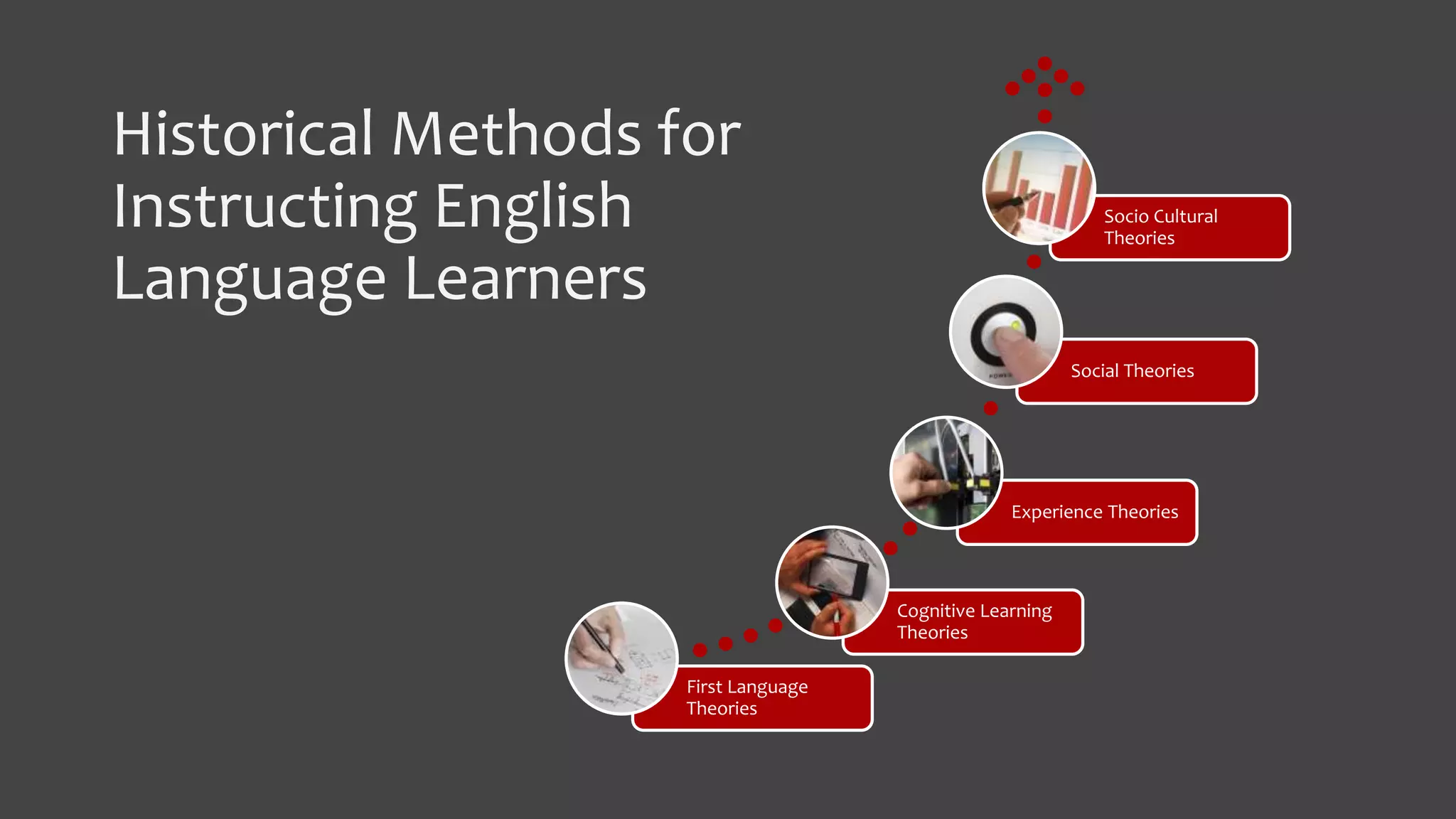
Historical Methods for
Instructing English
Language Learners

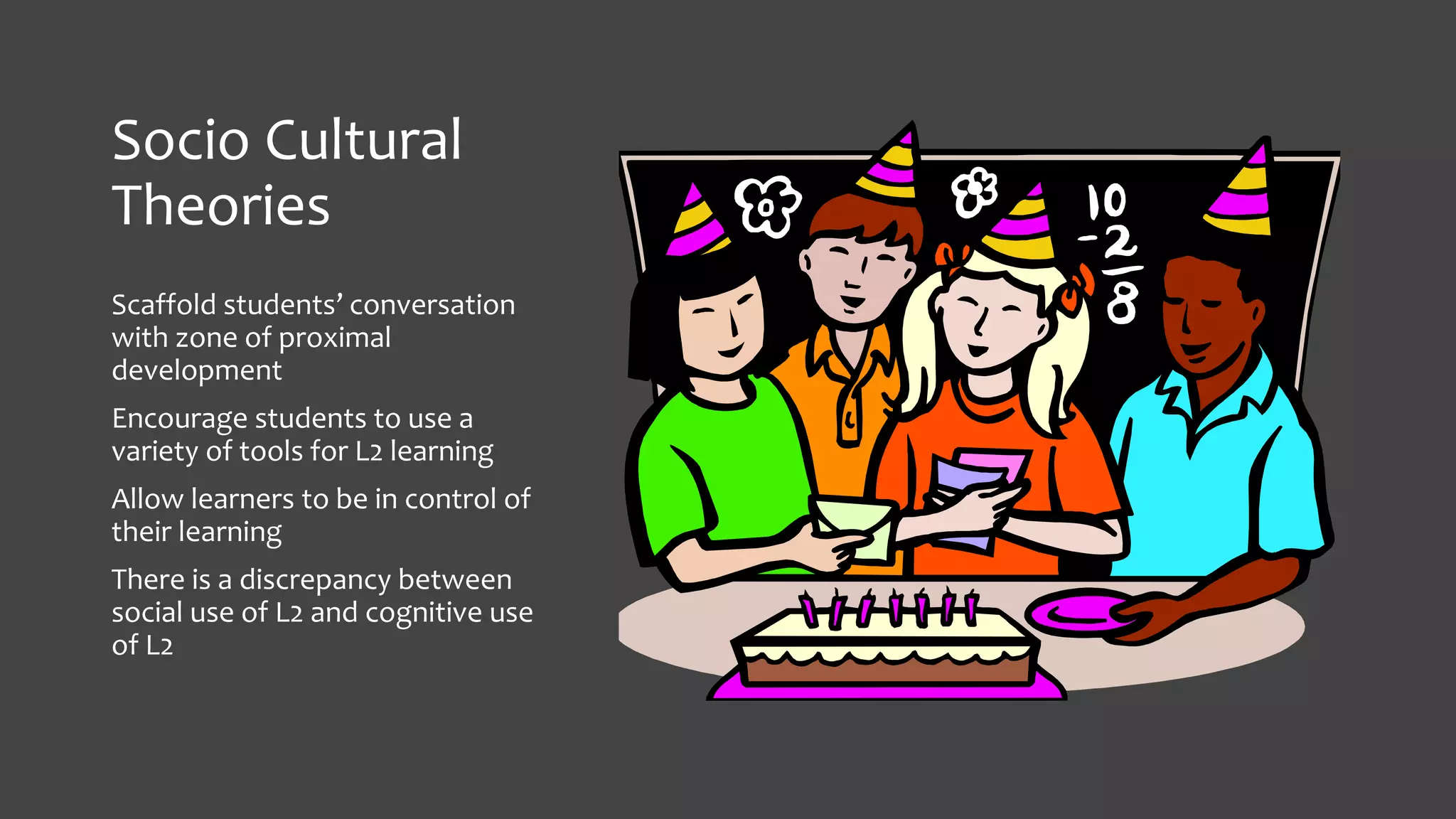
Socio Cultural
Theories

Social Theories

Experience Theories

Cognitive Learning
Theories
First Language
Theories
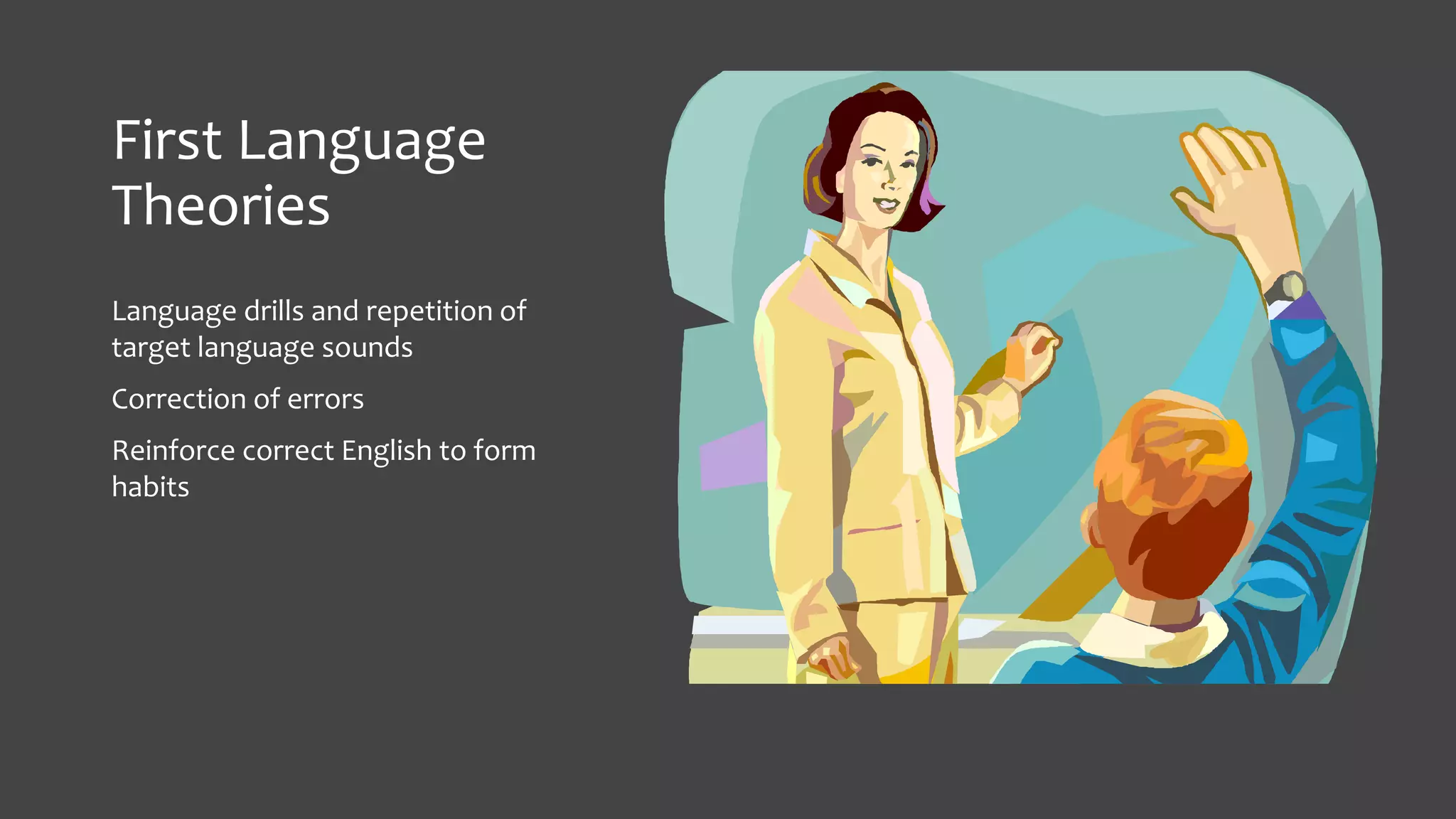
First Language
Theories
Language drills and repetition of
target language sounds
Correction of errors
Reinforce correct English to form
habits
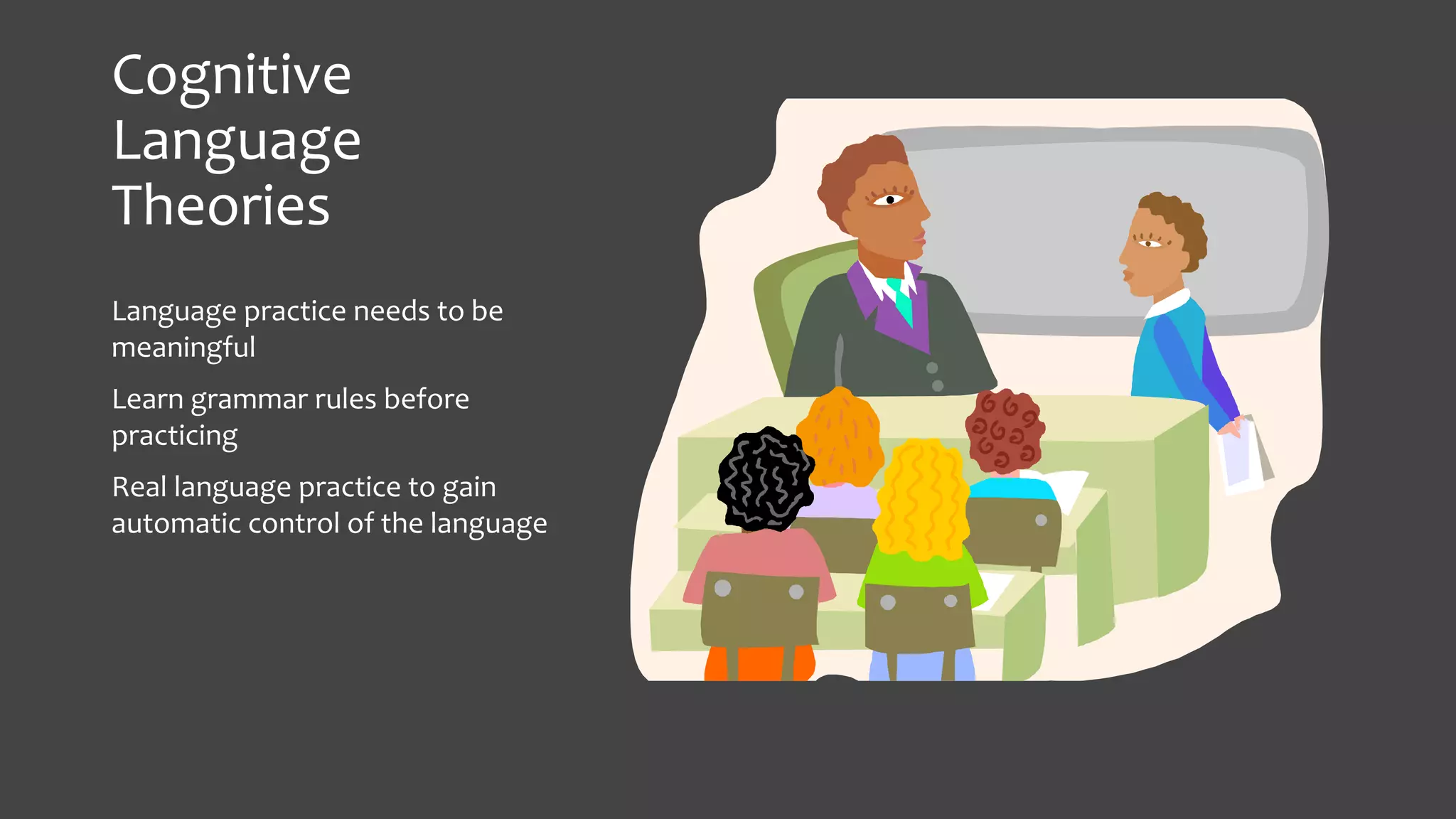
Cognitive
Language
Theories
Language practice needs to be
meaningful
Learn grammar rules before
practicing
Real language practice to gain
automatic control of the language
Experience
Theories
Students learn L2 by using L2
L2 acquisition is the focus, as
opposed to L2 learning

Teachers use high-interest
listening and reading materials for
input to learning
The affective filter, how a student
feels about learning the language,
affects the outcome
Scaffold students’ conversations
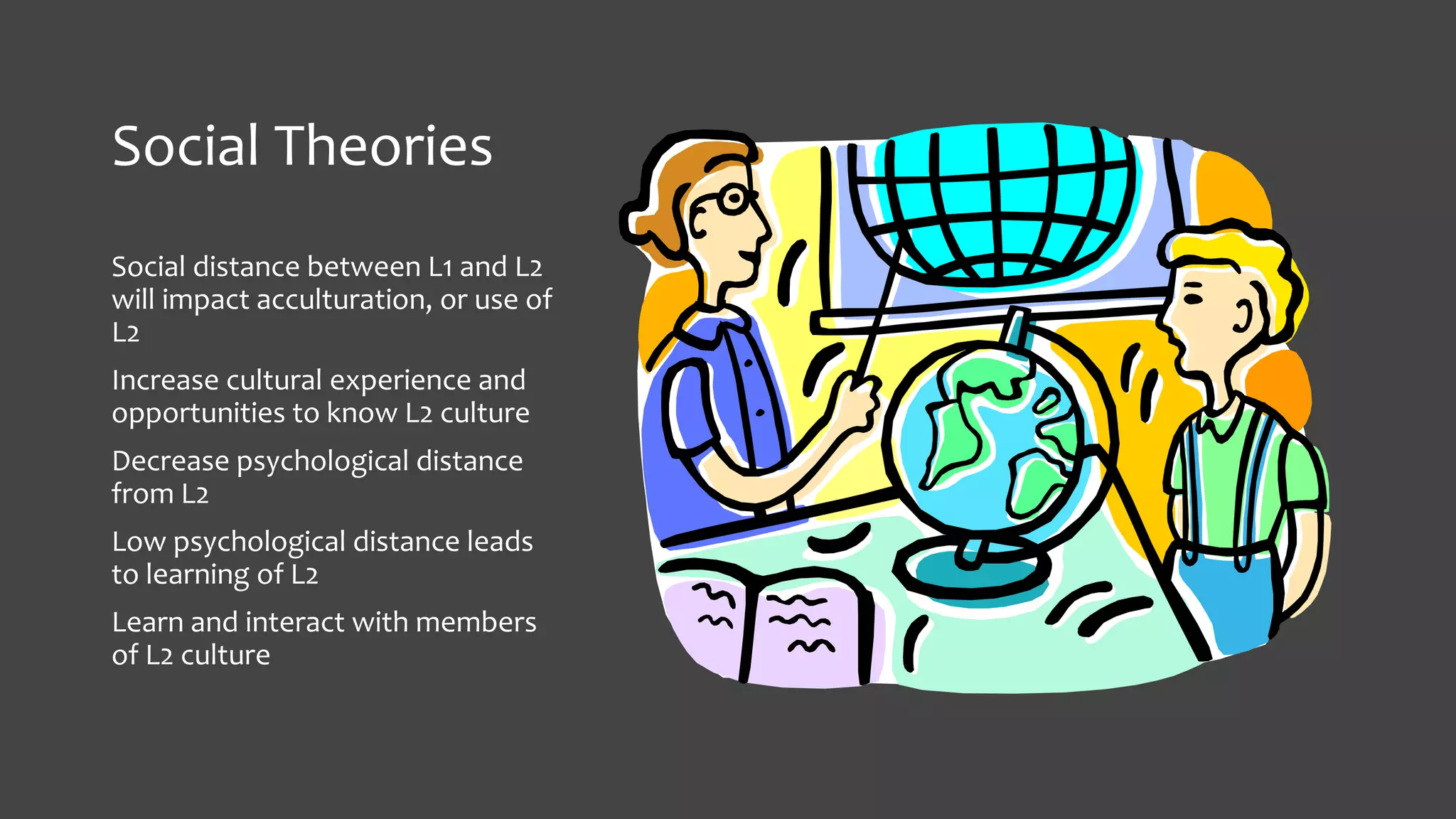
Social Theories
Social distance between L1 and L2
will impact acculturation, or use of
L2
Increase cultural experience and
opportunities to know L2 culture
Decrease psychological distance
from L2
Low psychological distance leads
to learning of L2

Learn and interact with members
of L2 culture
Socio Cultural
Theories
Scaffold students’ conversation
with zone of proximal
development

Encourage students to use a
variety of tools for L2 learning
Allow learners to be in control of
their learning
There is a discrepancy between
social use of L2 and cognitive use
of L2
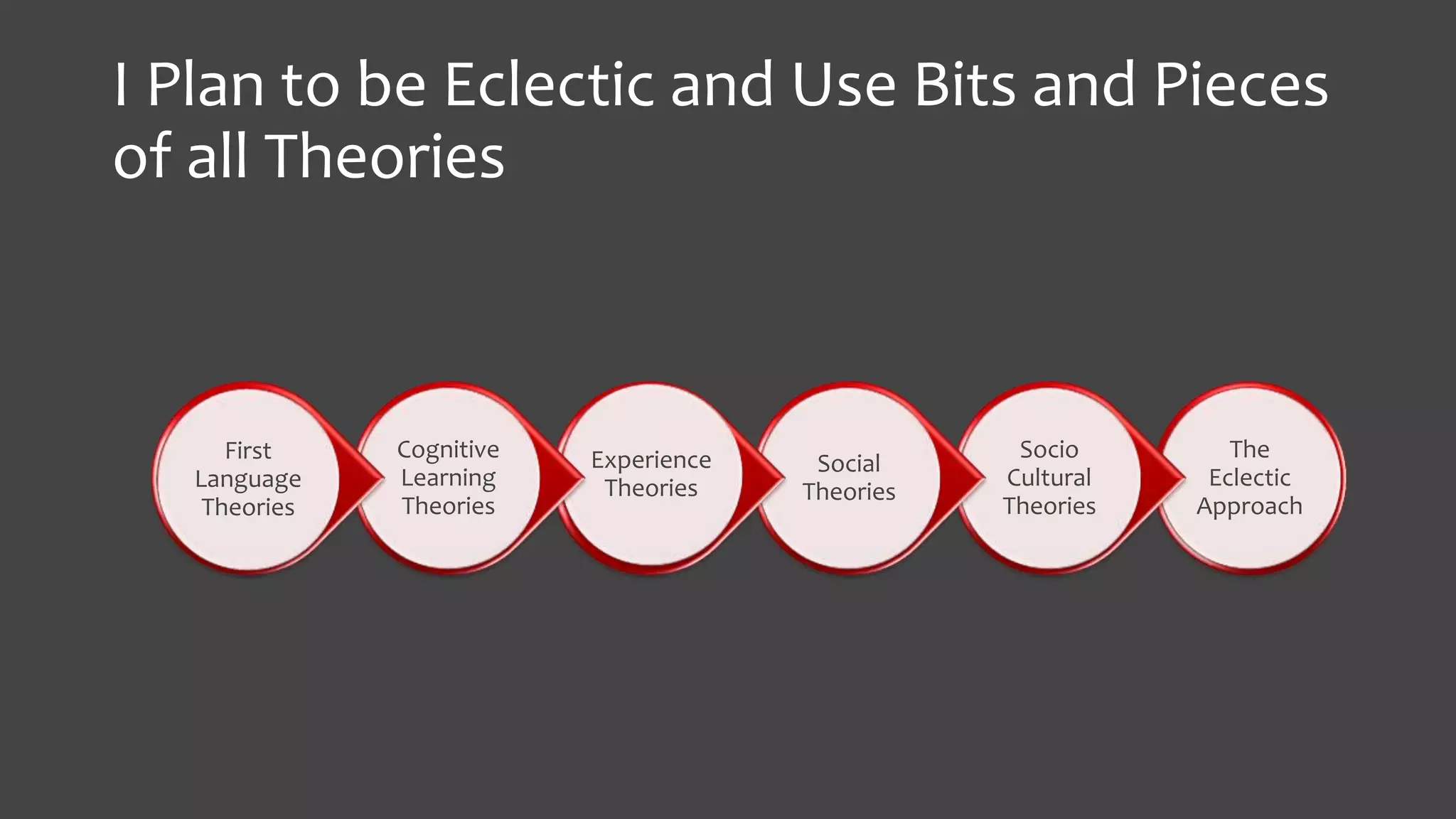
I Plan to be Eclectic and Use Bits and Pieces
of all Theories

First
Language
Theories

Cognitive
Learning
Theories

Experience
Theories

Social
Theories

Socio
Cultural
Theories

The
Eclectic
Approach
Cynthia Brown
TESOL 504
February 28, 2014
Sources:
Horwitz, E. K. (2013). Becoming a Language Teacher: A Practical Guide
to Second Language Learning and Teaching (2nd ed.). Upper Saddle
River, NJ: Pearson.
Herrera, S. G., & Murray, K. G. (2011). Mastering ESL and Bilingual
Methods: Differentiated Instruction for Culturally and Linguistically
Diverse (CLD) Students (2nd ed.). Boston, MA: Allyn & Bacon.
•

CERTIFICATE OF ORIGINALITY

•
•

I certify that the attached paper is my original work. I am familiar with, and acknowledge my responsibilities which are part
of, the University Of Phoenix Student Code Of Academic Integrity.

•
•

I affirm that any section of the paper which has been submitted previously is attributed and cited as such, and that this
paper has not been submitted by anyone else.

•
•

I have identified the sources of all information whether quoted verbatim or paraphrased, all images, and all quotations
with citations and reference listings.

•
•

Along with citations and reference listings, I have used quotation marks to identify quotations of fewer than 40 words
and have used block indentation for quotations of 40 or more words. (For examples of short and long quote citations
see: In-Text Citations: The Basics at http://owl.english.purdue.edu/owl/resource/560/02/ .)

•
•

Nothing in this assignment violates copyright, trademark, or other intellectual property laws. I further agree that my
name typed on the line below is intended to have, and shall have, the same validity as my handwritten signature.

•
•

Student's Signature

•

Cynthia Brown

Historical methods for instructing english language learners

  • 1.
    Historical Methods for InstructingEnglish Language Learners Socio Cultural Theories Social Theories Experience Theories Cognitive Learning Theories First Language Theories
  • 2.
    First Language Theories Language drillsand repetition of target language sounds Correction of errors Reinforce correct English to form habits
  • 3.
    Cognitive Language Theories Language practice needsto be meaningful Learn grammar rules before practicing Real language practice to gain automatic control of the language
  • 4.
    Experience Theories Students learn L2by using L2 L2 acquisition is the focus, as opposed to L2 learning Teachers use high-interest listening and reading materials for input to learning The affective filter, how a student feels about learning the language, affects the outcome Scaffold students’ conversations
  • 5.
    Social Theories Social distancebetween L1 and L2 will impact acculturation, or use of L2 Increase cultural experience and opportunities to know L2 culture Decrease psychological distance from L2 Low psychological distance leads to learning of L2 Learn and interact with members of L2 culture
  • 6.
    Socio Cultural Theories Scaffold students’conversation with zone of proximal development Encourage students to use a variety of tools for L2 learning Allow learners to be in control of their learning There is a discrepancy between social use of L2 and cognitive use of L2
  • 7.
    I Plan tobe Eclectic and Use Bits and Pieces of all Theories First Language Theories Cognitive Learning Theories Experience Theories Social Theories Socio Cultural Theories The Eclectic Approach
  • 8.
    Cynthia Brown TESOL 504 February28, 2014 Sources: Horwitz, E. K. (2013). Becoming a Language Teacher: A Practical Guide to Second Language Learning and Teaching (2nd ed.). Upper Saddle River, NJ: Pearson. Herrera, S. G., & Murray, K. G. (2011). Mastering ESL and Bilingual Methods: Differentiated Instruction for Culturally and Linguistically Diverse (CLD) Students (2nd ed.). Boston, MA: Allyn & Bacon.
  • 9.
    • CERTIFICATE OF ORIGINALITY • • Icertify that the attached paper is my original work. I am familiar with, and acknowledge my responsibilities which are part of, the University Of Phoenix Student Code Of Academic Integrity. • • I affirm that any section of the paper which has been submitted previously is attributed and cited as such, and that this paper has not been submitted by anyone else. • • I have identified the sources of all information whether quoted verbatim or paraphrased, all images, and all quotations with citations and reference listings. • • Along with citations and reference listings, I have used quotation marks to identify quotations of fewer than 40 words and have used block indentation for quotations of 40 or more words. (For examples of short and long quote citations see: In-Text Citations: The Basics at http://owl.english.purdue.edu/owl/resource/560/02/ .) • • Nothing in this assignment violates copyright, trademark, or other intellectual property laws. I further agree that my name typed on the line below is intended to have, and shall have, the same validity as my handwritten signature. • • Student's Signature • Cynthia Brown