Urban land values
SESSION 9
FACULTY : AR MAHIMA J
DATE : 4TH NOVEMBER, 2019
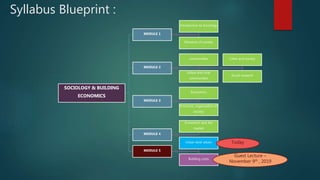
Syllabus Blueprint :
SOCIOLOGY & BUILDING
ECONOMICS
MODULE 1
Introduction to Sociology
Elements of society
MODULE 2
communities
Urban and rural
communities
Cities and society
Social research
MODULE 3
Economics
Economic organization of
society
MODULE 4
Economics and the
market
MODULE 5
Urban land values
Building costs
Today
Guest Lecture –
November 9th , 2019
Topics
 Various factors affecting the value of urban land.
 Difference between land use and land cover.
 The characteristics of developed land in the city
 The Bid Rent theory that defines relationship between location and land
value.
 Theoretical city models
What is urban land value?
 “The price, of a particular site of land in a city (urban area) is what a fair
exchange brings in terms of money during an agreed trade or transaction
between two parties, one of whom is the land owner is called land value”
 The ingredients that constitute land value are utility, scarcity and
desirability
FACTORS THAT CONTRIBUTE TO LAND VALUE
 The physical attributes of land
 quality of location, fertility and climate;
 convenience to shopping, schools and parks;
 availability of water, sewers, utilities and public
transportation;
 absence of bad smells, smoke and noise; and
 The legal or governmental forces
 the type and amount of taxation,
 zoning and building laws,
 planning and restrictions
 The social factors
 population growth or decline,
 changes in family sizes,
 typical ages,
 attitudes toward law and order,
 prestige and
 education levels
 The economic forces
 value and income levels,
 growth and new construction,
 vacancy and
 availability of land.
https://planningtank.com/urban-economics/factors-
affecting-land-value
Also refer
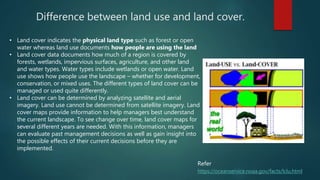
Difference between land use and land cover.
• Land cover indicates the physical land type such as forest or open
water whereas land use documents how people are using the land
• Land cover data documents how much of a region is covered by
forests, wetlands, impervious surfaces, agriculture, and other land
and water types. Water types include wetlands or open water. Land
use shows how people use the landscape – whether for development,
conservation, or mixed uses. The different types of land cover can be
managed or used quite differently.
• Land cover can be determined by analyzing satellite and aerial
imagery. Land use cannot be determined from satellite imagery. Land
cover maps provide information to help managers best understand
the current landscape. To see change over time, land cover maps for
several different years are needed. With this information, managers
can evaluate past management decisions as well as gain insight into
the possible effects of their current decisions before they are
implemented.
https://oceanservice.noaa.gov/facts/lclu.html
Refer
Characteristics of Land:
Land possesses the following characteristics:
 1. Free Gift of Nature: Man has to make efforts in order to acquire other factors of production. But to acquire land no human efforts are
needed. Land is not the outcome of human labour. Rather, it existed even long before the evolution of man.
 2. Fixed Quantity: The total quantity of land does not undergo any change. It is limited and cannot be increased or decreased with
human efforts. No alteration can be made in the surface area of land.
 3. Land is Permanent: All man-made things are perishable and these may even go out of existence. But land is indestructible. Thus it
cannot go out of existence. It is not destructible.
 4. Land is a Primary Factor of Production: In any kind of production process, we have to start with land. For example, in industries, it
helps to provide raw materials, and in agriculture, crops are produced on land.
 5. Land is a Passive Factor of Production: This is because it cannot produce anything by itself. For example, wheat cannot grow on a
piece of land automatically. To grow wheat, man has to cultivate land. Labour is an active factor but land is a passive factor of
production.
 6. Land is Immovable: It cannot be transported from one place to another. For instance, no portion of India’s surface can be transported
to some other country.
 7. Land has some Original Indestructible Powers: There are some original and indestructible powers of land, which a man cannot
destroy. Its fertility may be varied but it cannot be destroyed completely.
 8. Land Differs in Fertility: Fertility of land differs on different pieces of land. One piece of land may produce more and the other less.
 9. Supply of Land is Inelastic: The demand for a particular commodity makes way for the supply of that commodity, but the supply of
land cannot be increased or decreased according to its demand.
 10. Land has Many Uses: We can make use of land in many ways. On land, cultivation can be done, factories can be set up, roads can
be constructed, buildings can be raised and shipping is possible in the sea and big rivers.
Bid rent theory
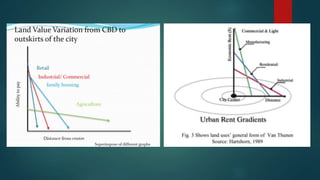
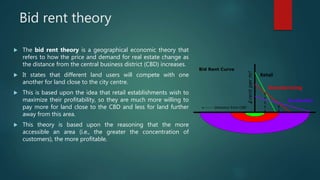
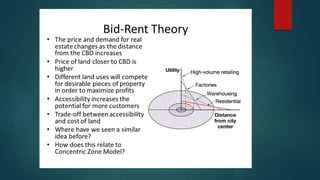
 The bid rent theory is a geographical economic theory that
refers to how the price and demand for real estate change as
the distance from the central business district (CBD) increases.
 It states that different land users will compete with one
another for land close to the city centre.
 This is based upon the idea that retail establishments wish to
maximize their profitability, so they are much more willing to
pay more for land close to the CBD and less for land further
away from this area.
 This theory is based upon the reasoning that the more
accessible an area (i.e., the greater the concentration of
customers), the more profitable.
Bid rent theory ( contd….)
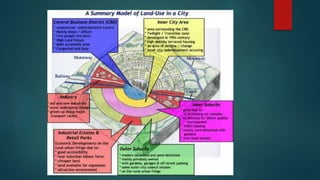
 Land users all compete for the most accessible land within the CBD. The
amount they are willing to pay is called "bid rent". The result is a pattern
of concentric rings of land use, creating the concentric zone model.
 It could be assumed that, according to this theory, the poorest houses and
buildings would be on the very outskirts of the city, as this is the only location
that they can afford to occupy. In modern times, however, this is rarely the
case, as many people prefer to trade off the accessibility of being close to the
CBD and move to the edges of a settlement, where it is possible to buy more
land for the same amount of money (as the bid rent theory states).
 Likewise, lower-income housing trades off greater living space for increased
accessibility to employment. For this reason, low-income housing in many
North American cities, for example, is often found in the inner city, and high-
income housing is at the edges of the settlement.
Bid rent theory in the central business district
 Land users, whether they be retail, office, or residential, all compete for the most accessible land within the
central business district (CBD). The amount they are willing to pay is called bid rent. This can generally be shown
in a "bid rent curve", based on the reasoning that the most accessible land, generally in the centre, is the most
expensive land.
 Commerce (in particular large department stores and chain stores) is willing to pay the greatest rent in order to
be located in the inner core. The inner core is very valuable for these users because it is traditionally the most
accessible location for a large population. This large population is essential for department stores, which require
a considerable turnover. As a result, they are willing and able to pay a very high land rent value. They maximize
the potential of their site by building many stories. As one travels farther from the inner core, the amount that
commerce is willing to pay declines rapidly.
 Industry, however, is willing to pay to be in the outer core. There is more land available for factories, but it still
has many of the benefits of the inner core, such as a marketplace and good transportation linkages.
 As one goes farther out, the land becomes less attractive to industry because of the reducing transportation
linkages and a decreasing marketplace. Because householders do not rely heavily on these factors and can
afford the reduced costs (compared with those in the inner and outer core), they can purchase land here. The
farther from the inner core, the cheaper the land. This is why inner-city areas are very densely populated (with,
e.g., terraces, flats, and high rises), while suburbs and rural areas are more sparsely populated (with semi-
detached and detached houses).
Theoretical city models
 Ppt by students
MIGRATION
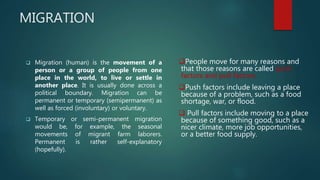
 Migration (human) is the movement of a
person or a group of people from one
place in the world, to live or settle in
another place. It is usually done across a
political boundary. Migration can be
permanent or temporary (semipermanent) as
well as forced (involuntary) or voluntary.
 Temporary or semi-permanent migration
would be, for example, the seasonal
movements of migrant farm laborers.
Permanent is rather self-explanatory
(hopefully).
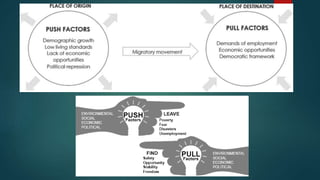
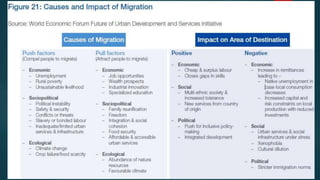
People move for many reasons and
that those reasons are called push
factors and pull factors.
Push factors include leaving a place
because of a problem, such as a food
shortage, war, or flood.
 Pull factors include moving to a place
because of something good, such as a
nicer climate, more job opportunities,
or a better food supply.
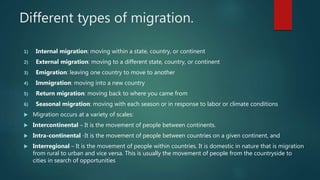
Different types of migration.
1) Internal migration: moving within a state, country, or continent
2) External migration: moving to a different state, country, or continent
3) Emigration: leaving one country to move to another
4) Immigration: moving into a new country
5) Return migration: moving back to where you came from
6) Seasonal migration: moving with each season or in response to labor or climate conditions
 Migration occurs at a variety of scales:
 Intercontinental – It is the movement of people between continents.
 Intra-continental -It is the movement of people between countries on a given continent, and
 Interregional – It is the movement of people within countries. It is domestic in nature that is migration
from rural to urban and vice versa. This is usually the movement of people from the countryside to
cities in search of opportunities
The impact of migration on urban
form.
 Cities have been destinations for
most of the world’s migrants, given
their degree of economic activity, their
cultural and intellectual expression,
and their development.
Taking stock of migration’s impact, its
opportunities and challenges is crucial,
as well as the connection it has with a
city’s economy and urban development.
Economic impact
Social impact
Political impact
Impact on Urban infrastructure & services
i. Housing
ii. Education and employment
iii. Health
iv. Transportation
v. Utilities
vi. Sanitation and waste
vii. Social cohesion and community
integration
viii. Safety and security
Effects of urbanization on rural areas
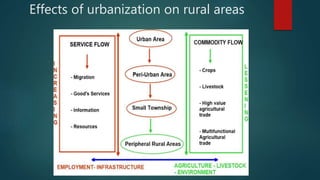
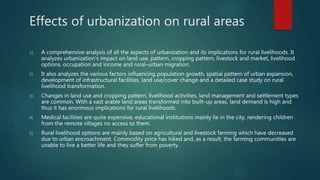
1) A comprehensive analysis of all the aspects of urbanization and its implications for rural livelihoods. It
analyzes urbanization’s impact on land use, pattern, cropping pattern, livestock and market, livelihood
options, occupation and income and rural–urban migration.
2) It also analyzes the various factors influencing population growth, spatial pattern of urban expansion,
development of infrastructural facilities, land use/cover change and a detailed case study on rural
livelihood transformation.
3) Changes in land use and cropping pattern, livelihood activities, land management and settlement types
are common. With a vast arable land areas transformed into built-up areas, land demand is high and
thus it has enormous implications for rural livelihoods.
4) Medical facilities are quite expensive, educational institutions mainly lie in the city, rendering children
from the remote villages no access to them.
5) Rural livelihood options are mainly based on agricultural and livestock farming which have decreased
due to urban encroachment. Commodity price has hiked and, as a result, the farming communities are
unable to live a better life and they suffer from poverty.
Effects of urbanization on rural areas

Session 9- Urban Land values

  • 1.
    Urban land values SESSION9 FACULTY : AR MAHIMA J DATE : 4TH NOVEMBER, 2019
  • 2.
    Syllabus Blueprint : SOCIOLOGY& BUILDING ECONOMICS MODULE 1 Introduction to Sociology Elements of society MODULE 2 communities Urban and rural communities Cities and society Social research MODULE 3 Economics Economic organization of society MODULE 4 Economics and the market MODULE 5 Urban land values Building costs Today Guest Lecture – November 9th , 2019
  • 3.
    Topics  Various factorsaffecting the value of urban land.  Difference between land use and land cover.  The characteristics of developed land in the city  The Bid Rent theory that defines relationship between location and land value.  Theoretical city models
  • 4.
    What is urbanland value?  “The price, of a particular site of land in a city (urban area) is what a fair exchange brings in terms of money during an agreed trade or transaction between two parties, one of whom is the land owner is called land value”  The ingredients that constitute land value are utility, scarcity and desirability
  • 5.
    FACTORS THAT CONTRIBUTETO LAND VALUE  The physical attributes of land  quality of location, fertility and climate;  convenience to shopping, schools and parks;  availability of water, sewers, utilities and public transportation;  absence of bad smells, smoke and noise; and  The legal or governmental forces  the type and amount of taxation,  zoning and building laws,  planning and restrictions  The social factors  population growth or decline,  changes in family sizes,  typical ages,  attitudes toward law and order,  prestige and  education levels  The economic forces  value and income levels,  growth and new construction,  vacancy and  availability of land. https://planningtank.com/urban-economics/factors- affecting-land-value Also refer
  • 7.
    Difference between landuse and land cover. • Land cover indicates the physical land type such as forest or open water whereas land use documents how people are using the land • Land cover data documents how much of a region is covered by forests, wetlands, impervious surfaces, agriculture, and other land and water types. Water types include wetlands or open water. Land use shows how people use the landscape – whether for development, conservation, or mixed uses. The different types of land cover can be managed or used quite differently. • Land cover can be determined by analyzing satellite and aerial imagery. Land use cannot be determined from satellite imagery. Land cover maps provide information to help managers best understand the current landscape. To see change over time, land cover maps for several different years are needed. With this information, managers can evaluate past management decisions as well as gain insight into the possible effects of their current decisions before they are implemented. https://oceanservice.noaa.gov/facts/lclu.html Refer
  • 8.
    Characteristics of Land: Landpossesses the following characteristics:  1. Free Gift of Nature: Man has to make efforts in order to acquire other factors of production. But to acquire land no human efforts are needed. Land is not the outcome of human labour. Rather, it existed even long before the evolution of man.  2. Fixed Quantity: The total quantity of land does not undergo any change. It is limited and cannot be increased or decreased with human efforts. No alteration can be made in the surface area of land.  3. Land is Permanent: All man-made things are perishable and these may even go out of existence. But land is indestructible. Thus it cannot go out of existence. It is not destructible.  4. Land is a Primary Factor of Production: In any kind of production process, we have to start with land. For example, in industries, it helps to provide raw materials, and in agriculture, crops are produced on land.  5. Land is a Passive Factor of Production: This is because it cannot produce anything by itself. For example, wheat cannot grow on a piece of land automatically. To grow wheat, man has to cultivate land. Labour is an active factor but land is a passive factor of production.  6. Land is Immovable: It cannot be transported from one place to another. For instance, no portion of India’s surface can be transported to some other country.  7. Land has some Original Indestructible Powers: There are some original and indestructible powers of land, which a man cannot destroy. Its fertility may be varied but it cannot be destroyed completely.  8. Land Differs in Fertility: Fertility of land differs on different pieces of land. One piece of land may produce more and the other less.  9. Supply of Land is Inelastic: The demand for a particular commodity makes way for the supply of that commodity, but the supply of land cannot be increased or decreased according to its demand.  10. Land has Many Uses: We can make use of land in many ways. On land, cultivation can be done, factories can be set up, roads can be constructed, buildings can be raised and shipping is possible in the sea and big rivers.
  • 9.
    Bid rent theory The bid rent theory is a geographical economic theory that refers to how the price and demand for real estate change as the distance from the central business district (CBD) increases.  It states that different land users will compete with one another for land close to the city centre.  This is based upon the idea that retail establishments wish to maximize their profitability, so they are much more willing to pay more for land close to the CBD and less for land further away from this area.  This theory is based upon the reasoning that the more accessible an area (i.e., the greater the concentration of customers), the more profitable.
  • 10.
    Bid rent theory( contd….)  Land users all compete for the most accessible land within the CBD. The amount they are willing to pay is called "bid rent". The result is a pattern of concentric rings of land use, creating the concentric zone model.  It could be assumed that, according to this theory, the poorest houses and buildings would be on the very outskirts of the city, as this is the only location that they can afford to occupy. In modern times, however, this is rarely the case, as many people prefer to trade off the accessibility of being close to the CBD and move to the edges of a settlement, where it is possible to buy more land for the same amount of money (as the bid rent theory states).  Likewise, lower-income housing trades off greater living space for increased accessibility to employment. For this reason, low-income housing in many North American cities, for example, is often found in the inner city, and high- income housing is at the edges of the settlement.
  • 11.
    Bid rent theoryin the central business district  Land users, whether they be retail, office, or residential, all compete for the most accessible land within the central business district (CBD). The amount they are willing to pay is called bid rent. This can generally be shown in a "bid rent curve", based on the reasoning that the most accessible land, generally in the centre, is the most expensive land.  Commerce (in particular large department stores and chain stores) is willing to pay the greatest rent in order to be located in the inner core. The inner core is very valuable for these users because it is traditionally the most accessible location for a large population. This large population is essential for department stores, which require a considerable turnover. As a result, they are willing and able to pay a very high land rent value. They maximize the potential of their site by building many stories. As one travels farther from the inner core, the amount that commerce is willing to pay declines rapidly.  Industry, however, is willing to pay to be in the outer core. There is more land available for factories, but it still has many of the benefits of the inner core, such as a marketplace and good transportation linkages.  As one goes farther out, the land becomes less attractive to industry because of the reducing transportation linkages and a decreasing marketplace. Because householders do not rely heavily on these factors and can afford the reduced costs (compared with those in the inner and outer core), they can purchase land here. The farther from the inner core, the cheaper the land. This is why inner-city areas are very densely populated (with, e.g., terraces, flats, and high rises), while suburbs and rural areas are more sparsely populated (with semi- detached and detached houses).
  • 14.
  • 16.
    MIGRATION  Migration (human)is the movement of a person or a group of people from one place in the world, to live or settle in another place. It is usually done across a political boundary. Migration can be permanent or temporary (semipermanent) as well as forced (involuntary) or voluntary.  Temporary or semi-permanent migration would be, for example, the seasonal movements of migrant farm laborers. Permanent is rather self-explanatory (hopefully). People move for many reasons and that those reasons are called push factors and pull factors. Push factors include leaving a place because of a problem, such as a food shortage, war, or flood.  Pull factors include moving to a place because of something good, such as a nicer climate, more job opportunities, or a better food supply.
  • 18.
    Different types ofmigration. 1) Internal migration: moving within a state, country, or continent 2) External migration: moving to a different state, country, or continent 3) Emigration: leaving one country to move to another 4) Immigration: moving into a new country 5) Return migration: moving back to where you came from 6) Seasonal migration: moving with each season or in response to labor or climate conditions  Migration occurs at a variety of scales:  Intercontinental – It is the movement of people between continents.  Intra-continental -It is the movement of people between countries on a given continent, and  Interregional – It is the movement of people within countries. It is domestic in nature that is migration from rural to urban and vice versa. This is usually the movement of people from the countryside to cities in search of opportunities
  • 19.
    The impact ofmigration on urban form.  Cities have been destinations for most of the world’s migrants, given their degree of economic activity, their cultural and intellectual expression, and their development. Taking stock of migration’s impact, its opportunities and challenges is crucial, as well as the connection it has with a city’s economy and urban development. Economic impact Social impact Political impact Impact on Urban infrastructure & services i. Housing ii. Education and employment iii. Health iv. Transportation v. Utilities vi. Sanitation and waste vii. Social cohesion and community integration viii. Safety and security
  • 21.
  • 22.
    1) A comprehensiveanalysis of all the aspects of urbanization and its implications for rural livelihoods. It analyzes urbanization’s impact on land use, pattern, cropping pattern, livestock and market, livelihood options, occupation and income and rural–urban migration. 2) It also analyzes the various factors influencing population growth, spatial pattern of urban expansion, development of infrastructural facilities, land use/cover change and a detailed case study on rural livelihood transformation. 3) Changes in land use and cropping pattern, livelihood activities, land management and settlement types are common. With a vast arable land areas transformed into built-up areas, land demand is high and thus it has enormous implications for rural livelihoods. 4) Medical facilities are quite expensive, educational institutions mainly lie in the city, rendering children from the remote villages no access to them. 5) Rural livelihood options are mainly based on agricultural and livestock farming which have decreased due to urban encroachment. Commodity price has hiked and, as a result, the farming communities are unable to live a better life and they suffer from poverty. Effects of urbanization on rural areas