LANDSLIDE
ENGR. MD. SHAMIM AHMED
LECTURER
DEPT. OF CIVIL ENGINEERING
SOUTHERN UNIVERSITY BANGLADESH
WHAT IS LANDSLIDE?
According to United States Geological Survey (USGS), “The term landslide
includes a wide range of ground movement, such as rock falls, deep
failure of slopes, and shallow debris flows.
A landslide is a downward or outward movement of soil, rock or
vegetation, under the influence of gravity.
They are mostly hill events, but also can occur in offshore, coastal and
onshore environments.
CAUSES OF LANDSLIDES
A) Natural Factors:
• Gravity: Gravity works more effectively on steeper slopes.
• Geological factors: Shear strength of silty clay type soil is much lower
than regular sand or clay soils.
• Heavy and prolonged rainfall: Slides occur often with intense rain by
creating zone of weakness, also water tables rise with heavy rain makes
some slopes unstable.
• Earthquakes: Ground vibrations created during Earthquakes.
• Waves: Wave action can erode the beach or the toe of a bluff, cutting
into the slope, and setting the stage for future slides.
CAUSES OF LANDSLIDES
• Volcanoes: volcanic ash deposits (sometimes called as lahars deposits)
are prone to erosion and subjected to mud flows due to intense rainfall.
• Fluctuation of water levels due to the tidal action.
• Deposition of loose sediments in delta areas.
B) Anthropogenic Factors:
•Inappropriate drainage system: Surface runoff of irrigated water on
slopes exposes soil under cultivation to erosion. Part of this water is
absorbed by soil increasing its weight, which can put an additional load
on the slope.
CAUSES OF LANDSLIDES
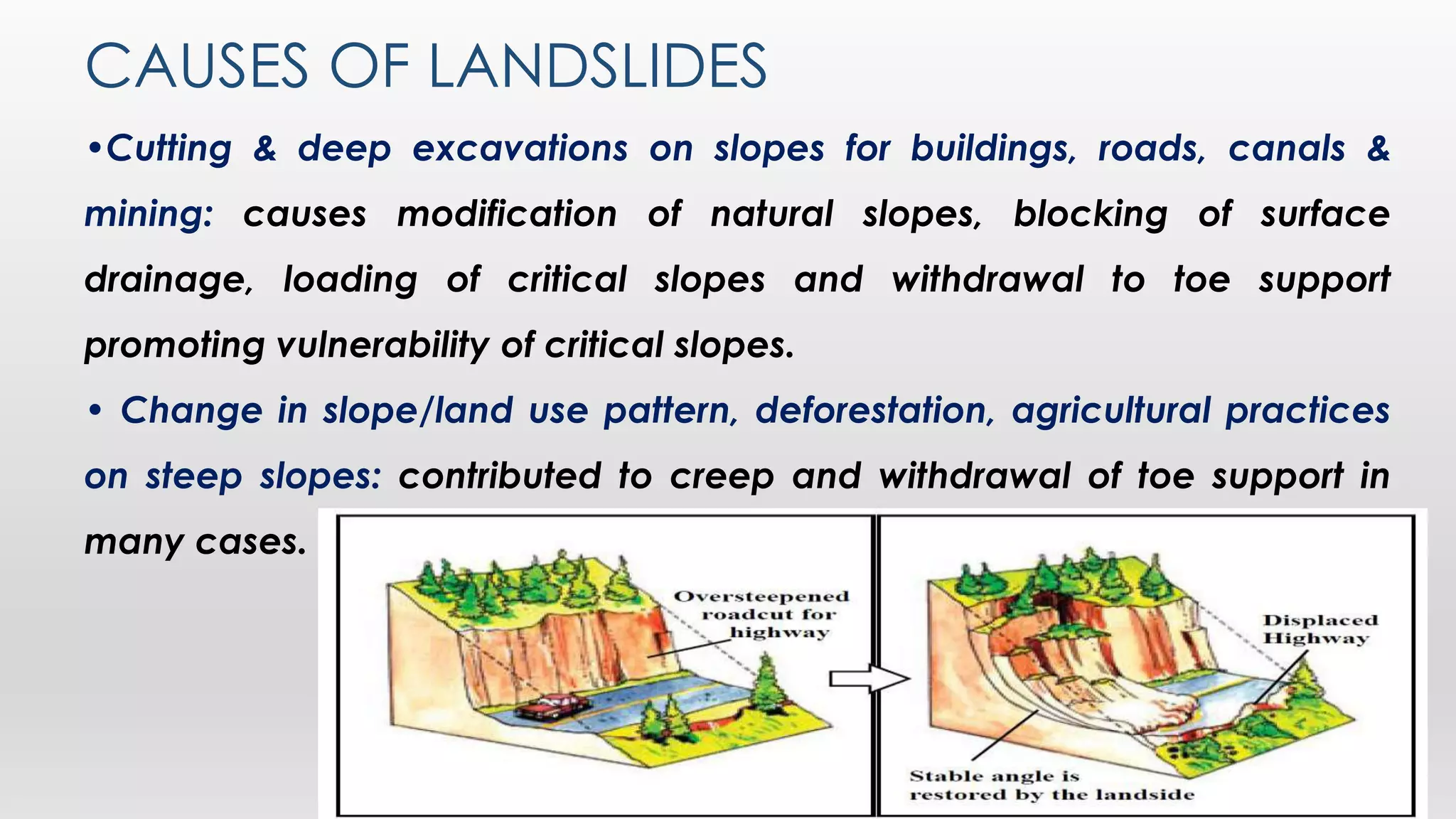
•Cutting & deep excavations on slopes for buildings, roads, canals &
mining: causes modification of natural slopes, blocking of surface
drainage, loading of critical slopes and withdrawal to toe support
promoting vulnerability of critical slopes.
• Change in slope/land use pattern, deforestation, agricultural practices
on steep slopes: contributed to creep and withdrawal of toe support in
many cases.
CAUSES OF LANDSLIDES
Other Causes:
• Influence of slope- Provides favorable condition for landslides.
• Ground water or associated water- Main factor responsible for slippage.
Suppose the hard or massive rocks are underlined by softer rocks.
• Lithology- rock which are rich in clay, mica, calcite, gypsum etc. are
prone to landslide because these minerals are prone to weathering.
• Human Influence- undercutting along the hill slopes for laying roads or rail
tracks can result into instability.
• Deforestation in the uplands- result into more erosion during the rainy
season.
COMMON TYPES OF LANDSLIDES
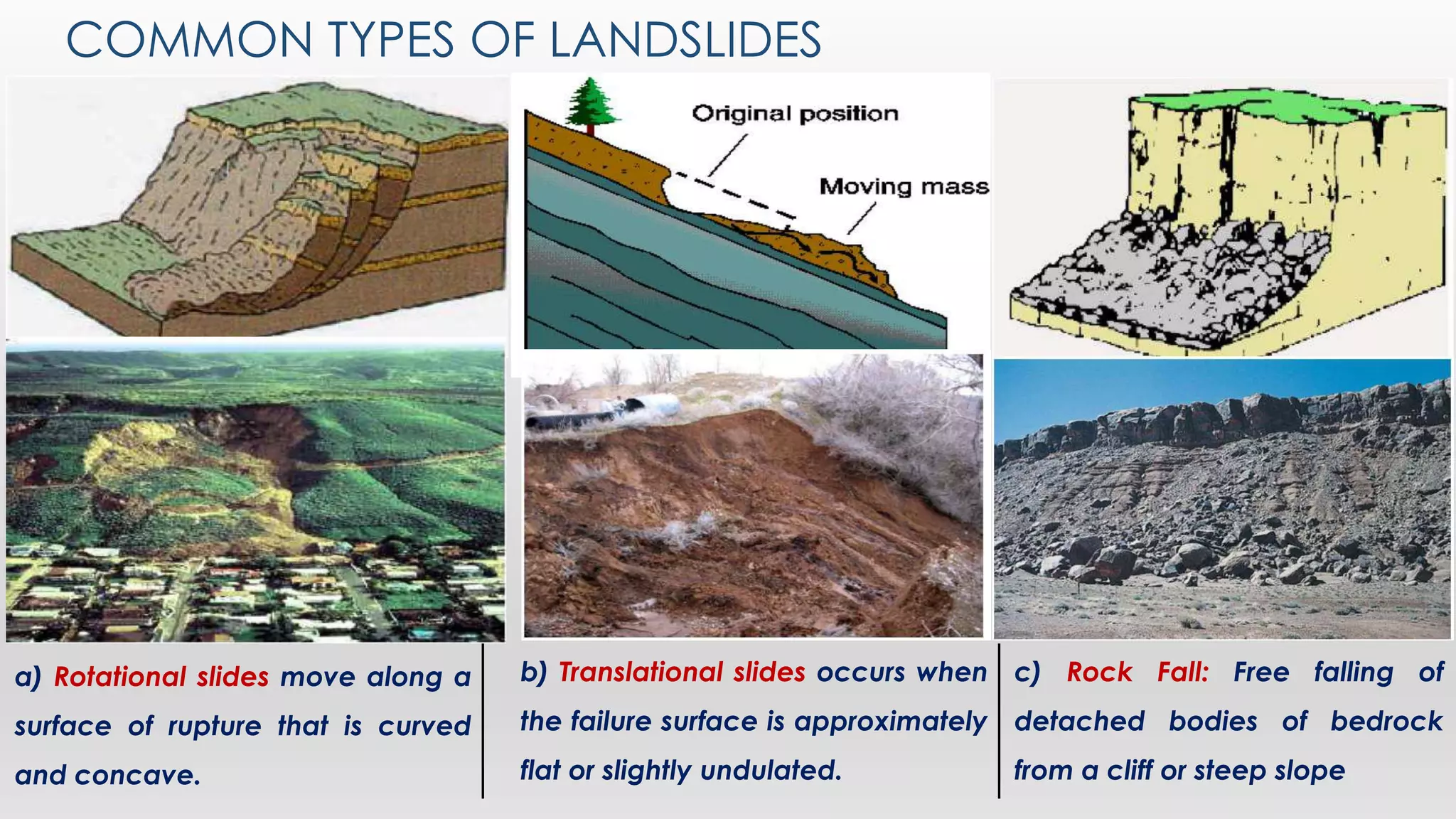
a) Rotational slides move along a
surface of rupture that is curved
and concave.
b) Translational slides occurs when
the failure surface is approximately
flat or slightly undulated.
c) Rock Fall: Free falling of
detached bodies of bedrock
from a cliff or steep slope
COMMON TYPES OF LANDSLIDES
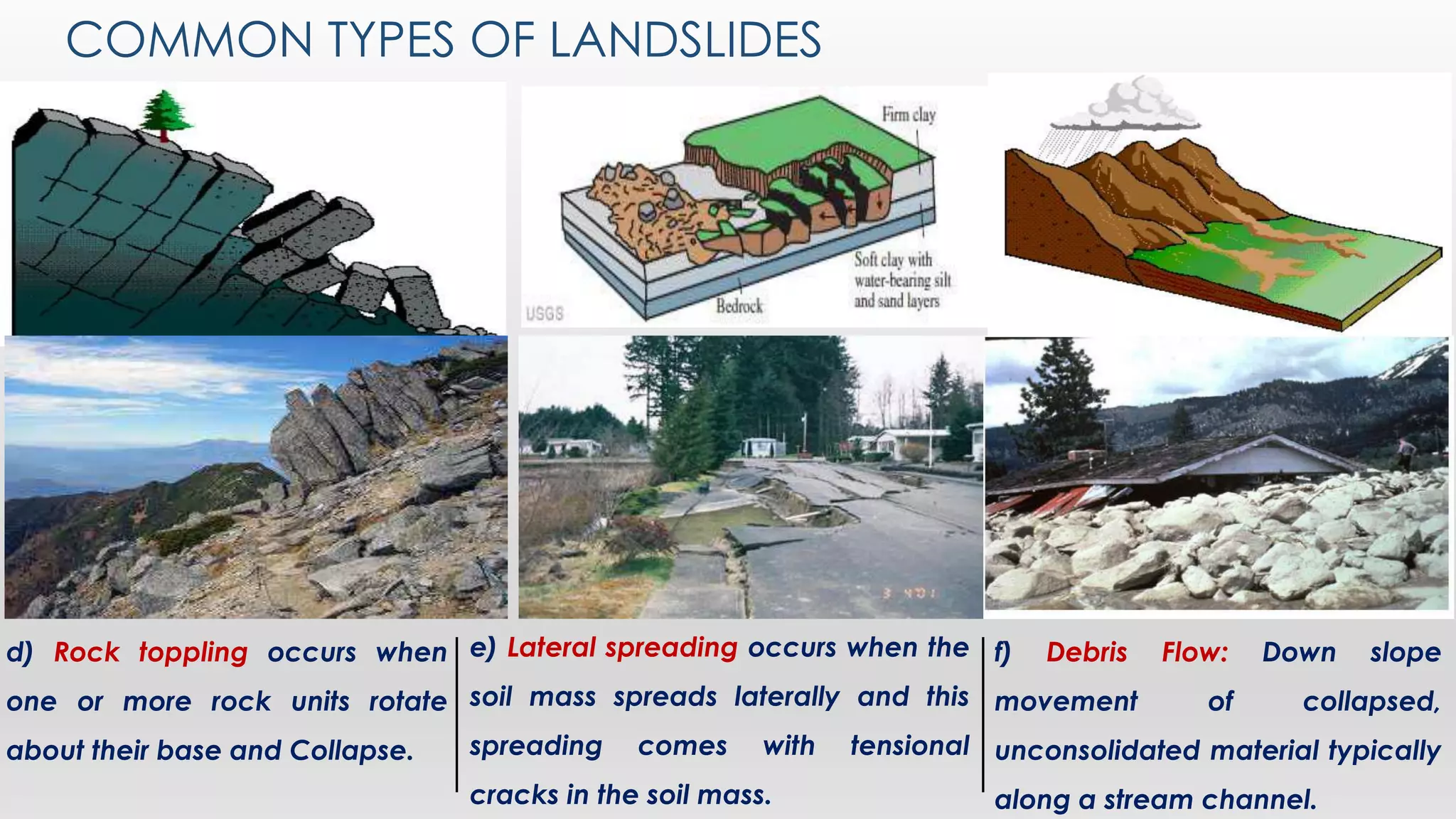
d) Rock toppling occurs when
one or more rock units rotate
about their base and Collapse.
e) Lateral spreading occurs when the
soil mass spreads laterally and this
spreading comes with tensional
cracks in the soil mass.
f) Debris Flow: Down slope
movement of collapsed,
unconsolidated material typically
along a stream channel.
MAIN MITIGATION STRATEGIES
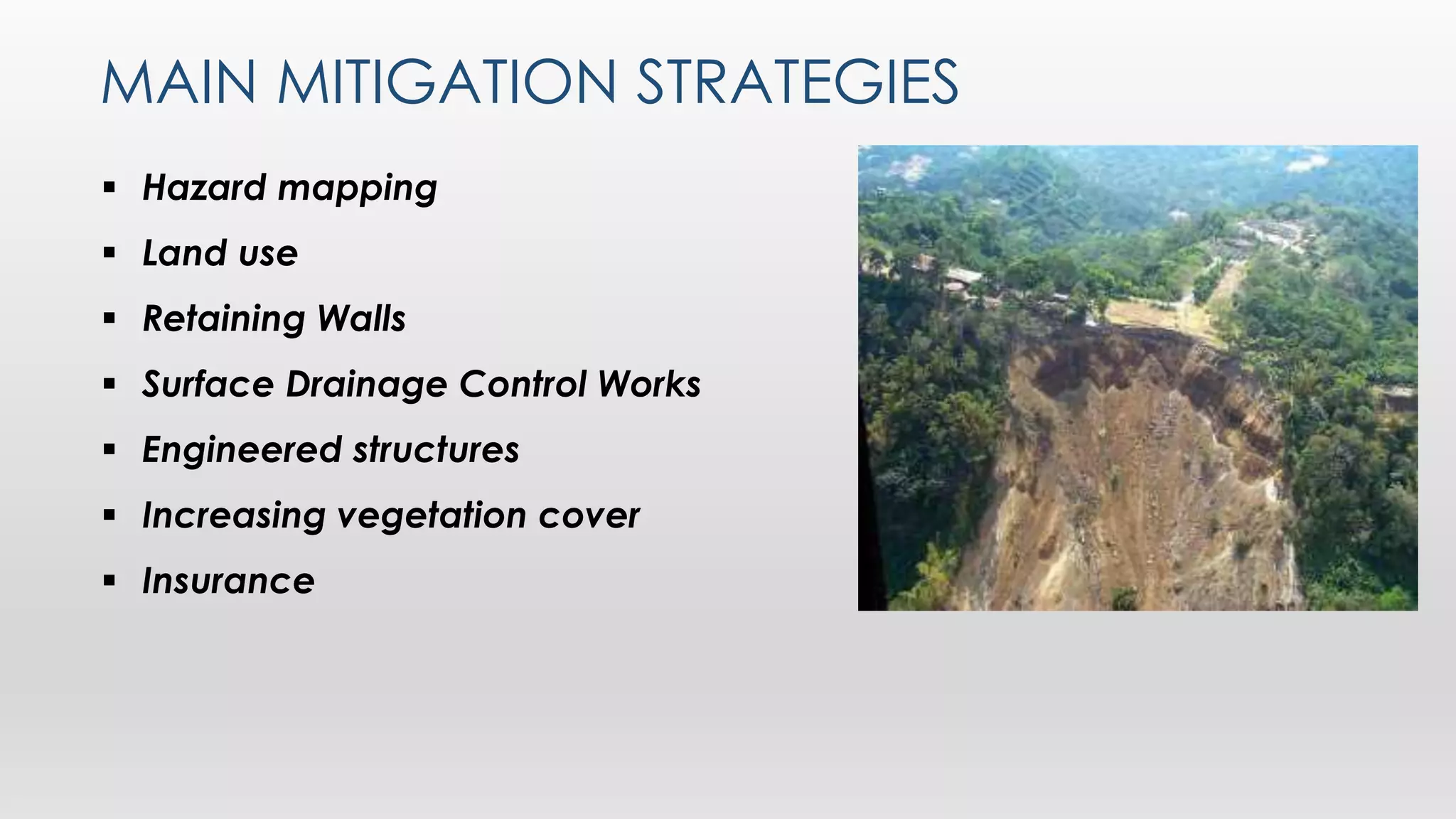
 Hazard mapping
 Land use
 Retaining Walls
 Surface Drainage Control Works
 Engineered structures
 Increasing vegetation cover
 Insurance
MAIN MITIGATION STRATEGIES
• Hazard mapping- will locate areas prone to slope failures. This will permit to identify
avoidance of areas for building settlements. These maps will serve as a tool for
mitigation planning.
• Land use practices such as:
• Areas covered by degraded natural vegetation in upper slopes are to be afforested
with suitable species.
• In construction of roads, irrigation canals etc. proper care is to be taken to avoid
blockage of natural drainage
• Total avoidance of settlement in the risk zone should be made mandatory.
• Relocate settlements and infrastructure that fall in the possible path of the landslide
• No construction of buildings in areas beyond a certain degree of slope.
MAIN MITIGATION STRATEGIES
• Retaining Walls- can be built to stop land from slipping (these walls are commonly seen
along roads in hill stations). It’s constructed to prevent smaller sized and secondary
landslides that often occur along the toe portion of the larger landslides.
• Surface Drainage Control Works- The surface drainage control works are implemented
to control the movement of landslides accompanied by infiltration of rain water and
spring flows.
• Engineered structures- with strong foundations can withstand or take the ground
movement forces. Underground installations (pipes, cables, etc.) should be made
flexible to move in order to withstand forces caused by the landslide.
• Increasing vegetation cover- is the cheapest and most effective way of arresting
landslides. This helps to bind the top layer of the soil with layers below, while preventing
excessive run-off and soil erosion.
WHERE DO IT OCCURS MOSTLY IN BANGLADESH?
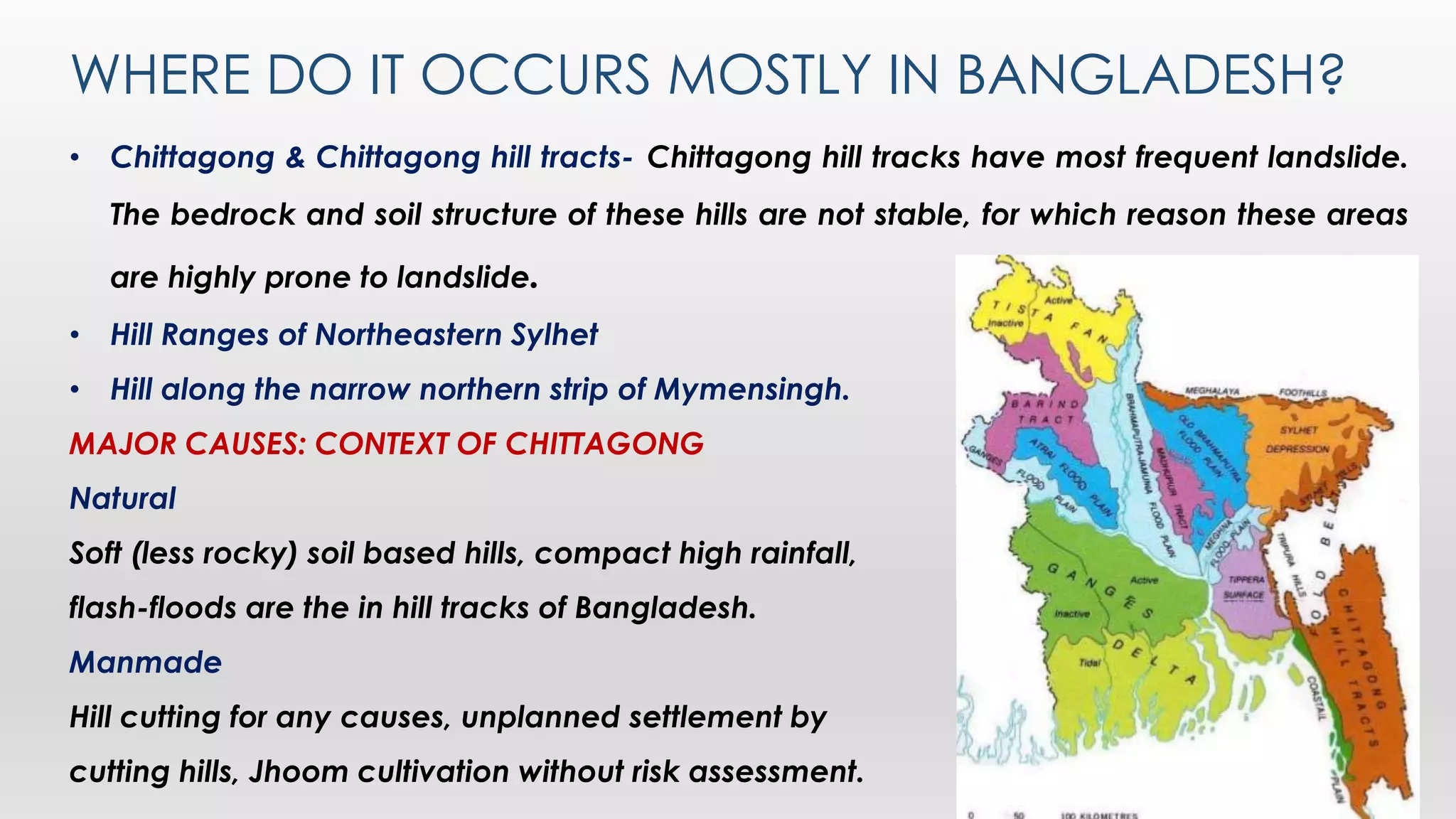
• Chittagong & Chittagong hill tracts- Chittagong hill tracks have most frequent landslide.
The bedrock and soil structure of these hills are not stable, for which reason these areas
are highly prone to landslide.
• Hill Ranges of Northeastern Sylhet
• Hill along the narrow northern strip of Mymensingh.
MAJOR CAUSES: CONTEXT OF CHITTAGONG
Natural
Soft (less rocky) soil based hills, compact high rainfall,
flash-floods are the in hill tracks of Bangladesh.
Manmade
Hill cutting for any causes, unplanned settlement by
cutting hills, Jhoom cultivation without risk assessment.
THANK YOU

Landslide_Engineering Geology & Geomorphology

  • 1.
    LANDSLIDE ENGR. MD. SHAMIMAHMED LECTURER DEPT. OF CIVIL ENGINEERING SOUTHERN UNIVERSITY BANGLADESH
  • 2.
    WHAT IS LANDSLIDE? Accordingto United States Geological Survey (USGS), “The term landslide includes a wide range of ground movement, such as rock falls, deep failure of slopes, and shallow debris flows. A landslide is a downward or outward movement of soil, rock or vegetation, under the influence of gravity. They are mostly hill events, but also can occur in offshore, coastal and onshore environments.
  • 3.
    CAUSES OF LANDSLIDES A)Natural Factors: • Gravity: Gravity works more effectively on steeper slopes. • Geological factors: Shear strength of silty clay type soil is much lower than regular sand or clay soils. • Heavy and prolonged rainfall: Slides occur often with intense rain by creating zone of weakness, also water tables rise with heavy rain makes some slopes unstable. • Earthquakes: Ground vibrations created during Earthquakes. • Waves: Wave action can erode the beach or the toe of a bluff, cutting into the slope, and setting the stage for future slides.
  • 4.
    CAUSES OF LANDSLIDES •Volcanoes: volcanic ash deposits (sometimes called as lahars deposits) are prone to erosion and subjected to mud flows due to intense rainfall. • Fluctuation of water levels due to the tidal action. • Deposition of loose sediments in delta areas. B) Anthropogenic Factors: •Inappropriate drainage system: Surface runoff of irrigated water on slopes exposes soil under cultivation to erosion. Part of this water is absorbed by soil increasing its weight, which can put an additional load on the slope.
  • 5.
    CAUSES OF LANDSLIDES •Cutting& deep excavations on slopes for buildings, roads, canals & mining: causes modification of natural slopes, blocking of surface drainage, loading of critical slopes and withdrawal to toe support promoting vulnerability of critical slopes. • Change in slope/land use pattern, deforestation, agricultural practices on steep slopes: contributed to creep and withdrawal of toe support in many cases.
  • 6.
    CAUSES OF LANDSLIDES OtherCauses: • Influence of slope- Provides favorable condition for landslides. • Ground water or associated water- Main factor responsible for slippage. Suppose the hard or massive rocks are underlined by softer rocks. • Lithology- rock which are rich in clay, mica, calcite, gypsum etc. are prone to landslide because these minerals are prone to weathering. • Human Influence- undercutting along the hill slopes for laying roads or rail tracks can result into instability. • Deforestation in the uplands- result into more erosion during the rainy season.
  • 7.
    COMMON TYPES OFLANDSLIDES a) Rotational slides move along a surface of rupture that is curved and concave. b) Translational slides occurs when the failure surface is approximately flat or slightly undulated. c) Rock Fall: Free falling of detached bodies of bedrock from a cliff or steep slope
  • 8.
    COMMON TYPES OFLANDSLIDES d) Rock toppling occurs when one or more rock units rotate about their base and Collapse. e) Lateral spreading occurs when the soil mass spreads laterally and this spreading comes with tensional cracks in the soil mass. f) Debris Flow: Down slope movement of collapsed, unconsolidated material typically along a stream channel.
  • 9.
    MAIN MITIGATION STRATEGIES Hazard mapping  Land use  Retaining Walls  Surface Drainage Control Works  Engineered structures  Increasing vegetation cover  Insurance
  • 10.
    MAIN MITIGATION STRATEGIES •Hazard mapping- will locate areas prone to slope failures. This will permit to identify avoidance of areas for building settlements. These maps will serve as a tool for mitigation planning. • Land use practices such as: • Areas covered by degraded natural vegetation in upper slopes are to be afforested with suitable species. • In construction of roads, irrigation canals etc. proper care is to be taken to avoid blockage of natural drainage • Total avoidance of settlement in the risk zone should be made mandatory. • Relocate settlements and infrastructure that fall in the possible path of the landslide • No construction of buildings in areas beyond a certain degree of slope.
  • 11.
    MAIN MITIGATION STRATEGIES •Retaining Walls- can be built to stop land from slipping (these walls are commonly seen along roads in hill stations). It’s constructed to prevent smaller sized and secondary landslides that often occur along the toe portion of the larger landslides. • Surface Drainage Control Works- The surface drainage control works are implemented to control the movement of landslides accompanied by infiltration of rain water and spring flows. • Engineered structures- with strong foundations can withstand or take the ground movement forces. Underground installations (pipes, cables, etc.) should be made flexible to move in order to withstand forces caused by the landslide. • Increasing vegetation cover- is the cheapest and most effective way of arresting landslides. This helps to bind the top layer of the soil with layers below, while preventing excessive run-off and soil erosion.
  • 12.
    WHERE DO ITOCCURS MOSTLY IN BANGLADESH? • Chittagong & Chittagong hill tracts- Chittagong hill tracks have most frequent landslide. The bedrock and soil structure of these hills are not stable, for which reason these areas are highly prone to landslide. • Hill Ranges of Northeastern Sylhet • Hill along the narrow northern strip of Mymensingh. MAJOR CAUSES: CONTEXT OF CHITTAGONG Natural Soft (less rocky) soil based hills, compact high rainfall, flash-floods are the in hill tracks of Bangladesh. Manmade Hill cutting for any causes, unplanned settlement by cutting hills, Jhoom cultivation without risk assessment.
  • 13.