Landscape
Architect-
Fredrick law Olmsted
Introduction
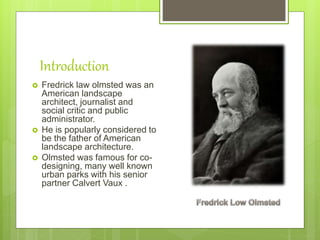
 Fredrick law olmsted was an
American landscape
architect, journalist and
social critic and public
administrator.
 He is popularly considered to
be the father of American
landscape architecture.
 Olmsted was famous for co-
designing, many well known
urban parks with his senior
partner Calvert Vaux .
Fact File
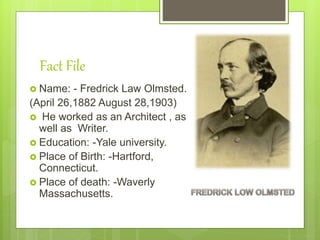
 Name: - Fredrick Law Olmsted.
(April 26,1882 August 28,1903)
 He worked as an Architect , as
well as Writer.
 Education: -Yale university.
 Place of Birth: -Hartford,
Connecticut.
 Place of death: -Waverly
Massachusetts.
Early Life
 Olmsted who loved spending time outdoors,
got sumac poisoning when he was 14, the
infection spread to his eyes.
 Though he eventually recovered he would
continue on to university
Career
 In 1837-worked as a clerk in New York city
 In 1843-served as apprentice on merchant
ship
 In 1845-started scientific farming
 In 1852-started career as writer
 In 1857-started job as superintendent of New
York’s Central park
Career
 As Olmsted had detailed knowledge about
topography of his work sight, architect Calvert
Vaux invented him as partner with him on a
design of new York's Central Park
 Their plan overcame the drawback of the
narrow, rectangular central park site to
propose a green oasis in city.
 In 1858, the pair won the competition.
Works
 Fredrick law Olmsted total work projects were
355.
 Some of important are listed below
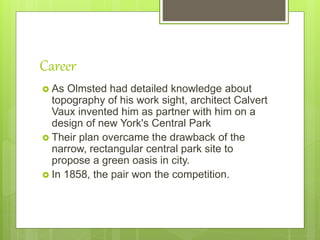
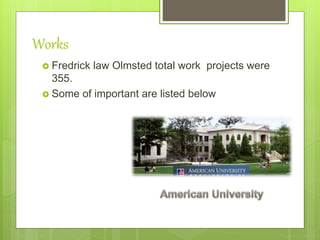
American University main campus Washington
D.C
 Founded 1893
 It consists of more than 2500 trees over 130 different
species & varieties which provide a shady canopy,

beneath which thrives a layered understory of
flowering trees, shrubs, ornamental grasses &
seasonal plantings.
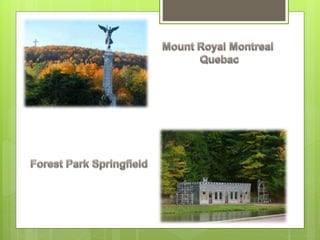
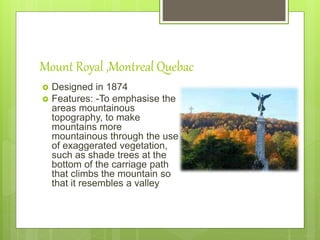
Mount Royal ,Montreal Quebac
 Designed in 1874
 Features: -To emphasise the
areas mountainous
topography, to make
mountains more
mountainous through the use
of exaggerated vegetation,
such as shade trees at the
bottom of the carriage path
that climbs the mountain so
that it resembles a valley
Parkways in Buffalo
 Began work in 1868
 It was the first attempt in America to layout
acoordinate system of public parks &
parkways
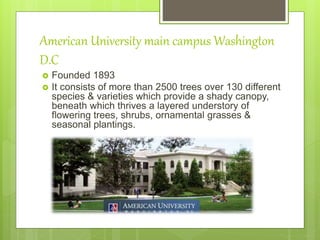
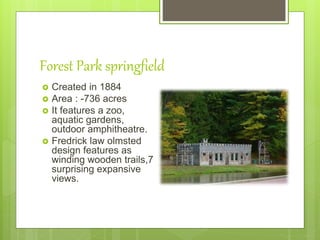
Forest Park springfield
 Created in 1884
 Area : -736 acres
 It features a zoo,
aquatic gardens,
outdoor amphitheatre.
 Fredrick law olmsted
design features as
winding wooden trails,7
surprising expansive
views.
Books
 Walks and talks of an American former in
England(1852)
 A journey in the seaboard slave states(1856)
 A journey through Texas(1857)
 A journey in the Back country in the
winter(1860)
 Journeys and Exploration in the cotton
kingdom(1861)
Philosophy
 To encourage the full utilization of the naturally
occurring features of a given space.
 Olmsted designed primarily in the pastoral and
picturesque styles, each to achieve a particular effect.
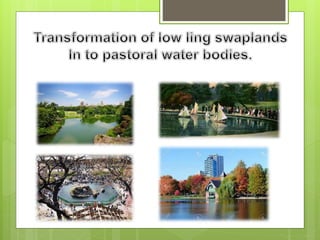
 The pastoral style featured vast expanse of green with
small lakes, trees and grooves and producing a
soothing restorative effect on the viewer.
 the picturesque style covered rocky, broken terrain
with teeming shrubs, and creepers a play of light and
shade to lend a landscape a sense of mystery.
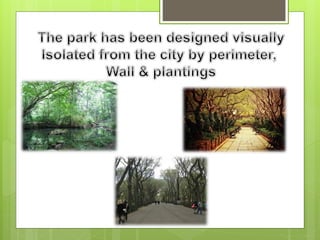
 Used indistinct boundaries using plants, brush and
trees.
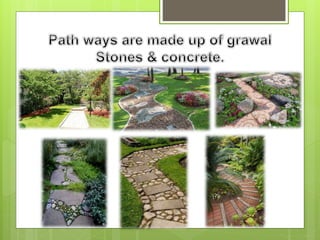
 A path that winds through a bit of landscape a
intersects with each other.
 Dividing terrain into triangular islands.
Case study of
Central park
New York
Introdaction
 Central park is an urban park in middle upper
manhottan , with in New York City.
 Cantral park is the most visited urban park in
the United States with 40 million visitors in
2013 .
 It is also one of the most filmed location in
the world .
History
 The park was established in 1857 on 778 acres (315
hacters) of city –owned land.
 In 1858 Fredrick law Olmsted and Calvert Vaux a
landscape architect and an architect respectively was a
design competition to improve and expand the park with a
plan they titled the “Greensward Plan”.
 Construction began in the same year and the park’s first
area was open to the public in the winter of 1858.
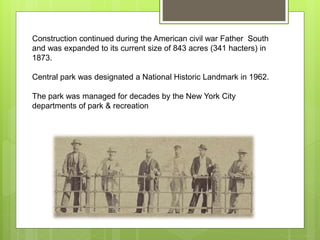
 Construction continued during the American civil war
Father South and was expanded to its current size of 843
acres (341 hacters) in 1873.
 Central park was designated a National Historic Landmark
in 1962.
 The park was managed for decades by the New York City
departments of park & recreation.
Construction continued during the American civil war Father South
and was expanded to its current size of 843 acres (341 hacters) in
1873.
Central park was designated a National Historic Landmark in 1962.
The park was managed for decades by the New York City
departments of park & recreation
DESIGN CONCEPT FOR PARK
 The design of park embodies Olmstrd’s social
consciousness & commitment to egalitarian
ideals.
 Influenced by downing and his own observations
regarding social class in England; China South
America.
 His main concept of the design was that the
common green space must always be equally
accessible to all citizens ,this principle is now
fundamental to the idea of public park
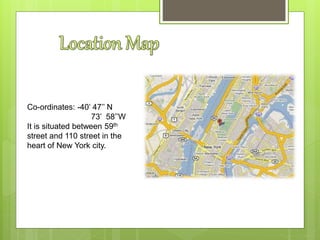
Co-ordinates: -40’ 47’’ N
73’ 58’’W
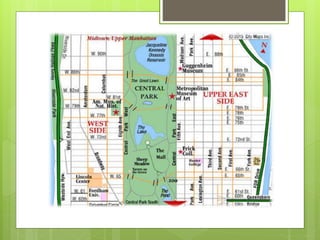
It is situated between 59th
street and 110 street in the
heart of New York city.
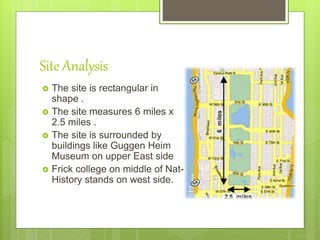
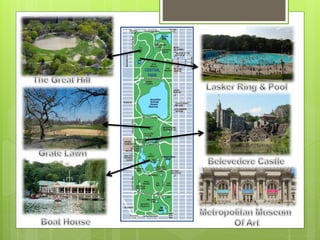
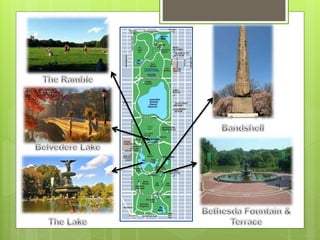
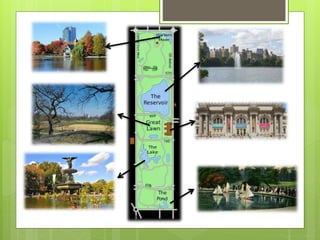
Site Analysis
 The site is rectangular in
shape .
 The site measures 6 miles x
2.5 miles .
 The site is surrounded by
buildings like Guggen Heim
Museum on upper East side
 Frick college on middle of Nat-
History stands on west side.
Construction Process
 1857- A CENTRAL Park Commission was
appointed to oversee the development of the
park.
 1860-1873 – Most of construction overcome
and park was sustantially completed.
 1934- First decline & Renovation
 23 October 2012-2015 – Post Renevation.
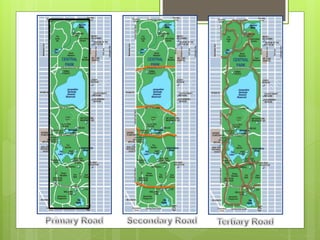
Planning
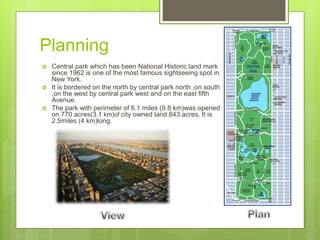
 Central park which has been National Historic land mark
since 1962 is one of the most famous sightseeing spot in
New York.
 It is bordered on the north by central park north ,on south
,on the west by central park west and on the east fifth
Avenue.
 The park with perimeter of 6.1 miles (9.8 km)was opened
on 770 acres(3.1 km)of city owned land 843 acres. It is
2.5miles (4 km)long.
Sales
Landscape Architect
Landscape Architect
Landscape Architect
Landscape Architect
Landscape Architect
Landscape Architect
Landscape Architect
Landscape Architect
Landscape Architect
Landscape Architect
Landscape Architect
Landscape Architect
Landscape Architect

Landscape Architect

  • 1.
  • 3.
    Introduction  Fredrick lawolmsted was an American landscape architect, journalist and social critic and public administrator.  He is popularly considered to be the father of American landscape architecture.  Olmsted was famous for co- designing, many well known urban parks with his senior partner Calvert Vaux .
  • 4.
    Fact File  Name:- Fredrick Law Olmsted. (April 26,1882 August 28,1903)  He worked as an Architect , as well as Writer.  Education: -Yale university.  Place of Birth: -Hartford, Connecticut.  Place of death: -Waverly Massachusetts.
  • 5.
    Early Life  Olmstedwho loved spending time outdoors, got sumac poisoning when he was 14, the infection spread to his eyes.  Though he eventually recovered he would continue on to university
  • 6.
    Career  In 1837-workedas a clerk in New York city  In 1843-served as apprentice on merchant ship  In 1845-started scientific farming  In 1852-started career as writer  In 1857-started job as superintendent of New York’s Central park
  • 7.
    Career  As Olmstedhad detailed knowledge about topography of his work sight, architect Calvert Vaux invented him as partner with him on a design of new York's Central Park  Their plan overcame the drawback of the narrow, rectangular central park site to propose a green oasis in city.  In 1858, the pair won the competition.
  • 8.
    Works  Fredrick lawOlmsted total work projects were 355.  Some of important are listed below
  • 10.
    American University maincampus Washington D.C  Founded 1893  It consists of more than 2500 trees over 130 different species & varieties which provide a shady canopy, beneath which thrives a layered understory of flowering trees, shrubs, ornamental grasses & seasonal plantings.
  • 11.
    Mount Royal ,MontrealQuebac  Designed in 1874  Features: -To emphasise the areas mountainous topography, to make mountains more mountainous through the use of exaggerated vegetation, such as shade trees at the bottom of the carriage path that climbs the mountain so that it resembles a valley
  • 12.
    Parkways in Buffalo Began work in 1868  It was the first attempt in America to layout acoordinate system of public parks & parkways
  • 13.
    Forest Park springfield Created in 1884  Area : -736 acres  It features a zoo, aquatic gardens, outdoor amphitheatre.  Fredrick law olmsted design features as winding wooden trails,7 surprising expansive views.
  • 14.
    Books  Walks andtalks of an American former in England(1852)  A journey in the seaboard slave states(1856)  A journey through Texas(1857)  A journey in the Back country in the winter(1860)  Journeys and Exploration in the cotton kingdom(1861)
  • 15.
    Philosophy  To encouragethe full utilization of the naturally occurring features of a given space.  Olmsted designed primarily in the pastoral and picturesque styles, each to achieve a particular effect.  The pastoral style featured vast expanse of green with small lakes, trees and grooves and producing a soothing restorative effect on the viewer.  the picturesque style covered rocky, broken terrain with teeming shrubs, and creepers a play of light and shade to lend a landscape a sense of mystery.  Used indistinct boundaries using plants, brush and trees.  A path that winds through a bit of landscape a intersects with each other.  Dividing terrain into triangular islands.
  • 16.
    Case study of Centralpark New York
  • 17.
    Introdaction  Central parkis an urban park in middle upper manhottan , with in New York City.  Cantral park is the most visited urban park in the United States with 40 million visitors in 2013 .  It is also one of the most filmed location in the world .
  • 18.
    History  The parkwas established in 1857 on 778 acres (315 hacters) of city –owned land.  In 1858 Fredrick law Olmsted and Calvert Vaux a landscape architect and an architect respectively was a design competition to improve and expand the park with a plan they titled the “Greensward Plan”.  Construction began in the same year and the park’s first area was open to the public in the winter of 1858.  Construction continued during the American civil war Father South and was expanded to its current size of 843 acres (341 hacters) in 1873.  Central park was designated a National Historic Landmark in 1962.  The park was managed for decades by the New York City departments of park & recreation.
  • 19.
    Construction continued duringthe American civil war Father South and was expanded to its current size of 843 acres (341 hacters) in 1873. Central park was designated a National Historic Landmark in 1962. The park was managed for decades by the New York City departments of park & recreation
  • 20.
    DESIGN CONCEPT FORPARK  The design of park embodies Olmstrd’s social consciousness & commitment to egalitarian ideals.  Influenced by downing and his own observations regarding social class in England; China South America.  His main concept of the design was that the common green space must always be equally accessible to all citizens ,this principle is now fundamental to the idea of public park
  • 21.
    Co-ordinates: -40’ 47’’N 73’ 58’’W It is situated between 59th street and 110 street in the heart of New York city.
  • 22.
    Site Analysis  Thesite is rectangular in shape .  The site measures 6 miles x 2.5 miles .  The site is surrounded by buildings like Guggen Heim Museum on upper East side  Frick college on middle of Nat- History stands on west side.
  • 24.
    Construction Process  1857-A CENTRAL Park Commission was appointed to oversee the development of the park.  1860-1873 – Most of construction overcome and park was sustantially completed.  1934- First decline & Renovation  23 October 2012-2015 – Post Renevation.
  • 25.
    Planning  Central parkwhich has been National Historic land mark since 1962 is one of the most famous sightseeing spot in New York.  It is bordered on the north by central park north ,on south ,on the west by central park west and on the east fifth Avenue.  The park with perimeter of 6.1 miles (9.8 km)was opened on 770 acres(3.1 km)of city owned land 843 acres. It is 2.5miles (4 km)long.
  • 31.