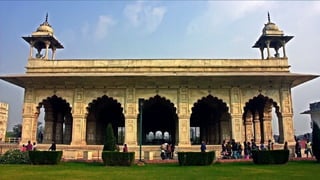
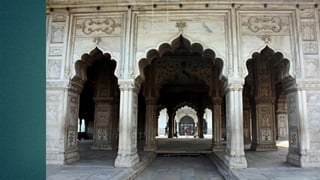
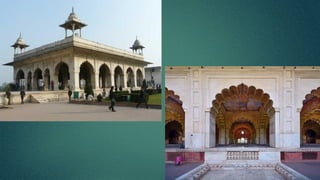
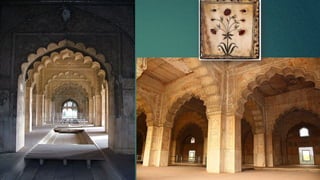
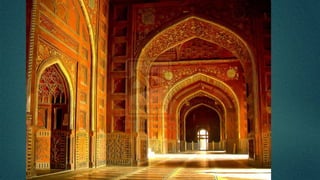
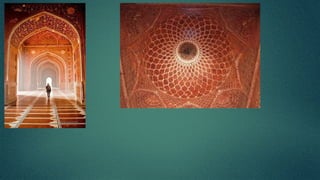
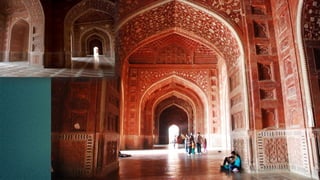
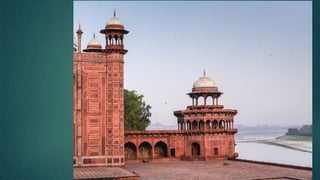
MUGHAL ARCHITECTURE
 Mughal Empire established by Babur in 1526.
 The Mughal era defines the most luxurious phase of Islamic Architecture in India,
due in part to the wealth and the settled political conditions of the empire and to
the aesthetic nature of the emperors.
 Mughal Architecture flourished under the first five ‘Great Mughals’ of the dynasty,
 Babur,
 Humayun,
 Akbar,
 Jahangir and
 Shah Jahan and declined after the rule of
 Aurangzeb.
The two most prolific builders of the dynasty were Akbar (1556-1605) and his
grandson Shah Jahan (1627-1658), with a transitional phase observed under
Jahangir (1605-1627).
 The style can be broadly divided into two phases,
 an earlier phase when the buildings were principally constructed of red
sandstone during the reign of Akbar and
 a later phase when the buildings were constructed principally of marble
under the reign of Shah Jahan.
 Due to the centralized political structure of the empire, the Mughal style of
architecture had no provincial or regional manifestations, but was an
imperial style only moderately affected by local influences.
 The major influences seen in the Mughal style come from Persia and from
the indigenous styles of Gujarat and Rajasthan.
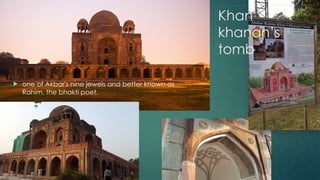
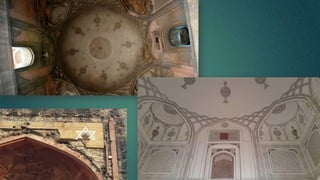
 one of Akbar's nine jewels and better known as
Rahim, the bhakti poet.
Khan
khanan’s
tomb
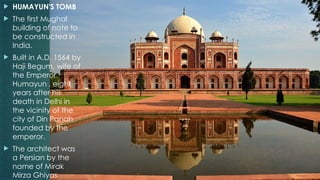
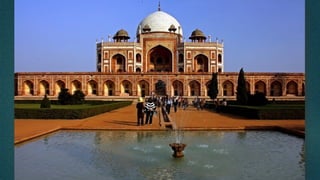
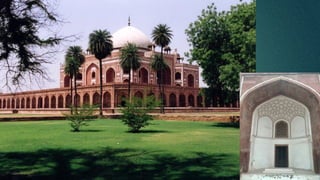
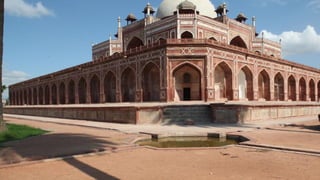
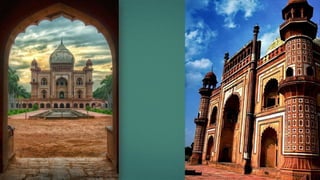
 HUMAYUN'S TOMB
 The first Mughal
building of note to
be constructed in
India.
 Built in A.D. 1564 by
Haji Begum, wife of
the Emperor
Humayun , eight
years after his
death in Delhi in
the vicinity of the
city of Din Panah
founded by the
emperor.
 The architect was
a Persian by the
name of Mirak
Mirza Ghiyas.
 .
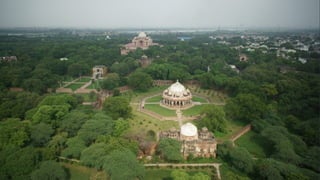
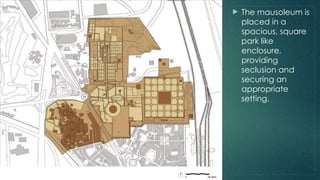
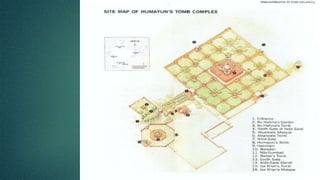
 The mausoleum is
placed in a
spacious, square
park like
enclosure,
providing
seclusion and
securing an
appropriate
setting.
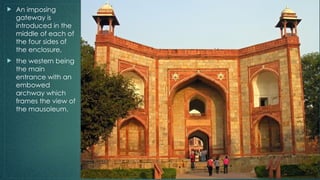
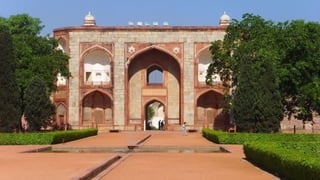
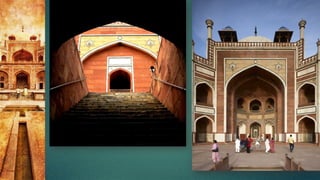
 An imposing
gateway is
introduced in the
middle of each of
the four sides of
the enclosure,
 the western being
the main
entrance with an
embowed
archway which
frames the view of
the mausoleum.
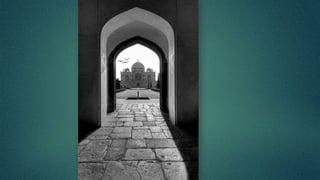
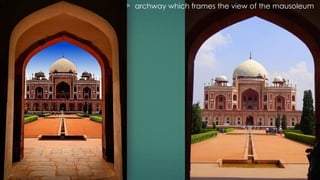
 archway which frames the view of the mausoleum
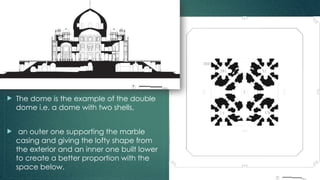
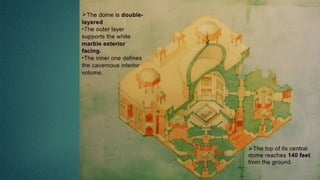
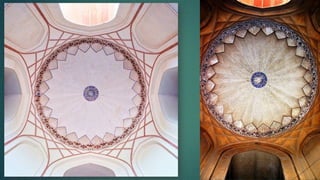
 The dome is the example of the double
dome i.e. a dome with two shells,
 an outer one supporting the marble
casing and giving the lofty shape from
the exterior and an inner one built lower
to create a better proportion with the
space below.
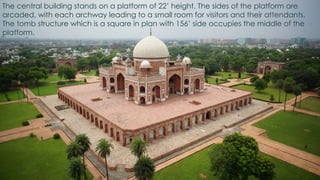
The central building stands on a platform of 22’ height. The sides of the platform are
arcaded, with each archway leading to a small room for visitors and their attendants.
The tomb structure which is a square in plan with 156’ side occupies the middle of the
platform.
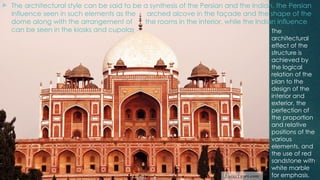
 The architectural style can be said to be a synthesis of the Persian and the Indian, the Persian
influence seen in such elements as the arched alcove in the façade and the shape of the
dome along with the arrangement of the rooms in the interior, while the Indian influence
can be seen in the kiosks and cupolas. The
architectural
effect of the
structure is
achieved by
the logical
relation of the
plan to the
design of the
interior and
exterior, the
perfection of
the proportion
and relative
positions of the
various
elements, and
the use of red
sandstone with
white marble
for emphasis.
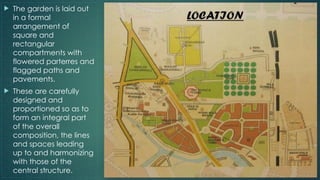
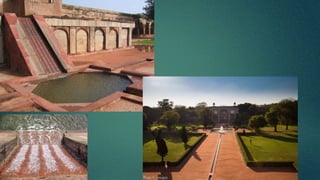
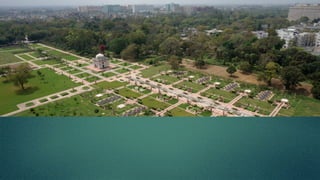
 The garden is laid out
in a formal
arrangement of
square and
rectangular
compartments with
flowered parterres and
flagged paths and
pavements.
 These are carefully
designed and
proportioned so as to
form an integral part
of the overall
composition, the lines
and spaces leading
up to and harmonizing
with those of the
central structure.
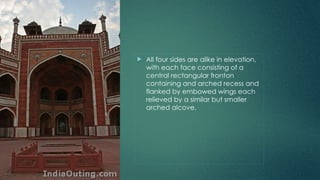
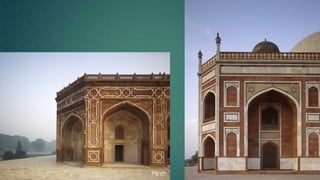
 All four sides are alike in elevation,
with each face consisting of a
central rectangular fronton
containing and arched recess and
flanked by embowed wings each
relieved by a similar but smaller
arched alcove.
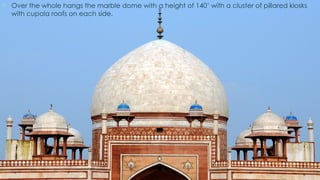
 Over the whole hangs the marble dome with a height of 140’ with a cluster of pillared kiosks
with cupola roofs on each side.
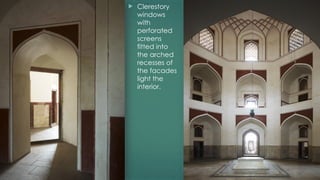
 Clerestory
windows
with
perforated
screens
fitted into
the arched
recesses of
the facades
light the
interior.
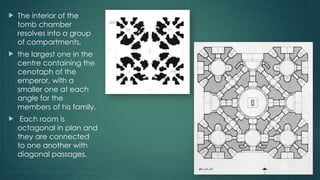
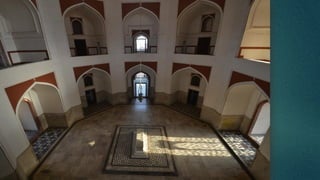
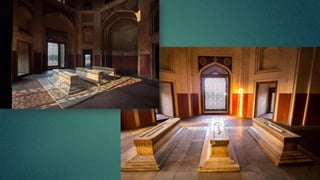
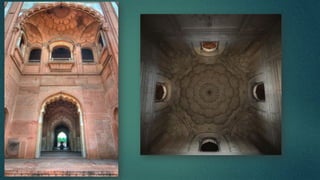
 The interior of the
tomb chamber
resolves into a group
of compartments,
 the largest one in the
centre containing the
cenotaph of the
emperor, with a
smaller one at each
angle for the
members of his family.
 Each room is
octagonal in plan and
they are connected
to one another with
diagonal passages.
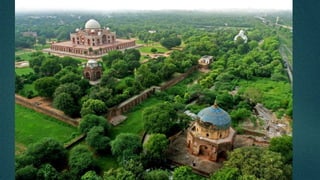
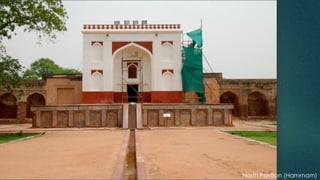
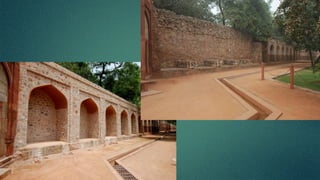
North Pavilion (Hammam)
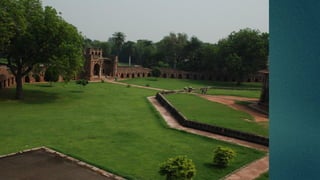
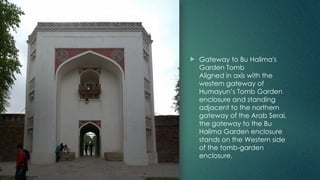
 Gateway to Bu Halima's
Garden Tomb
Aligned in axis with the
western gateway of
Humayun’s Tomb Garden
enclosure and standing
adjacent to the northern
gateway of the Arab Serai,
the gateway to the Bu
Halima Garden enclosure
stands on the Western side
of the tomb-garden
enclosure.
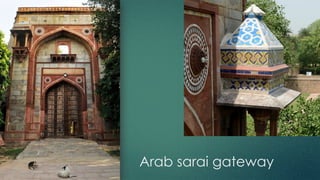
Arab sarai gateway
Plinth
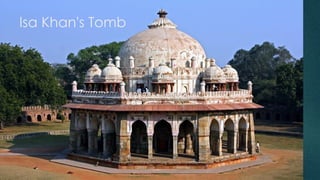
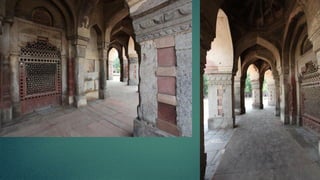
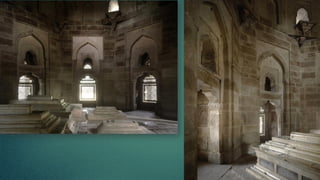
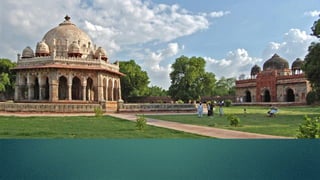
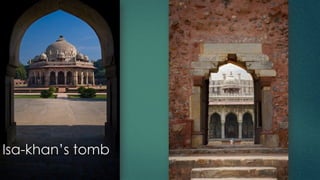
Isa-khan’s tomb
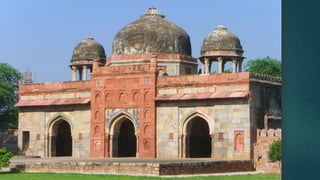
Isa Khan's Tomb
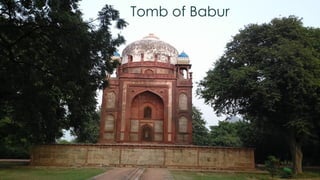
Tomb of Babur
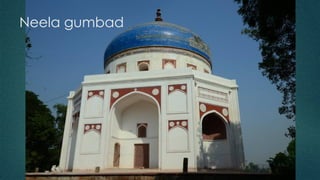
Neela gumbad
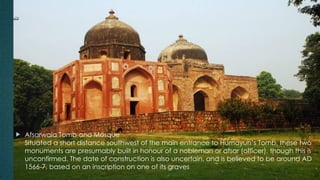
 Afsarwala Tomb and Mosque
Situated a short distance southwest of the main entrance to Humayun’s Tomb, these two
monuments are presumably built in honour of a nobleman or afsar (officer), though this is
unconfirmed. The date of construction is also uncertain, and is believed to be around AD
1566-7, based on an inscription on one of its graves
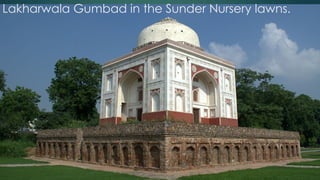
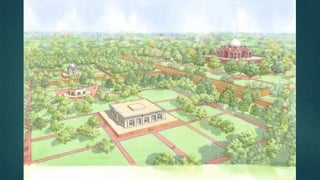
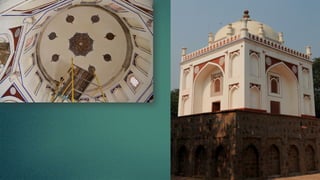
Lakharwala Gumbad in the Sunder Nursery lawns.
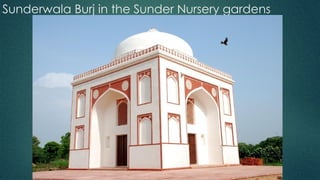
Sunderwala Burj in the Sunder Nursery gardens
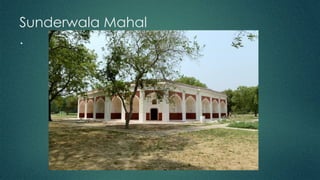
Sunderwala Mahal
.
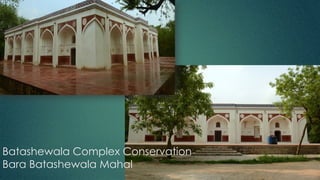
Batashewala Complex Conservation
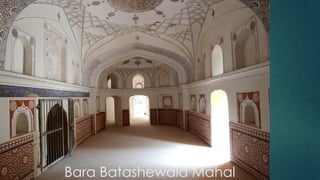
Bara Batashewala Mahal
 .
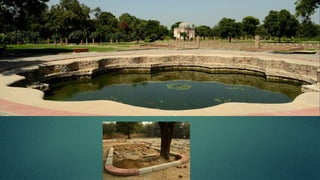
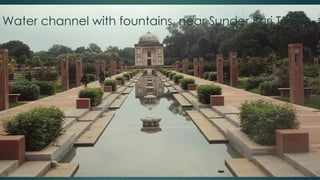
Water channel with fountains, near Sunder Burj Tomb
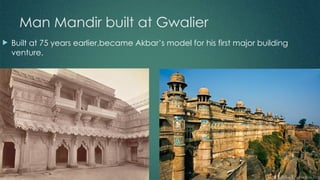
Man Mandir built at Gwalier
 Built at 75 years earlier,became Akbar’s model for his first major building
venture.
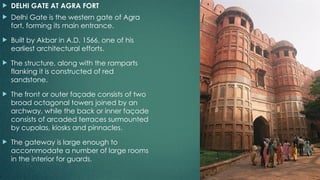
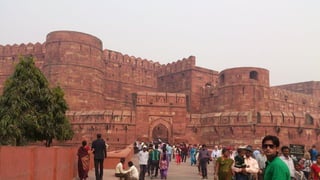
 DELHI GATE AT AGRA FORT
 Delhi Gate is the western gate of Agra
fort, forming its main entrance.
 Built by Akbar in A.D. 1566, one of his
earliest architectural efforts.
 The structure, along with the ramparts
flanking it is constructed of red
sandstone.
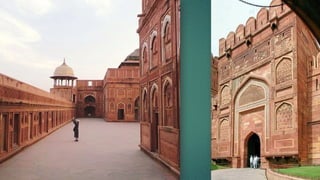
 The front or outer façade consists of two
broad octagonal towers joined by an
archway, while the back or inner façade
consists of arcaded terraces surmounted
by cupolas, kiosks and pinnacles.
 The gateway is large enough to
accommodate a number of large rooms
in the interior for guards.
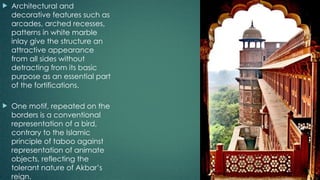
 Architectural and
decorative features such as
arcades, arched recesses,
patterns in white marble
inlay give the structure an
attractive appearance
from all sides without
detracting from its basic
purpose as an essential part
of the fortifications.
 One motif, repeated on the
borders is a conventional
representation of a bird,
contrary to the Islamic
principle of taboo against
representation of animate
objects, reflecting the
tolerant nature of Akbar’s
reign.
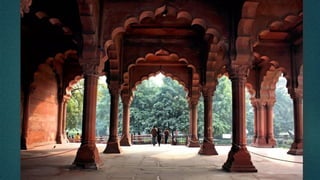
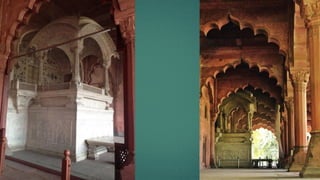
 DIWAN-I-AAM AT DELHI FORT
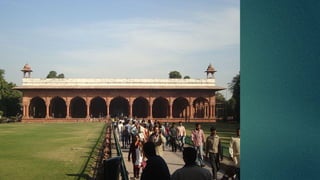
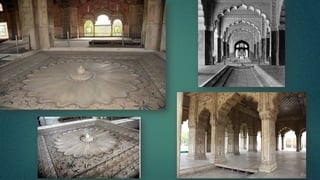
 The Diwan-i-Aam or Hall of Public Audience originally consisted of a square courtyard
surrounded by colonnades and the hall on the eastern side. Apart from the actual hall, the
rest of the subsidiary structures have since disappeared.
 The hall is a sandstone building measuring 185’ X 70’.
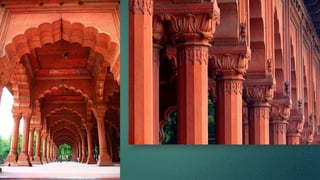
 Its façade is formed of an arcade of 9 arches with double pillars between each arch and
a group of 4 at each corner, thus making 40 pillars in all.
 There is a large oblong recess in the plain back wall.
 Although the structure is sandstone, it was probably originally covered with an overlay of
shell plaster, ivory polished, the technical procedure carried out by artisans from
Rajputana.
 A significant feature of the interior is the alcove in the back wall where the emperor sat in
state, and where the famous Peacock Throne was installed on special occasions.
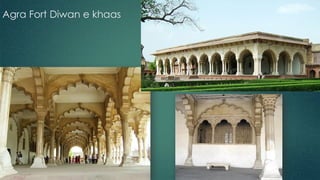
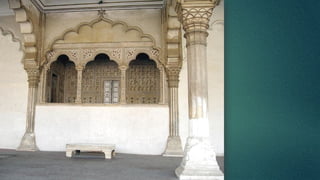
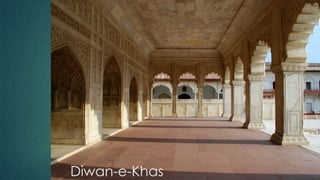
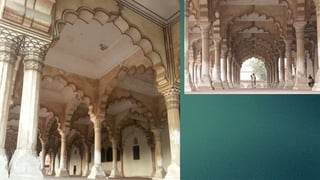
Agra Fort Diwan e khaas
Diwan-e-Khas
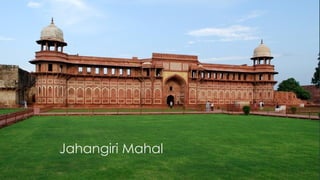
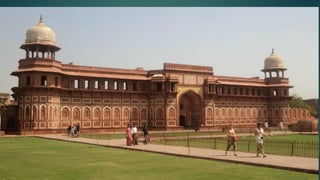
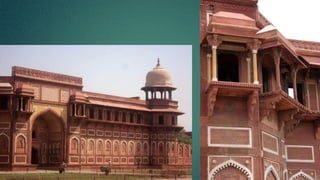
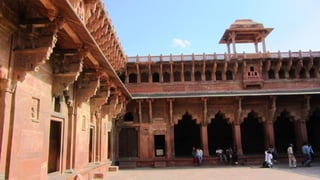
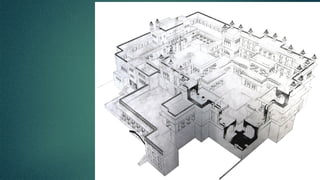
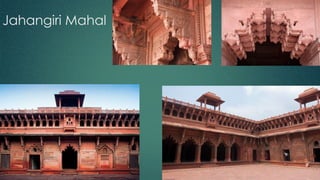
Jahangiri Mahal
Jahangiri Mahal
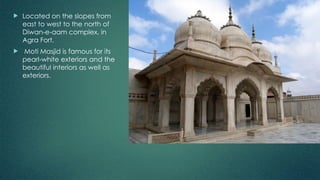
 Located on the slopes from
east to west to the north of
Diwan-e-aam complex, in
Agra Fort.
 Moti Masjid is famous for its
pearl-white exteriors and the
beautiful interiors as well as
exteriors.
 RANG MAHAL
 Built in the Delhi Fort by Shah Jahan in 1637.
 The Rang Mahal in plan is 153’ X 69’, consisting of a main central hall with smaller
compartments at each end.
 The central hall is divided into 15 bays of 20’ side each by means of ornamental piers.
 Originally, its outer arches were filled in with perforated screens and there were triple arches of
lattice work placed across the centre of each side.
 The structure takes the form of a open pavilion in one storey, its façade of engrailed arches
shaded by a wide eave or chhajja. Above this rises a parapet and from each corner a
graceful kiosk.
 The piers are massive and twelve sided, giving a spacious soffit to the arches.
 Ornamentation of gilt coloured and inlaid patterns are distributed throughout the structure.
 Within the foliations of the walls, piers and arches, conventional flowers were introduced freely,
the Mughals being enamored of flowers.
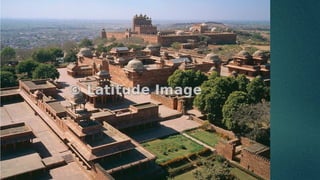
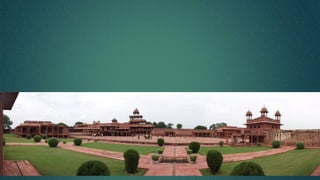
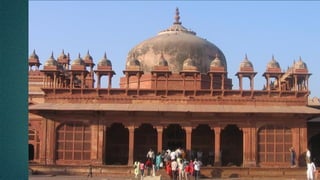
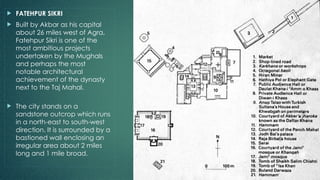
 FATEHPUR SIKRI
 Built by Akbar as his capital
about 26 miles west of Agra,
Fatehpur Sikri is one of the
most ambitious projects
undertaken by the Mughals
and perhaps the most
notable architectural
achievement of the dynasty
next to the Taj Mahal.
 The city stands on a
sandstone outcrop which runs
in a north-east to south-west
direction. It is surrounded by a
bastioned wall enclosing an
irregular area about 2 miles
long and 1 mile broad.
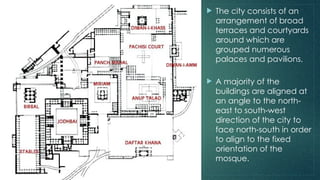
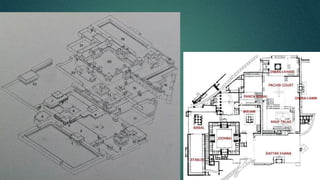
 The city consists of an
arrangement of broad
terraces and courtyards
around which are
grouped numerous
palaces and pavilions.
 A majority of the
buildings are aligned at
an angle to the north-
east to south-west
direction of the city to
face north-south in order
to align to the fixed
orientation of the
mosque.
 The main approach is from Agra, through the Agra Gate and a Naubat
Khana which leads straight to the Diwan-i-Aam.
 The road then continues the Jami Masjid, thus arranging the structures in such
a manner that the public areas are on the southern flank of the hill, while the
private areas reserved for the Royal family and personages of importance
are on the northern flank.
 Apart from the Jami Masjid, the structures in the city are for the most part
trabeate, with some diversities in detailed treatment due to the different
backgrounds of the artisans brought in from all parts of the vast empire.
 The dominant material used is red sandstone quarried on the spot.
 One of the earliest structures built on the site is the Stone-Cutters’ Masjid, a
small mosque on the western crest of the hill that the workmen built for
themselves.
 The buildings can be segregated
into two classes, the religious and
the secular, the former all being
part of the complex comprising
the Jami Masjid, its triumphal
gateway and the tomb of Salim
Chisti within its courtyard.
 The secular buildings are
palaces, administrative buildings
and miscellaneous structures.
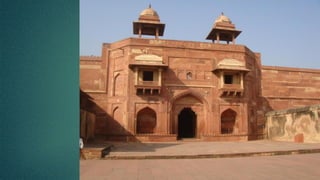
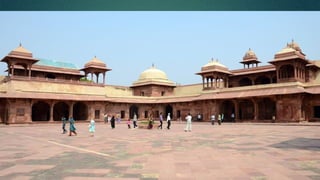
 JODH BAI'S PALACE
 Jodh Bai’s Palace is a structure built as the house of the principal queen and discloses
some of the conditions of living in the Mughal household.
 The palace in plan measures 320’ X 215’, consisting of a large central courtyard with
buildings arranged around its periphery. The only entrance is through a guarded
gatehouse with staggered doorways to provide seclusion.
 The external wall is 32’ high, plain and forbidding on the exterior, the buildings attached to
its inner side all facing the central courtyard.
 The outer façade of the wall is only interrupted thrice, once by the gatehouse on the east,
the hanging pavilion ofHawa Mahal on the north and service and bathing apartments on
the south.
 Most of the buildings, places symmetrically around the square courtyard are two storeyed,
with open terraced roofs at regular intervals.
 In the middle of each side and at each corner the structures rise up into separate
blocks. Each of these blocks is a self-contained suite of living rooms, with corridors
and passages communicating with each block on the ground floor. Each group of
apartments could be divided off from the others, while the chambers below could
be heated in cold weather; the one’s above always remaining airy and cool.
 In many of its elements and carved decoration, especially in the design of the
niches and brackets with their volute forms and the shapes of the pillars, an
influence of Hindu temple architecture can be seen, showing that artisans from
Gujarat were assigned with the construction of the palace.
 Other interesting details include the application blue glaze tiles to some of the
roofs and cupolas and the use of wagon-vault ceiling with groins in one of the
upper rooms.
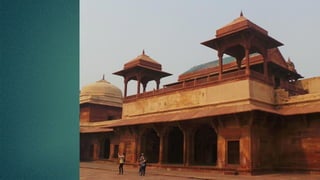
 BIRBAL'S HOUSE
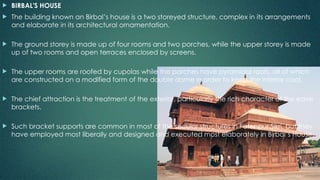
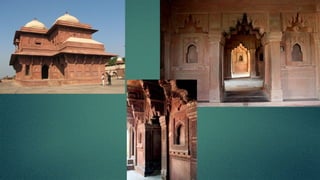
 The building known an Birbal’s house is a two storeyed structure, complex in its arrangements
and elaborate in its architectural ornamentation.
 The ground storey is made up of four rooms and two porches, while the upper storey is made
up of two rooms and open terraces enclosed by screens.
 The upper rooms are roofed by cupolas while the porches have pyramidal roofs, all of which
are constructed on a modified form of the double dome in order to keep the interior cool.
 The chief attraction is the treatment of the exterior, particularly the rich character of the eave
brackets.
 Such bracket supports are common in most of the secular structures in Fatehpur Sikri, but they
have employed most liberally and designed and executed most elaborately in Birbal’s House.
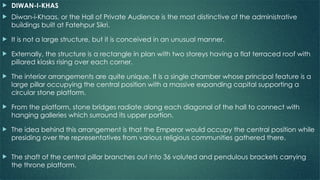
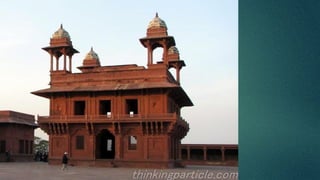
 DIWAN-I-KHAS
 Diwan-i-Khaas, or the Hall of Private Audience is the most distinctive of the administrative
buildings built at Fatehpur Sikri.
 It is not a large structure, but it is conceived in an unusual manner.
 Externally, the structure is a rectangle in plan with two storeys having a flat terraced roof with
pillared kiosks rising over each corner.
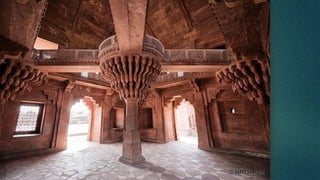
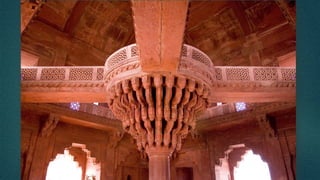
 The interior arrangements are quite unique. It is a single chamber whose principal feature is a
large pillar occupying the central position with a massive expanding capital supporting a
circular stone platform.
 From the platform, stone bridges radiate along each diagonal of the hall to connect with
hanging galleries which surround its upper portion.
 The idea behind this arrangement is that the Emperor would occupy the central position while
presiding over the representatives from various religious communities gathered there.
 The shaft of the central pillar branches out into 36 voluted and pendulous brackets carrying
the throne platform.
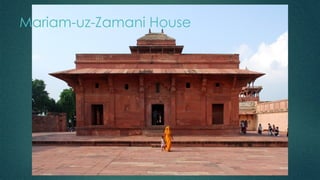
Mariam-uz-Zamani House
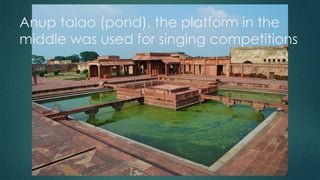
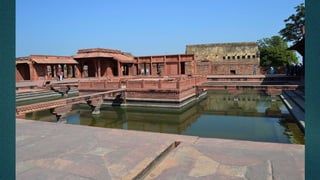
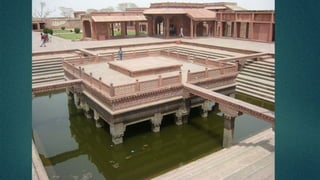
Anup talao (pond), the platform in the
middle was used for singing competitions
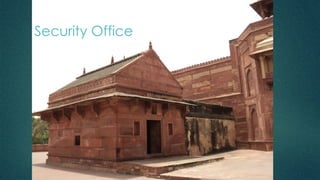
Security Office
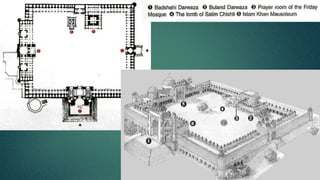
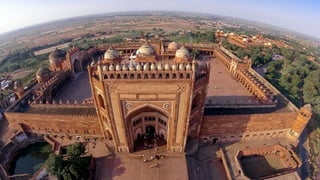
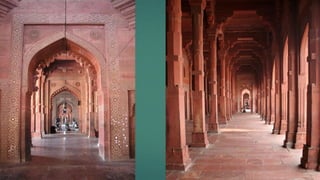
 JAMI MASJID AT FATEHPUR SIKRI
 The Jami Masjid at Fatehpur Sikri was built by Akbar in A.D. 1571.
 It covers a rectangular area measuring 542’ X 438’, with a large courtyard, originally entered
by gateways on the north, south and east. Of these, only the eastern or King’s Gateway has
remained unaltered by subsequent additions.
 It is one of the largest mosques in the country.
 The mosque follows the conventional plan form with a central courtyard surrounded by
cloisters on 3 sides and the sanctuary on the western side.
 The sanctuary façade consists of a large rectangular fronton in the centre containing a
spacious alcove, with a pillared arcade on each side to form the wings.
 Above and behind this central feature rises a large dome over the central nave and smaller
domes over the wings.
 A range of pillared kiosks all along the entire parapet breaks the skyline.
 The nave is a square hall entered through three doorways in the alcoved fronton which
contains the principalmihrab on its western wall and is covered by the main dome.
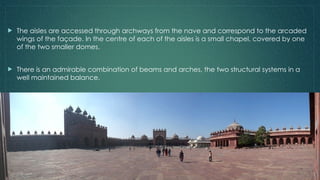
 The aisles are accessed through archways from the nave and correspond to the arcaded
wings of the façade. In the centre of each of the aisles is a small chapel, covered by one
of the two smaller domes.
 There is an admirable combination of beams and arches, the two structural systems in a
well maintained balance.
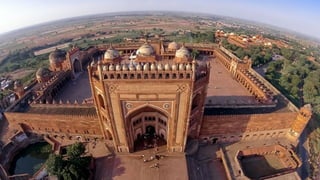
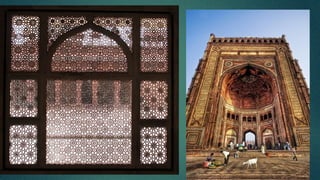
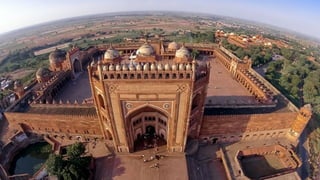
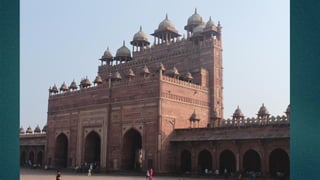
 BULAND DARWAZA
 Buland Darwaza is a triumphal gateway built by Akbar about 25 years after the completion
of the Jami Masjid. The southern gateway to the mosque courtyard was demolished and
replaced with this monument to commemorate Akbar’s victorious campaign in the
Deccan.
 The gateway is 134’ high, approached by a steep flight of steps 42’ high. Thus, the total
height of the structure comes out to be 176’ above the roadway.
 The structure is 130’ wide and 123’ deep.
 The structure may be resolved into two aspects, the frontal and highest aspect forming the
façade with the portal and the back view consisting of a lower and plainer portion intruding
into the mosque courtyard.
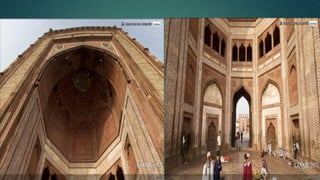
 The façade is embowed by the means of three planes comprising a large central face and
a lesser one on each side receding at an angle.
 The central plane is 86’ wide and is rectangular in shape, the greater part of its surface
occupied by and arched and domed recess whose semi-dome is carried on five surfaces
in the form of a half-decagon down to the ground, with a human height doorway at the
base.
 The smaller planes are in three levels with varied openings at each stage.
 The whole is crowned by a perforated parapet, behind which pillared kiosks break the
skyline.
 The rear aspect of the gateway is less pronounced, consisting of three arched entrances
and a parapet in two stages to accord with the arches and colonnades of the mosque
interior as far as possible.
 The main element of the decorative treatment of the outer façade is the wide border of
the gateway emphasizing its rectangular formation, providing ample space for a
continuous ornamental inscription.
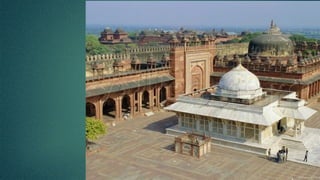
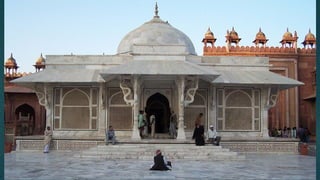
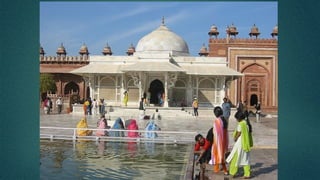
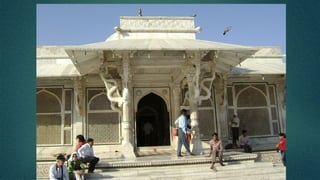
 TOMB OF SALIM CHISTI
 The tomb of Salim Chisti is located in the courtyard of the Jami Masjid at Fatehpur Sikri, its
construction beginning along with the mosque in A.D. 1571.
 Originally a sandstone structure, it was converted into a more expensive marble structure
sometime during the end of Jahangir’s reign and the beginning of Shah Jahan’s reign as per
the style of the period, and thus creates a contrast with the grandiose, massive and purposeful
nature of the structures surrounding it with its own light and airy nature which gives an
appearance of chiseled, polished and fretted exquisiteness.
 The tomb consists of a square exterior of 24’ side which contains a mortuary chamber of 16’
side, the whole covered by a low dome.
 A wide verandah is carried around the outside, its roof supported by pillars with the
interspaces filled with perforated screens, the whole measuring 48’ square.
 A porch, also supported on pillars is projected from the southern side.
 There are carved brackets all around to support the extremely wide eaves.
 The building itself is low and unimpressive but depends upon the material in which it is
built and the ethereal manner in which the material has been handled for its effect.
 The pillars forming the porch with their honeycomb capitals and the brackets springing
from their patterned shafts are its distinctive features. The brackets or struts are unique
as they consist of serpentine volutes with the spaces between the curves filled in with
perforated foliations, having the appearance of carved ivory than chiseled marble.
Their prototype can be seen in the temples of Gujarat.
 The struts serve no structural purpose, but are mainly decorative.
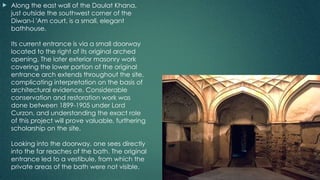
 Along the east wall of the Daulat Khana,
just outside the southwest corner of the
Diwan-i 'Am court, is a small, elegant
bathhouse.
Its current entrance is via a small doorway
located to the right of its original arched
opening. The later exterior masonry work
covering the lower portion of the original
entrance arch extends throughout the site,
complicating interpretation on the basis of
architectural evidence. Considerable
conservation and restoration work was
done between 1899-1905 under Lord
Curzon, and understanding the exact role
of this project will prove valuable, furthering
scholarship on the site.
Looking into the doorway, one sees directly
into the far reaches of the bath. The original
entrance led to a vestibule, from which the
private areas of the bath were not visible.
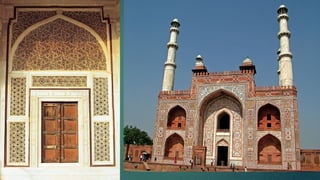
 AKBAR'S TOMB
 Akbar’s mausoleum was built by his son, the Emperor Jahangir, 8 years after
Akbar’s death, completed in 1613.
 The scheme of the mausoleum is on a grand scale, its perimeter walls enclosing a
large square garden, while the tomb structure situated in the centre of the
enclosure is a square in plan of 320’ side and over 100’ high.
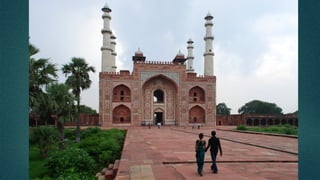
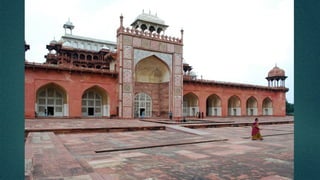
 In the middle of each side of the enclosure is a gatehouse, three of which are
false doorways added for symmetry and the southern being the main entrance.
 The main gateway is a minor monument in itself, with pleasing proportions and
bold inlaid ornamentation along with 4 graceful white marble minarets, one
above each corner.
 The arrangement of the garden beyond the gateway shows the collaboration between
the garden designer and the builder to create a cohesive and unified composition. The
wide flagstone causeways are expanded at suitable locations into square terraces
containing a fountain and a sunk basin.
 The tomb building takes the form of a low truncated pyramid built up in three storeys.
 The ground storey consists of a massive terrace, over 300’ side and 30’ high, with a series
of arches recessed within its sides. In the centre of each side is a tall rectangular structure
containing an arched alcove with a graceful marble kiosk above its parapet. A doorway
within the southern alcove leads to a corridor going to the tomb chamber which is a
small cell confined within the womb of the building.
 Above the terrace is a series of sandstone pavilions, arcades and kiosks and is a light and
fanciful structure in complete contrast with the powerful substructure. It may be assumed that
this part of the mausoleum was built under the supervision of Jahangir who demolished what
was built at this level and reconstructed it in accordance with his architectural ideals. The
contrast between the ground and upper storeys reflect the contrasting characters of Akbar
and Jahangir.
 The uppermost storey of Akbar’s tomb is in marked contrast with the rest of the structure as it is
composed entirely of white marble instead of red sandstone. It is a massive structure with a
solid projecting cornice with a tall and graceful kiosk over each corner. The entire structure is
surrounded by a range of delicately perforated screens. The interior of this storey is an open
court surrounded by arcaded cloisters and a cenotaph in the centre. It is probable that this
storey was supposed to have dome to provide a suitable apex to the pyramidal elevation and
to protect the exquisite craftsmanship of the cenotaph.
 Akbar’s mausoleum exhibits an experimental nature, its builders trying to depart from the
conventional structures and achieve an original composition. However, due to the lack of
proper vision and guidance, the experiment has produced a structure deficient in the
essentials of coherence and mass and also unity and definition.
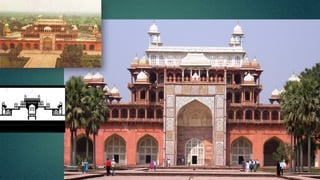
 TOMB OF ITMAD-UD-DAULA
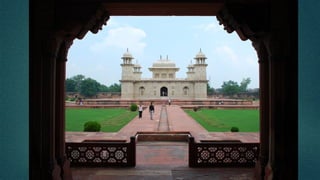
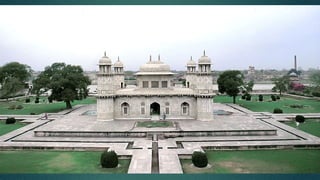
 Built in A.D. 1626 for a distinguished nobleman and Jahangir’s father-in-law, Itmad-ud-Daula at
Agra.
 The structure marks a transitional phase with a fresh interpretation of the building art in its most
delicate and refined aspect, disregarding size and emphasizing exquisite finish.
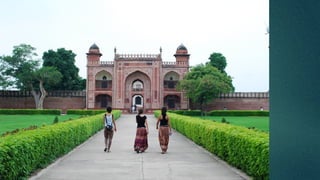
 The structure stands in a square enclosure of 540’ side, with red sandstone gateways.
 The tomb structure, built in white marble, stands in the centre of a garden with a formal
scheme of lawns, parterres, flagged pathways, tanks and fountains.
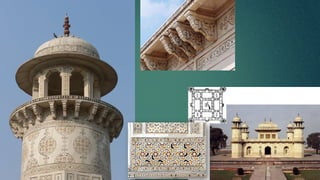
 The tomb is a square in plan of only 70’ side, comprising of a central structure with broad
octagonal towers in the form of minarets thrown out from each angle.
 A small pavilion or kind of upper storey rises above the roof.
 There are three arched opening in each side and cornices on brackets and a wide eave on
the upper portion.
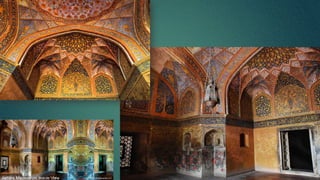
 The interior of the ground storey consists of a series of rooms and passages corresponding to
an enclosed verandah which surrounds the central chamber containing the cenotaph.
 The pavilion above is a square compartment with walls of screens of fine marble tracery.
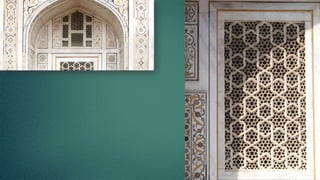
 There is little relief work in the ornamentation, the walls being coloured delicately by inlaid
stones. The inlay work was done with a new system called pietra dura in which hard and rare
stones such as lapis, onyx, jasper, topaz cornelian and the like were embedded in the
marble in graceful foliations, as opposed to the older system of opus sectile, a marble
intarsia of various colours.
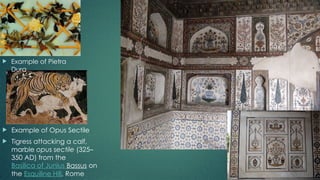
 Example of Opus Sectile
 Tigress attacking a calf,
marble opus sectile (325–
350 AD) from the
Basilica of Junius Bassus on
the Esquiline Hill, Rome
 Example of Pietra
Dura
 LANDSCAPE ARCHITECTURE UNDER THE MUGHALS
 Landscape architecture under the Mughals as illustrated by the large ornamental gardens which
the rulers laid out in various places is an important aspect of Mughal architecture.
 The idea of these retreats was brought in from Persia.
 Babur, the founder of the dynasty, commemorated his victory over Ibrahim Lodi in 1526 not with a
triumphal monument but with a large garden called Kabul Bagh at Panipat.
 Most of the principal architectural projects of the Mughal rulers were surrounded by park-like
enclosures.
 Spacious gardens not associated with buildings were also created, especially the gardens of
Kashmir, of which the Shalimar and Nishat Baghs are the most famous.
 In the plains of India, the Shalimar Bagh at Lahore was built by Shah Jahan in 1637.
 It is formed by means of a series of rectangular terraces arranged in descending levels to ensure a
continuous flow of water throughout the entire system.
 Fountains, pools, basins,
cascades and similar devices
turn the whole into a very
effective water garden.
 The layout is rigidly conventional
and axially symmetrical.
 The aim of the design is to
discipline nature and not to
imitate it. Hence, this style
belongs to the school of
formalists and not naturalists.
 The plan of the Mughal gardens
is worked out in a regular
arrangement of squares, often
subdivided into smaller squares
to form the figure of the char
bagh.
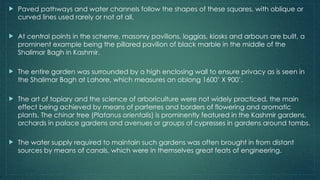
 Paved pathways and water channels follow the shapes of these squares, with oblique or
curved lines used rarely or not at all.
 At central points in the scheme, masonry pavilions, loggias, kiosks and arbours are built, a
prominent example being the pillared pavilion of black marble in the middle of the
Shalimar Bagh in Kashmir.
 The entire garden was surrounded by a high enclosing wall to ensure privacy as is seen in
the Shalimar Bagh at Lahore, which measures an oblong 1600’ X 900’.
 The art of topiary and the science of arboriculture were not widely practiced, the main
effect being achieved by means of parterres and borders of flowering and aromatic
plants. The chinar tree (Platanus orientalis) is prominently featured in the Kashmir gardens,
orchards in palace gardens and avenues or groups of cypresses in gardens around tombs.
 The water supply required to maintain such gardens was often brought in from distant
sources by means of canals, which were in themselves great feats of engineering.
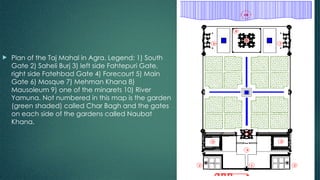
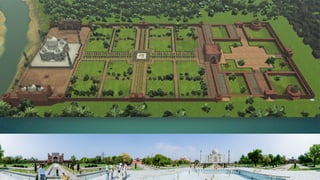
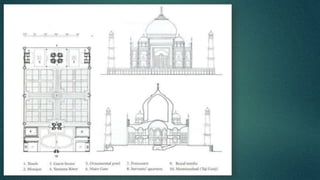
 Plan of the Taj Mahal in Agra. Legend: 1) South
Gate 2) Saheli Burj 3) left side Fahtepuri Gate,
right side Fatehbad Gate 4) Forecourt 5) Main
Gate 6) Mosque 7) Mehman Khana 8)
Mausoleum 9) one of the minarets 10) River
Yamuna. Not numbered in this map is the garden
(green shaded) called Char Bagh and the gates
on each side of the gardens called Naubat
Khana.
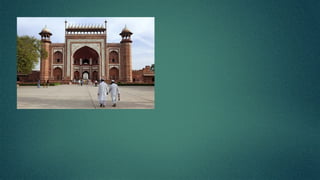
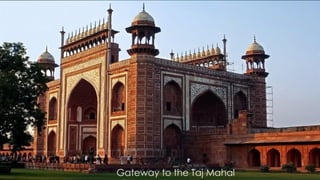
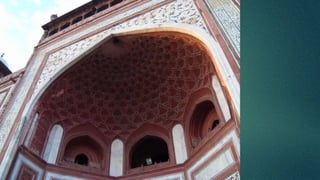
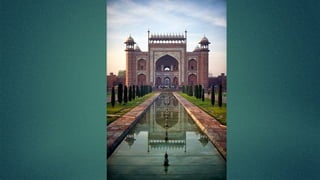
Gateway to the Taj Mahal
 TAJ MAHAL
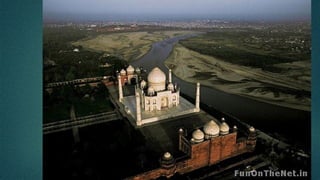
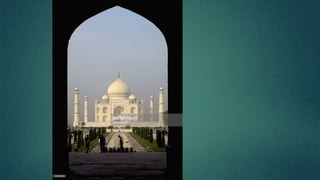
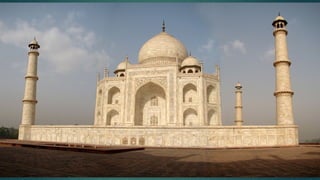
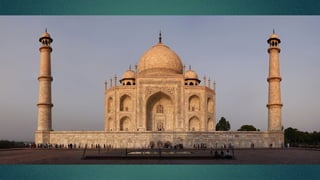
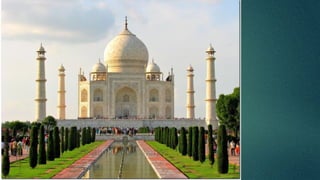
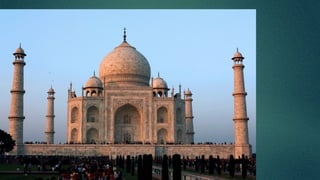
 The Taj Mahal, built by Shah Jahan at Agra as the mausoleum for his consort Mumtaz Mahal, is
considered to be the perfect moment in the evolution of Mughal architecture in India.
 The inspiration behind the Taj Mahal apparently comes from two sources, Humayun’s Tomb at
Delhi, built about 50 years before the Taj Mahal, and the lesser known tomb of Khan Khanan,
built a few years before the Taj Mahal.
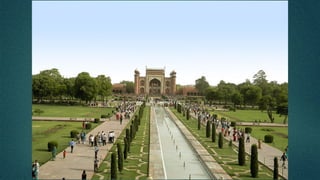
 The tomb building itself occupies only a small portion of the architectural scheme as a whole.
The plan of the whole complex is in the form of a large rectangular enclosure aligned to the
north-south direction measuring 1900’ X 1000’. The central area is occupied by a square
garden measuring 1000’ side, leaving two oblong rectangles at the north and south ends. The
southern end consists of a system of roads and service dwellings while the northern end,
abutting the Jumna River, consists of a raised terrace on which there are the tomb structure
and some subsidiary structures.
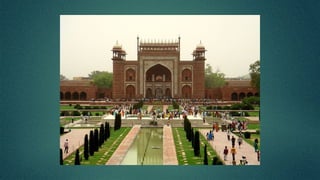
 The garden portion and terrace portion are surrounded by a high boundary wall with
octagonal pavilions at each corner and a monumental entrance gateway in the middle of
the southern side.
 Beyond the gateway on the south lie courtyards, stables, outhouses and other facilities with the
addition of a bazaar for supplies. The entire scheme evidences the amount of preliminary
thought that went into the design before any construction began.
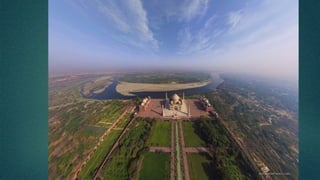
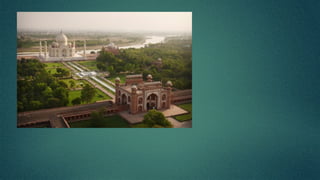
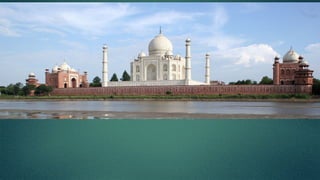
 The structure was designed to be approached from both the road and the river, the first view
of the building from the road being framed like a picture from the fine archways of the
entrance hall, while the first view from the river augmented by its reflection in the river.
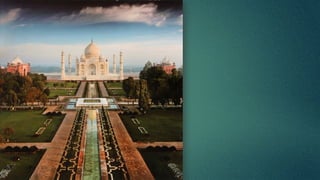
 The formal garden was laid out to harmonize with the main structure. There were water courses
with fountains and an elevated lotus pool to reflect the structure from various viewpoints.
 The structures on the northern terrace form the main architectural focus of the scheme, with
the tomb building at the centre and two detached subsidiary edifices on the eastern and
western ends.
 The western structure is a mosque, while the eastern one is a replica added for symmetry and
no real religious purpose and is known as the jawab or answer. It has been used as a kind of
reception hall or guest house.
 The central tomb structure, the focal point of the composition is elevated in a plinth 22’
high. It is a square in plan with 186’ side, its sides chamfered. The shape is carried up to a
height of 108’ with a marble cupola on each corner. Above this rises a bulbous dome,
taking the total height of the structure to 187’.
 From each corner of the plinth, a minaret in three stages and crowned by a kiosk rising
to a height of 137’ enhances the architectural effect.
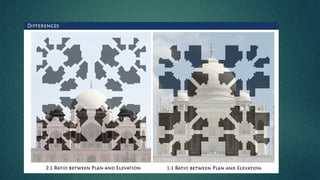
 The scheme and proportions of the structure are simple, for example, the façade width
is equal to the height, and the height of the façade in the centre is the same as the
height of the dome, thus the top of the parapet above the central alcove in the façade
is the central point of the composition.
 The dome forms the crowning feature of the composition. The shape of the feature is in
the form of a globe, its lower part truncated by the drum on which it rests, while the
curves on its upper part rising tangentially to from the foliated base of the finial. The
dome has two shells, making it of the double dome variety.
 The larger dome and the smaller cupolas at its base belong to two different architectural
traditions, the larger dome belonging to the Persian while the smaller cupolas without
constricted bases being of an indigenous variety.
 In the minarets, the face joints of the masonry are countersunk, forming a kind of
rustication not observed in the rest of the building.
 The interior of the tomb chamber is a copy of Humayun’s Tomb, with the octagonal
central hall connected to subsidiary chambers in the angles by radiating passages. The
main hall is in two storeys of arcades reflecting the treatment of the exterior. Above this is
the inner shell of the dome. Each of the subsidiary rooms at the angles has a similar upper
storey room right above it.
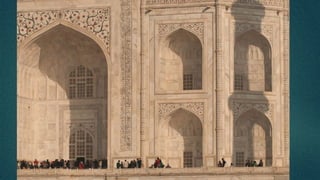
 The ornamentation consists mainly of a restrained use of murals of inlaid patterns over flat
surfaces reserved for this purpose. In addition, there are some carvings on the dados and
the perforated screens surrounding the cenotaphs are exquisitely carved.
 The main feature apart from the lucid and coherent composition is the quality and texture
of the material itself, which is marble from Makrana. It takes on subtle variations of tint and
tone, reflecting the changes in light that happen during the course of the day.
 The cenotaph of Mumtaz Mahal occupies the central position under the finial of the dome
in the central chamber, while that of the emperor Shah Jahan is situated to one side. This
may be due to the interment of the emperor there being an afterthought, the construction
of his own mausoleum not materializing due to the war of succession with his son
Aurangzeb.
 SAFDARJUNG'S TOMB
 Built in A.D. 1753 at Delhi as a mausoleum for Safdar Jung, a nephew of the first king of Oudh.
 It is the last Islamic monument of note to be built at Delhi.
 The tomb complex consists of a large ornamental garden designed in the Mughal fashion in the
centre of which stands the main structure.
 The central structure consists of an arcaded terrace of 110’ side and 10’ high on which rises a
double storeyed edifice of 60’ side covered by a large and almost spherical dome.
 The chief architectural elements visible in Mughal buildings such as large and small arched
alcoves, turrets with kiosks and a central dome are also seen in the structure.
 The features have been altered and distributed in a manner deviant from the original archetype,
thus producing a different effect which is rather stilted and unsatisfied. When compared with its
predecessors, Humayun’s Tomb and the Taj Mahal, the main defect becomes apparent, which is
the unpleasing nature of its proportions, the narrow and vertical tendency of the structure due to
the lack of correct expansion at the base which causes the absence of the pyramidal mass
which is responsible for the sense of rhythm in the previous examples.
 http://www.panoramio.com/photo/106905862

Final Mughal architecture style monuments

  • 1.
  • 2.
     Mughal Empireestablished by Babur in 1526.  The Mughal era defines the most luxurious phase of Islamic Architecture in India, due in part to the wealth and the settled political conditions of the empire and to the aesthetic nature of the emperors.  Mughal Architecture flourished under the first five ‘Great Mughals’ of the dynasty,  Babur,  Humayun,  Akbar,  Jahangir and  Shah Jahan and declined after the rule of  Aurangzeb. The two most prolific builders of the dynasty were Akbar (1556-1605) and his grandson Shah Jahan (1627-1658), with a transitional phase observed under Jahangir (1605-1627).
  • 3.
     The stylecan be broadly divided into two phases,  an earlier phase when the buildings were principally constructed of red sandstone during the reign of Akbar and  a later phase when the buildings were constructed principally of marble under the reign of Shah Jahan.  Due to the centralized political structure of the empire, the Mughal style of architecture had no provincial or regional manifestations, but was an imperial style only moderately affected by local influences.  The major influences seen in the Mughal style come from Persia and from the indigenous styles of Gujarat and Rajasthan.
  • 4.
     one ofAkbar's nine jewels and better known as Rahim, the bhakti poet. Khan khanan’s tomb
  • 6.
     HUMAYUN'S TOMB The first Mughal building of note to be constructed in India.  Built in A.D. 1564 by Haji Begum, wife of the Emperor Humayun , eight years after his death in Delhi in the vicinity of the city of Din Panah founded by the emperor.  The architect was a Persian by the name of Mirak Mirza Ghiyas.
  • 9.
     .  Themausoleum is placed in a spacious, square park like enclosure, providing seclusion and securing an appropriate setting.
  • 10.
     An imposing gatewayis introduced in the middle of each of the four sides of the enclosure,  the western being the main entrance with an embowed archway which frames the view of the mausoleum.
  • 12.
     archway whichframes the view of the mausoleum
  • 16.
     The domeis the example of the double dome i.e. a dome with two shells,  an outer one supporting the marble casing and giving the lofty shape from the exterior and an inner one built lower to create a better proportion with the space below.
  • 17.
    The central buildingstands on a platform of 22’ height. The sides of the platform are arcaded, with each archway leading to a small room for visitors and their attendants. The tomb structure which is a square in plan with 156’ side occupies the middle of the platform.
  • 18.
     The architecturalstyle can be said to be a synthesis of the Persian and the Indian, the Persian influence seen in such elements as the arched alcove in the façade and the shape of the dome along with the arrangement of the rooms in the interior, while the Indian influence can be seen in the kiosks and cupolas. The architectural effect of the structure is achieved by the logical relation of the plan to the design of the interior and exterior, the perfection of the proportion and relative positions of the various elements, and the use of red sandstone with white marble for emphasis.
  • 19.
     The gardenis laid out in a formal arrangement of square and rectangular compartments with flowered parterres and flagged paths and pavements.  These are carefully designed and proportioned so as to form an integral part of the overall composition, the lines and spaces leading up to and harmonizing with those of the central structure.
  • 22.
     All foursides are alike in elevation, with each face consisting of a central rectangular fronton containing and arched recess and flanked by embowed wings each relieved by a similar but smaller arched alcove.
  • 23.
     Over thewhole hangs the marble dome with a height of 140’ with a cluster of pillared kiosks with cupola roofs on each side.
  • 24.
     Clerestory windows with perforated screens fitted into thearched recesses of the facades light the interior.
  • 25.
     The interiorof the tomb chamber resolves into a group of compartments,  the largest one in the centre containing the cenotaph of the emperor, with a smaller one at each angle for the members of his family.  Each room is octagonal in plan and they are connected to one another with diagonal passages.
  • 33.
  • 34.
     Gateway toBu Halima's Garden Tomb Aligned in axis with the western gateway of Humayun’s Tomb Garden enclosure and standing adjacent to the northern gateway of the Arab Serai, the gateway to the Bu Halima Garden enclosure stands on the Western side of the tomb-garden enclosure.
  • 35.
  • 37.
  • 39.
  • 40.
  • 46.
  • 47.
  • 49.
     Afsarwala Tomband Mosque Situated a short distance southwest of the main entrance to Humayun’s Tomb, these two monuments are presumably built in honour of a nobleman or afsar (officer), though this is unconfirmed. The date of construction is also uncertain, and is believed to be around AD 1566-7, based on an inscription on one of its graves
  • 56.
    Lakharwala Gumbad inthe Sunder Nursery lawns.
  • 57.
    Sunderwala Burj inthe Sunder Nursery gardens
  • 60.
  • 62.
  • 63.
  • 65.
    Water channel withfountains, near Sunder Burj Tomb
  • 66.
    Man Mandir builtat Gwalier  Built at 75 years earlier,became Akbar’s model for his first major building venture.
  • 68.
     DELHI GATEAT AGRA FORT  Delhi Gate is the western gate of Agra fort, forming its main entrance.  Built by Akbar in A.D. 1566, one of his earliest architectural efforts.  The structure, along with the ramparts flanking it is constructed of red sandstone.  The front or outer façade consists of two broad octagonal towers joined by an archway, while the back or inner façade consists of arcaded terraces surmounted by cupolas, kiosks and pinnacles.  The gateway is large enough to accommodate a number of large rooms in the interior for guards.
  • 71.
     Architectural and decorativefeatures such as arcades, arched recesses, patterns in white marble inlay give the structure an attractive appearance from all sides without detracting from its basic purpose as an essential part of the fortifications.  One motif, repeated on the borders is a conventional representation of a bird, contrary to the Islamic principle of taboo against representation of animate objects, reflecting the tolerant nature of Akbar’s reign.
  • 74.
     DIWAN-I-AAM ATDELHI FORT  The Diwan-i-Aam or Hall of Public Audience originally consisted of a square courtyard surrounded by colonnades and the hall on the eastern side. Apart from the actual hall, the rest of the subsidiary structures have since disappeared.  The hall is a sandstone building measuring 185’ X 70’.  Its façade is formed of an arcade of 9 arches with double pillars between each arch and a group of 4 at each corner, thus making 40 pillars in all.  There is a large oblong recess in the plain back wall.  Although the structure is sandstone, it was probably originally covered with an overlay of shell plaster, ivory polished, the technical procedure carried out by artisans from Rajputana.  A significant feature of the interior is the alcove in the back wall where the emperor sat in state, and where the famous Peacock Throne was installed on special occasions.
  • 79.
  • 81.
  • 83.
  • 88.
  • 90.
     Located onthe slopes from east to west to the north of Diwan-e-aam complex, in Agra Fort.  Moti Masjid is famous for its pearl-white exteriors and the beautiful interiors as well as exteriors.
  • 91.
     RANG MAHAL Built in the Delhi Fort by Shah Jahan in 1637.  The Rang Mahal in plan is 153’ X 69’, consisting of a main central hall with smaller compartments at each end.  The central hall is divided into 15 bays of 20’ side each by means of ornamental piers.  Originally, its outer arches were filled in with perforated screens and there were triple arches of lattice work placed across the centre of each side.  The structure takes the form of a open pavilion in one storey, its façade of engrailed arches shaded by a wide eave or chhajja. Above this rises a parapet and from each corner a graceful kiosk.  The piers are massive and twelve sided, giving a spacious soffit to the arches.  Ornamentation of gilt coloured and inlaid patterns are distributed throughout the structure.  Within the foliations of the walls, piers and arches, conventional flowers were introduced freely, the Mughals being enamored of flowers.
  • 99.
     FATEHPUR SIKRI Built by Akbar as his capital about 26 miles west of Agra, Fatehpur Sikri is one of the most ambitious projects undertaken by the Mughals and perhaps the most notable architectural achievement of the dynasty next to the Taj Mahal.  The city stands on a sandstone outcrop which runs in a north-east to south-west direction. It is surrounded by a bastioned wall enclosing an irregular area about 2 miles long and 1 mile broad.
  • 100.
     The cityconsists of an arrangement of broad terraces and courtyards around which are grouped numerous palaces and pavilions.  A majority of the buildings are aligned at an angle to the north- east to south-west direction of the city to face north-south in order to align to the fixed orientation of the mosque.
  • 105.
     The mainapproach is from Agra, through the Agra Gate and a Naubat Khana which leads straight to the Diwan-i-Aam.  The road then continues the Jami Masjid, thus arranging the structures in such a manner that the public areas are on the southern flank of the hill, while the private areas reserved for the Royal family and personages of importance are on the northern flank.  Apart from the Jami Masjid, the structures in the city are for the most part trabeate, with some diversities in detailed treatment due to the different backgrounds of the artisans brought in from all parts of the vast empire.  The dominant material used is red sandstone quarried on the spot.  One of the earliest structures built on the site is the Stone-Cutters’ Masjid, a small mosque on the western crest of the hill that the workmen built for themselves.
  • 106.
     The buildingscan be segregated into two classes, the religious and the secular, the former all being part of the complex comprising the Jami Masjid, its triumphal gateway and the tomb of Salim Chisti within its courtyard.  The secular buildings are palaces, administrative buildings and miscellaneous structures.
  • 107.
     JODH BAI'SPALACE  Jodh Bai’s Palace is a structure built as the house of the principal queen and discloses some of the conditions of living in the Mughal household.  The palace in plan measures 320’ X 215’, consisting of a large central courtyard with buildings arranged around its periphery. The only entrance is through a guarded gatehouse with staggered doorways to provide seclusion.  The external wall is 32’ high, plain and forbidding on the exterior, the buildings attached to its inner side all facing the central courtyard.  The outer façade of the wall is only interrupted thrice, once by the gatehouse on the east, the hanging pavilion ofHawa Mahal on the north and service and bathing apartments on the south.  Most of the buildings, places symmetrically around the square courtyard are two storeyed, with open terraced roofs at regular intervals.
  • 108.
     In themiddle of each side and at each corner the structures rise up into separate blocks. Each of these blocks is a self-contained suite of living rooms, with corridors and passages communicating with each block on the ground floor. Each group of apartments could be divided off from the others, while the chambers below could be heated in cold weather; the one’s above always remaining airy and cool.  In many of its elements and carved decoration, especially in the design of the niches and brackets with their volute forms and the shapes of the pillars, an influence of Hindu temple architecture can be seen, showing that artisans from Gujarat were assigned with the construction of the palace.  Other interesting details include the application blue glaze tiles to some of the roofs and cupolas and the use of wagon-vault ceiling with groins in one of the upper rooms.
  • 112.
     BIRBAL'S HOUSE The building known an Birbal’s house is a two storeyed structure, complex in its arrangements and elaborate in its architectural ornamentation.  The ground storey is made up of four rooms and two porches, while the upper storey is made up of two rooms and open terraces enclosed by screens.  The upper rooms are roofed by cupolas while the porches have pyramidal roofs, all of which are constructed on a modified form of the double dome in order to keep the interior cool.  The chief attraction is the treatment of the exterior, particularly the rich character of the eave brackets.  Such bracket supports are common in most of the secular structures in Fatehpur Sikri, but they have employed most liberally and designed and executed most elaborately in Birbal’s House.
  • 114.
     DIWAN-I-KHAS  Diwan-i-Khaas,or the Hall of Private Audience is the most distinctive of the administrative buildings built at Fatehpur Sikri.  It is not a large structure, but it is conceived in an unusual manner.  Externally, the structure is a rectangle in plan with two storeys having a flat terraced roof with pillared kiosks rising over each corner.  The interior arrangements are quite unique. It is a single chamber whose principal feature is a large pillar occupying the central position with a massive expanding capital supporting a circular stone platform.  From the platform, stone bridges radiate along each diagonal of the hall to connect with hanging galleries which surround its upper portion.  The idea behind this arrangement is that the Emperor would occupy the central position while presiding over the representatives from various religious communities gathered there.  The shaft of the central pillar branches out into 36 voluted and pendulous brackets carrying the throne platform.
  • 118.
  • 119.
    Anup talao (pond),the platform in the middle was used for singing competitions
  • 123.
  • 124.
     JAMI MASJIDAT FATEHPUR SIKRI  The Jami Masjid at Fatehpur Sikri was built by Akbar in A.D. 1571.  It covers a rectangular area measuring 542’ X 438’, with a large courtyard, originally entered by gateways on the north, south and east. Of these, only the eastern or King’s Gateway has remained unaltered by subsequent additions.  It is one of the largest mosques in the country.  The mosque follows the conventional plan form with a central courtyard surrounded by cloisters on 3 sides and the sanctuary on the western side.  The sanctuary façade consists of a large rectangular fronton in the centre containing a spacious alcove, with a pillared arcade on each side to form the wings.  Above and behind this central feature rises a large dome over the central nave and smaller domes over the wings.  A range of pillared kiosks all along the entire parapet breaks the skyline.  The nave is a square hall entered through three doorways in the alcoved fronton which contains the principalmihrab on its western wall and is covered by the main dome.
  • 127.
     The aislesare accessed through archways from the nave and correspond to the arcaded wings of the façade. In the centre of each of the aisles is a small chapel, covered by one of the two smaller domes.  There is an admirable combination of beams and arches, the two structural systems in a well maintained balance.
  • 134.
     BULAND DARWAZA Buland Darwaza is a triumphal gateway built by Akbar about 25 years after the completion of the Jami Masjid. The southern gateway to the mosque courtyard was demolished and replaced with this monument to commemorate Akbar’s victorious campaign in the Deccan.  The gateway is 134’ high, approached by a steep flight of steps 42’ high. Thus, the total height of the structure comes out to be 176’ above the roadway.  The structure is 130’ wide and 123’ deep.  The structure may be resolved into two aspects, the frontal and highest aspect forming the façade with the portal and the back view consisting of a lower and plainer portion intruding into the mosque courtyard.  The façade is embowed by the means of three planes comprising a large central face and a lesser one on each side receding at an angle.
  • 136.
     The centralplane is 86’ wide and is rectangular in shape, the greater part of its surface occupied by and arched and domed recess whose semi-dome is carried on five surfaces in the form of a half-decagon down to the ground, with a human height doorway at the base.  The smaller planes are in three levels with varied openings at each stage.  The whole is crowned by a perforated parapet, behind which pillared kiosks break the skyline.  The rear aspect of the gateway is less pronounced, consisting of three arched entrances and a parapet in two stages to accord with the arches and colonnades of the mosque interior as far as possible.  The main element of the decorative treatment of the outer façade is the wide border of the gateway emphasizing its rectangular formation, providing ample space for a continuous ornamental inscription.
  • 139.
     TOMB OFSALIM CHISTI  The tomb of Salim Chisti is located in the courtyard of the Jami Masjid at Fatehpur Sikri, its construction beginning along with the mosque in A.D. 1571.  Originally a sandstone structure, it was converted into a more expensive marble structure sometime during the end of Jahangir’s reign and the beginning of Shah Jahan’s reign as per the style of the period, and thus creates a contrast with the grandiose, massive and purposeful nature of the structures surrounding it with its own light and airy nature which gives an appearance of chiseled, polished and fretted exquisiteness.  The tomb consists of a square exterior of 24’ side which contains a mortuary chamber of 16’ side, the whole covered by a low dome.  A wide verandah is carried around the outside, its roof supported by pillars with the interspaces filled with perforated screens, the whole measuring 48’ square.  A porch, also supported on pillars is projected from the southern side.
  • 140.
     There arecarved brackets all around to support the extremely wide eaves.  The building itself is low and unimpressive but depends upon the material in which it is built and the ethereal manner in which the material has been handled for its effect.  The pillars forming the porch with their honeycomb capitals and the brackets springing from their patterned shafts are its distinctive features. The brackets or struts are unique as they consist of serpentine volutes with the spaces between the curves filled in with perforated foliations, having the appearance of carved ivory than chiseled marble. Their prototype can be seen in the temples of Gujarat.  The struts serve no structural purpose, but are mainly decorative.
  • 144.
     Along theeast wall of the Daulat Khana, just outside the southwest corner of the Diwan-i 'Am court, is a small, elegant bathhouse. Its current entrance is via a small doorway located to the right of its original arched opening. The later exterior masonry work covering the lower portion of the original entrance arch extends throughout the site, complicating interpretation on the basis of architectural evidence. Considerable conservation and restoration work was done between 1899-1905 under Lord Curzon, and understanding the exact role of this project will prove valuable, furthering scholarship on the site. Looking into the doorway, one sees directly into the far reaches of the bath. The original entrance led to a vestibule, from which the private areas of the bath were not visible.
  • 145.
     AKBAR'S TOMB Akbar’s mausoleum was built by his son, the Emperor Jahangir, 8 years after Akbar’s death, completed in 1613.  The scheme of the mausoleum is on a grand scale, its perimeter walls enclosing a large square garden, while the tomb structure situated in the centre of the enclosure is a square in plan of 320’ side and over 100’ high.  In the middle of each side of the enclosure is a gatehouse, three of which are false doorways added for symmetry and the southern being the main entrance.  The main gateway is a minor monument in itself, with pleasing proportions and bold inlaid ornamentation along with 4 graceful white marble minarets, one above each corner.
  • 146.
     The arrangementof the garden beyond the gateway shows the collaboration between the garden designer and the builder to create a cohesive and unified composition. The wide flagstone causeways are expanded at suitable locations into square terraces containing a fountain and a sunk basin.  The tomb building takes the form of a low truncated pyramid built up in three storeys.  The ground storey consists of a massive terrace, over 300’ side and 30’ high, with a series of arches recessed within its sides. In the centre of each side is a tall rectangular structure containing an arched alcove with a graceful marble kiosk above its parapet. A doorway within the southern alcove leads to a corridor going to the tomb chamber which is a small cell confined within the womb of the building.
  • 147.
     Above theterrace is a series of sandstone pavilions, arcades and kiosks and is a light and fanciful structure in complete contrast with the powerful substructure. It may be assumed that this part of the mausoleum was built under the supervision of Jahangir who demolished what was built at this level and reconstructed it in accordance with his architectural ideals. The contrast between the ground and upper storeys reflect the contrasting characters of Akbar and Jahangir.  The uppermost storey of Akbar’s tomb is in marked contrast with the rest of the structure as it is composed entirely of white marble instead of red sandstone. It is a massive structure with a solid projecting cornice with a tall and graceful kiosk over each corner. The entire structure is surrounded by a range of delicately perforated screens. The interior of this storey is an open court surrounded by arcaded cloisters and a cenotaph in the centre. It is probable that this storey was supposed to have dome to provide a suitable apex to the pyramidal elevation and to protect the exquisite craftsmanship of the cenotaph.  Akbar’s mausoleum exhibits an experimental nature, its builders trying to depart from the conventional structures and achieve an original composition. However, due to the lack of proper vision and guidance, the experiment has produced a structure deficient in the essentials of coherence and mass and also unity and definition.
  • 152.
     TOMB OFITMAD-UD-DAULA  Built in A.D. 1626 for a distinguished nobleman and Jahangir’s father-in-law, Itmad-ud-Daula at Agra.  The structure marks a transitional phase with a fresh interpretation of the building art in its most delicate and refined aspect, disregarding size and emphasizing exquisite finish.  The structure stands in a square enclosure of 540’ side, with red sandstone gateways.  The tomb structure, built in white marble, stands in the centre of a garden with a formal scheme of lawns, parterres, flagged pathways, tanks and fountains.
  • 156.
     The tombis a square in plan of only 70’ side, comprising of a central structure with broad octagonal towers in the form of minarets thrown out from each angle.  A small pavilion or kind of upper storey rises above the roof.  There are three arched opening in each side and cornices on brackets and a wide eave on the upper portion.  The interior of the ground storey consists of a series of rooms and passages corresponding to an enclosed verandah which surrounds the central chamber containing the cenotaph.  The pavilion above is a square compartment with walls of screens of fine marble tracery.  There is little relief work in the ornamentation, the walls being coloured delicately by inlaid stones. The inlay work was done with a new system called pietra dura in which hard and rare stones such as lapis, onyx, jasper, topaz cornelian and the like were embedded in the marble in graceful foliations, as opposed to the older system of opus sectile, a marble intarsia of various colours.
  • 158.
     Example ofOpus Sectile  Tigress attacking a calf, marble opus sectile (325– 350 AD) from the Basilica of Junius Bassus on the Esquiline Hill, Rome  Example of Pietra Dura
  • 160.
     LANDSCAPE ARCHITECTUREUNDER THE MUGHALS  Landscape architecture under the Mughals as illustrated by the large ornamental gardens which the rulers laid out in various places is an important aspect of Mughal architecture.  The idea of these retreats was brought in from Persia.  Babur, the founder of the dynasty, commemorated his victory over Ibrahim Lodi in 1526 not with a triumphal monument but with a large garden called Kabul Bagh at Panipat.  Most of the principal architectural projects of the Mughal rulers were surrounded by park-like enclosures.  Spacious gardens not associated with buildings were also created, especially the gardens of Kashmir, of which the Shalimar and Nishat Baghs are the most famous.  In the plains of India, the Shalimar Bagh at Lahore was built by Shah Jahan in 1637.  It is formed by means of a series of rectangular terraces arranged in descending levels to ensure a continuous flow of water throughout the entire system.
  • 161.
     Fountains, pools,basins, cascades and similar devices turn the whole into a very effective water garden.  The layout is rigidly conventional and axially symmetrical.  The aim of the design is to discipline nature and not to imitate it. Hence, this style belongs to the school of formalists and not naturalists.  The plan of the Mughal gardens is worked out in a regular arrangement of squares, often subdivided into smaller squares to form the figure of the char bagh.
  • 162.
     Paved pathwaysand water channels follow the shapes of these squares, with oblique or curved lines used rarely or not at all.  At central points in the scheme, masonry pavilions, loggias, kiosks and arbours are built, a prominent example being the pillared pavilion of black marble in the middle of the Shalimar Bagh in Kashmir.  The entire garden was surrounded by a high enclosing wall to ensure privacy as is seen in the Shalimar Bagh at Lahore, which measures an oblong 1600’ X 900’.  The art of topiary and the science of arboriculture were not widely practiced, the main effect being achieved by means of parterres and borders of flowering and aromatic plants. The chinar tree (Platanus orientalis) is prominently featured in the Kashmir gardens, orchards in palace gardens and avenues or groups of cypresses in gardens around tombs.  The water supply required to maintain such gardens was often brought in from distant sources by means of canals, which were in themselves great feats of engineering.
  • 164.
     Plan ofthe Taj Mahal in Agra. Legend: 1) South Gate 2) Saheli Burj 3) left side Fahtepuri Gate, right side Fatehbad Gate 4) Forecourt 5) Main Gate 6) Mosque 7) Mehman Khana 8) Mausoleum 9) one of the minarets 10) River Yamuna. Not numbered in this map is the garden (green shaded) called Char Bagh and the gates on each side of the gardens called Naubat Khana.
  • 187.
    Gateway to theTaj Mahal
  • 194.
     TAJ MAHAL The Taj Mahal, built by Shah Jahan at Agra as the mausoleum for his consort Mumtaz Mahal, is considered to be the perfect moment in the evolution of Mughal architecture in India.  The inspiration behind the Taj Mahal apparently comes from two sources, Humayun’s Tomb at Delhi, built about 50 years before the Taj Mahal, and the lesser known tomb of Khan Khanan, built a few years before the Taj Mahal.  The tomb building itself occupies only a small portion of the architectural scheme as a whole. The plan of the whole complex is in the form of a large rectangular enclosure aligned to the north-south direction measuring 1900’ X 1000’. The central area is occupied by a square garden measuring 1000’ side, leaving two oblong rectangles at the north and south ends. The southern end consists of a system of roads and service dwellings while the northern end, abutting the Jumna River, consists of a raised terrace on which there are the tomb structure and some subsidiary structures.  The garden portion and terrace portion are surrounded by a high boundary wall with octagonal pavilions at each corner and a monumental entrance gateway in the middle of the southern side.
  • 195.
     Beyond thegateway on the south lie courtyards, stables, outhouses and other facilities with the addition of a bazaar for supplies. The entire scheme evidences the amount of preliminary thought that went into the design before any construction began.  The structure was designed to be approached from both the road and the river, the first view of the building from the road being framed like a picture from the fine archways of the entrance hall, while the first view from the river augmented by its reflection in the river.  The formal garden was laid out to harmonize with the main structure. There were water courses with fountains and an elevated lotus pool to reflect the structure from various viewpoints.  The structures on the northern terrace form the main architectural focus of the scheme, with the tomb building at the centre and two detached subsidiary edifices on the eastern and western ends.  The western structure is a mosque, while the eastern one is a replica added for symmetry and no real religious purpose and is known as the jawab or answer. It has been used as a kind of reception hall or guest house.

  • 196.
     The centraltomb structure, the focal point of the composition is elevated in a plinth 22’ high. It is a square in plan with 186’ side, its sides chamfered. The shape is carried up to a height of 108’ with a marble cupola on each corner. Above this rises a bulbous dome, taking the total height of the structure to 187’.  From each corner of the plinth, a minaret in three stages and crowned by a kiosk rising to a height of 137’ enhances the architectural effect.  The scheme and proportions of the structure are simple, for example, the façade width is equal to the height, and the height of the façade in the centre is the same as the height of the dome, thus the top of the parapet above the central alcove in the façade is the central point of the composition.  The dome forms the crowning feature of the composition. The shape of the feature is in the form of a globe, its lower part truncated by the drum on which it rests, while the curves on its upper part rising tangentially to from the foliated base of the finial. The dome has two shells, making it of the double dome variety.
  • 197.
     The largerdome and the smaller cupolas at its base belong to two different architectural traditions, the larger dome belonging to the Persian while the smaller cupolas without constricted bases being of an indigenous variety.  In the minarets, the face joints of the masonry are countersunk, forming a kind of rustication not observed in the rest of the building.  The interior of the tomb chamber is a copy of Humayun’s Tomb, with the octagonal central hall connected to subsidiary chambers in the angles by radiating passages. The main hall is in two storeys of arcades reflecting the treatment of the exterior. Above this is the inner shell of the dome. Each of the subsidiary rooms at the angles has a similar upper storey room right above it.
  • 198.
     The ornamentationconsists mainly of a restrained use of murals of inlaid patterns over flat surfaces reserved for this purpose. In addition, there are some carvings on the dados and the perforated screens surrounding the cenotaphs are exquisitely carved.  The main feature apart from the lucid and coherent composition is the quality and texture of the material itself, which is marble from Makrana. It takes on subtle variations of tint and tone, reflecting the changes in light that happen during the course of the day.  The cenotaph of Mumtaz Mahal occupies the central position under the finial of the dome in the central chamber, while that of the emperor Shah Jahan is situated to one side. This may be due to the interment of the emperor there being an afterthought, the construction of his own mausoleum not materializing due to the war of succession with his son Aurangzeb.
  • 199.
     SAFDARJUNG'S TOMB Built in A.D. 1753 at Delhi as a mausoleum for Safdar Jung, a nephew of the first king of Oudh.  It is the last Islamic monument of note to be built at Delhi.  The tomb complex consists of a large ornamental garden designed in the Mughal fashion in the centre of which stands the main structure.  The central structure consists of an arcaded terrace of 110’ side and 10’ high on which rises a double storeyed edifice of 60’ side covered by a large and almost spherical dome.  The chief architectural elements visible in Mughal buildings such as large and small arched alcoves, turrets with kiosks and a central dome are also seen in the structure.  The features have been altered and distributed in a manner deviant from the original archetype, thus producing a different effect which is rather stilted and unsatisfied. When compared with its predecessors, Humayun’s Tomb and the Taj Mahal, the main defect becomes apparent, which is the unpleasing nature of its proportions, the narrow and vertical tendency of the structure due to the lack of correct expansion at the base which causes the absence of the pyramidal mass which is responsible for the sense of rhythm in the previous examples.
  • 202.