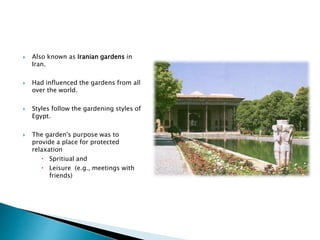
 Also known as Iranian gardens in
Iran.
 Had influenced the gardens from all
over the world.
 Styles follow the gardening styles of
Egypt.
 The garden's purpose was to
provide a place for protected
relaxation
 Spritiual and
 Leisure (e.g., meetings with
friends)
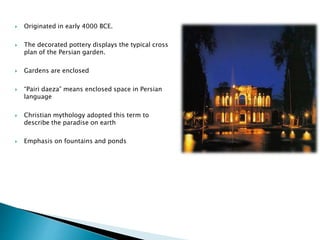
 Originated in early 4000 BCE.
 The decorated pottery displays the typical cross
plan of the Persian garden.
 Gardens are enclosed
 “Pairi daeza” means enclosed space in Persian
language
 Christian mythology adopted this term to
describe the paradise on earth
 Emphasis on fountains and ponds
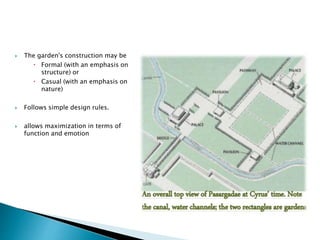
 The garden's construction may be
 Formal (with an emphasis on
structure) or
 Casual (with an emphasis on
nature)
 Follows simple design rules.
 allows maximization in terms of
function and emotion
 The construction have emphasis
either on
 nature or
 Structure
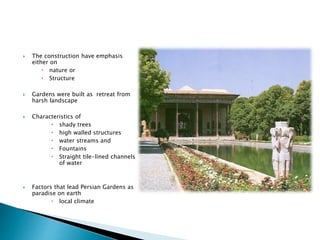
 Gardens were built as retreat from
harsh landscape
 Characteristics of
 shady trees
 high walled structures
 water streams and
 Fountains
 Straight tile-lined channels
of water
 Factors that lead Persian Gardens as
paradise on earth
 local climate
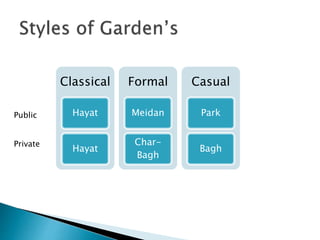
Classical
Hayat
Hayat
Formal
Meidan
Char-
Bagh
Casual
Park
Bagh
Public
Private
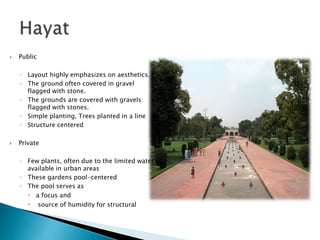
 Public
◦ Layout highly emphasizes on aesthetics.
◦ The ground often covered in gravel
flagged with stone.
◦ The grounds are covered with gravels
flagged with stones.
◦ Simple planting, Trees planted in a line
◦ Structure centered
 Private
◦ Few plants, often due to the limited water
available in urban areas
◦ These gardens pool-centered
◦ The pool serves as
 a focus and
 source of humidity for structural
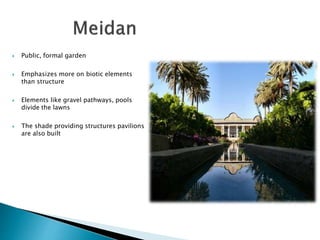
 Public, formal garden
 Emphasizes more on biotic elements
than structure
 Elements like gravel pathways, pools
divide the lawns
 The shade providing structures pavilions
are also built
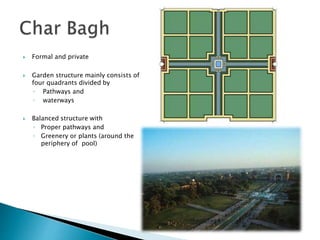
 Formal and private
 Garden structure mainly consists of
four quadrants divided by
◦ Pathways and
◦ waterways
 Balanced structure with
◦ Proper pathways and
◦ Greenery or plants (around the
periphery of pool)
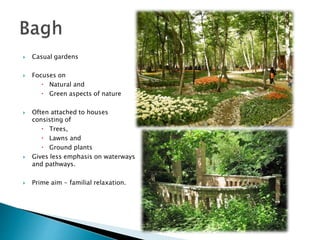
 Casual gardens
 Focuses on
 Natural and
 Green aspects of nature
 Often attached to houses
consisting of
 Trees,
 Lawns and
 Ground plants
 Gives less emphasis on waterways
and pathways.
 Prime aim - familial relaxation.
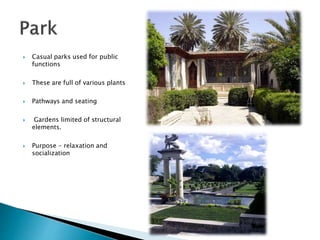
 Casual parks used for public
functions
 These are full of various plants
 Pathways and seating
 Gardens limited of structural
elements.
 Purpose - relaxation and
socialization
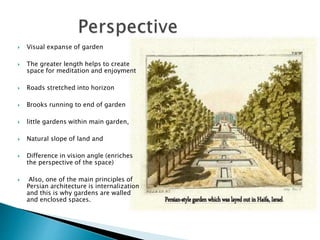
 Visual expanse of garden
 The greater length helps to create
space for meditation and enjoyment
 Roads stretched into horizon
 Brooks running to end of garden
 little gardens within main garden,
 Natural slope of land and
 Difference in vision angle (enriches
the perspective of the space)
 Also, one of the main principles of
Persian architecture is internalization
and this is why gardens are walled
and enclosed spaces.
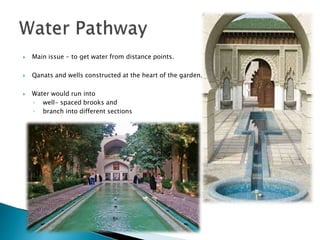
 Main issue - to get water from distance points.
 Qanats and wells constructed at the heart of the garden.
 Water would run into
◦ well- spaced brooks and
◦ branch into different sections
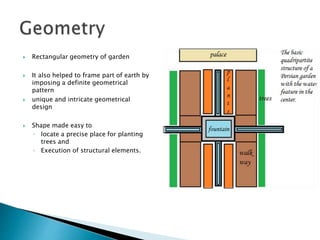
 Rectangular geometry of garden
 It also helped to frame part of earth by
imposing a definite geometrical
pattern
 unique and intricate geometrical
design
 Shape made easy to
◦ locate a precise place for planting
trees and
◦ Execution of structural elements.
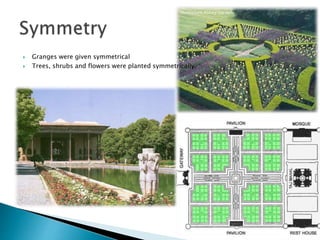
 Granges were given symmetrical
 Trees, shrubs and flowers were planted symmetrically.
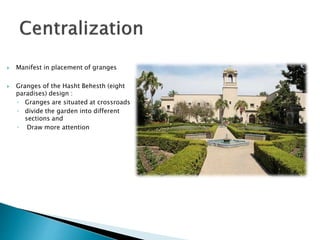
 Manifest in placement of granges
 Granges of the Hasht Behesth (eight
paradises) design :
◦ Granges are situated at crossroads
◦ divide the garden into different
sections and
◦ Draw more attention
Sunlight
◦ The important factor to be considered sunlight and its effects
◦ Architects arranged to restrain (control) sunlight
◦ Textures and shapes were used to harness (prevent) light.
Shade
◦ Important element due to heat of Iran
◦ Gardens includes trees, shrubs and trellises which work as biotic shades to provide
protection
◦ Walls and pavilions used in blocking the harsh sunrays
Water
o Deserted conditions, therefore water is also important feature
o Trees are planted in a ditch called a jub
o to prevent water evaporation and
o allow quick access of water to tree roots
o The underground water canals are built on slopes to facilitate
o natural or
o Artificial flow of water (waterfalls).
Building
o Different structural designs like royal palaces, mansions, temples, etc.
o build domes on square buildings
o These enhance the beauty of these gardens.
o beautiful arches were constructed.
o Beautiful types of glasses (e.g. stain glasses) were used for windows and other glass
works.
PERSIAN GARDEN
 Adds to beauty of the Taj, but they also give it the calm and serene
ambience which makes visiting the Taj Mahal a real pleasure.
 Gardens start from the main gateway and extend up to the Taj mausoleum
 Fountains and running channels of water are typical of garden
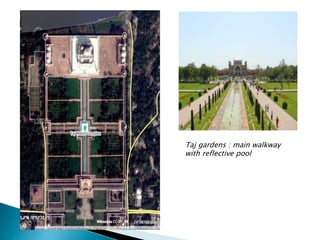
 Gardens are divided into four parts (char bagh), with two main walkways.

- Each of these four parts are further divided into four parts, thus
creating sixteen squares.
- A central canal with a line of fountains passes in between the main
walkway from the main gate to the base of the mausoleum
- The two main walkways(central and east-west)meet in the center where a
raised marble lotus platform is built, it includes a pool with fountains and two
marble bench
Taj gardens : main walkway
with reflective pool
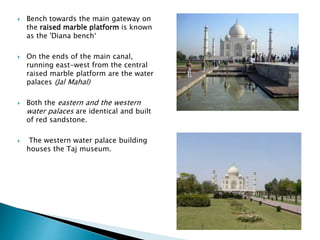
 Bench towards the main gateway on
the raised marble platform is known
as the 'Diana bench‘
 On the ends of the main canal,
running east-west from the central
raised marble platform are the water
palaces (Jal Mahal)
 Both the eastern and the western
water palaces are identical and built
of red sandstone.
 The western water palace building
houses the Taj museum.
 Mughal garden in India, linked through a
channel to the northeast of Dal Lake
 other names are Shalamar Garden, Shalamar
Bagh, Farah Baksh and Faiz Baksh, and the
other famous shore line garden in the vicinity
is Nishat Bagh
 The Bagh was built by Mughal Emperor
Jahangir for his wife Nur Jahan, in 1619.
 The Bagh is considered the high point of
Mughal horticulture
 It is now a public park.
 The similarity in layout of the garden and its architectural
features with the Shalimar Gardens suggest that they may have
been designed by the same architect, Ali Mardan
 Garden describe its profusion of vegetation, including
abundant roses, daffodils, and fruit trees.
 It symbolizes the four flowing rivers of Jannah (Paradise) and
reflects the Paradise garden derived from the Persian paridaeza,
meaning 'walled garden
 Paradise is described as an ideal garden of abundance with four
rivers flowing from a central spring or mountain, separating the
garden into north, west, south and east
 Garden is an adaptation of another Islamic Garden layout known as the Persian
garden
 Built on a flat land on a square plan with four radiating arms from a central
location as the water source
 The garden has three terraces fitted with fountains and with Chinar (sycamore)
tree-lined vistas
 Covers an area of 12.4 hectares built with a size 0f 587 m length on the main
axis channel with total width of 251 m
 The garden has three terraces fitted with fountains and with Chinar (sycamore)
tree-lined vistas
 Shah nahar is the main feeder channel to all the terraces.
 Each one of the three terraces has a specific role
 Willow groves and rice terraces fringed the lake edge.
 Broad green paths bordered the lake with rows of chinar trees.
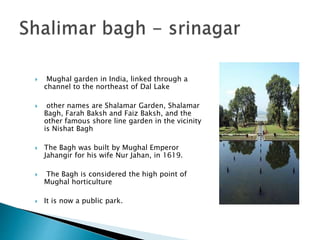
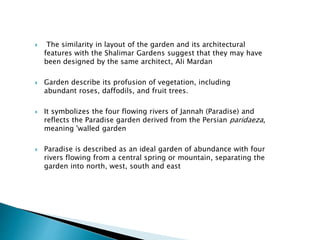
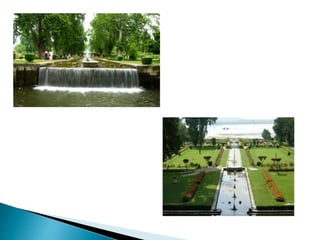
Marble pavilion entrance channel
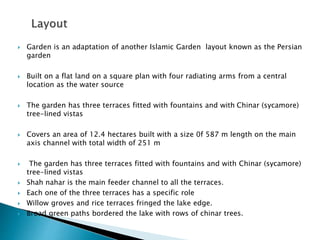
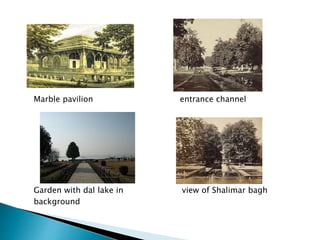
Garden with dal lake in view of Shalimar bagh
background
 first terrace - public garden or the outer garden ending in the Diwan-e-Aam
(public audience hall). In this hall, a small black marble throne was installed
over the waterfall
 Second terrace - The Diwan-e-Khas (the Hall of Private Audience), which was
accessible only to the noblemen or guests of the court
- However, the carved stone bases and a fine platform surrounded by
fountains are still seen
-The royal bathrooms are located on the north-west boundary of this
enclosure.
-The fountain pools of the Diwan-e-Khas, the Diwan-e-Aam, and in
turn, the Zenana terrace ae supplied in succession.
It has 410 fountains
 Third terrace - the axial water channel flows through the
Zenana garden, which is flanked by the Diwan-e-Khas and
chinar trees.
- At the entrance to this terrace, there are two small
pavilions or guard rooms (built in Kashmir style on stone plinth)
that is the restricted and controlled entry zone of the royal
harem
- encircled by a fountain pool that receives its supply from
a higher terrace
- double cascade falls against a low wall carved with small
niches behind the pavilion
-Two smaller, secondary water canals lead from the Black
Pavilion to a small baradari
 Fin Garden, or Bagh-e Fin, located in Kashan
 It contains Kashan's Fin Bath
 Completed in 1590, the Fin Garden is the oldest extant garden in Iran
 UNESCO declared the garden a world heritage site on July 18, 2012
 It was built near the village of Fin under the reign of Abbas I of Persia
(1571-1629).
 It is a historical Persian garden.
 The garden might have its origin in Safavid period
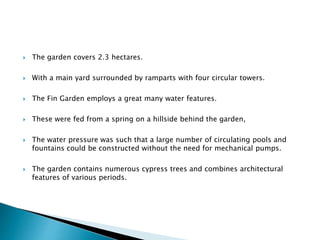
 The garden covers 2.3 hectares.
 With a main yard surrounded by ramparts with four circular towers.
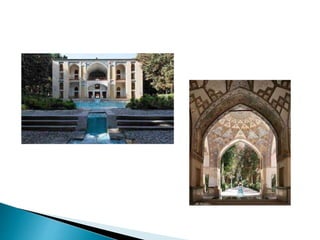
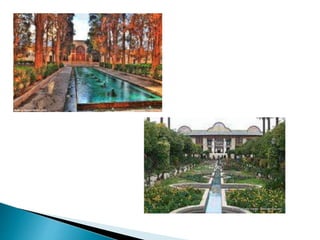
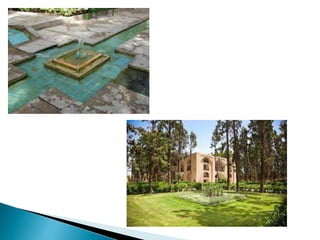
 The Fin Garden employs a great many water features.
 These were fed from a spring on a hillside behind the garden,
 The water pressure was such that a large number of circulating pools and
fountains could be constructed without the need for mechanical pumps.
 The garden contains numerous cypress trees and combines architectural
features of various periods.
Persian garden
Persian garden
Persian garden
Persian garden

Persian garden

  • 2.
     Also knownas Iranian gardens in Iran.  Had influenced the gardens from all over the world.  Styles follow the gardening styles of Egypt.  The garden's purpose was to provide a place for protected relaxation  Spritiual and  Leisure (e.g., meetings with friends)
  • 3.
     Originated inearly 4000 BCE.  The decorated pottery displays the typical cross plan of the Persian garden.  Gardens are enclosed  “Pairi daeza” means enclosed space in Persian language  Christian mythology adopted this term to describe the paradise on earth  Emphasis on fountains and ponds
  • 4.
     The garden'sconstruction may be  Formal (with an emphasis on structure) or  Casual (with an emphasis on nature)  Follows simple design rules.  allows maximization in terms of function and emotion
  • 5.
     The constructionhave emphasis either on  nature or  Structure  Gardens were built as retreat from harsh landscape  Characteristics of  shady trees  high walled structures  water streams and  Fountains  Straight tile-lined channels of water  Factors that lead Persian Gardens as paradise on earth  local climate
  • 6.
  • 7.
     Public ◦ Layouthighly emphasizes on aesthetics. ◦ The ground often covered in gravel flagged with stone. ◦ The grounds are covered with gravels flagged with stones. ◦ Simple planting, Trees planted in a line ◦ Structure centered  Private ◦ Few plants, often due to the limited water available in urban areas ◦ These gardens pool-centered ◦ The pool serves as  a focus and  source of humidity for structural
  • 8.
     Public, formalgarden  Emphasizes more on biotic elements than structure  Elements like gravel pathways, pools divide the lawns  The shade providing structures pavilions are also built
  • 9.
     Formal andprivate  Garden structure mainly consists of four quadrants divided by ◦ Pathways and ◦ waterways  Balanced structure with ◦ Proper pathways and ◦ Greenery or plants (around the periphery of pool)
  • 10.
     Casual gardens Focuses on  Natural and  Green aspects of nature  Often attached to houses consisting of  Trees,  Lawns and  Ground plants  Gives less emphasis on waterways and pathways.  Prime aim - familial relaxation.
  • 11.
     Casual parksused for public functions  These are full of various plants  Pathways and seating  Gardens limited of structural elements.  Purpose - relaxation and socialization
  • 12.
     Visual expanseof garden  The greater length helps to create space for meditation and enjoyment  Roads stretched into horizon  Brooks running to end of garden  little gardens within main garden,  Natural slope of land and  Difference in vision angle (enriches the perspective of the space)  Also, one of the main principles of Persian architecture is internalization and this is why gardens are walled and enclosed spaces.
  • 13.
     Main issue- to get water from distance points.  Qanats and wells constructed at the heart of the garden.  Water would run into ◦ well- spaced brooks and ◦ branch into different sections
  • 14.
     Rectangular geometryof garden  It also helped to frame part of earth by imposing a definite geometrical pattern  unique and intricate geometrical design  Shape made easy to ◦ locate a precise place for planting trees and ◦ Execution of structural elements.
  • 15.
     Granges weregiven symmetrical  Trees, shrubs and flowers were planted symmetrically.
  • 16.
     Manifest inplacement of granges  Granges of the Hasht Behesth (eight paradises) design : ◦ Granges are situated at crossroads ◦ divide the garden into different sections and ◦ Draw more attention
  • 17.
    Sunlight ◦ The importantfactor to be considered sunlight and its effects ◦ Architects arranged to restrain (control) sunlight ◦ Textures and shapes were used to harness (prevent) light. Shade ◦ Important element due to heat of Iran ◦ Gardens includes trees, shrubs and trellises which work as biotic shades to provide protection ◦ Walls and pavilions used in blocking the harsh sunrays
  • 18.
    Water o Deserted conditions,therefore water is also important feature o Trees are planted in a ditch called a jub o to prevent water evaporation and o allow quick access of water to tree roots o The underground water canals are built on slopes to facilitate o natural or o Artificial flow of water (waterfalls). Building o Different structural designs like royal palaces, mansions, temples, etc. o build domes on square buildings o These enhance the beauty of these gardens. o beautiful arches were constructed. o Beautiful types of glasses (e.g. stain glasses) were used for windows and other glass works.
  • 19.
  • 20.
     Adds tobeauty of the Taj, but they also give it the calm and serene ambience which makes visiting the Taj Mahal a real pleasure.  Gardens start from the main gateway and extend up to the Taj mausoleum  Fountains and running channels of water are typical of garden  Gardens are divided into four parts (char bagh), with two main walkways.  - Each of these four parts are further divided into four parts, thus creating sixteen squares. - A central canal with a line of fountains passes in between the main walkway from the main gate to the base of the mausoleum - The two main walkways(central and east-west)meet in the center where a raised marble lotus platform is built, it includes a pool with fountains and two marble bench
  • 21.
    Taj gardens :main walkway with reflective pool
  • 22.
     Bench towardsthe main gateway on the raised marble platform is known as the 'Diana bench‘  On the ends of the main canal, running east-west from the central raised marble platform are the water palaces (Jal Mahal)  Both the eastern and the western water palaces are identical and built of red sandstone.  The western water palace building houses the Taj museum.
  • 23.
     Mughal gardenin India, linked through a channel to the northeast of Dal Lake  other names are Shalamar Garden, Shalamar Bagh, Farah Baksh and Faiz Baksh, and the other famous shore line garden in the vicinity is Nishat Bagh  The Bagh was built by Mughal Emperor Jahangir for his wife Nur Jahan, in 1619.  The Bagh is considered the high point of Mughal horticulture  It is now a public park.
  • 24.
     The similarityin layout of the garden and its architectural features with the Shalimar Gardens suggest that they may have been designed by the same architect, Ali Mardan  Garden describe its profusion of vegetation, including abundant roses, daffodils, and fruit trees.  It symbolizes the four flowing rivers of Jannah (Paradise) and reflects the Paradise garden derived from the Persian paridaeza, meaning 'walled garden  Paradise is described as an ideal garden of abundance with four rivers flowing from a central spring or mountain, separating the garden into north, west, south and east
  • 25.
     Garden isan adaptation of another Islamic Garden layout known as the Persian garden  Built on a flat land on a square plan with four radiating arms from a central location as the water source  The garden has three terraces fitted with fountains and with Chinar (sycamore) tree-lined vistas  Covers an area of 12.4 hectares built with a size 0f 587 m length on the main axis channel with total width of 251 m  The garden has three terraces fitted with fountains and with Chinar (sycamore) tree-lined vistas  Shah nahar is the main feeder channel to all the terraces.  Each one of the three terraces has a specific role  Willow groves and rice terraces fringed the lake edge.  Broad green paths bordered the lake with rows of chinar trees.
  • 26.
    Marble pavilion entrancechannel Garden with dal lake in view of Shalimar bagh background
  • 27.
     first terrace- public garden or the outer garden ending in the Diwan-e-Aam (public audience hall). In this hall, a small black marble throne was installed over the waterfall  Second terrace - The Diwan-e-Khas (the Hall of Private Audience), which was accessible only to the noblemen or guests of the court - However, the carved stone bases and a fine platform surrounded by fountains are still seen -The royal bathrooms are located on the north-west boundary of this enclosure. -The fountain pools of the Diwan-e-Khas, the Diwan-e-Aam, and in turn, the Zenana terrace ae supplied in succession. It has 410 fountains
  • 28.
     Third terrace- the axial water channel flows through the Zenana garden, which is flanked by the Diwan-e-Khas and chinar trees. - At the entrance to this terrace, there are two small pavilions or guard rooms (built in Kashmir style on stone plinth) that is the restricted and controlled entry zone of the royal harem - encircled by a fountain pool that receives its supply from a higher terrace - double cascade falls against a low wall carved with small niches behind the pavilion -Two smaller, secondary water canals lead from the Black Pavilion to a small baradari
  • 30.
     Fin Garden,or Bagh-e Fin, located in Kashan  It contains Kashan's Fin Bath  Completed in 1590, the Fin Garden is the oldest extant garden in Iran  UNESCO declared the garden a world heritage site on July 18, 2012  It was built near the village of Fin under the reign of Abbas I of Persia (1571-1629).  It is a historical Persian garden.  The garden might have its origin in Safavid period
  • 31.
     The gardencovers 2.3 hectares.  With a main yard surrounded by ramparts with four circular towers.  The Fin Garden employs a great many water features.  These were fed from a spring on a hillside behind the garden,  The water pressure was such that a large number of circulating pools and fountains could be constructed without the need for mechanical pumps.  The garden contains numerous cypress trees and combines architectural features of various periods.