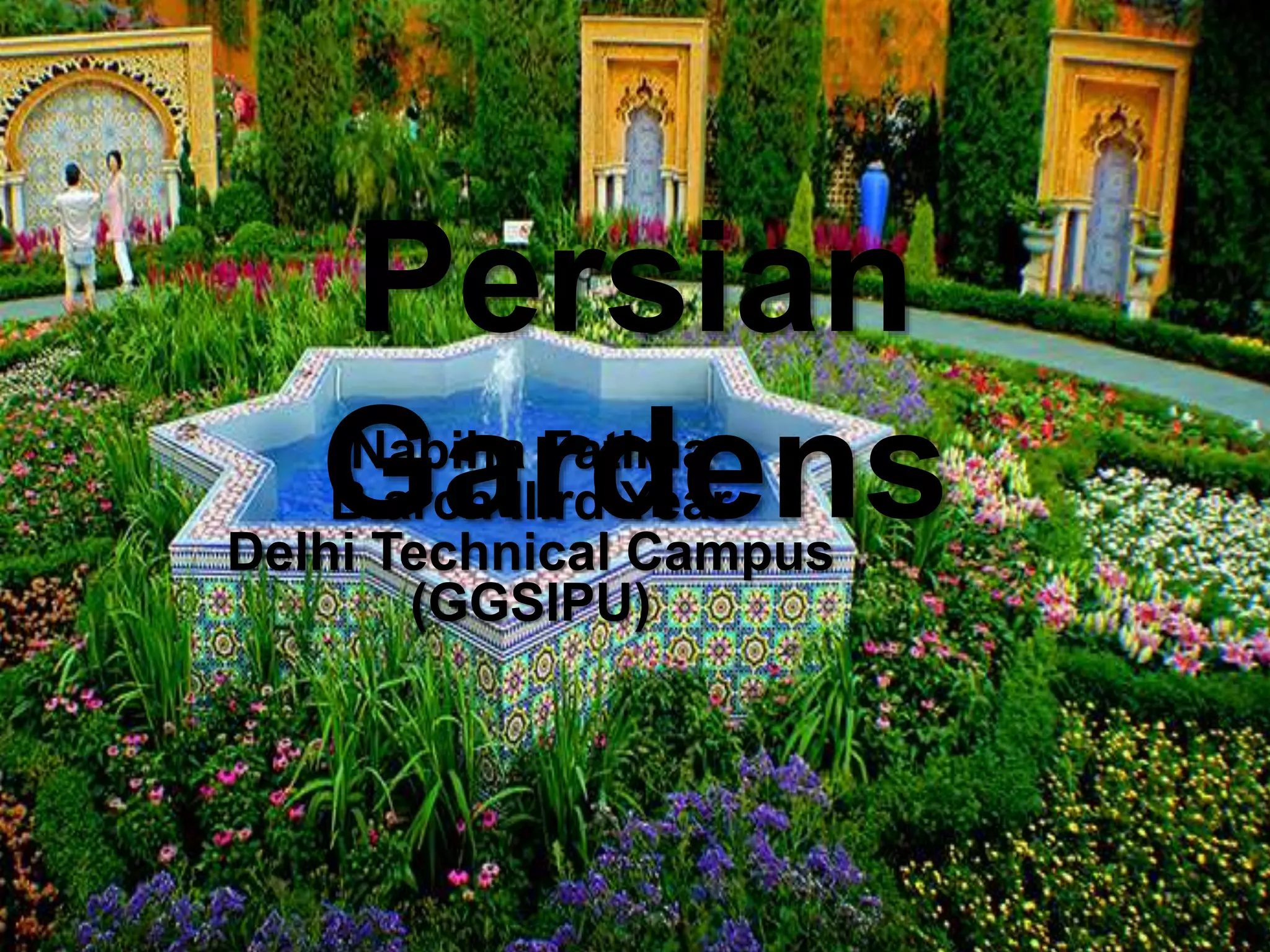
Persian
GardensNabiha Fatima
B.arch IIIrd Year
Delhi Technical Campus
(GGSIPU)
Persian Gardens 2
INTRODUCTION
>The Persian gardens were created as a
model of paradise.
> Greater part of Persia was arid, lacking
water and vegetation.
>The concept of Persian garden was
definitely paradise like, fertile and rich with
fruits and flowers in contrast to the draught,
heat and sun outside.
>It had order and tranquility.
>It can be identified as a place where one
could sit in shade and relax, enjoy the
sounds of the birds, water flow and
fragrance of flowers.
Persian Gardens 3
THE BINDING FACTOR- ISLAM
>In Quran, the garden is constantly cited as
the symbol of paradise, with shade and
water as its ideal elements.
>For main rivers of paradise are also
specified, one with water, one with milk, one
with wine and one of purified honey .
>This is the origin of the Quartered Garden
known in Persia as >Chahar Bagh or Four
Gardens which were divided by means of
THE CONCEPT OF PARADISE GARDENS
paradise is derived from old Iranian root, as
pairi.daêza
Persian Gardens 4
Persian Gardens 5
“The god has actually defined paradise as Garden, and it
is up to individual not only to aspire to it in the after-life,
but also to try to create its image hare on earth.”
The concept of Persian garden was definitely paradise
like, fertile and rich with fruits and flowers in contrast to
the draught, heat and sun outside. It had order and
tranquility.
“It can be identified as a place where one could sit
in shade and relax, enjoy the sounds of the birds,
water flow and fragrance of flowers.
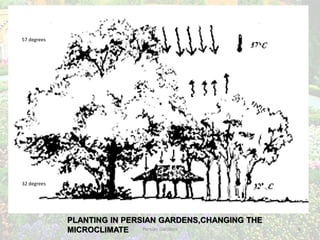
Planting of trees and selection of species was
carefully done in order to improve micro climate
Persian Gardens 6
57 degrees
32 degrees
PLANTING IN PERSIAN GARDENS,CHANGING THE
MICROCLIMATE
Persian Gardens 7
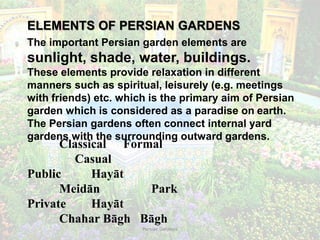
ELEMENTS OF PERSIAN GARDENS
The important Persian garden elements are
sunlight, shade, water, buildings.
These elements provide relaxation in different
manners such as spiritual, leisurely (e.g. meetings
with friends) etc. which is the primary aim of Persian
garden which is considered as a paradise on earth.
The Persian gardens often connect internal yard
gardens with the surrounding outward gardens.
Classical Formal
Casual
Public Hayāt
Meidān Park
Private Hayāt
Chahar Bāgh Bāgh
Persian Gardens 8
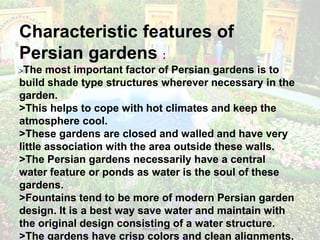
Characteristic features of
Persian gardens :
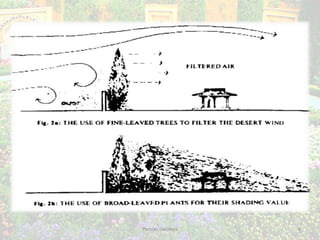
>The most important factor of Persian gardens is to
build shade type structures wherever necessary in the
garden.
>This helps to cope with hot climates and keep the
atmosphere cool.
>These gardens are closed and walled and have very
little association with the area outside these walls.
>The Persian gardens necessarily have a central
water feature or ponds as water is the soul of these
gardens.
>Fountains tend to be more of modern Persian garden
design. It is a best way save water and maintain with
the original design consisting of a water structure.
>The gardens have crisp colors and clean alignments.
Persian Gardens 9
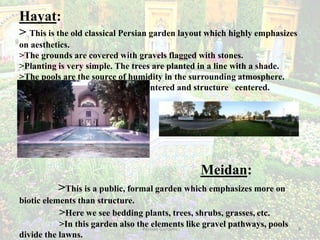
Hayat:
> This is the old classical Persian garden layout which highly emphasizes
on aesthetics.
>The grounds are covered with gravels flagged with stones.
>Planting is very simple. The trees are planted in a line with a shade.
>The pools are the source of humidity in the surrounding atmosphere.
>These gardens are mainly pool centered and structure centered.
Meidan:
>This is a public, formal garden which emphasizes more on
biotic elements than structure.
>Here we see bedding plants, trees, shrubs, grasses, etc.
>In this garden also the elements like gravel pathways, pools
divide the lawns.
Persian Gardens 10
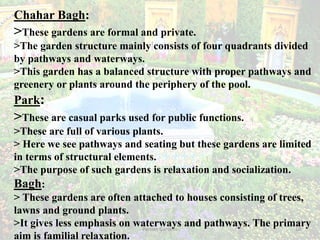
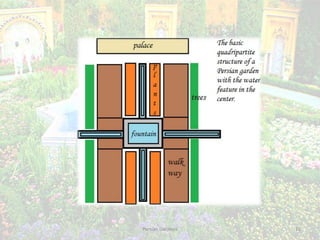
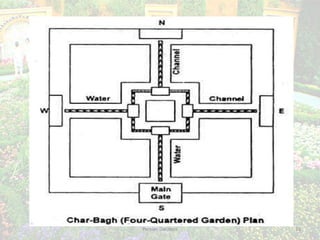
Chahar Bagh:
>These gardens are formal and private.
>The garden structure mainly consists of four quadrants divided
by pathways and waterways.
>This garden has a balanced structure with proper pathways and
greenery or plants around the periphery of the pool.
Park:
>These are casual parks used for public functions.
>These are full of various plants.
> Here we see pathways and seating but these gardens are limited
in terms of structural elements.
>The purpose of such gardens is relaxation and socialization.
Bagh:
> These gardens are often attached to houses consisting of trees,
lawns and ground plants.
>It gives less emphasis on waterways and pathways. The primary
aim is familial relaxation.
Persian Gardens 11
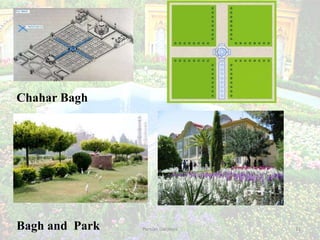
Chahar Bagh
Bagh and Park
Persian Gardens 12
Persian Gardens 13
Persian Gardens 14
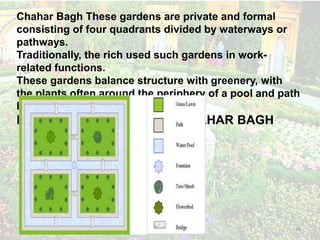
Chahar Bagh These gardens are private and formal
consisting of four quadrants divided by waterways or
pathways.
Traditionally, the rich used such gardens in work-
related functions.
These gardens balance structure with greenery, with
the plants often around the periphery of a pool and path
based structure.
ESSENTIAL FEATURES OF CHAHAR BAGH
Persian Gardens 15
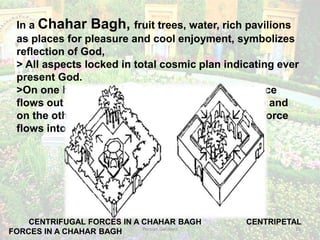
In a Chahar Bagh, fruit trees, water, rich pavilions
as places for pleasure and cool enjoyment, symbolizes
reflection of God,
> All aspects locked in total cosmic plan indicating ever
present God.
>On one hand centrifugal or outward directed force
flows out of the building into the natural paradise and
on the other hand a centripetal or inner directed force
flows into the fountain.
CENTRIFUGAL FORCES IN A CHAHAR BAGH CENTRIPETAL
FORCES IN A CHAHAR BAGH
Persian Gardens 16
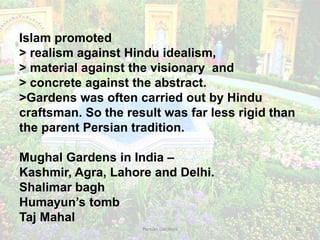
Islam promoted
> realism against Hindu idealism,
> material against the visionary and
> concrete against the abstract.
>Gardens was often carried out by Hindu
craftsman. So the result was far less rigid than
the parent Persian tradition.
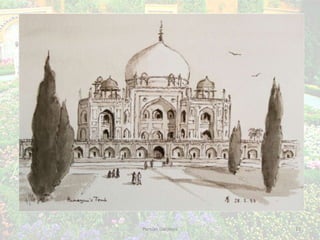
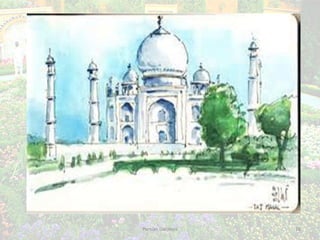
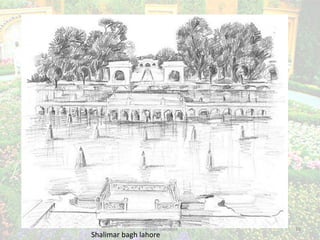
Mughal Gardens in India –
Kashmir, Agra, Lahore and Delhi.
Shalimar bagh
Humayun’s tomb
Taj Mahal
Persian Gardens 17
Persian Gardens 18
Persian Gardens 19
Shalimar bagh lahore

Persian gardens

  • 1.
    Persian GardensNabiha Fatima B.arch IIIrdYear Delhi Technical Campus (GGSIPU)
  • 2.
    Persian Gardens 2 INTRODUCTION >ThePersian gardens were created as a model of paradise. > Greater part of Persia was arid, lacking water and vegetation. >The concept of Persian garden was definitely paradise like, fertile and rich with fruits and flowers in contrast to the draught, heat and sun outside. >It had order and tranquility. >It can be identified as a place where one could sit in shade and relax, enjoy the sounds of the birds, water flow and fragrance of flowers.
  • 3.
    Persian Gardens 3 THEBINDING FACTOR- ISLAM >In Quran, the garden is constantly cited as the symbol of paradise, with shade and water as its ideal elements. >For main rivers of paradise are also specified, one with water, one with milk, one with wine and one of purified honey . >This is the origin of the Quartered Garden known in Persia as >Chahar Bagh or Four Gardens which were divided by means of THE CONCEPT OF PARADISE GARDENS paradise is derived from old Iranian root, as pairi.daêza
  • 4.
  • 5.
    Persian Gardens 5 “Thegod has actually defined paradise as Garden, and it is up to individual not only to aspire to it in the after-life, but also to try to create its image hare on earth.” The concept of Persian garden was definitely paradise like, fertile and rich with fruits and flowers in contrast to the draught, heat and sun outside. It had order and tranquility. “It can be identified as a place where one could sit in shade and relax, enjoy the sounds of the birds, water flow and fragrance of flowers. Planting of trees and selection of species was carefully done in order to improve micro climate
  • 6.
    Persian Gardens 6 57degrees 32 degrees PLANTING IN PERSIAN GARDENS,CHANGING THE MICROCLIMATE
  • 7.
    Persian Gardens 7 ELEMENTSOF PERSIAN GARDENS The important Persian garden elements are sunlight, shade, water, buildings. These elements provide relaxation in different manners such as spiritual, leisurely (e.g. meetings with friends) etc. which is the primary aim of Persian garden which is considered as a paradise on earth. The Persian gardens often connect internal yard gardens with the surrounding outward gardens. Classical Formal Casual Public Hayāt Meidān Park Private Hayāt Chahar Bāgh Bāgh
  • 8.
    Persian Gardens 8 Characteristicfeatures of Persian gardens : >The most important factor of Persian gardens is to build shade type structures wherever necessary in the garden. >This helps to cope with hot climates and keep the atmosphere cool. >These gardens are closed and walled and have very little association with the area outside these walls. >The Persian gardens necessarily have a central water feature or ponds as water is the soul of these gardens. >Fountains tend to be more of modern Persian garden design. It is a best way save water and maintain with the original design consisting of a water structure. >The gardens have crisp colors and clean alignments.
  • 9.
    Persian Gardens 9 Hayat: >This is the old classical Persian garden layout which highly emphasizes on aesthetics. >The grounds are covered with gravels flagged with stones. >Planting is very simple. The trees are planted in a line with a shade. >The pools are the source of humidity in the surrounding atmosphere. >These gardens are mainly pool centered and structure centered. Meidan: >This is a public, formal garden which emphasizes more on biotic elements than structure. >Here we see bedding plants, trees, shrubs, grasses, etc. >In this garden also the elements like gravel pathways, pools divide the lawns.
  • 10.
    Persian Gardens 10 ChaharBagh: >These gardens are formal and private. >The garden structure mainly consists of four quadrants divided by pathways and waterways. >This garden has a balanced structure with proper pathways and greenery or plants around the periphery of the pool. Park: >These are casual parks used for public functions. >These are full of various plants. > Here we see pathways and seating but these gardens are limited in terms of structural elements. >The purpose of such gardens is relaxation and socialization. Bagh: > These gardens are often attached to houses consisting of trees, lawns and ground plants. >It gives less emphasis on waterways and pathways. The primary aim is familial relaxation.
  • 11.
    Persian Gardens 11 ChaharBagh Bagh and Park
  • 12.
  • 13.
  • 14.
    Persian Gardens 14 ChaharBagh These gardens are private and formal consisting of four quadrants divided by waterways or pathways. Traditionally, the rich used such gardens in work- related functions. These gardens balance structure with greenery, with the plants often around the periphery of a pool and path based structure. ESSENTIAL FEATURES OF CHAHAR BAGH
  • 15.
    Persian Gardens 15 Ina Chahar Bagh, fruit trees, water, rich pavilions as places for pleasure and cool enjoyment, symbolizes reflection of God, > All aspects locked in total cosmic plan indicating ever present God. >On one hand centrifugal or outward directed force flows out of the building into the natural paradise and on the other hand a centripetal or inner directed force flows into the fountain. CENTRIFUGAL FORCES IN A CHAHAR BAGH CENTRIPETAL FORCES IN A CHAHAR BAGH
  • 16.
    Persian Gardens 16 Islampromoted > realism against Hindu idealism, > material against the visionary and > concrete against the abstract. >Gardens was often carried out by Hindu craftsman. So the result was far less rigid than the parent Persian tradition. Mughal Gardens in India – Kashmir, Agra, Lahore and Delhi. Shalimar bagh Humayun’s tomb Taj Mahal
  • 17.
  • 18.
  • 19.