MUGHAL GARDENMUGHAL GARDEN
Submitted By:
Ayushi Goel
•MUGHAL
GARDENS are a group of gardens built by the Mughals in the Islamic style of architecture.
•This style
was influenced by Persian gardens.
•Significant
use of rectilinear layouts are made within the walled enclosures.
•Some of
the typical features include pools, fountains and canals inside the gardens.
History
•India,
Bangladesh and Pakistan have a number of Mughal gardens which differ from their
Central Asian predecessors with respect to "the highly disciplined geometry".
•From the
beginnings of the Mughal Empire, the construction of gardens was a beloved imperial
pastime.
Introduction
•Akba
r built several gardens first in Delhi, then in Agra,
•These
tended to be riverfront gardens rather than the fortress garden.
•Buildi
ng riverfront rather than fortress gardens influenced later Mughal garden
architecture considerably.
•Akba
r’s son, Jahangir, did not build as much, but he helped to lay out the famous
Shalimar garden.
•Jaha
ngir's son, Shah Jahan, marks the apex of Mughal garden architecture and floral
design.
•He is
famous for the construction of the Taj Mahal.
•He is
•I
slamic garden as walled
off and protected from the
outside world; within, its
design was rigidly formal.
•I
ts essential features
included running water
(perhaps the most
important element) and a
pool to reflect the beauties
of sky and garden;
•T
rees of various sorts, some
to provide shade merely,
and others to produce
fruits;
•T
AJ MAHAL, AGRA
•H
UMAYUN’S TOMB, DELHI
•R
AM BAGH, AGRA
•S
HALIMAR BAGH
•N
ISHANT BAGH
Sites of Mughal GardensSites of Mughal Gardens
• T
he complex is set around a large 300 Sq. M.
‘Charbagh or Mughal garden.’
• T
he garden uses raised pathways that divide each
of the four quarters of the garden into 16 sunken
flowerbeds.
• A
raised marble water tank at the center of the
garden, halfway between the tomb and
gateway with a reflecting pool on a north-south
axis, reflects the image of the mausoleum.
• E
lsewhere, the garden is laid out with avenues of
trees and fountains.
TAJ MAHALTAJ MAHAL
he Taj Mahal garden is unusual in
that the main element, the tomb, is
located at the end of the garden.
he use of symmetry and pattern can
be seen in the relationship between
sunlight and shade, plants and
water, and light and dark tones. The
effect is that of a Persian rug leading
to the entrance of the mausoleum.
arly accounts of the garden describe
its surplus of vegetation, including
abundant roses, daffodils, and fruit
trees.
HUMAYUN'S TOMB, DELHIHUMAYUN'S TOMB, DELHI
• While the main tomb took over eight years to
build, it was placed in center of a 30-acre
Charbagh Garden, with quadrilateral layout
and was the first of its kind in the South Asia
region in such a scale.
• The highly geometrical and enclosed
Paradise garden is divided into four squares
by paved walkways and two bisecting
central water channels.
• Each of the four square is further divided into
smaller squares with pathways, creating into
36 squares in all, a design typical of later
Mughal gardens.
• The central water channels appear to be
disappearing beneath the tomb structure
and reappearing on the other side in a
straight line, suggesting the Quranic verse,
which talks of rivers flowing beneath the
‘Garden of Paradise’.
• The entire tomb and the garden
is enclosed within high rubble
walls on three sides, the fourth
side was meant to be the river
Yamuna, which has since shifted
course away from the structure.
• The central walkways, terminate
at two gates: a main one in the
southern wall, and a smaller one
in the western wall.
• It has two double-storey
entrances, the West gate which
used now, while the South gate,
which was used during Mughal
era, now remains closed.
• The palm trees have recently
been added to the garden for
making the pathways junction
more appealing.
RAM BAGHRAM BAGH
• The Ram Bagh is the oldest Mughal Garden in India, originally built by
the Mughal Emperor Babur in 1528, located about five kilometers
northeast of the Taj Mahal.
• The garden is a Charbagh, where pathways and canals divide the
garden to represent the Islamic ideal of paradise, an abundant
garden through which rivers flow.
• The Ram Bagh provides an
example of a variant of the
charbagh in which water
cascades down three
terraces in a sequence of
cascades.
• Two viewing pavilions face
the Jumna river and
incorporates a
subterranean 'tahkhana'
which was used during the
hot summers to provide
relief for visitors.
• The garden has numerous
water courses and
fountains.
SHALIMAR BAGHSHALIMAR BAGH
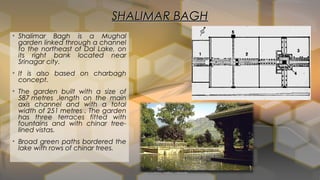
• Shalimar Bagh is a Mughal
garden linked through a channel
to the northeast of Dal Lake, on
its right bank located near
Srinagar city.
• It is also based on charbagh
concept.
• The garden built with a size of
587 metres ,length on the main
axis channel and with a total
width of 251 metres . The garden
has three terraces fitted with
fountains and with chinar tree-
lined vistas.
• Broad green paths bordered the
lake with rows of chinar trees.
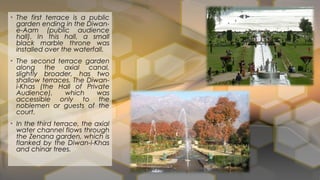
• The first terrace is a public
garden ending in the Diwan-
e-Aam (public audience
hall). In this hall, a small
black marble throne was
installed over the waterfall.
• The second terrace garden
along the axial canal,
slightly broader, has two
shallow terraces. The Diwan-
i-Khas (the Hall of Private
Audience), which was
accessible only to the
noblemen or guests of the
court.
• In the third terrace, the axial
water channel flows through
the Zenana garden, which is
flanked by the Diwan-i-Khas
and chinar trees.
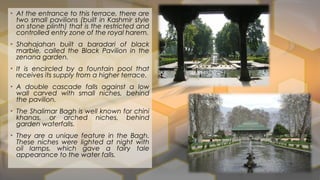
• At the entrance to this terrace, there are
two small pavilions (built in Kashmir style
on stone plinth) that is the restricted and
controlled entry zone of the royal harem.
• Shahajahan built a baradari of black
marble, called the Black Pavilion in the
zenana garden.
• It is encircled by a fountain pool that
receives its supply from a higher terrace.
• A double cascade falls against a low
wall carved with small niches, behind
the pavilion.
• The Shalimar Bagh is well known for chini
khanas, or arched niches, behind
garden waterfalls.
• They are a unique feature in the Bagh.
These niches were lighted at night with
oil lamps, which gave a fairy tale
appearance to the water falls.
NISHAT BAGHNISHAT BAGH
ishat Bagh is a Mughal garden built on
the eastern side of the Dal Lake, close
to the Srinagar city.
ven though the layout of Nishat Bagh
was based on the basic conceptual
model of the Chahar Bagh, it had to be
remodeled to fit the topographic and
water source conditions at the site
chosen in the Kashmir valley.
rectangular layout with east-west
length of 548 meters and width of
338 meters was adopted.
ishat Bagh as laid out now is a broad
cascade of terraces lined with avenues
of chinar and cypress trees, which starts
from the lakeshore and reaches up to
an artificial façade at the hill end.
•R
ising from the edge of the Dal Lake,
it has 12 terraces representing
twelve Zodiacal signs.
•T
here are, however, some similarities
with the Shalimar Bagh, such as the
polished stone channel and
terraces.
•T
he source of water supply to the two
gardens is the same.
•B
uilt in an east-west direction, the top
terrace has the Zenana garden
while the lowest terrace is
connected to the Dal Lake.
•T
he central canal, which runs through
the garden from the top end, is
4 metres wide and has a water
• W
ater flows down in a cascade
from the top to the first
terrace at the lake level.
• T
he water flow from one
terrace to the next is over
stepped stone ramps that
provide the sparkle to the
flow.
• A
t all the terraces fountains
with pools are provided,
along the water channel.
• A
t channel crossings, benches
are provided for people to sit
and enjoy the beauty of the
garden and the cascading
flows and fountain jets.
Mughal Garden

Mughal Garden

  • 1.
  • 2.
    •MUGHAL GARDENS are agroup of gardens built by the Mughals in the Islamic style of architecture. •This style was influenced by Persian gardens. •Significant use of rectilinear layouts are made within the walled enclosures. •Some of the typical features include pools, fountains and canals inside the gardens. History •India, Bangladesh and Pakistan have a number of Mughal gardens which differ from their Central Asian predecessors with respect to "the highly disciplined geometry". •From the beginnings of the Mughal Empire, the construction of gardens was a beloved imperial pastime. Introduction
  • 3.
    •Akba r built severalgardens first in Delhi, then in Agra, •These tended to be riverfront gardens rather than the fortress garden. •Buildi ng riverfront rather than fortress gardens influenced later Mughal garden architecture considerably. •Akba r’s son, Jahangir, did not build as much, but he helped to lay out the famous Shalimar garden. •Jaha ngir's son, Shah Jahan, marks the apex of Mughal garden architecture and floral design. •He is famous for the construction of the Taj Mahal. •He is
  • 4.
    •I slamic garden aswalled off and protected from the outside world; within, its design was rigidly formal. •I ts essential features included running water (perhaps the most important element) and a pool to reflect the beauties of sky and garden; •T rees of various sorts, some to provide shade merely, and others to produce fruits;
  • 5.
    •T AJ MAHAL, AGRA •H UMAYUN’STOMB, DELHI •R AM BAGH, AGRA •S HALIMAR BAGH •N ISHANT BAGH Sites of Mughal GardensSites of Mughal Gardens
  • 6.
    • T he complexis set around a large 300 Sq. M. ‘Charbagh or Mughal garden.’ • T he garden uses raised pathways that divide each of the four quarters of the garden into 16 sunken flowerbeds. • A raised marble water tank at the center of the garden, halfway between the tomb and gateway with a reflecting pool on a north-south axis, reflects the image of the mausoleum. • E lsewhere, the garden is laid out with avenues of trees and fountains. TAJ MAHALTAJ MAHAL
  • 7.
    he Taj Mahalgarden is unusual in that the main element, the tomb, is located at the end of the garden. he use of symmetry and pattern can be seen in the relationship between sunlight and shade, plants and water, and light and dark tones. The effect is that of a Persian rug leading to the entrance of the mausoleum. arly accounts of the garden describe its surplus of vegetation, including abundant roses, daffodils, and fruit trees.
  • 8.
    HUMAYUN'S TOMB, DELHIHUMAYUN'STOMB, DELHI • While the main tomb took over eight years to build, it was placed in center of a 30-acre Charbagh Garden, with quadrilateral layout and was the first of its kind in the South Asia region in such a scale. • The highly geometrical and enclosed Paradise garden is divided into four squares by paved walkways and two bisecting central water channels. • Each of the four square is further divided into smaller squares with pathways, creating into 36 squares in all, a design typical of later Mughal gardens. • The central water channels appear to be disappearing beneath the tomb structure and reappearing on the other side in a straight line, suggesting the Quranic verse, which talks of rivers flowing beneath the ‘Garden of Paradise’.
  • 9.
    • The entiretomb and the garden is enclosed within high rubble walls on three sides, the fourth side was meant to be the river Yamuna, which has since shifted course away from the structure. • The central walkways, terminate at two gates: a main one in the southern wall, and a smaller one in the western wall. • It has two double-storey entrances, the West gate which used now, while the South gate, which was used during Mughal era, now remains closed. • The palm trees have recently been added to the garden for making the pathways junction more appealing.
  • 10.
    RAM BAGHRAM BAGH •The Ram Bagh is the oldest Mughal Garden in India, originally built by the Mughal Emperor Babur in 1528, located about five kilometers northeast of the Taj Mahal. • The garden is a Charbagh, where pathways and canals divide the garden to represent the Islamic ideal of paradise, an abundant garden through which rivers flow.
  • 11.
    • The RamBagh provides an example of a variant of the charbagh in which water cascades down three terraces in a sequence of cascades. • Two viewing pavilions face the Jumna river and incorporates a subterranean 'tahkhana' which was used during the hot summers to provide relief for visitors. • The garden has numerous water courses and fountains.
  • 12.
    SHALIMAR BAGHSHALIMAR BAGH •Shalimar Bagh is a Mughal garden linked through a channel to the northeast of Dal Lake, on its right bank located near Srinagar city. • It is also based on charbagh concept. • The garden built with a size of 587 metres ,length on the main axis channel and with a total width of 251 metres . The garden has three terraces fitted with fountains and with chinar tree- lined vistas. • Broad green paths bordered the lake with rows of chinar trees.
  • 13.
    • The firstterrace is a public garden ending in the Diwan- e-Aam (public audience hall). In this hall, a small black marble throne was installed over the waterfall. • The second terrace garden along the axial canal, slightly broader, has two shallow terraces. The Diwan- i-Khas (the Hall of Private Audience), which was accessible only to the noblemen or guests of the court. • In the third terrace, the axial water channel flows through the Zenana garden, which is flanked by the Diwan-i-Khas and chinar trees.
  • 14.
    • At theentrance to this terrace, there are two small pavilions (built in Kashmir style on stone plinth) that is the restricted and controlled entry zone of the royal harem. • Shahajahan built a baradari of black marble, called the Black Pavilion in the zenana garden. • It is encircled by a fountain pool that receives its supply from a higher terrace. • A double cascade falls against a low wall carved with small niches, behind the pavilion. • The Shalimar Bagh is well known for chini khanas, or arched niches, behind garden waterfalls. • They are a unique feature in the Bagh. These niches were lighted at night with oil lamps, which gave a fairy tale appearance to the water falls.
  • 16.
    NISHAT BAGHNISHAT BAGH ishatBagh is a Mughal garden built on the eastern side of the Dal Lake, close to the Srinagar city. ven though the layout of Nishat Bagh was based on the basic conceptual model of the Chahar Bagh, it had to be remodeled to fit the topographic and water source conditions at the site chosen in the Kashmir valley. rectangular layout with east-west length of 548 meters and width of 338 meters was adopted. ishat Bagh as laid out now is a broad cascade of terraces lined with avenues of chinar and cypress trees, which starts from the lakeshore and reaches up to an artificial façade at the hill end.
  • 17.
    •R ising from theedge of the Dal Lake, it has 12 terraces representing twelve Zodiacal signs. •T here are, however, some similarities with the Shalimar Bagh, such as the polished stone channel and terraces. •T he source of water supply to the two gardens is the same. •B uilt in an east-west direction, the top terrace has the Zenana garden while the lowest terrace is connected to the Dal Lake. •T he central canal, which runs through the garden from the top end, is 4 metres wide and has a water
  • 18.
    • W ater flowsdown in a cascade from the top to the first terrace at the lake level. • T he water flow from one terrace to the next is over stepped stone ramps that provide the sparkle to the flow. • A t all the terraces fountains with pools are provided, along the water channel. • A t channel crossings, benches are provided for people to sit and enjoy the beauty of the garden and the cascading flows and fountain jets.