HINDU GARDEN Made by :- Manisha
khandelwal , kashif zafar
INTRODUCTION
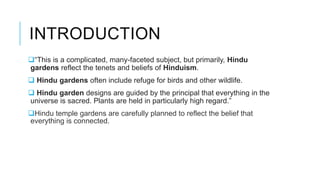
“This is a complicated, many-faceted subject, but primarily, Hindu
gardens reflect the tenets and beliefs of Hinduism.
 Hindu gardens often include refuge for birds and other wildlife.
 Hindu garden designs are guided by the principal that everything in the
universe is sacred. Plants are held in particularly high regard.”
Hindu temple gardens are carefully planned to reflect the belief that
everything is connected.
CONCEPT
A Hindu garden is a tropical paradise resplendent with beautiful tropical
flowers that explode with bright color and sweet aroma.
Other features include shady trees, walkways, water features (such as
natural ponds, waterfalls or streams), and quiet places to sit and meditate.
Most Hindu Gardens include statues, pedestals, lanterns and potted plants.
Statues in rock garden
Bright tropical flower in saheliyon ki bar
PHILOSOPHY
Hinduism is the world’s third largest religion, and many historians believe it
is the world’s oldest religion.
It is the predominant religion in India and Nepal, and is widely practiced in
countries around the world, including Canada and the United States.
Hindu temple gardens are places of worship, designed to connect people
with gods.
The gardens are rich in symbolism that reflects Hindu values.
ARCHITECT /MASTER
ARCHITECT
1. Maharana sajjan singh – gulabh garden, udaipur
2. Nek chand saini – rock garden, chandigarh
3. Maharana sangram singh – saheliyon ki bari , udaipur
Saheliyon ki bari
Gulab bagh
Rock garden
ELEMENTS AND PRINCIPLES
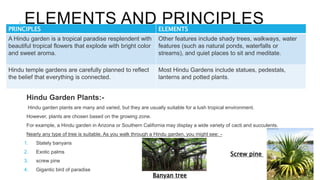
Hindu Garden Plants:-
Hindu garden plants are many and varied, but they are usually suitable for a lush tropical environment.
However, plants are chosen based on the growing zone.
For example, a Hindu garden in Arizona or Southern California may display a wide variety of cacti and succulents.
Nearly any type of tree is suitable. As you walk through a Hindu garden, you might see: -
1. Stately banyans
2. Exotic palms
3. screw pine
4. Gigantic bird of paradise
PRINCIPLES ELEMENTS
A Hindu garden is a tropical paradise resplendent with
beautiful tropical flowers that explode with bright color
and sweet aroma.
Other features include shady trees, walkways, water
features (such as natural ponds, waterfalls or
streams), and quiet places to sit and meditate.
Hindu temple gardens are carefully planned to reflect
the belief that everything is connected.
Most Hindu Gardens include statues, pedestals,
lanterns and potted plants.
Banyan tree
Screw pine
Fruiting or flowering trees may include: -
1. Banana
2. Guava
3. Papaya
4. Royal Poinciana
Common tropical shrubs include: -
1. Colocasia
2. Hibiscus
3. Ti
4. Lantana
Planning a Hindu garden presents a nearly endless choice of blooming plants and vines such as:
1. Bougainvillea
2. Canna
3. Orchids
4. Plumeria
5. Anthurium
6. Crocosmia
7. Trumpet vine
Pampas grass, mondo grass, and other types of ornamental grasses create texture and year-round interest.
Papaya tree Hibiscus shrub
Ti shrub
Lantana shru
Bougainvillea
Orchids
EXAMPLES :-
1) BRINDAVANA GARDEN
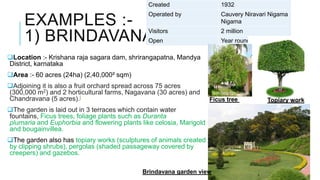
Location :- Krishana raja sagara dam, shrirangapatna, Mandya
District, karnataka
Area :- 60 acres (24ha) (2,40,000² sqm)
Adjoining it is also a fruit orchard spread across 75 acres
(300,000 m2) and 2 horticultural farms, Nagavana (30 acres) and
Chandravana (5 acres).[
The garden is laid out in 3 terraces which contain water
fountains, Ficus trees, foliage plants such as Duranta
plumaria and Euphorbia and flowering plants like celosia, Marigold
and bougainvillea.
The garden also has topiary works (sculptures of animals created
by clipping shrubs), pergolas (shaded passageway covered by
creepers) and gazebos.
Created 1932
Operated by Cauvery Niravari Nigama
Nigama
Visitors 2 million
Open Year round
Topiary workFicus tree
Brindavana garden view
The main attraction of the park is the musical fountain in which bursts of
water are synchronised to the music of songs.
There is also a lake within the garden with boating facilities available for
visitors.
The garden was renovated in 2005 with a cost of Rs. 50 million.
The renovation included sprucing up the musical fountain using a digitised
system and repairs of dysfunctional fountains.
In 2007, the Gardens were closed for a brief duration as a safety measure
to avoid trouble related to the Kaveri water dispute.
Lake between the garden Musical fountain
EXAMPLE :-
2) GULABH BAGH
 Location :- Gulab Bagh (Sajjan Niwas Garden) is the largest garden in
Udaipur, Rajasthan, India.
 Area :- It is spread over 100 acres (40 ha) of land.
The garden has innumerable varieties of roses. Gulab Bagh gets its name from the
abundance of rose flowers it has.
Gulab Bagh is an old Sub-City Level Park, having lush green campus and several places of
attraction including ponds, library, zoological park, temples and several government offices.
The park has 4 entrance gates, Out of 4, only 2 gates are open for general public.
There is appropriate parking facility is available at 2 operational entry gates, and it can
currently accommodate 350 two wheelers and 50 car parking inside the park.
The entire park is surrounded by a boundary wall, 3–5 m in height and made of mix of
concrete, stone and brick.
Country India
State Rajasthan
District Udaipur
Elevation 598 m (1,962 ft)
Fountain in gulab bag
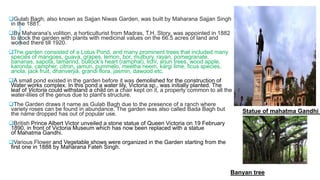
Gulab Bagh, also known as Sajjan Niwas Garden, was built by Maharana Sajjan Singh
in the 1881.
By Maharana's volition, a horticulturist from Madras, T.H. Story, was appointed in 1882
to stock the garden with plants with medicinal values on the 66.5 acres of land and
worked there till 1920.
The garden consisted of a Lotus Pond, and many prominent trees that included many
species of mangoes, guava, grapes, lemon, bor, mulbury, rayan, pomegranate,
bananas, sapota, tamarind, bullock’s heart (ramphal), lichi, arjun trees, wood apple,
karonda, campher, citron, jamun, pummelo, meetha neem, kargi lime, ficus species,
anola, jack fruit, dhanverjia, grandi flora, jasmin, dawood etc.
A small pond existed in the garden before it was demolished for the construction of
Water works complex. In this pond a water lily, Victoria sp., was initially planted. The
leaf of Victoria could withstand a child on a chair kept on it, a property common to all the
water-lilies of the genus due to plant's structure.
The Garden draws it name as Gulab Bagh due to the presence of a ranch where
variety roses can be found in abundance. The garden was also called Bada Bagh but
the name dropped has out of popular use.
British Prince Albert Victor unveiled a stone statue of Queen Victoria on 19 February
1890, in front of Victoria Museum which has now been replaced with a statue
of Mahatma Gandhi.
Various Flower and Vegetable shows were organized in the Garden starting from the
first one in 1888 by Maharana Fateh Singh.
Statue of mahatma Gandhi
Banyan tree
Places within gulabh bagh :-
Saraswati Library
Gulab Bagh encompasses a library, Saraswati Library, which
was originally a museum known as Victoria Hall Museum.
 Navlakha Mahal
Gulab Bagh has a Navlakha Mahal or Navlakha Palace, which is
a religious place for Arya Samaj
Toy Train
There is also a small train that meanders within the zoo. It is
open for kids as well as adults, and there is a nominal fees
for the ride. The train station is named as Luv Kush Railway
Station.
Gulab Bagh Zoo
A zoo is situated within the garden.
Kamal Talai
There is a huge artificial water body named as Kamal Talai,
situated towards north-eastern end of Gulab Bagh. It is an
oval-like structure, consisting of four bridges connecting
with each other at the central junction.
Miraj Jyotish Upvan
There is an Acupressure park called ‘Miraj Jyotish Upvan’
Saraswati library
Kamal talai
Toy train railway station
Miraj jyotish upva
THANKU

Hindu garden

  • 1.
    HINDU GARDEN Madeby :- Manisha khandelwal , kashif zafar
  • 2.
    INTRODUCTION “This is acomplicated, many-faceted subject, but primarily, Hindu gardens reflect the tenets and beliefs of Hinduism.  Hindu gardens often include refuge for birds and other wildlife.  Hindu garden designs are guided by the principal that everything in the universe is sacred. Plants are held in particularly high regard.” Hindu temple gardens are carefully planned to reflect the belief that everything is connected.
  • 3.
    CONCEPT A Hindu gardenis a tropical paradise resplendent with beautiful tropical flowers that explode with bright color and sweet aroma. Other features include shady trees, walkways, water features (such as natural ponds, waterfalls or streams), and quiet places to sit and meditate. Most Hindu Gardens include statues, pedestals, lanterns and potted plants. Statues in rock garden Bright tropical flower in saheliyon ki bar
  • 4.
    PHILOSOPHY Hinduism is theworld’s third largest religion, and many historians believe it is the world’s oldest religion. It is the predominant religion in India and Nepal, and is widely practiced in countries around the world, including Canada and the United States. Hindu temple gardens are places of worship, designed to connect people with gods. The gardens are rich in symbolism that reflects Hindu values.
  • 5.
    ARCHITECT /MASTER ARCHITECT 1. Maharanasajjan singh – gulabh garden, udaipur 2. Nek chand saini – rock garden, chandigarh 3. Maharana sangram singh – saheliyon ki bari , udaipur Saheliyon ki bari Gulab bagh Rock garden
  • 6.
    ELEMENTS AND PRINCIPLES HinduGarden Plants:- Hindu garden plants are many and varied, but they are usually suitable for a lush tropical environment. However, plants are chosen based on the growing zone. For example, a Hindu garden in Arizona or Southern California may display a wide variety of cacti and succulents. Nearly any type of tree is suitable. As you walk through a Hindu garden, you might see: - 1. Stately banyans 2. Exotic palms 3. screw pine 4. Gigantic bird of paradise PRINCIPLES ELEMENTS A Hindu garden is a tropical paradise resplendent with beautiful tropical flowers that explode with bright color and sweet aroma. Other features include shady trees, walkways, water features (such as natural ponds, waterfalls or streams), and quiet places to sit and meditate. Hindu temple gardens are carefully planned to reflect the belief that everything is connected. Most Hindu Gardens include statues, pedestals, lanterns and potted plants. Banyan tree Screw pine
  • 7.
    Fruiting or floweringtrees may include: - 1. Banana 2. Guava 3. Papaya 4. Royal Poinciana Common tropical shrubs include: - 1. Colocasia 2. Hibiscus 3. Ti 4. Lantana Planning a Hindu garden presents a nearly endless choice of blooming plants and vines such as: 1. Bougainvillea 2. Canna 3. Orchids 4. Plumeria 5. Anthurium 6. Crocosmia 7. Trumpet vine Pampas grass, mondo grass, and other types of ornamental grasses create texture and year-round interest. Papaya tree Hibiscus shrub Ti shrub Lantana shru Bougainvillea Orchids
  • 8.
    EXAMPLES :- 1) BRINDAVANAGARDEN Location :- Krishana raja sagara dam, shrirangapatna, Mandya District, karnataka Area :- 60 acres (24ha) (2,40,000² sqm) Adjoining it is also a fruit orchard spread across 75 acres (300,000 m2) and 2 horticultural farms, Nagavana (30 acres) and Chandravana (5 acres).[ The garden is laid out in 3 terraces which contain water fountains, Ficus trees, foliage plants such as Duranta plumaria and Euphorbia and flowering plants like celosia, Marigold and bougainvillea. The garden also has topiary works (sculptures of animals created by clipping shrubs), pergolas (shaded passageway covered by creepers) and gazebos. Created 1932 Operated by Cauvery Niravari Nigama Nigama Visitors 2 million Open Year round Topiary workFicus tree Brindavana garden view
  • 9.
    The main attractionof the park is the musical fountain in which bursts of water are synchronised to the music of songs. There is also a lake within the garden with boating facilities available for visitors. The garden was renovated in 2005 with a cost of Rs. 50 million. The renovation included sprucing up the musical fountain using a digitised system and repairs of dysfunctional fountains. In 2007, the Gardens were closed for a brief duration as a safety measure to avoid trouble related to the Kaveri water dispute. Lake between the garden Musical fountain
  • 10.
    EXAMPLE :- 2) GULABHBAGH  Location :- Gulab Bagh (Sajjan Niwas Garden) is the largest garden in Udaipur, Rajasthan, India.  Area :- It is spread over 100 acres (40 ha) of land. The garden has innumerable varieties of roses. Gulab Bagh gets its name from the abundance of rose flowers it has. Gulab Bagh is an old Sub-City Level Park, having lush green campus and several places of attraction including ponds, library, zoological park, temples and several government offices. The park has 4 entrance gates, Out of 4, only 2 gates are open for general public. There is appropriate parking facility is available at 2 operational entry gates, and it can currently accommodate 350 two wheelers and 50 car parking inside the park. The entire park is surrounded by a boundary wall, 3–5 m in height and made of mix of concrete, stone and brick. Country India State Rajasthan District Udaipur Elevation 598 m (1,962 ft) Fountain in gulab bag
  • 11.
    Gulab Bagh, alsoknown as Sajjan Niwas Garden, was built by Maharana Sajjan Singh in the 1881. By Maharana's volition, a horticulturist from Madras, T.H. Story, was appointed in 1882 to stock the garden with plants with medicinal values on the 66.5 acres of land and worked there till 1920. The garden consisted of a Lotus Pond, and many prominent trees that included many species of mangoes, guava, grapes, lemon, bor, mulbury, rayan, pomegranate, bananas, sapota, tamarind, bullock’s heart (ramphal), lichi, arjun trees, wood apple, karonda, campher, citron, jamun, pummelo, meetha neem, kargi lime, ficus species, anola, jack fruit, dhanverjia, grandi flora, jasmin, dawood etc. A small pond existed in the garden before it was demolished for the construction of Water works complex. In this pond a water lily, Victoria sp., was initially planted. The leaf of Victoria could withstand a child on a chair kept on it, a property common to all the water-lilies of the genus due to plant's structure. The Garden draws it name as Gulab Bagh due to the presence of a ranch where variety roses can be found in abundance. The garden was also called Bada Bagh but the name dropped has out of popular use. British Prince Albert Victor unveiled a stone statue of Queen Victoria on 19 February 1890, in front of Victoria Museum which has now been replaced with a statue of Mahatma Gandhi. Various Flower and Vegetable shows were organized in the Garden starting from the first one in 1888 by Maharana Fateh Singh. Statue of mahatma Gandhi Banyan tree
  • 12.
    Places within gulabhbagh :- Saraswati Library Gulab Bagh encompasses a library, Saraswati Library, which was originally a museum known as Victoria Hall Museum.  Navlakha Mahal Gulab Bagh has a Navlakha Mahal or Navlakha Palace, which is a religious place for Arya Samaj Toy Train There is also a small train that meanders within the zoo. It is open for kids as well as adults, and there is a nominal fees for the ride. The train station is named as Luv Kush Railway Station. Gulab Bagh Zoo A zoo is situated within the garden. Kamal Talai There is a huge artificial water body named as Kamal Talai, situated towards north-eastern end of Gulab Bagh. It is an oval-like structure, consisting of four bridges connecting with each other at the central junction. Miraj Jyotish Upvan There is an Acupressure park called ‘Miraj Jyotish Upvan’ Saraswati library Kamal talai Toy train railway station Miraj jyotish upva
  • 13.