HISTORY OF GARDENS 1
INTRODUCTION
A brief look at historical styles still has a relevance for the
academicians as well as the professionals today even though the
terms of reference may have changed.
Many of the elements that make up today’s landscapes have historical
antecedents, while the number of old gardens which actually remain indicates
that they have stood the test of time visually and as places for use.
In its earliest form the garden was basically an enclosure, made
of thorn or scrub, to keep out wild animals and keep in domestic
ones. The enclosure later took more permanent shape as a defense
against other humans as much as the animals. This was also used
for growing both food and plants.
This creation of a small private sanctuary characterized early enclosed gardens,
although their function varied according to the climate and lifestyle.
HISTORY OF GARDENS 2
DIFFERENT STYLES
•Early Egyptian Gardens
•Persian & Moorish Landscapes
•Mughal Gardens
•16th C. Italian Renaissance Gardens
•17th C. French Renaissance Landscapes
•18th C. English Romantic Landscapes
•Japanese Landscapes
•Chinese landscapes
•American Contemporary Landscapes
•Indian Traditional Landscapes
HISTORY OF GARDENS 3
Early Gardens
Earliest recorded garden in Egypt in 3000 BC.
•Completely utilitarian in concept & layout
•Surrounded by mud wall to ward off sun and heat
•Square or rectangular shaped with the house located within
•Formal layout
•Use of water as irrigation channels
•Channels for functional reasons divided the garden into geometric
areas
•Plants & herbs were grown for consumption and medicinal values
(e.g. Onion as their staple diet & other vegetables)
•More elaborate gardens had channels widened into pools with fish
and arbours with vines to sit under as well as shade giving
Palms.
HISTORY OF GARDENS 4
Examples
This fresco (1400 BC) found on the tomb of
Nebamun in Thebes shows an ornamental fish
Pond in the centre with fruit trees, Palms & Vines
This Persian miniature paintings shows Babur in
Bagh-I-vafa (Garden of Fidelity). The irrigation channel
Divides the garden into four and there are Orange & Pomegranate trees surrounding the
Reservoir.
HISTORY OF GARDENS 5
PERSIAN GARDENS
The formal style of early Egyptian gardens characterized the whole
Islamic world during the next few thousand years.
• Gardens were walled with grape vines and other creepers
• Fruit trees like Peach, Apple, Cherry, Banana, Date and Olive
were cultivated.
• Flowers like Poppies, Lilies, Chrysanthemums and Roses were
grown in formal beds between the cross shaped water channels.
• The idea of a flowering Paradise within a formal setting were
captured in Persian writings, painted miniatures and woven
carpets.
HISTORY OF GARDENS 6
MOORISH GARDENS
The Persian concept influenced
the Mughal and Moorish gardens.
Water was used to link different
planted areas and for cooling
effect.
The Moorish influence stretched
along North Africa into Sicily and
Southern Italy to Southern Spain
to South America to California
where it was eventually
metamorphosed into today’s patio
Garden, with water in the form of
swimming pool.
Style remained same as formal &
symmetrical with high walls for
shade and privacy.
Moorish Tradition in Californian water garden:
Formal & symmetrical with high walls giving a
Private, enclosed feeling.
HISTORY OF GARDENS 7
MOORISH GARDENS
Designed for outdoor living within
the confines of one’s own property.
Moorish Garden in Spain consisted
of several courtyards, known as
Patios, with water as the connecting
link.
Canals with central fountain, ornate
pillars, tiled floors & walls.
Orange trees planted along wall to
give extra shade & Aromatic plants
along the edge of water – A
progress of utilitarian concept to
aesthetics.
Patio-de la Riadh in Granada, Spain:
•Curving jets of water fall
•Flower-edged central canal
•Walled enclosure
HISTORY OF GARDENS 8
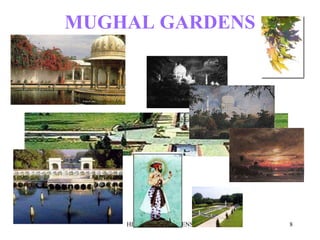
MUGHAL GARDENS
HISTORY OF GARDENS 9
PHILOSOPHY OF
MUGHALS
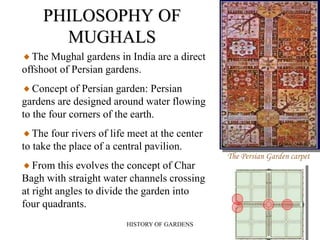
The Mughal gardens in India are a direct
offshoot of Persian gardens.
Concept of Persian garden: Persian
gardens are designed around water flowing
to the four corners of the earth.
The four rivers of life meet at the center
to take the place of a central pavilion.
From this evolves the concept of Char
Bagh with straight water channels crossing
at right angles to divide the garden into
four quadrants.
The Persian Garden carpet
HISTORY OF GARDENS 10
A
BABAR WITH HIS
LADIES,BESIDE THE
LOTUS POND
 The Mughal Empire
in Northern India
lasted as an
effective power
from 1526 to the
1750s.
 The gardens
created by the
Mughal dynasty rank
as one of the great
landscape traditions
of the world.
HISTORY OF GARDENS 11
There were basically two types of Mughal gardens
—those surrounding a mausoleum (mausoleum
garden) and those developed for pleasure (pleasure
garden).
The first one was built by the owner during his own
life for holding receptions and banquets. After his
death it was converted into a tomb- Humayun’s tomb/
Taj Mahal.
The next was related to the traditional formal
paradise-type layout - Kashmir has many pleasure
gardens which were situated on the lower slopes of
the surrounding mountains like Shalimar bagh, Nishat
bagh etc.
12
TYPICAL MUGHAL GARDEN
A new environment in
which water was to play an
important role.
Mughal gardens were laid
out in conformation with
geometrical patterns, with
divisions and sub-divisions.
Normally square or rectangular in plan, was divided into four
quarters (CHAR BAGH) and was enclosed by a high wall.
Typical tomb garden plan
Charbagh is a Persian-style garden layout, in which the main building is put at the centre
of a quadrilateral garden, divided by walkways or flowing water into four smaller
parts. Charbagh style was brought to India by Mughals. Humayun's tomb and Taj Mahal
in India are the most famous examples of this style
HISTORY OF GARDENS 13
PLANTS AS ELEMENT
Fresh green willows
form a leafy green
canopy.
Fruit trees were
planted for
revenue and beauty
Flowers like jasmine &
michelia were used for
colour and scent
Chenar gave weight,
shade & sense of scale
within the gardens.
HISTORY OF GARDENS
14
PLANT MATERIALS IN MUGHAL
GARDENS
 It is known that their gardens were full of flowers,
fruits and in Kashmir shade trees as cypress, willow,
poplar were present. The plains added to palms, mango,
tamarind and the pagoda tree.
 Fruits included Almond, Cherry, Apple, Mango, Melons,
Pineapple, Orange, etc.
 The Saffron crop of Kashmir was economically very
important. Flowers included Carnation, Coxcomb,
Jasmine, Lotus, Hollyhock etc.
HISTORY OF GARDENS 15
WATER AS ELEMENT
It is an idealized
form in the pattern
of irrigation
Water containers included
Channels, chaddars,
Reflecting pools etc.
Water is shown
symbolically & physically
as the source of life
Channels divide
area into four
rectangular parts
Water is the basic
essence of a
Mughal garden
HISTORY OF GARDENS 16
From terrace to terrace the
water was led down the
beautiful slopes called Chadars
which mean white shawls of
water - of marble or stone
chutes carved in various patterns
so that the water running over
them were thrown up and
broken into ripples and splashes.
constructed canals and tanks
like the Persians.
Carved marble chaddar or water chute
Moving water
HISTORY OF GARDENS 17
Series of niches were also provided behind the waterfall
The Mughals like the Persians paved the channels of water
with blue tiles.
HISTORY OF GARDENS 18
Fountains
HISTORY OF GARDENS 19
Still water Although water was visually
confined within the water axes,
its presence was everywhere
apparent. Water has a visual and
psychological cooling effect,
which contributed to the overall
sense of lushness in the garden
HISTORY OF GARDENS 20
HARDSCAPING ELEMENTS
Chabutra-thrones
overlooking the
garden.
Pavilions built
of marble
sandstone
Monumental
and ornate
gateways
Intricate marble
lattice in tomb
gardens
Brick and
stone paving.
HISTORY OF GARDENS 21
BABUR
 The first Mughal emperor was a
great patron of garden art. He
gave instructions that the
gardens he had created should be
well kept, properly watered and
maintained with flowers.
 The important gardens under his
patronage include Bagh-i-wafa,
Ram bagh, Dehra bagh, Zahara
bagh etc.
HISTORY OF GARDENS 22
RAM BAGH, AGRA
Dramatic siting, brilliant use of water and a deep and skilful
delight in planting and architecture.
Rambagh or Arambagh- ‘Garden of Rest’
The basic pattern is
one of geometrically laid
out walks,with platforms
raised well above ground
level from which to view
the gardens.
A terrace follows the
east bank of Jamuna and
on it are the remains of
two substantial
buildings.
HISTORY OF GARDENS 23
HUMAYUN’S TOMB, DELHI
The garden has four main parts.
These are divided by waterways
that come out of the central tomb
area and lead to the four gates.
It takes the Char Bagh motive
and enlarges and repeats it in an
intricate pattern almost wholly two-
dimensional and Persian in
character.
Plan of the tomb garden
The tomb of Emperor Humayun is a typical Mughal mausoleum
garden of the earliest period.
HISTORY OF GARDENS 24
HUMAYUN’S TOMB, DELHI
The channels and tanks
have the depth of mere
engravings but minute
differences of level are
created in order to exploit
the ripple of water.
Water and the garden
are important parts of
tombs because they remind
the visitor of paradise,
where water and vegetation
are abundant. The first memorial garden tomb of a Mughal Emperor
HISTORY OF GARDENS 25
AKBAR’S TOMB , SIKANDRA
The tomb stands
on a raised
platform from
which four wide
raised causeways
lead to four
gateways.
The garden
needs its trees
(cypress, pine,
plane and palm) to
create a soothing
atmosphere. The perspective of Akbar’s Tomb
HISTORY OF GARDENS 26
AKBAR’S TOMB , SIKANDRA
The plan is exactly
geometrical, dimension
repeats dimension and the
whole is finely proportioned
to set off the great tomb
within it.
A walled enclosure is
divided symmetrically by the
mausoleum at the centre, into
the four fold plot of Babar’s
Bagh-I-wafa
Four tanks set in the centre
platform supplied water to the
narrow runnels
HISTORY OF GARDENS 27
MUGHAL GARDENS OF KASHMIR
HISTORY OF GARDENS 28
SHALAMAR BAGH , KASHMIR
Built by Emperor
Jehangir for his wife
Nur Jehan,
Shalimar, is a
beautiful garden with
sweeping vistas over
gardens and lakes,
and shallow terraces.
The garden is 539
m by 182 m and has
four terraces, rising
one above the other.
EMPEROR’S
GARDEN
ZENANA
GARDEN
Plan
Section
HISTORY OF GARDENS 29
A canal lined with polished stones and supplied
with water from Harwan runs through the middle
of the garden.
The fourth terrace, by far the best, was once
reserved for royal ladies called the Black Pavilion.
The entrance pavilion Shalimar Garden in summer
SHALAMAR BAGH , KASHMIR
HISTORY OF GARDENS 30
NISHAT BAGH , KASHMIR
Situated on the banks of the
Dal Lake, with the Zabarwan
Mountains as its backdrop
and was designed by Asaf
Khan
It's the largest of the
Mughal gardens measuring
548 metres by 338 metres,
and often the most crowded.
The walks beside the channel
are bordered with lines of
Cypresses and Chinars. “The Garden of Bliss” in autumn
Nishat Bagh has 12 terraces representing the 12 signs of the zodiac
which descend gradually and seem to almost merge into the lake.
HISTORY OF GARDENS 31
NISHAT BAGH , KASHMIR
Situated at the foot of a hill with a row of chinars framing it, the
garden is a visual delight with their stepped terraces, formal elegance,
ornamental shrubs, sparkling fountains, a beautiful pink pavilion and
a steeply angular bridge into a hitherto unsuspected inner lake.
HISTORY OF GARDENS 32
CHASME SHAHI, KASHMIR
Smallest of the Srinagar
Mughal gardens, measuring
just 108 metres by 38 metres,
the Chasma Shahi, or 'Royal
Spring', are well up the
hillside.
The fresh water spring in
these pleasant, quieter
gardens is reputed to have
medicinal properties.
The gardens were laid out
in 1632 by Ali Mardan Khan
and include three terraces, an
aqueduct, waterfalls and
fountains
SECTION
PLAN
HISTORY OF GARDENS 33
CHASME SHAHI, KASHMIR
The water from the spring supplies
the fountains and then goes through the
floor of the pavilion and falls to the
lower terrace in a cascade of 5metres,
over a polished black stone chute.
There is a small shrine,
the Chasma Sahibi, near
the gardens, which also has
a fresh water spring.
Quiet garden or “The Royal Spring”
HISTORY OF GARDENS 34
SHALAMAR BAGH , LAHORE
The Shalamar gardens at Lahore were laid
out by Ali Mardan Khan, on Shah
Jahan’s instructions.
• The design comprises three terraces,
dropping down from the south, the
changes in level being about 15’.
• The first and third terraces are char-
baghs of similar proportion and design; the
middle one contains the great reservoir
which is the principal feature of the garden.
• The garden seems to have been especially
noted for the large number of buildings
which it contained.
HISTORY OF GARDENS 35
FAIZ BAKSH LOWER , LAHORE
The lower terrace,
forming more public part of
the garden, were known
together as the Faiz Baksh
(the Bestower of Plenty).
Eighteen feet wide, 800
feet long, and 1.5 feet deep,
this was the most
commanding water channel
built in the Mughal gardens
This was merely the cross-axis in the lowest, most public,
terrace of the garden.
View from the lower terrace to upper terrace
HISTORY OF GARDENS 36
FAIZ BAKSH MIDDLE , LAHORE
The central level is the
most spectacular. The great
reservoir, 200 across, once
contained 152 fountains.
In the centre is a marble
platform, reached by a
narrow causeway.
Round the whole reservoir
runs a double paved path,
with a flower parterre.
The water flows through the southern pavilion by way of a
broad carved marble chute or chadar and at the bottom,
overhanging the water, is the emperor’s throne of white marble.
HISTORY OF GARDENS 37
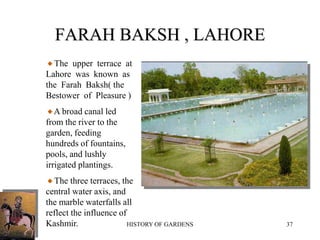
FARAH BAKSH , LAHORE
The upper terrace at
Lahore was known as
the Farah Baksh( the
Bestower of Pleasure )
A broad canal led
from the river to the
garden, feeding
hundreds of fountains,
pools, and lushly
irrigated plantings.
The three terraces, the
central water axis, and
the marble waterfalls all
reflect the influence of
Kashmir.
HISTORY OF GARDENS 38
TAJ MAHAL, AGRA
The mausoleum, instead of occupying the
central point stands at the north end just above
the river.
Each of the four quarters of the garden have
again been sub-divided into sixteen flower
beds by stone-paved raised pathways.
The tank has been arranged to perfectly
reflect the Taj in its waters.
At the centre of the garden, halfway
between the tomb and the gateway, stands a
raised marble lotus-tank with a cusped and
tree foiled border.
Two marble canals studded with fountains
and lined with cypress trees (symbolising
death) cross in the centre of the garden
dividing it into four equal squares.
HISTORY OF GARDENS 39
TAJ MAHAL, AGRA
Modeled after the Persian
concept of earthly paradise, the
Taj exhibits elaborate renditions
of cut-stone architecture, water
chutes, standing pools, flowing
fountains, and plantings to
stimulate all the senses
Landscape artists at the Taj
attempted to translate the
perfection of heaven into
terrestrial terms by following
certain formulas.
In Islam, four is the holiest of all numbers - most arrangements of the
Taj are based on that number or its multiples - and the gardens were
thus laid out in the quadrate plan.
HISTORY OF GARDENS 40
TAJ MAHAL, AGRA
The star shaped pattern of the
parterres is preserved along the
main canal.
The architects designed a clever
system to procure water for the Taj
through underground pipes
To ensure uniform and
undiminished water pressure in the
fountains, irrespective of the
distance and the outflow of water, a
copper pot was provided under
each fountain pipe
The floral inlays, possibly the
outstanding decorative feature,
are world renowned.
HISTORY OF GARDENS 41
PINJORE GARDENS, HARYANA
Nawab Fidai Khan, a cousin of
Aurangzeb, and an architect of repute
planned the architecture of the
gardens.
He planned the Garden on the
classical Charbagh pattern, giving the
area central waterway.
Both sides of this waterway were
covered with the patches of green
bordered with flowers and shaded by
plants like the traditional Palm, the
Cypress and Magnolia. Romantic Sunset at Pinjore
HISTORY OF GARDENS 42
PINJORE GARDENS, HARYANA
The seven terraces at Pinjore,
instead of ascending, descend into the
distance.
From the stately Sheesh Mahal
built in the Rajasthani–Mughal style,
the watercourse with its never-ending
bubbling cascades, flowing under the
towering Rang Mahal, and then
around the Jal Mahal.
The graceful arched balconies and
tinkling fountains, luxuriant green
lawns and murmuring watercourse,
and colourful flowerbeds, and
monumental gateways—all were
carefully planned to create a special
effect.
HISTORY OF GARDENS 43
METAMORPHOSIS
Narrow rills developed into wider canals and great tanks- to enjoy the cool air
generated by large sheets of water and its need in Indian heat.
Transformation from simple stone thrones in the water channels of Nishat and
Shalamar to elaborate building set in centre of great tanks surrounded by sprouting
jets of water.
Another Persian feature which persisted in the earlier Mughal Gardens was the
underground room but as the new comer adjusted to the surroundings they
delighted more in life in open air.
Single jets from Persian tanks developed into hundreds of fountains.
Level Landscape to contoured landscape indicative of increasing magnificence
and simplicity.
Water from its simple existence as channels and tanks were found in great
fountains and cascades.
HISTORY OF GARDENS 44
In early 15th C., merchants in Florence began to build villas or farms
on the surrounding hills. The earliest Renaissance garden were at
first in the formal enclosed tradition but gradually a view was
allowed into the garden through a hole in the wall. As a natural view
became more important the enclosures were swept away and the hill
side gardens were allowed to stretch through the Olive groves and
vineyards.
ITALIAN LANDSCAPE
HISTORY OF GARDENS 45
During 16th C., in Rome, architect Bramante designed a Papal
Garden within the Vatican.
This was the fore-runner of High Renaissance style, with a
magnificent arrangement of steps and terraces, which became a
prototype of everything that followed.
From then on, the
garden design had
terraces at different
levels retained by
walls and
interconnected by
grand staircases.
HISTORY OF GARDENS 46
Water remained as a major feature, but in more engineered form. It
was pressurised and used spectacularly, progressing down an incline
or displayed in an elaborate fountain.
While these renaissance gardens were cool retreat with shade and
water of great importance, they were also show places where
vegetation were deliberately manipulated.
The Italians were
the first to make
decorative use of
plants with
HEDGES to link
the house and
garden
structurally.
HISTORY OF GARDENS 47
Two Great Gardens:
1. Villa d Este, Tivoli
2. Villa Lante
HISTORY OF GARDENS 48
Villa d Este, Tivoli, Italy
Villa d‘ Este overlooking beautiful Lake Como.
The villa is actually situated in the town of
Cernobbio (pronounced 'chair-know-bee-oh')
With hilly terrain as the
natural landform, the garden
was laid out in terraces with
ornamental vegetative patterns
Made to use the slopes.
HISTORY OF GARDENS 49
Villa d Este, Tivoli, Italy
Villa d Este, 16th C.
garden of
Renaissance Italy:
Ridges and high
Points tend to segment
the land
Into separate spaces
and use areas
In the form of terraces.
HISTORY OF GARDENS 50
HISTORY OF GARDENS 51
Water provides a great
Spectacle with grand
Displays such as these:
Cascading down
terraces which are
carved out of hill sides
And create a dramatic
water fall.
Terraces are edged
with balustrades and
the theatrical setting is
complemented by
statuaries – readily
available from ancient
Roman sites.
HISTORY OF GARDENS 52
HISTORY OF GARDENS 53
HISTORY OF GARDENS 54
Water in various moods of dynamicity:
Shooting up, falling gracefully,
Gushing with rage etc.
HISTORY OF GARDENS 55
Villa Lante
HISTORY OF GARDENS 56
Lavish use of carved stone
Sculptures integrated with
water and vegetation.
HISTORY OF GARDENS 57
FRENCH LANDSCAPE
Some Great Gardens of Renaissance France:
1.Villandry
2.Vaux Le Vicomte
3.Versailles
The Renaissance movement originating in Italy spread Northwards,
together with increased knowledge about plants and their cultivation.
In France, the small formal gardens within the walls of moated
cha^teau moved outside becoming more grander in scope.
Dictated by the natural landform of flat plain terrains of France,
Large expanses of water body or grass areas were possible to create.
The style remained geometric, as the original pattern of formal beds
Within a grid system of paths was simply repeated in order to enlarge
The garden.
HISTORY OF GARDENS 58
Chateau Garden at Villandry, France
Geometric garden with intricate parterres of clipped box-hedges
And vegetables grown for their colour, beauty and consumption.
HISTORY OF GARDENS 59
Vaux-Le Vicomte: Location
In 17th C., Andre Le Notre changed
French garden planning
significantly. With Vaux-le-
Vicomte in 1661, he established a
style that was to influence the
whole of Europe for a century.
His layout was still very
geometrical and formal, but they
became much more elaborate and
interesting with long magnificent
vistas, pools or rectangular canals
and grand water parterres.
HISTORY OF GARDENS 60
Vaux Le Vicomte
HISTORY OF GARDENS 61
HISTORY OF GARDENS 62
HISTORY OF GARDENS 63
HISTORY OF GARDENS 64
HISTORY OF GARDENS 65
Another distinctive character
Was the hedge lined avenues
Which fanned out through the
Surrounding forest known as
Pattes d’oie (Goose feet).
HISTORY OF GARDENS 66
HISTORY OF GARDENS 67
HISTORY OF GARDENS 68
HISTORY OF GARDENS 69
VERSAILLES
Versailles, the 17th Century
French Renaissance
Garden:
In the context of the flat
topography of France,
landform at Versailles
Functions as a unifying
factor, visually and
functionally, Connecting
other components in the
landscape e.g. Vista
formation
HISTORY OF GARDENS 70
Location of Versailles
HISTORY OF GARDENS 71
The Grand Canal
Le Notre was appointed royal landscape architect to King Louis
XIV & The garden at VERSAILLES is his best creation.
•In concept, it was a vast outdoor drawing room, intended for the
entertainment of a court of thousands.
•Canals and display water,clipped and trained vegetation,
Statuaries and the elaborate parterres provided visual interest.
HISTORY OF GARDENS 72
A grand royal garden laid out in monumental scale.
HISTORY OF GARDENS 73
View of the landscape
74
Latona Fountain
Apollo Fountain Tapis vert or Grass Carpet
HISTORY OF GARDENS 75
HISTORY OF GARDENS 76
HISTORY OF GARDENS 77
View of the Grand Canal across Latona fountain
HISTORY OF GARDENS 78
Apollo Fountain
Parterres
HISTORY OF GARDENS 79
ENGLISH LANDSCAPE
The gardens of English royalty and aristocracy were developed on
the lines of Italian and French Renaissance layouts during the 16th &
17th C. They were less rigorously formal as the English climate is
more conducive to mixed planting. There was also a developing
interest in horticulture and emphasis on flowers grown for their
appearance rather than for culinary or medicinal use.
HISTORY OF GARDENS 80
Early English Gardens
One of the first gardens in the grand formal
Style was at Hampton Court Palace, later
emulated by all the nobility.
The flower beds were laid out in a knot-
garden pattern and other characteristics
included mazes, gazebos, topiary, sun-
dials, trellis and arbour. Vegetable gardens
were usually walled and separate from the
main garden.
After 1660, the influence of Versailles
reflected in the replacement of simple
knots by grand parterres, gentle fountains
by vast lakes and canals, while broad
beech-lined avenues stretched out to the
horizon.
HISTORY OF GARDENS 81
Sheffield Park
The Great Garden of Stourhead
During the 18th C., influenced by writers,
landscape painters & philosophers, the
English Landscape Movement reacted
Against the artificiality of formal gardens.
It professed the curved lines and irregularity
of nature and the idea of a romantic natural garden. Formal gardens were entirely swept
away by this new school of thought.
With William Kent as the pioneer of this movement, followed by Lancelot Brown and
Humphrey Repton, contours were altered, hills built and valleys excavated, straight paths
were abandoned and straight canals turned into serpentine lakes.
Garden of Stourhead
HISTORY OF GARDENS 82
The Garden of Stowe
HISTORY OF GARDENS 83
William Kent 1685 - 1748
William Kent was born in Bridlington, East Yorkshire.
He firstly trained as a sign painter then progressed to
landscape painting, followed by architecture.
Through his architectural commissions Kent moved
onto developing the surrounding landscape.
He had a vision that all landscape should be
viewed as a classical painting remarking that
‘all gardening is landscape painting’, with
sympathetic arrangements to maximise the
artistic effects of shape, light and colour.
HISTORY OF GARDENS 84
Kent ’s career as a landscape designer proved very
successful and he is viewed as the master of the
‘picturesque’ and ‘natural’ gardening style.
It was William Kent who provided the grounding
for the illustrious career of Lancelot ‘Capability’
Brown who for a time worked under his direction
at Stowe.
Kent’s most famous and unique garden can be
found at Rousham House, the gardens remaining
much as he had planned them almost 300 years
later.
HISTORY OF GARDENS 85
Lancelot ‘Capability’ Brown
1716 – 1783
Lancelot Brown was born in Northumberland.
A move to Buckinghamshire in 1739 led to
employment by Lord Cobham at Stowe in 1741,
where his job as head gardener lasted for 10 long
years.
It was here at Stowe that gave Brown the
opportunity to work with William Kent and John
Vanbrugh, and see great works carried out there
under the overall direction of Kent.
HISTORY OF GARDENS 86
Lancelot Brown was a leader in the development
of the ‘natural’, ‘English’ or ‘serpentine’ style of
gardening.
In 1751, Brown became an independent landscape gardener,
although he described himself as a ‘place-maker’ rather than a
landscape gardener, and quickly became very fashionable and in
great demand.
Lancelot Brown became known as ‘Capability’ because of his
fondness of speaking of a country estate having a great
‘capability’ for improvement.
He rejected the very formal geometric French style of gardening,
a la Versailles, and concentrated on echoing the natural
undulations of the English landscape.
Characteristics of his work included grass meadows in front of the
mansion, serpentine lakes, follies, encircling carriage drives, belts
and circular clumps of trees. Bridges or cascades often were
used to connect the ‘natural’ lakes.
HISTORY OF GARDENS 87
Humphrey Repton 1752-1818
Repton was born in Bury St. Edmunds in 1752, the son of a
successful tax collector.
His real passions were botany, entomology and gardening and he
wished to have a career in which he could enjoy these interests.
Repton spent some time in Ireland working as private secretary to
William Windham, Lord Lieutenant of Ireland . It was here that he
made many acquaintances which, when he returned to Essex , he
called upon offering his services as an ‘improver of the landscape’.
As a result he soon had a steady flow of work. Repton returned to
England determined to become a worthy successor to Capability
Brown.
Repton’s style continued on from Brown’s as he included a vision of
the house and how it was placed with relation to the landscape
surrounding it.
HISTORY OF GARDENS 88
Repton saw gardening as an art form with the landscape as his
canvas, his ideal being natural beauty enhanced by art.
Repton carried on the landscape gardening skills developed by
Brown, introducing terracing to the foreground and gravel walks.
He also reintroduced the flower bed and separate flower
gardens.
Repton outlined his principles of landscape gardening in his book
‘Observations on the Theory and Practice of Landscape
Gardening’ -
“The perfection of landscape gardening consists in the four
following requisites. First, it must display the natural beauties
and hide the defects of every situation. Secondly, it should give
the appearance of extent and freedom by carefully disguising or
hiding the boundary. Thirdly, it must studiously conceal every
interference of art. However expensive by which the natural
scenery is improved; making the whole appear the production of
nature only; and fourthly, all objects of mere convenience or
comfort, if incapable of being made ornamental, or of becoming
proper parts of the general scenery, must be removed or
concealed”.
HISTORY OF GARDENS 89
Repton also published a book called ‘Sketches and Hints on
Landscape Gardening’(1795). These books were based on his
findings during his prolific career.
For every client Repton would keep a record in a red leather
bound book detailing proposals for changes, maps, plans,
drawings, watercolours and before and after sketches. These
became known as his famous Red Books some of which
survive, leaving a legacy of innovative ideas and helping to
shape a new ideology which remains a part of modern day
landscaping practice.
Repton undertook over four hundred commissions during his
thirty year career working on many important stately homes.
One Repton garden, largely unchanged, can be viewed at
Betchworth House in Surrey . Others include ; Ashridge,
Cobham Hall, Dyrham Park, Harewood House, Longleat,
Brighton Royal Pavilion, Sheringham Park, Tatton Park and
Woburn Abbey.
HISTORY OF GARDENS 90
JAPANESE LANDSCAPE
HISTORY OF GARDENS 91
The most important characteristic of the Japanese
Garden is their expression of the ESSENCE OF
NATURE, rather than its mere representation.
HISTORY OF GARDENS 92
The Japanese designer composes his garden picture from
nature, reproducing in an exaggerated form the impression he
obtains from it in the given space.
HISTORY OF GARDENS 93
Boundary Treatment
HISTORY OF GARDENS 94
•HILL GARDEN
•FLAT GARDEN
•TEA GARDEN
HISTORY OF GARDENS 95
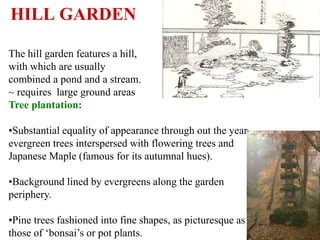
HILL GARDEN
The hill garden features a hill,
with which are usually
combined a pond and a stream.
~ requires large ground areas
Tree plantation:
•Substantial equality of appearance through out the year…
evergreen trees interspersed with flowering trees and
Japanese Maple (famous for its autumnal hues).
•Background lined by evergreens along the garden
periphery.
•Pine trees fashioned into fine shapes, as picturesque as
those of ‘bonsai’s or pot plants.
HISTORY OF GARDENS 96
FLAT GARDENS
~ are those laid on flat terrains
and believed that the scenic
features of the sea, lake or pond
are taken as inspiration.
While the HILL GARDEN is said
to represent the mountains or
valleys, the FLAT GARDEN
represents the coast or island.
Stone groups in a flat garden represent island
of varying size.
HISTORY OF GARDENS 97
~ not have any ups or downs and
the monotony is relieved by stones and trees, and
further complexity is effected by either a well, a
water-basin or some stepping stones.
HISTORY OF GARDENS 98
HISTORY OF GARDENS 99
TEA GARDENS
~ are gardens attached to tea-houses, and in their design, the issue
of utility plays an important part –
-to reflect the rites required to be observed by the guests
-It is divided into two sections:
-Outer garden or ‘Soto-roji’
-Inner garden or ‘uchi-roji’
-The outer garden has a waiting place, a small edifice for guests’
waiting.
-Provision for washing hands in a water-basin and a stone lantern
for illumination
HISTORY OF GARDENS 100
Pathway leads to the inner
garden, entry marked with
a simple Gate
Inner garden consists of the
tea-house, a rest place
called ‘koshikake’ and a
convenience.
A second water-basin,
placed low on the ground,
for rinsing mouth.
Path, water-basin and rest place are all lit with stone lanterns.
Tree plantation:
HARMONY is preferred. Both evergreen & deciduous trees may be
used, but not made imposing…
Outer garden is aesthetically in contrast to the inner garden…..
Outer garden may be fully exposed to sun-light (deciduous trees),
Inner garden will be darkened by shadowy trees (evergreen)
HISTORY OF GARDENS 101
ELEMENTS:
1. Water
Pond
Stream
Waterfall
Wells
2. Islands
3. Bridges
4. Stones
5. Fences
6. Stone lanterns
7. Water-basins
8. Garden paths:
stepping stones/
paved path
HISTORY OF GARDENS 102
Ryoan-ji
HISTORY OF GARDENS 103
HISTORY OF GARDENS 104
HISTORY OF GARDENS 105
Religious
Buildings &
Landscapes
HISTORY OF GARDENS 106
Mount Fuji (Fuji san) is with 3776 meters Japan's highest mountain. has been
worshipped as the GOD.
Venue: Gotemba
HISTORY OF GARDENS 107
Revered as the living god Takosugi, a very old cedar tree.
Venue: Mt Takao
HISTORY OF GARDENS 108
Divine Figures outside Temple
Venue: Mt Takao
HISTORY OF GARDENS 109
Other statues outside Temple
Venue: Mt Takao
HISTORY OF GARDENS 110
Close-up of the statues
HISTORY OF GARDENS 111
Kamisama or God in Japanese
HISTORY OF GARDENS 112
Life and Times of Lord Buddha
HISTORY OF GARDENS 113
Kamisama or God in Japanese.
HISTORY OF GARDENS 114
Wishes offered to God by devotees.
HISTORY OF GARDENS 115
Divine Inscriptions
HISTORY OF GARDENS 116
Protectors Outside the Temple
HISTORY OF GARDENS 117
Protectors Outside the Temple
HISTORY OF GARDENS 118
Largest Bronze Buddha Statue outside Temple in Japan.
Venue: Kamakura
HISTORY OF GARDENS 119
Shrine in Kamakura
Venue: Kamakura
HISTORY OF GARDENS 120
The World Heritage Toshogu shrine
Venue: Nikko
HISTORY OF GARDENS 121
Shinkyo or the sacred bridge
Venue: Nikko
HISTORY OF GARDENS 122
The Famous opening Torii of Fushimi Inari Shrine
Venue: Kyoto
HISTORY OF GARDENS 123
The series of Torii in Fushimi
Inari Shrine
HISTORY OF GARDENS 124
The series of Torii in Fushimi Inari Shrine
Venue: Kyoto
HISTORY OF GARDENS 125
Fushimi Inari Shrine
Venue: Kyoto
HISTORY OF GARDENS 126
Main Building Fushimi Inari Shrine
Venue: Kyoto
HISTORY OF GARDENS 127
Fushimi Inari Shrine
HISTORY OF GARDENS 128
Deity at mountain top Fushimi Inari Shrine
Venue: Kyoto
HISTORY OF GARDENS 129
Deity at mountain top Fushimi Inari Shrine
Venue: Kyoto
HISTORY OF GARDENS 130
Inside the premises of KinKakuji or Golden Pavilion
Venue: Kyoto
HISTORY OF GARDENS 131
KinKakuji or Golden Pavilion
HISTORY OF GARDENS 132
Inside KinKakuji or Golden Pavilion
Venue: Kyoto
HISTORY OF GARDENS 133
Inside KinKakuji or Golden Pavilion
HISTORY OF GARDENS 134
Ryoanji or Zen Temple
Venue: Kyoto
HISTORY OF GARDENS 135
The famous Zen Rock Garden
Venue: Kyoto
HISTORY OF GARDENS 136
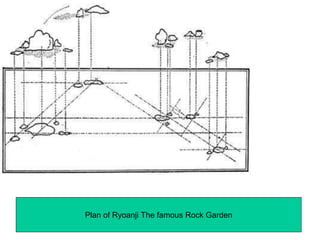
Plan of Ryoanji The famous Rock Garden
HISTORY OF GARDENS 137
Tsukubai, water basin, in Ryoan-ji
Venue: Kyoto
HISTORY OF GARDENS 138
Kyu-Mizu-Dera or Temple of Pure Water
Venue: Kyoto
HISTORY OF GARDENS 139
Entrance of the Kyu-Mizu-Dera or Temple of Pure Water
Venue: Kyoto
HISTORY OF GARDENS 140
Kyu-Mizu-Dera or Temple of Pure Water
Venue: Kyoto
HISTORY OF GARDENS 141
The three streams of Kyo-Mizu Dera represents , longevity, love and wealth.
HISTORY OF GARDENS 142
Venue: Nara
Todaiji Temple
HISTORY OF GARDENS 143
Venue: Nara
Entrance of the , Todaiji temple Nara
HISTORY OF GARDENS 144
Guards at the Entrance of the , Todaiji temple Nara
Venue: Nara
HISTORY OF GARDENS 145
Venue: Nara
Inside the Shrine in Nara
HISTORY OF GARDENS 146
Venue: Hiroshima
The famous Torii of Itkushima Shrine
HISTORY OF GARDENS 147
Venue: Hiroshima
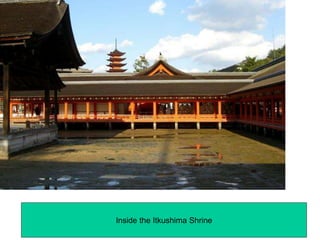
Inside the Itkushima Shrine
HISTORY OF GARDENS 148
Inside the Itkushima Shrine
HISTORY OF GARDENS 149
LIGHTING
To illuminate different landscape elements like plants, landform, pools
and other water features, man-made structures and sculptures etc. to
dramatize the overall visual composition.
Daytime gives no hint of how lighting
Will transform this yard at night.
In darkness, the shoji acts as a giant
projection screen, showing silhouettes of
banana trees positioned behind it.
HISTORY OF GARDENS 150
COMPARATIVE STATEMENT
HISTORY OF GARDENS 151
ITALIAN / MUGHAL
The starting point of the Italian
garden is the house from which the
garden extends into the landscape.
The Mughal garden is a dwelling
place in its own right not
necessarily connected with the
palace or house.
While the use of water as a a central theme is
shared by both, their attitude to it is quite
different.The Mughal relies on the form and quality
of water, keeping container simple. In Italian
gardens the water gushes from carved figures and
flows into wrought basins. The intricate carving of
the chaddar in the Mughal garden is designed to
give shape to the falling water.
HISTORY OF GARDENS 152
FRENCH & JAPANESE/
MUGHAL
French & Mughal:
Both served as
setting for court
ceremonials
Japanese and
Mughal: The similarity
between Mughal garden
makers and Japanese
garden makers is that
both loved plants,
respected nature and
were influenced by
religion.
But whereas the
Japanese Buddhism
worked through the
sanctity of living forms
the Muslim religion
stresses geometric
form.
But Mughal
gardens also
provided space for
seclusion and
informal living.

01 Landspace Main Study Mat.ppt

  • 1.
    HISTORY OF GARDENS1 INTRODUCTION A brief look at historical styles still has a relevance for the academicians as well as the professionals today even though the terms of reference may have changed. Many of the elements that make up today’s landscapes have historical antecedents, while the number of old gardens which actually remain indicates that they have stood the test of time visually and as places for use. In its earliest form the garden was basically an enclosure, made of thorn or scrub, to keep out wild animals and keep in domestic ones. The enclosure later took more permanent shape as a defense against other humans as much as the animals. This was also used for growing both food and plants. This creation of a small private sanctuary characterized early enclosed gardens, although their function varied according to the climate and lifestyle.
  • 2.
    HISTORY OF GARDENS2 DIFFERENT STYLES •Early Egyptian Gardens •Persian & Moorish Landscapes •Mughal Gardens •16th C. Italian Renaissance Gardens •17th C. French Renaissance Landscapes •18th C. English Romantic Landscapes •Japanese Landscapes •Chinese landscapes •American Contemporary Landscapes •Indian Traditional Landscapes
  • 3.
    HISTORY OF GARDENS3 Early Gardens Earliest recorded garden in Egypt in 3000 BC. •Completely utilitarian in concept & layout •Surrounded by mud wall to ward off sun and heat •Square or rectangular shaped with the house located within •Formal layout •Use of water as irrigation channels •Channels for functional reasons divided the garden into geometric areas •Plants & herbs were grown for consumption and medicinal values (e.g. Onion as their staple diet & other vegetables) •More elaborate gardens had channels widened into pools with fish and arbours with vines to sit under as well as shade giving Palms.
  • 4.
    HISTORY OF GARDENS4 Examples This fresco (1400 BC) found on the tomb of Nebamun in Thebes shows an ornamental fish Pond in the centre with fruit trees, Palms & Vines This Persian miniature paintings shows Babur in Bagh-I-vafa (Garden of Fidelity). The irrigation channel Divides the garden into four and there are Orange & Pomegranate trees surrounding the Reservoir.
  • 5.
    HISTORY OF GARDENS5 PERSIAN GARDENS The formal style of early Egyptian gardens characterized the whole Islamic world during the next few thousand years. • Gardens were walled with grape vines and other creepers • Fruit trees like Peach, Apple, Cherry, Banana, Date and Olive were cultivated. • Flowers like Poppies, Lilies, Chrysanthemums and Roses were grown in formal beds between the cross shaped water channels. • The idea of a flowering Paradise within a formal setting were captured in Persian writings, painted miniatures and woven carpets.
  • 6.
    HISTORY OF GARDENS6 MOORISH GARDENS The Persian concept influenced the Mughal and Moorish gardens. Water was used to link different planted areas and for cooling effect. The Moorish influence stretched along North Africa into Sicily and Southern Italy to Southern Spain to South America to California where it was eventually metamorphosed into today’s patio Garden, with water in the form of swimming pool. Style remained same as formal & symmetrical with high walls for shade and privacy. Moorish Tradition in Californian water garden: Formal & symmetrical with high walls giving a Private, enclosed feeling.
  • 7.
    HISTORY OF GARDENS7 MOORISH GARDENS Designed for outdoor living within the confines of one’s own property. Moorish Garden in Spain consisted of several courtyards, known as Patios, with water as the connecting link. Canals with central fountain, ornate pillars, tiled floors & walls. Orange trees planted along wall to give extra shade & Aromatic plants along the edge of water – A progress of utilitarian concept to aesthetics. Patio-de la Riadh in Granada, Spain: •Curving jets of water fall •Flower-edged central canal •Walled enclosure
  • 8.
    HISTORY OF GARDENS8 MUGHAL GARDENS
  • 9.
    HISTORY OF GARDENS9 PHILOSOPHY OF MUGHALS The Mughal gardens in India are a direct offshoot of Persian gardens. Concept of Persian garden: Persian gardens are designed around water flowing to the four corners of the earth. The four rivers of life meet at the center to take the place of a central pavilion. From this evolves the concept of Char Bagh with straight water channels crossing at right angles to divide the garden into four quadrants. The Persian Garden carpet
  • 10.
    HISTORY OF GARDENS10 A BABAR WITH HIS LADIES,BESIDE THE LOTUS POND  The Mughal Empire in Northern India lasted as an effective power from 1526 to the 1750s.  The gardens created by the Mughal dynasty rank as one of the great landscape traditions of the world.
  • 11.
    HISTORY OF GARDENS11 There were basically two types of Mughal gardens —those surrounding a mausoleum (mausoleum garden) and those developed for pleasure (pleasure garden). The first one was built by the owner during his own life for holding receptions and banquets. After his death it was converted into a tomb- Humayun’s tomb/ Taj Mahal. The next was related to the traditional formal paradise-type layout - Kashmir has many pleasure gardens which were situated on the lower slopes of the surrounding mountains like Shalimar bagh, Nishat bagh etc.
  • 12.
    12 TYPICAL MUGHAL GARDEN Anew environment in which water was to play an important role. Mughal gardens were laid out in conformation with geometrical patterns, with divisions and sub-divisions. Normally square or rectangular in plan, was divided into four quarters (CHAR BAGH) and was enclosed by a high wall. Typical tomb garden plan Charbagh is a Persian-style garden layout, in which the main building is put at the centre of a quadrilateral garden, divided by walkways or flowing water into four smaller parts. Charbagh style was brought to India by Mughals. Humayun's tomb and Taj Mahal in India are the most famous examples of this style
  • 13.
    HISTORY OF GARDENS13 PLANTS AS ELEMENT Fresh green willows form a leafy green canopy. Fruit trees were planted for revenue and beauty Flowers like jasmine & michelia were used for colour and scent Chenar gave weight, shade & sense of scale within the gardens.
  • 14.
    HISTORY OF GARDENS 14 PLANTMATERIALS IN MUGHAL GARDENS  It is known that their gardens were full of flowers, fruits and in Kashmir shade trees as cypress, willow, poplar were present. The plains added to palms, mango, tamarind and the pagoda tree.  Fruits included Almond, Cherry, Apple, Mango, Melons, Pineapple, Orange, etc.  The Saffron crop of Kashmir was economically very important. Flowers included Carnation, Coxcomb, Jasmine, Lotus, Hollyhock etc.
  • 15.
    HISTORY OF GARDENS15 WATER AS ELEMENT It is an idealized form in the pattern of irrigation Water containers included Channels, chaddars, Reflecting pools etc. Water is shown symbolically & physically as the source of life Channels divide area into four rectangular parts Water is the basic essence of a Mughal garden
  • 16.
    HISTORY OF GARDENS16 From terrace to terrace the water was led down the beautiful slopes called Chadars which mean white shawls of water - of marble or stone chutes carved in various patterns so that the water running over them were thrown up and broken into ripples and splashes. constructed canals and tanks like the Persians. Carved marble chaddar or water chute Moving water
  • 17.
    HISTORY OF GARDENS17 Series of niches were also provided behind the waterfall The Mughals like the Persians paved the channels of water with blue tiles.
  • 18.
    HISTORY OF GARDENS18 Fountains
  • 19.
    HISTORY OF GARDENS19 Still water Although water was visually confined within the water axes, its presence was everywhere apparent. Water has a visual and psychological cooling effect, which contributed to the overall sense of lushness in the garden
  • 20.
    HISTORY OF GARDENS20 HARDSCAPING ELEMENTS Chabutra-thrones overlooking the garden. Pavilions built of marble sandstone Monumental and ornate gateways Intricate marble lattice in tomb gardens Brick and stone paving.
  • 21.
    HISTORY OF GARDENS21 BABUR  The first Mughal emperor was a great patron of garden art. He gave instructions that the gardens he had created should be well kept, properly watered and maintained with flowers.  The important gardens under his patronage include Bagh-i-wafa, Ram bagh, Dehra bagh, Zahara bagh etc.
  • 22.
    HISTORY OF GARDENS22 RAM BAGH, AGRA Dramatic siting, brilliant use of water and a deep and skilful delight in planting and architecture. Rambagh or Arambagh- ‘Garden of Rest’ The basic pattern is one of geometrically laid out walks,with platforms raised well above ground level from which to view the gardens. A terrace follows the east bank of Jamuna and on it are the remains of two substantial buildings.
  • 23.
    HISTORY OF GARDENS23 HUMAYUN’S TOMB, DELHI The garden has four main parts. These are divided by waterways that come out of the central tomb area and lead to the four gates. It takes the Char Bagh motive and enlarges and repeats it in an intricate pattern almost wholly two- dimensional and Persian in character. Plan of the tomb garden The tomb of Emperor Humayun is a typical Mughal mausoleum garden of the earliest period.
  • 24.
    HISTORY OF GARDENS24 HUMAYUN’S TOMB, DELHI The channels and tanks have the depth of mere engravings but minute differences of level are created in order to exploit the ripple of water. Water and the garden are important parts of tombs because they remind the visitor of paradise, where water and vegetation are abundant. The first memorial garden tomb of a Mughal Emperor
  • 25.
    HISTORY OF GARDENS25 AKBAR’S TOMB , SIKANDRA The tomb stands on a raised platform from which four wide raised causeways lead to four gateways. The garden needs its trees (cypress, pine, plane and palm) to create a soothing atmosphere. The perspective of Akbar’s Tomb
  • 26.
    HISTORY OF GARDENS26 AKBAR’S TOMB , SIKANDRA The plan is exactly geometrical, dimension repeats dimension and the whole is finely proportioned to set off the great tomb within it. A walled enclosure is divided symmetrically by the mausoleum at the centre, into the four fold plot of Babar’s Bagh-I-wafa Four tanks set in the centre platform supplied water to the narrow runnels
  • 27.
    HISTORY OF GARDENS27 MUGHAL GARDENS OF KASHMIR
  • 28.
    HISTORY OF GARDENS28 SHALAMAR BAGH , KASHMIR Built by Emperor Jehangir for his wife Nur Jehan, Shalimar, is a beautiful garden with sweeping vistas over gardens and lakes, and shallow terraces. The garden is 539 m by 182 m and has four terraces, rising one above the other. EMPEROR’S GARDEN ZENANA GARDEN Plan Section
  • 29.
    HISTORY OF GARDENS29 A canal lined with polished stones and supplied with water from Harwan runs through the middle of the garden. The fourth terrace, by far the best, was once reserved for royal ladies called the Black Pavilion. The entrance pavilion Shalimar Garden in summer SHALAMAR BAGH , KASHMIR
  • 30.
    HISTORY OF GARDENS30 NISHAT BAGH , KASHMIR Situated on the banks of the Dal Lake, with the Zabarwan Mountains as its backdrop and was designed by Asaf Khan It's the largest of the Mughal gardens measuring 548 metres by 338 metres, and often the most crowded. The walks beside the channel are bordered with lines of Cypresses and Chinars. “The Garden of Bliss” in autumn Nishat Bagh has 12 terraces representing the 12 signs of the zodiac which descend gradually and seem to almost merge into the lake.
  • 31.
    HISTORY OF GARDENS31 NISHAT BAGH , KASHMIR Situated at the foot of a hill with a row of chinars framing it, the garden is a visual delight with their stepped terraces, formal elegance, ornamental shrubs, sparkling fountains, a beautiful pink pavilion and a steeply angular bridge into a hitherto unsuspected inner lake.
  • 32.
    HISTORY OF GARDENS32 CHASME SHAHI, KASHMIR Smallest of the Srinagar Mughal gardens, measuring just 108 metres by 38 metres, the Chasma Shahi, or 'Royal Spring', are well up the hillside. The fresh water spring in these pleasant, quieter gardens is reputed to have medicinal properties. The gardens were laid out in 1632 by Ali Mardan Khan and include three terraces, an aqueduct, waterfalls and fountains SECTION PLAN
  • 33.
    HISTORY OF GARDENS33 CHASME SHAHI, KASHMIR The water from the spring supplies the fountains and then goes through the floor of the pavilion and falls to the lower terrace in a cascade of 5metres, over a polished black stone chute. There is a small shrine, the Chasma Sahibi, near the gardens, which also has a fresh water spring. Quiet garden or “The Royal Spring”
  • 34.
    HISTORY OF GARDENS34 SHALAMAR BAGH , LAHORE The Shalamar gardens at Lahore were laid out by Ali Mardan Khan, on Shah Jahan’s instructions. • The design comprises three terraces, dropping down from the south, the changes in level being about 15’. • The first and third terraces are char- baghs of similar proportion and design; the middle one contains the great reservoir which is the principal feature of the garden. • The garden seems to have been especially noted for the large number of buildings which it contained.
  • 35.
    HISTORY OF GARDENS35 FAIZ BAKSH LOWER , LAHORE The lower terrace, forming more public part of the garden, were known together as the Faiz Baksh (the Bestower of Plenty). Eighteen feet wide, 800 feet long, and 1.5 feet deep, this was the most commanding water channel built in the Mughal gardens This was merely the cross-axis in the lowest, most public, terrace of the garden. View from the lower terrace to upper terrace
  • 36.
    HISTORY OF GARDENS36 FAIZ BAKSH MIDDLE , LAHORE The central level is the most spectacular. The great reservoir, 200 across, once contained 152 fountains. In the centre is a marble platform, reached by a narrow causeway. Round the whole reservoir runs a double paved path, with a flower parterre. The water flows through the southern pavilion by way of a broad carved marble chute or chadar and at the bottom, overhanging the water, is the emperor’s throne of white marble.
  • 37.
    HISTORY OF GARDENS37 FARAH BAKSH , LAHORE The upper terrace at Lahore was known as the Farah Baksh( the Bestower of Pleasure ) A broad canal led from the river to the garden, feeding hundreds of fountains, pools, and lushly irrigated plantings. The three terraces, the central water axis, and the marble waterfalls all reflect the influence of Kashmir.
  • 38.
    HISTORY OF GARDENS38 TAJ MAHAL, AGRA The mausoleum, instead of occupying the central point stands at the north end just above the river. Each of the four quarters of the garden have again been sub-divided into sixteen flower beds by stone-paved raised pathways. The tank has been arranged to perfectly reflect the Taj in its waters. At the centre of the garden, halfway between the tomb and the gateway, stands a raised marble lotus-tank with a cusped and tree foiled border. Two marble canals studded with fountains and lined with cypress trees (symbolising death) cross in the centre of the garden dividing it into four equal squares.
  • 39.
    HISTORY OF GARDENS39 TAJ MAHAL, AGRA Modeled after the Persian concept of earthly paradise, the Taj exhibits elaborate renditions of cut-stone architecture, water chutes, standing pools, flowing fountains, and plantings to stimulate all the senses Landscape artists at the Taj attempted to translate the perfection of heaven into terrestrial terms by following certain formulas. In Islam, four is the holiest of all numbers - most arrangements of the Taj are based on that number or its multiples - and the gardens were thus laid out in the quadrate plan.
  • 40.
    HISTORY OF GARDENS40 TAJ MAHAL, AGRA The star shaped pattern of the parterres is preserved along the main canal. The architects designed a clever system to procure water for the Taj through underground pipes To ensure uniform and undiminished water pressure in the fountains, irrespective of the distance and the outflow of water, a copper pot was provided under each fountain pipe The floral inlays, possibly the outstanding decorative feature, are world renowned.
  • 41.
    HISTORY OF GARDENS41 PINJORE GARDENS, HARYANA Nawab Fidai Khan, a cousin of Aurangzeb, and an architect of repute planned the architecture of the gardens. He planned the Garden on the classical Charbagh pattern, giving the area central waterway. Both sides of this waterway were covered with the patches of green bordered with flowers and shaded by plants like the traditional Palm, the Cypress and Magnolia. Romantic Sunset at Pinjore
  • 42.
    HISTORY OF GARDENS42 PINJORE GARDENS, HARYANA The seven terraces at Pinjore, instead of ascending, descend into the distance. From the stately Sheesh Mahal built in the Rajasthani–Mughal style, the watercourse with its never-ending bubbling cascades, flowing under the towering Rang Mahal, and then around the Jal Mahal. The graceful arched balconies and tinkling fountains, luxuriant green lawns and murmuring watercourse, and colourful flowerbeds, and monumental gateways—all were carefully planned to create a special effect.
  • 43.
    HISTORY OF GARDENS43 METAMORPHOSIS Narrow rills developed into wider canals and great tanks- to enjoy the cool air generated by large sheets of water and its need in Indian heat. Transformation from simple stone thrones in the water channels of Nishat and Shalamar to elaborate building set in centre of great tanks surrounded by sprouting jets of water. Another Persian feature which persisted in the earlier Mughal Gardens was the underground room but as the new comer adjusted to the surroundings they delighted more in life in open air. Single jets from Persian tanks developed into hundreds of fountains. Level Landscape to contoured landscape indicative of increasing magnificence and simplicity. Water from its simple existence as channels and tanks were found in great fountains and cascades.
  • 44.
    HISTORY OF GARDENS44 In early 15th C., merchants in Florence began to build villas or farms on the surrounding hills. The earliest Renaissance garden were at first in the formal enclosed tradition but gradually a view was allowed into the garden through a hole in the wall. As a natural view became more important the enclosures were swept away and the hill side gardens were allowed to stretch through the Olive groves and vineyards. ITALIAN LANDSCAPE
  • 45.
    HISTORY OF GARDENS45 During 16th C., in Rome, architect Bramante designed a Papal Garden within the Vatican. This was the fore-runner of High Renaissance style, with a magnificent arrangement of steps and terraces, which became a prototype of everything that followed. From then on, the garden design had terraces at different levels retained by walls and interconnected by grand staircases.
  • 46.
    HISTORY OF GARDENS46 Water remained as a major feature, but in more engineered form. It was pressurised and used spectacularly, progressing down an incline or displayed in an elaborate fountain. While these renaissance gardens were cool retreat with shade and water of great importance, they were also show places where vegetation were deliberately manipulated. The Italians were the first to make decorative use of plants with HEDGES to link the house and garden structurally.
  • 47.
    HISTORY OF GARDENS47 Two Great Gardens: 1. Villa d Este, Tivoli 2. Villa Lante
  • 48.
    HISTORY OF GARDENS48 Villa d Este, Tivoli, Italy Villa d‘ Este overlooking beautiful Lake Como. The villa is actually situated in the town of Cernobbio (pronounced 'chair-know-bee-oh') With hilly terrain as the natural landform, the garden was laid out in terraces with ornamental vegetative patterns Made to use the slopes.
  • 49.
    HISTORY OF GARDENS49 Villa d Este, Tivoli, Italy Villa d Este, 16th C. garden of Renaissance Italy: Ridges and high Points tend to segment the land Into separate spaces and use areas In the form of terraces.
  • 50.
  • 51.
    HISTORY OF GARDENS51 Water provides a great Spectacle with grand Displays such as these: Cascading down terraces which are carved out of hill sides And create a dramatic water fall. Terraces are edged with balustrades and the theatrical setting is complemented by statuaries – readily available from ancient Roman sites.
  • 52.
  • 53.
  • 54.
    HISTORY OF GARDENS54 Water in various moods of dynamicity: Shooting up, falling gracefully, Gushing with rage etc.
  • 55.
    HISTORY OF GARDENS55 Villa Lante
  • 56.
    HISTORY OF GARDENS56 Lavish use of carved stone Sculptures integrated with water and vegetation.
  • 57.
    HISTORY OF GARDENS57 FRENCH LANDSCAPE Some Great Gardens of Renaissance France: 1.Villandry 2.Vaux Le Vicomte 3.Versailles The Renaissance movement originating in Italy spread Northwards, together with increased knowledge about plants and their cultivation. In France, the small formal gardens within the walls of moated cha^teau moved outside becoming more grander in scope. Dictated by the natural landform of flat plain terrains of France, Large expanses of water body or grass areas were possible to create. The style remained geometric, as the original pattern of formal beds Within a grid system of paths was simply repeated in order to enlarge The garden.
  • 58.
    HISTORY OF GARDENS58 Chateau Garden at Villandry, France Geometric garden with intricate parterres of clipped box-hedges And vegetables grown for their colour, beauty and consumption.
  • 59.
    HISTORY OF GARDENS59 Vaux-Le Vicomte: Location In 17th C., Andre Le Notre changed French garden planning significantly. With Vaux-le- Vicomte in 1661, he established a style that was to influence the whole of Europe for a century. His layout was still very geometrical and formal, but they became much more elaborate and interesting with long magnificent vistas, pools or rectangular canals and grand water parterres.
  • 60.
    HISTORY OF GARDENS60 Vaux Le Vicomte
  • 61.
  • 62.
  • 63.
  • 64.
  • 65.
    HISTORY OF GARDENS65 Another distinctive character Was the hedge lined avenues Which fanned out through the Surrounding forest known as Pattes d’oie (Goose feet).
  • 66.
  • 67.
  • 68.
  • 69.
    HISTORY OF GARDENS69 VERSAILLES Versailles, the 17th Century French Renaissance Garden: In the context of the flat topography of France, landform at Versailles Functions as a unifying factor, visually and functionally, Connecting other components in the landscape e.g. Vista formation
  • 70.
    HISTORY OF GARDENS70 Location of Versailles
  • 71.
    HISTORY OF GARDENS71 The Grand Canal Le Notre was appointed royal landscape architect to King Louis XIV & The garden at VERSAILLES is his best creation. •In concept, it was a vast outdoor drawing room, intended for the entertainment of a court of thousands. •Canals and display water,clipped and trained vegetation, Statuaries and the elaborate parterres provided visual interest.
  • 72.
    HISTORY OF GARDENS72 A grand royal garden laid out in monumental scale.
  • 73.
    HISTORY OF GARDENS73 View of the landscape
  • 74.
    74 Latona Fountain Apollo FountainTapis vert or Grass Carpet
  • 75.
  • 76.
  • 77.
    HISTORY OF GARDENS77 View of the Grand Canal across Latona fountain
  • 78.
    HISTORY OF GARDENS78 Apollo Fountain Parterres
  • 79.
    HISTORY OF GARDENS79 ENGLISH LANDSCAPE The gardens of English royalty and aristocracy were developed on the lines of Italian and French Renaissance layouts during the 16th & 17th C. They were less rigorously formal as the English climate is more conducive to mixed planting. There was also a developing interest in horticulture and emphasis on flowers grown for their appearance rather than for culinary or medicinal use.
  • 80.
    HISTORY OF GARDENS80 Early English Gardens One of the first gardens in the grand formal Style was at Hampton Court Palace, later emulated by all the nobility. The flower beds were laid out in a knot- garden pattern and other characteristics included mazes, gazebos, topiary, sun- dials, trellis and arbour. Vegetable gardens were usually walled and separate from the main garden. After 1660, the influence of Versailles reflected in the replacement of simple knots by grand parterres, gentle fountains by vast lakes and canals, while broad beech-lined avenues stretched out to the horizon.
  • 81.
    HISTORY OF GARDENS81 Sheffield Park The Great Garden of Stourhead During the 18th C., influenced by writers, landscape painters & philosophers, the English Landscape Movement reacted Against the artificiality of formal gardens. It professed the curved lines and irregularity of nature and the idea of a romantic natural garden. Formal gardens were entirely swept away by this new school of thought. With William Kent as the pioneer of this movement, followed by Lancelot Brown and Humphrey Repton, contours were altered, hills built and valleys excavated, straight paths were abandoned and straight canals turned into serpentine lakes. Garden of Stourhead
  • 82.
    HISTORY OF GARDENS82 The Garden of Stowe
  • 83.
    HISTORY OF GARDENS83 William Kent 1685 - 1748 William Kent was born in Bridlington, East Yorkshire. He firstly trained as a sign painter then progressed to landscape painting, followed by architecture. Through his architectural commissions Kent moved onto developing the surrounding landscape. He had a vision that all landscape should be viewed as a classical painting remarking that ‘all gardening is landscape painting’, with sympathetic arrangements to maximise the artistic effects of shape, light and colour.
  • 84.
    HISTORY OF GARDENS84 Kent ’s career as a landscape designer proved very successful and he is viewed as the master of the ‘picturesque’ and ‘natural’ gardening style. It was William Kent who provided the grounding for the illustrious career of Lancelot ‘Capability’ Brown who for a time worked under his direction at Stowe. Kent’s most famous and unique garden can be found at Rousham House, the gardens remaining much as he had planned them almost 300 years later.
  • 85.
    HISTORY OF GARDENS85 Lancelot ‘Capability’ Brown 1716 – 1783 Lancelot Brown was born in Northumberland. A move to Buckinghamshire in 1739 led to employment by Lord Cobham at Stowe in 1741, where his job as head gardener lasted for 10 long years. It was here at Stowe that gave Brown the opportunity to work with William Kent and John Vanbrugh, and see great works carried out there under the overall direction of Kent.
  • 86.
    HISTORY OF GARDENS86 Lancelot Brown was a leader in the development of the ‘natural’, ‘English’ or ‘serpentine’ style of gardening. In 1751, Brown became an independent landscape gardener, although he described himself as a ‘place-maker’ rather than a landscape gardener, and quickly became very fashionable and in great demand. Lancelot Brown became known as ‘Capability’ because of his fondness of speaking of a country estate having a great ‘capability’ for improvement. He rejected the very formal geometric French style of gardening, a la Versailles, and concentrated on echoing the natural undulations of the English landscape. Characteristics of his work included grass meadows in front of the mansion, serpentine lakes, follies, encircling carriage drives, belts and circular clumps of trees. Bridges or cascades often were used to connect the ‘natural’ lakes.
  • 87.
    HISTORY OF GARDENS87 Humphrey Repton 1752-1818 Repton was born in Bury St. Edmunds in 1752, the son of a successful tax collector. His real passions were botany, entomology and gardening and he wished to have a career in which he could enjoy these interests. Repton spent some time in Ireland working as private secretary to William Windham, Lord Lieutenant of Ireland . It was here that he made many acquaintances which, when he returned to Essex , he called upon offering his services as an ‘improver of the landscape’. As a result he soon had a steady flow of work. Repton returned to England determined to become a worthy successor to Capability Brown. Repton’s style continued on from Brown’s as he included a vision of the house and how it was placed with relation to the landscape surrounding it.
  • 88.
    HISTORY OF GARDENS88 Repton saw gardening as an art form with the landscape as his canvas, his ideal being natural beauty enhanced by art. Repton carried on the landscape gardening skills developed by Brown, introducing terracing to the foreground and gravel walks. He also reintroduced the flower bed and separate flower gardens. Repton outlined his principles of landscape gardening in his book ‘Observations on the Theory and Practice of Landscape Gardening’ - “The perfection of landscape gardening consists in the four following requisites. First, it must display the natural beauties and hide the defects of every situation. Secondly, it should give the appearance of extent and freedom by carefully disguising or hiding the boundary. Thirdly, it must studiously conceal every interference of art. However expensive by which the natural scenery is improved; making the whole appear the production of nature only; and fourthly, all objects of mere convenience or comfort, if incapable of being made ornamental, or of becoming proper parts of the general scenery, must be removed or concealed”.
  • 89.
    HISTORY OF GARDENS89 Repton also published a book called ‘Sketches and Hints on Landscape Gardening’(1795). These books were based on his findings during his prolific career. For every client Repton would keep a record in a red leather bound book detailing proposals for changes, maps, plans, drawings, watercolours and before and after sketches. These became known as his famous Red Books some of which survive, leaving a legacy of innovative ideas and helping to shape a new ideology which remains a part of modern day landscaping practice. Repton undertook over four hundred commissions during his thirty year career working on many important stately homes. One Repton garden, largely unchanged, can be viewed at Betchworth House in Surrey . Others include ; Ashridge, Cobham Hall, Dyrham Park, Harewood House, Longleat, Brighton Royal Pavilion, Sheringham Park, Tatton Park and Woburn Abbey.
  • 90.
    HISTORY OF GARDENS90 JAPANESE LANDSCAPE
  • 91.
    HISTORY OF GARDENS91 The most important characteristic of the Japanese Garden is their expression of the ESSENCE OF NATURE, rather than its mere representation.
  • 92.
    HISTORY OF GARDENS92 The Japanese designer composes his garden picture from nature, reproducing in an exaggerated form the impression he obtains from it in the given space.
  • 93.
    HISTORY OF GARDENS93 Boundary Treatment
  • 94.
    HISTORY OF GARDENS94 •HILL GARDEN •FLAT GARDEN •TEA GARDEN
  • 95.
    HISTORY OF GARDENS95 HILL GARDEN The hill garden features a hill, with which are usually combined a pond and a stream. ~ requires large ground areas Tree plantation: •Substantial equality of appearance through out the year… evergreen trees interspersed with flowering trees and Japanese Maple (famous for its autumnal hues). •Background lined by evergreens along the garden periphery. •Pine trees fashioned into fine shapes, as picturesque as those of ‘bonsai’s or pot plants.
  • 96.
    HISTORY OF GARDENS96 FLAT GARDENS ~ are those laid on flat terrains and believed that the scenic features of the sea, lake or pond are taken as inspiration. While the HILL GARDEN is said to represent the mountains or valleys, the FLAT GARDEN represents the coast or island. Stone groups in a flat garden represent island of varying size.
  • 97.
    HISTORY OF GARDENS97 ~ not have any ups or downs and the monotony is relieved by stones and trees, and further complexity is effected by either a well, a water-basin or some stepping stones.
  • 98.
  • 99.
    HISTORY OF GARDENS99 TEA GARDENS ~ are gardens attached to tea-houses, and in their design, the issue of utility plays an important part – -to reflect the rites required to be observed by the guests -It is divided into two sections: -Outer garden or ‘Soto-roji’ -Inner garden or ‘uchi-roji’ -The outer garden has a waiting place, a small edifice for guests’ waiting. -Provision for washing hands in a water-basin and a stone lantern for illumination
  • 100.
    HISTORY OF GARDENS100 Pathway leads to the inner garden, entry marked with a simple Gate Inner garden consists of the tea-house, a rest place called ‘koshikake’ and a convenience. A second water-basin, placed low on the ground, for rinsing mouth. Path, water-basin and rest place are all lit with stone lanterns. Tree plantation: HARMONY is preferred. Both evergreen & deciduous trees may be used, but not made imposing… Outer garden is aesthetically in contrast to the inner garden….. Outer garden may be fully exposed to sun-light (deciduous trees), Inner garden will be darkened by shadowy trees (evergreen)
  • 101.
    HISTORY OF GARDENS101 ELEMENTS: 1. Water Pond Stream Waterfall Wells 2. Islands 3. Bridges 4. Stones 5. Fences 6. Stone lanterns 7. Water-basins 8. Garden paths: stepping stones/ paved path
  • 102.
    HISTORY OF GARDENS102 Ryoan-ji
  • 103.
  • 104.
  • 105.
    HISTORY OF GARDENS105 Religious Buildings & Landscapes
  • 106.
    HISTORY OF GARDENS106 Mount Fuji (Fuji san) is with 3776 meters Japan's highest mountain. has been worshipped as the GOD. Venue: Gotemba
  • 107.
    HISTORY OF GARDENS107 Revered as the living god Takosugi, a very old cedar tree. Venue: Mt Takao
  • 108.
    HISTORY OF GARDENS108 Divine Figures outside Temple Venue: Mt Takao
  • 109.
    HISTORY OF GARDENS109 Other statues outside Temple Venue: Mt Takao
  • 110.
    HISTORY OF GARDENS110 Close-up of the statues
  • 111.
    HISTORY OF GARDENS111 Kamisama or God in Japanese
  • 112.
    HISTORY OF GARDENS112 Life and Times of Lord Buddha
  • 113.
    HISTORY OF GARDENS113 Kamisama or God in Japanese.
  • 114.
    HISTORY OF GARDENS114 Wishes offered to God by devotees.
  • 115.
    HISTORY OF GARDENS115 Divine Inscriptions
  • 116.
    HISTORY OF GARDENS116 Protectors Outside the Temple
  • 117.
    HISTORY OF GARDENS117 Protectors Outside the Temple
  • 118.
    HISTORY OF GARDENS118 Largest Bronze Buddha Statue outside Temple in Japan. Venue: Kamakura
  • 119.
    HISTORY OF GARDENS119 Shrine in Kamakura Venue: Kamakura
  • 120.
    HISTORY OF GARDENS120 The World Heritage Toshogu shrine Venue: Nikko
  • 121.
    HISTORY OF GARDENS121 Shinkyo or the sacred bridge Venue: Nikko
  • 122.
    HISTORY OF GARDENS122 The Famous opening Torii of Fushimi Inari Shrine Venue: Kyoto
  • 123.
    HISTORY OF GARDENS123 The series of Torii in Fushimi Inari Shrine
  • 124.
    HISTORY OF GARDENS124 The series of Torii in Fushimi Inari Shrine Venue: Kyoto
  • 125.
    HISTORY OF GARDENS125 Fushimi Inari Shrine Venue: Kyoto
  • 126.
    HISTORY OF GARDENS126 Main Building Fushimi Inari Shrine Venue: Kyoto
  • 127.
    HISTORY OF GARDENS127 Fushimi Inari Shrine
  • 128.
    HISTORY OF GARDENS128 Deity at mountain top Fushimi Inari Shrine Venue: Kyoto
  • 129.
    HISTORY OF GARDENS129 Deity at mountain top Fushimi Inari Shrine Venue: Kyoto
  • 130.
    HISTORY OF GARDENS130 Inside the premises of KinKakuji or Golden Pavilion Venue: Kyoto
  • 131.
    HISTORY OF GARDENS131 KinKakuji or Golden Pavilion
  • 132.
    HISTORY OF GARDENS132 Inside KinKakuji or Golden Pavilion Venue: Kyoto
  • 133.
    HISTORY OF GARDENS133 Inside KinKakuji or Golden Pavilion
  • 134.
    HISTORY OF GARDENS134 Ryoanji or Zen Temple Venue: Kyoto
  • 135.
    HISTORY OF GARDENS135 The famous Zen Rock Garden Venue: Kyoto
  • 136.
    HISTORY OF GARDENS136 Plan of Ryoanji The famous Rock Garden
  • 137.
    HISTORY OF GARDENS137 Tsukubai, water basin, in Ryoan-ji Venue: Kyoto
  • 138.
    HISTORY OF GARDENS138 Kyu-Mizu-Dera or Temple of Pure Water Venue: Kyoto
  • 139.
    HISTORY OF GARDENS139 Entrance of the Kyu-Mizu-Dera or Temple of Pure Water Venue: Kyoto
  • 140.
    HISTORY OF GARDENS140 Kyu-Mizu-Dera or Temple of Pure Water Venue: Kyoto
  • 141.
    HISTORY OF GARDENS141 The three streams of Kyo-Mizu Dera represents , longevity, love and wealth.
  • 142.
    HISTORY OF GARDENS142 Venue: Nara Todaiji Temple
  • 143.
    HISTORY OF GARDENS143 Venue: Nara Entrance of the , Todaiji temple Nara
  • 144.
    HISTORY OF GARDENS144 Guards at the Entrance of the , Todaiji temple Nara Venue: Nara
  • 145.
    HISTORY OF GARDENS145 Venue: Nara Inside the Shrine in Nara
  • 146.
    HISTORY OF GARDENS146 Venue: Hiroshima The famous Torii of Itkushima Shrine
  • 147.
    HISTORY OF GARDENS147 Venue: Hiroshima Inside the Itkushima Shrine
  • 148.
    HISTORY OF GARDENS148 Inside the Itkushima Shrine
  • 149.
    HISTORY OF GARDENS149 LIGHTING To illuminate different landscape elements like plants, landform, pools and other water features, man-made structures and sculptures etc. to dramatize the overall visual composition. Daytime gives no hint of how lighting Will transform this yard at night. In darkness, the shoji acts as a giant projection screen, showing silhouettes of banana trees positioned behind it.
  • 150.
    HISTORY OF GARDENS150 COMPARATIVE STATEMENT
  • 151.
    HISTORY OF GARDENS151 ITALIAN / MUGHAL The starting point of the Italian garden is the house from which the garden extends into the landscape. The Mughal garden is a dwelling place in its own right not necessarily connected with the palace or house. While the use of water as a a central theme is shared by both, their attitude to it is quite different.The Mughal relies on the form and quality of water, keeping container simple. In Italian gardens the water gushes from carved figures and flows into wrought basins. The intricate carving of the chaddar in the Mughal garden is designed to give shape to the falling water.
  • 152.
    HISTORY OF GARDENS152 FRENCH & JAPANESE/ MUGHAL French & Mughal: Both served as setting for court ceremonials Japanese and Mughal: The similarity between Mughal garden makers and Japanese garden makers is that both loved plants, respected nature and were influenced by religion. But whereas the Japanese Buddhism worked through the sanctity of living forms the Muslim religion stresses geometric form. But Mughal gardens also provided space for seclusion and informal living.