Quest for Progress
The Math and Design of Idle Games
Anthony Pecorella
Kongregate.com
Who Am I?
• At Kongregate for 7 years,
directing our browser-based
F2P virtual goods business
• Producer for
AdVenture Capitalist mobile
• Also an indie designer,
cofounder of Level Up Labs
Kongregate.com
Kongregate Publishing
Opening Disclaimers
• This is a design and math talk, not a data and
monetization talk
• There is some calculus, but you don’t need to
remember how it works
• If you don’t like graphs, numbers, and formulas
you’re not going to like this talk
Interactive Charts and Sheets
• All of the graphs generated in this talk come from
sheets that are publicly available as both Google
Sheets and .xls files
• You can access these sheets here:
http://kon.gg/idle-math-spreadsheets
Genre Terminology
• Incremental Games
– A game in which the primary goal is to continually increase
a number
– Often grows in complexity over time
• When the scope of a game change substantially it is can referred
to as an “unfolding game”
• Examples: A Dark Room, Candy Box, Frog Fractions
Genre Terminology
• Idle Games
– Subset of Incrementals
– Progress or income is made without player interaction
– Player choices impact growth rates
– It is expected that players leave the game alone regularly
– Typically do not have an “end”
Genre Terminology
• Clicker Games
– Emphasis on clicking or tapping to progress
– Ex. Feed Your Monster, Football Clicker
– Can, but does not necessarily, have idle elements
• Clicker Heroes is an “idle clicker”
– Physicality of the game can be fun but also tiring
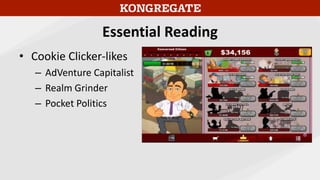
Essential Reading
• Cookie Clicker-likes
– AdVenture Capitalist
– Realm Grinder
– Pocket Politics
Essential Reading
• Clicker Heroes-likes
– Tap Titans
– Crusaders of the
Lost Idols
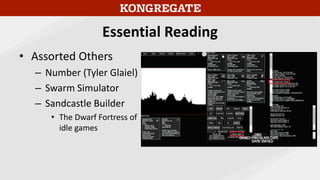
Essential Reading
• Assorted Others
– Number (Tyler Glaiel)
– Swarm Simulator
– Sandcastle Builder
• The Dwarf Fortress of
idle games
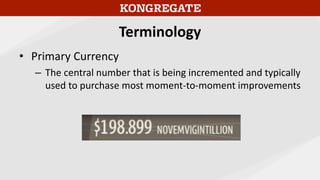
Terminology
• Primary Currency
– The central number that is being incremented and typically
used to purchase most moment-to-moment improvements
Terminology
• Generator
– The buildings, investments, characters, etc. that a player
amasses
– They automatically generate Primary Currency (or
Exchange Currency) over time
– Costs grow magnitude faster than value
Terminology
• Primary Exchange Currency
– A special case worth mentioning, in some cases generators
produce an exchange currency
– The most common example is damage / DPS in RPG idlers
• Damage is not the primary currency but is tied directly to it
• Gives designer a little more control over primary currency
accumulation since you can gate or buff conversion at certain
points in the progression
Terminology
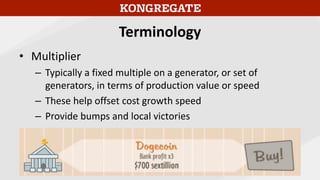
• Multiplier
– Typically a fixed multiple on a generator, or set of
generators, in terms of production value or speed
– These help offset cost growth speed
– Provide bumps and local victories
Terminology
• Multiplier
– More complex ones might have dependencies on:
• Its target (e.g. this generator count)
• Other generators (e.g. total generator count)
• Meta statistics (e.g. total time played, count of lifetime skills used,
lifetime currency earned, seconds since last reset, etc.)
• External data (e.g. time of day, holidays/events, concurrent player
count, etc.)
– Incentivized ads are often implemented as a multiplier
Terminology
• Active Skill
– Powerful abilities players can initiate
– Typically have a long cooldown (5 minutes – a few hours)
– Increases player agency, letting them burst income or get
over a hump
– In more complex situations, players can strategize around
best selection, order, and timing of skill usage
Terminology
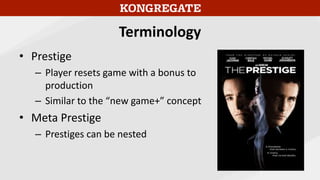
• Prestige
– Player resets game with a bonus to
production
– Similar to the “new game+” concept
• Meta Prestige
– Prestiges can be nested
Terminology
• Prestige Currency
– Provides player with Prestige Currency that controls the
production bonus
• This currency typically grows at a slower order of magnitude than
Primary Currency – we’ll look into examples later
– In some cases this currency can also be spent for boosts (at
the loss of the relative Prestige Currency boost)
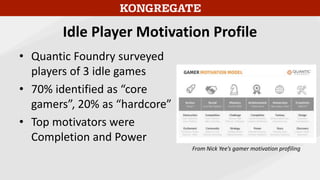
Idle Player Motivation Profile
• Quantic Foundry surveyed
players of 3 idle games
• 70% identified as “core
gamers”, 20% as “hardcore”
• Top motivators were
Completion and Power
From Nick Yee’s gamer motivation profiling
Idle Player Motivation Profile
• This can help guide your design process
• Players of this genre want to collection and
complete, and they want to grow in power
– Power growth is central to the genre but you want to make
sure players “feel” that growth
– Can you incorporate collection or completionism into your
idle game design?
Super quick review of exp growth curves
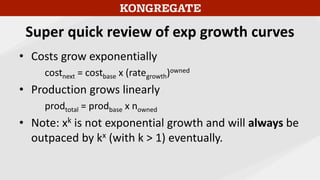
• Costs grow exponentially
costnext = costbase x (rategrowth)owned
• Production grows linearly
prodtotal = prodbase x nowned
• Note: xk is not exponential growth and will always be
outpaced by kx (with k > 1) eventually.
Exponential Growth Rates in AdCap
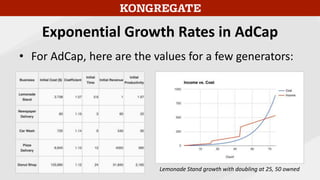
• For AdCap, here are the values for a few generators:
Lemonade Stand growth with doubling at 25, 50 owned
Exponential Growth Rates in AdCap
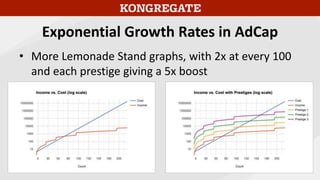
• More Lemonade Stand graphs, with 2x at every 100
and each prestige giving a 5x boost
Optimal Decisions
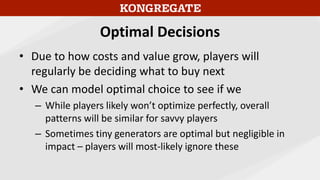
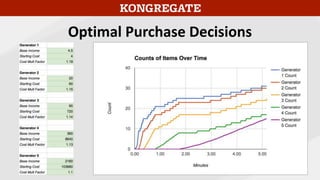
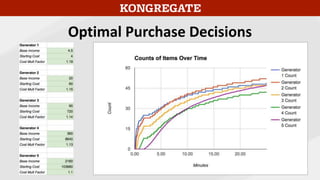
• Due to how costs and value grow, players will
regularly be deciding what to buy next
• We can model optimal choice to see if we
– While players likely won’t optimize perfectly, overall
patterns will be similar for savvy players
– Sometimes tiny generators are optimal but negligible in
impact – players will most-likely ignore these
Optimal Purchase Decisions
• Do you want optimal purchasing to be an interesting
choice for players?
– If so and you see optimal patterns always favoring the
highest tier generator, you may have a balance problem
– If not then you likely have other game elements that are
interesting and don’t need to balance this carefully
Optimal Purchase Decisions
Total Cost of Bulk Purchases
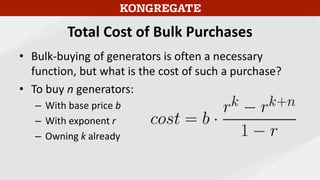
• Bulk-buying of generators is often a necessary
function, but what is the cost of such a purchase?
• To buy n generators:
– With base price b
– With exponent r
– Owning k already
Total Cost of Bulk Purchases
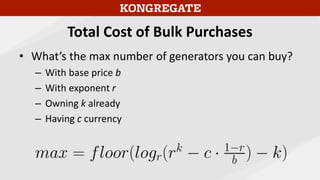
• What’s the max number of generators you can buy?
– With base price b
– With exponent r
– Owning k already
– Having c currency
Non-Cookie Clicker Growth
• Cookie Clicker set standard for growth patterns of
generators
• Other options exist though and can be explored
Non-Cookie Clicker Growth
• What if generators produced generators?
– Generator 1 produces Primary Currency
– Generator 2 produces Generator 1’s
– Generator 3 produces Generator 2’s
– etc.
• These are actually…
Derivatives
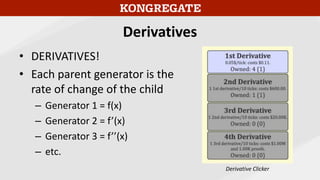
• DERIVATIVES!
• Each parent generator is the
rate of change of the child
– Generator 1 = f(x)
– Generator 2 = f’(x)
– Generator 3 = f’’(x)
– etc.
Derivative Clicker
Educational!
• People don’t even realize they’re working with
derivatives!
• Great way to conceptualize relationship of higher-
order derivatives
– Physics: Location, Speed, Acceleration, Jerk, …?
– Here: Each is just the rate of change of the one above it
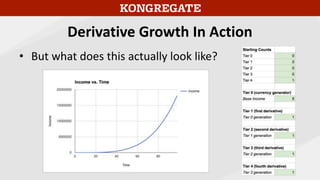
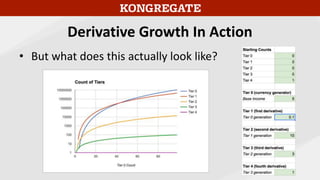
Derivative Growth In Action
• But what does this actually look like?
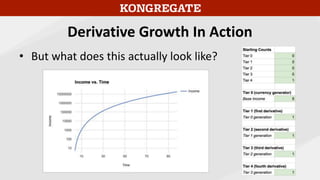
Derivative Growth In Action
• But what does this actually look like?
Derivative Growth In Action
• But what does this actually look like?
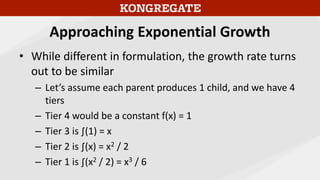
Approaching Exponential Growth
• While different in formulation, the growth rate turns
out to be similar
– Let’s assume each parent produces 1 child, and we have 4
tiers
– Tier 4 would be a constant f(x) = 1
– Tier 3 is ∫(1) = x
– Tier 2 is ∫(x) = x2 / 2
– Tier 1 is ∫(x2 / 2) = x3 / 6
Approaching Exponential Growth
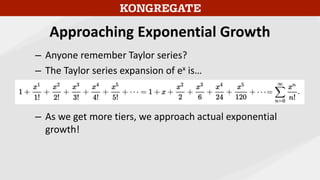
– Anyone remember Taylor series?
– The Taylor series expansion of ex is…
– As we get more tiers, we approach actual exponential
growth!
Intermission: On Big Numbers
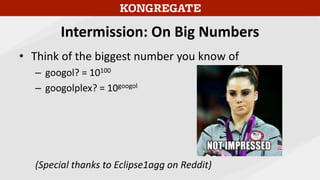
• Think of the biggest number you know of
– googol? = 10100
– googolplex? = 10googol
(Special thanks to Eclipse1agg on Reddit)
Intermission: On Big Numbers
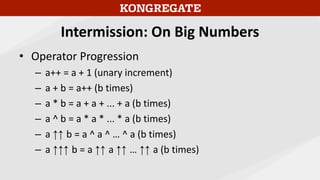
• Operator Progression
– a++ = a + 1 (unary increment)
– a + b = a++ (b times)
– a * b = a + a + ... + a (b times)
– a ^ b = a * a * ... * a (b times)
– a ↑↑ b = a ^ a ^ … ^ a (b times)
– a ↑↑↑ b = a ↑↑ a ↑↑ … ↑↑ a (b times)
Intermission: On Big Numbers
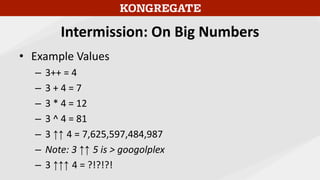
• Example Values
– 3++ = 4
– 3 + 4 = 7
– 3 * 4 = 12
– 3 ^ 4 = 81
– 3 ↑↑ 4 = 7,625,597,484,987
– Note: 3 ↑↑ 5 is > googolplex
– 3 ↑↑↑ 4 = ?!?!?!
Intermission: On Big Numbers
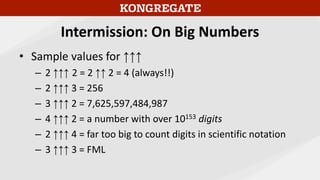
• Sample values for ↑↑↑
– 2 ↑↑↑ 2 = 2 ↑↑ 2 = 4 (always!!)
– 2 ↑↑↑ 3 = 256
– 3 ↑↑↑ 2 = 7,625,597,484,987
– 4 ↑↑↑ 2 = a number with over 10153 digits
– 2 ↑↑↑ 4 = far too big to count digits in scientific notation
– 3 ↑↑↑ 3 = FML
Intermission: On Big Numbers
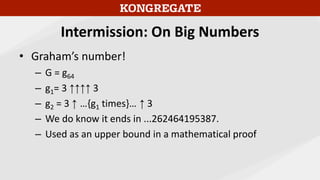
• Graham’s number!
– G = g64
– g1= 3 ↑↑↑↑ 3
– g2 = 3 ↑ …{g1 times}… ↑ 3
– We do know it ends in ...262464195387.
– Used as an upper bound in a mathematical proof
Keeping All Generators Relevant
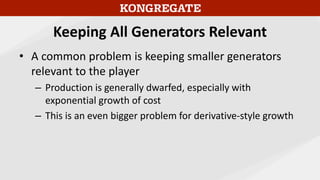
• A common problem is keeping smaller generators
relevant to the player
– Production is generally dwarfed, especially with
exponential growth of cost
– This is an even bigger problem for derivative-style growth
Keeping All Generators Relevant
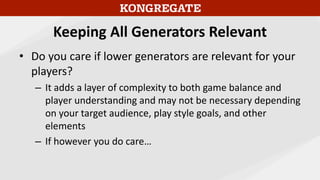
• Do you care if lower generators are relevant for your
players?
– It adds a layer of complexity to both game balance and
player understanding and may not be necessary depending
on your target audience, play style goals, and other
elements
– If however you do care…
Keeping All Generators Relevant
• Possible Solutions
– Aggressive multipliers to force relevance
– Base bonuses on ownership of these generators
• Even if direct generation is low, impact of purchasing is high
– Example: Newspapers in AdVenture Capitalist multiply other
investments
• Note: track purchased and earned generators separately in
derivative growth systems (Derivative Clicker example)
Keeping All Generators Relevant
• Possible Solutions
– Tie prestige currency to ownership
• Clicker Heroes gives one prestige currency for every 2000
generators owned
– Use ownership multipliers to compound on cheaper
generators
• Clicker Heroes gives a x4 bonus for every 25 of a generator
Prestige Cycles
• When will players prestige?
– Common rule of thumb is to reset when you would gain
somewhere in the range of +50% to +200% prestige
currency
• What formula will you use for prestige currency?
– Take a log or a fractional exponent (like square root) to
scale back growth rates
– Ensure that players reach a valuable prestige point
regularly
Prestige Cycles
• What does the next cycle look like for players?
– Will their progress through the early part be quick? This is
an important feeling of growth of power.
– Will they be able to get noticeably farther than last time?
• Do you want the cycles to get faster, slower, or vary?
– Faster: players will shift prestige point to be a lot higher
– Slower: could get tiresome, must have a meta prestige too
– Varied: prestige provides surprises, harder to design
Prestige Cycles
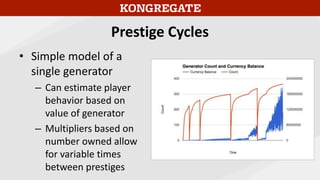
• Simple model of a
single generator
– Can estimate player
behavior based on
value of generator
– Multipliers based on
number owned allow
for variable times
between prestiges
Prestige Cycles
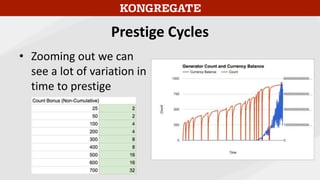
• Zooming out we can
see a lot of variation in
time to prestige
Other Growth Patterns
– Combinatorics
• Pizza store game, income based on how many different types of
pizza you can make
• nCr = n! / (n-r)!r!
• Upgrade to use more ingredients per pizza (r) and have larger
variety of ingredients to use (n)
– Node connections
• City-builder with a prestige to found a new city, trade routes
between all cities [(n)(n-1)/2]
Notable New Genre Additions
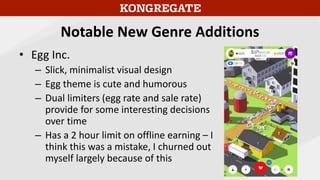
• Egg Inc.
– Slick, minimalist visual design
– Egg theme is cute and humorous
– Dual limiters (egg rate and sale rate)
provide for some interesting decisions
over time
– Has a 2 hour limit on offline earning – I
think this was a mistake, I churned out
myself largely because of this
Notable New Genre Additions
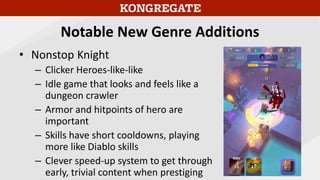
• Nonstop Knight
– Clicker Heroes-like-like
– Idle game that looks and feels like a
dungeon crawler
– Armor and hitpoints of hero are
important
– Skills have short cooldowns, playing
more like Diablo skills
– Clever speed-up system to get through
early, trivial content when prestiging
Notable New Genre Additions
• War Tortoise
– Visually very strong
with really cool
visualization of
combat and upgrades
– Player interaction is
powerful and
thankfully requires no
rapid tapping
Notable New Genre Additions
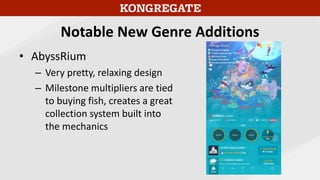
• AbyssRium
– Very pretty, relaxing design
– Milestone multipliers are tied
to buying fish, creates a great
collection system built into
the mechanics
Thank You!
• Check out developers.kongregate.com
• Browser games: apps@kongregate.com
• Mobile games: bd@kongregate.com
• Me: anthony@kongregate.com
• Slides will be available at
developers.kongregate.com/blog

Quest for Progress (GDC Europe 2016)

  • 1.
    Quest for Progress TheMath and Design of Idle Games Anthony Pecorella Kongregate.com
  • 2.
    Who Am I? •At Kongregate for 7 years, directing our browser-based F2P virtual goods business • Producer for AdVenture Capitalist mobile • Also an indie designer, cofounder of Level Up Labs
  • 3.
  • 4.
  • 5.
    Opening Disclaimers • Thisis a design and math talk, not a data and monetization talk • There is some calculus, but you don’t need to remember how it works • If you don’t like graphs, numbers, and formulas you’re not going to like this talk
  • 6.
    Interactive Charts andSheets • All of the graphs generated in this talk come from sheets that are publicly available as both Google Sheets and .xls files • You can access these sheets here: http://kon.gg/idle-math-spreadsheets
  • 7.
    Genre Terminology • IncrementalGames – A game in which the primary goal is to continually increase a number – Often grows in complexity over time • When the scope of a game change substantially it is can referred to as an “unfolding game” • Examples: A Dark Room, Candy Box, Frog Fractions
  • 8.
    Genre Terminology • IdleGames – Subset of Incrementals – Progress or income is made without player interaction – Player choices impact growth rates – It is expected that players leave the game alone regularly – Typically do not have an “end”
  • 9.
    Genre Terminology • ClickerGames – Emphasis on clicking or tapping to progress – Ex. Feed Your Monster, Football Clicker – Can, but does not necessarily, have idle elements • Clicker Heroes is an “idle clicker” – Physicality of the game can be fun but also tiring
  • 10.
    Essential Reading • CookieClicker-likes – AdVenture Capitalist – Realm Grinder – Pocket Politics
  • 11.
    Essential Reading • ClickerHeroes-likes – Tap Titans – Crusaders of the Lost Idols
  • 12.
    Essential Reading • AssortedOthers – Number (Tyler Glaiel) – Swarm Simulator – Sandcastle Builder • The Dwarf Fortress of idle games
  • 13.
    Terminology • Primary Currency –The central number that is being incremented and typically used to purchase most moment-to-moment improvements
  • 14.
    Terminology • Generator – Thebuildings, investments, characters, etc. that a player amasses – They automatically generate Primary Currency (or Exchange Currency) over time – Costs grow magnitude faster than value
  • 15.
    Terminology • Primary ExchangeCurrency – A special case worth mentioning, in some cases generators produce an exchange currency – The most common example is damage / DPS in RPG idlers • Damage is not the primary currency but is tied directly to it • Gives designer a little more control over primary currency accumulation since you can gate or buff conversion at certain points in the progression
  • 16.
    Terminology • Multiplier – Typicallya fixed multiple on a generator, or set of generators, in terms of production value or speed – These help offset cost growth speed – Provide bumps and local victories
  • 17.
    Terminology • Multiplier – Morecomplex ones might have dependencies on: • Its target (e.g. this generator count) • Other generators (e.g. total generator count) • Meta statistics (e.g. total time played, count of lifetime skills used, lifetime currency earned, seconds since last reset, etc.) • External data (e.g. time of day, holidays/events, concurrent player count, etc.) – Incentivized ads are often implemented as a multiplier
  • 18.
    Terminology • Active Skill –Powerful abilities players can initiate – Typically have a long cooldown (5 minutes – a few hours) – Increases player agency, letting them burst income or get over a hump – In more complex situations, players can strategize around best selection, order, and timing of skill usage
  • 19.
    Terminology • Prestige – Playerresets game with a bonus to production – Similar to the “new game+” concept • Meta Prestige – Prestiges can be nested
  • 20.
    Terminology • Prestige Currency –Provides player with Prestige Currency that controls the production bonus • This currency typically grows at a slower order of magnitude than Primary Currency – we’ll look into examples later – In some cases this currency can also be spent for boosts (at the loss of the relative Prestige Currency boost)
  • 21.
    Idle Player MotivationProfile • Quantic Foundry surveyed players of 3 idle games • 70% identified as “core gamers”, 20% as “hardcore” • Top motivators were Completion and Power From Nick Yee’s gamer motivation profiling
  • 22.
    Idle Player MotivationProfile • This can help guide your design process • Players of this genre want to collection and complete, and they want to grow in power – Power growth is central to the genre but you want to make sure players “feel” that growth – Can you incorporate collection or completionism into your idle game design?
  • 23.
    Super quick reviewof exp growth curves • Costs grow exponentially costnext = costbase x (rategrowth)owned • Production grows linearly prodtotal = prodbase x nowned • Note: xk is not exponential growth and will always be outpaced by kx (with k > 1) eventually.
  • 24.
    Exponential Growth Ratesin AdCap • For AdCap, here are the values for a few generators: Lemonade Stand growth with doubling at 25, 50 owned
  • 25.
    Exponential Growth Ratesin AdCap • More Lemonade Stand graphs, with 2x at every 100 and each prestige giving a 5x boost
  • 26.
    Optimal Decisions • Dueto how costs and value grow, players will regularly be deciding what to buy next • We can model optimal choice to see if we – While players likely won’t optimize perfectly, overall patterns will be similar for savvy players – Sometimes tiny generators are optimal but negligible in impact – players will most-likely ignore these
  • 27.
    Optimal Purchase Decisions •Do you want optimal purchasing to be an interesting choice for players? – If so and you see optimal patterns always favoring the highest tier generator, you may have a balance problem – If not then you likely have other game elements that are interesting and don’t need to balance this carefully
  • 28.
  • 29.
  • 30.
    Total Cost ofBulk Purchases • Bulk-buying of generators is often a necessary function, but what is the cost of such a purchase? • To buy n generators: – With base price b – With exponent r – Owning k already
  • 31.
    Total Cost ofBulk Purchases • What’s the max number of generators you can buy? – With base price b – With exponent r – Owning k already – Having c currency
  • 32.
    Non-Cookie Clicker Growth •Cookie Clicker set standard for growth patterns of generators • Other options exist though and can be explored
  • 33.
    Non-Cookie Clicker Growth •What if generators produced generators? – Generator 1 produces Primary Currency – Generator 2 produces Generator 1’s – Generator 3 produces Generator 2’s – etc. • These are actually…
  • 34.
    Derivatives • DERIVATIVES! • Eachparent generator is the rate of change of the child – Generator 1 = f(x) – Generator 2 = f’(x) – Generator 3 = f’’(x) – etc. Derivative Clicker
  • 35.
    Educational! • People don’teven realize they’re working with derivatives! • Great way to conceptualize relationship of higher- order derivatives – Physics: Location, Speed, Acceleration, Jerk, …? – Here: Each is just the rate of change of the one above it
  • 36.
    Derivative Growth InAction • But what does this actually look like?
  • 37.
    Derivative Growth InAction • But what does this actually look like?
  • 38.
    Derivative Growth InAction • But what does this actually look like?
  • 39.
    Approaching Exponential Growth •While different in formulation, the growth rate turns out to be similar – Let’s assume each parent produces 1 child, and we have 4 tiers – Tier 4 would be a constant f(x) = 1 – Tier 3 is ∫(1) = x – Tier 2 is ∫(x) = x2 / 2 – Tier 1 is ∫(x2 / 2) = x3 / 6
  • 40.
    Approaching Exponential Growth –Anyone remember Taylor series? – The Taylor series expansion of ex is… – As we get more tiers, we approach actual exponential growth!
  • 41.
    Intermission: On BigNumbers • Think of the biggest number you know of – googol? = 10100 – googolplex? = 10googol (Special thanks to Eclipse1agg on Reddit)
  • 42.
    Intermission: On BigNumbers • Operator Progression – a++ = a + 1 (unary increment) – a + b = a++ (b times) – a * b = a + a + ... + a (b times) – a ^ b = a * a * ... * a (b times) – a ↑↑ b = a ^ a ^ … ^ a (b times) – a ↑↑↑ b = a ↑↑ a ↑↑ … ↑↑ a (b times)
  • 43.
    Intermission: On BigNumbers • Example Values – 3++ = 4 – 3 + 4 = 7 – 3 * 4 = 12 – 3 ^ 4 = 81 – 3 ↑↑ 4 = 7,625,597,484,987 – Note: 3 ↑↑ 5 is > googolplex – 3 ↑↑↑ 4 = ?!?!?!
  • 44.
    Intermission: On BigNumbers • Sample values for ↑↑↑ – 2 ↑↑↑ 2 = 2 ↑↑ 2 = 4 (always!!) – 2 ↑↑↑ 3 = 256 – 3 ↑↑↑ 2 = 7,625,597,484,987 – 4 ↑↑↑ 2 = a number with over 10153 digits – 2 ↑↑↑ 4 = far too big to count digits in scientific notation – 3 ↑↑↑ 3 = FML
  • 45.
    Intermission: On BigNumbers • Graham’s number! – G = g64 – g1= 3 ↑↑↑↑ 3 – g2 = 3 ↑ …{g1 times}… ↑ 3 – We do know it ends in ...262464195387. – Used as an upper bound in a mathematical proof
  • 46.
    Keeping All GeneratorsRelevant • A common problem is keeping smaller generators relevant to the player – Production is generally dwarfed, especially with exponential growth of cost – This is an even bigger problem for derivative-style growth
  • 47.
    Keeping All GeneratorsRelevant • Do you care if lower generators are relevant for your players? – It adds a layer of complexity to both game balance and player understanding and may not be necessary depending on your target audience, play style goals, and other elements – If however you do care…
  • 48.
    Keeping All GeneratorsRelevant • Possible Solutions – Aggressive multipliers to force relevance – Base bonuses on ownership of these generators • Even if direct generation is low, impact of purchasing is high – Example: Newspapers in AdVenture Capitalist multiply other investments • Note: track purchased and earned generators separately in derivative growth systems (Derivative Clicker example)
  • 49.
    Keeping All GeneratorsRelevant • Possible Solutions – Tie prestige currency to ownership • Clicker Heroes gives one prestige currency for every 2000 generators owned – Use ownership multipliers to compound on cheaper generators • Clicker Heroes gives a x4 bonus for every 25 of a generator
  • 50.
    Prestige Cycles • Whenwill players prestige? – Common rule of thumb is to reset when you would gain somewhere in the range of +50% to +200% prestige currency • What formula will you use for prestige currency? – Take a log or a fractional exponent (like square root) to scale back growth rates – Ensure that players reach a valuable prestige point regularly
  • 51.
    Prestige Cycles • Whatdoes the next cycle look like for players? – Will their progress through the early part be quick? This is an important feeling of growth of power. – Will they be able to get noticeably farther than last time? • Do you want the cycles to get faster, slower, or vary? – Faster: players will shift prestige point to be a lot higher – Slower: could get tiresome, must have a meta prestige too – Varied: prestige provides surprises, harder to design
  • 52.
    Prestige Cycles • Simplemodel of a single generator – Can estimate player behavior based on value of generator – Multipliers based on number owned allow for variable times between prestiges
  • 53.
    Prestige Cycles • Zoomingout we can see a lot of variation in time to prestige
  • 54.
    Other Growth Patterns –Combinatorics • Pizza store game, income based on how many different types of pizza you can make • nCr = n! / (n-r)!r! • Upgrade to use more ingredients per pizza (r) and have larger variety of ingredients to use (n) – Node connections • City-builder with a prestige to found a new city, trade routes between all cities [(n)(n-1)/2]
  • 55.
    Notable New GenreAdditions • Egg Inc. – Slick, minimalist visual design – Egg theme is cute and humorous – Dual limiters (egg rate and sale rate) provide for some interesting decisions over time – Has a 2 hour limit on offline earning – I think this was a mistake, I churned out myself largely because of this
  • 56.
    Notable New GenreAdditions • Nonstop Knight – Clicker Heroes-like-like – Idle game that looks and feels like a dungeon crawler – Armor and hitpoints of hero are important – Skills have short cooldowns, playing more like Diablo skills – Clever speed-up system to get through early, trivial content when prestiging
  • 57.
    Notable New GenreAdditions • War Tortoise – Visually very strong with really cool visualization of combat and upgrades – Player interaction is powerful and thankfully requires no rapid tapping
  • 58.
    Notable New GenreAdditions • AbyssRium – Very pretty, relaxing design – Milestone multipliers are tied to buying fish, creates a great collection system built into the mechanics
  • 59.
    Thank You! • Checkout developers.kongregate.com • Browser games: apps@kongregate.com • Mobile games: bd@kongregate.com • Me: anthony@kongregate.com • Slides will be available at developers.kongregate.com/blog