Will the real please step forward? Dr. Andrew Ferguson MEd FRCA DIBICM FCCP Attending Intensivist
Dogma…. A concept or principle accepted as absolute truth on the basis of unquestioned acceptance of an authority's  statement to that effect rather than on the basis of  logical reasoning or demonstrated proof A blind belief in things often without a material base
Useless end-product or  essential fuel?
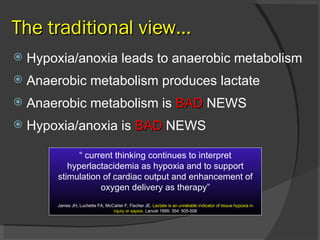
The traditional view… Hypoxia/anoxia leads to anaerobic metabolism Anaerobic metabolism produces lactate Anaerobic metabolism is  BAD  NEWS Hypoxia/anoxia is  BAD  NEWS “  current thinking continues to interpret hyperlactacidemia as hypoxia and to support stimulation of cardiac output and enhancement of oxygen delivery as therapy” James JH, Luchette FA, McCarter F, Fischer JE.  Lactate is an unreliable indicator of tissue hypoxia in injury or sepsis . Lancet 1999; 354: 505-508
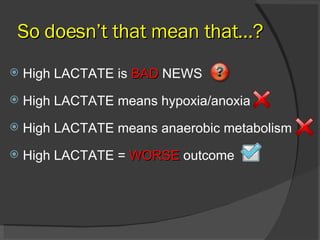
So doesn’t that mean that…? High LACTATE is  BAD  NEWS High LACTATE means hypoxia/anoxia High LACTATE means anaerobic metabolism High LACTATE =  WORSE  outcome
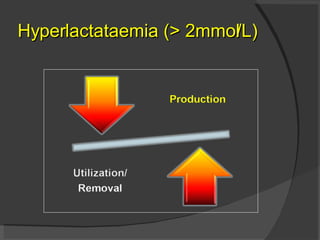
Hyperlactataemia (> 2mmol/L)
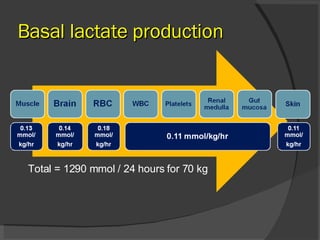
Basal lactate production Total = 1290 mmol / 24 hours for 70 kg
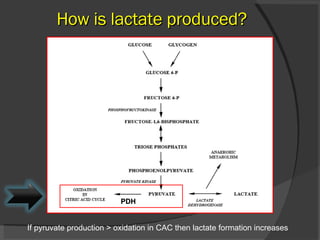
How is lactate produced? If pyruvate production > oxidation in CAC then lactate formation increases PDH
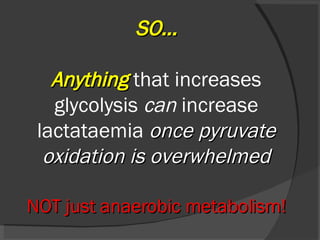
SO… Anything  that increases glycolysis  can  increase lactataemia  once pyruvate oxidation is overwhelmed NOT just anaerobic metabolism!
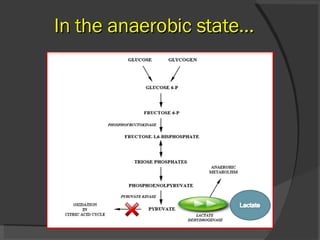
In the anaerobic state…
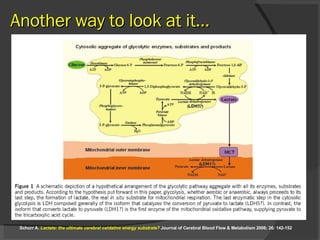
Another way to look at it… Schurr A.  Lactate: the ultimate cerebral oxidative energy substrate?  Journal of Cerebral Blood Flow & Metabolism 2006; 26: 142-152
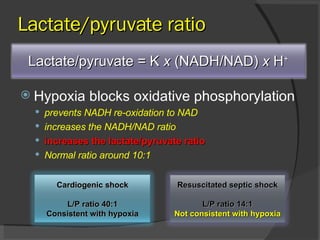
Lactate/pyruvate ratio Hypoxia blocks oxidative phosphorylation prevents NADH re-oxidation to NAD increases the NADH/NAD ratio increases the lactate/pyruvate ratio Normal ratio around 10:1 Lactate/pyruvate = K  x  (NADH/NAD)  x  H + Cardiogenic shock L/P ratio 40:1 Consistent with hypoxia Resuscitated septic shock L/P ratio 14:1 Not consistent with hypoxia
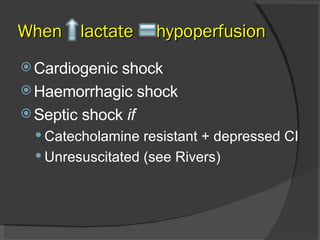
When  lactate  hypoperfusion Cardiogenic shock Haemorrhagic shock Septic shock  if Catecholamine resistant + depressed CI Unresuscitated (see Rivers)
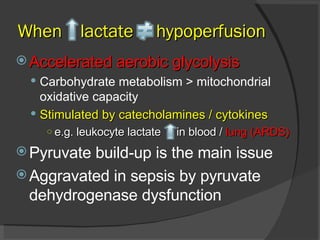
Accelerated aerobic glycolysis Carbohydrate metabolism > mitochondrial oxidative capacity Stimulated by catecholamines / cytokines e.g. leukocyte lactate  in blood /  lung (ARDS) Pyruvate build-up is the main issue Aggravated in sepsis by pyruvate dehydrogenase dysfunction When  lactate  hypoperfusion
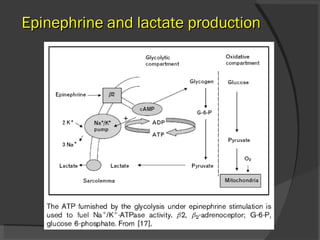
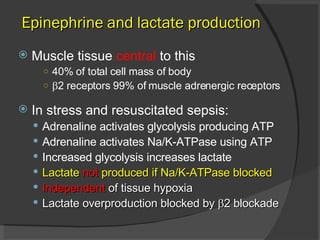
Epinephrine and lactate production
Muscle tissue  central  to this 40% of total cell mass of body  2 receptors 99% of muscle adrenergic receptors In stress and resuscitated sepsis: Adrenaline activates glycolysis producing ATP Adrenaline activates Na/K-ATPase using ATP Increased glycolysis increases lactate Lactate  not  produced if Na/K-ATPase blocked Independent  of tissue hypoxia Lactate overproduction blocked by   2 blockade Epinephrine and lactate production
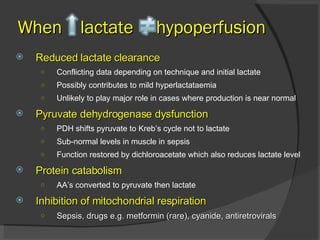
Reduced lactate clearance Conflicting data depending on technique and initial lactate Possibly contributes to mild hyperlactataemia Unlikely to play major role in cases where production is near normal Pyruvate dehydrogenase dysfunction PDH shifts pyruvate to Kreb’s cycle not to lactate Sub-normal levels in muscle in sepsis  Function restored by dichloroacetate which also reduces lactate level Protein catabolism AA’s converted to pyruvate then lactate  Inhibition of mitochondrial respiration Sepsis, drugs e.g. metformin (rare), cyanide, antiretrovirals When  lactate  hypoperfusion
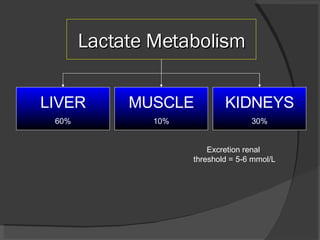
Lactate Metabolism LIVER 60% KIDNEYS 30% Excretion renal  threshold = 5-6 mmol/L MUSCLE 10%
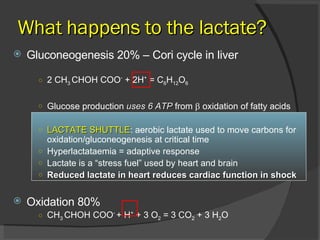
What happens to the lactate? Gluconeogenesis 20% – Cori cycle in liver 2 CH 3  CHOH COO -  + 2H +  = C 6 H 12 O 6 Glucose production  uses 6 ATP  from    oxidation of fatty acids LACTATE SHUTTLE : aerobic lactate used to move carbons for oxidation/gluconeogenesis at critical time Hyperlactataemia = adaptive response Lactate is a “stress fuel” used by heart and brain Reduced lactate in heart reduces cardiac function in shock Oxidation 80% CH 3  CHOH COO -  + H +  + 3 O 2  = 3 CO 2  + 3 H 2 O
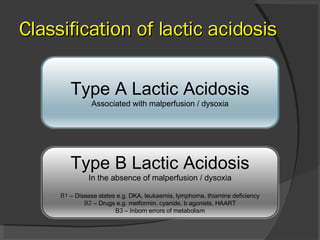
Classification of lactic acidosis Type A Lactic Acidosis Associated with malperfusion / dysoxia Type B Lactic Acidosis In the absence of malperfusion / dysoxia B1  – Disease states e.g. DKA, leukaemia, lymphoma, thiamine deficiency B2  – Drugs e.g. metformin, cyanide, b agonists, HAART B3  – Inborn errors of metabolism
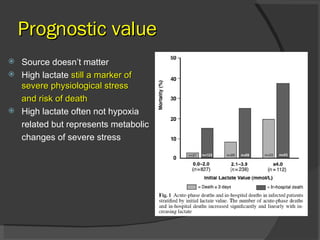
Prognostic value Source doesn’t matter High lactate  still a marker of severe physiological stress  and risk of death High lactate often not hypoxia  related but represents metabolic  changes of severe stress
So what do we do about it? Look for evidence of malperfusion If present augment CO & O 2  delivery BUT  don’t do this just for the lactate level TREAT the malperfusion not the lactate Consider the other reasons for high lactate Lactate is the messenger…don’t shoot it!
References Levy B.  Lactate and shock state: the metabolic view . Curr Opin Crit Care 2006; 12: 315-321 Cohen RD, Simpson R.  Lactate metabolism . Anesthesiology 1975; 43: 661-673 De Backer D.  Lactic acidosis . Intensive care Med 2003; 29: 699-702 Levy B, Gibot S, Franck P, Cravoisy A, Bollaert P-E.  Relation between muscle Na+K+ ATPase activity and raised lactate concentration in septic shock: a prospective study . Lancet 2005; 365:871-875 Trzeciak S, Dellinger RP, Chansky ME, Arnold RC, Schorr C, Milcarek B, Hollenberg SM, Parrillo JE.  Serum lactate as a predictor of mortality in patients with infection . Intensive Care Med 2007; 33: 970-977 James JH, Luchette FA, McCarter F, Fischer JE.  Lactate is an unreliable indicator of tissue hypoxia in injury or sepsis .  Lancet 1999; 354: 505-508 Matejovic M, Radermacher P, Fontaine E.  Lactate in shock: a high-octane fuel for the heart?  Intensive Care Med 2007; 33: 406-408 Schurr A.  Lactate: the ultimate cerebral oxidative energy substrate?  Journal of Cerebral Blood Flow & Metabolism 2006; 26: 142-152

Lactate Overview

  • 1.
    Will the realplease step forward? Dr. Andrew Ferguson MEd FRCA DIBICM FCCP Attending Intensivist
  • 2.
    Dogma…. A conceptor principle accepted as absolute truth on the basis of unquestioned acceptance of an authority's statement to that effect rather than on the basis of logical reasoning or demonstrated proof A blind belief in things often without a material base
  • 3.
    Useless end-product or essential fuel?
  • 4.
    The traditional view…Hypoxia/anoxia leads to anaerobic metabolism Anaerobic metabolism produces lactate Anaerobic metabolism is BAD NEWS Hypoxia/anoxia is BAD NEWS “ current thinking continues to interpret hyperlactacidemia as hypoxia and to support stimulation of cardiac output and enhancement of oxygen delivery as therapy” James JH, Luchette FA, McCarter F, Fischer JE. Lactate is an unreliable indicator of tissue hypoxia in injury or sepsis . Lancet 1999; 354: 505-508
  • 5.
    So doesn’t thatmean that…? High LACTATE is BAD NEWS High LACTATE means hypoxia/anoxia High LACTATE means anaerobic metabolism High LACTATE = WORSE outcome
  • 6.
  • 7.
    Basal lactate productionTotal = 1290 mmol / 24 hours for 70 kg
  • 8.
    How is lactateproduced? If pyruvate production > oxidation in CAC then lactate formation increases PDH
  • 9.
    SO… Anything that increases glycolysis can increase lactataemia once pyruvate oxidation is overwhelmed NOT just anaerobic metabolism!
  • 10.
  • 11.
    Another way tolook at it… Schurr A. Lactate: the ultimate cerebral oxidative energy substrate? Journal of Cerebral Blood Flow & Metabolism 2006; 26: 142-152
  • 12.
    Lactate/pyruvate ratio Hypoxiablocks oxidative phosphorylation prevents NADH re-oxidation to NAD increases the NADH/NAD ratio increases the lactate/pyruvate ratio Normal ratio around 10:1 Lactate/pyruvate = K x (NADH/NAD) x H + Cardiogenic shock L/P ratio 40:1 Consistent with hypoxia Resuscitated septic shock L/P ratio 14:1 Not consistent with hypoxia
  • 13.
    When lactate hypoperfusion Cardiogenic shock Haemorrhagic shock Septic shock if Catecholamine resistant + depressed CI Unresuscitated (see Rivers)
  • 14.
    Accelerated aerobic glycolysisCarbohydrate metabolism > mitochondrial oxidative capacity Stimulated by catecholamines / cytokines e.g. leukocyte lactate in blood / lung (ARDS) Pyruvate build-up is the main issue Aggravated in sepsis by pyruvate dehydrogenase dysfunction When lactate hypoperfusion
  • 15.
  • 16.
    Muscle tissue central to this 40% of total cell mass of body  2 receptors 99% of muscle adrenergic receptors In stress and resuscitated sepsis: Adrenaline activates glycolysis producing ATP Adrenaline activates Na/K-ATPase using ATP Increased glycolysis increases lactate Lactate not produced if Na/K-ATPase blocked Independent of tissue hypoxia Lactate overproduction blocked by  2 blockade Epinephrine and lactate production
  • 17.
    Reduced lactate clearanceConflicting data depending on technique and initial lactate Possibly contributes to mild hyperlactataemia Unlikely to play major role in cases where production is near normal Pyruvate dehydrogenase dysfunction PDH shifts pyruvate to Kreb’s cycle not to lactate Sub-normal levels in muscle in sepsis Function restored by dichloroacetate which also reduces lactate level Protein catabolism AA’s converted to pyruvate then lactate Inhibition of mitochondrial respiration Sepsis, drugs e.g. metformin (rare), cyanide, antiretrovirals When lactate hypoperfusion
  • 18.
    Lactate Metabolism LIVER60% KIDNEYS 30% Excretion renal threshold = 5-6 mmol/L MUSCLE 10%
  • 19.
    What happens tothe lactate? Gluconeogenesis 20% – Cori cycle in liver 2 CH 3 CHOH COO - + 2H + = C 6 H 12 O 6 Glucose production uses 6 ATP from  oxidation of fatty acids LACTATE SHUTTLE : aerobic lactate used to move carbons for oxidation/gluconeogenesis at critical time Hyperlactataemia = adaptive response Lactate is a “stress fuel” used by heart and brain Reduced lactate in heart reduces cardiac function in shock Oxidation 80% CH 3 CHOH COO - + H + + 3 O 2 = 3 CO 2 + 3 H 2 O
  • 20.
    Classification of lacticacidosis Type A Lactic Acidosis Associated with malperfusion / dysoxia Type B Lactic Acidosis In the absence of malperfusion / dysoxia B1 – Disease states e.g. DKA, leukaemia, lymphoma, thiamine deficiency B2 – Drugs e.g. metformin, cyanide, b agonists, HAART B3 – Inborn errors of metabolism
  • 21.
    Prognostic value Sourcedoesn’t matter High lactate still a marker of severe physiological stress and risk of death High lactate often not hypoxia related but represents metabolic changes of severe stress
  • 22.
    So what dowe do about it? Look for evidence of malperfusion If present augment CO & O 2 delivery BUT don’t do this just for the lactate level TREAT the malperfusion not the lactate Consider the other reasons for high lactate Lactate is the messenger…don’t shoot it!
  • 23.
    References Levy B. Lactate and shock state: the metabolic view . Curr Opin Crit Care 2006; 12: 315-321 Cohen RD, Simpson R. Lactate metabolism . Anesthesiology 1975; 43: 661-673 De Backer D. Lactic acidosis . Intensive care Med 2003; 29: 699-702 Levy B, Gibot S, Franck P, Cravoisy A, Bollaert P-E. Relation between muscle Na+K+ ATPase activity and raised lactate concentration in septic shock: a prospective study . Lancet 2005; 365:871-875 Trzeciak S, Dellinger RP, Chansky ME, Arnold RC, Schorr C, Milcarek B, Hollenberg SM, Parrillo JE. Serum lactate as a predictor of mortality in patients with infection . Intensive Care Med 2007; 33: 970-977 James JH, Luchette FA, McCarter F, Fischer JE. Lactate is an unreliable indicator of tissue hypoxia in injury or sepsis . Lancet 1999; 354: 505-508 Matejovic M, Radermacher P, Fontaine E. Lactate in shock: a high-octane fuel for the heart? Intensive Care Med 2007; 33: 406-408 Schurr A. Lactate: the ultimate cerebral oxidative energy substrate? Journal of Cerebral Blood Flow & Metabolism 2006; 26: 142-152