SHOCK
MANAGEMENT
Dr. GT Wijesinghe, MBBS
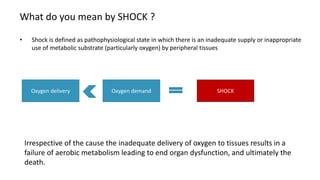
Irrespective of the cause the inadequate delivery of oxygen to tissues results in a
failure of aerobic metabolism leading to end organ dysfunction, and ultimately the
death.
Oxygen delivery Oxygen demand SHOCK
What do you mean by SHOCK ?
• Shock is defined as pathophysiological state in which there is an inadequate supply or inappropriate
use of metabolic substrate (particularly oxygen) by peripheral tissues
Importance of Oxygen delivery
For practical purposes global oxygen delivery can be calculated as:
Cardiac output (HR x SV) x [Hb]g/dl x 10 x 1.34 x Saturation(sO2) ml/l
• ATP is the fuel of body ( energy source in cellular metabolism )
• ATP is produced by glucose metabolism
• Oxygen is needed in this reaction, but limited reaction also possible without oxygen (anerobic)
• Glucose Pyruvate Lactate + CO2
• Limitation of oxygen result in altered cellular activities leading to organ dysfunction
Aerobic >>> Anerobic ( 18 times higher efficacy )
MANAGEMENT STEPS...
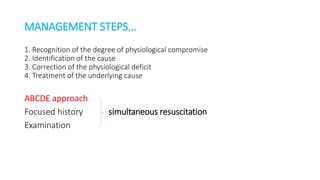
1. Recognition of the degree of physiological compromise
2. Identification of the cause
3. Correction of the physiological deficit
4. Treatment of the underlying cause
ABCDE approach
Focused history simultaneous resuscitation
Examination
Normal Early signs Late signs Irreversible state, death
Identify the shock… and Intervene
• Early signs - Results of compensatory mechanisms
• Late signs - Secondary to organ dysfunction
1 2
3
Time is an important factor !
Heart rate
Absence of tachycardia does not rule out hemorrhagic
shock
Skin
Cold / clammy - Hypovolemic
Warm - Neurogenic / Early sepsis
Erythema / Urticaria / Angioedema - Anaphylaxis
Respiratory rate
excellent marker of physiological compromise
Secondary to hypoxia / Metabolic acidosis
Blood pressure
Normal at early stages
Pulse pressure drops prior to BP
MAP > 65 mmHg important
GCS
Lack of cerebral perfusion
Urine Out Put
Reduced UOP is a Late sign, useful in assessment of
resuscitation in shocked patients
May be misleading ; Eg: Diabetic ketoacidosis
LOOK FOR THESE…
Seemingly normal physiology may be concealing a
significantly compensated shock !!!
Investigations
Target to identify the cause
FAST / CT - trauma
ECG - cardiogenic shock
Echo - Pulmonary embolism
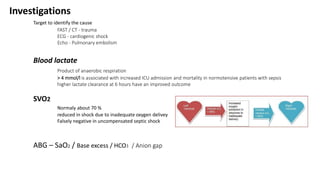
Blood lactate
Product of anaerobic respiration
> 4 mmol/l is associated with increased ICU admission and mortality in normotensive patients with sepsis
higher lactate clearance at 6 hours have an improved outcome
SVO2
Normaly about 70 %
reduced in shock due to inadequate oxygen delivey
Falsely negative in uncompensated septic shock
ABG – SaO2 / Base excess / HCO3 / Anion gap
High flow
supplementary
oxygen
Once a shock state is recognized, treatment must focus on:
1. Reversing the physiological deficit (resuscitation)
2. Treating the cause
+/-Fluid resuscitation
Blood, colloid, Crystalloid
Inotropes
Frequent clinical re-assessment Response ? Accuracy of diagnosis | Need of intervention
Surgical intervention
Antibiotics
Intubation & Ventilation
Effect on oxygen delivery Intervention Increase in oxygen delivery
Greatest
Increasing [Hb] from 6g/dl to
9g/dl
50%
Increasing cardiac output by
20% with crystalloid boluses
20%
Increasing oxygen saturation
from 91% to 100% with
supplemental oxygen
10%
Least
Increasing PaO2 from 12kPa to
40kPa with supplemental
oxygen
<1%
Incresing Hb - Blood transfusion – Not more / not less
Increasing Cardiac Output - Crystalloids | Colloids | Inotropes
Increasing oxygen saturation - Supplementary Oxygen | Intubation and Ventilation
GOAL of resuscitation
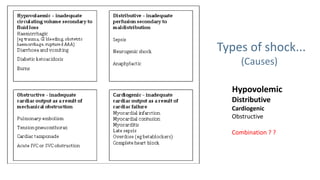
Types of shock...
(Causes)
Hypovolemic
Distributive
Cardiogenic
Obstructive
Combination ? ?
• Place of surgical intervention
with uncontrolled haemorrhage temporary or definitive haemostasis (even in the presence of hypotension)
should be performed first, followed by intravascular fluid replacement
• Crystalloids
 250 ml bolus over 5 – 10 min
 Reassess after each
 There is no evidence that ordinary crystalloid ( Normal saline or Hartmanns ) is inferior to colloid
 Reduction in the hemoglobin by approximately 1g/dl per 500 ml of colloid or crystalloid solution
remaining in the vascular compartment
 Place of hypertonic saline?
• Blood
Target Hb 8 – 9 g/dl
Judicious transfusion, avoid fluid overload
• Role of passive leg raising
only 100-150 mL are transferred to the intravascular space by this method
Role of Inotropes
Exactly which inotrope in which setting is a subject of vigourous ongoing debate
Considered in unresponsive shock for resuscitation
Norepinephrine is considered firstline in Septic shock
Dobutamine increase contractility but vasodilate; worsen the septic or anaphylactic shock if give early.
Useful in cardiogenic shock
Intubation & Ventilation
Early intubation and ventilation may needed
Oxygen consumption can be dramatically reduced by taking over the work of breathing
Need to consider intubation once fluid resuscitation exceeds 40-60 ml/kg in children due to risk of
pulmonary edema
Role of Low dose steroids ??
Initial enthusiasm for low dose steroids in sepsis is now waning
[ exception in adrenal insufficiency (Addisonian crisis) ]
Take home message
Shock is not a diagnosis , it is a pathophysiological state secondary to many
disease conditions
Inadequate oxygen delivery to tissues is the main problem
Do not rely simply on heart rate and blood pressure while tackling with a patient
who is carrying the possibility of shock, because initial compensation may mask
the imminent decompensation
Increased respiratory rate is an excellent early clinical indicator of ongoing shock
Serum lactate level > 4 mmol/ l is a good early indicator
Prompt early resuscitation +/- surgical intervention(when necessary) and
definitive treatment for underlying pathology is the mainstay of management
Intubation and ventilation will help to minimize the work load needed for
breathing

Shock management

  • 1.
  • 2.
    Irrespective of thecause the inadequate delivery of oxygen to tissues results in a failure of aerobic metabolism leading to end organ dysfunction, and ultimately the death. Oxygen delivery Oxygen demand SHOCK What do you mean by SHOCK ? • Shock is defined as pathophysiological state in which there is an inadequate supply or inappropriate use of metabolic substrate (particularly oxygen) by peripheral tissues
  • 3.
    Importance of Oxygendelivery For practical purposes global oxygen delivery can be calculated as: Cardiac output (HR x SV) x [Hb]g/dl x 10 x 1.34 x Saturation(sO2) ml/l • ATP is the fuel of body ( energy source in cellular metabolism ) • ATP is produced by glucose metabolism • Oxygen is needed in this reaction, but limited reaction also possible without oxygen (anerobic) • Glucose Pyruvate Lactate + CO2 • Limitation of oxygen result in altered cellular activities leading to organ dysfunction Aerobic >>> Anerobic ( 18 times higher efficacy )
  • 4.
    MANAGEMENT STEPS... 1. Recognitionof the degree of physiological compromise 2. Identification of the cause 3. Correction of the physiological deficit 4. Treatment of the underlying cause ABCDE approach Focused history simultaneous resuscitation Examination
  • 5.
    Normal Early signsLate signs Irreversible state, death Identify the shock… and Intervene • Early signs - Results of compensatory mechanisms • Late signs - Secondary to organ dysfunction 1 2 3 Time is an important factor !
  • 6.
    Heart rate Absence oftachycardia does not rule out hemorrhagic shock Skin Cold / clammy - Hypovolemic Warm - Neurogenic / Early sepsis Erythema / Urticaria / Angioedema - Anaphylaxis Respiratory rate excellent marker of physiological compromise Secondary to hypoxia / Metabolic acidosis Blood pressure Normal at early stages Pulse pressure drops prior to BP MAP > 65 mmHg important GCS Lack of cerebral perfusion Urine Out Put Reduced UOP is a Late sign, useful in assessment of resuscitation in shocked patients May be misleading ; Eg: Diabetic ketoacidosis LOOK FOR THESE…
  • 7.
    Seemingly normal physiologymay be concealing a significantly compensated shock !!!
  • 8.
    Investigations Target to identifythe cause FAST / CT - trauma ECG - cardiogenic shock Echo - Pulmonary embolism Blood lactate Product of anaerobic respiration > 4 mmol/l is associated with increased ICU admission and mortality in normotensive patients with sepsis higher lactate clearance at 6 hours have an improved outcome SVO2 Normaly about 70 % reduced in shock due to inadequate oxygen delivey Falsely negative in uncompensated septic shock ABG – SaO2 / Base excess / HCO3 / Anion gap
  • 9.
    High flow supplementary oxygen Once ashock state is recognized, treatment must focus on: 1. Reversing the physiological deficit (resuscitation) 2. Treating the cause +/-Fluid resuscitation Blood, colloid, Crystalloid Inotropes Frequent clinical re-assessment Response ? Accuracy of diagnosis | Need of intervention Surgical intervention Antibiotics Intubation & Ventilation
  • 10.
    Effect on oxygendelivery Intervention Increase in oxygen delivery Greatest Increasing [Hb] from 6g/dl to 9g/dl 50% Increasing cardiac output by 20% with crystalloid boluses 20% Increasing oxygen saturation from 91% to 100% with supplemental oxygen 10% Least Increasing PaO2 from 12kPa to 40kPa with supplemental oxygen <1% Incresing Hb - Blood transfusion – Not more / not less Increasing Cardiac Output - Crystalloids | Colloids | Inotropes Increasing oxygen saturation - Supplementary Oxygen | Intubation and Ventilation GOAL of resuscitation
  • 11.
  • 12.
    • Place ofsurgical intervention with uncontrolled haemorrhage temporary or definitive haemostasis (even in the presence of hypotension) should be performed first, followed by intravascular fluid replacement • Crystalloids  250 ml bolus over 5 – 10 min  Reassess after each  There is no evidence that ordinary crystalloid ( Normal saline or Hartmanns ) is inferior to colloid  Reduction in the hemoglobin by approximately 1g/dl per 500 ml of colloid or crystalloid solution remaining in the vascular compartment  Place of hypertonic saline? • Blood Target Hb 8 – 9 g/dl Judicious transfusion, avoid fluid overload • Role of passive leg raising only 100-150 mL are transferred to the intravascular space by this method
  • 13.
    Role of Inotropes Exactlywhich inotrope in which setting is a subject of vigourous ongoing debate Considered in unresponsive shock for resuscitation Norepinephrine is considered firstline in Septic shock Dobutamine increase contractility but vasodilate; worsen the septic or anaphylactic shock if give early. Useful in cardiogenic shock Intubation & Ventilation Early intubation and ventilation may needed Oxygen consumption can be dramatically reduced by taking over the work of breathing Need to consider intubation once fluid resuscitation exceeds 40-60 ml/kg in children due to risk of pulmonary edema Role of Low dose steroids ?? Initial enthusiasm for low dose steroids in sepsis is now waning [ exception in adrenal insufficiency (Addisonian crisis) ]
  • 14.
    Take home message Shockis not a diagnosis , it is a pathophysiological state secondary to many disease conditions Inadequate oxygen delivery to tissues is the main problem Do not rely simply on heart rate and blood pressure while tackling with a patient who is carrying the possibility of shock, because initial compensation may mask the imminent decompensation Increased respiratory rate is an excellent early clinical indicator of ongoing shock Serum lactate level > 4 mmol/ l is a good early indicator Prompt early resuscitation +/- surgical intervention(when necessary) and definitive treatment for underlying pathology is the mainstay of management Intubation and ventilation will help to minimize the work load needed for breathing