Presented By:
Krishna Gupta
B.B.A. 2 Sem.
Labour Cost Control
Presented By:
Krishna Gupta
B.B.A. 2 Sem.
CONTENTS
• Introduction
• Classification
• Labour cost control
• Casual worker
• Out worker
• Leave with pay
• Holiday with pay
• Idle time
• Classification of idle time
• Incentive plans
Labour refers to human efforts and skill
utilised in the production of goods or in the
performance of service or in the execution
of jobs.
Introduction
Classification Of Labour
Labour can be classified into two categories i.e.
1. Direct labour- Direct labour is that which is
directly engaged in production work and can
be conveniently identified.
2. 2. Indirect Labour- Indirect labour refers to
that labour which cannot be conveniently
identified with a particular cost or cost unit.
Labour cost control refers to the control of
labour cost per unit of production through
proper employment and efficient utilisation
of labour force
Labour Cost Control
Casual Worker
Casual worker are those workers who
are employed casually either daily or
short periods, when there is some extra
work or urgent work in the factory or
when some of the regular workers of
the factory are on leave.
Out Worker
A workers do not work in factory but work
independently in his house, is called Out
workers.
Leave With Pay
Workers are entitled to annual leave with
full pay for a specified number of days in a
year.
Labours or workers are given paid holiday
for some national day or festival. Such
holiday for which workers are get salary or
wages, is called holiday with pay.
Holiday With Pay
Idle time represents time lost by workers who
are paid on time basis. When workers are paid
on time basis, some difference between the
time for which they are paid and that which
they actually spend on production.
Idle Time
CLASSIFICATION OF IDLE TIME
•Normal Idle Time
•Abnormal Idle Time
• Time taken by the workers to reach their
department from factory gate.
• Setting up tools, equipments and machines.
• Moving from one job to another.
• In attending their personnel needs.
• Tea and lunch.
• Minor accident to any workers.
Normal Idle Time
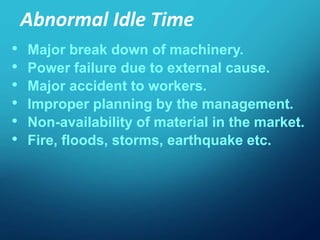
• Major break down of machinery.
• Power failure due to external cause.
• Major accident to workers.
• Improper planning by the management.
• Non-availability of material in the market.
• Fire, floods, storms, earthquake etc.
Abnormal Idle Time
Various Incentive Plans
The primary purpose of an incentive plan is
to induce a worker to produce more to earn a
higher wage. Naturally, producing more in the
same period of time should result in higher
wages for the workers.
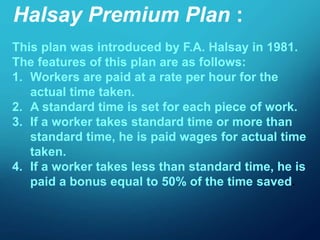
Halsay Premium Plan :
This plan was introduced by F.A. Halsay in 1981.
The features of this plan are as follows:
1. Workers are paid at a rate per hour for the
actual time taken.
2. A standard time is set for each piece of work.
3. If a worker takes standard time or more than
standard time, he is paid wages for actual time
taken.
4. If a worker takes less than standard time, he is
paid a bonus equal to 50% of the time saved.
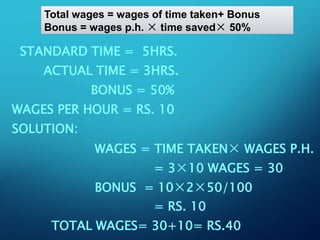
STANDARD TIME = 5HRS.
ACTUAL TIME = 3HRS.
BONUS = 50%
WAGES PER HOUR = RS. 10
SOLUTION:
WAGES = TIME TAKEN× WAGES P.H.
= 3×10 WAGES = 30
BONUS = 10×2×50/100
= RS. 10
TOTAL WAGES= 30+10= RS.40
Total wages = wages of time taken+ Bonus
Bonus = wages p.h. × time saved× 50%
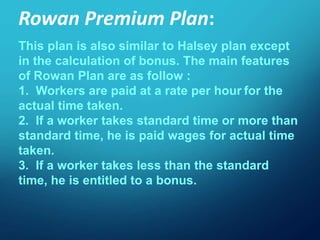
This plan is also similar to Halsey plan except
in the calculation of bonus. The main features
of Rowan Plan are as follow :
1. Workers are paid at a rate per hour for the
actual time taken.
2. If a worker takes standard time or more than
standard time, he is paid wages for actual time
taken.
3. If a worker takes less than the standard
time, he is entitled to a bonus.
Rowan Premium Plan:
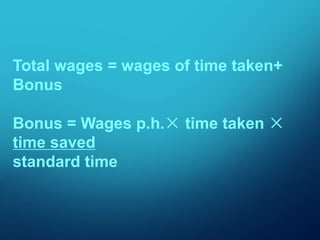
Total wages = wages of time taken+
Bonus
Bonus = Wages p.h.× time taken ×
time saved
standard time
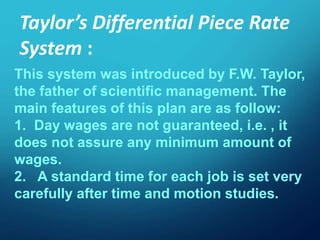
This system was introduced by F.W. Taylor,
the father of scientific management. The
main features of this plan are as follow:
1. Day wages are not guaranteed, i.e. , it
does not assure any minimum amount of
wages.
2. A standard time for each job is set very
carefully after time and motion studies.
Taylor’s Differential Piece Rate
System :

Labour Cost Control in cost accounting

  • 1.
    Presented By: Krishna Gupta B.B.A.2 Sem. Labour Cost Control Presented By: Krishna Gupta B.B.A. 2 Sem.
  • 2.
    CONTENTS • Introduction • Classification •Labour cost control • Casual worker • Out worker • Leave with pay • Holiday with pay • Idle time • Classification of idle time • Incentive plans
  • 3.
    Labour refers tohuman efforts and skill utilised in the production of goods or in the performance of service or in the execution of jobs. Introduction
  • 4.
    Classification Of Labour Labourcan be classified into two categories i.e. 1. Direct labour- Direct labour is that which is directly engaged in production work and can be conveniently identified. 2. 2. Indirect Labour- Indirect labour refers to that labour which cannot be conveniently identified with a particular cost or cost unit.
  • 5.
    Labour cost controlrefers to the control of labour cost per unit of production through proper employment and efficient utilisation of labour force Labour Cost Control
  • 6.
    Casual Worker Casual workerare those workers who are employed casually either daily or short periods, when there is some extra work or urgent work in the factory or when some of the regular workers of the factory are on leave.
  • 7.
    Out Worker A workersdo not work in factory but work independently in his house, is called Out workers.
  • 8.
    Leave With Pay Workersare entitled to annual leave with full pay for a specified number of days in a year.
  • 9.
    Labours or workersare given paid holiday for some national day or festival. Such holiday for which workers are get salary or wages, is called holiday with pay. Holiday With Pay
  • 10.
    Idle time representstime lost by workers who are paid on time basis. When workers are paid on time basis, some difference between the time for which they are paid and that which they actually spend on production. Idle Time
  • 11.
    CLASSIFICATION OF IDLETIME •Normal Idle Time •Abnormal Idle Time
  • 12.
    • Time takenby the workers to reach their department from factory gate. • Setting up tools, equipments and machines. • Moving from one job to another. • In attending their personnel needs. • Tea and lunch. • Minor accident to any workers. Normal Idle Time
  • 13.
    • Major breakdown of machinery. • Power failure due to external cause. • Major accident to workers. • Improper planning by the management. • Non-availability of material in the market. • Fire, floods, storms, earthquake etc. Abnormal Idle Time
  • 14.
    Various Incentive Plans Theprimary purpose of an incentive plan is to induce a worker to produce more to earn a higher wage. Naturally, producing more in the same period of time should result in higher wages for the workers.
  • 15.
    Halsay Premium Plan: This plan was introduced by F.A. Halsay in 1981. The features of this plan are as follows: 1. Workers are paid at a rate per hour for the actual time taken. 2. A standard time is set for each piece of work. 3. If a worker takes standard time or more than standard time, he is paid wages for actual time taken. 4. If a worker takes less than standard time, he is paid a bonus equal to 50% of the time saved.
  • 16.
    STANDARD TIME =5HRS. ACTUAL TIME = 3HRS. BONUS = 50% WAGES PER HOUR = RS. 10 SOLUTION: WAGES = TIME TAKEN× WAGES P.H. = 3×10 WAGES = 30 BONUS = 10×2×50/100 = RS. 10 TOTAL WAGES= 30+10= RS.40 Total wages = wages of time taken+ Bonus Bonus = wages p.h. × time saved× 50%
  • 17.
    This plan isalso similar to Halsey plan except in the calculation of bonus. The main features of Rowan Plan are as follow : 1. Workers are paid at a rate per hour for the actual time taken. 2. If a worker takes standard time or more than standard time, he is paid wages for actual time taken. 3. If a worker takes less than the standard time, he is entitled to a bonus. Rowan Premium Plan:
  • 18.
    Total wages =wages of time taken+ Bonus Bonus = Wages p.h.× time taken × time saved standard time
  • 19.
    This system wasintroduced by F.W. Taylor, the father of scientific management. The main features of this plan are as follow: 1. Day wages are not guaranteed, i.e. , it does not assure any minimum amount of wages. 2. A standard time for each job is set very carefully after time and motion studies. Taylor’s Differential Piece Rate System :