Submitted To: Submitted By:
Mr. Naresh Kedia Adarsh Jain
Akshara Talegaonkar
Mitika Ghorpade
Sakhi Chaudhary
B. Com . (H) Sem III Sec A
Introduction
• Labour cost is classified as direct and indirect. They
form the labour cost which in turn forms a
significant percentage of the total cost of production
in a manufacturing or service organization and there
is need to exercise maximum care to minimize these
costs.
• Minimizing costs does not mean reducing cost but
means getting optimal and efficient productivity
from the employees.
Elements of Labour Cost.
Labour Cost can either be direct, or Indirect they
include:
• Basic Wages
• Overtime premium
• Idle time
• Labour turnover
Control of Labour Cost
• Salaries and wages are one of the largest costs
of every company, and are often the most
difficult to control. But changing
compensation is touchy for those who are
affected, so it is important to handle the
changes with compassion, truth, and firmness.
Review Levels of
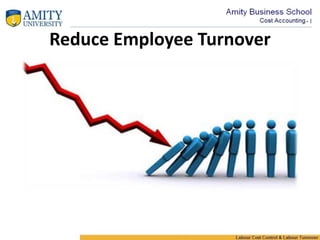
Reduce Employee Turnover
Jobs Between Employees
Automate and Outsource Non-Critical
Tasks
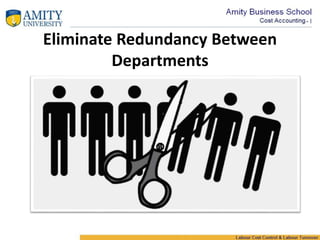
Eliminate Redundancy Between
Departments
LABOUR TURNOVER
• A measure of the proportion of people leaving
relative to the average number of people
employed over a period of time. This rate
should be kept as low as possible.
Management might wish to monitor labour
turnover so that control measures might be
considered if turnover rate is too high since
business is losing experience and valuable
staff at a fast rate.
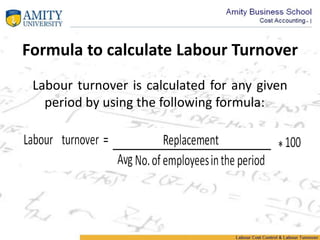
Formula to calculate Labour Turnover
Labour turnover is calculated for any given
period by using the following formula:
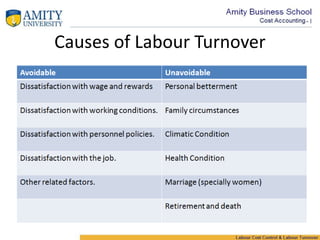
Causes of Labour Turnover
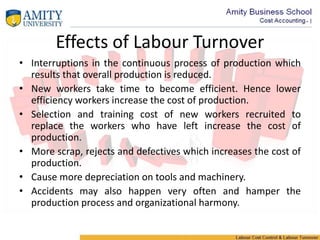
Effects of Labour Turnover
• Interruptions in the continuous process of production which
results that overall production is reduced.
• New workers take time to become efficient. Hence lower
efficiency workers increase the cost of production.
• Selection and training cost of new workers recruited to
replace the workers who have left increase the cost of
production.
• More scrap, rejects and defectives which increases the cost of
production.
• Cause more depreciation on tools and machinery.
• Accidents may also happen very often and hamper the
production process and organizational harmony.
Labour turnover, Labour Cost

Labour turnover, Labour Cost

  • 1.
    Submitted To: SubmittedBy: Mr. Naresh Kedia Adarsh Jain Akshara Talegaonkar Mitika Ghorpade Sakhi Chaudhary B. Com . (H) Sem III Sec A
  • 2.
    Introduction • Labour costis classified as direct and indirect. They form the labour cost which in turn forms a significant percentage of the total cost of production in a manufacturing or service organization and there is need to exercise maximum care to minimize these costs. • Minimizing costs does not mean reducing cost but means getting optimal and efficient productivity from the employees.
  • 3.
    Elements of LabourCost. Labour Cost can either be direct, or Indirect they include: • Basic Wages • Overtime premium • Idle time • Labour turnover
  • 4.
    Control of LabourCost • Salaries and wages are one of the largest costs of every company, and are often the most difficult to control. But changing compensation is touchy for those who are affected, so it is important to handle the changes with compassion, truth, and firmness.
  • 6.
  • 7.
  • 8.
  • 9.
    Automate and OutsourceNon-Critical Tasks
  • 10.
  • 11.
    LABOUR TURNOVER • Ameasure of the proportion of people leaving relative to the average number of people employed over a period of time. This rate should be kept as low as possible. Management might wish to monitor labour turnover so that control measures might be considered if turnover rate is too high since business is losing experience and valuable staff at a fast rate.
  • 12.
    Formula to calculateLabour Turnover Labour turnover is calculated for any given period by using the following formula:
  • 13.
  • 14.
    Effects of LabourTurnover • Interruptions in the continuous process of production which results that overall production is reduced. • New workers take time to become efficient. Hence lower efficiency workers increase the cost of production. • Selection and training cost of new workers recruited to replace the workers who have left increase the cost of production. • More scrap, rejects and defectives which increases the cost of production. • Cause more depreciation on tools and machinery. • Accidents may also happen very often and hamper the production process and organizational harmony.