RETIREMENT AND OTHER
SEPARATIONS
HUMAN RESOURCE MANAGEMENT
SEPARATION




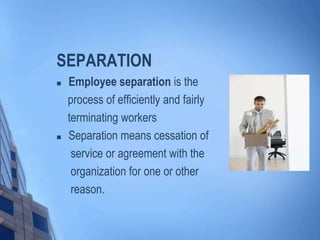
Employee separation is the
process of efficiently and fairly
terminating workers
Separation means cessation of
service or agreement with the
organization for one or other
reason.
BENEFITS OF EMPLOYEE
SEPARATION






Reduced labor costs
Replacements of poor
performances
Increased innovation
The opportunity for greater diversity
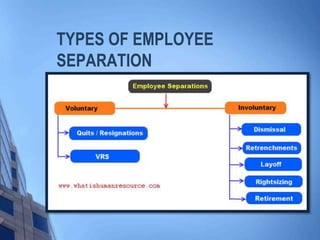
TYPES OF EMPLOYEE
SEPARATION
TYPES OF EMPLOYEE
SEPARATION


Involuntary separations
It occurs when an employer decides to terminate its
relationship with an employee due to





Economic necessity or
A poor fit between the employee and the organization.

Voluntary separations
A separation that occurs when an employee decides,
for personal or professional reasons to end the
relationship with the employer.
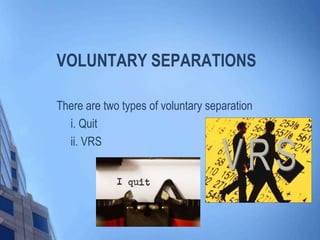
VOLUNTARY SEPARATIONS
There are two types of voluntary separation
i. Quit
ii. VRS
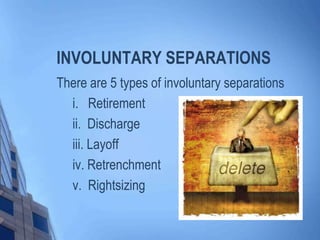
INVOLUNTARY SEPARATIONS
There are 5 types of involuntary separations
i. Retirement
ii. Discharge
iii. Layoff
iv. Retrenchment
v. Rightsizing
Do You Know What This Movie is
About?
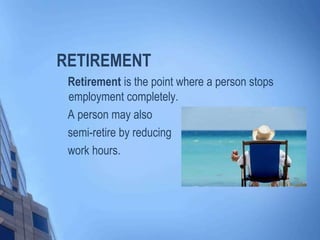
RETIREMENT
Retirement is the point where a person stops
employment completely.
A person may also
semi-retire by reducing
work hours.
FACTOR AFFECTING
RETIREMENT








health status
financial circumstances
attachment to and conditions at work
work-life balance
caring and unpaid work responsibilities
policy context
labor market demand
TYPES OF RETIREMENT









Retirement on Superannuation
Voluntary Retirement
Compulsory Retirement as a measure of
punishment
Compulsory Retirement due to Administrative
Reason
Death While in Service
Retirement due to invalidation on Medical Ground
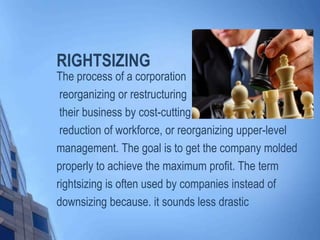
RIGHTSIZING

The process of a corporation
reorganizing or restructuring
their business by cost-cutting,
reduction of workforce, or reorganizing upper-level
management. The goal is to get the company molded
properly to achieve the maximum profit. The term
rightsizing is often used by companies instead of
downsizing because. it sounds less drastic
RETRENCHMENT
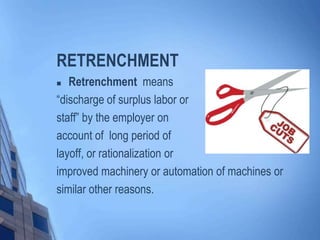
Retrenchment means
“discharge of surplus labor or
staff” by the employer on
account of long period of
layoff, or rationalization or
improved machinery or automation of machines or
similar other reasons.

DISMISSAL


Dismissal is where the
employer chooses to
require the employee to leave, generally for a
reason which is the fault of the employee. The
most common colloquial term for dismissal in
America is "getting fired" whereas in Britain the
term "getting the sack" or "getting sacked" is also
used.
LAYOFF


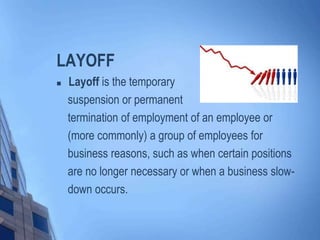
Layoff is the temporary
suspension or permanent
termination of employment of an employee or
(more commonly) a group of employees for
business reasons, such as when certain positions
are no longer necessary or when a business slowdown occurs.
IMPACT OF LAYOFF







Effects the morale of remaining employees
Regions economic vitality
Entire community suffers
Investors are affected
Company’s image
Difficult to attract & recruit highly skilled
employees
OUTPLACEMENT


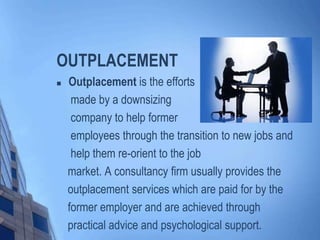
Outplacement is the efforts
made by a downsizing
company to help former
employees through the transition to new jobs and
help them re-orient to the job
market. A consultancy firm usually provides the
outplacement services which are paid for by the
former employer and are achieved through
practical advice and psychological support.
Goals of outplacement






Reducing the morale problem of employees who
are about to be laid off.
Minimizing the amount of litigation initiated by
separated employees
Assisting separated employees in finding new jobs
More About the Art of Firing



http://artoffiring.blogspot.in
“Art of Firing”
Retirement and other separations

Retirement and other separations

  • 1.
  • 2.
    SEPARATION   Employee separation isthe process of efficiently and fairly terminating workers Separation means cessation of service or agreement with the organization for one or other reason.
  • 3.
    BENEFITS OF EMPLOYEE SEPARATION     Reducedlabor costs Replacements of poor performances Increased innovation The opportunity for greater diversity
  • 4.
  • 5.
    TYPES OF EMPLOYEE SEPARATION  Involuntaryseparations It occurs when an employer decides to terminate its relationship with an employee due to    Economic necessity or A poor fit between the employee and the organization. Voluntary separations A separation that occurs when an employee decides, for personal or professional reasons to end the relationship with the employer.
  • 6.
    VOLUNTARY SEPARATIONS There aretwo types of voluntary separation i. Quit ii. VRS
  • 7.
    INVOLUNTARY SEPARATIONS There are5 types of involuntary separations i. Retirement ii. Discharge iii. Layoff iv. Retrenchment v. Rightsizing
  • 8.
    Do You KnowWhat This Movie is About?
  • 9.
    RETIREMENT Retirement is thepoint where a person stops employment completely. A person may also semi-retire by reducing work hours.
  • 10.
    FACTOR AFFECTING RETIREMENT        health status financialcircumstances attachment to and conditions at work work-life balance caring and unpaid work responsibilities policy context labor market demand
  • 11.
    TYPES OF RETIREMENT       Retirementon Superannuation Voluntary Retirement Compulsory Retirement as a measure of punishment Compulsory Retirement due to Administrative Reason Death While in Service Retirement due to invalidation on Medical Ground
  • 12.
    RIGHTSIZING The process ofa corporation reorganizing or restructuring their business by cost-cutting, reduction of workforce, or reorganizing upper-level management. The goal is to get the company molded properly to achieve the maximum profit. The term rightsizing is often used by companies instead of downsizing because. it sounds less drastic
  • 13.
    RETRENCHMENT Retrenchment means “discharge ofsurplus labor or staff” by the employer on account of long period of layoff, or rationalization or improved machinery or automation of machines or similar other reasons. 
  • 14.
    DISMISSAL  Dismissal is wherethe employer chooses to require the employee to leave, generally for a reason which is the fault of the employee. The most common colloquial term for dismissal in America is "getting fired" whereas in Britain the term "getting the sack" or "getting sacked" is also used.
  • 15.
    LAYOFF  Layoff is thetemporary suspension or permanent termination of employment of an employee or (more commonly) a group of employees for business reasons, such as when certain positions are no longer necessary or when a business slowdown occurs.
  • 16.
    IMPACT OF LAYOFF       Effectsthe morale of remaining employees Regions economic vitality Entire community suffers Investors are affected Company’s image Difficult to attract & recruit highly skilled employees
  • 17.
    OUTPLACEMENT  Outplacement is theefforts made by a downsizing company to help former employees through the transition to new jobs and help them re-orient to the job market. A consultancy firm usually provides the outplacement services which are paid for by the former employer and are achieved through practical advice and psychological support.
  • 18.
    Goals of outplacement    Reducingthe morale problem of employees who are about to be laid off. Minimizing the amount of litigation initiated by separated employees Assisting separated employees in finding new jobs
  • 19.
    More About theArt of Firing   http://artoffiring.blogspot.in “Art of Firing”