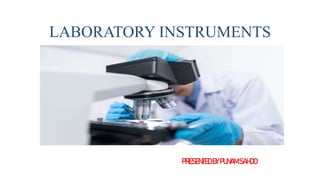
LABORATORY INSTRUMENTS
PRESENTED BYPUNAM SAHOO
INTRODUCTION
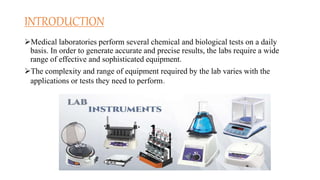
Medical laboratories perform several chemical and biological tests on a daily
basis. In order to generate accurate and precise results, the labs require a wide
range of effective and sophisticated equipment.
The complexity and range of equipment required by the lab varies with the
applications or tests they need to perform.
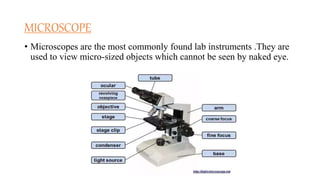
MICROSCOPE
• Microscopes are the most commonly found lab instruments .They are
used to view micro-sized objects which cannot be seen by naked eye.
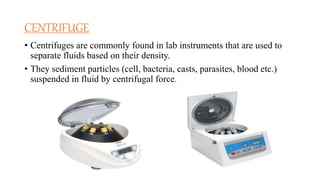
CENTRIFUGE
• Centrifuges are commonly found in lab instruments that are used to
separate fluids based on their density.
• They sediment particles (cell, bacteria, casts, parasites, blood etc.)
suspended in fluid by centrifugal force.
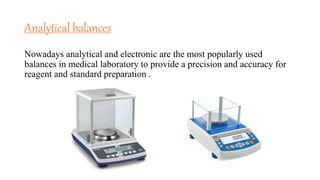
Analytical balances
Nowadays analytical and electronic are the most popularly used
balances in medical laboratory to provide a precision and accuracy for
reagent and standard preparation .
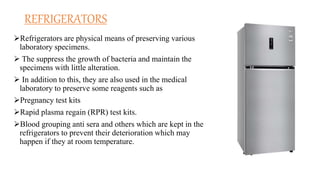
REFRIGERATORS
Refrigerators are physical means of preserving various
laboratory specimens.
 The suppress the growth of bacteria and maintain the
specimens with little alteration.
 In addition to this, they are also used in the medical
laboratory to preserve some reagents such as
Pregnancy test kits
Rapid plasma regain (RPR) test kits.
Blood grouping anti sera and others which are kept in the
refrigerators to prevent their deterioration which may
happen if they at room temperature.
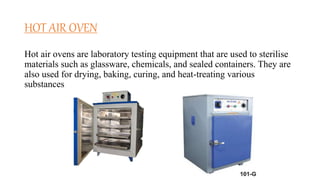
HOT AIR OVEN
Hot air ovens are laboratory testing equipment that are used to sterilise
materials such as glassware, chemicals, and sealed containers. They are
also used for drying, baking, curing, and heat-treating various
substances.
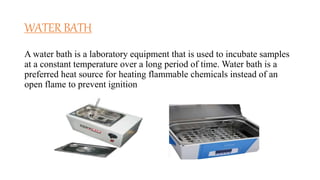
WATER BATH
A water bath is a laboratory equipment that is used to incubate samples
at a constant temperature over a long period of time. Water bath is a
preferred heat source for heating flammable chemicals instead of an
open flame to prevent ignition
INCUBATORS
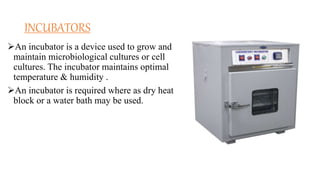
An incubator is a device used to grow and
maintain microbiological cultures or cell
cultures. The incubator maintains optimal
temperature & humidity .
An incubator is required where as dry heat
block or a water bath may be used.
colorimeter/ photometer
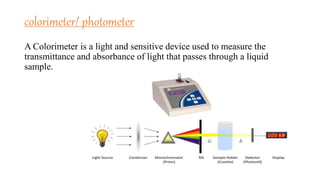
A Colorimeter is a light and sensitive device used to measure the
transmittance and absorbance of light that passes through a liquid
sample.
DESICCATORS
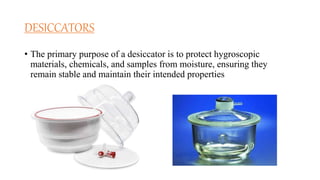
• The primary purpose of a desiccator is to protect hygroscopic
materials, chemicals, and samples from moisture, ensuring they
remain stable and maintain their intended properties
pH meter
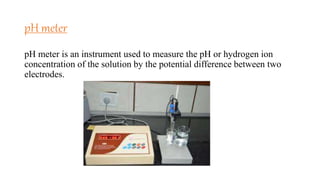
pH meter is an instrument used to measure the pH or hydrogen ion
concentration of the solution by the potential difference between two
electrodes.
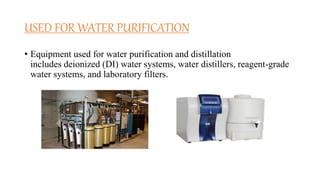
USED FOR WATER PURIFICATION
• Equipment used for water purification and distillation
includes deionized (DI) water systems, water distillers, reagent-grade
water systems, and laboratory filters.
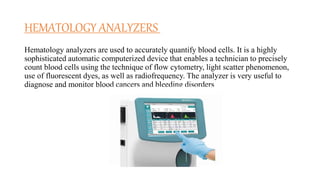
HEMATOLOGY ANALYZERS
Hematology analyzers are used to accurately quantify blood cells. It is a highly
sophisticated automatic computerized device that enables a technician to precisely
count blood cells using the technique of flow cytometry, light scatter phenomenon,
use of fluorescent dyes, as well as radiofrequency. The analyzer is very useful to
diagnose and monitor blood cancers and bleeding disorders
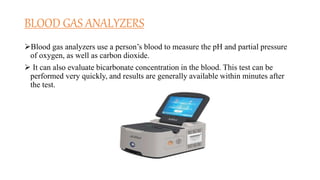
BLOOD GAS ANALYZERS
Blood gas analyzers use a person’s blood to measure the pH and partial pressure
of oxygen, as well as carbon dioxide.
 It can also evaluate bicarbonate concentration in the blood. This test can be
performed very quickly, and results are generally available within minutes after
the test.
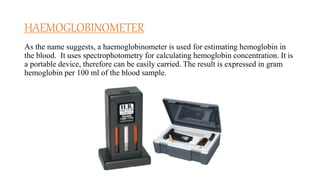
HAEMOGLOBINOMETER
As the name suggests, a haemoglobinometer is used for estimating hemoglobin in
the blood. It uses spectrophotometry for calculating hemoglobin concentration. It is
a portable device, therefore can be easily carried. The result is expressed in gram
hemoglobin per 100 ml of the blood sample.
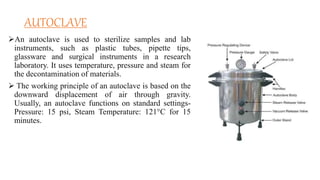
AUTOCLAVE
An autoclave is used to sterilize samples and lab
instruments, such as plastic tubes, pipette tips,
glassware and surgical instruments in a research
laboratory. It uses temperature, pressure and steam for
the decontamination of materials.
 The working principle of an autoclave is based on the
downward displacement of air through gravity.
Usually, an autoclave functions on standard settings-
Pressure: 15 psi, Steam Temperature: 121°C for 15
minutes.
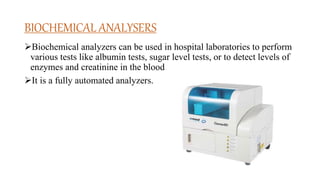
BIOCHEMICAL ANALYSERS
Biochemical analyzers can be used in hospital laboratories to perform
various tests like albumin tests, sugar level tests, or to detect levels of
enzymes and creatinine in the blood.
It is a fully automated analyzers.
LABORATORY INSTRUMENTS.DMLT 1ST YEARpptx

LABORATORY INSTRUMENTS.DMLT 1ST YEARpptx

  • 1.
  • 2.
    INTRODUCTION Medical laboratories performseveral chemical and biological tests on a daily basis. In order to generate accurate and precise results, the labs require a wide range of effective and sophisticated equipment. The complexity and range of equipment required by the lab varies with the applications or tests they need to perform.
  • 3.
    MICROSCOPE • Microscopes arethe most commonly found lab instruments .They are used to view micro-sized objects which cannot be seen by naked eye.
  • 4.
    CENTRIFUGE • Centrifuges arecommonly found in lab instruments that are used to separate fluids based on their density. • They sediment particles (cell, bacteria, casts, parasites, blood etc.) suspended in fluid by centrifugal force.
  • 5.
    Analytical balances Nowadays analyticaland electronic are the most popularly used balances in medical laboratory to provide a precision and accuracy for reagent and standard preparation .
  • 6.
    REFRIGERATORS Refrigerators are physicalmeans of preserving various laboratory specimens.  The suppress the growth of bacteria and maintain the specimens with little alteration.  In addition to this, they are also used in the medical laboratory to preserve some reagents such as Pregnancy test kits Rapid plasma regain (RPR) test kits. Blood grouping anti sera and others which are kept in the refrigerators to prevent their deterioration which may happen if they at room temperature.
  • 7.
    HOT AIR OVEN Hotair ovens are laboratory testing equipment that are used to sterilise materials such as glassware, chemicals, and sealed containers. They are also used for drying, baking, curing, and heat-treating various substances.
  • 8.
    WATER BATH A waterbath is a laboratory equipment that is used to incubate samples at a constant temperature over a long period of time. Water bath is a preferred heat source for heating flammable chemicals instead of an open flame to prevent ignition
  • 9.
    INCUBATORS An incubator isa device used to grow and maintain microbiological cultures or cell cultures. The incubator maintains optimal temperature & humidity . An incubator is required where as dry heat block or a water bath may be used.
  • 10.
    colorimeter/ photometer A Colorimeteris a light and sensitive device used to measure the transmittance and absorbance of light that passes through a liquid sample.
  • 11.
    DESICCATORS • The primarypurpose of a desiccator is to protect hygroscopic materials, chemicals, and samples from moisture, ensuring they remain stable and maintain their intended properties
  • 12.
    pH meter pH meteris an instrument used to measure the pH or hydrogen ion concentration of the solution by the potential difference between two electrodes.
  • 13.
    USED FOR WATERPURIFICATION • Equipment used for water purification and distillation includes deionized (DI) water systems, water distillers, reagent-grade water systems, and laboratory filters.
  • 14.
    HEMATOLOGY ANALYZERS Hematology analyzersare used to accurately quantify blood cells. It is a highly sophisticated automatic computerized device that enables a technician to precisely count blood cells using the technique of flow cytometry, light scatter phenomenon, use of fluorescent dyes, as well as radiofrequency. The analyzer is very useful to diagnose and monitor blood cancers and bleeding disorders
  • 15.
    BLOOD GAS ANALYZERS Bloodgas analyzers use a person’s blood to measure the pH and partial pressure of oxygen, as well as carbon dioxide.  It can also evaluate bicarbonate concentration in the blood. This test can be performed very quickly, and results are generally available within minutes after the test.
  • 16.
    HAEMOGLOBINOMETER As the namesuggests, a haemoglobinometer is used for estimating hemoglobin in the blood. It uses spectrophotometry for calculating hemoglobin concentration. It is a portable device, therefore can be easily carried. The result is expressed in gram hemoglobin per 100 ml of the blood sample.
  • 17.
    AUTOCLAVE An autoclave isused to sterilize samples and lab instruments, such as plastic tubes, pipette tips, glassware and surgical instruments in a research laboratory. It uses temperature, pressure and steam for the decontamination of materials.  The working principle of an autoclave is based on the downward displacement of air through gravity. Usually, an autoclave functions on standard settings- Pressure: 15 psi, Steam Temperature: 121°C for 15 minutes.
  • 18.
    BIOCHEMICAL ANALYSERS Biochemical analyzerscan be used in hospital laboratories to perform various tests like albumin tests, sugar level tests, or to detect levels of enzymes and creatinine in the blood. It is a fully automated analyzers.