EQUIPMENT
MAINTENANCE
Dr. Hemali Parmar
MBBS, M.D. Microbiology
Tutor, Baroda Medical College, Gujarat
Equipments used in laboratory
 Biosafety cabinet
 Incubator
 Refrigerator
 Deep freeze
 Hot air oven
 Centrifuge
 Microscope
2
Biosafety cabinet
3
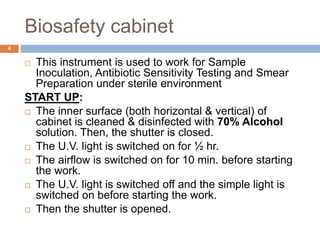
Biosafety cabinet
 This instrument is used to work for Sample
Inoculation, Antibiotic Sensitivity Testing and Smear
Preparation under sterile environment
START UP:
 The inner surface (both horizontal & vertical) of
cabinet is cleaned & disinfected with 70% Alcohol
solution. Then, the shutter is closed.
 The U.V. light is switched on for ½ hr.
 The airflow is switched on for 10 min. before starting
the work.
 The U.V. light is switched off and the simple light is
switched on before starting the work.
 Then the shutter is opened.
4
contd…
5
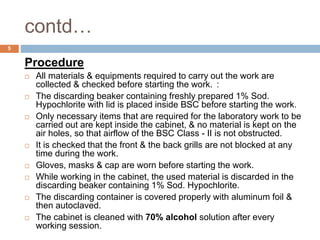
Procedure
 All materials & equipments required to carry out the work are
collected & checked before starting the work. :
 The discarding beaker containing freshly prepared 1% Sod.
Hypochlorite with lid is placed inside BSC before starting the work.
 Only necessary items that are required for the laboratory work to be
carried out are kept inside the cabinet, & no material is kept on the
air holes, so that airflow of the BSC Class - II is not obstructed.
 It is checked that the front & the back grills are not blocked at any
time during the work.
 Gloves, masks & cap are worn before starting the work.
 While working in the cabinet, the used material is discarded in the
discarding beaker containing 1% Sod. Hypochlorite.
 The discarding container is covered properly with aluminum foil &
then autoclaved.
 The cabinet is cleaned with 70% alcohol solution after every
working session.
Contd…
6
SHUT DOWN:
 The inner surface of the cabinet is cleaned
and decontaminated with alcohol or spirit
solution.
 The shutter is then closed.
 The simple light & airflow are switched off.
 U.V. light is switched on for 10min.
 The U.V. (Ultraviolet) light is then switched off.
MAINTENANCE SCHEDULE
7
 Proper cleaning of BSC is done regularly
before starting the work and completing the
work.
 Direct exposure to U.V. light is avoided.
 All precautions are taken to avoid cross
contamination while working in the hood.
 Toxic, explosive or flammable substances are
not used in this cabinet.
 The sterility is checked every fortnightly using
BHI/ NA agar plates.
Incubator
8
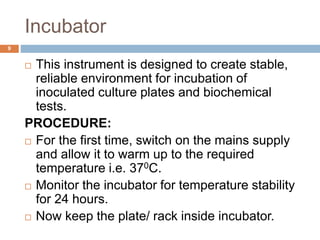
Incubator
9
 This instrument is designed to create stable,
reliable environment for incubation of
inoculated culture plates and biochemical
tests.
PROCEDURE:
 For the first time, switch on the mains supply
and allow it to warm up to the required
temperature i.e. 370C.
 Monitor the incubator for temperature stability
for 24 hours.
 Now keep the plate/ rack inside incubator.
MAINTENANCE
10
 Place the equipment on flat surface away from direct sunlight.
 Clean exterior of incubator daily with a clean wet mop.
 Clean the interior of the incubator once a week using sterile cotton
or gauze soaked in 70% Alcohol or 0.1% Sodium hypochlorite
solution. Allow the interior to dry completely.
 Temperature of the incubator is to be recorded daily with a
calibrated thermometer. Temperature chart should be maintained.
Record the temperature of incubator in the morning in the
temperature-monitoring sheet on the incubator by the first person
who opens it.
 At the end of month the temperature record sheet is filed in File No
D-21 Temperature record file.
 Any operating problem should be recorded and to be brought in
notice of the Section officer concerned.
 Service person should be informed regarding the problem as soon
as possible to solve the problem.
Refrigerator
11
Refrigerator
12
 It is used to store samples, Antibiotic sensitivity discs and culture
plates in follow up & reagents.
Maintenance
 Place the equipment on flat surface away from direct
sunlight.
 Refrigerator must be placed in such place where sufficient
air can circulate to facilitate heat exchange of compressor.
 Always close the refrigerator door to prevent warm air from
outside to enter cool chamber.
 Do not store eatables in refrigerator.
 Record the temperature of refrigerator in the morning in the
temperature-monitoring sheet on the refrigerator, by the
first person who opens it. Similarly record the temperature
of refrigerator in the evening.
 Temperature should not exceed 08°C.
Contd…
13
 Clean the cool chamber with freshly prepared 70% alcohol/
0.1% Sodium hypochlorite once every fortnightly and wipe
with sterile cloth after defrosting properly.
 Clean refrigerator from outside daily with a clean wet mop.
 Keep the compressor dust free.
 Clean door gasket.
 Record the temperature and cleaning in File No D-21
SAFETY CONDITION:
 Check for leakage or exhaust of gas and if found inform the Section
in-charge and workshop immediately.
 For any problem in the refrigerator the officer in- charge must be
informed immediately.
 Service person should be informed regarding the problem as soon
as possible to solve the problem.
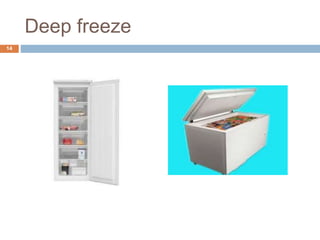
Deep freeze
14
Deep freeze
15
 Deep freeze is used to store Antibiotic discs &
sometimes stock culture.
 Operation:
 The Deep freeze is switched on.
 Adjustment of the required temperature i.e. -
20C is done.
 After the required temperature is attained, the
necessary materials are put inside the deep
freeze.
Contd…
16
Maintenance:
 Temperature of the deep freeze is daily recorded in the
morning in the temperature monitoring sheet which is pasted
on the incubator. Temperature should not exceed 20 0C.
 One temperature sheet includes charts for 1 month
temperature record. At the end of 1 month, the temperature
record sheet is filed in File No.-BF6 ‘Temperature monitoring
file’.
 Defrosting is done once a month. The cool chamber is
cleaned with 70% Alcohol and wiped with clean cloth after
defrosting properly. While defrosting, contents are kept in
freezer compartments of refrigerator No.1 & 2.
 The deep freeze is cleaned from outside (at least once a
month).
Contd…
17
Safety precautions:
 Disconnect unit from main power before attempting
any maintenance to equipment or control.
 Do not keep the door opened for longer period of
time.
 Check for leakage or exhaust of gas and if found
inform the Section in charge and workshop
immediately.
 Do not use metal or sharp scrapers to scrape off
frost.
 Do not open the lid of the freezer unnecessarily or
frequently.
 Any operating problem should be recorded and to
be brought in notice of the laboratory In-charge.
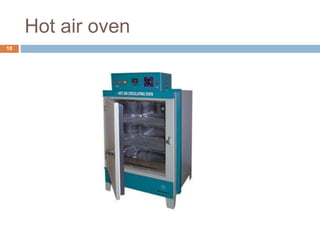
Hot air oven
18
Hot air oven
19
 This instrument is designed to sterilize the test
tubes, or to dry the media plates before
inoculation.
Procedure:
 Switch on the mains supply and allow it to
warm up to the required temperature.
 Start using the hot air oven after the
temperature has reached the required
temperature.
 Keep the plates/ rack inside incubator after the
temperature has reached the required
temperature and is maintained for 30 minutes.
Contd…
20
Maintenance:
 Place the equipment on flat surface away from direct sunlight.
 Clean exterior of hot air oven daily.
 Clean the interior of the instrument once a week using sterile
cotton or gauze soaked in 70% Alcohol or 1% Sodium
hypochlorite solution. Allow the interior to dry completely.
 Temperature of the instrument is to be recorded daily,
whenever put in use, with a calibrated thermometer.
Temperature chart should be maintained.
 At the end of month the temperature record sheet is filed in
File No D-21
 Any operating problem should be recorded and to be brought
in notice of the Section officer concerned.
 Service person should be informed regarding the problem as
soon as possible to solve the problem.
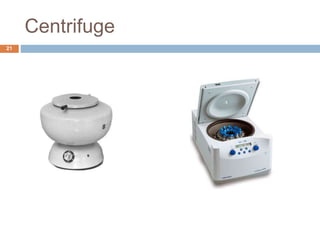
Centrifuge
21
Centrifuge
22
 This is used for centrifugation of body fluids except for sputum.
Procedure:
 It should be placed on flat and non slippery surface, to prevent
moving away from place when in use.
 Its load should be balanced always, for balance dummy tube filled
with equal quantity water can be placed on opposite side.
 Cover it with lid before using it.
 Turn speed control slowly up and down.
Maintenance:
 Switch off immediately if makes abnormal noise.
 After use invert buckets to drain dry.
 After any spillage, wipe and disinfect immediately with freshly
prepared (within 8 hrs.) 0.5% Sodium hypochlorite.
 Clean it daily.
 Check for brushes and bearing every 3 monthly.
Contd…
23
Safety precautions:
 Do not use without balance on opposite side
 Do not stop it manually.
 Do not use without plugging the test tube mouth.
 Speed should not be raised rapidly.
 Switch off immediately if there is breakage of
tube.
 For any problem in the centrifuge the officer in-
charge must be informed immediately.
 Service person should be informed regarding the
problem as soon as possible to solve the problem.
Microscope
24
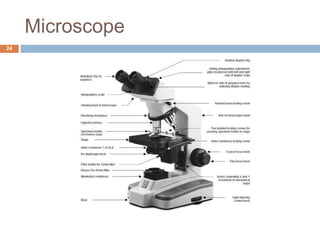
Microscope
25
 This instrument is designed to visualize the
microorganisms that one can not see with naked eye
in different clinical samples as well as slides prepared
from culture positive colonies.
Procedure:
 Switch on the mains supply and then switch on the
supply from base of the microscope.
 Adjust the objective and condenser as per
requirement and place the slide on the stage.
 Make coarse and fine adjustment to focus the slide.
 After the work is over switch off the electric supply first
on base and then from the mains.
Contd…
26
Maintenance:
 Place the equipment on flat surface away from direct
sunlight.
 Keep the Microscope covered when not in use.
 Clean the objective lens with soft cotton cloth or tissue
paper after use.
 Do not clean the lens with alcohol or xylene as it may
damage the cement.
 Any operating problem should be recorded and to be
brought in notice of the Section officer concerned.
 Service person should be informed regarding the
problem as soon as possible to solve the problem.

Equipment maintenance

  • 1.
    EQUIPMENT MAINTENANCE Dr. Hemali Parmar MBBS,M.D. Microbiology Tutor, Baroda Medical College, Gujarat
  • 2.
    Equipments used inlaboratory  Biosafety cabinet  Incubator  Refrigerator  Deep freeze  Hot air oven  Centrifuge  Microscope 2
  • 3.
  • 4.
    Biosafety cabinet  Thisinstrument is used to work for Sample Inoculation, Antibiotic Sensitivity Testing and Smear Preparation under sterile environment START UP:  The inner surface (both horizontal & vertical) of cabinet is cleaned & disinfected with 70% Alcohol solution. Then, the shutter is closed.  The U.V. light is switched on for ½ hr.  The airflow is switched on for 10 min. before starting the work.  The U.V. light is switched off and the simple light is switched on before starting the work.  Then the shutter is opened. 4
  • 5.
    contd… 5 Procedure  All materials& equipments required to carry out the work are collected & checked before starting the work. :  The discarding beaker containing freshly prepared 1% Sod. Hypochlorite with lid is placed inside BSC before starting the work.  Only necessary items that are required for the laboratory work to be carried out are kept inside the cabinet, & no material is kept on the air holes, so that airflow of the BSC Class - II is not obstructed.  It is checked that the front & the back grills are not blocked at any time during the work.  Gloves, masks & cap are worn before starting the work.  While working in the cabinet, the used material is discarded in the discarding beaker containing 1% Sod. Hypochlorite.  The discarding container is covered properly with aluminum foil & then autoclaved.  The cabinet is cleaned with 70% alcohol solution after every working session.
  • 6.
    Contd… 6 SHUT DOWN:  Theinner surface of the cabinet is cleaned and decontaminated with alcohol or spirit solution.  The shutter is then closed.  The simple light & airflow are switched off.  U.V. light is switched on for 10min.  The U.V. (Ultraviolet) light is then switched off.
  • 7.
    MAINTENANCE SCHEDULE 7  Propercleaning of BSC is done regularly before starting the work and completing the work.  Direct exposure to U.V. light is avoided.  All precautions are taken to avoid cross contamination while working in the hood.  Toxic, explosive or flammable substances are not used in this cabinet.  The sterility is checked every fortnightly using BHI/ NA agar plates.
  • 8.
  • 9.
    Incubator 9  This instrumentis designed to create stable, reliable environment for incubation of inoculated culture plates and biochemical tests. PROCEDURE:  For the first time, switch on the mains supply and allow it to warm up to the required temperature i.e. 370C.  Monitor the incubator for temperature stability for 24 hours.  Now keep the plate/ rack inside incubator.
  • 10.
    MAINTENANCE 10  Place theequipment on flat surface away from direct sunlight.  Clean exterior of incubator daily with a clean wet mop.  Clean the interior of the incubator once a week using sterile cotton or gauze soaked in 70% Alcohol or 0.1% Sodium hypochlorite solution. Allow the interior to dry completely.  Temperature of the incubator is to be recorded daily with a calibrated thermometer. Temperature chart should be maintained. Record the temperature of incubator in the morning in the temperature-monitoring sheet on the incubator by the first person who opens it.  At the end of month the temperature record sheet is filed in File No D-21 Temperature record file.  Any operating problem should be recorded and to be brought in notice of the Section officer concerned.  Service person should be informed regarding the problem as soon as possible to solve the problem.
  • 11.
  • 12.
    Refrigerator 12  It isused to store samples, Antibiotic sensitivity discs and culture plates in follow up & reagents. Maintenance  Place the equipment on flat surface away from direct sunlight.  Refrigerator must be placed in such place where sufficient air can circulate to facilitate heat exchange of compressor.  Always close the refrigerator door to prevent warm air from outside to enter cool chamber.  Do not store eatables in refrigerator.  Record the temperature of refrigerator in the morning in the temperature-monitoring sheet on the refrigerator, by the first person who opens it. Similarly record the temperature of refrigerator in the evening.  Temperature should not exceed 08°C.
  • 13.
    Contd… 13  Clean thecool chamber with freshly prepared 70% alcohol/ 0.1% Sodium hypochlorite once every fortnightly and wipe with sterile cloth after defrosting properly.  Clean refrigerator from outside daily with a clean wet mop.  Keep the compressor dust free.  Clean door gasket.  Record the temperature and cleaning in File No D-21 SAFETY CONDITION:  Check for leakage or exhaust of gas and if found inform the Section in-charge and workshop immediately.  For any problem in the refrigerator the officer in- charge must be informed immediately.  Service person should be informed regarding the problem as soon as possible to solve the problem.
  • 14.
  • 15.
    Deep freeze 15  Deepfreeze is used to store Antibiotic discs & sometimes stock culture.  Operation:  The Deep freeze is switched on.  Adjustment of the required temperature i.e. - 20C is done.  After the required temperature is attained, the necessary materials are put inside the deep freeze.
  • 16.
    Contd… 16 Maintenance:  Temperature ofthe deep freeze is daily recorded in the morning in the temperature monitoring sheet which is pasted on the incubator. Temperature should not exceed 20 0C.  One temperature sheet includes charts for 1 month temperature record. At the end of 1 month, the temperature record sheet is filed in File No.-BF6 ‘Temperature monitoring file’.  Defrosting is done once a month. The cool chamber is cleaned with 70% Alcohol and wiped with clean cloth after defrosting properly. While defrosting, contents are kept in freezer compartments of refrigerator No.1 & 2.  The deep freeze is cleaned from outside (at least once a month).
  • 17.
    Contd… 17 Safety precautions:  Disconnectunit from main power before attempting any maintenance to equipment or control.  Do not keep the door opened for longer period of time.  Check for leakage or exhaust of gas and if found inform the Section in charge and workshop immediately.  Do not use metal or sharp scrapers to scrape off frost.  Do not open the lid of the freezer unnecessarily or frequently.  Any operating problem should be recorded and to be brought in notice of the laboratory In-charge.
  • 18.
  • 19.
    Hot air oven 19 This instrument is designed to sterilize the test tubes, or to dry the media plates before inoculation. Procedure:  Switch on the mains supply and allow it to warm up to the required temperature.  Start using the hot air oven after the temperature has reached the required temperature.  Keep the plates/ rack inside incubator after the temperature has reached the required temperature and is maintained for 30 minutes.
  • 20.
    Contd… 20 Maintenance:  Place theequipment on flat surface away from direct sunlight.  Clean exterior of hot air oven daily.  Clean the interior of the instrument once a week using sterile cotton or gauze soaked in 70% Alcohol or 1% Sodium hypochlorite solution. Allow the interior to dry completely.  Temperature of the instrument is to be recorded daily, whenever put in use, with a calibrated thermometer. Temperature chart should be maintained.  At the end of month the temperature record sheet is filed in File No D-21  Any operating problem should be recorded and to be brought in notice of the Section officer concerned.  Service person should be informed regarding the problem as soon as possible to solve the problem.
  • 21.
  • 22.
    Centrifuge 22  This isused for centrifugation of body fluids except for sputum. Procedure:  It should be placed on flat and non slippery surface, to prevent moving away from place when in use.  Its load should be balanced always, for balance dummy tube filled with equal quantity water can be placed on opposite side.  Cover it with lid before using it.  Turn speed control slowly up and down. Maintenance:  Switch off immediately if makes abnormal noise.  After use invert buckets to drain dry.  After any spillage, wipe and disinfect immediately with freshly prepared (within 8 hrs.) 0.5% Sodium hypochlorite.  Clean it daily.  Check for brushes and bearing every 3 monthly.
  • 23.
    Contd… 23 Safety precautions:  Donot use without balance on opposite side  Do not stop it manually.  Do not use without plugging the test tube mouth.  Speed should not be raised rapidly.  Switch off immediately if there is breakage of tube.  For any problem in the centrifuge the officer in- charge must be informed immediately.  Service person should be informed regarding the problem as soon as possible to solve the problem.
  • 24.
  • 25.
    Microscope 25  This instrumentis designed to visualize the microorganisms that one can not see with naked eye in different clinical samples as well as slides prepared from culture positive colonies. Procedure:  Switch on the mains supply and then switch on the supply from base of the microscope.  Adjust the objective and condenser as per requirement and place the slide on the stage.  Make coarse and fine adjustment to focus the slide.  After the work is over switch off the electric supply first on base and then from the mains.
  • 26.
    Contd… 26 Maintenance:  Place theequipment on flat surface away from direct sunlight.  Keep the Microscope covered when not in use.  Clean the objective lens with soft cotton cloth or tissue paper after use.  Do not clean the lens with alcohol or xylene as it may damage the cement.  Any operating problem should be recorded and to be brought in notice of the Section officer concerned.  Service person should be informed regarding the problem as soon as possible to solve the problem.