Medical Laboratory Science
The Hidden Profession
Instructor
Mr. Naeem Bukhari
Medical Lab Science
 is a health care profession with special expertise
in laboratory medicine. Members of this
challenging profession are responsible for
providing accurate, reliable laboratory tests for
monitoring health, diagnosing and treating
disease
A Day as a Medical Lab
Scientist
 MLS will arrive at work early in the
morning, especially in hospital settings.
Physicians like to have all laboratory results
completed when they are making their
morning visits with patients. Therefore,
your MLS is working hard behind the
scenes to ensure your lab tests are done
before the doctor arrives.
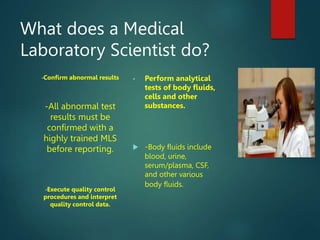
What does a Medical
Laboratory Scientist do?
•Confirm abnormal results
-All abnormal test
results must be
confirmed with a
highly trained MLS
before reporting.
•Execute quality control
procedures and interpret
quality control data.
• Perform analytical
tests of body fluids,
cells and other
substances.
 -Body fluids include
blood, urine,
serum/plasma, CSF,
and other various
body fluids.
Cont. what do Medical Lab
Scientists do.
• Execute preventive maintenance of equipment
and/or identify appropriate sources for repairs.
 Laboratory is a place that is equipped with different
instruments, equipment's and chemicals (reagents) etc.,
for performing experimental works, research activities
and investigative procedures.
 Medical laboratory is one part of the laboratory that is
equipped with various biomedical instruments,
equipment's, materials and reagents (chemicals) for
performing different laboratory investigative activities
by using biological specimens (whole blood, serum,
plasma, urine, stool, etc).
General overview of Lab
Departments in the Medical
Laboratory
 Hematology
 Blood Banking
 Microbiology
 Chemistry
 Serology
 Pathology
Hematology
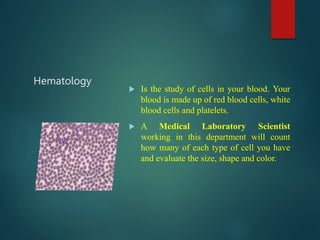
 Is the study of cells in your blood. Your
blood is made up of red blood cells, white
blood cells and platelets.
 A Medical Laboratory Scientist
working in this department will count
how many of each type of cell you have
and evaluate the size, shape and color.
Blood Banking
 Is the practice of cross matching blood components
for healthy transfusions. A Medical Laboratory Scientist
working in the Blood Bank department will identify
blood types, perform accurate and safe cross matches
with various blood components, as well as identify
unsuspected antibodies.
Microbiology
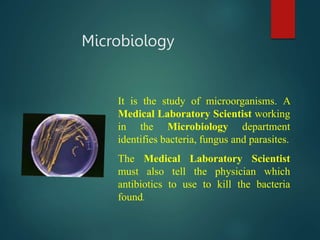
It is the study of microorganisms. A
Medical Laboratory Scientist working
in the Microbiology department
identifies bacteria, fungus and parasites.
The Medical Laboratory Scientist
must also tell the physician which
antibiotics to use to kill the bacteria
found.
Chemistry
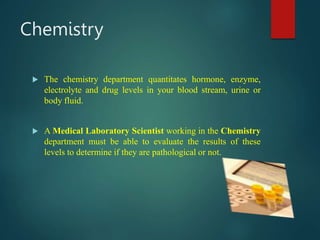
 The chemistry department quantitates hormone, enzyme,
electrolyte and drug levels in your blood stream, urine or
body fluid.
 A Medical Laboratory Scientist working in the Chemistry
department must be able to evaluate the results of these
levels to determine if they are pathological or not.
Serology
 Is the study of immunity and antibodies in your blood.
A Medical Laboratory Scientist working in the Serology
department identifies antibodies to pathological
syndromes such as measles, chicken pox,
mononucleosis, and Strep. throat.
 In a single medical laboratory at least there are two interlocking
components of organizations.
 These are laboratory head and other staff having their own duties
and responsibilities.
Laboratory organization
Role of medical
laboratory services
The medical laboratory services play a pivotal role in the promotion,
curative and preventive aspects of a nation’s health delivery system.
The service gives a scientific foundation by providing accurate
information to those with the responsibility for:
1. Treating patients and monitoring their response to treatment,
2. Monitoring the development and spread of infectious and
dangerous pathogens (disease causing organisms),
3. Deciding effective control measures against major Prevalent
disease,
1. The source of a disease may not be identified correctly.
2. Patients are less likely to receive the best possible care.
3. Resistance to essential drugs may develop and continue to
spread.
4. Epidemic diseases may not be identified on time and with
confidence.
Without reliable laboratory
services
Role of medical laboratory
technologist
• Carry out routine and advanced laboratory tests using
standard laboratory methods;
• Apply problem-solving strategies to administrative, technical
and research problems;
• Conduct community – based researches in collaboration with
other categories of health professionals;
• Provide professional consultancy on matters related to the
establishment, renovation, upgrading and reorganization of
medical laboratories of intermediate levels.
Medical Laboratory sciences

Medical Laboratory sciences

  • 1.
    Medical Laboratory Science TheHidden Profession Instructor Mr. Naeem Bukhari
  • 2.
    Medical Lab Science is a health care profession with special expertise in laboratory medicine. Members of this challenging profession are responsible for providing accurate, reliable laboratory tests for monitoring health, diagnosing and treating disease
  • 3.
    A Day asa Medical Lab Scientist  MLS will arrive at work early in the morning, especially in hospital settings. Physicians like to have all laboratory results completed when they are making their morning visits with patients. Therefore, your MLS is working hard behind the scenes to ensure your lab tests are done before the doctor arrives.
  • 4.
    What does aMedical Laboratory Scientist do? •Confirm abnormal results -All abnormal test results must be confirmed with a highly trained MLS before reporting. •Execute quality control procedures and interpret quality control data. • Perform analytical tests of body fluids, cells and other substances.  -Body fluids include blood, urine, serum/plasma, CSF, and other various body fluids.
  • 5.
    Cont. what doMedical Lab Scientists do. • Execute preventive maintenance of equipment and/or identify appropriate sources for repairs.
  • 6.
     Laboratory isa place that is equipped with different instruments, equipment's and chemicals (reagents) etc., for performing experimental works, research activities and investigative procedures.  Medical laboratory is one part of the laboratory that is equipped with various biomedical instruments, equipment's, materials and reagents (chemicals) for performing different laboratory investigative activities by using biological specimens (whole blood, serum, plasma, urine, stool, etc). General overview of Lab
  • 7.
    Departments in theMedical Laboratory  Hematology  Blood Banking  Microbiology  Chemistry  Serology  Pathology
  • 8.
    Hematology  Is thestudy of cells in your blood. Your blood is made up of red blood cells, white blood cells and platelets.  A Medical Laboratory Scientist working in this department will count how many of each type of cell you have and evaluate the size, shape and color.
  • 9.
    Blood Banking  Isthe practice of cross matching blood components for healthy transfusions. A Medical Laboratory Scientist working in the Blood Bank department will identify blood types, perform accurate and safe cross matches with various blood components, as well as identify unsuspected antibodies.
  • 10.
    Microbiology It is thestudy of microorganisms. A Medical Laboratory Scientist working in the Microbiology department identifies bacteria, fungus and parasites. The Medical Laboratory Scientist must also tell the physician which antibiotics to use to kill the bacteria found.
  • 11.
    Chemistry  The chemistrydepartment quantitates hormone, enzyme, electrolyte and drug levels in your blood stream, urine or body fluid.  A Medical Laboratory Scientist working in the Chemistry department must be able to evaluate the results of these levels to determine if they are pathological or not.
  • 12.
    Serology  Is thestudy of immunity and antibodies in your blood. A Medical Laboratory Scientist working in the Serology department identifies antibodies to pathological syndromes such as measles, chicken pox, mononucleosis, and Strep. throat.
  • 13.
     In asingle medical laboratory at least there are two interlocking components of organizations.  These are laboratory head and other staff having their own duties and responsibilities. Laboratory organization
  • 14.
    Role of medical laboratoryservices The medical laboratory services play a pivotal role in the promotion, curative and preventive aspects of a nation’s health delivery system. The service gives a scientific foundation by providing accurate information to those with the responsibility for: 1. Treating patients and monitoring their response to treatment, 2. Monitoring the development and spread of infectious and dangerous pathogens (disease causing organisms), 3. Deciding effective control measures against major Prevalent disease,
  • 15.
    1. The sourceof a disease may not be identified correctly. 2. Patients are less likely to receive the best possible care. 3. Resistance to essential drugs may develop and continue to spread. 4. Epidemic diseases may not be identified on time and with confidence. Without reliable laboratory services
  • 16.
    Role of medicallaboratory technologist • Carry out routine and advanced laboratory tests using standard laboratory methods; • Apply problem-solving strategies to administrative, technical and research problems; • Conduct community – based researches in collaboration with other categories of health professionals; • Provide professional consultancy on matters related to the establishment, renovation, upgrading and reorganization of medical laboratories of intermediate levels.