TYPES AND USES OF
CLEANING AGENTS
Lovely Grace Sampaga
Capuz
CLEANING AGENTS ARE:
1.Substances usually liquids, powder
sprays or granule used to remove dirt,
grime, stains, bad smells and clutter or
deposits from different surfaces.
2.They are normally water solutions of
different chemicals and substances tha
might be acidic, alkaline or neutral
depending on the use.
CLEANING AGENTS ARE:
1.Therefore, cleaning agents include acid
cleaners, neutral cleaners, alkaline
cleaners, abrasive, caustic carbon soot
removers, degreasers, detergents,
disinfectants, sanitizers, biocides,
germicide rust removers, rinse aids,
cleaning additives, and corrosion
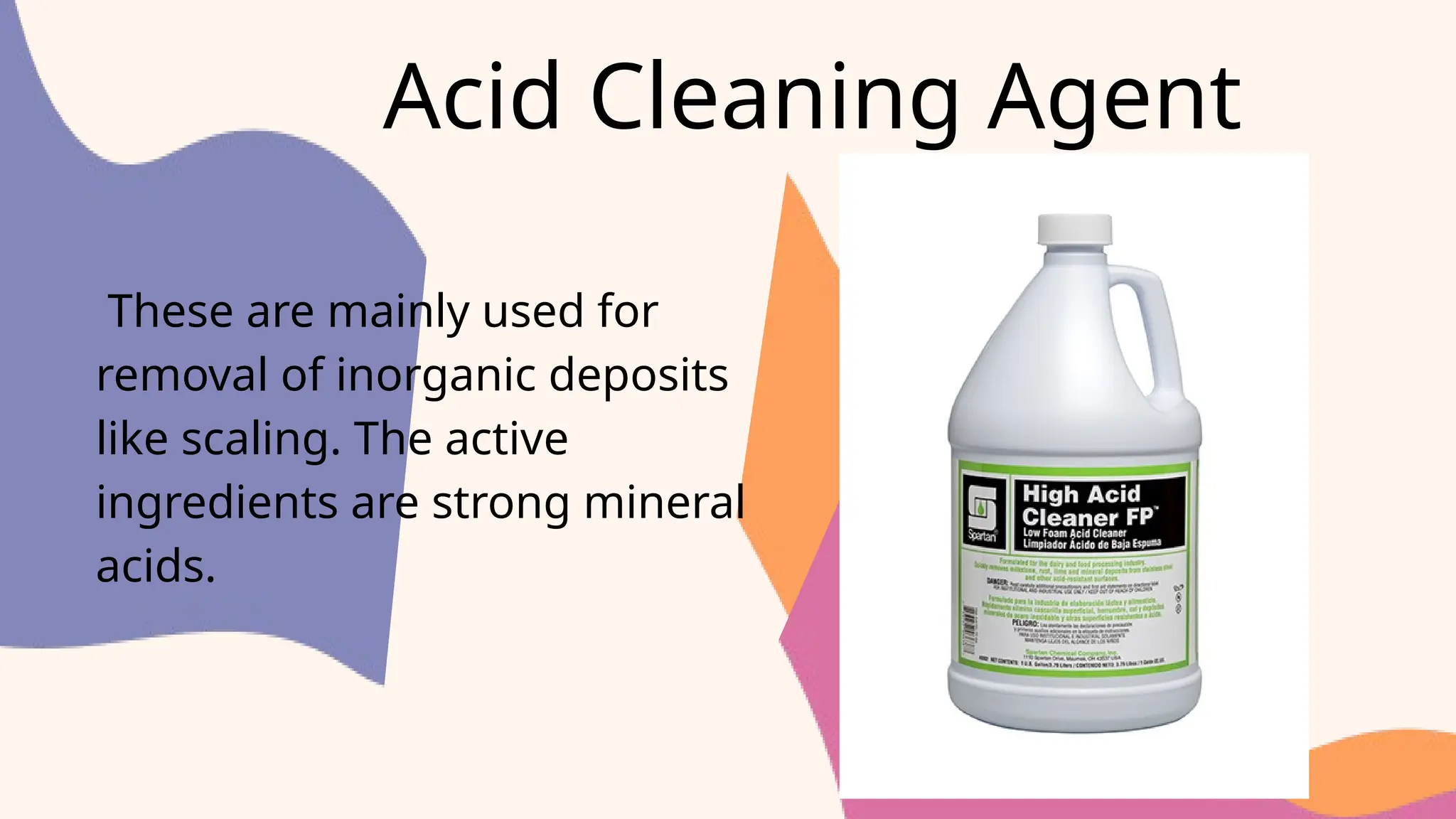
Acid Cleaning Agent
These are mainly used for
removal of inorganic deposits
like scaling. The active
ingredients are strong mineral
acids.
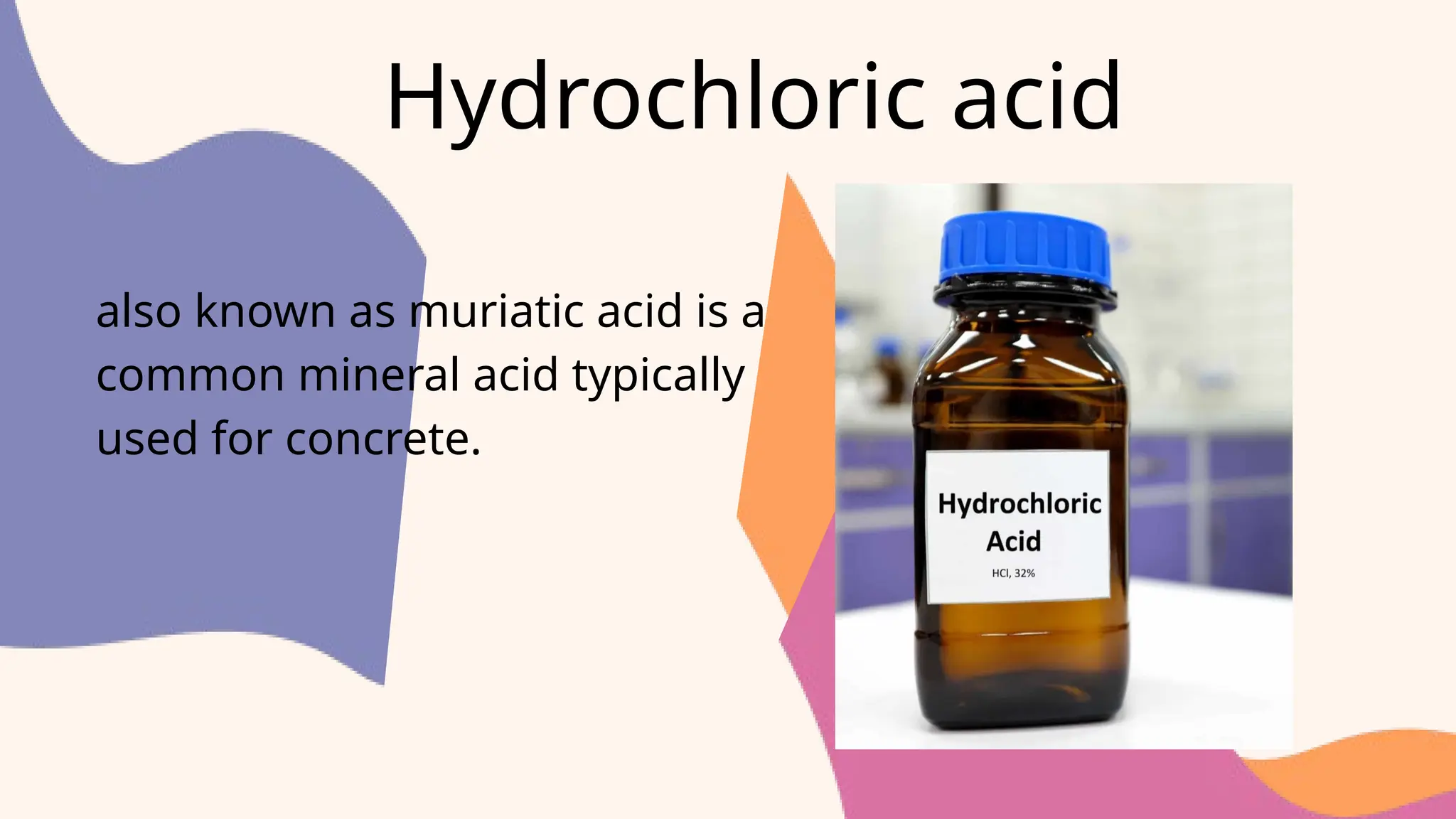
Hydrochloric acid
also known as muriatic acid is a
common mineral acid typically
used for concrete.
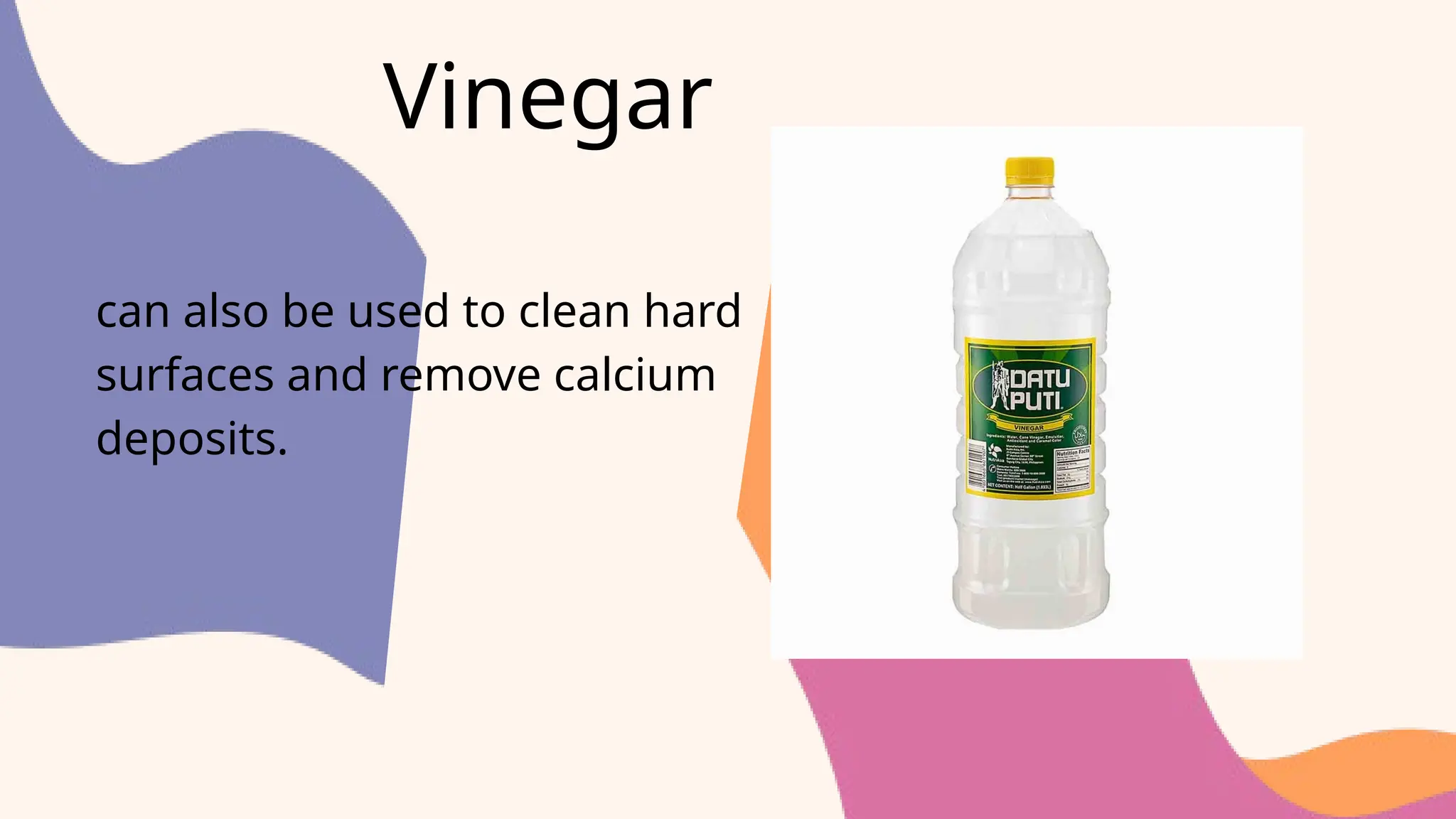
Vinegar
can also be used to clean hard
surfaces and remove calcium
deposits.
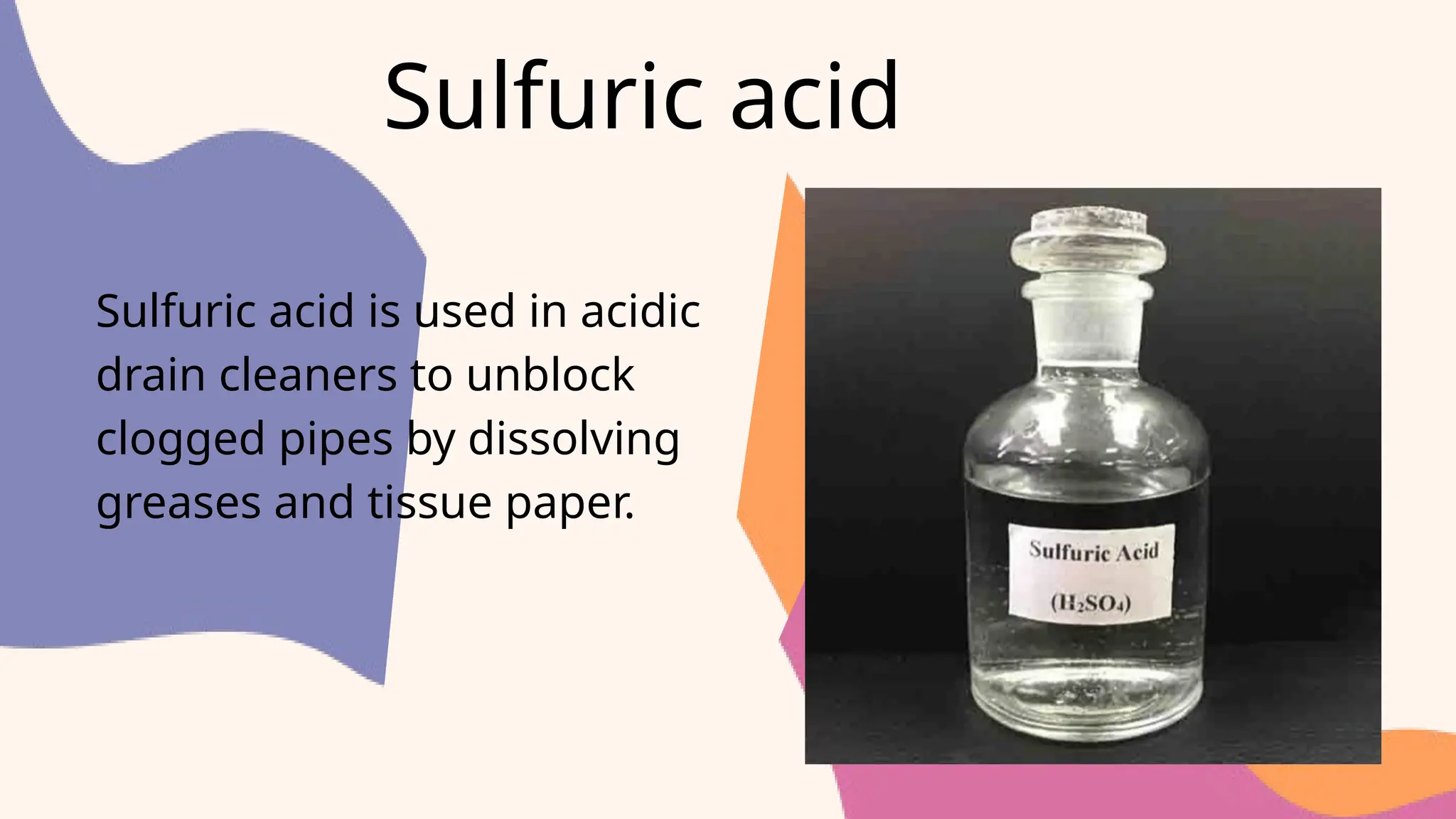
Sulfuric acid
Sulfuric acid is used in acidic
drain cleaners to unblock
clogged pipes by dissolving
greases and tissue paper.
Alkaline cleaning agents
Alkaline cleaning agents contain strong
bases like sodium hydroxide or
potassium hydroxide. Bleach (pH 12)
and ammonia (pH 11) are common
alkaline cleaning agents. Often
dispersants and chelants are added to
the alkaline agent, the former to
prevent deposition of dissolved dirt
and the latter to attack rust. Alkaline
can easily dissolve grease.
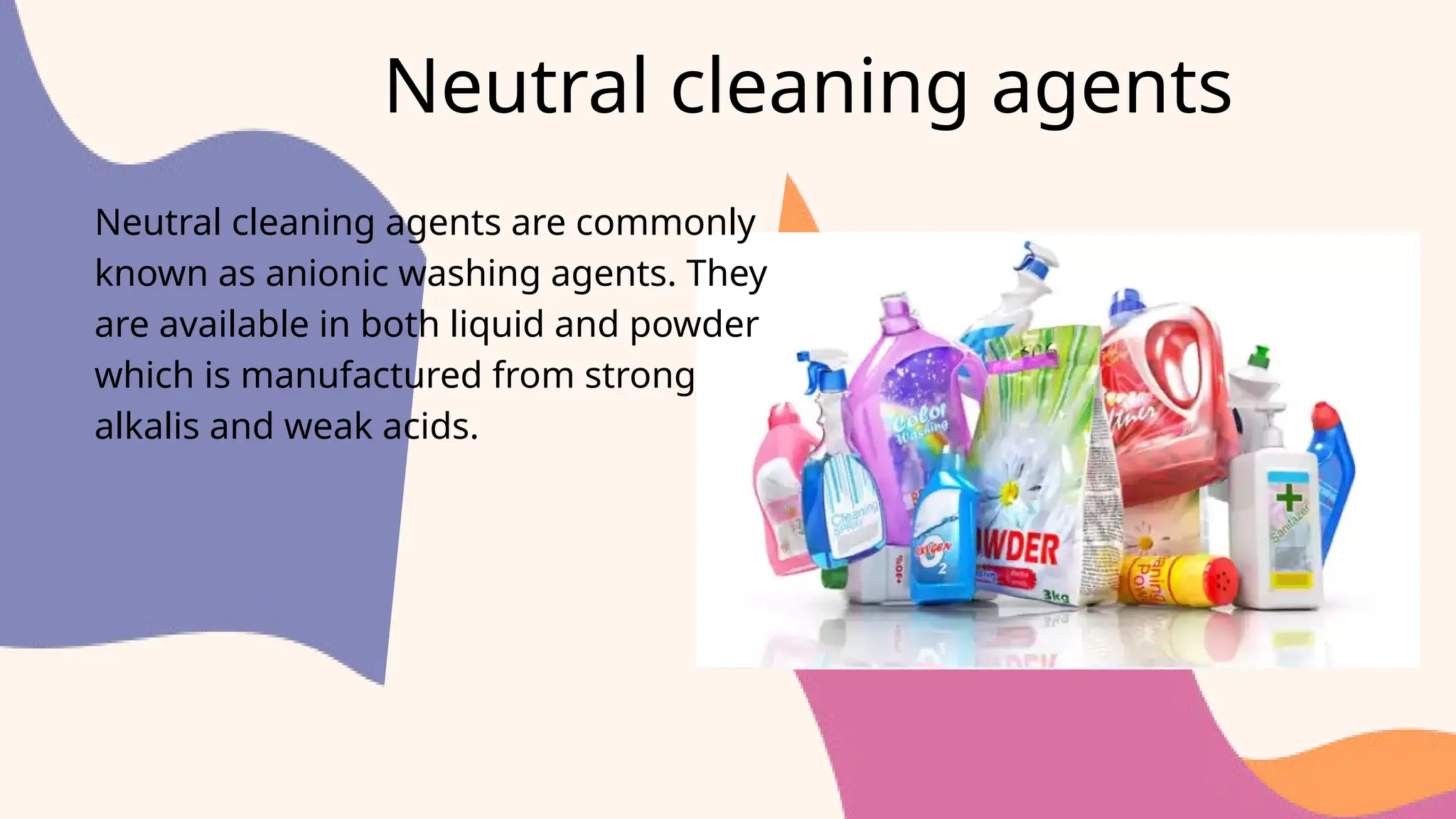
Neutral cleaning agents
Neutral cleaning agents are commonly
known as anionic washing agents. They
are available in both liquid and powder
which is manufactured from strong
alkalis and weak acids.
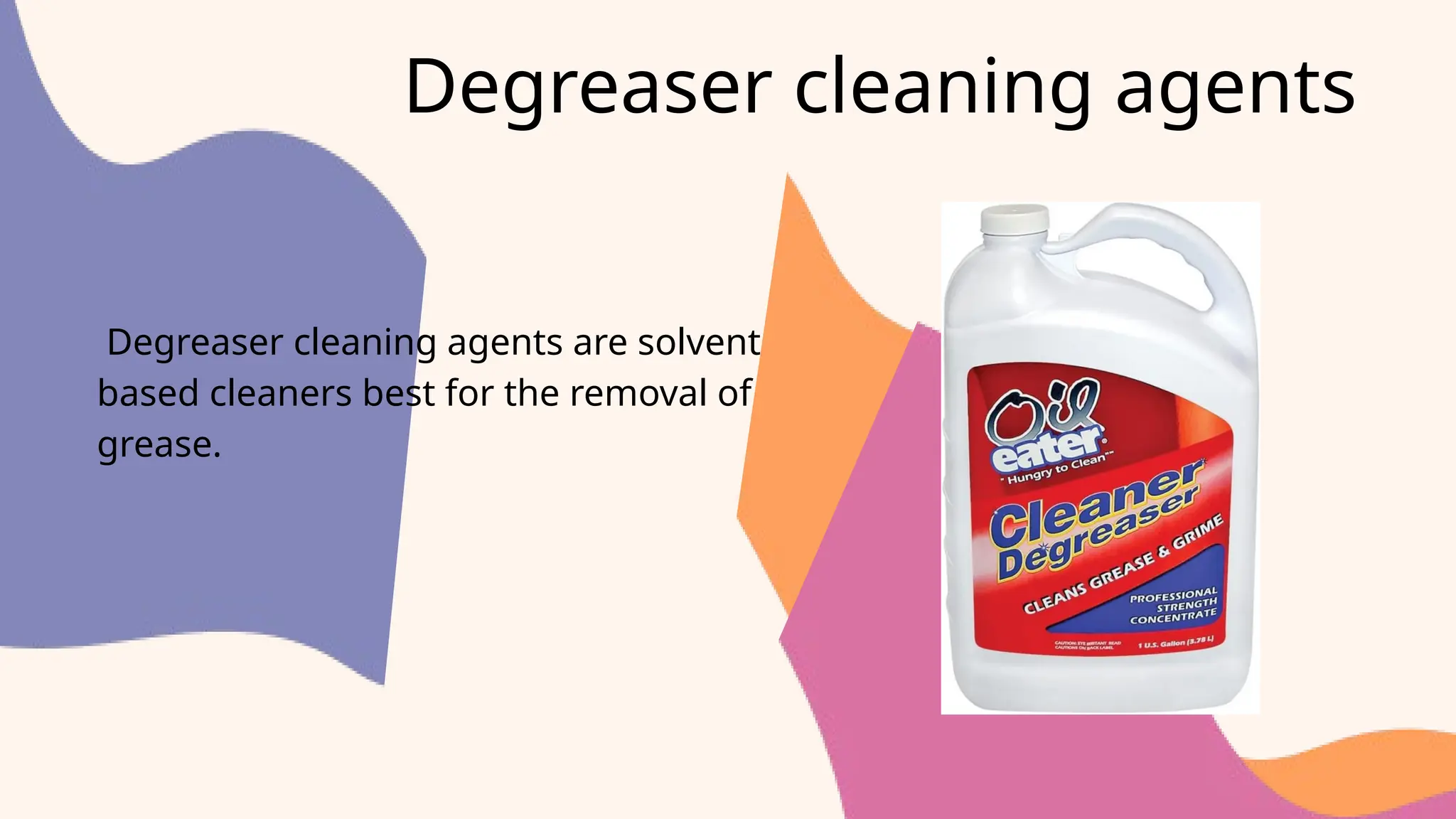
Degreaser cleaning agents
Degreaser cleaning agents are solvent
based cleaners best for the removal of
grease.
METHODS OF
MIXING
• Special care is needed for highly concentrated cleaning
products.
• Products should be diluted accurately according to
manufacturer's directions.
• This can be achieved through a variety of methods
including the use of measuring cups, simple
dispensing pumps and more complicated automated
dilution equipment.
METHODS OF MIXING
2
• Dilution equipment should be checked periodically for
accuracy or one may consult the supplier or
manufacturer for assistance.
METHODS OF MIXING
2
SPECIAL CARE IS ALSO NEEDED IN MIXING CLEANING AGENTS. THERE ARE
CLEANING AGENTS THAT SHOULD NOT BE MIXED SUCH AS:
2
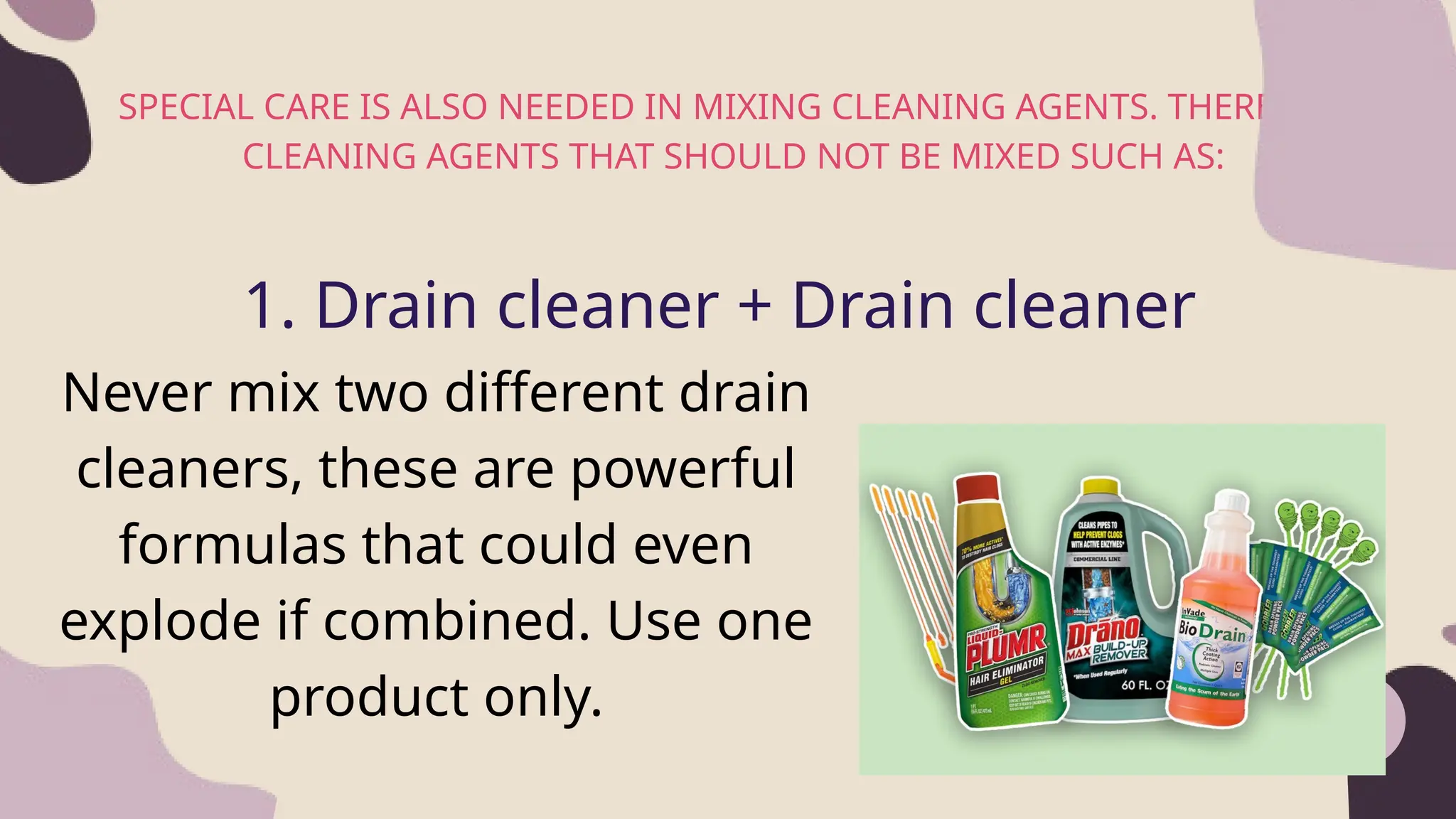
1. Drain cleaner + Drain cleaner
Never mix two different drain
cleaners, these are powerful
formulas that could even
explode if combined. Use one
product only.
SPECIAL CARE IS ALSO NEEDED IN MIXING CLEANING AGENTS. THERE ARE
CLEANING AGENTS THAT SHOULD NOT BE MIXED SUCH AS:
2
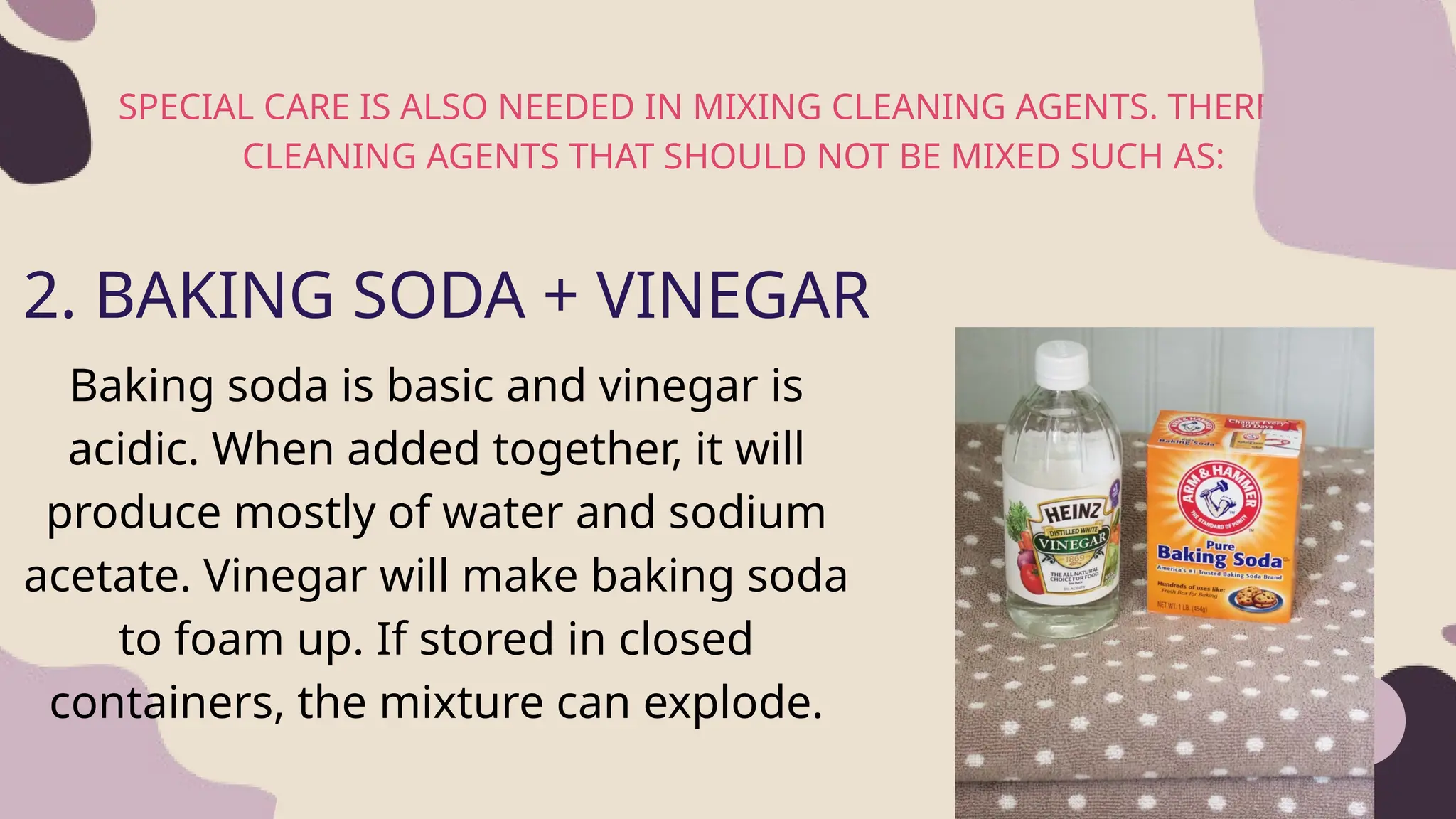
2. BAKING SODA + VINEGAR
Baking soda is basic and vinegar is
acidic. When added together, it will
produce mostly of water and sodium
acetate. Vinegar will make baking soda
to foam up. If stored in closed
containers, the mixture can explode.
SPECIAL CARE IS ALSO NEEDED IN MIXING CLEANING AGENTS. THERE ARE
CLEANING AGENTS THAT SHOULD NOT BE MIXED SUCH AS:
2
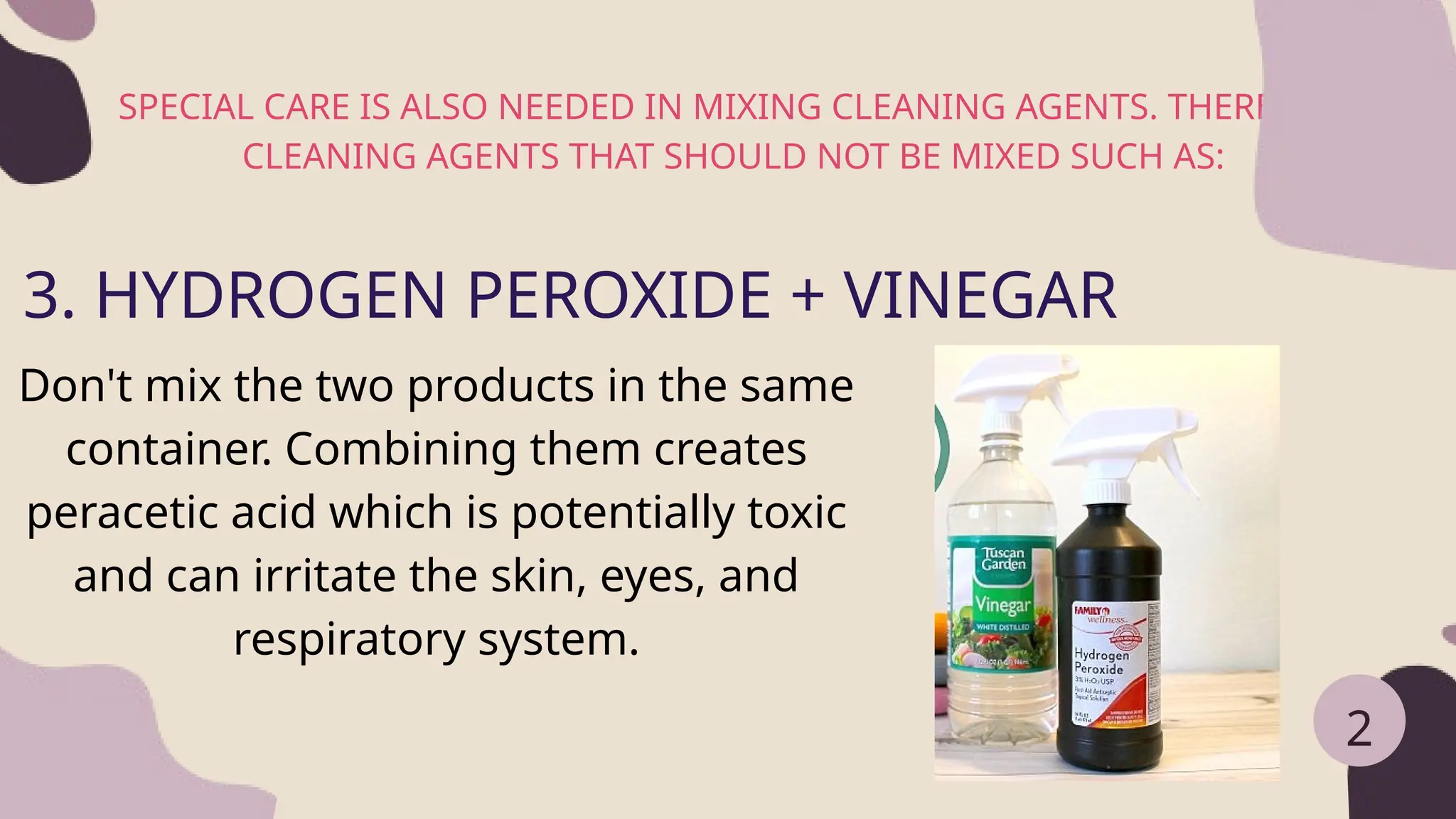
3. HYDROGEN PEROXIDE + VINEGAR
Don't mix the two products in the same
container. Combining them creates
peracetic acid which is potentially toxic
and can irritate the skin, eyes, and
respiratory system.
SPECIAL CARE IS ALSO NEEDED IN MIXING CLEANING AGENTS. THERE ARE
CLEANING AGENTS THAT SHOULD NOT BE MIXED SUCH AS:
2
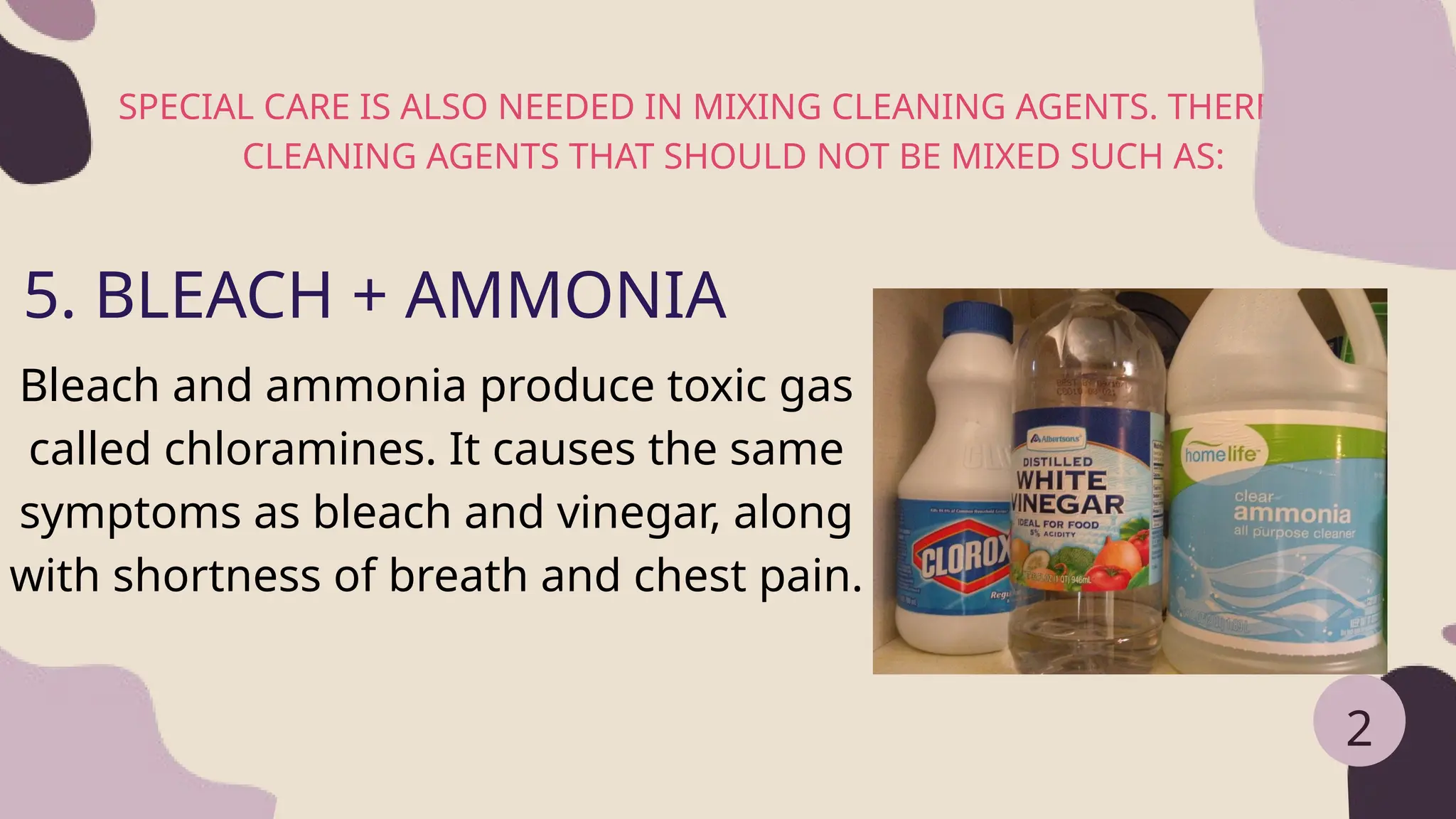
5. BLEACH + AMMONIA
Bleach and ammonia produce toxic gas
called chloramines. It causes the same
symptoms as bleach and vinegar, along
with shortness of breath and chest pain.
SPECIAL CARE IS ALSO NEEDED IN MIXING CLEANING AGENTS. THERE ARE
CLEANING AGENTS THAT SHOULD NOT BE MIXED SUCH AS:
2
6. BLEACH + RUBBING ALCOHOL
The combination can be irritating and
toxic. Make it a rule to never mix bleach
with anything but plain water.
PRECAUTIONAR
Y MEASURES
• one must have knowledge on basic first aid
• wear thick plastic or rubber gloves
• wear protective face or eye wear
• ensure adequate ventilation
• wear suitable footwear
• use cotton clothing to cover the parts of the body exposed to
the cleaning agent
THE FOLLOWING ARE PRECAUTIONARY MEASURES
WHEN USING CLEANING AGENTS:
• Keep cleaning agents away from foods and other
products.
• Place them in separate areas.
• Store in a cool and well-ventilated room. This helps
prevent any fumes from spreading to other areas of the
facility.
• Do not store near heat.
• Keep on lower compartments to keep it from falling into
foods and prevent accidents. Refrain from keeping
punctured aerosols.
STORAGE AND SECURITY OF CHEMICALS
• Store chemicals with their lids tightly on and in their
original containers.
• Manufacturing and expiration dates must be readable.
• Never attempt to mix chemicals even if they are the
same type of chemical.
• Chemicals must be clearly labeled. Be informed of the
following signal words.
STORAGE AND SECURITY OF CHEMICALS
1.Caution - The product should be used carefully but is
relatively safe.
2.Warning - The product is moderately toxic.
3.Danger - The product is highly toxic and may cause
permanent danger to skin and eyes.
STORAGE AND SECURITY OF CHEMICALS
• Get rid of chemicals that have not been used for a
prolonged period of time. A good rule of thumb is to
consider disposing of any chemical product that has not
been used for six months.
STORAGE AND SECURITY OF CHEMICALS

lesson 4Types and Uses of Cleaning Agents.pptx

  • 1.
    TYPES AND USESOF CLEANING AGENTS Lovely Grace Sampaga Capuz
  • 2.
    CLEANING AGENTS ARE: 1.Substancesusually liquids, powder sprays or granule used to remove dirt, grime, stains, bad smells and clutter or deposits from different surfaces. 2.They are normally water solutions of different chemicals and substances tha might be acidic, alkaline or neutral depending on the use.
  • 3.
    CLEANING AGENTS ARE: 1.Therefore,cleaning agents include acid cleaners, neutral cleaners, alkaline cleaners, abrasive, caustic carbon soot removers, degreasers, detergents, disinfectants, sanitizers, biocides, germicide rust removers, rinse aids, cleaning additives, and corrosion
  • 4.
    Acid Cleaning Agent Theseare mainly used for removal of inorganic deposits like scaling. The active ingredients are strong mineral acids.
  • 5.
    Hydrochloric acid also knownas muriatic acid is a common mineral acid typically used for concrete.
  • 6.
    Vinegar can also beused to clean hard surfaces and remove calcium deposits.
  • 7.
    Sulfuric acid Sulfuric acidis used in acidic drain cleaners to unblock clogged pipes by dissolving greases and tissue paper.
  • 8.
    Alkaline cleaning agents Alkalinecleaning agents contain strong bases like sodium hydroxide or potassium hydroxide. Bleach (pH 12) and ammonia (pH 11) are common alkaline cleaning agents. Often dispersants and chelants are added to the alkaline agent, the former to prevent deposition of dissolved dirt and the latter to attack rust. Alkaline can easily dissolve grease.
  • 9.
    Neutral cleaning agents Neutralcleaning agents are commonly known as anionic washing agents. They are available in both liquid and powder which is manufactured from strong alkalis and weak acids.
  • 10.
    Degreaser cleaning agents Degreasercleaning agents are solvent based cleaners best for the removal of grease.
  • 11.
  • 12.
    • Special careis needed for highly concentrated cleaning products. • Products should be diluted accurately according to manufacturer's directions. • This can be achieved through a variety of methods including the use of measuring cups, simple dispensing pumps and more complicated automated dilution equipment. METHODS OF MIXING 2
  • 13.
    • Dilution equipmentshould be checked periodically for accuracy or one may consult the supplier or manufacturer for assistance. METHODS OF MIXING 2
  • 14.
    SPECIAL CARE ISALSO NEEDED IN MIXING CLEANING AGENTS. THERE ARE CLEANING AGENTS THAT SHOULD NOT BE MIXED SUCH AS: 2 1. Drain cleaner + Drain cleaner Never mix two different drain cleaners, these are powerful formulas that could even explode if combined. Use one product only.
  • 15.
    SPECIAL CARE ISALSO NEEDED IN MIXING CLEANING AGENTS. THERE ARE CLEANING AGENTS THAT SHOULD NOT BE MIXED SUCH AS: 2 2. BAKING SODA + VINEGAR Baking soda is basic and vinegar is acidic. When added together, it will produce mostly of water and sodium acetate. Vinegar will make baking soda to foam up. If stored in closed containers, the mixture can explode.
  • 16.
    SPECIAL CARE ISALSO NEEDED IN MIXING CLEANING AGENTS. THERE ARE CLEANING AGENTS THAT SHOULD NOT BE MIXED SUCH AS: 2 3. HYDROGEN PEROXIDE + VINEGAR Don't mix the two products in the same container. Combining them creates peracetic acid which is potentially toxic and can irritate the skin, eyes, and respiratory system.
  • 17.
    SPECIAL CARE ISALSO NEEDED IN MIXING CLEANING AGENTS. THERE ARE CLEANING AGENTS THAT SHOULD NOT BE MIXED SUCH AS: 2 5. BLEACH + AMMONIA Bleach and ammonia produce toxic gas called chloramines. It causes the same symptoms as bleach and vinegar, along with shortness of breath and chest pain.
  • 18.
    SPECIAL CARE ISALSO NEEDED IN MIXING CLEANING AGENTS. THERE ARE CLEANING AGENTS THAT SHOULD NOT BE MIXED SUCH AS: 2 6. BLEACH + RUBBING ALCOHOL The combination can be irritating and toxic. Make it a rule to never mix bleach with anything but plain water.
  • 19.
  • 20.
    • one musthave knowledge on basic first aid • wear thick plastic or rubber gloves • wear protective face or eye wear • ensure adequate ventilation • wear suitable footwear • use cotton clothing to cover the parts of the body exposed to the cleaning agent THE FOLLOWING ARE PRECAUTIONARY MEASURES WHEN USING CLEANING AGENTS:
  • 21.
    • Keep cleaningagents away from foods and other products. • Place them in separate areas. • Store in a cool and well-ventilated room. This helps prevent any fumes from spreading to other areas of the facility. • Do not store near heat. • Keep on lower compartments to keep it from falling into foods and prevent accidents. Refrain from keeping punctured aerosols. STORAGE AND SECURITY OF CHEMICALS
  • 22.
    • Store chemicalswith their lids tightly on and in their original containers. • Manufacturing and expiration dates must be readable. • Never attempt to mix chemicals even if they are the same type of chemical. • Chemicals must be clearly labeled. Be informed of the following signal words. STORAGE AND SECURITY OF CHEMICALS
  • 23.
    1.Caution - Theproduct should be used carefully but is relatively safe. 2.Warning - The product is moderately toxic. 3.Danger - The product is highly toxic and may cause permanent danger to skin and eyes. STORAGE AND SECURITY OF CHEMICALS
  • 24.
    • Get ridof chemicals that have not been used for a prolonged period of time. A good rule of thumb is to consider disposing of any chemical product that has not been used for six months. STORAGE AND SECURITY OF CHEMICALS