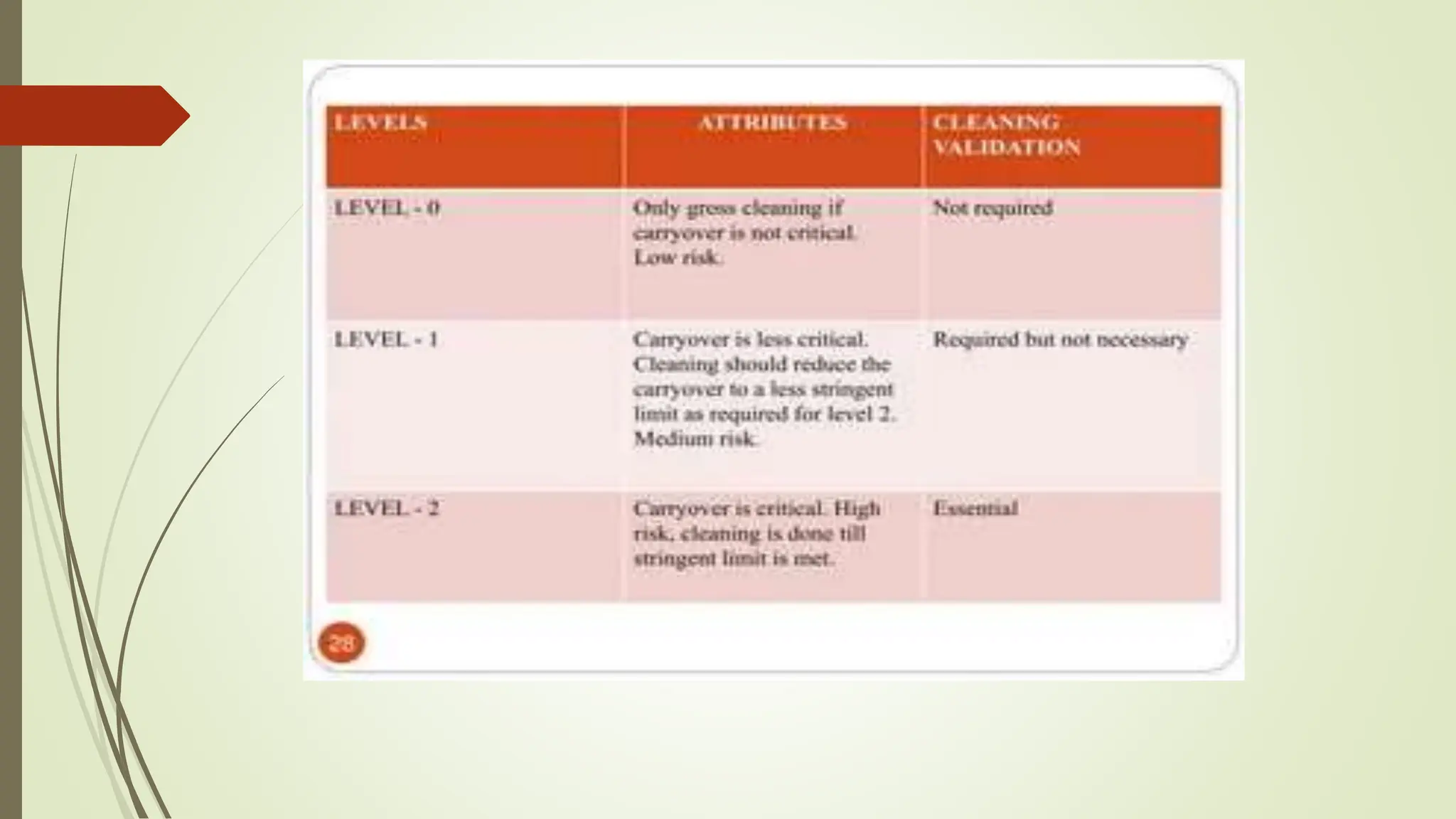
Types of validation
cleaning validation
Defination
 Cleaning validation is the methodology used to assure that a cleaning process
removes chemical and microbial residues of the active, inactive or detergent
ingredients of the product manufactured in a piece of equipment, the cleaning aids
utilized in the cleaning process and the microbial attributes.
 All residues are removed to predetermined levels to ensure the quality of the next
product manufactured is not compromised by residues from the previous product
and the quality of future products using the equipment, to prevent cross-
contamination and as a good manufacturing practice requirement
Principle of cleaning validation
 The three main validation principles in product design and construction are quality,
safety, and efficacy.
 Cleaning validation should be a part of a pharmaceutical company's overall quality
system and it should be based on a scientific rational.
 Cleaning should always start from the least soiled areas (cleanest) first to the most
soiled areas (dirtiest) last and from higher levels to lower levels so that debris may
fall on the floor and is cleaned last (4). Detergent and/or disinfectant solutions
must be discarded after each use.
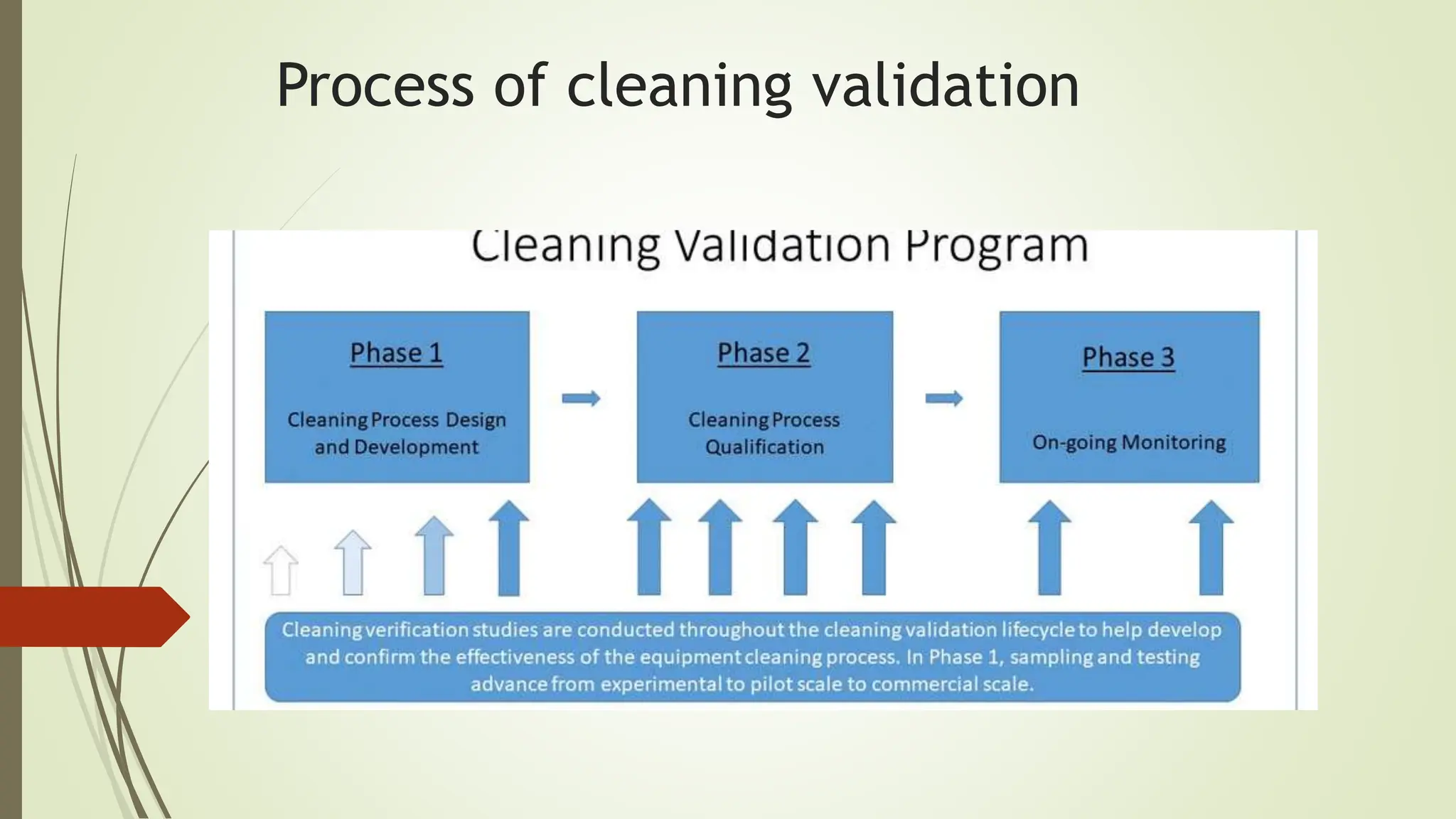
Process of cleaning validation
Importance of validation
Cleaning validation plan
 A cleaning validation protocol is a comprehensive plan that guides the entire
validation process.
 It includes clear objectives, equipment and product details, worst-case
assessments, sampling procedures, testing methods, acceptance criteria, safety
instructions, and protocols for managing failures or changes.
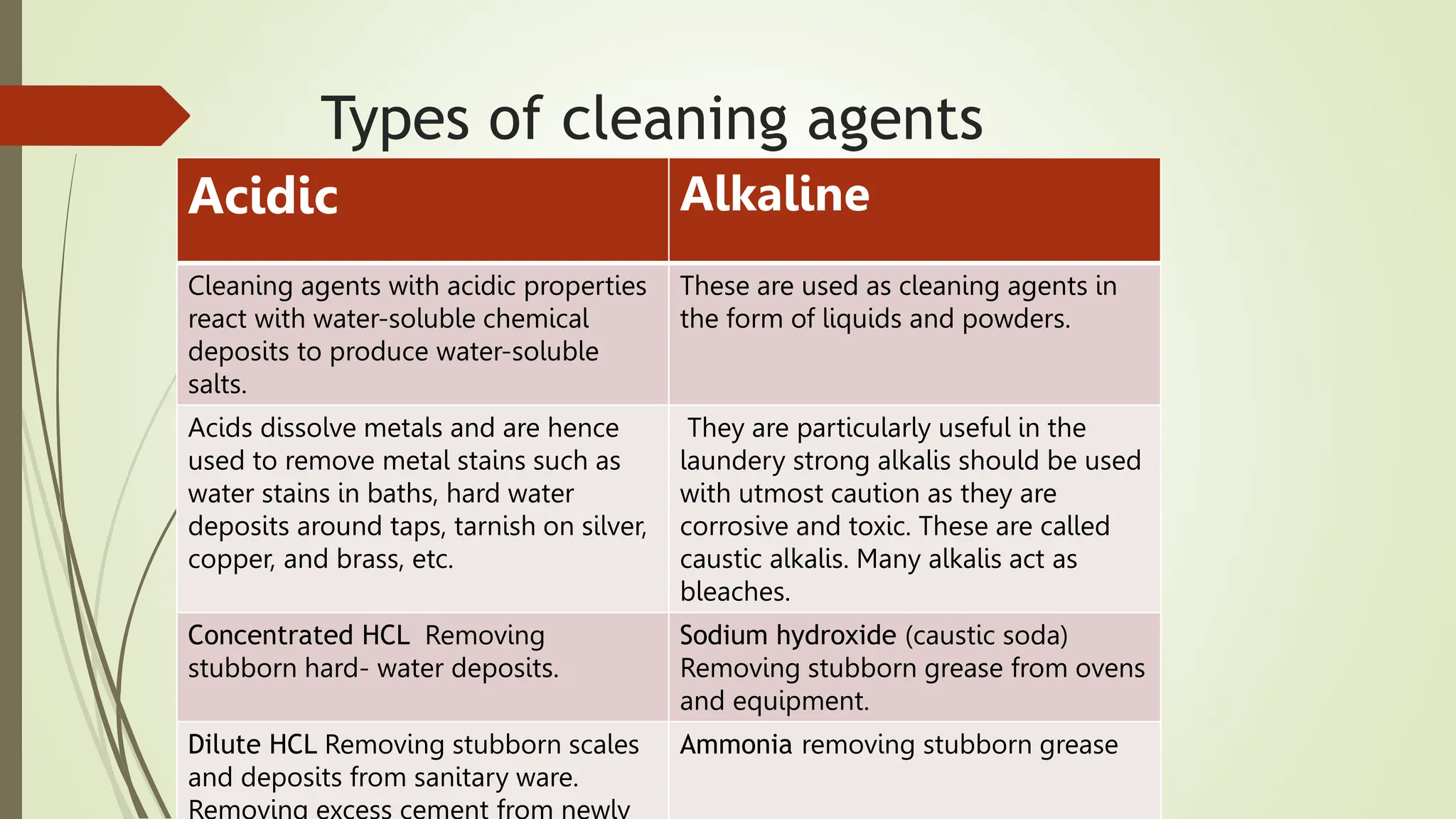
Types of cleaning agents
Alkaline
Acidic Alkaline
Cleaning agents with acidic properties
react with water-soluble chemical
deposits to produce water-soluble
salts.
These are used as cleaning agents in
the form of liquids and powders.
Acids dissolve metals and are hence
used to remove metal stains such as
water stains in baths, hard water
deposits around taps, tarnish on silver,
copper, and brass, etc.
They are particularly useful in the
laundery strong alkalis should be used
with utmost caution as they are
corrosive and toxic. These are called
caustic alkalis. Many alkalis act as
bleaches.
Concentrated HCL Removing
stubborn hard- water deposits.
Sodium hydroxide (caustic soda)
Removing stubborn grease from ovens
and equipment.
Dilute HCL Removing stubborn scales
and deposits from sanitary ware.
Ammonia removing stubborn grease
Organic Solvents
These are chemicals that dissolve fat, oil, grease, wax, or
similar compounds from the different surfaces, e.g.
methylated spirit, white spirit (turpentine substitute),
carbon tetrachloride.
Degreasing agents
They usually consist of strong alkalis, which can dissolve
proteins and emulsify and disperse grease and similar
substance.
Abrasives
The cleaning action of abrasives depends on the presence
of fine particles which when rubbed over a soiled hard
surface, dislodges the soil, removes tarnishing, and surface
scratches from meat surfaces.
Detergent
Detergents are those cleaning agents, which contain significant
quantities of a group of chemicals known as ‘Surfactants’
(chemicals that have water and soil attracting properties).
Mechanism of cleaning
Saponification is simply the process of making soaps. Soaps
are just potassium or sodium salts of long-chain fatty acids.
During saponification, ester reacts with an inorganic base to
produce alcohol and soap.
Wetting agents are used in a number of household and
industrial cleaning applications, such as detergents, surface
cleaners, skin cleaning and laundry care products that are
typically used with water.
Conclusion
 Cleaning environment and clean operations is the heart of pharmaceutical
activities.
 Four basic requirements of cGMP are safety, identify, strength , and purity which
can be achieved by cleaning process and its proper validation

Types of validation in 7 th sem b pharma

  • 1.
  • 2.
    Defination  Cleaning validationis the methodology used to assure that a cleaning process removes chemical and microbial residues of the active, inactive or detergent ingredients of the product manufactured in a piece of equipment, the cleaning aids utilized in the cleaning process and the microbial attributes.  All residues are removed to predetermined levels to ensure the quality of the next product manufactured is not compromised by residues from the previous product and the quality of future products using the equipment, to prevent cross- contamination and as a good manufacturing practice requirement
  • 3.
    Principle of cleaningvalidation  The three main validation principles in product design and construction are quality, safety, and efficacy.  Cleaning validation should be a part of a pharmaceutical company's overall quality system and it should be based on a scientific rational.  Cleaning should always start from the least soiled areas (cleanest) first to the most soiled areas (dirtiest) last and from higher levels to lower levels so that debris may fall on the floor and is cleaned last (4). Detergent and/or disinfectant solutions must be discarded after each use.
  • 4.
  • 5.
  • 6.
    Cleaning validation plan A cleaning validation protocol is a comprehensive plan that guides the entire validation process.  It includes clear objectives, equipment and product details, worst-case assessments, sampling procedures, testing methods, acceptance criteria, safety instructions, and protocols for managing failures or changes.
  • 9.
    Types of cleaningagents Alkaline Acidic Alkaline Cleaning agents with acidic properties react with water-soluble chemical deposits to produce water-soluble salts. These are used as cleaning agents in the form of liquids and powders. Acids dissolve metals and are hence used to remove metal stains such as water stains in baths, hard water deposits around taps, tarnish on silver, copper, and brass, etc. They are particularly useful in the laundery strong alkalis should be used with utmost caution as they are corrosive and toxic. These are called caustic alkalis. Many alkalis act as bleaches. Concentrated HCL Removing stubborn hard- water deposits. Sodium hydroxide (caustic soda) Removing stubborn grease from ovens and equipment. Dilute HCL Removing stubborn scales and deposits from sanitary ware. Ammonia removing stubborn grease
  • 10.
    Organic Solvents These arechemicals that dissolve fat, oil, grease, wax, or similar compounds from the different surfaces, e.g. methylated spirit, white spirit (turpentine substitute), carbon tetrachloride. Degreasing agents They usually consist of strong alkalis, which can dissolve proteins and emulsify and disperse grease and similar substance. Abrasives The cleaning action of abrasives depends on the presence of fine particles which when rubbed over a soiled hard surface, dislodges the soil, removes tarnishing, and surface scratches from meat surfaces. Detergent Detergents are those cleaning agents, which contain significant quantities of a group of chemicals known as ‘Surfactants’ (chemicals that have water and soil attracting properties).
  • 11.
  • 12.
    Saponification is simplythe process of making soaps. Soaps are just potassium or sodium salts of long-chain fatty acids. During saponification, ester reacts with an inorganic base to produce alcohol and soap. Wetting agents are used in a number of household and industrial cleaning applications, such as detergents, surface cleaners, skin cleaning and laundry care products that are typically used with water.
  • 13.
    Conclusion  Cleaning environmentand clean operations is the heart of pharmaceutical activities.  Four basic requirements of cGMP are safety, identify, strength , and purity which can be achieved by cleaning process and its proper validation