Architecture of DBMS

                Mrs. Maninder Kaur
            professormaninder@gmail.com


1      Mrs. Maninder Kaur      www.eazynotes.com
Introduction to DBMS
                    Architecture
    DBMS is a collection of programs that enable the users to
      create and maintain the database .
    Purpose of DBMS is to provide the user with the abstract
      view of database i.e. system does not provide all the details
      of the data, rather it hides the details how data is stored &
      maintained.
    In order to use the system, data must be retrieved efficiently.
    This leads to the design of complex data structures in the
      database.


2           Mrs. Maninder Kaur             www.eazynotes.com
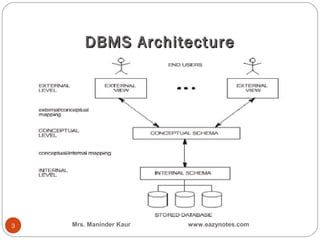
DBMS Architecture


3   Mrs. Maninder Kaur   www.eazynotes.com
Three levels of the architecture
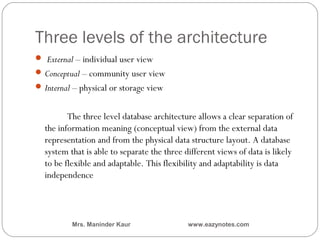
 External – individual user view
 Conceptual – community user view
 Internal – physical or storage view


         The three level database architecture allows a clear separation of
  the information meaning (conceptual view) from the external data
  representation and from the physical data structure layout. A database
  system that is able to separate the three different views of data is likely
  to be flexible and adaptable. This flexibility and adaptability is data
  independence


          Mrs. Maninder Kaur                 www.eazynotes.com
External View / Level / Schema /
         User View / Global View
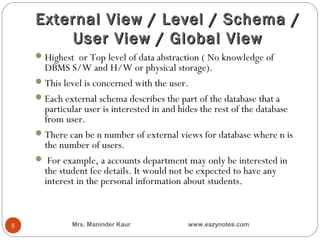
     Highest or Top level of data abstraction ( No knowledge of
      DBMS S/W and H/W or physical storage).
     This level is concerned with the user.
     Each external schema describes the part of the database that a
      particular user is interested in and hides the rest of the database
      from user.
     There can be n number of external views for database where n is
      the number of users.
     For example, a accounts department may only be interested in
      the student fee details. It would not be expected to have any
      interest in the personal information about students.


5            Mrs. Maninder Kaur             www.eazynotes.com
Conceptual View
    This level is in between the user level and physical storage
      view.
    There is only one conceptual view for single database.
    It hides the details of physical storage structures and
      concentrates on describing entities, data types, relationships,
      user operations, and constraints.


6             Mrs. Maninder Kaur         www.eazynotes.com
Internal View / Physical View
     It is the lowest level of data abstraction. (it has the knowledge about s/w and
       h/w)

     At this level, it keeps the information about the actual representation of the
      entire database i.e. the actual storage of the data on the disk in the form of
      records or blocks.
     It is close to the physical storage method.

     The internal view is the view that tells us what data is stored in the database and
       how. At least the following aspects are considered at this level: Storage
       allocation, Access paths etc.

     The internal view does not deal with the physical devices directly. Instead it
       views a physical device as a collection of physical pages and allocates space in
       terms of logical pages.


7              Mrs. Maninder Kaur                    www.eazynotes.com
TYPES OF DATA INDEPENDENCE

    LOGICAL DATA INDEPENDENCE


    PHYSICAL DATA INDEPENDENCE


8       Mrs. Maninder Kaur   www.eazynotes.com
LOGICAL DATA INDEPENDENCE
    Whenever, there is a change or modification at the
      conceptual level without affecting the user level or
      external level, it is known as logical data independence.

    E.g. The name field in conceptual view is stored as first
      name, middle name and last name whereas in external
      view, it remains to be as a single name field.


9           Mrs. Maninder Kaur        www.eazynotes.com
PHYSICAL DATA INDEPENDENCE
     Whenever, the changes are made at the internal level
       without affecting the above layers, it is known as physical
       data independence.

     E.g. The location of the database, if changed from C
       drive to D drive will not affect the conceptual view or
       external view as the commands are independent of the
       location of the database.


10           Mrs. Maninder Kaur         www.eazynotes.com
Difference between Logical Data Independence &
       Physical Data Independence
          Logical Data Independence                           Physical Data Independence
 It is concerned with the structure of the data or    It is concerned with storage of the data.
 changing the data definition.

 It is very difficult as the retrieving of data are   It is easy to retrieve.
 heavily dependent on logical structure of data.

 Application program need not be changed if new
 fields are added or deleted from the database. Physical database is concerned with the change
                                                of the storage device.
 It is concerned with the conceptual schema.

                                                      It is concerned with the internal schema.


11                   Mrs. Maninder Kaur                        www.eazynotes.com
12   Mrs. Maninder Kaur   www.eazynotes.com

Architecture of-dbms-and-data-independence

  • 1.
    Architecture of DBMS Mrs. Maninder Kaur professormaninder@gmail.com 1 Mrs. Maninder Kaur www.eazynotes.com
  • 2.
    Introduction to DBMS Architecture DBMS is a collection of programs that enable the users to create and maintain the database . Purpose of DBMS is to provide the user with the abstract view of database i.e. system does not provide all the details of the data, rather it hides the details how data is stored & maintained. In order to use the system, data must be retrieved efficiently. This leads to the design of complex data structures in the database. 2 Mrs. Maninder Kaur www.eazynotes.com
  • 3.
    DBMS Architecture 3 Mrs. Maninder Kaur www.eazynotes.com
  • 4.
    Three levels ofthe architecture  External – individual user view  Conceptual – community user view  Internal – physical or storage view The three level database architecture allows a clear separation of the information meaning (conceptual view) from the external data representation and from the physical data structure layout. A database system that is able to separate the three different views of data is likely to be flexible and adaptable. This flexibility and adaptability is data independence Mrs. Maninder Kaur www.eazynotes.com
  • 5.
    External View /Level / Schema / User View / Global View  Highest or Top level of data abstraction ( No knowledge of DBMS S/W and H/W or physical storage).  This level is concerned with the user.  Each external schema describes the part of the database that a particular user is interested in and hides the rest of the database from user.  There can be n number of external views for database where n is the number of users.  For example, a accounts department may only be interested in the student fee details. It would not be expected to have any interest in the personal information about students. 5 Mrs. Maninder Kaur www.eazynotes.com
  • 6.
    Conceptual View This level is in between the user level and physical storage view. There is only one conceptual view for single database. It hides the details of physical storage structures and concentrates on describing entities, data types, relationships, user operations, and constraints. 6 Mrs. Maninder Kaur www.eazynotes.com
  • 7.
    Internal View /Physical View  It is the lowest level of data abstraction. (it has the knowledge about s/w and h/w)  At this level, it keeps the information about the actual representation of the entire database i.e. the actual storage of the data on the disk in the form of records or blocks.  It is close to the physical storage method.  The internal view is the view that tells us what data is stored in the database and how. At least the following aspects are considered at this level: Storage allocation, Access paths etc.  The internal view does not deal with the physical devices directly. Instead it views a physical device as a collection of physical pages and allocates space in terms of logical pages. 7 Mrs. Maninder Kaur www.eazynotes.com
  • 8.
    TYPES OF DATAINDEPENDENCE LOGICAL DATA INDEPENDENCE PHYSICAL DATA INDEPENDENCE 8 Mrs. Maninder Kaur www.eazynotes.com
  • 9.
    LOGICAL DATA INDEPENDENCE Whenever, there is a change or modification at the conceptual level without affecting the user level or external level, it is known as logical data independence. E.g. The name field in conceptual view is stored as first name, middle name and last name whereas in external view, it remains to be as a single name field. 9 Mrs. Maninder Kaur www.eazynotes.com
  • 10.
    PHYSICAL DATA INDEPENDENCE Whenever, the changes are made at the internal level without affecting the above layers, it is known as physical data independence. E.g. The location of the database, if changed from C drive to D drive will not affect the conceptual view or external view as the commands are independent of the location of the database. 10 Mrs. Maninder Kaur www.eazynotes.com
  • 11.
    Difference between LogicalData Independence & Physical Data Independence Logical Data Independence Physical Data Independence It is concerned with the structure of the data or It is concerned with storage of the data. changing the data definition. It is very difficult as the retrieving of data are It is easy to retrieve. heavily dependent on logical structure of data. Application program need not be changed if new fields are added or deleted from the database. Physical database is concerned with the change of the storage device. It is concerned with the conceptual schema. It is concerned with the internal schema. 11 Mrs. Maninder Kaur www.eazynotes.com
  • 12.
    12 Mrs. Maninder Kaur www.eazynotes.com