)
DATA MODELS INTRODUCTION
• A Data Model is a set of concepts that can be used
to describe the structure of data in a database.
• A database model shows the logical structure of a
database, including the relationships and constraints
that determine how data can be stored and
accessed.
• Data Models are used to support the development of
information systems by providing the definition and
format of data to be involved in future systems.
• Data model also gives idea about possible alternatives
to achieve targeted solution.
8/20/2018 2DBMS
Types of Data Models
• Hierarchical Model
• Network Model
• Relational Model
8/20/2018 3DBMS
Hierarchical Model
• This model is developed by IBM and
North American Rockwell Known as
Information Management System.
• This is the oldest and simplest DBMS
model.
• The model is sorted hierarchical ,either in
top down or bottom up approach of
designing.
• This model uses pointers to navigate
between stored data.
8/20/2018 4DBMS
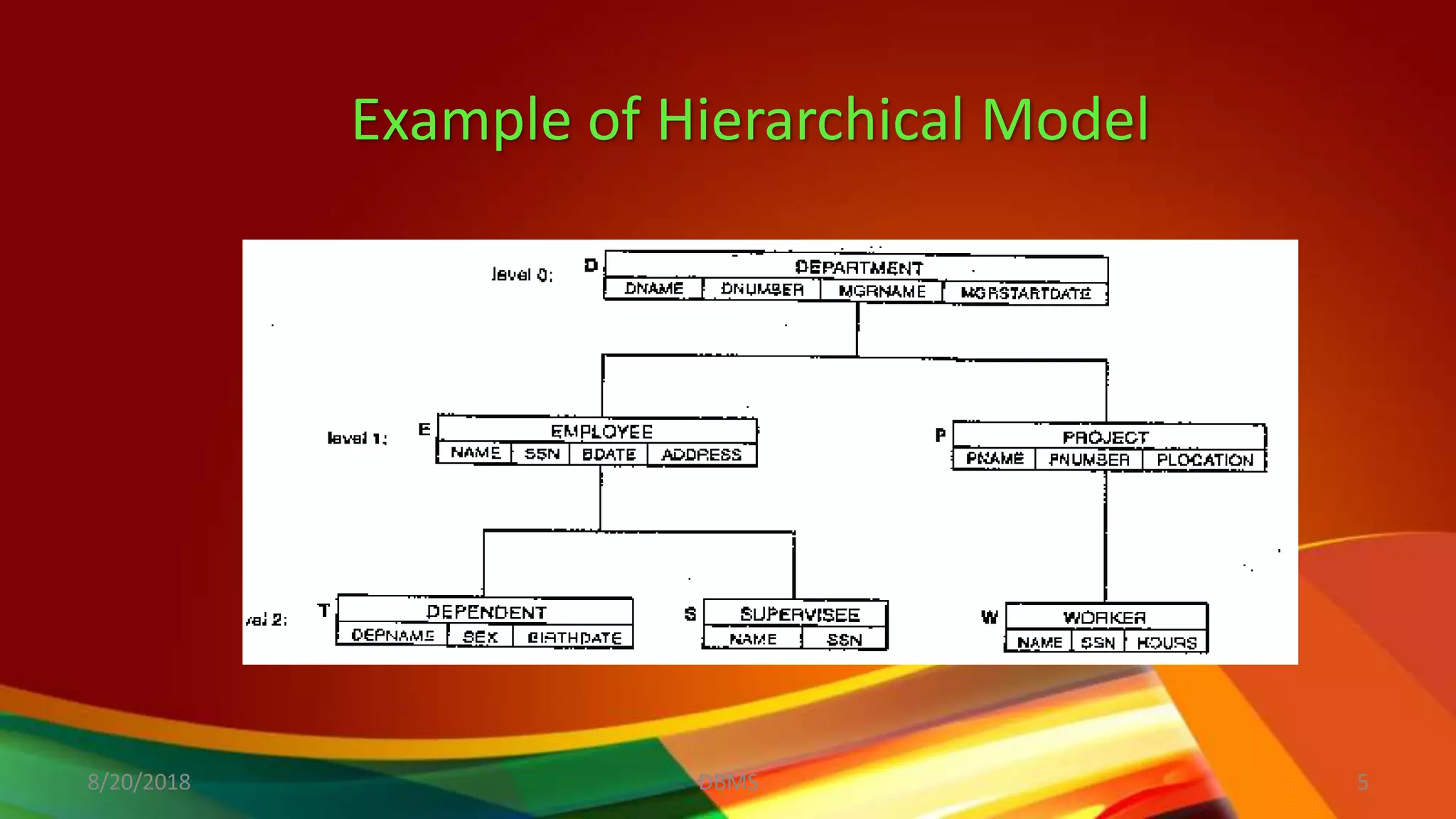
Example of Hierarchical Model
8/20/2018 5DBMS
Business Rule
• One parent node can have many child
nodes ,but one child cannot have
more than one parent.
• Relationship is one to many.
8/20/2018 6DBMS
Advantages of Hierarchical Model
1. Conceptual simplicity
• Relationship between various level
is logically very simple. Hence
database structure becomes
easier to view.
2. Database Security
• Security is given by DBMS system
itself.
8/20/2018 7DBMS
3. Simple creation ,Updation and Access
• This model is simple to construct
with help of pointers .
• Easy to understand .
• Easy to delete and add records in the
database using pointers .
• This is faster and easy data retrival
through higher level records in tree
structure.
8/20/2018 8DBMS
4. Database Integrity
• There is parent child association
between different levels of
records in files.
• Child record is attached with the
parent record which maintains the
integrity
8/20/2018 9DBMS
5. Efficiency
• This model having good
performance when database
contains large amount of data in
which one record has many
related records like a class
contains many students studying
in it.
8/20/2018 10DBMS
Disadvantages of Hierarchical Model
1. Complex Implementation
• Programmers and designers need to
have knowledge of physical data storage
which may be complex.
2. Difficult to manage
• Any change in a location of data needs
change in all application programs that
accesses changes data.
• Data access is restricted by pointer path.
8/20/2018 11DBMS
3. Limitations in implementation
• It is difficult to implement many to
many relationship.
• Query optimization is not possible
or possible up to certain extent.
8/20/2018 12DBMS
Network Model
• This model is similar to Hierarchical
model, this model also uses pointers
toward data but there is no need of
parent to child association .
• It uses graph data structure.
• A child can have more than one parent.
• It has one to many or many to many
relationship.
8/20/2018 13DBMS
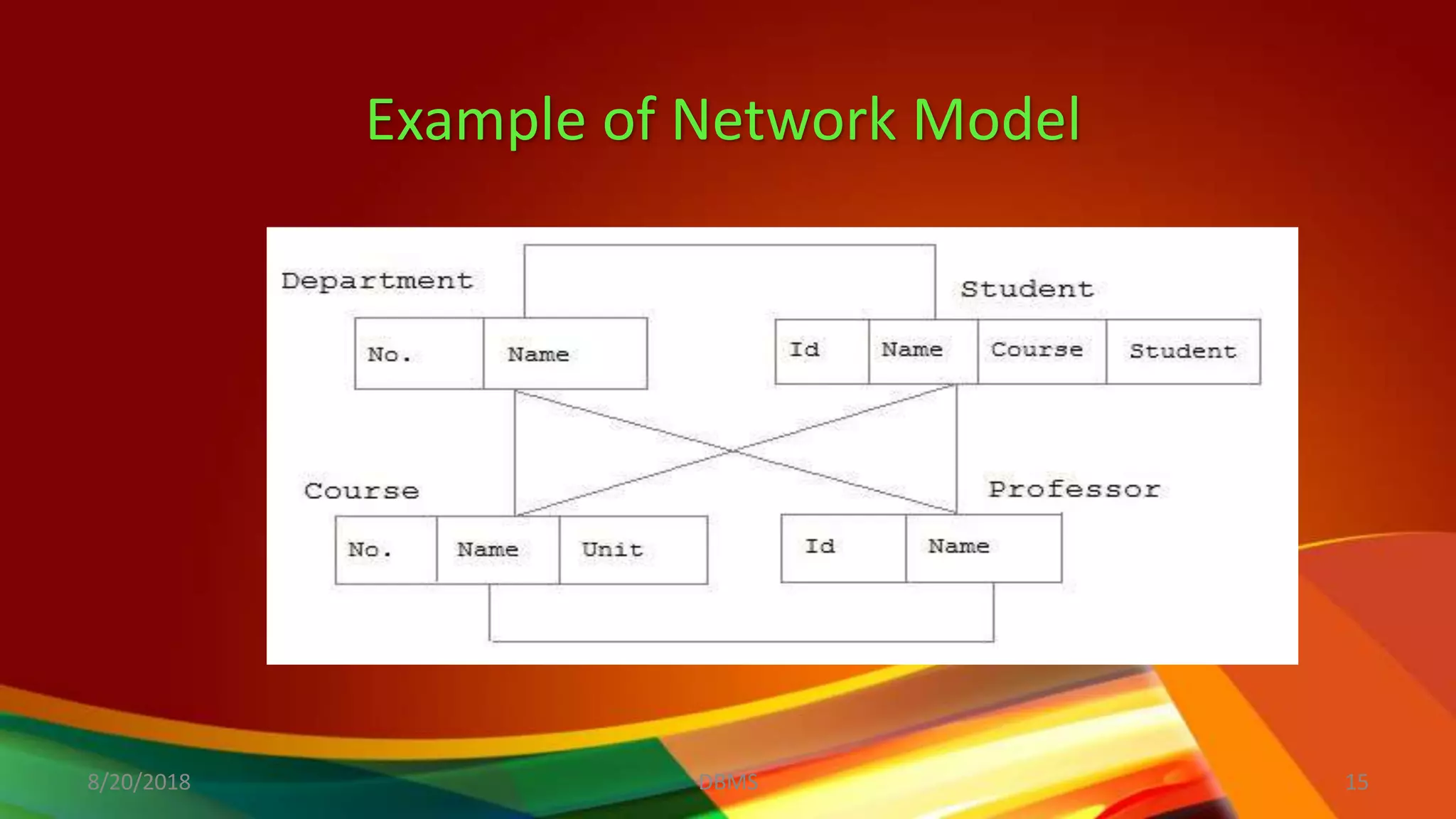
• A relationship between any two record
types is called as a set.
• Data in network model are
represented by collection of records
and relationships among data are
represented by links, which can be
viewed as pointers.
• The records in the database are
organized as collection of arbitrary
groups.
8/20/2018 14DBMS
Example of Network Model
8/20/2018 15DBMS
Advantages of Network Model
1. Simple design
• The network model is simple and
easy to design and understand.
2. Ability to handle many types of
relationship
• The network model can handle the
one to many or many to many or
other relationships.
• Hence network model manages
multiuser environment.
8/20/2018 16DBMS
3. Ease of data access
• In a network model, an application can
access a root(parent) record and all the
member records within a SET (child).
• Provide very efficient and high speed
retrieval.
4. Data Integrity
• In a network model, no member can exist
without a parent entity.
• A user must first define the root record and
then the child record.
8/20/2018 17DBMS
5. Data Independence
• In network model, application
programs work independently of the
data.
• Any changes made in the data do not
affect the application programs.
• In a network model ,administrators
offer data creation by DDL and DML.
8/20/2018 18DBMS
Disadvantages of Network Model
1. System Complexity
• In a network model ,data are accessed
one record at a time.
• This can increase the complexity of
system for accessing multiple records at
a time.
2. Lack of structural independence
• Any changes made to the database
structure require the application
programs to be modified before it can
access data.
8/20/2018 19DBMS
Relational Model
• The Relational Model is first proposed by E.F
Codd.
• This model uses collection of tables to represent
relationships amongst the data.
• In this model ,each database item is viewed as a
record with attributes. A set of records with
similar attributes is called a TABLE. Each table
contains a record of a particular type.
• The database uses Relational model called as
RDBMS .
• A Relational database is a collection of 2-D tables
which consist of rows and columns.
8/20/2018 20DBMS
• Relational model is the most popular model and the
most extensively used model.
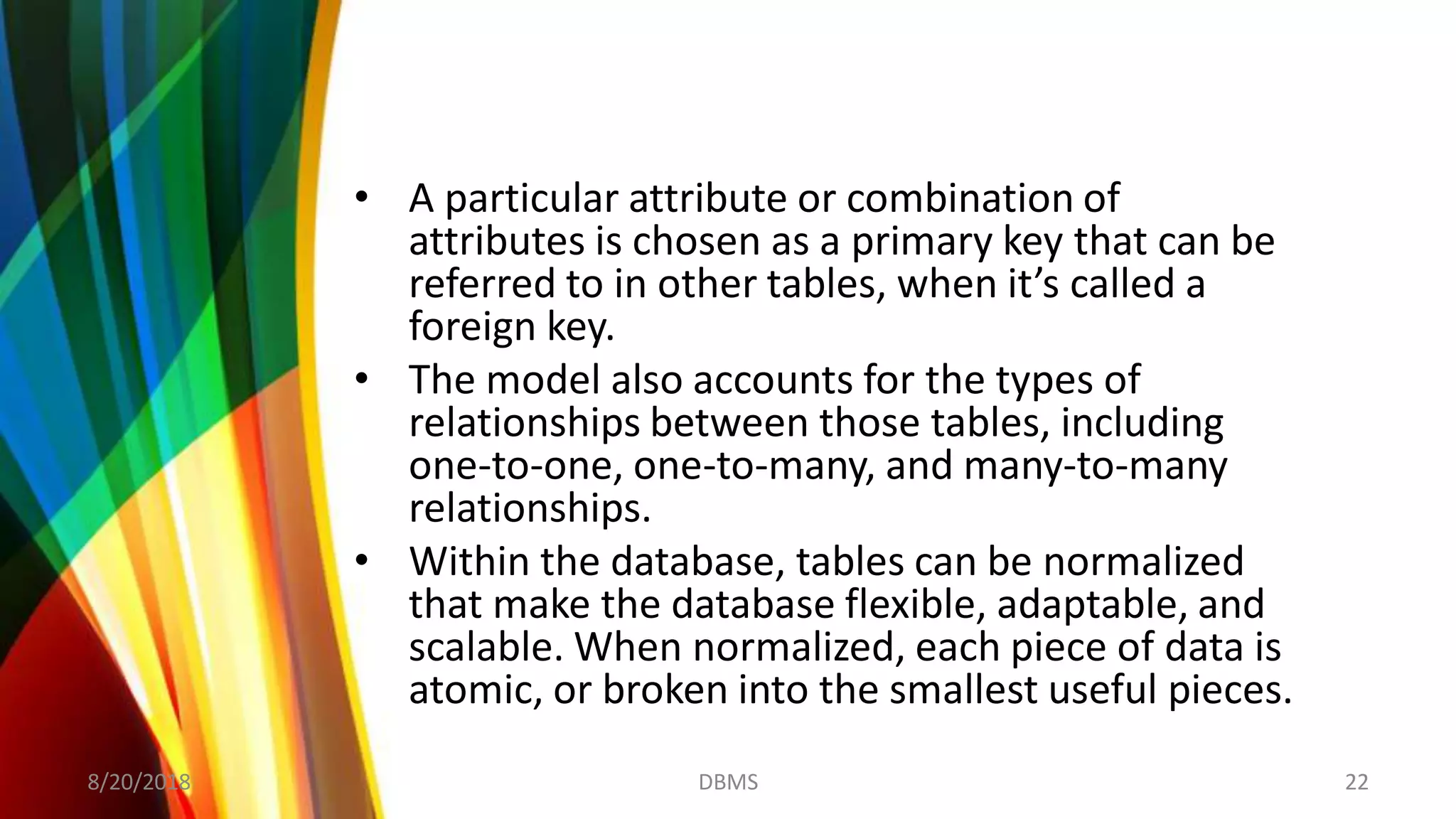
• In this model the data can be stored in the “tables”
and this storing is called as “relation”, the relations
can be normalized and the normalized relation values
are called atomic values.
• Each row in a relation contains unique value and it is
called as “tuple”, each column contains value from
same domain and it is called as “attribute”.
• Most of the popular commercial DBMS products like
Oracle, Sybase , MySQL, are based on relational
model.
8/20/2018 21DBMS
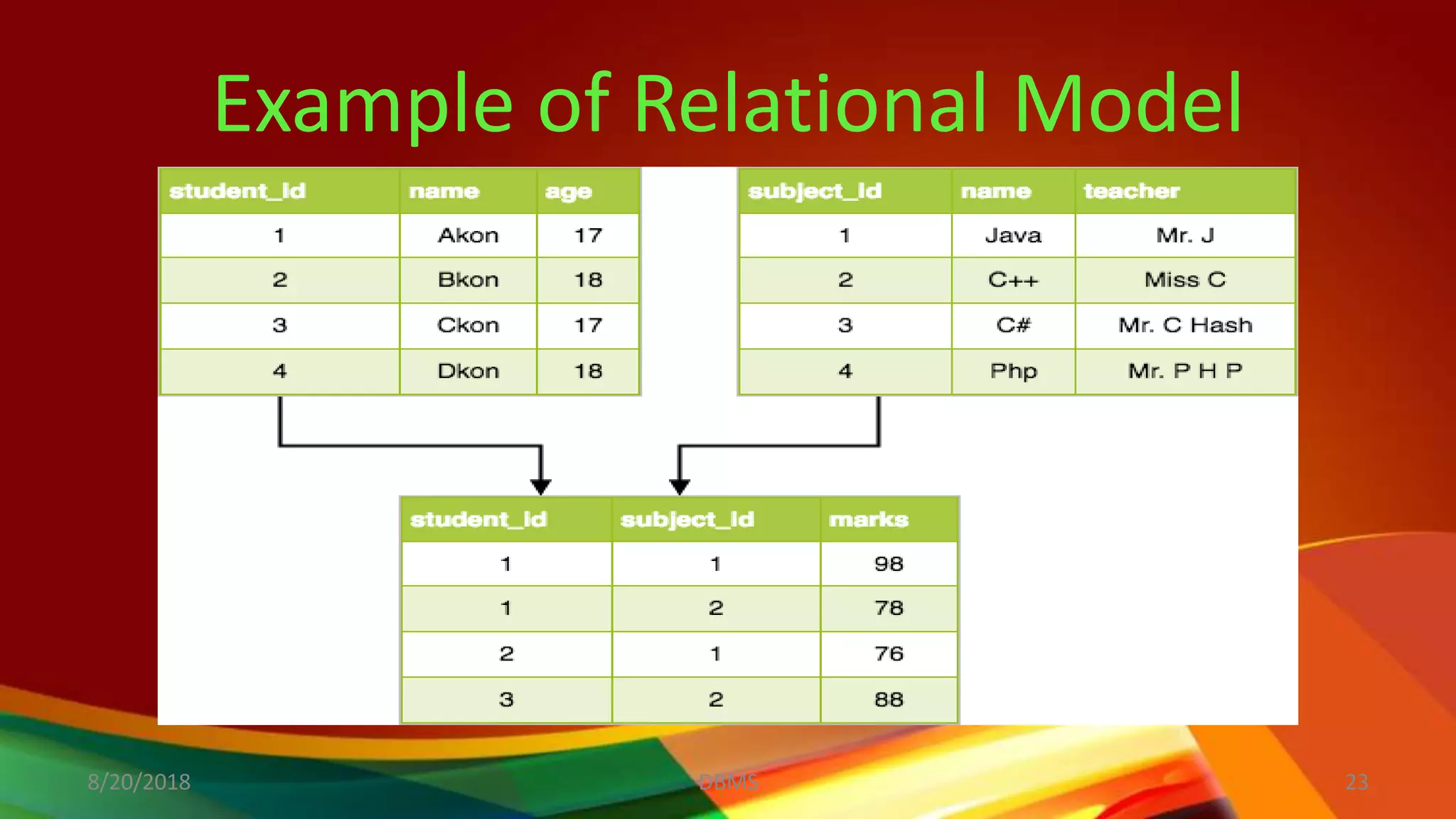
• A particular attribute or combination of
attributes is chosen as a primary key that can be
referred to in other tables, when it’s called a
foreign key.
• The model also accounts for the types of
relationships between those tables, including
one-to-one, one-to-many, and many-to-many
relationships.
• Within the database, tables can be normalized
that make the database flexible, adaptable, and
scalable. When normalized, each piece of data is
atomic, or broken into the smallest useful pieces.
8/20/2018 22DBMS
Example of Relational Model
8/20/2018 23DBMS
ADVANTAGES OF RELATIONAL MODEL
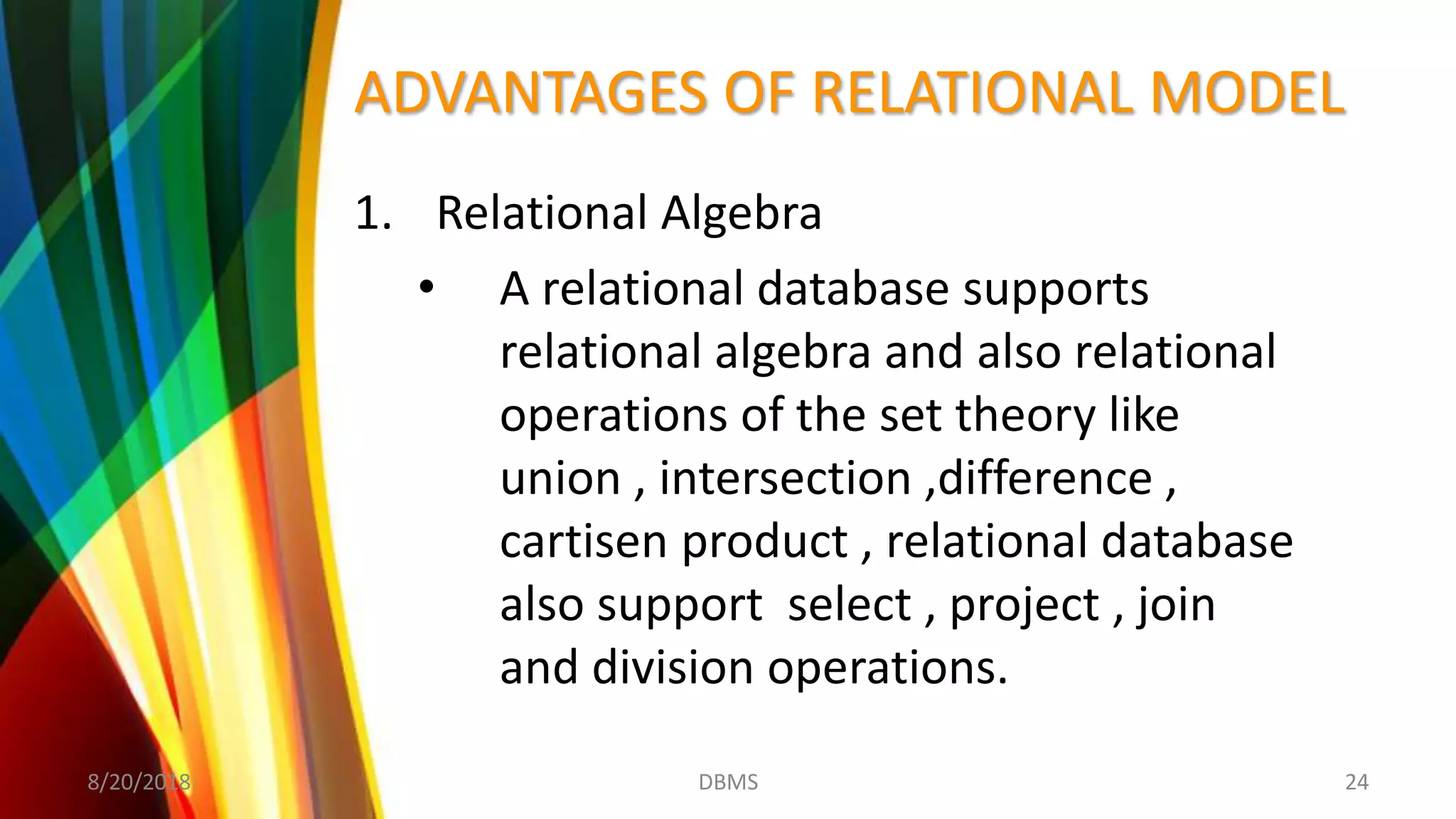
1. Relational Algebra
• A relational database supports
relational algebra and also relational
operations of the set theory like
union , intersection ,difference ,
cartisen product , relational database
also support select , project , join
and division operations.
8/20/2018 24DBMS
2. Dynamic Views
• In a RDBMS , a view is not a part of
the physical schema , it is always
dynamic.
3. Structured query language (SQL)
• For data access in RDBMS we have
query language SQL .Most of the
database vendors support the SQL
standards.
8/20/2018 25DBMS
4. Excellent data security
• Relational databases support the
concept of user rights, every user is
assigned with some database
permission called as user rights.
• Relational databases are scalable and
provide good support for the
implementation of distributed systems
and other advanced database
systems.
8/20/2018 26DBMS
8/20/2018 27DBMS

Data models

  • 1.
  • 2.
    DATA MODELS INTRODUCTION •A Data Model is a set of concepts that can be used to describe the structure of data in a database. • A database model shows the logical structure of a database, including the relationships and constraints that determine how data can be stored and accessed. • Data Models are used to support the development of information systems by providing the definition and format of data to be involved in future systems. • Data model also gives idea about possible alternatives to achieve targeted solution. 8/20/2018 2DBMS
  • 3.
    Types of DataModels • Hierarchical Model • Network Model • Relational Model 8/20/2018 3DBMS
  • 4.
    Hierarchical Model • Thismodel is developed by IBM and North American Rockwell Known as Information Management System. • This is the oldest and simplest DBMS model. • The model is sorted hierarchical ,either in top down or bottom up approach of designing. • This model uses pointers to navigate between stored data. 8/20/2018 4DBMS
  • 5.
    Example of HierarchicalModel 8/20/2018 5DBMS
  • 6.
    Business Rule • Oneparent node can have many child nodes ,but one child cannot have more than one parent. • Relationship is one to many. 8/20/2018 6DBMS
  • 7.
    Advantages of HierarchicalModel 1. Conceptual simplicity • Relationship between various level is logically very simple. Hence database structure becomes easier to view. 2. Database Security • Security is given by DBMS system itself. 8/20/2018 7DBMS
  • 8.
    3. Simple creation,Updation and Access • This model is simple to construct with help of pointers . • Easy to understand . • Easy to delete and add records in the database using pointers . • This is faster and easy data retrival through higher level records in tree structure. 8/20/2018 8DBMS
  • 9.
    4. Database Integrity •There is parent child association between different levels of records in files. • Child record is attached with the parent record which maintains the integrity 8/20/2018 9DBMS
  • 10.
    5. Efficiency • Thismodel having good performance when database contains large amount of data in which one record has many related records like a class contains many students studying in it. 8/20/2018 10DBMS
  • 11.
    Disadvantages of HierarchicalModel 1. Complex Implementation • Programmers and designers need to have knowledge of physical data storage which may be complex. 2. Difficult to manage • Any change in a location of data needs change in all application programs that accesses changes data. • Data access is restricted by pointer path. 8/20/2018 11DBMS
  • 12.
    3. Limitations inimplementation • It is difficult to implement many to many relationship. • Query optimization is not possible or possible up to certain extent. 8/20/2018 12DBMS
  • 13.
    Network Model • Thismodel is similar to Hierarchical model, this model also uses pointers toward data but there is no need of parent to child association . • It uses graph data structure. • A child can have more than one parent. • It has one to many or many to many relationship. 8/20/2018 13DBMS
  • 14.
    • A relationshipbetween any two record types is called as a set. • Data in network model are represented by collection of records and relationships among data are represented by links, which can be viewed as pointers. • The records in the database are organized as collection of arbitrary groups. 8/20/2018 14DBMS
  • 15.
    Example of NetworkModel 8/20/2018 15DBMS
  • 16.
    Advantages of NetworkModel 1. Simple design • The network model is simple and easy to design and understand. 2. Ability to handle many types of relationship • The network model can handle the one to many or many to many or other relationships. • Hence network model manages multiuser environment. 8/20/2018 16DBMS
  • 17.
    3. Ease ofdata access • In a network model, an application can access a root(parent) record and all the member records within a SET (child). • Provide very efficient and high speed retrieval. 4. Data Integrity • In a network model, no member can exist without a parent entity. • A user must first define the root record and then the child record. 8/20/2018 17DBMS
  • 18.
    5. Data Independence •In network model, application programs work independently of the data. • Any changes made in the data do not affect the application programs. • In a network model ,administrators offer data creation by DDL and DML. 8/20/2018 18DBMS
  • 19.
    Disadvantages of NetworkModel 1. System Complexity • In a network model ,data are accessed one record at a time. • This can increase the complexity of system for accessing multiple records at a time. 2. Lack of structural independence • Any changes made to the database structure require the application programs to be modified before it can access data. 8/20/2018 19DBMS
  • 20.
    Relational Model • TheRelational Model is first proposed by E.F Codd. • This model uses collection of tables to represent relationships amongst the data. • In this model ,each database item is viewed as a record with attributes. A set of records with similar attributes is called a TABLE. Each table contains a record of a particular type. • The database uses Relational model called as RDBMS . • A Relational database is a collection of 2-D tables which consist of rows and columns. 8/20/2018 20DBMS
  • 21.
    • Relational modelis the most popular model and the most extensively used model. • In this model the data can be stored in the “tables” and this storing is called as “relation”, the relations can be normalized and the normalized relation values are called atomic values. • Each row in a relation contains unique value and it is called as “tuple”, each column contains value from same domain and it is called as “attribute”. • Most of the popular commercial DBMS products like Oracle, Sybase , MySQL, are based on relational model. 8/20/2018 21DBMS
  • 22.
    • A particularattribute or combination of attributes is chosen as a primary key that can be referred to in other tables, when it’s called a foreign key. • The model also accounts for the types of relationships between those tables, including one-to-one, one-to-many, and many-to-many relationships. • Within the database, tables can be normalized that make the database flexible, adaptable, and scalable. When normalized, each piece of data is atomic, or broken into the smallest useful pieces. 8/20/2018 22DBMS
  • 23.
    Example of RelationalModel 8/20/2018 23DBMS
  • 24.
    ADVANTAGES OF RELATIONALMODEL 1. Relational Algebra • A relational database supports relational algebra and also relational operations of the set theory like union , intersection ,difference , cartisen product , relational database also support select , project , join and division operations. 8/20/2018 24DBMS
  • 25.
    2. Dynamic Views •In a RDBMS , a view is not a part of the physical schema , it is always dynamic. 3. Structured query language (SQL) • For data access in RDBMS we have query language SQL .Most of the database vendors support the SQL standards. 8/20/2018 25DBMS
  • 26.
    4. Excellent datasecurity • Relational databases support the concept of user rights, every user is assigned with some database permission called as user rights. • Relational databases are scalable and provide good support for the implementation of distributed systems and other advanced database systems. 8/20/2018 26DBMS
  • 27.