Acquisition We have an innate capacity to learn languages. This enables children to construct the grammar of the language in spite of the poverty of the stimulus.
How does acquisition proceed? Children learn not the language per se, but the grammar of language - the rules.  Past tense: add –ed walk, walked break, *breaked Acquire rule, but memorise exceptions.
How do we know how children learn? naturalistic/observational methods:   diary studies watch children play, interact, and record language on audio and videotape. experimental studies: comprehension: interpret sentences  John asked Tom to shut the door  - who should? production: describe pictures (e.g., the wug test) imitation: children can only imitate if they have rule:  Mummy is going  ->  Mummy going
What are the stages of language development? 1 month 3 months 1 year 18 months Discrimination can tell  ba  from  pa   prefer own language prefer motherese  Babbling larynx descends bilabials  m, b, p   deaf children babble  Words 2-word strings
Emergence of words Objects milk, dog, baby Actions go, run Social functions hello Perception precedes production R It’s your [  s ] C No, my [  ] R Oh, your [  ʃ] . C Yes, [  ]
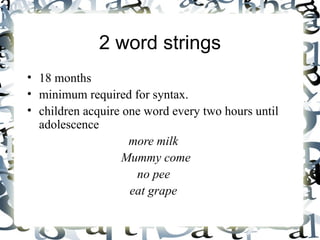
2 word strings 18 months minimum required for syntax.  children acquire one word every two hours until adolescence more milk Mummy come no pee eat grape
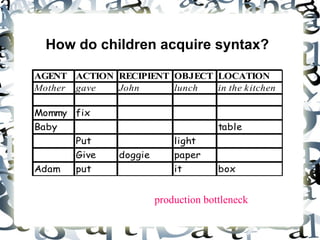
How do children acquire syntax?   production bottleneck
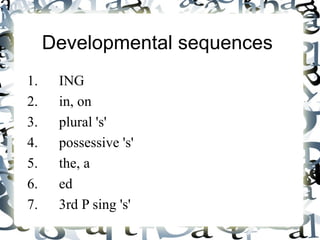
Developmental sequences   1.  ING 2.  in, on 3.  plural 's' 4.  possessive 's' 5.  the, a 6.  ed 7. 3rd P sing 's'
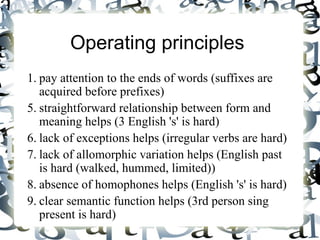
Operating principles   1. pay attention to the ends of words (suffixes are acquired before prefixes) 5. straightforward relationship between form and meaning helps (3 English 's' is hard) 6. lack of exceptions helps (irregular verbs are hard) 7. lack of allomorphic variation helps (English past is hard (walked, hummed, limited)) 8. absence of homophones helps (English 's' is hard) 9. clear semantic function helps (3rd person sing present is hard)
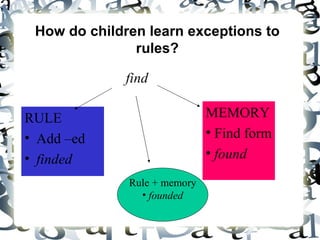
How do children learn exceptions to rules? RULE Add –ed finded MEMORY Find form found find Rule + memory founded
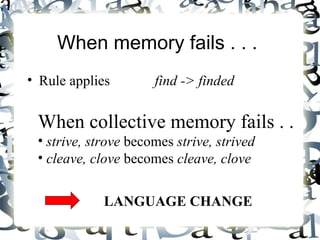
When memory fails . . .  Rule applies find -> finded When collective memory fails . .  strive, strove  becomes  strive, strived cleave, clove  becomes  cleave, clove LANGUAGE CHANGE
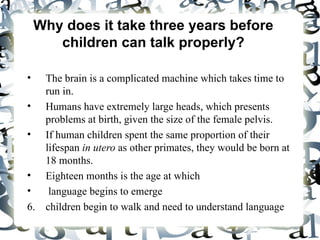
Why does it take three years before children can talk properly? The brain is a complicated machine which takes time to run in.  Humans have extremely large heads, which presents problems at birth, given the size of the female pelvis.  If human children spent the same proportion of their lifespan  in utero  as other primates, they would be born at 18 months. Eighteen months is the age at which language begins to emerge children begin to walk and need to understand language

L1

  • 1.
    Acquisition We havean innate capacity to learn languages. This enables children to construct the grammar of the language in spite of the poverty of the stimulus.
  • 2.
    How does acquisitionproceed? Children learn not the language per se, but the grammar of language - the rules. Past tense: add –ed walk, walked break, *breaked Acquire rule, but memorise exceptions.
  • 3.
    How do weknow how children learn? naturalistic/observational methods: diary studies watch children play, interact, and record language on audio and videotape. experimental studies: comprehension: interpret sentences John asked Tom to shut the door - who should? production: describe pictures (e.g., the wug test) imitation: children can only imitate if they have rule: Mummy is going -> Mummy going
  • 4.
    What are thestages of language development? 1 month 3 months 1 year 18 months Discrimination can tell ba from pa prefer own language prefer motherese Babbling larynx descends bilabials m, b, p deaf children babble Words 2-word strings
  • 5.
    Emergence of wordsObjects milk, dog, baby Actions go, run Social functions hello Perception precedes production R It’s your [  s ] C No, my [  ] R Oh, your [  ʃ] . C Yes, [  ]
  • 6.
    2 word strings18 months minimum required for syntax. children acquire one word every two hours until adolescence more milk Mummy come no pee eat grape
  • 7.
    How do childrenacquire syntax? production bottleneck
  • 8.
    Developmental sequences 1. ING 2. in, on 3. plural 's' 4. possessive 's' 5. the, a 6. ed 7. 3rd P sing 's'
  • 9.
    Operating principles 1. pay attention to the ends of words (suffixes are acquired before prefixes) 5. straightforward relationship between form and meaning helps (3 English 's' is hard) 6. lack of exceptions helps (irregular verbs are hard) 7. lack of allomorphic variation helps (English past is hard (walked, hummed, limited)) 8. absence of homophones helps (English 's' is hard) 9. clear semantic function helps (3rd person sing present is hard)
  • 10.
    How do childrenlearn exceptions to rules? RULE Add –ed finded MEMORY Find form found find Rule + memory founded
  • 11.
    When memory fails. . . Rule applies find -> finded When collective memory fails . . strive, strove becomes strive, strived cleave, clove becomes cleave, clove LANGUAGE CHANGE
  • 12.
    Why does ittake three years before children can talk properly? The brain is a complicated machine which takes time to run in. Humans have extremely large heads, which presents problems at birth, given the size of the female pelvis. If human children spent the same proportion of their lifespan in utero as other primates, they would be born at 18 months. Eighteen months is the age at which language begins to emerge children begin to walk and need to understand language