First language
acquisition
& newborns’
cry melody
Manuel Ordóñez Hidalgo. Language
development. 16/03/2022.
Introduction
● First language acquisition takes place really fast, long
before a child starts school, they have become an
extremely sophisticated language-user.
● Also, it occurs without manifest instruction for all
children regardless of great differences in their
circumstances.
Acquisition
The process of language acquisition has some basic requirements:
● During the first two or three years of development, a child requires interaction with other
language-users in order to bring the general language capacity into contact with a
particular language → The case of Genie.
● The importance of cultural transmission, the particular language that a child learns is
not genetically inherited but acquired in a particular language-using environment.
● The child must also be physically capable of sending and receiving sound signals in a
language.
● Basically, in order to speak a language, a child must be able to hear that language
being used but hearing language sounds is not enough.
Input
Human infants are helped in their language acquisition by older children and adults in the
home environment who provide language samples or input for the child:
● The adults address the child not with normal adult-to-adult conversation but with a simplified
speech-style related to ‘’baby talk.’’
- These are simplified words or alternative forms with repeated simple sounds and syllables,
for things in the child’s environment.
- It is characterized by the frequent use of questions, often using exaggerated intonation, extra
loudness and a slower tempo with longer pauses.
- This can be described as ‘’motherese’’, ‘’child-directed speech’’ or ‘’caregiver speech’’.
Caregiver Speech
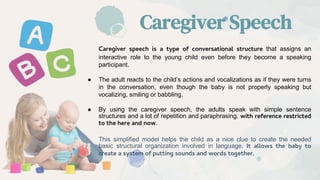
Caregiver speech is a type of conversational structure that assigns an
interactive role to the young child even before they become a speaking
participant.
● The adult reacts to the child’s actions and vocalizations as if they were turns
in the conversation, even though the baby is not properly speaking but
vocalizing, smiling or babbling.
● By using the caregiver speech, the adults speak with simple sentence
structures and a lot of repetition and paraphrasing, with reference restricted
to the here and now.
This simplified model helps the child as a nice clue to create the needed
basic structural organization involved in language. It allows the baby to
create a system of putting sounds and words together.
The Acquisition Schedule
All normal children develop language at roughly the same time with the same schedule.
● Language acquisition schedule has the same basis as the biologically determined
development of motor skills and the maturation of the infant’s brain.
● Long before children begin to talk, they have been actively processing what they hear,
they have the biological capacity to identify aspects of linguistic input at different stages at
the early years of life.
- We can identify what young children are paying attention to by the way the increase or
decrease sucking behaviour in response to speech sounds or turn their heads in the
direction of those sounds.
- At one month, an infant can distinguish between [ba] and [pa].
- During the first three months, the child produces big smiles in response to a speaking face
and start creating distinct vocalizations.
The Acquisition Schedule (2)
● Cooing: the earliest use of speech-like sounds
- During the first few months of life, the child gradually becomes capable of producing sequences of vowel-
like sounds; concretely high vowels similar to i and u.
- By four months of age, the kid starts developing the ability to bring the back of the tongue into regular
contact with the back of the palate and this allows the infant to create sounds similar to the consonants k
and g.
- By five months, babies can already hear the difference between the vowels i and a and discriminate
between syllables like ba and ga.
● Babbling: when babies between six and eight months produce sounds with a number of different vowels
and consonants as well as combinations such as ba-ba-ba and ga-ga-ga.
- In the later babbling stage, around nine to ten months, we can find recognizable intonation patterns,
combining vowels and consonants and also variables in the combinations such as ba-ba-da-da so nasal
sounds become more common and parents start interpreting their children saying mom and dad.
The Acquisition Schedule (3)
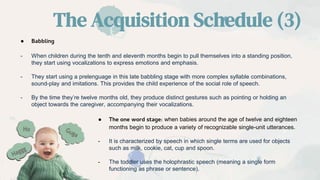
● Babbling
- When children during the tenth and eleventh months begin to pull themselves into a standing position,
they start using vocalizations to express emotions and emphasis.
- They start using a prelenguage in this late babbling stage with more complex syllable combinations,
sound-play and imitations. This provides the child experience of the social role of speech.
- By the time they’re twelve months old, they produce distinct gestures such as pointing or holding an
object towards the caregiver, accompanying their vocalizations.
● The one word stage: when babies around the age of twelve and eighteen
months begin to produce a variety of recognizable single-unit utterances.
- It is characterized by speech in which single terms are used for objects
such as milk, cookie, cat, cup and spoon.
- The toddler uses the holophrastic speech (meaning a single form
functioning as phrase or sentence).
The Acquisition Schedule (4)
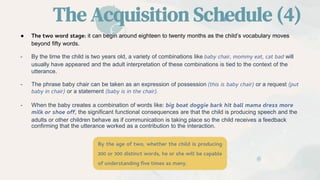
● The two word stage: it can begin around eighteen to twenty months as the child’s vocabulary moves
beyond fifty words.
- By the time the child is two years old, a variety of combinations like baby chair, mommy eat, cat bad will
usually have appeared and the adult interpretation of these combinations is tied to the context of the
utterance.
- The phrase baby chair can be taken as an expression of possession (this is baby chair) or a request (put
baby in chair) or a statement (baby is in the chair).
- When the baby creates a combination of words like: big boat doggie bark hit ball mama dress more
milk or shoe off, the significant functional consequences are that the child is producing speech and the
adults or other children behave as if communication is taking place so the child receives a feedback
confirming that the utterance worked as a contribution to the interaction.
By the age of two, whether the child is producing
200 or 300 distinct words, he or she will be capable
of understanding five times as many.
The Acquisition Schedule (5)
● The telegraphic speech: between two and a half years old, the child begins
producing a large number of utterances that could be classified as multiple
word speech.
- This stage is characterized by strings of words (lexical morphemes) in
phrases or sentences such as this shoe all wet, cat drink milk and daddy
go bye-bye.
- The child has developed some sentence-building capacity by this stage
and can get the word order correct, inflections (ing) begin to appear and
simple prepositions like (in, on) are also used.
- By the age of two and a half, the child is initiating more talk while increased
physical activity like running or jumping and the vocabulary has grown to
hundreds of words while pronunciation becomes clearer.
The
acquisition
process
How do children learn language?
● It is often assumed that the child is, in some sense, being taught the language but for the
majority of children, no one provides any instruction on how to speak the language.
A more accurate way of looking at it would be that the child is actively constructing from
what is said to them and around them, possible ways of using the language.
The child’s linguistic production is mostly a matter of trying out constructions and testing
whether they work or not.
● It is not possible that the child acquires the language through adult instruction. Children
imitate what adults say and they are in the process of adopting vocabulary from the input.
However, we can observe that adults do not produce many of the expressions that end up in
the children’s speech.
The Acquisition Process
● ¿Learning through imitation?
- As I just mentioned, adults do not produce many of the expressions that
end up in the children’s speech. They may repeat single words or phrases
but not the sentence structures.
- The children understand what the adults are saying but they have their
own way of expressing what they understand.
● ¿Learning through correction?
- It is also unlikely that adult corrections are a very effective determiner of
how the child speaks.
- When an adult makes a correction, even though they try many times, the
child will continue to use a personally constructed form. They normally
don’t imitate and don’t accept the adult’s correction.
The Acquisition Process (2)
Developing
Morphology
How the morphological development
occurs?
● By the time a child is two and a half years old,
they are going through telegraphic speech,
incorporating morphemes to their language.
- The first to appear is the ing form in
expressions such as cat sitting or mommy
reading book, this is often followed by the
propositions in and on.
- The next morphological development is
typically the marking of regular plurals with
the -s form as in boys and cats.
The acquisition of the plural marker is often
accompanied by a process of
overgeneralization so the child basically adds
-s to every singular word.
Then they learn the irregular plurals like men
and feet but they often overgeneralize them
saying some mens or two feets.
Developing Morphology
- After, they learn the irregular past
tense forms, the different forms of the
verb to be and the possessive
inflection -’s.
- Then, they will start using articles like a
and the.
- Finally, the regular past tense forms
with -ed with some overgeneralizations
also.
- The final morpheme to be used is the
present tense -s which occurs first on
verbs and then with auxiliary verbs.
Developing
Syntax
How is syntax developed?
● There have been numerous studies of the development of syntax in children’s speech,
specially in the formation of questions and the use of negatives where we can find three
stages.
● The first stage occurs between 18 and 26 months, the second one occurs between 22 and
30 months and the third stage occurs between 24 and 40 months.
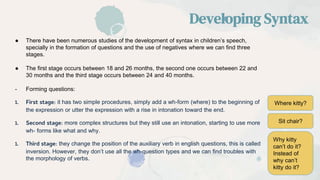
- Forming questions:
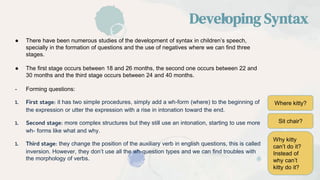
1. First stage: it has two simple procedures, simply add a wh-form (where) to the beginning of
the expression or utter the expression with a rise in intonation toward the end.
1. Second stage: more complex structures but they still use an intonation, starting to use more
wh- forms like what and why.
1. Third stage: they change the position of the auxiliary verb in english questions, this is called
inversion. However, they don’t use all the wh-question types and we can find troubles with
the morphology of verbs.
Developing Syntax
Where kitty?
Sit chair?
Why kitty
can’t do it?
Instead of
why can’t
kitty do it?
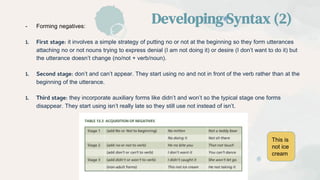
- Forming negatives:
1. First stage: it involves a simple strategy of putting no or not at the beginning so they form utterances
attaching no or not nouns trying to express denial (I am not doing it) or desire (I don’t want to do it) but
the utterance doesn’t change (no/not + verb/noun).
1. Second stage: don’t and can’t appear. They start using no and not in front of the verb rather than at the
beginning of the utterance.
1. Third stage: they incorporate auxiliary forms like didn’t and won’t so the typical stage one forms
disappear. They start using isn’t really late so they still use not instead of isn’t.
Developing Syntax (2)
This is
not ice
cream
Developing
Semantics
How are semantics developed?
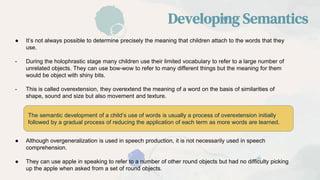
● It’s not always possible to determine precisely the meaning that children attach to the words that they
use.
- During the holophrastic stage many children use their limited vocabulary to refer to a large number of
unrelated objects. They can use bow-wow to refer to many different things but the meaning for them
would be object with shiny bits.
- This is called overextension, they overextend the meaning of a word on the basis of similarities of
shape, sound and size but also movement and texture.
Developing Semantics
The semantic development of a child’s use of words is usually a process of overextension initially
followed by a gradual process of reducing the application of each term as more words are learned.
● Although overgeneralization is used in speech production, it is not necessarily used in speech
comprehension.
● They can use apple in speaking to refer to a number of other round objects but had no difficulty picking
up the apple when asked from a set of round objects.
● There have been numerous studies of the development of syntax in children’s speech,
specially in the formation of questions and the use of negatives where we can find three
stages.
● The first stage occurs between 18 and 26 months, the second one occurs between 22 and
30 months and the third stage occurs between 24 and 40 months.
- Forming questions:
1. First stage: it has two simple procedures, simply add a wh-form (where) to the beginning of
the expression or utter the expression with a rise in intonation toward the end.
1. Second stage: more complex structures but they still use an intonation, starting to use more
wh- forms like what and why.
1. Third stage: they change the position of the auxiliary verb in english questions, this is called
inversion. However, they don’t use all the wh-question types and we can find troubles with
the morphology of verbs.
Developing Syntax
Where kitty?
Sit chair?
Why kitty
can’t do it?
Instead of
why can’t
kitty do it?
Newborns’ Cry
melody Is Shaped
by Their Native
Language
Experiment
● Human fetuses are able to memorize auditory stimuli from the external world by the last trimester of
pregnancy, with a particular sensitivity to melody contour in music and language.
● Newborns prefer their mother’s voice over other voices and perceive the emotional content of messages via
the intonation contour in maternal speech (motherese).
● They have a perceptual preference for the surrounding language and they can distinguish prosodically
between different languages and pitch changes by primarily, melody.
● Newborns can appreciate musical melodies and emotional and linguistic prosody thanks to their adult-like
processing of pitch intervals.
→ In the study, they analyse the crying patterns of 30 French and 30 German newborns with respect to their
melody and intensity contours.
→ The french group preferentially produced cries with a rising melody contour, whereas the German group
produced falling contours.
→ The data shows an influence of the surrounding speech prosody on newborn’s cry melody, via vocal
learning based on biological predispositions.
Introduction
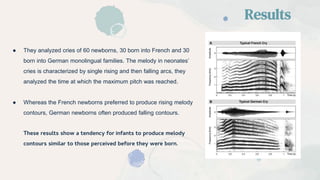
● They analyzed cries of 60 newborns, 30 born into French and 30
born into German monolingual families. The melody in neonates’
cries is characterized by single rising and then falling arcs, they
analyzed the time at which the maximum pitch was reached.
● Whereas the French newborns preferred to produce rising melody
contours, German newborns often produced falling contours.
These results show a tendency for infants to produce melody
contours similar to those perceived before they were born.
Results
● Prosodic features such as melody, intensity and rhythm are essential for an infant acquiring language, infants are
sensitive to prosodic features of their native language long before speech-like babbling sounds are uttered or first
words are produced.
● Auditory learning starts as early as the third semester of gestation, prosodic characteristics are very salient for the
human fetus not like phonetic aspects.
● Newborns show preference towards melodies to which they were exposed prenatally.
● The observed melody contours on French and German newborn’s crying show that they not only have memorized
the main intonation patterns of their respective surrounding language but are also able to reproduce these
patterns in their own production.
● Newborns produced significantly more often those melody types and intensity contours that were prosodically
typical for their native languages. French produced low to high contours and German high to low contours for
melody and intensity → This patterns are consistent with the intonation patterns observed in both languages.
Discussion
● The newborns in the study probably learned the characteristics of their mother tongue by listening to it
prenatally, although we cannot completely exclude early postnatal learning during the first 2-5 days of life.
Neonates’ cries are already turned toward their native language.
● The specific perceptual abilities of human fetuses for melody properties evolved over several million years
of vocal and auditory communication and spoken language. There are similarities between nonhuman primate
calls and human infant cries but they differ in perceptual capacities as well in early productive performances.
● The data suggest that human infants’ melody production is based on well-coordinated respiratory-laryngeal
activity in contradiction to studies that argued that cry was constrained by the respiratory circle. German
and French infants create different types of cries, even though they share the same physiology.
● Anatomical and functional characteristics of the immature vocal tract mechanisms do not allow imitation of
articulated speech sounds before about 3 months. Newborns are probably highly motivated to imitate their
mother’s behaviour in order to attract her get a faster bonding, also the melody contour is the only aspect they
can imitate.
Discussion (2)
The significant
finding is that
newborns
already
reproduce
some of the
prosodic
properties of
the specific
language that
they were
exposed
prenatally

First language acquisition

  • 1.
    First language acquisition & newborns’ crymelody Manuel Ordóñez Hidalgo. Language development. 16/03/2022.
  • 2.
    Introduction ● First languageacquisition takes place really fast, long before a child starts school, they have become an extremely sophisticated language-user. ● Also, it occurs without manifest instruction for all children regardless of great differences in their circumstances.
  • 3.
    Acquisition The process oflanguage acquisition has some basic requirements: ● During the first two or three years of development, a child requires interaction with other language-users in order to bring the general language capacity into contact with a particular language → The case of Genie. ● The importance of cultural transmission, the particular language that a child learns is not genetically inherited but acquired in a particular language-using environment. ● The child must also be physically capable of sending and receiving sound signals in a language. ● Basically, in order to speak a language, a child must be able to hear that language being used but hearing language sounds is not enough.
  • 4.
    Input Human infants arehelped in their language acquisition by older children and adults in the home environment who provide language samples or input for the child: ● The adults address the child not with normal adult-to-adult conversation but with a simplified speech-style related to ‘’baby talk.’’ - These are simplified words or alternative forms with repeated simple sounds and syllables, for things in the child’s environment. - It is characterized by the frequent use of questions, often using exaggerated intonation, extra loudness and a slower tempo with longer pauses. - This can be described as ‘’motherese’’, ‘’child-directed speech’’ or ‘’caregiver speech’’.
  • 5.
    Caregiver Speech Caregiver speechis a type of conversational structure that assigns an interactive role to the young child even before they become a speaking participant. ● The adult reacts to the child’s actions and vocalizations as if they were turns in the conversation, even though the baby is not properly speaking but vocalizing, smiling or babbling. ● By using the caregiver speech, the adults speak with simple sentence structures and a lot of repetition and paraphrasing, with reference restricted to the here and now. This simplified model helps the child as a nice clue to create the needed basic structural organization involved in language. It allows the baby to create a system of putting sounds and words together.
  • 6.
    The Acquisition Schedule Allnormal children develop language at roughly the same time with the same schedule. ● Language acquisition schedule has the same basis as the biologically determined development of motor skills and the maturation of the infant’s brain. ● Long before children begin to talk, they have been actively processing what they hear, they have the biological capacity to identify aspects of linguistic input at different stages at the early years of life. - We can identify what young children are paying attention to by the way the increase or decrease sucking behaviour in response to speech sounds or turn their heads in the direction of those sounds. - At one month, an infant can distinguish between [ba] and [pa]. - During the first three months, the child produces big smiles in response to a speaking face and start creating distinct vocalizations.
  • 7.
    The Acquisition Schedule(2) ● Cooing: the earliest use of speech-like sounds - During the first few months of life, the child gradually becomes capable of producing sequences of vowel- like sounds; concretely high vowels similar to i and u. - By four months of age, the kid starts developing the ability to bring the back of the tongue into regular contact with the back of the palate and this allows the infant to create sounds similar to the consonants k and g. - By five months, babies can already hear the difference between the vowels i and a and discriminate between syllables like ba and ga. ● Babbling: when babies between six and eight months produce sounds with a number of different vowels and consonants as well as combinations such as ba-ba-ba and ga-ga-ga. - In the later babbling stage, around nine to ten months, we can find recognizable intonation patterns, combining vowels and consonants and also variables in the combinations such as ba-ba-da-da so nasal sounds become more common and parents start interpreting their children saying mom and dad.
  • 8.
    The Acquisition Schedule(3) ● Babbling - When children during the tenth and eleventh months begin to pull themselves into a standing position, they start using vocalizations to express emotions and emphasis. - They start using a prelenguage in this late babbling stage with more complex syllable combinations, sound-play and imitations. This provides the child experience of the social role of speech. - By the time they’re twelve months old, they produce distinct gestures such as pointing or holding an object towards the caregiver, accompanying their vocalizations. ● The one word stage: when babies around the age of twelve and eighteen months begin to produce a variety of recognizable single-unit utterances. - It is characterized by speech in which single terms are used for objects such as milk, cookie, cat, cup and spoon. - The toddler uses the holophrastic speech (meaning a single form functioning as phrase or sentence).
  • 9.
    The Acquisition Schedule(4) ● The two word stage: it can begin around eighteen to twenty months as the child’s vocabulary moves beyond fifty words. - By the time the child is two years old, a variety of combinations like baby chair, mommy eat, cat bad will usually have appeared and the adult interpretation of these combinations is tied to the context of the utterance. - The phrase baby chair can be taken as an expression of possession (this is baby chair) or a request (put baby in chair) or a statement (baby is in the chair). - When the baby creates a combination of words like: big boat doggie bark hit ball mama dress more milk or shoe off, the significant functional consequences are that the child is producing speech and the adults or other children behave as if communication is taking place so the child receives a feedback confirming that the utterance worked as a contribution to the interaction. By the age of two, whether the child is producing 200 or 300 distinct words, he or she will be capable of understanding five times as many.
  • 10.
    The Acquisition Schedule(5) ● The telegraphic speech: between two and a half years old, the child begins producing a large number of utterances that could be classified as multiple word speech. - This stage is characterized by strings of words (lexical morphemes) in phrases or sentences such as this shoe all wet, cat drink milk and daddy go bye-bye. - The child has developed some sentence-building capacity by this stage and can get the word order correct, inflections (ing) begin to appear and simple prepositions like (in, on) are also used. - By the age of two and a half, the child is initiating more talk while increased physical activity like running or jumping and the vocabulary has grown to hundreds of words while pronunciation becomes clearer.
  • 11.
  • 12.
    ● It isoften assumed that the child is, in some sense, being taught the language but for the majority of children, no one provides any instruction on how to speak the language. A more accurate way of looking at it would be that the child is actively constructing from what is said to them and around them, possible ways of using the language. The child’s linguistic production is mostly a matter of trying out constructions and testing whether they work or not. ● It is not possible that the child acquires the language through adult instruction. Children imitate what adults say and they are in the process of adopting vocabulary from the input. However, we can observe that adults do not produce many of the expressions that end up in the children’s speech. The Acquisition Process
  • 13.
    ● ¿Learning throughimitation? - As I just mentioned, adults do not produce many of the expressions that end up in the children’s speech. They may repeat single words or phrases but not the sentence structures. - The children understand what the adults are saying but they have their own way of expressing what they understand. ● ¿Learning through correction? - It is also unlikely that adult corrections are a very effective determiner of how the child speaks. - When an adult makes a correction, even though they try many times, the child will continue to use a personally constructed form. They normally don’t imitate and don’t accept the adult’s correction. The Acquisition Process (2)
  • 14.
  • 15.
    ● By thetime a child is two and a half years old, they are going through telegraphic speech, incorporating morphemes to their language. - The first to appear is the ing form in expressions such as cat sitting or mommy reading book, this is often followed by the propositions in and on. - The next morphological development is typically the marking of regular plurals with the -s form as in boys and cats. The acquisition of the plural marker is often accompanied by a process of overgeneralization so the child basically adds -s to every singular word. Then they learn the irregular plurals like men and feet but they often overgeneralize them saying some mens or two feets. Developing Morphology - After, they learn the irregular past tense forms, the different forms of the verb to be and the possessive inflection -’s. - Then, they will start using articles like a and the. - Finally, the regular past tense forms with -ed with some overgeneralizations also. - The final morpheme to be used is the present tense -s which occurs first on verbs and then with auxiliary verbs.
  • 16.
  • 17.
    ● There havebeen numerous studies of the development of syntax in children’s speech, specially in the formation of questions and the use of negatives where we can find three stages. ● The first stage occurs between 18 and 26 months, the second one occurs between 22 and 30 months and the third stage occurs between 24 and 40 months. - Forming questions: 1. First stage: it has two simple procedures, simply add a wh-form (where) to the beginning of the expression or utter the expression with a rise in intonation toward the end. 1. Second stage: more complex structures but they still use an intonation, starting to use more wh- forms like what and why. 1. Third stage: they change the position of the auxiliary verb in english questions, this is called inversion. However, they don’t use all the wh-question types and we can find troubles with the morphology of verbs. Developing Syntax Where kitty? Sit chair? Why kitty can’t do it? Instead of why can’t kitty do it?
  • 18.
    - Forming negatives: 1.First stage: it involves a simple strategy of putting no or not at the beginning so they form utterances attaching no or not nouns trying to express denial (I am not doing it) or desire (I don’t want to do it) but the utterance doesn’t change (no/not + verb/noun). 1. Second stage: don’t and can’t appear. They start using no and not in front of the verb rather than at the beginning of the utterance. 1. Third stage: they incorporate auxiliary forms like didn’t and won’t so the typical stage one forms disappear. They start using isn’t really late so they still use not instead of isn’t. Developing Syntax (2) This is not ice cream
  • 19.
  • 20.
    ● It’s notalways possible to determine precisely the meaning that children attach to the words that they use. - During the holophrastic stage many children use their limited vocabulary to refer to a large number of unrelated objects. They can use bow-wow to refer to many different things but the meaning for them would be object with shiny bits. - This is called overextension, they overextend the meaning of a word on the basis of similarities of shape, sound and size but also movement and texture. Developing Semantics The semantic development of a child’s use of words is usually a process of overextension initially followed by a gradual process of reducing the application of each term as more words are learned. ● Although overgeneralization is used in speech production, it is not necessarily used in speech comprehension. ● They can use apple in speaking to refer to a number of other round objects but had no difficulty picking up the apple when asked from a set of round objects.
  • 21.
    ● There havebeen numerous studies of the development of syntax in children’s speech, specially in the formation of questions and the use of negatives where we can find three stages. ● The first stage occurs between 18 and 26 months, the second one occurs between 22 and 30 months and the third stage occurs between 24 and 40 months. - Forming questions: 1. First stage: it has two simple procedures, simply add a wh-form (where) to the beginning of the expression or utter the expression with a rise in intonation toward the end. 1. Second stage: more complex structures but they still use an intonation, starting to use more wh- forms like what and why. 1. Third stage: they change the position of the auxiliary verb in english questions, this is called inversion. However, they don’t use all the wh-question types and we can find troubles with the morphology of verbs. Developing Syntax Where kitty? Sit chair? Why kitty can’t do it? Instead of why can’t kitty do it?
  • 22.
    Newborns’ Cry melody IsShaped by Their Native Language Experiment
  • 23.
    ● Human fetusesare able to memorize auditory stimuli from the external world by the last trimester of pregnancy, with a particular sensitivity to melody contour in music and language. ● Newborns prefer their mother’s voice over other voices and perceive the emotional content of messages via the intonation contour in maternal speech (motherese). ● They have a perceptual preference for the surrounding language and they can distinguish prosodically between different languages and pitch changes by primarily, melody. ● Newborns can appreciate musical melodies and emotional and linguistic prosody thanks to their adult-like processing of pitch intervals. → In the study, they analyse the crying patterns of 30 French and 30 German newborns with respect to their melody and intensity contours. → The french group preferentially produced cries with a rising melody contour, whereas the German group produced falling contours. → The data shows an influence of the surrounding speech prosody on newborn’s cry melody, via vocal learning based on biological predispositions. Introduction
  • 24.
    ● They analyzedcries of 60 newborns, 30 born into French and 30 born into German monolingual families. The melody in neonates’ cries is characterized by single rising and then falling arcs, they analyzed the time at which the maximum pitch was reached. ● Whereas the French newborns preferred to produce rising melody contours, German newborns often produced falling contours. These results show a tendency for infants to produce melody contours similar to those perceived before they were born. Results
  • 25.
    ● Prosodic featuressuch as melody, intensity and rhythm are essential for an infant acquiring language, infants are sensitive to prosodic features of their native language long before speech-like babbling sounds are uttered or first words are produced. ● Auditory learning starts as early as the third semester of gestation, prosodic characteristics are very salient for the human fetus not like phonetic aspects. ● Newborns show preference towards melodies to which they were exposed prenatally. ● The observed melody contours on French and German newborn’s crying show that they not only have memorized the main intonation patterns of their respective surrounding language but are also able to reproduce these patterns in their own production. ● Newborns produced significantly more often those melody types and intensity contours that were prosodically typical for their native languages. French produced low to high contours and German high to low contours for melody and intensity → This patterns are consistent with the intonation patterns observed in both languages. Discussion
  • 26.
    ● The newbornsin the study probably learned the characteristics of their mother tongue by listening to it prenatally, although we cannot completely exclude early postnatal learning during the first 2-5 days of life. Neonates’ cries are already turned toward their native language. ● The specific perceptual abilities of human fetuses for melody properties evolved over several million years of vocal and auditory communication and spoken language. There are similarities between nonhuman primate calls and human infant cries but they differ in perceptual capacities as well in early productive performances. ● The data suggest that human infants’ melody production is based on well-coordinated respiratory-laryngeal activity in contradiction to studies that argued that cry was constrained by the respiratory circle. German and French infants create different types of cries, even though they share the same physiology. ● Anatomical and functional characteristics of the immature vocal tract mechanisms do not allow imitation of articulated speech sounds before about 3 months. Newborns are probably highly motivated to imitate their mother’s behaviour in order to attract her get a faster bonding, also the melody contour is the only aspect they can imitate. Discussion (2) The significant finding is that newborns already reproduce some of the prosodic properties of the specific language that they were exposed prenatally