Shahid Younas Lecture 5
INTRODUCTION TO CT PHYSICS
Introduction CT Physics
Computed Tomography
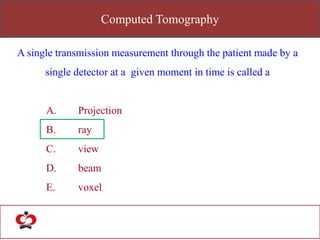
A single transmission measurement through the patient made by a
single detector at a given moment in time is called a
A. Projection
B. ray
C. view
D. beam
E. voxel
Computed Tomography
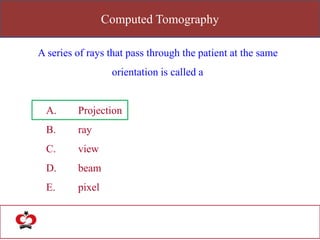
A series of rays that pass through the patient at the same
orientation is called a
A. Projection
B. ray
C. view
D. beam
E. pixel
Computed Tomography
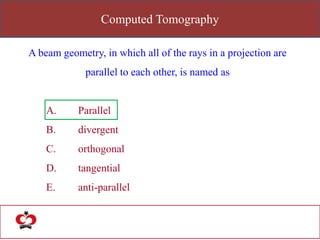
A beam geometry, in which all of the rays in a projection are
parallel to each other, is named as
A. Parallel
B. divergent
C. orthogonal
D. tangential
E. anti-parallel
Computed Tomography
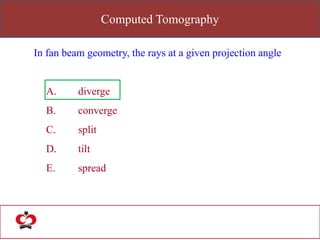
In fan beam geometry, the rays at a given projection angle
A. diverge
B. converge
C. split
D. tilt
E. spread
Computed Tomography
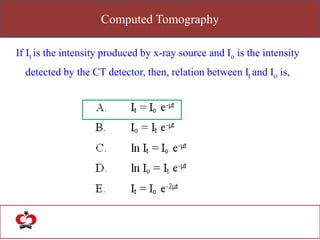
If It is the intensity produced by x-ray source and Io is the intensity
detected by the CT detector, then, relation between It and Io is,
Computed Tomography
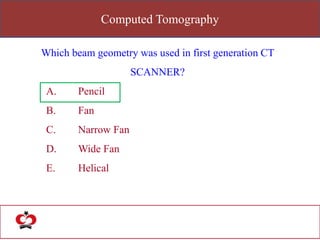
Which beam geometry was used in first generation CT
SCANNER?
A. Pencil
B. Fan
C. Narrow Fan
D. Wide Fan
E. Helical
Computed Tomography
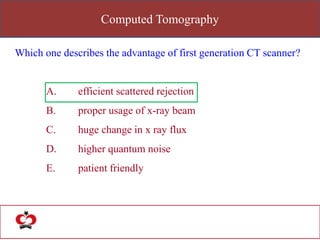
Which one describes the advantage of first generation CT scanner?
A. efficient scattered rejection
B. proper usage of x-ray beam
C. huge change in x ray flux
D. higher quantum noise
E. patient friendly
Computed Tomography
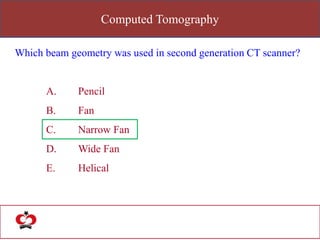
Which beam geometry was used in second generation CT scanner?
A. Pencil
B. Fan
C. Narrow Fan
D. Wide Fan
E. Helical
Computed Tomography
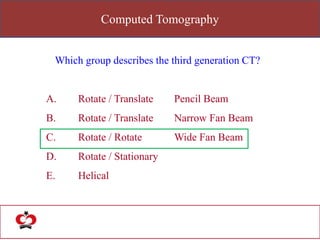
Which group describes the third generation CT?
A. Rotate / Translate Pencil Beam
B. Rotate / Translate Narrow Fan Beam
C. Rotate / Rotate Wide Fan Beam
D. Rotate / Stationary
E. Helical
Computed Tomography
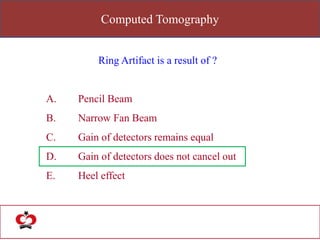
Ring Artifact is a result of ?
A. Pencil Beam
B. Narrow Fan Beam
C. Gain of detectors remains equal
D. Gain of detectors does not cancel out
E. Heel effect
Fifth Generation CT : Stationary / Stationary
5th Generation CT
Electron Beam CT Scanner
Fifth Generation CT : Stationary / Stationary
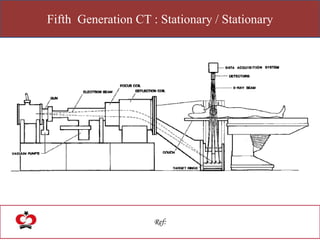
 Cine CT
 Electron Cone Beam Tomography (ECBT)
 does not use a conventional x-ray tube
 large arc of tungsten encircles the patient and lies directly
opposite to the detector ring.
Fifth Generation CT : Stationary / Stationary
Ref:
Fifth Generation CT : Stationary / Stationary
 X-rays are produced from the focal track as a high-energy
electron beam strikes the tungsten.
 No moving parts to this scanner gantry
 Primarily to cardiologists.
 They are capable of 50-msec scan times and can produce fast-
frame-rate CT movies of the beating heart.
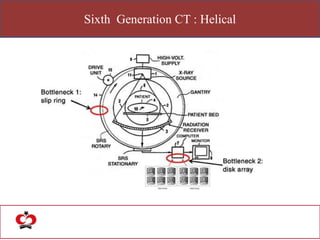
Sixth Generation CT : Helical
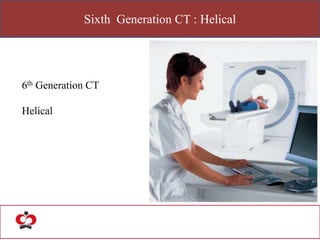
6th Generation CT
Helical
Sixth Generation CT : Helical
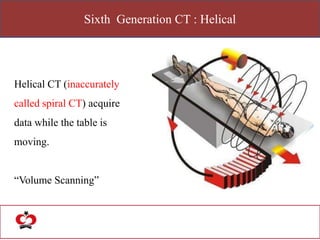
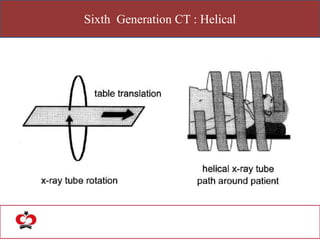
Helical CT (inaccurately
called spiral CT) acquire
data while the table is
moving.
“Volume Scanning”
Sixth Generation CT : Helical
By avoiding the time required to translate the patient table, the
total scan time required to image the patient can be much shorter
(~ 30 seconds for the entire abdomen).
Consequently, helical scanning allows the use of less contrast
agent and increases patient throughput. In
Sixth Generation CT : Helical
The table movement in the z direction during the acquisition
will naturally generate inconsistent sets of data, causing every
image reconstructed directly from a volume data set to be
degraded by artifacts.
However, special reconstruction principles generates a planar set
of data for each table position – produce artifact-free images
Second Generation CT : Rotate Translate Narrow Fan Beam
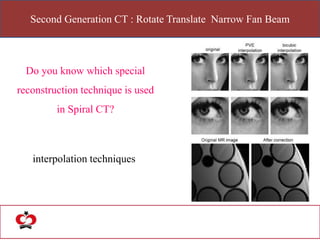
Do you know which special
reconstruction technique is used
in Spiral CT?
interpolation techniques
Sixth Generation CT : Helical
 Software applications enable the clinical use of spiral CT
even for regions which are subject to involuntary
movements.
 The speed of the table motion relative to the rotation of
the CT gantry is a very important consideration and the
pitch is the parameter that describes this relationship.
Sixth Generation CT : Helical
 Pitch = table feed per rotation/collimation
 The larger the table feed, the faster (i.e. with fewer
rotations) a body region can be scanned.
 However, if the table feed is too large, image quality will
be impaired.
Sixth Generation CT : Helical
Advantages of spiral CT in clinical use
1. Complete coverage of organs in a single respiratory position.
2. Short scan times (resulting in fewer motion artifacts and a
lower contrast medium requirement)
3. Additional diagnostic information due to improved resolution
(thinner slices) and 3D visualization in routine operation
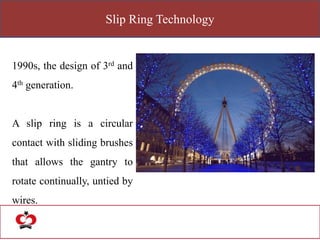
Slip Ring Technology
1990s, the design of 3rd and
4th generation.
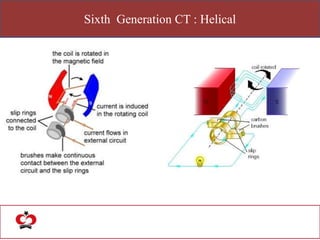
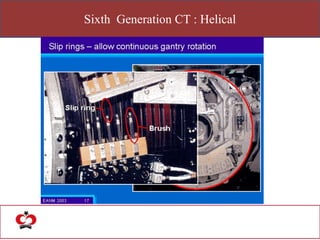
A slip ring is a circular
contact with sliding brushes
that allows the gantry to
rotate continually, untied by
wires.
Sixth Generation CT : Helical
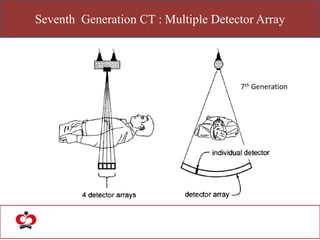
Seventh Generation CT : Multiple Detector Array
7th Generation
Seventh Generation CT : Multiple Detector Array
1. An approach to make better use of the x-rays.
2. Collimator spacing is wider and therefore more of the x-rays
are used in producing image data.
3. Slice thickness is determined by the detector size.
4. four contiguous 5-mm detector arrays and 20-mm c. spacing
Thanks

L 5 ct physics

  • 1.
    Shahid Younas Lecture5 INTRODUCTION TO CT PHYSICS Introduction CT Physics
  • 2.
    Computed Tomography A singletransmission measurement through the patient made by a single detector at a given moment in time is called a A. Projection B. ray C. view D. beam E. voxel
  • 3.
    Computed Tomography A seriesof rays that pass through the patient at the same orientation is called a A. Projection B. ray C. view D. beam E. pixel
  • 4.
    Computed Tomography A beamgeometry, in which all of the rays in a projection are parallel to each other, is named as A. Parallel B. divergent C. orthogonal D. tangential E. anti-parallel
  • 5.
    Computed Tomography In fanbeam geometry, the rays at a given projection angle A. diverge B. converge C. split D. tilt E. spread
  • 6.
    Computed Tomography If Itis the intensity produced by x-ray source and Io is the intensity detected by the CT detector, then, relation between It and Io is,
  • 7.
    Computed Tomography Which beamgeometry was used in first generation CT SCANNER? A. Pencil B. Fan C. Narrow Fan D. Wide Fan E. Helical
  • 8.
    Computed Tomography Which onedescribes the advantage of first generation CT scanner? A. efficient scattered rejection B. proper usage of x-ray beam C. huge change in x ray flux D. higher quantum noise E. patient friendly
  • 9.
    Computed Tomography Which beamgeometry was used in second generation CT scanner? A. Pencil B. Fan C. Narrow Fan D. Wide Fan E. Helical
  • 10.
    Computed Tomography Which groupdescribes the third generation CT? A. Rotate / Translate Pencil Beam B. Rotate / Translate Narrow Fan Beam C. Rotate / Rotate Wide Fan Beam D. Rotate / Stationary E. Helical
  • 11.
    Computed Tomography Ring Artifactis a result of ? A. Pencil Beam B. Narrow Fan Beam C. Gain of detectors remains equal D. Gain of detectors does not cancel out E. Heel effect
  • 12.
    Fifth Generation CT: Stationary / Stationary 5th Generation CT Electron Beam CT Scanner
  • 13.
    Fifth Generation CT: Stationary / Stationary  Cine CT  Electron Cone Beam Tomography (ECBT)  does not use a conventional x-ray tube  large arc of tungsten encircles the patient and lies directly opposite to the detector ring.
  • 14.
    Fifth Generation CT: Stationary / Stationary Ref:
  • 15.
    Fifth Generation CT: Stationary / Stationary  X-rays are produced from the focal track as a high-energy electron beam strikes the tungsten.  No moving parts to this scanner gantry  Primarily to cardiologists.  They are capable of 50-msec scan times and can produce fast- frame-rate CT movies of the beating heart.
  • 16.
    Sixth Generation CT: Helical 6th Generation CT Helical
  • 17.
    Sixth Generation CT: Helical Helical CT (inaccurately called spiral CT) acquire data while the table is moving. “Volume Scanning”
  • 18.
  • 19.
    Sixth Generation CT: Helical By avoiding the time required to translate the patient table, the total scan time required to image the patient can be much shorter (~ 30 seconds for the entire abdomen). Consequently, helical scanning allows the use of less contrast agent and increases patient throughput. In
  • 20.
    Sixth Generation CT: Helical The table movement in the z direction during the acquisition will naturally generate inconsistent sets of data, causing every image reconstructed directly from a volume data set to be degraded by artifacts. However, special reconstruction principles generates a planar set of data for each table position – produce artifact-free images
  • 21.
    Second Generation CT: Rotate Translate Narrow Fan Beam Do you know which special reconstruction technique is used in Spiral CT? interpolation techniques
  • 22.
    Sixth Generation CT: Helical  Software applications enable the clinical use of spiral CT even for regions which are subject to involuntary movements.  The speed of the table motion relative to the rotation of the CT gantry is a very important consideration and the pitch is the parameter that describes this relationship.
  • 23.
    Sixth Generation CT: Helical  Pitch = table feed per rotation/collimation  The larger the table feed, the faster (i.e. with fewer rotations) a body region can be scanned.  However, if the table feed is too large, image quality will be impaired.
  • 24.
    Sixth Generation CT: Helical Advantages of spiral CT in clinical use 1. Complete coverage of organs in a single respiratory position. 2. Short scan times (resulting in fewer motion artifacts and a lower contrast medium requirement) 3. Additional diagnostic information due to improved resolution (thinner slices) and 3D visualization in routine operation
  • 25.
    Slip Ring Technology 1990s,the design of 3rd and 4th generation. A slip ring is a circular contact with sliding brushes that allows the gantry to rotate continually, untied by wires.
  • 26.
  • 27.
  • 28.
  • 29.
    Seventh Generation CT: Multiple Detector Array 7th Generation
  • 30.
    Seventh Generation CT: Multiple Detector Array 1. An approach to make better use of the x-rays. 2. Collimator spacing is wider and therefore more of the x-rays are used in producing image data. 3. Slice thickness is determined by the detector size. 4. four contiguous 5-mm detector arrays and 20-mm c. spacing
  • 31.