Lecture 7: May, 12, 2014
Shahid Younas
RADIOACTIVITY & NUCLEAR TRANSFORMATION
INTRODUCTION
Lecture 7
Radioactivity burst into the world without warning.
INTRODUCTION
Lecture 7
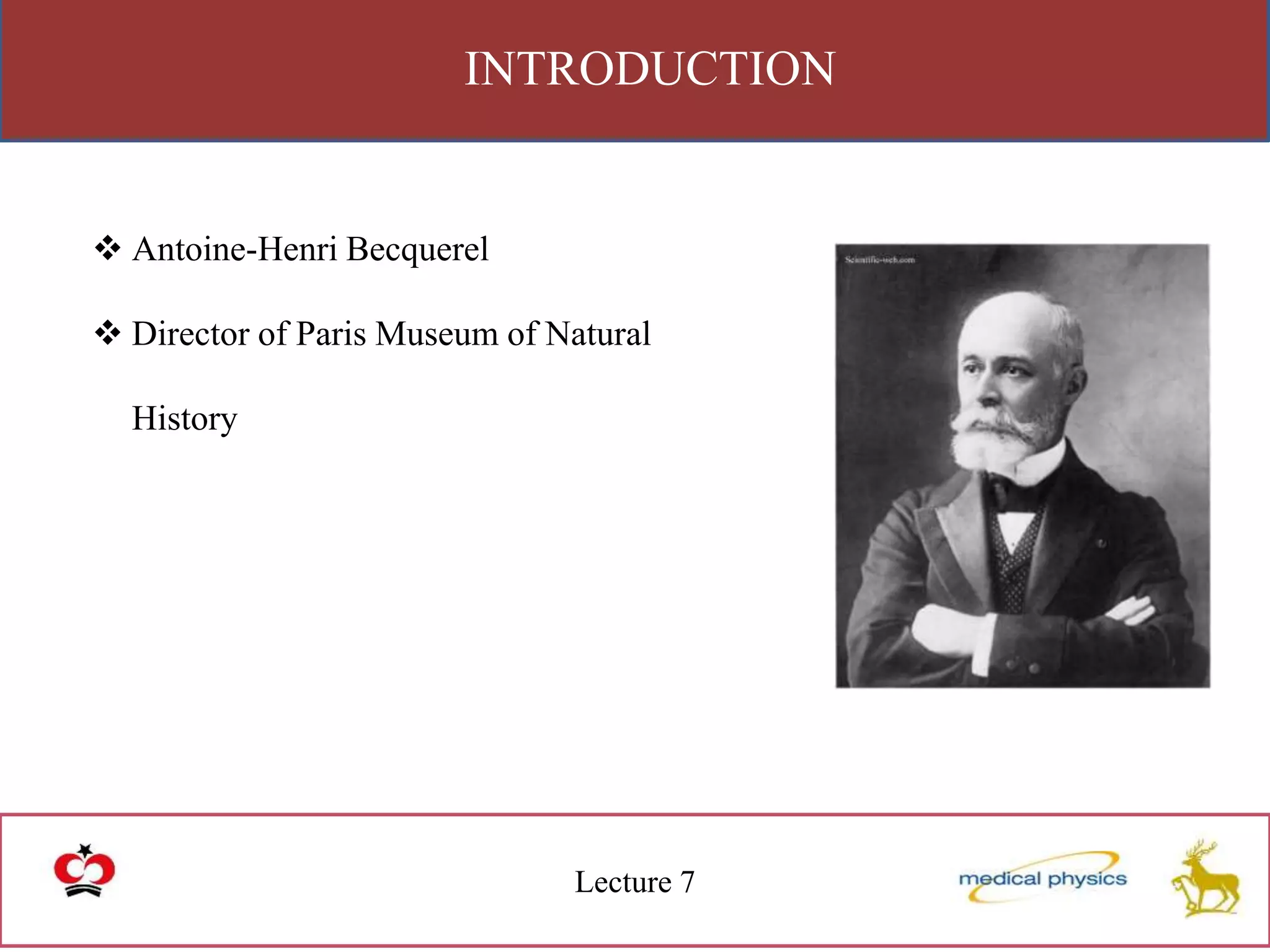
 Antoine-Henri Becquerel
 Director of Paris Museum of Natural
History
INTRODUCTION
Lecture 7
 Becquerel began testing samples from
his father’s collection.
 He was particularly interested in
luminescent Uranium mineral.
 It was used to color ceramics and glass.
INTRODUCTION
Lecture 7
Do you know why Uranium was given this name?
After the name of newly discovered planet Uranus in those
days.
INTRODUCTION
Lecture 7
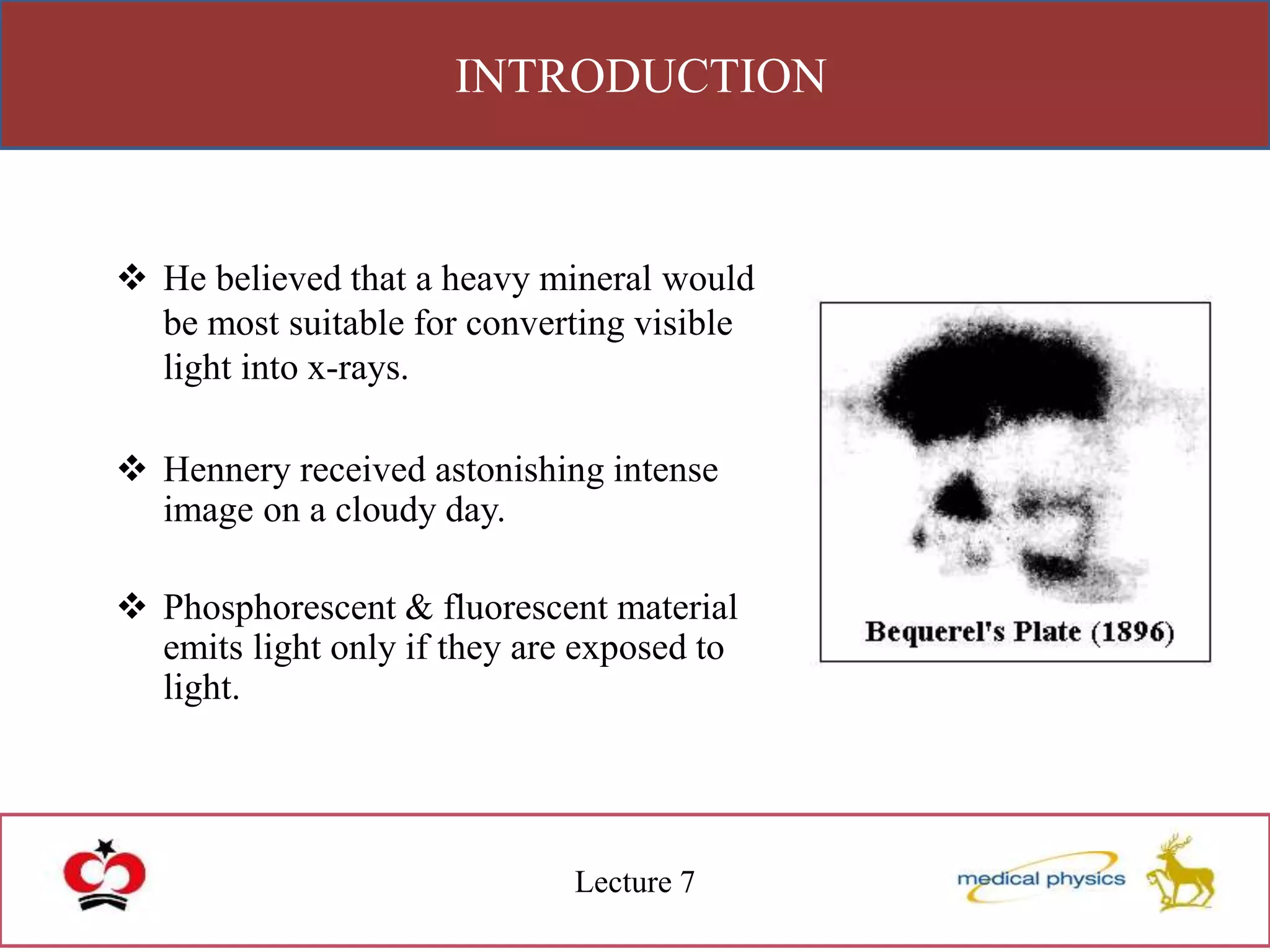
 He believed that a heavy mineral would
be most suitable for converting visible
light into x-rays.
 Hennery received astonishing intense
image on a cloudy day.
 Phosphorescent & fluorescent material
emits light only if they are exposed to
light.
INTRODUCTION
Lecture 7
 Silvanus P. Thompson- a British Electrical
Engineer.
 Uranium compound gave off invisible rays.
 Hyper-phosphorescence
INTRODUCTION
Lecture 7
 Becquerel believed that effect would fade if he waited long enough.
 Hours turned into days, weeks, months; yet even after more than a
year; Uranium’s power could not be abated.
INTRODUCTION
Lecture 7
Do you know what is the half life of Uranium?
U-238 : 447 Billion Years
U-235: 704 Million Years
INTRODUCTION
Lecture 7
 He tried to destroy Uranium’s power by dissolving and re-
crystalizing to retain his philosophy of phosphorescence.
 But
 All in Vain.
INTRODUCTION
Lecture 7
 Innocent Henry discovered about his rays that these,
 Electrified air
 Pass through cardboard, aluminum, copper and platinum
 Penetrate Opaque materials- property of x-rays
INTRODUCTION
Lecture 04
 The ability to pass through opaque materials suggests that uranium rays
were a type of x rays.
 He believed them as “Mysterious Rays”.
Radioactivity
Lecture 7
Process of spontaneous decay and
transformation of unstable atomic
nuclei accompanied with the emission
of nuclear particles and/or nuclear
radiation.
Radioactivity
Lecture 7
Henri worked on Uranium. Do you know on which source Madam
Curie worked?
Radium
Radionuclide Decay Terms and Relationships
Lecture 7
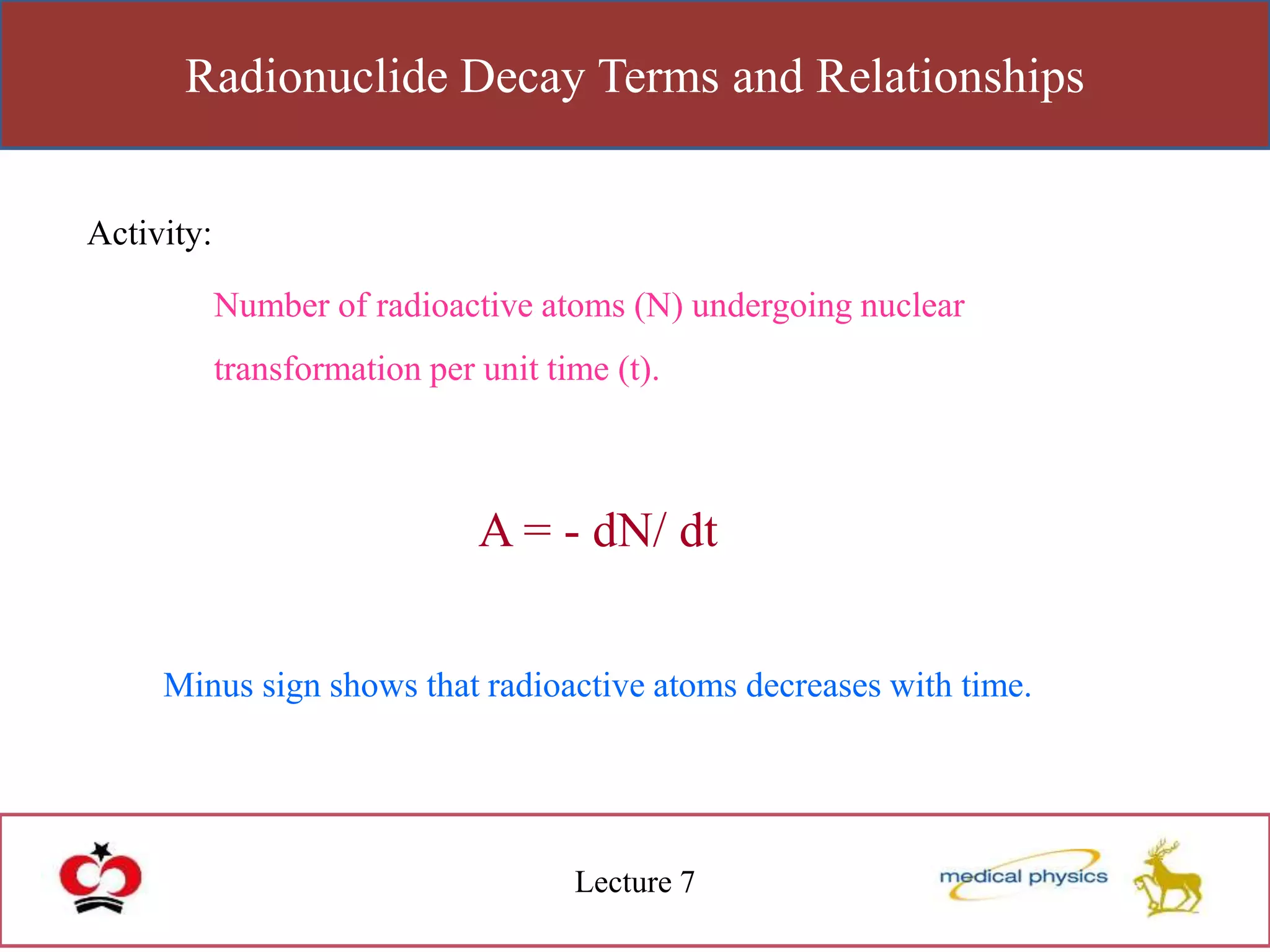
Activity:
Number of radioactive atoms (N) undergoing nuclear
transformation per unit time (t).
A = - dN/ dt
Minus sign shows that radioactive atoms decreases with time.
Radionuclide Decay Terms and Relationships
Lecture 7
 Activity
 Tradition unit is Curie (Ci)
 1 µ Ci = 2.22 x 10⁶dpm
 S.I. unit is Becquerel (Bq)
 Becquerel is one disintegration per second (dps)
Radionuclide Decay Terms and Relationships
Lecture 7
Do you know the relation between Henry Becquerel and Curie?
a. Henry was cousin of Curie.
b. Curie and Henry studied same high school
c. Henry and Curie shared first noble prize.
d. 1 milli Curie = 37 MBq
Radionuclide Decay Terms and Relationships
Lecture 7
 Decay Constant λ:
Number of radioactive atoms decaying per unit time (dN/dt)
is proportional to the number of unstable atoms (N)
Proportionality can be transformed into an equality by a constant
Radionuclide Decay Terms and Relationships
Lecture 7
 Decay Constant:
Decay constant is equal to the fraction of the number of
radioactive atoms remaining in a sample that decay per unit time.
A = λN
 Decay constant is characteristic of each radionuclide.
Radionuclide Decay Terms and Relationships
Lecture 7
Decay constant for 99Mo is 0.252 per day.
Do you know the decay constant for technetium-99m?
0.115 per hour
Radionuclide Decay Terms and Relationships
Lecture 7
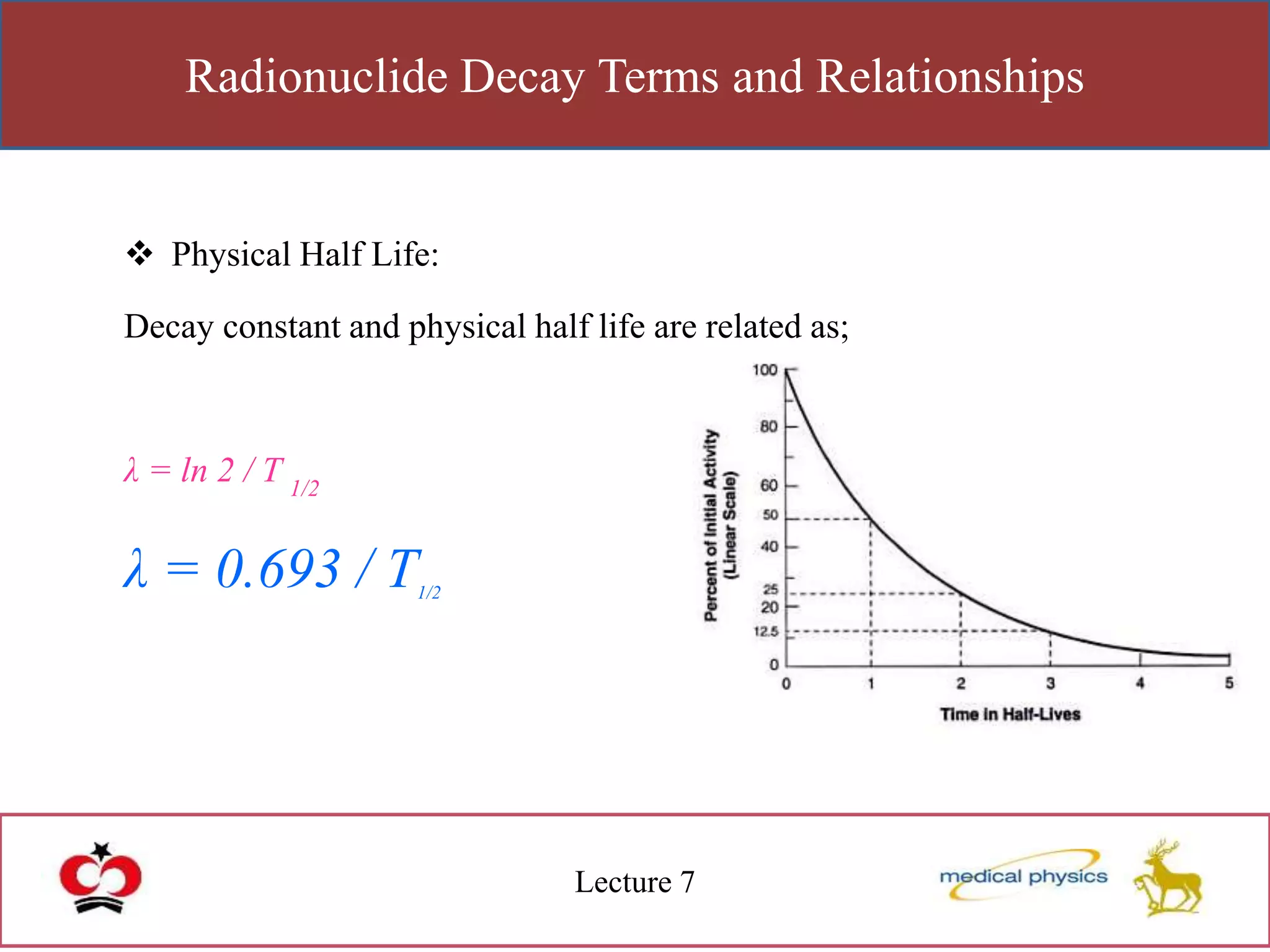
 Physical Half Life:
Time required for number of radioactive atoms in a sample to
decrease by one half. .
N = No / 2n
 N is number of radioactive atoms remaining
 No is the initial number of radioactive atoms
 n is the number of half lives.
Radionuclide Decay Terms and Relationships
Lecture 7
 Physical Half Life:
 After ten half-lives number of radioactive atoms in a sample is
reduced by ~ a thousand and after twenty these reduced to a million.
Radionuclide Decay Terms and Relationships
Lecture 7
 Physical Half Life:
Decay constant and physical half life are related as;
λ = ln 2 / T 1/2
λ = 0.693 / T1/2
Radionuclide Decay Terms and Relationships
Lecture 7
If we mix 99mTc and 131I with each other. How would you find
the decay of the mixture?
Mixture Rule or otherwise count for the longest half life
Radionuclide Decay Terms and Relationships
Lecture 7
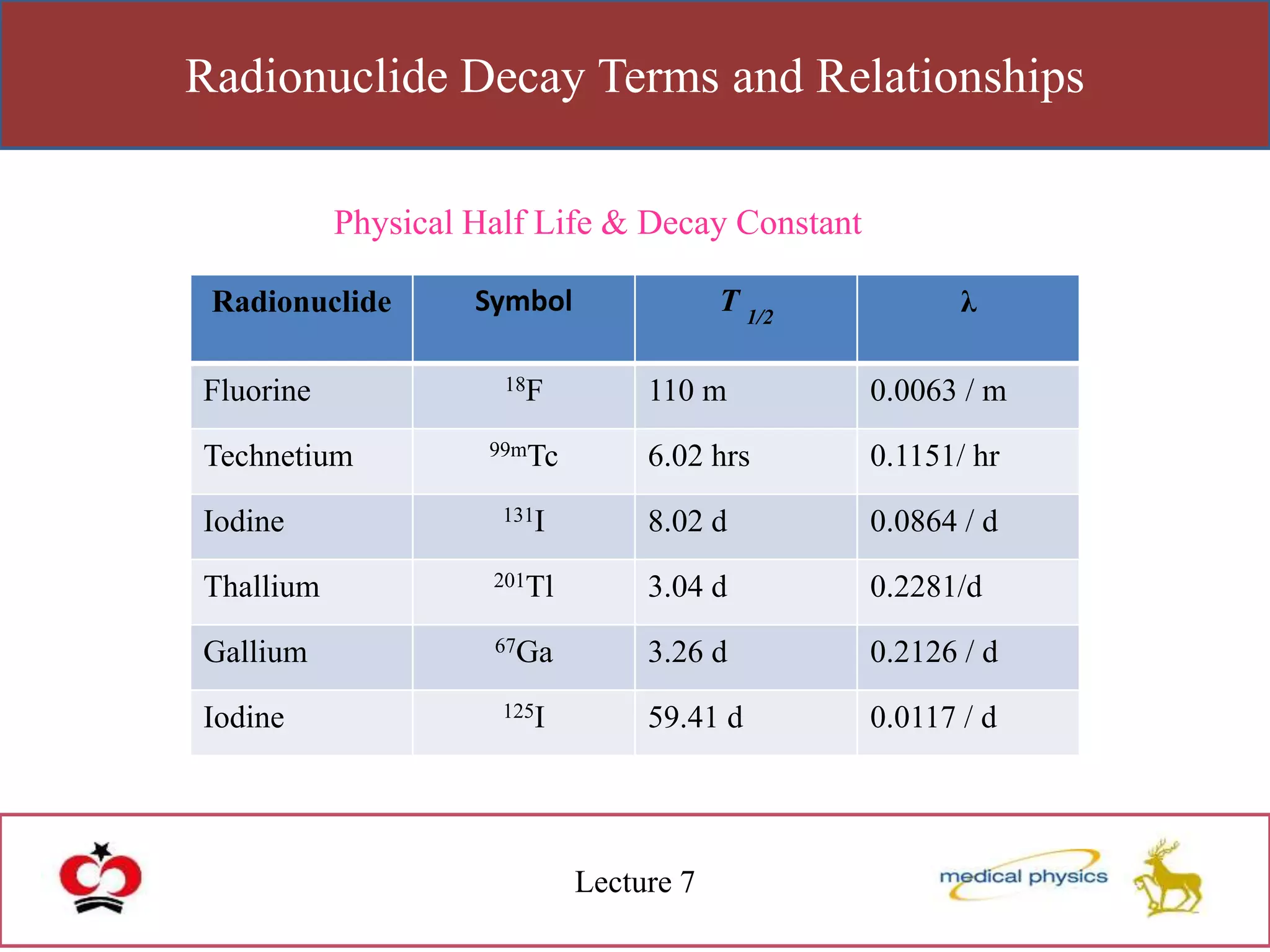
Physical Half Life & Decay Constant
Radionuclide Symbol T 1/2
λ
Fluorine 18F 110 m 0.0063 / m
Technetium 99mTc 6.02 hrs 0.1151/ hr
Iodine 131I 8.02 d 0.0864 / d
Thallium 201Tl 3.04 d 0.2281/d
Gallium 67Ga 3.26 d 0.2126 / d
Iodine 125I 59.41 d 0.0117 / d
Radionuclide Decay Terms and Relationships
Lecture 7
 Fundamental Decay Equation:
Decay constant and physical half life are related as;
Nt = No e - λt
or
At = Ao e - λt
Radionuclide Decay Terms and Relationships
Lecture 7
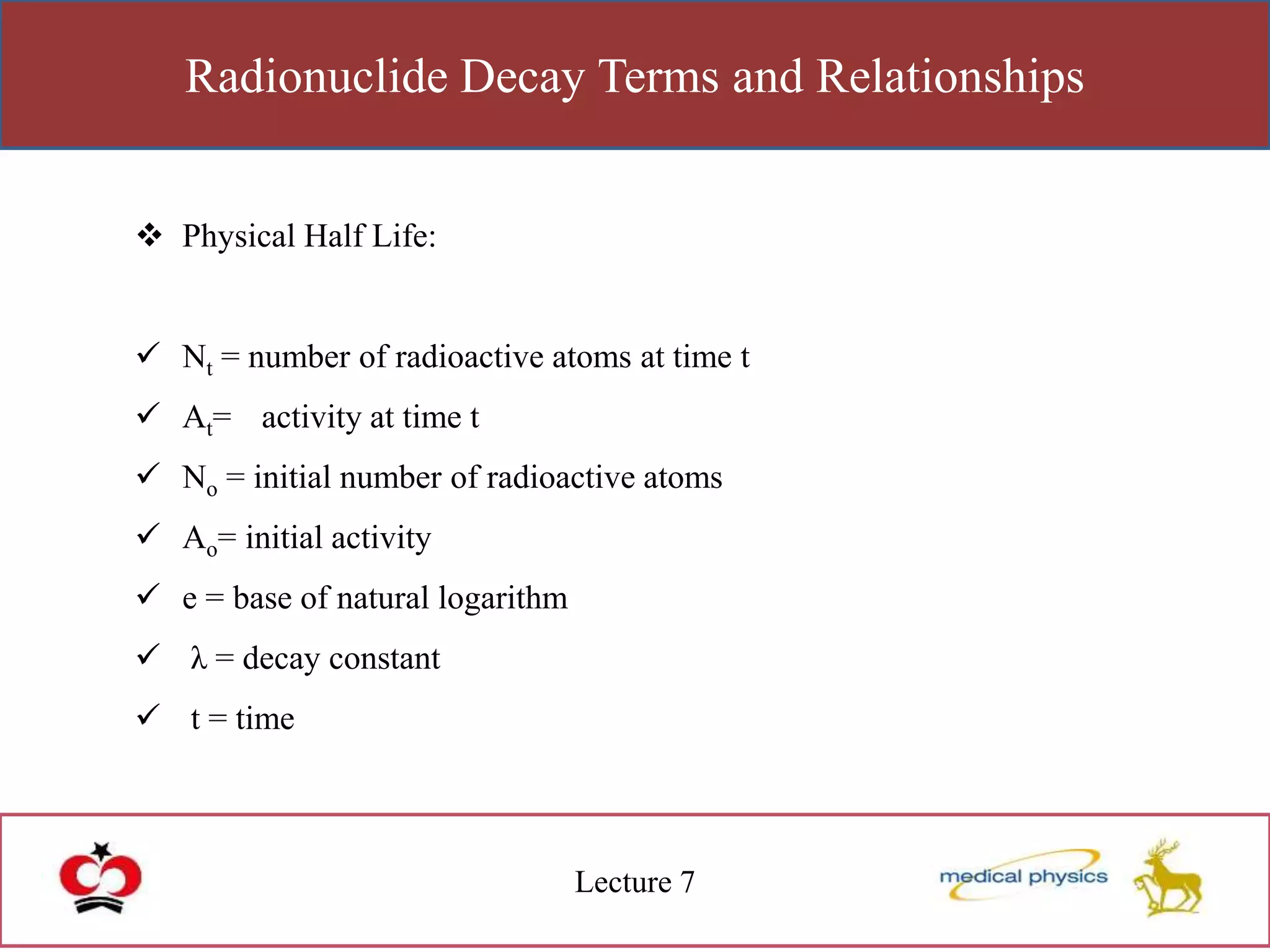
 Physical Half Life:
 Nt = number of radioactive atoms at time t
 At= activity at time t
 No = initial number of radioactive atoms
 Ao= initial activity
 e = base of natural logarithm
 λ = decay constant
 t = time
Radionuclide Decay Terms and Relationships
Lecture 7
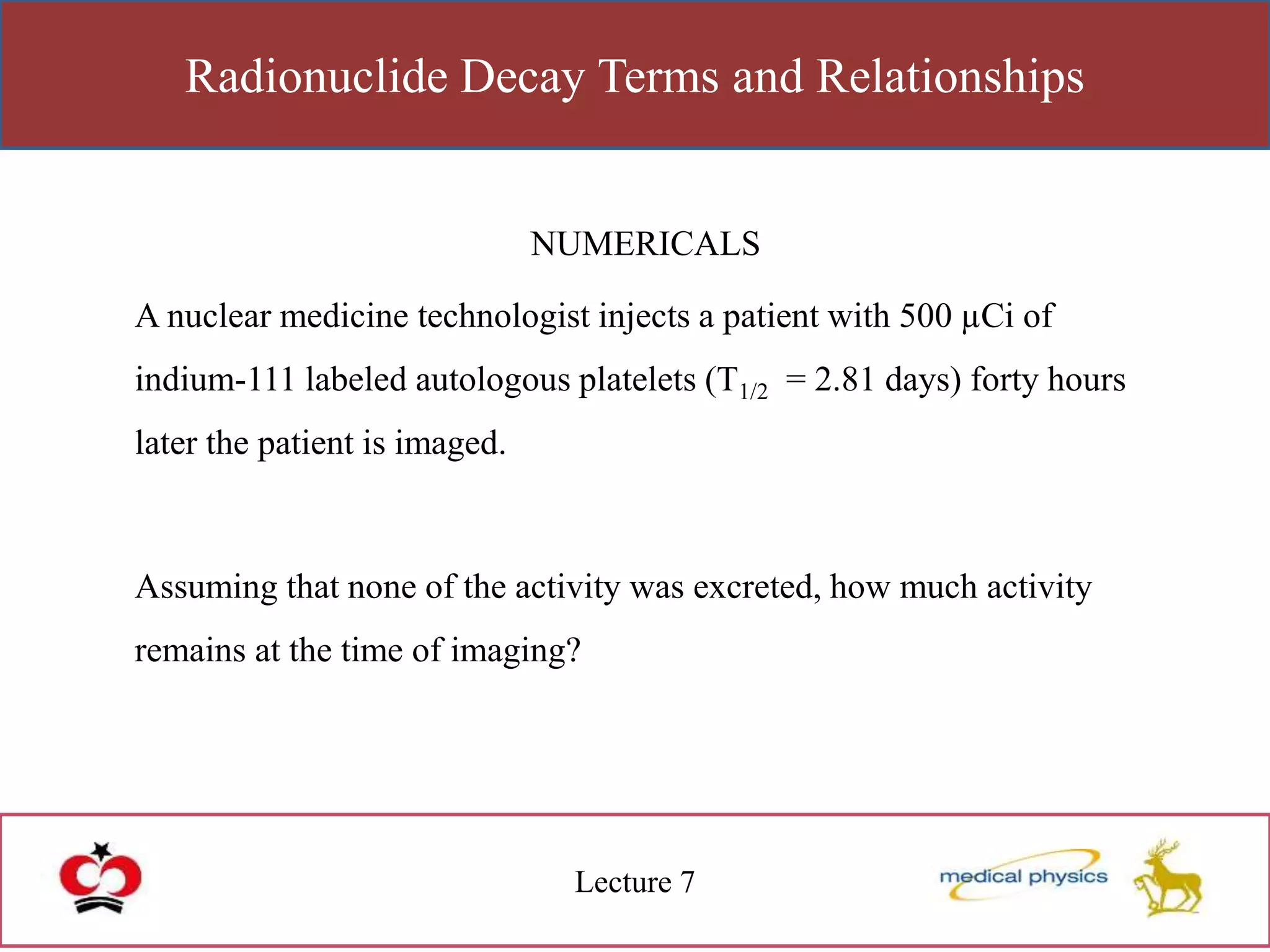
NUMERICALS
A nuclear medicine technologist injects a patient with 500 µCi of
indium-111 labeled autologous platelets (T1/2 = 2.81 days) forty hours
later the patient is imaged.
Assuming that none of the activity was excreted, how much activity
remains at the time of imaging?
Radionuclide Decay Terms and Relationships
Lecture 7
NUMERICAL-1
Step 1: Collection of Data
Ao = 500 uCi
T1/2 = 2.82 days
t = 48 hrs
At = ?
NUMERICAL-1
Step 2: Look at the Units
 time t and half life should be in
same unit.
 Pick the relevant equation
 N = No / 2n
 λ = 0.693 / T1/2
 At = Ao e – λt
Radionuclide Decay Terms and Relationships
Lecture 7
NUMERICAL-1
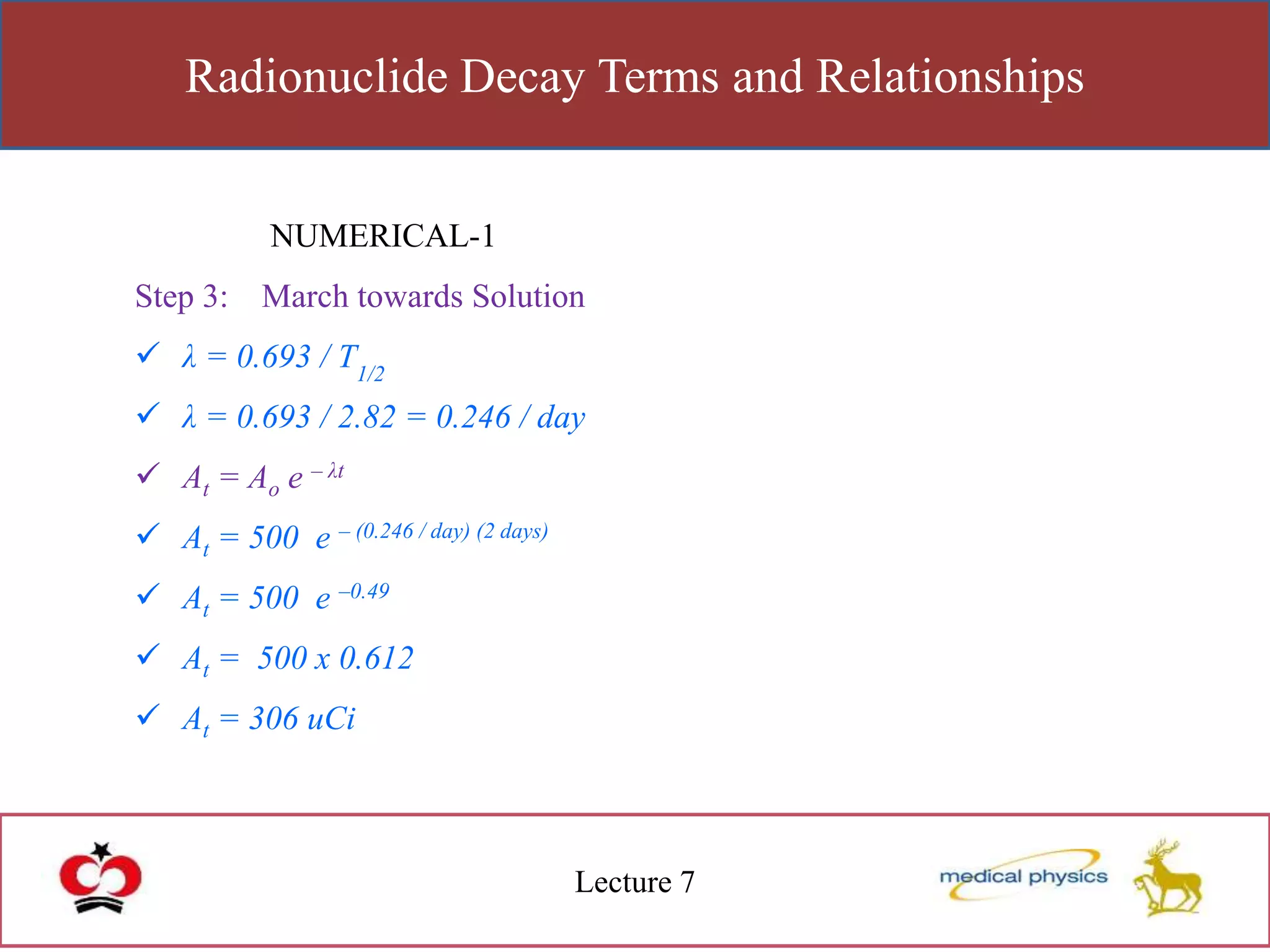
Step 3: March towards Solution
 λ = 0.693 / T1/2
 λ = 0.693 / 2.82 = 0.246 / day
 At = Ao e – λt
 At = 500 e – (0.246 / day) (2 days)
 At = 500 e –0.49
 At = 500 x 0.612
 At = 306 uCi
IQBAL‘S COLLECTION
Lecture 7
NUMERICAL-2
At 11:00 am of a rainy day ;
99mTc was measured 9mCi
(333 MBq). What was the
activity at 0800 hrs on the
same day.
NUMERICAL-2
Step 1: Collection of Data
Ao = ?
At = 9 mCi
T1/2 = 6 hrs
Elapsed time t = 3 hrs
Radionuclide Decay Terms and Relationships
Lecture 7
NUMERICAL-2
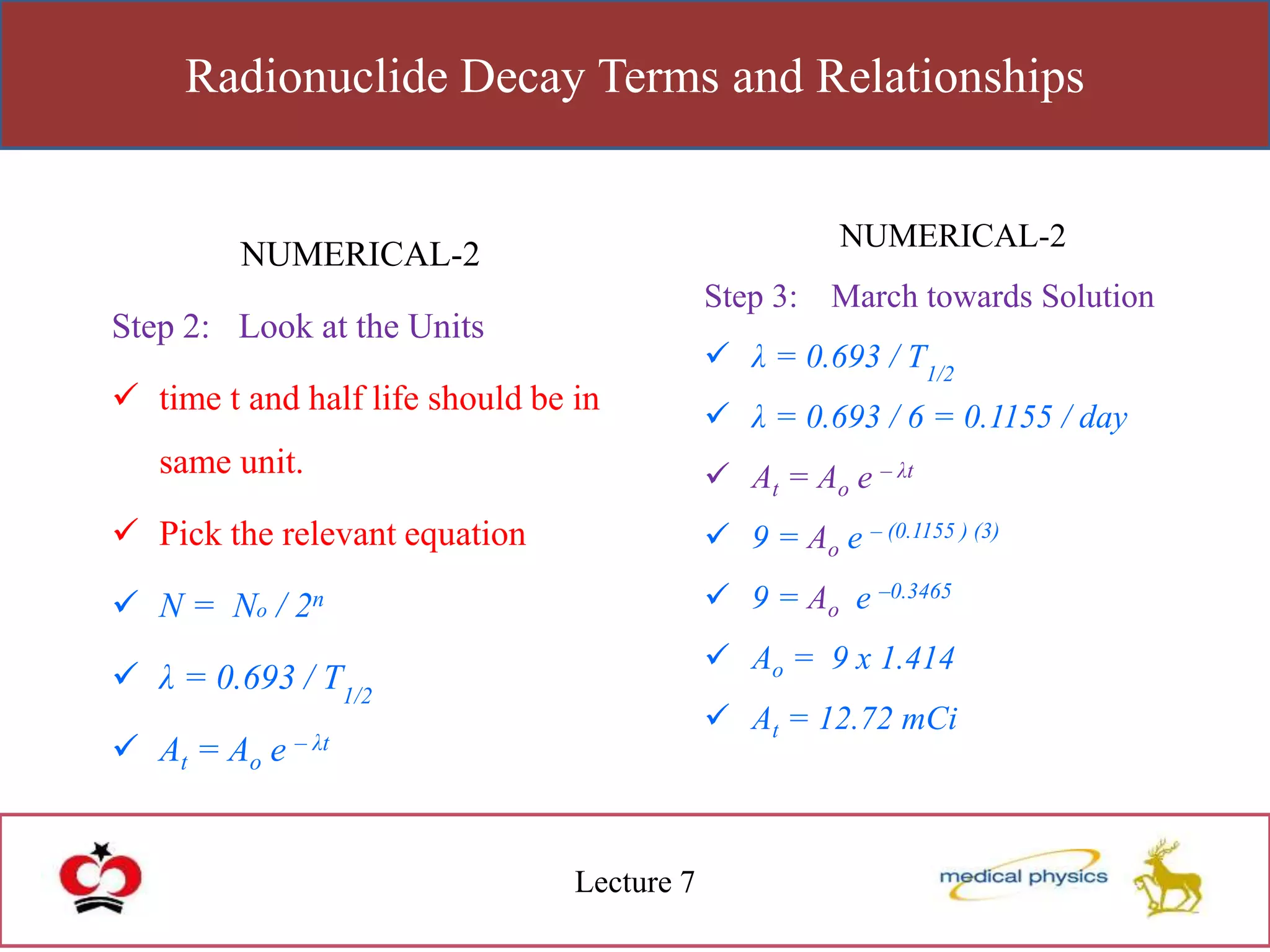
Step 2: Look at the Units
 time t and half life should be in
same unit.
 Pick the relevant equation
 N = No / 2n
 λ = 0.693 / T1/2
 At = Ao e – λt
NUMERICAL-2
Step 3: March towards Solution
 λ = 0.693 / T1/2
 λ = 0.693 / 6 = 0.1155 / day
 At = Ao e – λt
 9 = Ao e – (0.1155 ) (3)
 9 = Ao e –0.3465
 Ao = 9 x 1.414
 At = 12.72 mCi
Radionuclide Decay Terms and Relationships
Lecture 7
NUMERICAL-3
There is an activity of 360 mCi in 10 ml of a certain radioactive
material. What will be its strength after two half lives in 2 ml?
NUMERICAL-2
Step 2: Look at the Units
 time t and half life should be in
same unit.
 Pick the relevant equation
 N = No / 2n
 λ = 0.693 / T1/2
 At = Ao e – λt
NUMERICAL-2
Step 3: March towards Solution
N = No / 2n
90 mCi in 10 ml
18 mCi in 2 ml
Radionuclide Decay Terms and Relationships
Lecture 7
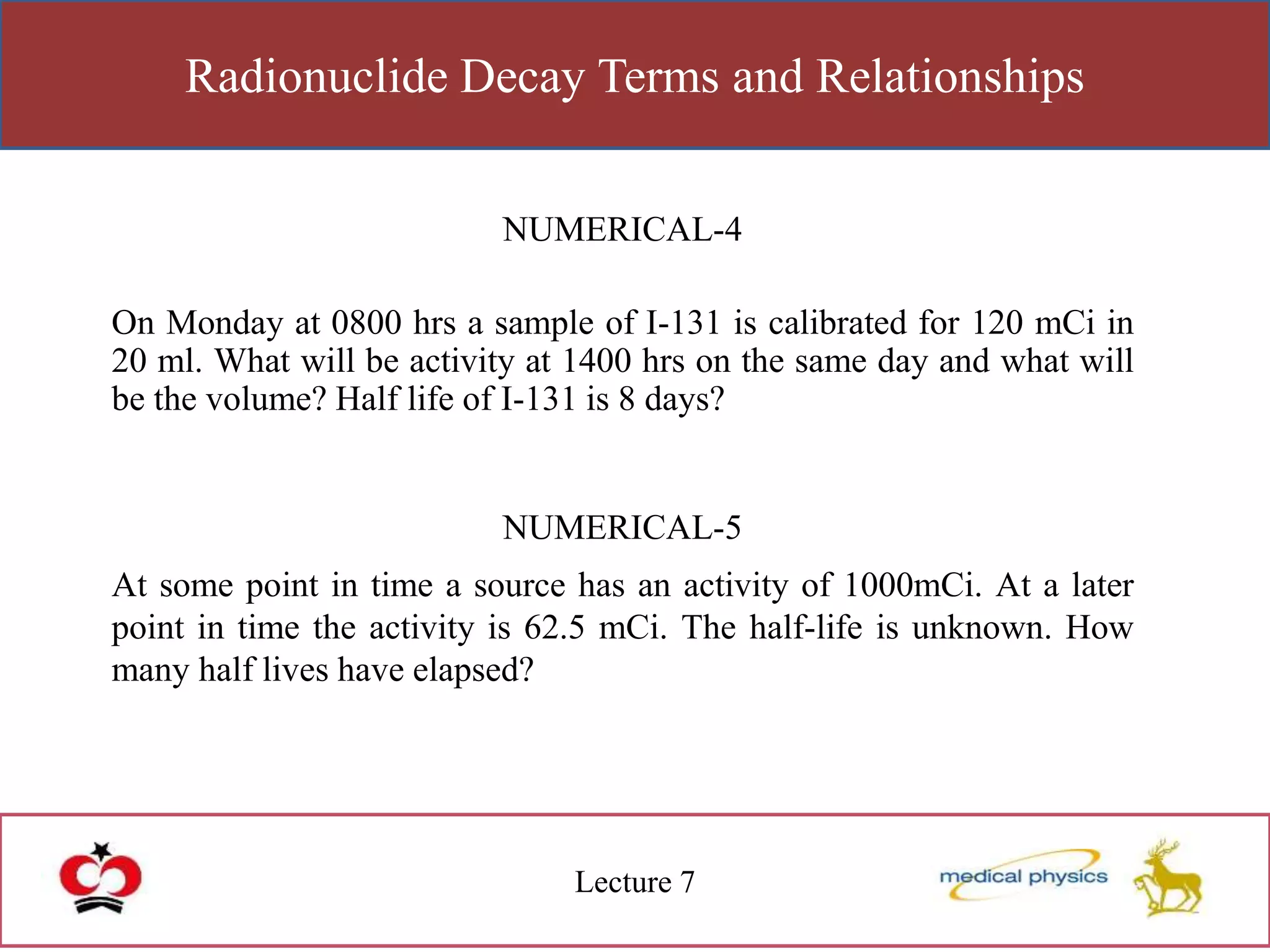
NUMERICAL-4
On Monday at 0800 hrs a sample of I-131 is calibrated for 120 mCi in
20 ml. What will be activity at 1400 hrs on the same day and what will
be the volume? Half life of I-131 is 8 days?
NUMERICAL-5
At some point in time a source has an activity of 1000mCi. At a later
point in time the activity is 62.5 mCi. The half-life is unknown. How
many half lives have elapsed?
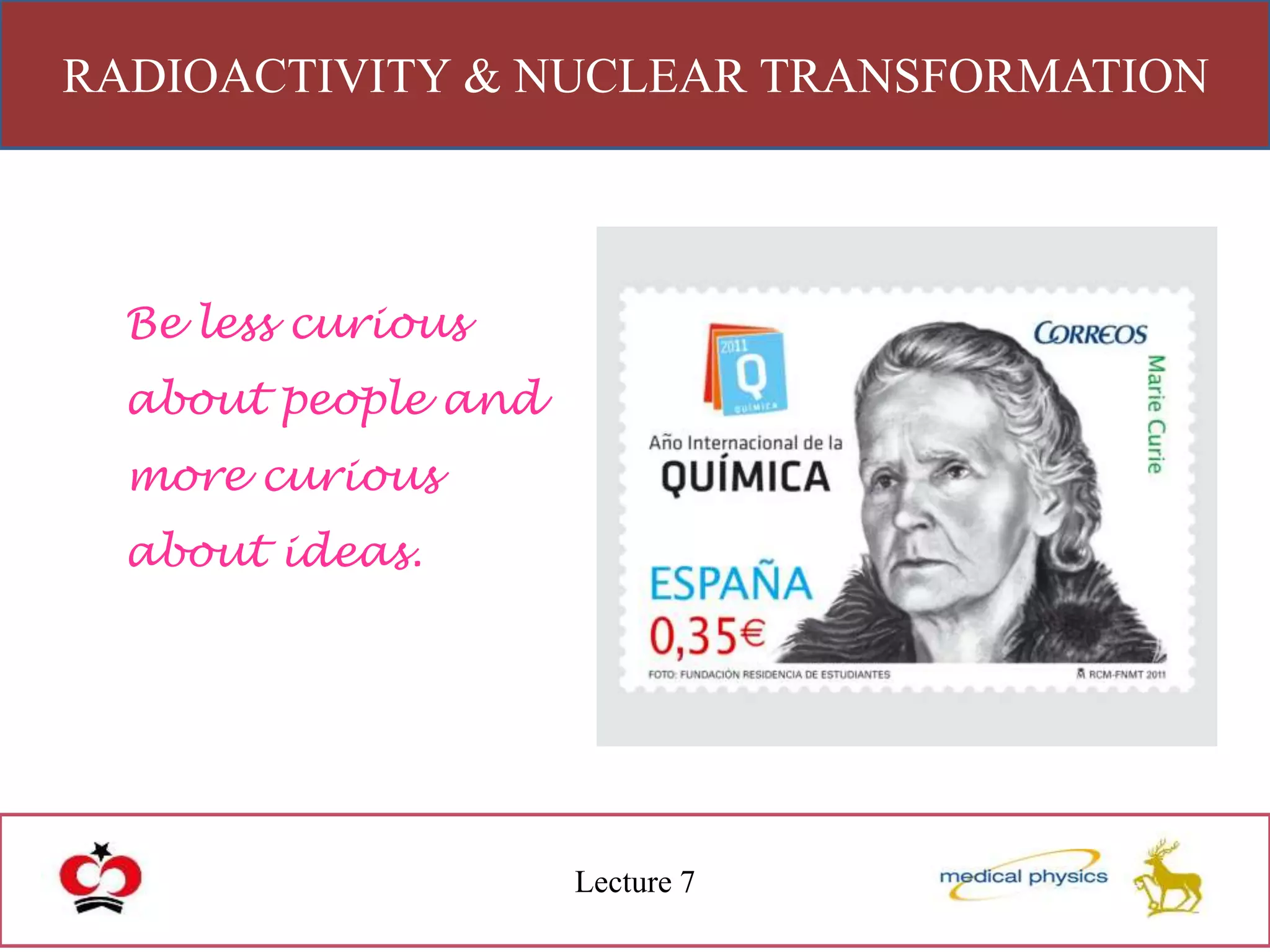
RADIOACTIVITY & NUCLEAR TRANSFORMATION
Lecture 7
Be less curious
about people and
more curious
about ideas.

Radioactivity and nuclear transformation

  • 1.
    Lecture 7: May,12, 2014 Shahid Younas RADIOACTIVITY & NUCLEAR TRANSFORMATION
  • 2.
    INTRODUCTION Lecture 7 Radioactivity burstinto the world without warning.
  • 3.
    INTRODUCTION Lecture 7  Antoine-HenriBecquerel  Director of Paris Museum of Natural History
  • 4.
    INTRODUCTION Lecture 7  Becquerelbegan testing samples from his father’s collection.  He was particularly interested in luminescent Uranium mineral.  It was used to color ceramics and glass.
  • 5.
    INTRODUCTION Lecture 7 Do youknow why Uranium was given this name? After the name of newly discovered planet Uranus in those days.
  • 6.
    INTRODUCTION Lecture 7  Hebelieved that a heavy mineral would be most suitable for converting visible light into x-rays.  Hennery received astonishing intense image on a cloudy day.  Phosphorescent & fluorescent material emits light only if they are exposed to light.
  • 7.
    INTRODUCTION Lecture 7  SilvanusP. Thompson- a British Electrical Engineer.  Uranium compound gave off invisible rays.  Hyper-phosphorescence
  • 8.
    INTRODUCTION Lecture 7  Becquerelbelieved that effect would fade if he waited long enough.  Hours turned into days, weeks, months; yet even after more than a year; Uranium’s power could not be abated.
  • 9.
    INTRODUCTION Lecture 7 Do youknow what is the half life of Uranium? U-238 : 447 Billion Years U-235: 704 Million Years
  • 10.
    INTRODUCTION Lecture 7  Hetried to destroy Uranium’s power by dissolving and re- crystalizing to retain his philosophy of phosphorescence.  But  All in Vain.
  • 11.
    INTRODUCTION Lecture 7  InnocentHenry discovered about his rays that these,  Electrified air  Pass through cardboard, aluminum, copper and platinum  Penetrate Opaque materials- property of x-rays
  • 12.
    INTRODUCTION Lecture 04  Theability to pass through opaque materials suggests that uranium rays were a type of x rays.  He believed them as “Mysterious Rays”.
  • 13.
    Radioactivity Lecture 7 Process ofspontaneous decay and transformation of unstable atomic nuclei accompanied with the emission of nuclear particles and/or nuclear radiation.
  • 14.
    Radioactivity Lecture 7 Henri workedon Uranium. Do you know on which source Madam Curie worked? Radium
  • 15.
    Radionuclide Decay Termsand Relationships Lecture 7 Activity: Number of radioactive atoms (N) undergoing nuclear transformation per unit time (t). A = - dN/ dt Minus sign shows that radioactive atoms decreases with time.
  • 16.
    Radionuclide Decay Termsand Relationships Lecture 7  Activity  Tradition unit is Curie (Ci)  1 µ Ci = 2.22 x 10⁶dpm  S.I. unit is Becquerel (Bq)  Becquerel is one disintegration per second (dps)
  • 17.
    Radionuclide Decay Termsand Relationships Lecture 7 Do you know the relation between Henry Becquerel and Curie? a. Henry was cousin of Curie. b. Curie and Henry studied same high school c. Henry and Curie shared first noble prize. d. 1 milli Curie = 37 MBq
  • 18.
    Radionuclide Decay Termsand Relationships Lecture 7  Decay Constant λ: Number of radioactive atoms decaying per unit time (dN/dt) is proportional to the number of unstable atoms (N) Proportionality can be transformed into an equality by a constant
  • 19.
    Radionuclide Decay Termsand Relationships Lecture 7  Decay Constant: Decay constant is equal to the fraction of the number of radioactive atoms remaining in a sample that decay per unit time. A = λN  Decay constant is characteristic of each radionuclide.
  • 20.
    Radionuclide Decay Termsand Relationships Lecture 7 Decay constant for 99Mo is 0.252 per day. Do you know the decay constant for technetium-99m? 0.115 per hour
  • 21.
    Radionuclide Decay Termsand Relationships Lecture 7  Physical Half Life: Time required for number of radioactive atoms in a sample to decrease by one half. . N = No / 2n  N is number of radioactive atoms remaining  No is the initial number of radioactive atoms  n is the number of half lives.
  • 22.
    Radionuclide Decay Termsand Relationships Lecture 7  Physical Half Life:  After ten half-lives number of radioactive atoms in a sample is reduced by ~ a thousand and after twenty these reduced to a million.
  • 23.
    Radionuclide Decay Termsand Relationships Lecture 7  Physical Half Life: Decay constant and physical half life are related as; λ = ln 2 / T 1/2 λ = 0.693 / T1/2
  • 24.
    Radionuclide Decay Termsand Relationships Lecture 7 If we mix 99mTc and 131I with each other. How would you find the decay of the mixture? Mixture Rule or otherwise count for the longest half life
  • 25.
    Radionuclide Decay Termsand Relationships Lecture 7 Physical Half Life & Decay Constant Radionuclide Symbol T 1/2 λ Fluorine 18F 110 m 0.0063 / m Technetium 99mTc 6.02 hrs 0.1151/ hr Iodine 131I 8.02 d 0.0864 / d Thallium 201Tl 3.04 d 0.2281/d Gallium 67Ga 3.26 d 0.2126 / d Iodine 125I 59.41 d 0.0117 / d
  • 26.
    Radionuclide Decay Termsand Relationships Lecture 7  Fundamental Decay Equation: Decay constant and physical half life are related as; Nt = No e - λt or At = Ao e - λt
  • 27.
    Radionuclide Decay Termsand Relationships Lecture 7  Physical Half Life:  Nt = number of radioactive atoms at time t  At= activity at time t  No = initial number of radioactive atoms  Ao= initial activity  e = base of natural logarithm  λ = decay constant  t = time
  • 28.
    Radionuclide Decay Termsand Relationships Lecture 7 NUMERICALS A nuclear medicine technologist injects a patient with 500 µCi of indium-111 labeled autologous platelets (T1/2 = 2.81 days) forty hours later the patient is imaged. Assuming that none of the activity was excreted, how much activity remains at the time of imaging?
  • 29.
    Radionuclide Decay Termsand Relationships Lecture 7 NUMERICAL-1 Step 1: Collection of Data Ao = 500 uCi T1/2 = 2.82 days t = 48 hrs At = ? NUMERICAL-1 Step 2: Look at the Units  time t and half life should be in same unit.  Pick the relevant equation  N = No / 2n  λ = 0.693 / T1/2  At = Ao e – λt
  • 30.
    Radionuclide Decay Termsand Relationships Lecture 7 NUMERICAL-1 Step 3: March towards Solution  λ = 0.693 / T1/2  λ = 0.693 / 2.82 = 0.246 / day  At = Ao e – λt  At = 500 e – (0.246 / day) (2 days)  At = 500 e –0.49  At = 500 x 0.612  At = 306 uCi
  • 31.
    IQBAL‘S COLLECTION Lecture 7 NUMERICAL-2 At11:00 am of a rainy day ; 99mTc was measured 9mCi (333 MBq). What was the activity at 0800 hrs on the same day. NUMERICAL-2 Step 1: Collection of Data Ao = ? At = 9 mCi T1/2 = 6 hrs Elapsed time t = 3 hrs
  • 32.
    Radionuclide Decay Termsand Relationships Lecture 7 NUMERICAL-2 Step 2: Look at the Units  time t and half life should be in same unit.  Pick the relevant equation  N = No / 2n  λ = 0.693 / T1/2  At = Ao e – λt NUMERICAL-2 Step 3: March towards Solution  λ = 0.693 / T1/2  λ = 0.693 / 6 = 0.1155 / day  At = Ao e – λt  9 = Ao e – (0.1155 ) (3)  9 = Ao e –0.3465  Ao = 9 x 1.414  At = 12.72 mCi
  • 33.
    Radionuclide Decay Termsand Relationships Lecture 7 NUMERICAL-3 There is an activity of 360 mCi in 10 ml of a certain radioactive material. What will be its strength after two half lives in 2 ml? NUMERICAL-2 Step 2: Look at the Units  time t and half life should be in same unit.  Pick the relevant equation  N = No / 2n  λ = 0.693 / T1/2  At = Ao e – λt NUMERICAL-2 Step 3: March towards Solution N = No / 2n 90 mCi in 10 ml 18 mCi in 2 ml
  • 34.
    Radionuclide Decay Termsand Relationships Lecture 7 NUMERICAL-4 On Monday at 0800 hrs a sample of I-131 is calibrated for 120 mCi in 20 ml. What will be activity at 1400 hrs on the same day and what will be the volume? Half life of I-131 is 8 days? NUMERICAL-5 At some point in time a source has an activity of 1000mCi. At a later point in time the activity is 62.5 mCi. The half-life is unknown. How many half lives have elapsed?
  • 35.
    RADIOACTIVITY & NUCLEARTRANSFORMATION Lecture 7 Be less curious about people and more curious about ideas.