Number Systems


Autumn    Programming and   1
Number Representation


Autumn       Programming and   2
Topics to be Discussed

• How are numeric data items actually
  stored in computer memory?
• How much space (memory locations) is
  allocated for each type of data?
  – int, float, char, etc.
• How are characters and strings stored in
  memory?


Autumn           Programming and   3
Number System :: The Basics

•   We are accustomed to using the so-
    called decimal number system.
    – Ten digits :: 0,1,2,3,4,5,6,7,8,9
    – Every digit position has a weight which is a
      power of 10.
    – Base or radix is 10.
•   Example:
    234 = 2 x 10² + 3 x 101 + 4 x 100
    250.67 = 2 x 10² + 5 x 101 + 0 x 100 + 6 x 10⁻¹
                     + 7 x 10⁻²


Autumn            Programming and         4
Binary Number System

•   Two digits:
    – 0 and 1.
    – Every digit position has a weight which is a
      power of 2.
    – Base or radix is 2.
•   Example:
    110 = 1 x 22 + 1 x 21 + 0 x 20
    101.01 = 1 x 22 + 0 x 21 + 1 x 20 + 0 x 2-1 + 1 x 2-
       2


Autumn            Programming and          5
Counting with Binary Numbers

             0
             1
           10
           11
          100
          101
          110
          111
         1000
           .

Autumn       Programming and   6
Multiplication and Division with base

 Multiplication with 10 (decimal system)
    435 x 10 = 4350                Left Shift and add
                                    zero at right end
 Multiplication with 10 (=2 ) (binary system)
   1101 x 10 = 11010
                                      Right shift and drop
                                       right most digit or
 Division by 10 (decimal system) shift after decimal
   435 / 10 = 43.5                    point

 Division by 10 (=2) (binary system)
   1101 / 10 = 110.1

Autumn           Programming and          7
Adding two bits


                                         Carries

         0   +0   =0
                                     1       1   1   0
         0   +1   =1                         1   0   1   1
         1   +0   =1             +           1   1   1   0
         1   +1   = 10               1       1   0   0   1


                         carry


Autumn       Programming and             8
Binary addition: Another example


                            The initial carry
                            in is implicitly 0


                1    1      0   0        (Carries)
                     1      1   0   1
            +        1      1   0   0
                1    1      0   0   1    (Sum)


         most significant       least significant
         bit (MSB)              bit (LSB)


Autumn              Programming and                  9
Binary-to-Decimal Conversion

• Each digit position of a binary number has
  a weight.
  – Some power of 2.
• A binary number:
         B = bn-1 bn-2 …..b1 b0 . b-1 b-2 ….. b-m
  Corresponding value in decimal:
        n-1

         D = =Σ bi 2i
            i -m


Autumn               Programming and                10
Examples

1. 101011  1x25 + 0x24 + 1x23 + 0x22 + 1x21 + 1x20
                   = 43
     (101011)2 = (43)10


2. .0101     0x2-1 + 1x2-2 + 0x2-3 + 1x2-4
                     = .3125
      (.0101)2 = (.3125)10


3. 101.11   1x22 + 0x21 + 1x20 + 1x2-1 + 1x2-2
                   5.75
     (101.11)2 = (5.75)10
  Autumn            Programming and         11
Decimal-to-Binary Conversion
• Consider the integer and fractional parts
  separately.
• For the integer part,
  – Repeatedly divide the given number by 2, and
    go on accumulating the remainders, until the
    number becomes zero.
  – Arrange the remainders in reverse order.
• For the fractional part,
  – Repeatedly multiply the given fraction by 2.
     • Accumulate the integer part (0 or 1).
     • If the integer part is 1, chop it off.
  – Arrange the integer parts in the order they are
    obtained.

Autumn            Programming and               12
Example 1 :: 239

         2   239
         2   119    --- 1
         2   59    --- 1
         2    29   --- 1
         2   14     --- 1
                                     (239)10 = (11101111)2
         2    7    --- 0
         2    3    --- 1
         2    1    --- 1
         2    0    --- 1


Autumn             Programming and           13
Example 2 :: 64

         2   64
         2   32 --- 0
         2   16 --- 0
         2    8 --- 0
         2    4 --- 0
                                   (64)10 = (1000000)2
         2    2 --- 0
         2    1 --- 0
         2    0 --- 1


Autumn           Programming and           14
Example 3 :: .634

     .634   x   2   =   1.268
     .268   x   2   =   0.536
     .536   x   2   =   1.072
     .072   x   2   =   0.144
                                      (.634)10 = (.10100……)2
     .144   x   2   =   0.288
     :
     :


Autumn                  Programming and       15
Example 4 :: 37.0625


   (37)10 = (100101)2
   (.0625)10 = (.0001)2


   ∴(37.0625)10 = (100101 . 0001)2


Autumn          Programming and      16
Hexadecimal Number System

• A compact way of representing binary
  numbers.
• 16 different symbols (radix = 16).
    0       0000     8      1000
    1       0001     9      1001
    2       0010     A      1010
    3       0011     B      1011
    4       0100     C      1100
    5       0101     D      1101
    6       0110     E      1110
    7       0111     F      1111


Autumn              Programming and   17
Binary-to-Hexadecimal Conversion

• For the integer part,
  – Scan the binary number from right to left.
  – Translate each group of four bits into the
    corresponding hexadecimal digit.
     • Add leading zeros if necessary.
• For the fractional part,
  – Scan the binary number from left to right.
  – Translate each group of four bits into the
    corresponding hexadecimal digit.
     • Add trailing zeros if necessary.


Autumn            Programming and         18
Example

1. (1011 0100 0011)2 = (B43)16

2. (10 1010 0001)2        = (2A1)16

3. (.1000 010)2           = (.84)16

4. (101 . 0101 111)2      = (5.5E)16


Autumn            Programming and      19
Hexadecimal-to-Binary Conversion

•   Translate every hexadecimal digit into its
    4-bit binary equivalent.
•   Examples:
     (3A5)16   = (0011 1010 0101)2
     (12.3D)16 = (0001 0010 . 0011 1101)2
     (1.8)16   = (0001 . 1000)2


Autumn          Programming and        20
Unsigned Binary Numbers

• An n-bit binary number
    B = bn-1bn-2 …. b2b1b0
     • 2n distinct combinations are possible, 0 to 2n-1.
• For example, for n = 3, there are 8 distinct
  combinations.
  – 000, 001, 010, 011, 100, 101, 110, 111
• Range of numbers that can be represented
    n=8             0 to 28-1 (255)
    n=16            0 to 216-1 (65535)
    n=32            0 to 232-1 (4294967295)

Autumn            Programming and               21
Signed Integer Representation

• Many of the numerical data items that are
  used in a program are signed (positive or
  negative).
  – Question:: How to represent sign?
• Three possible approaches:
  – Sign-magnitude representation
  – One’s complement representation
  – Two’s complement representation


Autumn         Programming and          22
Sign-magnitude Representation

• For an n-bit number representation
  – The most significant bit (MSB) indicates sign
         0  positive
         1  negative
  – The remaining n-1 bits represent magnitude.


         bn-1   bn-2                     b1   b0

         Sign                Magnitude


Autumn                 Programming and         23
Contd.

• Range of numbers that can be
  represented:
     Maximum :: + (2n-1 – 1)
     Minimum :: − (2n-1 – 1)
• A problem:
     Two different representations of zero.
         +0  0 000….0
         -0  1 000….0


Autumn          Programming and        24
One’s Complement Representation

• Basic idea:
  – Positive numbers are represented exactly as in
    sign-magnitude form.
  – Negative numbers are represented in 1’s
    complement form.
• How to compute the 1’s complement of a
  number?
  – Complement every bit of the number (10 and
    01).
  – MSB will indicate the sign of the number.
      0  positive
      1  negative


 Autumn         Programming and         25
Example :: n=4
         0000       +0               1000       -7
         0001       +1               1001       -6
         0010       +2               1010       -5
         0011       +3               1011       -4
         0100       +4               1100       -3
         0101       +5               1101       -2
         0110       +6               1110       -1
         0111       +7               1111       -0
 To find the representation of, say, -4, first note that
      +4 = 0100
      -4 = 1’s complement of 0100 = 1011


Autumn               Programming and               26
Contd.

• Range of numbers that can be represented:
     Maximum :: + (2n-1 – 1)
     Minimum :: − (2n-1 – 1)
• A problem:
     Two different representations of zero.
         +0  0 000….0
         -0  1 111….1
• Advantage of 1’s complement representation
  – Subtraction can be done using addition.
  – Leads to substantial saving in circuitry.


Autumn            Programming and               27
Two’s Complement Representation

• Basic idea:
  – Positive numbers are represented exactly as in
    sign-magnitude form.
  – Negative numbers are represented in 2’s
    complement form.
• How to compute the 2’s complement of a
  number?
  – Complement every bit of the number (10 and
    01), and then add one to the resulting number.
  – MSB will indicate the sign of the number.
      0  positive
      1  negative


 Autumn         Programming and         28
Example :: n=4
         0000       +0               1000       -8
         0001       +1               1001       -7
         0010       +2               1010       -6
         0011       +3               1011       -5
         0100       +4               1100       -4
         0101       +5               1101       -3
         0110       +6               1110       -2
         0111       +7               1111       -1
 To find the representation of, say, -4, first note that
      +4 = 0100
      -4 = 2’s complement of 0100 = 1011+1 = 1100


Autumn               Programming and               29
Contd.

• In C
  – short int
     • 16 bits  + (215-1) to -215
  – int
     • 32 bits  + (231-1) to -231
  – long int
     • 64 bits  + (263-1) to -263


Autumn           Programming and     30
Contd.

• Range of numbers that can be represented:
     Maximum :: + (2n-1 – 1)
     Minimum :: − 2n-1
• Advantage:
  – Unique representation of zero.
  – Subtraction can be done using addition.
  – Leads to substantial saving in circuitry.
• Almost all computers today use the 2’s
  complement representation for storing
  negative numbers.

 Autumn          Programming and         31
Subtraction Using Addition :: 1’s
                   Complement

• How to compute A – B ?
  – Compute the 1’s complement of B (say, B1).
  – Compute R = A + B1
  – If the carry obtained after addition is ‘1’
     • Add the carry back to R (called end-around carry).
     • That is, R = R + 1.
     • The result is a positive number.
    Else
     • The result is negative, and is in 1’s complement
       form.


Autumn           Programming and              32
Example 1 :: 6 – 2

       1’s complement of 2 = 1101

          6 :: 0110     A
                                     Assume 4-bit
         -2 :: 1101     B1           representations.
              1 0011    R            Since there is a carry, it is
End-around
carry              1                 added back to the result.
                0100     +4         The result is positive.


    Autumn             Programming and           33
Example 2 :: 3 – 5

  1’s complement of 5 = 1010

    3 :: 0011    A
   -5 :: 1010    B1
         1101    R
                             Assume 4-bit representations.

         -2                  Since there is no carry, the
                             result is negative.
                             1101 is the 1’s complement of
                             0010, that is, it represents –2.


Autumn          Programming and           34
Subtraction Using Addition :: 2’s
                   Complement

• How to compute A – B ?

  – Compute the 2’s complement of B (say, B2).


  – Compute R = A + B2

  – Ignore carry if it is there.

  – The result is in 2’s complement form.


Autumn           Programming and       35
Example 1 :: 6 – 2

      2’s complement of 2 = 1101 + 1 = 1110

        6 :: 0110     A
       -2 :: 1110     B2
            1 0100    R


Ignore carry   +4


   Autumn            Programming and     36
Example 2 :: 3 – 5

  2’s complement of 5 = 1010 + 1 = 1011

    3 :: 0011    A
   -5 :: 1011    B2
         1110    R


         -2


Autumn          Programming and     37
Example 3 :: -3 – 5

      2’s complement of 3 = 1100 + 1 = 1101
      2’s complement of 5 = 1010 + 1 = 1011


      -3 :: 1101
      -5 :: 1011
           1 1000


Ignore carry
               -8


  Autumn             Programming and      38
Floating-point Numbers
• The representations discussed so far applies only
  to integers.
   – Cannot represent numbers with fractional parts.
• We can assume a decimal point before a 2’s
  complement number.
   – In that case, pure fractions (without integer parts) can
     be represented.
• We can also assume the decimal point
  somewhere in between.
   – This lacks flexibility.
   – Very large and very small numbers cannot be
     represented.


Autumn             Programming and               39
Representation of Floating-Point
             Numbers
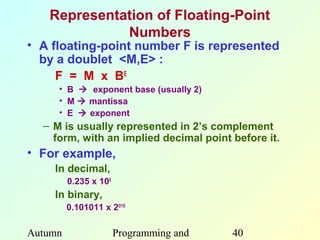
• A floating-point number F is represented
  by a doublet <M,E> :
     F = M x BE
     • B  exponent base (usually 2)
     • M  mantissa
     • E  exponent
  – M is usually represented in 2’s complement
    form, with an implied decimal point before it.
• For example,
    In decimal,
         0.235 x 10⁶
    In binary,
         0.101011 x 20110

Autumn                 Programming and   40
Example :: 32-bit representation
                      M                         E
                      24                            8
   – M represents a 2’s complement fraction
         1 > M > -1
   – E represents the exponent (in 2’s complement form)
         127 > E > -128
• Points to note:
   – The number of significant digits depends on the number
     of bits in M.
      • 6 significant digits for 24-bit mantissa.
   – The range of the number depends on the number of bits
     in E.
      • 1038 to 10-38 for 8-bit exponent.


Autumn               Programming and                    41
A Warning

• The representation for floating-point
  numbers as shown is just for illustration.
• The actual representation is a little more
  complex.
• In C:
  – float  :: 32-bit representation
  – double :: 64-bit representation


Autumn         Programming and        42
Representation of Characters
• Many applications have to deal with non-numerical
  data.
   – Characters and strings.
   – There must be a standard mechanism to represent
     alphanumeric and other characters in memory.
• Three standards in use:
   – Extended Binary Coded Decimal Interchange Code (EBCDIC)
      • Used in older IBM machines.
   – American Standard Code for Information Interchange (ASCII)
      • Most widely used today.
   – UNICODE
      • Used to represent all international characters.
      • Used by Java.


 Autumn              Programming and                  43
ASCII Code

• Each individual character is numerically
  encoded into a unique 7-bit binary code.
  – A total of 27 or 128 different characters.
  – A character is normally encoded in a byte (8
    bits), with the MSB not been used.
• The binary encoding of the characters
  follow a regular ordering.
  – Digits are ordered consecutively in their
    proper numerical sequence (0 to 9).
  – Letters (uppercase and lowercase) are
    arranged consecutively in their proper
    alphabetic order.

Autumn         Programming and          44
Some Common ASCII Codes

 ‘A’ :: 41 (H) 65 (D)      ‘0’ :: 30 (H) 48 (D)
 ‘B’ :: 42 (H) 66 (D)      ‘1’ :: 31 (H) 49 (D)
 ………..                     ………..
 ‘Z’ :: 5A (H) 90 (D)      ‘9’ :: 39 (H) 57 (D)

 ‘a’ :: 61 (H) 97 (D)      ‘(‘ ::    28 (H) 40 (D)
 ‘b’ :: 62 (H) 98 (D)      ‘+’ ::    2B (H) 43 (D)
 ………..                     ‘?’ ::     3F (H) 63 (D)
 ‘z’ :: 7A (H) 122 (D)     ‘n’ ::   0A (H) 10 (D)
                           ‘0’ ::   00 (H) 00 (D)


Autumn          Programming and            45
Character Strings

• Two ways of representing a sequence of
  characters in memory.
  – The first location contains the number of
    characters in the string, followed by the actual
    characters.
             5   H   e   l   l   o


  – The characters follow one another, and is
    terminated by a special delimiter.
             H   e   l   l   o   ⊥


Autumn           Programming and        46
String Representation in C

• In C, the second approach is used.
  – The ‘0’ character is used as the string
    delimiter.
• Example:             H   e   l   l   o ‘0’
  “Hello”     


• A null string “” occupies one byte in
  memory.
  – Only the ‘0’ character.


Autumn            Programming and               47

L2 number

  • 1.
    Number Systems Autumn Programming and 1
  • 2.
  • 3.
    Topics to beDiscussed • How are numeric data items actually stored in computer memory? • How much space (memory locations) is allocated for each type of data? – int, float, char, etc. • How are characters and strings stored in memory? Autumn Programming and 3
  • 4.
    Number System ::The Basics • We are accustomed to using the so- called decimal number system. – Ten digits :: 0,1,2,3,4,5,6,7,8,9 – Every digit position has a weight which is a power of 10. – Base or radix is 10. • Example: 234 = 2 x 10² + 3 x 101 + 4 x 100 250.67 = 2 x 10² + 5 x 101 + 0 x 100 + 6 x 10⁻¹ + 7 x 10⁻² Autumn Programming and 4
  • 5.
    Binary Number System • Two digits: – 0 and 1. – Every digit position has a weight which is a power of 2. – Base or radix is 2. • Example: 110 = 1 x 22 + 1 x 21 + 0 x 20 101.01 = 1 x 22 + 0 x 21 + 1 x 20 + 0 x 2-1 + 1 x 2- 2 Autumn Programming and 5
  • 6.
    Counting with BinaryNumbers 0 1 10 11 100 101 110 111 1000 . Autumn Programming and 6
  • 7.
    Multiplication and Divisionwith base  Multiplication with 10 (decimal system) 435 x 10 = 4350 Left Shift and add zero at right end  Multiplication with 10 (=2 ) (binary system) 1101 x 10 = 11010 Right shift and drop right most digit or  Division by 10 (decimal system) shift after decimal 435 / 10 = 43.5 point  Division by 10 (=2) (binary system) 1101 / 10 = 110.1 Autumn Programming and 7
  • 8.
    Adding two bits Carries 0 +0 =0 1 1 1 0 0 +1 =1 1 0 1 1 1 +0 =1 + 1 1 1 0 1 +1 = 10 1 1 0 0 1 carry Autumn Programming and 8
  • 9.
    Binary addition: Anotherexample The initial carry in is implicitly 0 1 1 0 0 (Carries) 1 1 0 1 + 1 1 0 0 1 1 0 0 1 (Sum) most significant least significant bit (MSB) bit (LSB) Autumn Programming and 9
  • 10.
    Binary-to-Decimal Conversion • Eachdigit position of a binary number has a weight. – Some power of 2. • A binary number: B = bn-1 bn-2 …..b1 b0 . b-1 b-2 ….. b-m Corresponding value in decimal: n-1 D = =Σ bi 2i i -m Autumn Programming and 10
  • 11.
    Examples 1. 101011 1x25 + 0x24 + 1x23 + 0x22 + 1x21 + 1x20 = 43 (101011)2 = (43)10 2. .0101  0x2-1 + 1x2-2 + 0x2-3 + 1x2-4 = .3125 (.0101)2 = (.3125)10 3. 101.11  1x22 + 0x21 + 1x20 + 1x2-1 + 1x2-2 5.75 (101.11)2 = (5.75)10 Autumn Programming and 11
  • 12.
    Decimal-to-Binary Conversion • Considerthe integer and fractional parts separately. • For the integer part, – Repeatedly divide the given number by 2, and go on accumulating the remainders, until the number becomes zero. – Arrange the remainders in reverse order. • For the fractional part, – Repeatedly multiply the given fraction by 2. • Accumulate the integer part (0 or 1). • If the integer part is 1, chop it off. – Arrange the integer parts in the order they are obtained. Autumn Programming and 12
  • 13.
    Example 1 ::239 2 239 2 119 --- 1 2 59 --- 1 2 29 --- 1 2 14 --- 1 (239)10 = (11101111)2 2 7 --- 0 2 3 --- 1 2 1 --- 1 2 0 --- 1 Autumn Programming and 13
  • 14.
    Example 2 ::64 2 64 2 32 --- 0 2 16 --- 0 2 8 --- 0 2 4 --- 0 (64)10 = (1000000)2 2 2 --- 0 2 1 --- 0 2 0 --- 1 Autumn Programming and 14
  • 15.
    Example 3 ::.634 .634 x 2 = 1.268 .268 x 2 = 0.536 .536 x 2 = 1.072 .072 x 2 = 0.144 (.634)10 = (.10100……)2 .144 x 2 = 0.288 : : Autumn Programming and 15
  • 16.
    Example 4 ::37.0625 (37)10 = (100101)2 (.0625)10 = (.0001)2 ∴(37.0625)10 = (100101 . 0001)2 Autumn Programming and 16
  • 17.
    Hexadecimal Number System •A compact way of representing binary numbers. • 16 different symbols (radix = 16). 0  0000 8  1000 1  0001 9  1001 2  0010 A  1010 3  0011 B  1011 4  0100 C  1100 5  0101 D  1101 6  0110 E  1110 7  0111 F  1111 Autumn Programming and 17
  • 18.
    Binary-to-Hexadecimal Conversion • Forthe integer part, – Scan the binary number from right to left. – Translate each group of four bits into the corresponding hexadecimal digit. • Add leading zeros if necessary. • For the fractional part, – Scan the binary number from left to right. – Translate each group of four bits into the corresponding hexadecimal digit. • Add trailing zeros if necessary. Autumn Programming and 18
  • 19.
    Example 1. (1011 01000011)2 = (B43)16 2. (10 1010 0001)2 = (2A1)16 3. (.1000 010)2 = (.84)16 4. (101 . 0101 111)2 = (5.5E)16 Autumn Programming and 19
  • 20.
    Hexadecimal-to-Binary Conversion • Translate every hexadecimal digit into its 4-bit binary equivalent. • Examples: (3A5)16 = (0011 1010 0101)2 (12.3D)16 = (0001 0010 . 0011 1101)2 (1.8)16 = (0001 . 1000)2 Autumn Programming and 20
  • 21.
    Unsigned Binary Numbers •An n-bit binary number B = bn-1bn-2 …. b2b1b0 • 2n distinct combinations are possible, 0 to 2n-1. • For example, for n = 3, there are 8 distinct combinations. – 000, 001, 010, 011, 100, 101, 110, 111 • Range of numbers that can be represented n=8  0 to 28-1 (255) n=16  0 to 216-1 (65535) n=32  0 to 232-1 (4294967295) Autumn Programming and 21
  • 22.
    Signed Integer Representation •Many of the numerical data items that are used in a program are signed (positive or negative). – Question:: How to represent sign? • Three possible approaches: – Sign-magnitude representation – One’s complement representation – Two’s complement representation Autumn Programming and 22
  • 23.
    Sign-magnitude Representation • Foran n-bit number representation – The most significant bit (MSB) indicates sign 0  positive 1  negative – The remaining n-1 bits represent magnitude. bn-1 bn-2 b1 b0 Sign Magnitude Autumn Programming and 23
  • 24.
    Contd. • Range ofnumbers that can be represented: Maximum :: + (2n-1 – 1) Minimum :: − (2n-1 – 1) • A problem: Two different representations of zero. +0  0 000….0 -0  1 000….0 Autumn Programming and 24
  • 25.
    One’s Complement Representation •Basic idea: – Positive numbers are represented exactly as in sign-magnitude form. – Negative numbers are represented in 1’s complement form. • How to compute the 1’s complement of a number? – Complement every bit of the number (10 and 01). – MSB will indicate the sign of the number. 0  positive 1  negative Autumn Programming and 25
  • 26.
    Example :: n=4 0000  +0 1000  -7 0001  +1 1001  -6 0010  +2 1010  -5 0011  +3 1011  -4 0100  +4 1100  -3 0101  +5 1101  -2 0110  +6 1110  -1 0111  +7 1111  -0 To find the representation of, say, -4, first note that +4 = 0100 -4 = 1’s complement of 0100 = 1011 Autumn Programming and 26
  • 27.
    Contd. • Range ofnumbers that can be represented: Maximum :: + (2n-1 – 1) Minimum :: − (2n-1 – 1) • A problem: Two different representations of zero. +0  0 000….0 -0  1 111….1 • Advantage of 1’s complement representation – Subtraction can be done using addition. – Leads to substantial saving in circuitry. Autumn Programming and 27
  • 28.
    Two’s Complement Representation •Basic idea: – Positive numbers are represented exactly as in sign-magnitude form. – Negative numbers are represented in 2’s complement form. • How to compute the 2’s complement of a number? – Complement every bit of the number (10 and 01), and then add one to the resulting number. – MSB will indicate the sign of the number. 0  positive 1  negative Autumn Programming and 28
  • 29.
    Example :: n=4 0000  +0 1000  -8 0001  +1 1001  -7 0010  +2 1010  -6 0011  +3 1011  -5 0100  +4 1100  -4 0101  +5 1101  -3 0110  +6 1110  -2 0111  +7 1111  -1 To find the representation of, say, -4, first note that +4 = 0100 -4 = 2’s complement of 0100 = 1011+1 = 1100 Autumn Programming and 29
  • 30.
    Contd. • In C – short int • 16 bits  + (215-1) to -215 – int • 32 bits  + (231-1) to -231 – long int • 64 bits  + (263-1) to -263 Autumn Programming and 30
  • 31.
    Contd. • Range ofnumbers that can be represented: Maximum :: + (2n-1 – 1) Minimum :: − 2n-1 • Advantage: – Unique representation of zero. – Subtraction can be done using addition. – Leads to substantial saving in circuitry. • Almost all computers today use the 2’s complement representation for storing negative numbers. Autumn Programming and 31
  • 32.
    Subtraction Using Addition:: 1’s Complement • How to compute A – B ? – Compute the 1’s complement of B (say, B1). – Compute R = A + B1 – If the carry obtained after addition is ‘1’ • Add the carry back to R (called end-around carry). • That is, R = R + 1. • The result is a positive number. Else • The result is negative, and is in 1’s complement form. Autumn Programming and 32
  • 33.
    Example 1 ::6 – 2 1’s complement of 2 = 1101 6 :: 0110 A Assume 4-bit -2 :: 1101 B1 representations. 1 0011 R Since there is a carry, it is End-around carry 1 added back to the result. 0100  +4 The result is positive. Autumn Programming and 33
  • 34.
    Example 2 ::3 – 5 1’s complement of 5 = 1010 3 :: 0011 A -5 :: 1010 B1 1101 R Assume 4-bit representations. -2 Since there is no carry, the result is negative. 1101 is the 1’s complement of 0010, that is, it represents –2. Autumn Programming and 34
  • 35.
    Subtraction Using Addition:: 2’s Complement • How to compute A – B ? – Compute the 2’s complement of B (say, B2). – Compute R = A + B2 – Ignore carry if it is there. – The result is in 2’s complement form. Autumn Programming and 35
  • 36.
    Example 1 ::6 – 2 2’s complement of 2 = 1101 + 1 = 1110 6 :: 0110 A -2 :: 1110 B2 1 0100 R Ignore carry +4 Autumn Programming and 36
  • 37.
    Example 2 ::3 – 5 2’s complement of 5 = 1010 + 1 = 1011 3 :: 0011 A -5 :: 1011 B2 1110 R -2 Autumn Programming and 37
  • 38.
    Example 3 ::-3 – 5 2’s complement of 3 = 1100 + 1 = 1101 2’s complement of 5 = 1010 + 1 = 1011 -3 :: 1101 -5 :: 1011 1 1000 Ignore carry -8 Autumn Programming and 38
  • 39.
    Floating-point Numbers • Therepresentations discussed so far applies only to integers. – Cannot represent numbers with fractional parts. • We can assume a decimal point before a 2’s complement number. – In that case, pure fractions (without integer parts) can be represented. • We can also assume the decimal point somewhere in between. – This lacks flexibility. – Very large and very small numbers cannot be represented. Autumn Programming and 39
  • 40.
    Representation of Floating-Point Numbers • A floating-point number F is represented by a doublet <M,E> : F = M x BE • B  exponent base (usually 2) • M  mantissa • E  exponent – M is usually represented in 2’s complement form, with an implied decimal point before it. • For example, In decimal, 0.235 x 10⁶ In binary, 0.101011 x 20110 Autumn Programming and 40
  • 41.
    Example :: 32-bitrepresentation M E 24 8 – M represents a 2’s complement fraction 1 > M > -1 – E represents the exponent (in 2’s complement form) 127 > E > -128 • Points to note: – The number of significant digits depends on the number of bits in M. • 6 significant digits for 24-bit mantissa. – The range of the number depends on the number of bits in E. • 1038 to 10-38 for 8-bit exponent. Autumn Programming and 41
  • 42.
    A Warning • Therepresentation for floating-point numbers as shown is just for illustration. • The actual representation is a little more complex. • In C: – float :: 32-bit representation – double :: 64-bit representation Autumn Programming and 42
  • 43.
    Representation of Characters •Many applications have to deal with non-numerical data. – Characters and strings. – There must be a standard mechanism to represent alphanumeric and other characters in memory. • Three standards in use: – Extended Binary Coded Decimal Interchange Code (EBCDIC) • Used in older IBM machines. – American Standard Code for Information Interchange (ASCII) • Most widely used today. – UNICODE • Used to represent all international characters. • Used by Java. Autumn Programming and 43
  • 44.
    ASCII Code • Eachindividual character is numerically encoded into a unique 7-bit binary code. – A total of 27 or 128 different characters. – A character is normally encoded in a byte (8 bits), with the MSB not been used. • The binary encoding of the characters follow a regular ordering. – Digits are ordered consecutively in their proper numerical sequence (0 to 9). – Letters (uppercase and lowercase) are arranged consecutively in their proper alphabetic order. Autumn Programming and 44
  • 45.
    Some Common ASCIICodes ‘A’ :: 41 (H) 65 (D) ‘0’ :: 30 (H) 48 (D) ‘B’ :: 42 (H) 66 (D) ‘1’ :: 31 (H) 49 (D) ……….. ……….. ‘Z’ :: 5A (H) 90 (D) ‘9’ :: 39 (H) 57 (D) ‘a’ :: 61 (H) 97 (D) ‘(‘ :: 28 (H) 40 (D) ‘b’ :: 62 (H) 98 (D) ‘+’ :: 2B (H) 43 (D) ……….. ‘?’ :: 3F (H) 63 (D) ‘z’ :: 7A (H) 122 (D) ‘n’ :: 0A (H) 10 (D) ‘0’ :: 00 (H) 00 (D) Autumn Programming and 45
  • 46.
    Character Strings • Twoways of representing a sequence of characters in memory. – The first location contains the number of characters in the string, followed by the actual characters. 5 H e l l o – The characters follow one another, and is terminated by a special delimiter. H e l l o ⊥ Autumn Programming and 46
  • 47.
    String Representation inC • In C, the second approach is used. – The ‘0’ character is used as the string delimiter. • Example: H e l l o ‘0’ “Hello”  • A null string “” occupies one byte in memory. – Only the ‘0’ character. Autumn Programming and 47