Copyright © 2004 South-Western
KULIAH 2 DAN 3
The Market Forces of Supply and
Demand
Copyright © 2004 South-Western
• Supply and demand are the two words that
economists use most often.
• Supply and demand are the forces that make
market economies work.
• Modern microeconomics is about supply,
demand, and market equilibrium.
Copyright © 2004 South-Western
• A market is a group of buyers and sellers of a
particular good or service.
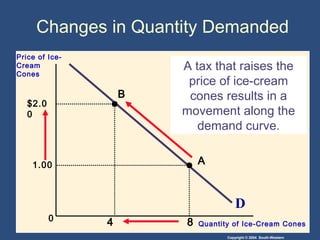
• The terms supply and demand refer to the
behavior of people . . . as they interact with one
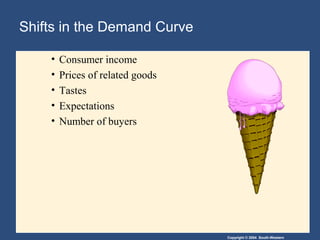
another in markets.
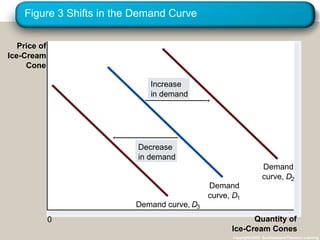
MARKETS AND COMPETITION
Copyright © 2004 South-Western
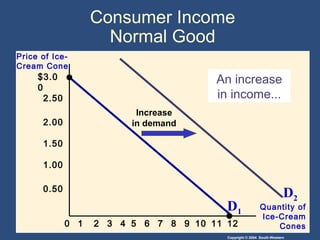
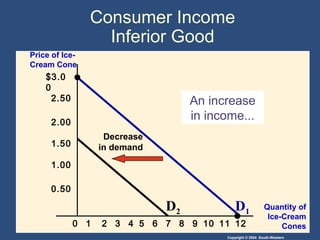
MARKETS AND COMPETITION
• Buyers determine demand.
• Sellers determine supply
Copyright © 2004 South-Western
Competitive Markets
• A competitive market is a market in which there
are many buyers and sellers so that each has a
negligible impact on the market price.
Copyright © 2004 South-Western
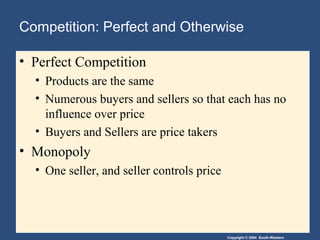
• Perfect Competition
• Products are the same
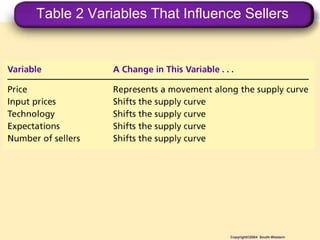
• Numerous buyers and sellers so that each has no
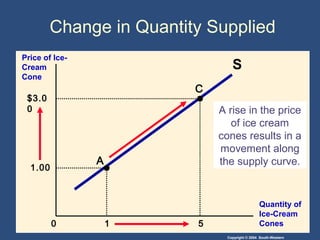
influence over price
• Buyers and Sellers are price takers
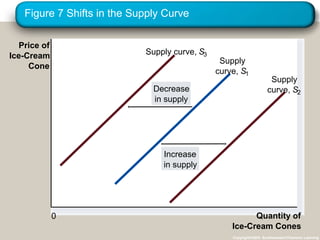
• Monopoly
• One seller, and seller controls price
Competition: Perfect and Otherwise
Copyright © 2004 South-Western
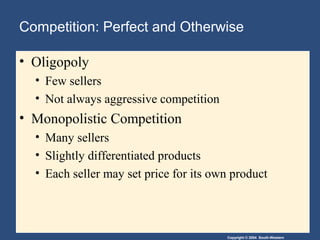
• Oligopoly
• Few sellers
• Not always aggressive competition
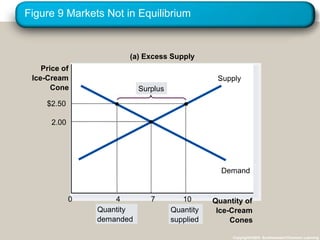
• Monopolistic Competition
• Many sellers
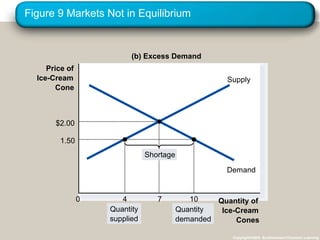
• Slightly differentiated products
• Each seller may set price for its own product
Competition: Perfect and Otherwise
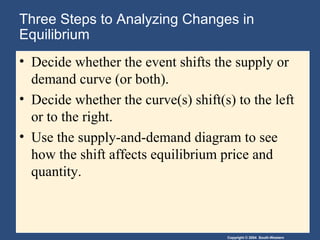
Copyright © 2004 South-Western
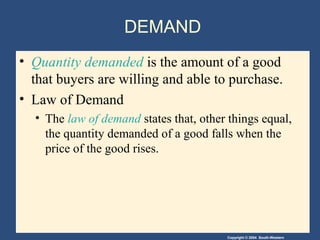
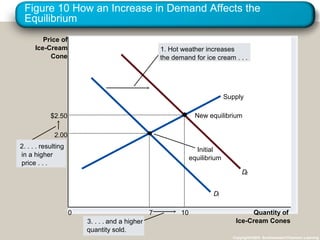
DEMAND
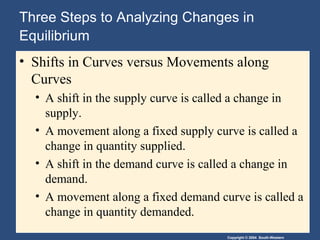
• Quantity demanded is the amount of a good
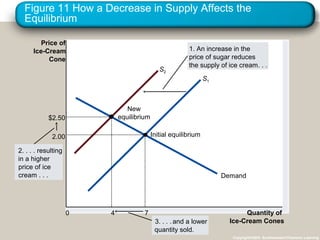
that buyers are willing and able to purchase.
• Law of Demand
• The law of demand states that, other things equal,
the quantity demanded of a good falls when the
price of the good rises.
Copyright © 2004 South-Western
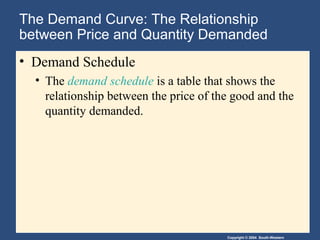
The Demand Curve: The Relationship
between Price and Quantity Demanded
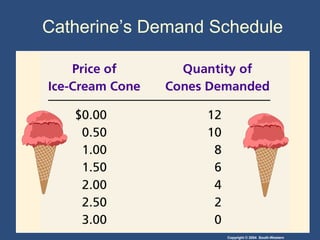
• Demand Schedule
• The demand schedule is a table that shows the
relationship between the price of the good and the
quantity demanded.
Copyright © 2004 South-Western
Catherine’s Demand Schedule
Copyright © 2004 South-Western
The Demand Curve: The Relationship
between Price and Quantity Demanded
• Demand Curve
• The demand curve is a graph of the relationship
between the price of a good and the quantity
demanded.
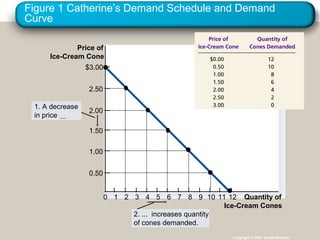
Figure 1 Catherine’s Demand Schedule and Demand
Curve
Copyright © 2004 South-Western
Price of
Ice-Cream Cone
0
2.50
2.00
1.50
1.00
0.50
1 2 3 4 5 6 7 8 9 10 11 Quantity of
Ice-Cream Cones
$3.00
12
1. A decrease
in price ...
2. ... increases quantity
of cones demanded.
Copyright © 2004 South-Western
Market Demand versus Individual Demand
• Market demand refers to the sum of all
individual demands for a particular good or
service.
• Graphically, individual demand curves are
summed horizontally to obtain the market
demand curve.
Copyright © 2004 South-Western
Shifts in the Demand Curve
• Change in Quantity Demanded
• Movement along the demand curve.
• Caused by a change in the price of the product.
Copyright © 2004 South-Western
0
D
Price of Ice-
Cream
Cones
Quantity of Ice-Cream Cones
A tax that raises the
price of ice-cream
cones results in a
movement along the
demand curve.
A
B
8
1.00
$2.0
0
4
Changes in Quantity Demanded
Copyright © 2004 South-Western
Shifts in the Demand Curve
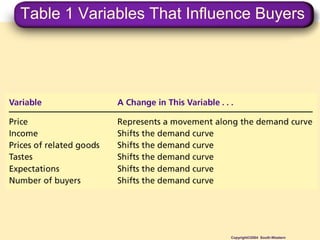
• Consumer income
• Prices of related goods
• Tastes
• Expectations
• Number of buyers
Copyright © 2004 South-Western
Shifts in the Demand Curve
• Change in Demand
• A shift in the demand curve, either to the left or
right.
• Caused by any change that alters the quantity
demanded at every price.
Figure 3 Shifts in the Demand Curve
Copyright©2003 Southwestern/Thomson Learning
Price of
Ice-Cream
Cone
Quantity of
Ice-Cream Cones
Increase
in demand
Decrease
in demand
Demand curve, D3
Demand
curve, D1
Demand
curve, D2
0
Copyright © 2004 South-Western
Shifts in the Demand Curve
• Consumer Income
• As income increases the demand for a normal good
will increase.
• As income increases the demand for an inferior
good will decrease.
Copyright © 2004 South-Western
$3.0
0
2.50
2.00
1.50
1.00
0.50
21 3 4 5 6 7 8 9 10 1211
Price of Ice-
Cream Cone
Quantity of
Ice-Cream
Cones0
Increase
in demand
An increase
in income...
D1
D2
Consumer Income
Normal Good
Copyright © 2004 South-Western
$3.0
0
2.50
2.00
1.50
1.00
0.50
21 3 4 5 6 7 8 9 10 1211
Price of Ice-
Cream Cone
Quantity of
Ice-Cream
Cones0
Decrease
in demand
An increase
in income...
D1D2
Consumer Income
Inferior Good
Copyright © 2004 South-Western
Shifts in the Demand Curve
• Prices of Related Goods
• When a fall in the price of one good reduces the
demand for another good, the two goods are called
substitutes.
• When a fall in the price of one good increases the
demand for another good, the two goods are called
complements.
Table 1 Variables That Influence Buyers
Copyright©2004 South-Western
Copyright © 2004 South-Western
SUPPLY
• Quantity supplied is the amount of a good that
sellers are willing and able to sell.
• Law of Supply
• The law of supply states that, other things equal, the
quantity supplied of a good rises when the price of
the good rises.
Copyright © 2004 South-Western
The Supply Curve: The Relationship between
Price and Quantity Supplied
• Supply Schedule
• The supply schedule is a table that shows the
relationship between the price of the good and the
quantity supplied.
Copyright © 2004 South-Western
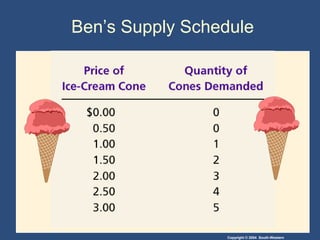
Ben’s Supply Schedule
Copyright © 2004 South-Western
The Supply Curve: The Relationship between
Price and Quantity Supplied
• Supply Curve
• The supply curve is the graph of the relationship
between the price of a good and the quantity
supplied.
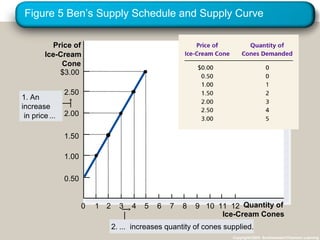
Figure 5 Ben’s Supply Schedule and Supply Curve
Copyright©2003 Southwestern/Thomson Learning
Price of
Ice-Cream
Cone
0
2.50
2.00
1.50
1.00
1 2 3 4 5 6 7 8 9 10 11 Quantity of
Ice-Cream Cones
$3.00
12
0.50
1. An
increase
in price...
2. ... increases quantity of cones supplied.
Copyright © 2004 South-Western
Market Supply versus Individual Supply
• Market supply refers to the sum of all
individual supplies for all sellers of a particular
good or service.
• Graphically, individual supply curves are
summed horizontally to obtain the market
supply curve.
Copyright © 2004 South-Western
Shifts in the Supply Curve
• Input prices
• Technology
• Expectations
• Number of sellers
Copyright © 2004 South-Western
Shifts in the Supply Curve
• Change in Quantity Supplied
• Movement along the supply curve.
• Caused by a change in anything that alters the
quantity supplied at each price.
Copyright © 2004 South-Western
1 5
Price of Ice-
Cream
Cone
Quantity of
Ice-Cream
Cones0
S
1.00
A
C
$3.0
0 A rise in the price
of ice cream
cones results in a
movement along
the supply curve.
Change in Quantity Supplied
Copyright © 2004 South-Western
Shifts in the Supply Curve
• Change in Supply
• A shift in the supply curve, either to the left or right.
• Caused by a change in a determinant other than
price.
Figure 7 Shifts in the Supply Curve
Copyright©2003 Southwestern/Thomson Learning
Price of
Ice-Cream
Cone
Quantity of
Ice-Cream Cones
0
Increase
in supply
Decrease
in supply
Supply curve, S3
curve,
Supply
S1
Supply
curve, S2
Table 2 Variables That Influence Sellers
Copyright©2004 South-Western
Copyright © 2004 South-Western
SUPPLY AND DEMAND
TOGETHER
• Equilibrium refers to a situation in which the
price has reached the level where quantity
supplied equals quantity demanded.
Copyright © 2004 South-Western
SUPPLY AND DEMAND
TOGETHER
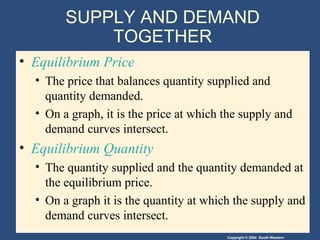
• Equilibrium Price
• The price that balances quantity supplied and
quantity demanded.
• On a graph, it is the price at which the supply and
demand curves intersect.
• Equilibrium Quantity
• The quantity supplied and the quantity demanded at
the equilibrium price.
• On a graph it is the quantity at which the supply and
demand curves intersect.
Copyright © 2004 South-Western
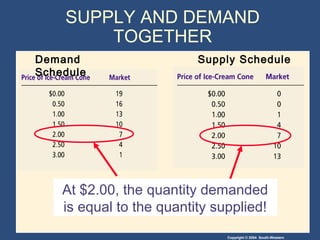
At $2.00, the quantity demanded
is equal to the quantity supplied!
SUPPLY AND DEMAND
TOGETHER
Demand
Schedule
Supply Schedule
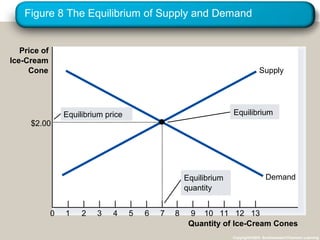
Figure 8 The Equilibrium of Supply and Demand
Copyright©2003 Southwestern/Thomson Learning
Price of
Ice-Cream
Cone
0 1 2 3 4 5 6 7 8 9 10 11 12
Quantity of Ice-Cream Cones
13
Equilibrium
quantity
Equilibrium price Equilibrium
Supply
Demand
$2.00
Figure 9 Markets Not in Equilibrium
Copyright©2003 Southwestern/Thomson Learning
Price of
Ice-Cream
Cone
0
Supply
Demand
(a) Excess Supply
Quantity
demanded
Quantity
supplied
Surplus
Quantity of
Ice-Cream
Cones
4
$2.50
10
2.00
7
Copyright © 2004 South-Western
Equilibrium
• Surplus
• When price > equilibrium price, then quantity
supplied > quantity demanded.
• There is excess supply or a surplus.
• Suppliers will lower the price to increase sales, thereby
moving toward equilibrium.
Copyright © 2004 South-Western
Equilibrium
• Shortage
• When price < equilibrium price, then quantity
demanded > the quantity supplied.
• There is excess demand or a shortage.
• Suppliers will raise the price due to too many buyers
chasing too few goods, thereby moving toward
equilibrium.
Figure 9 Markets Not in Equilibrium
Copyright©2003 Southwestern/Thomson Learning
Price of
Ice-Cream
Cone
0 Quantity of
Ice-Cream
Cones
Supply
Demand
(b) Excess Demand
Quantity
supplied
Quantity
demanded
1.50
10
$2.00
74
Shortage
Copyright © 2004 South-Western
Equilibrium
• Law of supply and demand
• The claim that the price of any good adjusts to bring
the quantity supplied and the quantity demanded for
that good into balance.
Copyright © 2004 South-Western
Three Steps to Analyzing Changes in
Equilibrium
• Decide whether the event shifts the supply or
demand curve (or both).
• Decide whether the curve(s) shift(s) to the left
or to the right.
• Use the supply-and-demand diagram to see
how the shift affects equilibrium price and
quantity.
Figure 10 How an Increase in Demand Affects the
Equilibrium
Copyright©2003 Southwestern/Thomson Learning
Price of
Ice-Cream
Cone
0 Quantity of
Ice-Cream Cones
Supply
Initial
equilibrium
D
D
3. . . . and a higher
quantity sold.
2. . . . resulting
in a higher
price . . .
1. Hot weather increases
the demand for ice cream . . .
2.00
7
New equilibrium$2.50
10
Copyright © 2004 South-Western
Three Steps to Analyzing Changes in
Equilibrium
• Shifts in Curves versus Movements along
Curves
• A shift in the supply curve is called a change in
supply.
• A movement along a fixed supply curve is called a
change in quantity supplied.
• A shift in the demand curve is called a change in
demand.
• A movement along a fixed demand curve is called a
change in quantity demanded.
Figure 11 How a Decrease in Supply Affects the
Equilibrium
Copyright©2003 Southwestern/Thomson Learning
Price of
Ice-Cream
Cone
0 Quantity of
Ice-Cream Cones
Demand
New
equilibrium
Initial equilibrium
S1
S2
2. . . . resulting
in a higher
price of ice
cream . . .
1. An increase in the
price of sugar reduces
the supply of ice cream. . .
3. . . . and a lower
quantity sold.
2.00
7
$2.50
4
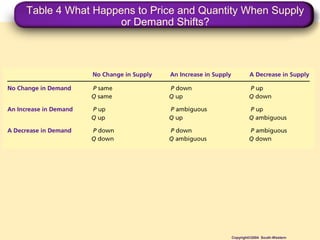
Table 4 What Happens to Price and Quantity When Supply
or Demand Shifts?
Copyright©2004 South-Western

Kuliah 2 demand and supply

  • 1.
    Copyright © 2004South-Western KULIAH 2 DAN 3 The Market Forces of Supply and Demand
  • 2.
    Copyright © 2004South-Western • Supply and demand are the two words that economists use most often. • Supply and demand are the forces that make market economies work. • Modern microeconomics is about supply, demand, and market equilibrium.
  • 3.
    Copyright © 2004South-Western • A market is a group of buyers and sellers of a particular good or service. • The terms supply and demand refer to the behavior of people . . . as they interact with one another in markets. MARKETS AND COMPETITION
  • 4.
    Copyright © 2004South-Western MARKETS AND COMPETITION • Buyers determine demand. • Sellers determine supply
  • 5.
    Copyright © 2004South-Western Competitive Markets • A competitive market is a market in which there are many buyers and sellers so that each has a negligible impact on the market price.
  • 6.
    Copyright © 2004South-Western • Perfect Competition • Products are the same • Numerous buyers and sellers so that each has no influence over price • Buyers and Sellers are price takers • Monopoly • One seller, and seller controls price Competition: Perfect and Otherwise
  • 7.
    Copyright © 2004South-Western • Oligopoly • Few sellers • Not always aggressive competition • Monopolistic Competition • Many sellers • Slightly differentiated products • Each seller may set price for its own product Competition: Perfect and Otherwise
  • 8.
    Copyright © 2004South-Western DEMAND • Quantity demanded is the amount of a good that buyers are willing and able to purchase. • Law of Demand • The law of demand states that, other things equal, the quantity demanded of a good falls when the price of the good rises.
  • 9.
    Copyright © 2004South-Western The Demand Curve: The Relationship between Price and Quantity Demanded • Demand Schedule • The demand schedule is a table that shows the relationship between the price of the good and the quantity demanded.
  • 10.
    Copyright © 2004South-Western Catherine’s Demand Schedule
  • 11.
    Copyright © 2004South-Western The Demand Curve: The Relationship between Price and Quantity Demanded • Demand Curve • The demand curve is a graph of the relationship between the price of a good and the quantity demanded.
  • 12.
    Figure 1 Catherine’sDemand Schedule and Demand Curve Copyright © 2004 South-Western Price of Ice-Cream Cone 0 2.50 2.00 1.50 1.00 0.50 1 2 3 4 5 6 7 8 9 10 11 Quantity of Ice-Cream Cones $3.00 12 1. A decrease in price ... 2. ... increases quantity of cones demanded.
  • 13.
    Copyright © 2004South-Western Market Demand versus Individual Demand • Market demand refers to the sum of all individual demands for a particular good or service. • Graphically, individual demand curves are summed horizontally to obtain the market demand curve.
  • 14.
    Copyright © 2004South-Western Shifts in the Demand Curve • Change in Quantity Demanded • Movement along the demand curve. • Caused by a change in the price of the product.
  • 15.
    Copyright © 2004South-Western 0 D Price of Ice- Cream Cones Quantity of Ice-Cream Cones A tax that raises the price of ice-cream cones results in a movement along the demand curve. A B 8 1.00 $2.0 0 4 Changes in Quantity Demanded
  • 16.
    Copyright © 2004South-Western Shifts in the Demand Curve • Consumer income • Prices of related goods • Tastes • Expectations • Number of buyers
  • 17.
    Copyright © 2004South-Western Shifts in the Demand Curve • Change in Demand • A shift in the demand curve, either to the left or right. • Caused by any change that alters the quantity demanded at every price.
  • 18.
    Figure 3 Shiftsin the Demand Curve Copyright©2003 Southwestern/Thomson Learning Price of Ice-Cream Cone Quantity of Ice-Cream Cones Increase in demand Decrease in demand Demand curve, D3 Demand curve, D1 Demand curve, D2 0
  • 19.
    Copyright © 2004South-Western Shifts in the Demand Curve • Consumer Income • As income increases the demand for a normal good will increase. • As income increases the demand for an inferior good will decrease.
  • 20.
    Copyright © 2004South-Western $3.0 0 2.50 2.00 1.50 1.00 0.50 21 3 4 5 6 7 8 9 10 1211 Price of Ice- Cream Cone Quantity of Ice-Cream Cones0 Increase in demand An increase in income... D1 D2 Consumer Income Normal Good
  • 21.
    Copyright © 2004South-Western $3.0 0 2.50 2.00 1.50 1.00 0.50 21 3 4 5 6 7 8 9 10 1211 Price of Ice- Cream Cone Quantity of Ice-Cream Cones0 Decrease in demand An increase in income... D1D2 Consumer Income Inferior Good
  • 22.
    Copyright © 2004South-Western Shifts in the Demand Curve • Prices of Related Goods • When a fall in the price of one good reduces the demand for another good, the two goods are called substitutes. • When a fall in the price of one good increases the demand for another good, the two goods are called complements.
  • 23.
    Table 1 VariablesThat Influence Buyers Copyright©2004 South-Western
  • 24.
    Copyright © 2004South-Western SUPPLY • Quantity supplied is the amount of a good that sellers are willing and able to sell. • Law of Supply • The law of supply states that, other things equal, the quantity supplied of a good rises when the price of the good rises.
  • 25.
    Copyright © 2004South-Western The Supply Curve: The Relationship between Price and Quantity Supplied • Supply Schedule • The supply schedule is a table that shows the relationship between the price of the good and the quantity supplied.
  • 26.
    Copyright © 2004South-Western Ben’s Supply Schedule
  • 27.
    Copyright © 2004South-Western The Supply Curve: The Relationship between Price and Quantity Supplied • Supply Curve • The supply curve is the graph of the relationship between the price of a good and the quantity supplied.
  • 28.
    Figure 5 Ben’sSupply Schedule and Supply Curve Copyright©2003 Southwestern/Thomson Learning Price of Ice-Cream Cone 0 2.50 2.00 1.50 1.00 1 2 3 4 5 6 7 8 9 10 11 Quantity of Ice-Cream Cones $3.00 12 0.50 1. An increase in price... 2. ... increases quantity of cones supplied.
  • 29.
    Copyright © 2004South-Western Market Supply versus Individual Supply • Market supply refers to the sum of all individual supplies for all sellers of a particular good or service. • Graphically, individual supply curves are summed horizontally to obtain the market supply curve.
  • 30.
    Copyright © 2004South-Western Shifts in the Supply Curve • Input prices • Technology • Expectations • Number of sellers
  • 31.
    Copyright © 2004South-Western Shifts in the Supply Curve • Change in Quantity Supplied • Movement along the supply curve. • Caused by a change in anything that alters the quantity supplied at each price.
  • 32.
    Copyright © 2004South-Western 1 5 Price of Ice- Cream Cone Quantity of Ice-Cream Cones0 S 1.00 A C $3.0 0 A rise in the price of ice cream cones results in a movement along the supply curve. Change in Quantity Supplied
  • 33.
    Copyright © 2004South-Western Shifts in the Supply Curve • Change in Supply • A shift in the supply curve, either to the left or right. • Caused by a change in a determinant other than price.
  • 34.
    Figure 7 Shiftsin the Supply Curve Copyright©2003 Southwestern/Thomson Learning Price of Ice-Cream Cone Quantity of Ice-Cream Cones 0 Increase in supply Decrease in supply Supply curve, S3 curve, Supply S1 Supply curve, S2
  • 35.
    Table 2 VariablesThat Influence Sellers Copyright©2004 South-Western
  • 36.
    Copyright © 2004South-Western SUPPLY AND DEMAND TOGETHER • Equilibrium refers to a situation in which the price has reached the level where quantity supplied equals quantity demanded.
  • 37.
    Copyright © 2004South-Western SUPPLY AND DEMAND TOGETHER • Equilibrium Price • The price that balances quantity supplied and quantity demanded. • On a graph, it is the price at which the supply and demand curves intersect. • Equilibrium Quantity • The quantity supplied and the quantity demanded at the equilibrium price. • On a graph it is the quantity at which the supply and demand curves intersect.
  • 38.
    Copyright © 2004South-Western At $2.00, the quantity demanded is equal to the quantity supplied! SUPPLY AND DEMAND TOGETHER Demand Schedule Supply Schedule
  • 39.
    Figure 8 TheEquilibrium of Supply and Demand Copyright©2003 Southwestern/Thomson Learning Price of Ice-Cream Cone 0 1 2 3 4 5 6 7 8 9 10 11 12 Quantity of Ice-Cream Cones 13 Equilibrium quantity Equilibrium price Equilibrium Supply Demand $2.00
  • 40.
    Figure 9 MarketsNot in Equilibrium Copyright©2003 Southwestern/Thomson Learning Price of Ice-Cream Cone 0 Supply Demand (a) Excess Supply Quantity demanded Quantity supplied Surplus Quantity of Ice-Cream Cones 4 $2.50 10 2.00 7
  • 41.
    Copyright © 2004South-Western Equilibrium • Surplus • When price > equilibrium price, then quantity supplied > quantity demanded. • There is excess supply or a surplus. • Suppliers will lower the price to increase sales, thereby moving toward equilibrium.
  • 42.
    Copyright © 2004South-Western Equilibrium • Shortage • When price < equilibrium price, then quantity demanded > the quantity supplied. • There is excess demand or a shortage. • Suppliers will raise the price due to too many buyers chasing too few goods, thereby moving toward equilibrium.
  • 43.
    Figure 9 MarketsNot in Equilibrium Copyright©2003 Southwestern/Thomson Learning Price of Ice-Cream Cone 0 Quantity of Ice-Cream Cones Supply Demand (b) Excess Demand Quantity supplied Quantity demanded 1.50 10 $2.00 74 Shortage
  • 44.
    Copyright © 2004South-Western Equilibrium • Law of supply and demand • The claim that the price of any good adjusts to bring the quantity supplied and the quantity demanded for that good into balance.
  • 45.
    Copyright © 2004South-Western Three Steps to Analyzing Changes in Equilibrium • Decide whether the event shifts the supply or demand curve (or both). • Decide whether the curve(s) shift(s) to the left or to the right. • Use the supply-and-demand diagram to see how the shift affects equilibrium price and quantity.
  • 46.
    Figure 10 Howan Increase in Demand Affects the Equilibrium Copyright©2003 Southwestern/Thomson Learning Price of Ice-Cream Cone 0 Quantity of Ice-Cream Cones Supply Initial equilibrium D D 3. . . . and a higher quantity sold. 2. . . . resulting in a higher price . . . 1. Hot weather increases the demand for ice cream . . . 2.00 7 New equilibrium$2.50 10
  • 47.
    Copyright © 2004South-Western Three Steps to Analyzing Changes in Equilibrium • Shifts in Curves versus Movements along Curves • A shift in the supply curve is called a change in supply. • A movement along a fixed supply curve is called a change in quantity supplied. • A shift in the demand curve is called a change in demand. • A movement along a fixed demand curve is called a change in quantity demanded.
  • 48.
    Figure 11 Howa Decrease in Supply Affects the Equilibrium Copyright©2003 Southwestern/Thomson Learning Price of Ice-Cream Cone 0 Quantity of Ice-Cream Cones Demand New equilibrium Initial equilibrium S1 S2 2. . . . resulting in a higher price of ice cream . . . 1. An increase in the price of sugar reduces the supply of ice cream. . . 3. . . . and a lower quantity sold. 2.00 7 $2.50 4
  • 49.
    Table 4 WhatHappens to Price and Quantity When Supply or Demand Shifts? Copyright©2004 South-Western