CHAPTER 3 : BRAND MANAGEMENT
BRAND IDENTITY
F.GAUCHER - Corporate Reputation and Brand Management
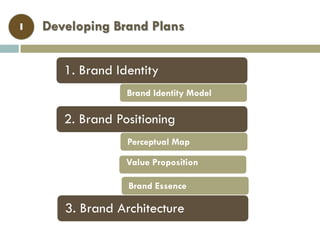
Developing Brand Plans
2. Brand Positioning
I
1. Brand Identity
3. Brand Architecture
Brand Essence
Perceptual Map
Value Proposition
Brand Identity Model
Brand Management – Brand Identity1
Developing Brand Plans – Brand Identity
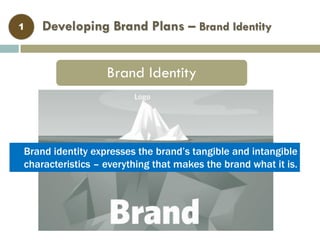
Brand Identity
1
Brand identity expresses the brand’s tangible and intangible
characteristics – everything that makes the brand what it is.
Developing Brand Plans – Brand Identity
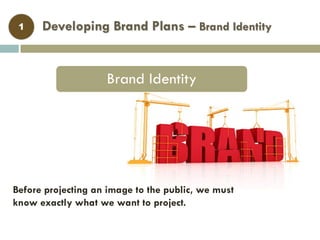
Brand Identity
1
Before projecting an image to the public, we must
know exactly what we want to project.
Developing Brand Plans – Brand Identity
Brand Identity
1
A company's brand identity is how that business wants to be
perceived by consumers (its target audience).
Brand Identity represents what the organization wants the
brand to stand for.
Developing Brand Plans – Brand Identity1
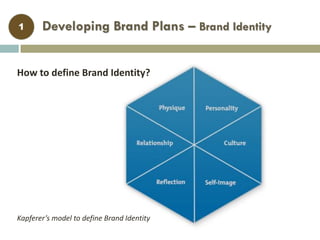
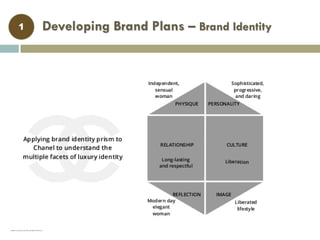
Kapferer’s model to define Brand Identity
How to define Brand Identity?
Developing Brand Plans – Brand Identity1
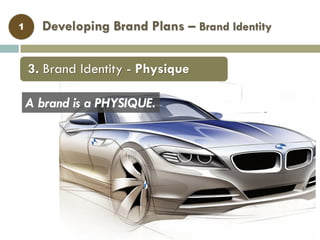
A brand is a PHYSIQUE.
3. Brand Identity - Physique
Developing Brand Plans – Brand Identity
1. Brand Identity - Physique
1
Tangible elements: Product, Design, Features
• Physique: the set of the brand physical features
• All the specific design and product features that
identify the brand
A brand has physical specificities and qualities
Developing Brand Plans – Brand Identity1Tangibleelements-Physique:
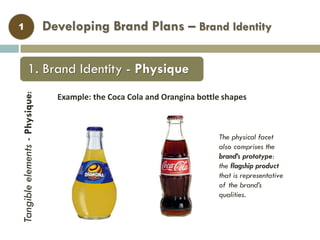
The physical facet
also comprises the
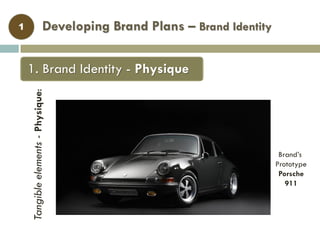
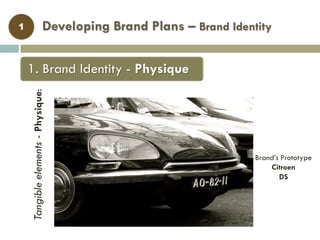
brand’s prototype:
the flagship product
that is representative
of the brand’s
qualities.
1. Brand Identity - Physique
Example: the Coca Cola and Orangina bottle shapes
Developing Brand Plans – Brand Identity1
Tangibleelements-Physique:
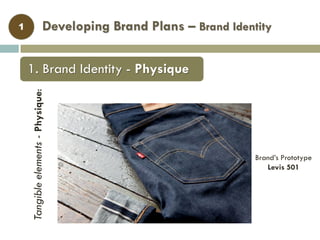
Brand’s Prototype
Levis 501
1. Brand Identity - Physique
Developing Brand Plans – Brand Identity1
Tangibleelements-Physique:
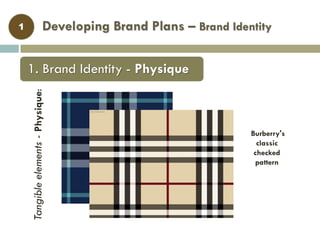
Burberry's
classic
checked
pattern
1. Brand Identity - Physique
Developing Brand Plans – Brand Identity1
Tangibleelements-Physique:
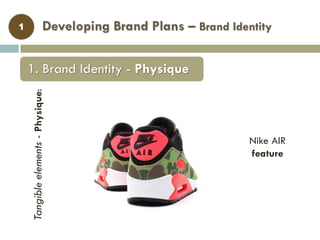
Nike AIR
feature
1. Brand Identity - Physique
Developing Brand Plans – Brand Identity1
Tangibleelements-Physique:
Brand’s
Prototype
Porsche
911
1. Brand Identity - Physique
Developing Brand Plans – Brand Identity1
Tangibleelements-Physique:
Brand’s Prototype
Citroen
DS
1. Brand Identity - Physique
Developing Brand Plans – Brand Identity1
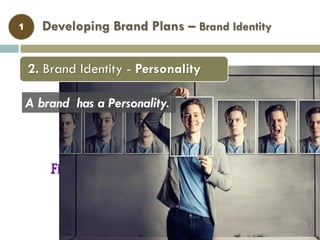
A brand has a Personality.
2. Brand Identity - Personality
Developing Brand Plans – Brand Identity1
• Brand personality: it is the brand character.
• Brand personality says how the brand
communicates with the outside world.
A brand has a personality
2. Brand Identity - Personality
Developing Brand Plans – Brand Identity1
How the brand communicates with the outside world:
• Using specific VI (Visual Identity): colors, typo, logo,
writing style or voice, etc.
• Personality traits: smart, professional, creative, etc.
2. Brand Identity - Personality
Developing Brand Plans – Brand Identity
Brand Identity (2)
1
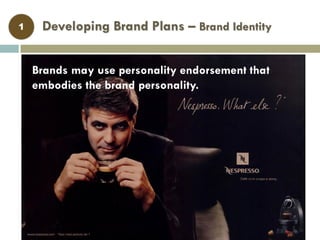
Brands may use personality endorsement that
embodies the brand personality.
Developing Brand Plans – Brand Identity
Brand Identity (2)
1
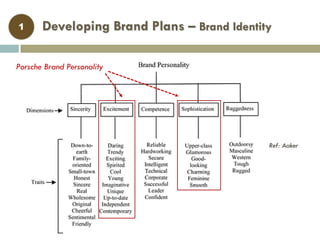
Ref: Aaker
Porsche Brand Personality
Developing Brand Plans – Brand Identity1
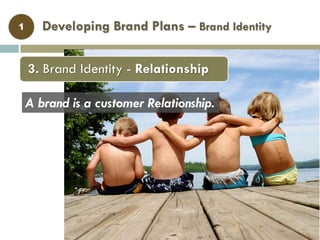
A brand is a customer Relationship.
3. Brand Identity - Relationship
Developing Brand Plans – Brand Identity1
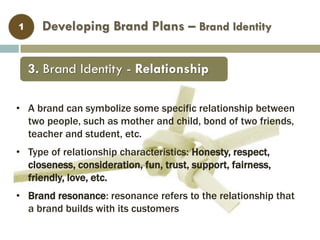
• A brand can symbolize some specific relationship between
two people, such as mother and child, bond of two friends,
teacher and student, etc.
• Type of relationship characteristics: Honesty, respect,
closeness, consideration, fun, trust, support, fairness,
friendly, love, etc.
• Brand resonance: resonance refers to the relationship that
a brand builds with its customers
3. Brand Identity - Relationship
Developing Brand Plans – Brand Identity1
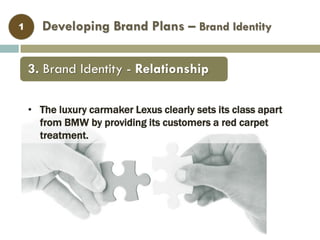
• The luxury carmaker Lexus clearly sets its class apart
from BMW by providing its customers a red carpet
treatment.
3. Brand Identity - Relationship
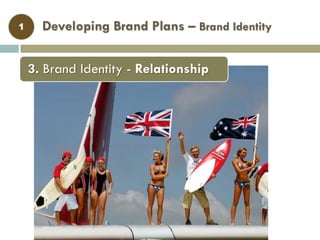
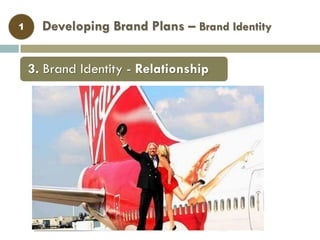
 Virgin: Customers are fun companions.
Developing Brand Plans – Brand Identity1
3. Brand Identity - Relationship
Developing Brand Plans – Brand Identity1
3. Brand Identity - Relationship
Developing Brand Plans – Brand Identity1
3. Brand Identity - Relationship
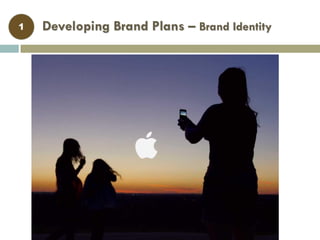
 Apple: Friendly and approachable
Developing Brand Plans – Brand Identity1
3. Brand Identity - Relationship
Developing Brand Plans – Brand Identity
Brand Identity (3)
1
Developing Brand Plans – Brand Identity
Brand Identity (3)
1
Developing Brand Plans – Brand Identity1
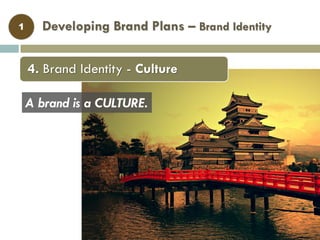
A brand is a CULTURE.
4. Brand Identity - Culture
Developing Brand Plans – Brand Identity1
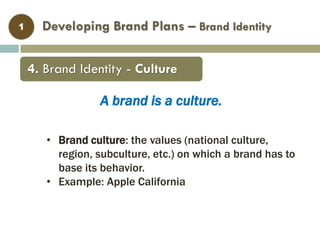
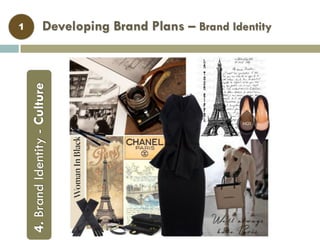
• Brand culture: the values (national culture,
region, subculture, etc.) on which a brand has to
base its behavior.
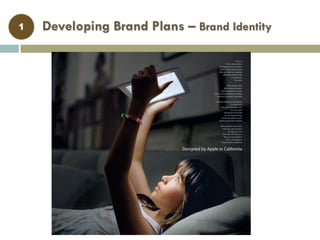
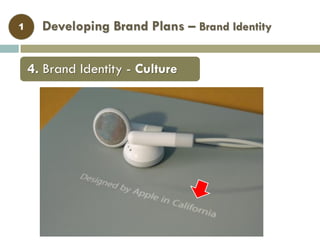
• Example: Apple California
A brand is a culture.
4. Brand Identity - Culture
Developing Brand Plans – Brand Identity1
4. Brand Identity - Culture
Developing Brand Plans – Brand Identity1
4.BrandIdentity-Culture
Developing Brand Plans – Brand Identity
Brand Identity
1
Developing Brand Plans – Brand Identity1
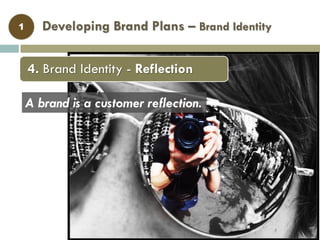
A brand is a customer reflection.
4. Brand Identity - Reflection
Developing Brand Plans – Brand Identity1
• Brand Reflection: A brand builds a reflection or an image
of the buyer or user.
• In other words, the brand's most stereotypical buyer.
• “that’s a brand for young people!”, “For fathers!”, “for
show-offs!”
4. Brand Identity - Reflection
Developing Brand Plans – Brand Identity1
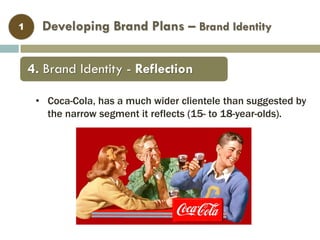
• Coca-Cola, has a much wider clientele than suggested by
the narrow segment it reflects (15- to 18-year-olds).
4. Brand Identity - Reflection
Developing Brand Plans – Brand Identity1
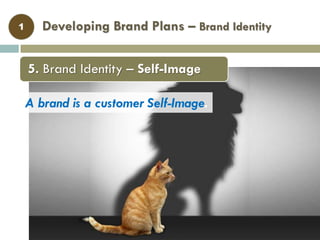
A brand is a customer Self-Image.
5. Brand Identity – Self-Image
Developing Brand Plans – Brand Identity1
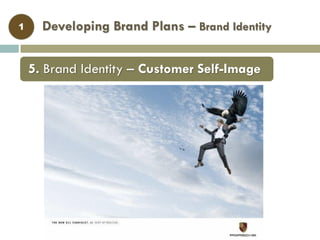
• Customer’s self image: the mirror the target group
holds up to itself
• Ex: Porsche is focusing on designing vehicles that
would reinforce the feeling of success, and
reflecting the customers’ high self-esteem, their
roles, and their status.
5. Brand Identity – Customer Self-Image
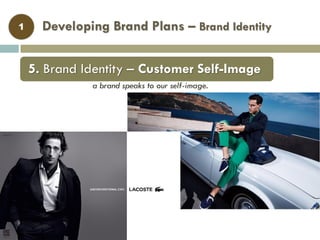
A brand speaks to our self-image.
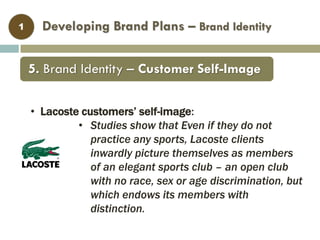
• Lacoste customers’ self-image:
• Studies show that Even if they do not
practice any sports, Lacoste clients
inwardly picture themselves as members
of an elegant sports club – an open club
with no race, sex or age discrimination, but
which endows its members with
distinction.
Developing Brand Plans – Brand Identity1
5. Brand Identity – Customer Self-Image
Developing Brand Plans – Brand Identity1
a brand speaks to our self-image.
5. Brand Identity – Customer Self-Image
Developing Brand Plans – Brand Identity1
5. Brand Identity – Customer Self-Image
Developing Brand Plans – Brand Identity
Brand Identity (3)
Developing Brand Plans – Brand Identity1

Brand Identity

  • 1.
    CHAPTER 3 :BRAND MANAGEMENT BRAND IDENTITY F.GAUCHER - Corporate Reputation and Brand Management
  • 2.
    Developing Brand Plans 2.Brand Positioning I 1. Brand Identity 3. Brand Architecture Brand Essence Perceptual Map Value Proposition Brand Identity Model
  • 3.
    Brand Management –Brand Identity1
  • 4.
    Developing Brand Plans– Brand Identity Brand Identity 1 Brand identity expresses the brand’s tangible and intangible characteristics – everything that makes the brand what it is.
  • 5.
    Developing Brand Plans– Brand Identity Brand Identity 1 Before projecting an image to the public, we must know exactly what we want to project.
  • 6.
    Developing Brand Plans– Brand Identity Brand Identity 1 A company's brand identity is how that business wants to be perceived by consumers (its target audience). Brand Identity represents what the organization wants the brand to stand for.
  • 7.
    Developing Brand Plans– Brand Identity1 Kapferer’s model to define Brand Identity How to define Brand Identity?
  • 8.
    Developing Brand Plans– Brand Identity1 A brand is a PHYSIQUE. 3. Brand Identity - Physique
  • 9.
    Developing Brand Plans– Brand Identity 1. Brand Identity - Physique 1 Tangible elements: Product, Design, Features • Physique: the set of the brand physical features • All the specific design and product features that identify the brand A brand has physical specificities and qualities
  • 10.
    Developing Brand Plans– Brand Identity1Tangibleelements-Physique: The physical facet also comprises the brand’s prototype: the flagship product that is representative of the brand’s qualities. 1. Brand Identity - Physique Example: the Coca Cola and Orangina bottle shapes
  • 11.
    Developing Brand Plans– Brand Identity1 Tangibleelements-Physique: Brand’s Prototype Levis 501 1. Brand Identity - Physique
  • 12.
    Developing Brand Plans– Brand Identity1 Tangibleelements-Physique: Burberry's classic checked pattern 1. Brand Identity - Physique
  • 13.
    Developing Brand Plans– Brand Identity1 Tangibleelements-Physique: Nike AIR feature 1. Brand Identity - Physique
  • 14.
    Developing Brand Plans– Brand Identity1 Tangibleelements-Physique: Brand’s Prototype Porsche 911 1. Brand Identity - Physique
  • 15.
    Developing Brand Plans– Brand Identity1 Tangibleelements-Physique: Brand’s Prototype Citroen DS 1. Brand Identity - Physique
  • 16.
    Developing Brand Plans– Brand Identity1 A brand has a Personality. 2. Brand Identity - Personality
  • 17.
    Developing Brand Plans– Brand Identity1 • Brand personality: it is the brand character. • Brand personality says how the brand communicates with the outside world. A brand has a personality 2. Brand Identity - Personality
  • 18.
    Developing Brand Plans– Brand Identity1 How the brand communicates with the outside world: • Using specific VI (Visual Identity): colors, typo, logo, writing style or voice, etc. • Personality traits: smart, professional, creative, etc. 2. Brand Identity - Personality
  • 19.
    Developing Brand Plans– Brand Identity Brand Identity (2) 1 Brands may use personality endorsement that embodies the brand personality.
  • 20.
    Developing Brand Plans– Brand Identity Brand Identity (2) 1 Ref: Aaker Porsche Brand Personality
  • 21.
    Developing Brand Plans– Brand Identity1 A brand is a customer Relationship. 3. Brand Identity - Relationship
  • 22.
    Developing Brand Plans– Brand Identity1 • A brand can symbolize some specific relationship between two people, such as mother and child, bond of two friends, teacher and student, etc. • Type of relationship characteristics: Honesty, respect, closeness, consideration, fun, trust, support, fairness, friendly, love, etc. • Brand resonance: resonance refers to the relationship that a brand builds with its customers 3. Brand Identity - Relationship
  • 23.
    Developing Brand Plans– Brand Identity1 • The luxury carmaker Lexus clearly sets its class apart from BMW by providing its customers a red carpet treatment. 3. Brand Identity - Relationship
  • 24.
     Virgin: Customersare fun companions. Developing Brand Plans – Brand Identity1 3. Brand Identity - Relationship
  • 25.
    Developing Brand Plans– Brand Identity1 3. Brand Identity - Relationship
  • 26.
    Developing Brand Plans– Brand Identity1 3. Brand Identity - Relationship
  • 27.
     Apple: Friendlyand approachable Developing Brand Plans – Brand Identity1 3. Brand Identity - Relationship
  • 28.
    Developing Brand Plans– Brand Identity Brand Identity (3) 1
  • 29.
    Developing Brand Plans– Brand Identity Brand Identity (3) 1
  • 30.
    Developing Brand Plans– Brand Identity1 A brand is a CULTURE. 4. Brand Identity - Culture
  • 31.
    Developing Brand Plans– Brand Identity1 • Brand culture: the values (national culture, region, subculture, etc.) on which a brand has to base its behavior. • Example: Apple California A brand is a culture. 4. Brand Identity - Culture
  • 32.
    Developing Brand Plans– Brand Identity1 4. Brand Identity - Culture
  • 33.
    Developing Brand Plans– Brand Identity1 4.BrandIdentity-Culture
  • 34.
    Developing Brand Plans– Brand Identity Brand Identity 1
  • 35.
    Developing Brand Plans– Brand Identity1 A brand is a customer reflection. 4. Brand Identity - Reflection
  • 36.
    Developing Brand Plans– Brand Identity1 • Brand Reflection: A brand builds a reflection or an image of the buyer or user. • In other words, the brand's most stereotypical buyer. • “that’s a brand for young people!”, “For fathers!”, “for show-offs!” 4. Brand Identity - Reflection
  • 37.
    Developing Brand Plans– Brand Identity1 • Coca-Cola, has a much wider clientele than suggested by the narrow segment it reflects (15- to 18-year-olds). 4. Brand Identity - Reflection
  • 38.
    Developing Brand Plans– Brand Identity1 A brand is a customer Self-Image. 5. Brand Identity – Self-Image
  • 39.
    Developing Brand Plans– Brand Identity1 • Customer’s self image: the mirror the target group holds up to itself • Ex: Porsche is focusing on designing vehicles that would reinforce the feeling of success, and reflecting the customers’ high self-esteem, their roles, and their status. 5. Brand Identity – Customer Self-Image A brand speaks to our self-image.
  • 40.
    • Lacoste customers’self-image: • Studies show that Even if they do not practice any sports, Lacoste clients inwardly picture themselves as members of an elegant sports club – an open club with no race, sex or age discrimination, but which endows its members with distinction. Developing Brand Plans – Brand Identity1 5. Brand Identity – Customer Self-Image
  • 41.
    Developing Brand Plans– Brand Identity1 a brand speaks to our self-image. 5. Brand Identity – Customer Self-Image
  • 42.
    Developing Brand Plans– Brand Identity1 5. Brand Identity – Customer Self-Image
  • 43.
    Developing Brand Plans– Brand Identity Brand Identity (3)
  • 44.
    Developing Brand Plans– Brand Identity1