


Kubernetes Security Best Practices
Connor Gorman, Principal Engineer, StackRox
21 February 2020
2©2019 StackRox. All rights reserved.
What we’ll cover
• General Kubernetes hygiene
• Workload best practices
• Demo
• Questions?
3©2019 StackRox. All rights reserved.
What are we doing here?
4©2019 StackRox. All rights reserved.
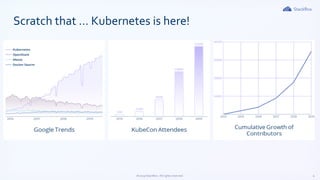
Scratch that … Kubernetes is here!
5©2019 StackRox. All rights reserved.
Kubernetes Hygiene
6©2019 StackRox. All rights reserved.
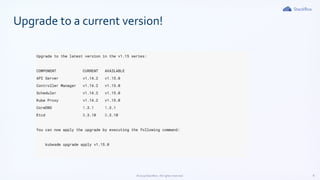
Upgrade to a current version!
7©2019 StackRox. All rights reserved.
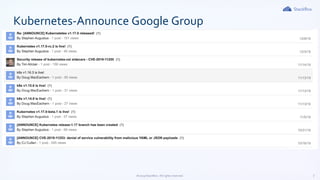
Keep up to date with Security and major API announcements
https://groups.google.com/forum/#!forum/kubernetes-announce
Kubernetes-Announce Google Group
8©2019 StackRox. All rights reserved.
Harden Node Security
Control network access to sensitive ports.
Make sure that your network blocks access to ports used by kubelet, including 10250 and
10255. Consider limiting access to the Kubernetes API server except from trusted
networks.
9©2019 StackRox. All rights reserved.
Harden Node Security
Minimize administrative access to Kubernetes nodes.
Access to the nodes in your cluster should generally be restricted — debugging and other
tasks can usually be handled without direct access to the node.
10©2019 StackRox. All rights reserved.
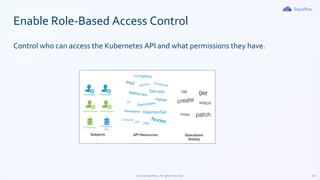
Enable Role-Based Access Control
Control who can access the Kubernetes API and what permissions they have.
11©2019 StackRox. All rights reserved.
Workload Best Practices
12©2019 StackRox. All rights reserved.
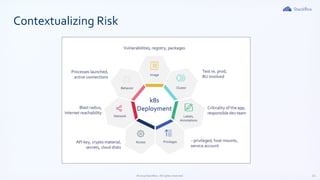
Contextualizing Risk
13©2019 StackRox. All rights reserved.
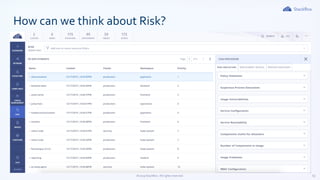
How can we think about Risk?
14©2019 StackRox. All rights reserved.
Leverage Namespaces
• Great for resource usage tracking
• Allows RBAC to be finely-tuned
• Allows for generic network policies and network segmentation
• Makes kubectl results more sane
15©2019 StackRox. All rights reserved.
Leverage Network Policies
• Pod-centric firewalling - Pod A can/can’t talk to Pod B
• Generic policies on Ingress/Egress can help ensure fine-grained connections
• Namespace isolation helps ensure compliance especially in multi-tenant
environments
Challenges
• What if my environment already exists?
• How can I scale network policies at my organization?
• How do I make sure that developers are enabled to build their own network
policies?
16©2019 StackRox. All rights reserved.
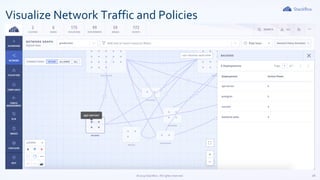
Visualize Network Traffic and Policies
17©2019 StackRox. All rights reserved.
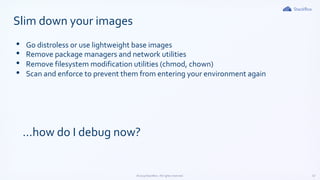
Slim down your images
• Go distroless or use lightweight base images
• Remove package managers and network utilities
• Remove filesystem modification utilities (chmod, chown)
• Scan and enforce to prevent them from entering your environment again
...how do I debug now?
18©2019 StackRox. All rights reserved.
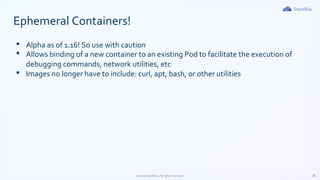
• Alpha as of 1.16! So use with caution
• Allows binding of a new container to an existing Pod to facilitate the execution of
debugging commands, network utilities, etc
• Images no longer have to include: curl, apt, bash, or other utilities
Ephemeral Containers!
19©2019 StackRox. All rights reserved.
Demo
20©2019 StackRox. All rights reserved.
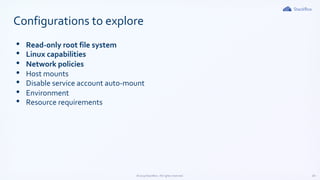
Configurations to explore
• Read-only root file system
• Linux capabilities
• Network policies
• Host mounts
• Disable service account auto-mount
• Environment
• Resource requirements
21©2019 StackRox. All rights reserved.
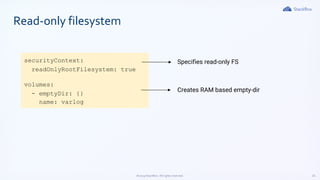
Read-only filesystem
securityContext:
readOnlyRootFilesystem: true
volumes:
- emptyDir: {}
name: varlog
Specifies read-only FS
Creates RAM based empty-dir
22©2019 StackRox. All rights reserved.
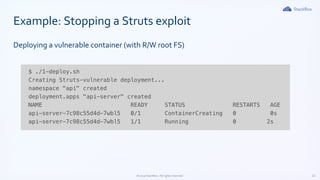
Example: Stopping a Struts exploit
Deploying a vulnerable container (with R/W root FS)
23©2019 StackRox. All rights reserved.
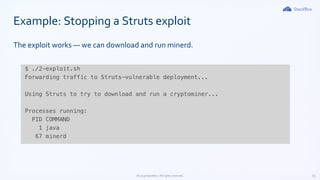
Example: Stopping a Struts exploit
The exploit works — we can download and run minerd.
24©2019 StackRox. All rights reserved.
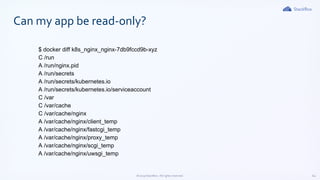
Can my app be read-only?
$ docker diff k8s_nginx_nginx-7db9fccd9b-xyz
C /run
A /run/nginx.pid
A /run/secrets
A /run/secrets/kubernetes.io
A /run/secrets/kubernetes.io/serviceaccount
C /var
C /var/cache
C /var/cache/nginx
A /var/cache/nginx/client_temp
A /var/cache/nginx/fastcgi_temp
A /var/cache/nginx/proxy_temp
A /var/cache/nginx/scgi_temp
A /var/cache/nginx/uwsgi_temp
25©2019 StackRox. All rights reserved.
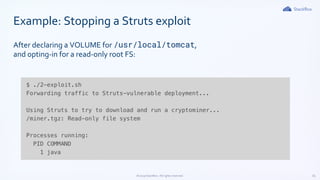
Example: Stopping a Struts exploit
After declaring a VOLUME for /usr/local/tomcat,
and opting-in for a read-only root FS:
26©2019 StackRox. All rights reserved.
Linux Capabilities
Split root superpowers into a series of capabilities such as
- CAP_FOWNER (used by chmod)
- CAP_CHOWN (used by chown)
- CAP_NET_RAW (used by ping)
27©2019 StackRox. All rights reserved.
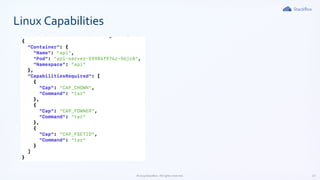
Linux Capabilities
28©2019 StackRox. All rights reserved.
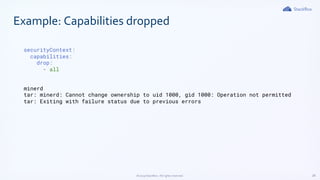
securityContext:
capabilities:
drop:
- all
minerd
tar: minerd: Cannot change ownership to uid 1000, gid 1000: Operation not permitted
tar: Exiting with failure status due to previous errors
Example: Capabilities dropped
29©2019 StackRox. All rights reserved.
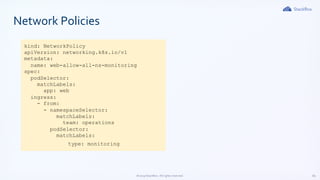
Network Policies
kind: NetworkPolicy
apiVersion: networking.k8s.io/v1
metadata:
name: web-allow-all-ns-monitoring
spec:
podSelector:
matchLabels:
app: web
ingress:
- from:
- namespaceSelector:
matchLabels:
team: operations
podSelector:
matchLabels:
type: monitoring
30©2019 StackRox. All rights reserved.
Security is Hard!
31©2019 StackRox. All rights reserved.
Let’s chat
Think of a question later?
cgorman@stackrox.com
Want to learn more?
https://www.stackrox.com/
We’re hiring!

Kubernetes Security Best Practices for DevOps

  • 1.
    Kubernetes Security BestPractices Connor Gorman, Principal Engineer, StackRox 21 February 2020
  • 2.
    2©2019 StackRox. Allrights reserved. What we’ll cover • General Kubernetes hygiene • Workload best practices • Demo • Questions?
  • 3.
    3©2019 StackRox. Allrights reserved. What are we doing here?
  • 4.
    4©2019 StackRox. Allrights reserved. Scratch that … Kubernetes is here!
  • 5.
    5©2019 StackRox. Allrights reserved. Kubernetes Hygiene
  • 6.
    6©2019 StackRox. Allrights reserved. Upgrade to a current version!
  • 7.
    7©2019 StackRox. Allrights reserved. Keep up to date with Security and major API announcements https://groups.google.com/forum/#!forum/kubernetes-announce Kubernetes-Announce Google Group
  • 8.
    8©2019 StackRox. Allrights reserved. Harden Node Security Control network access to sensitive ports. Make sure that your network blocks access to ports used by kubelet, including 10250 and 10255. Consider limiting access to the Kubernetes API server except from trusted networks.
  • 9.
    9©2019 StackRox. Allrights reserved. Harden Node Security Minimize administrative access to Kubernetes nodes. Access to the nodes in your cluster should generally be restricted — debugging and other tasks can usually be handled without direct access to the node.
  • 10.
    10©2019 StackRox. Allrights reserved. Enable Role-Based Access Control Control who can access the Kubernetes API and what permissions they have.
  • 11.
    11©2019 StackRox. Allrights reserved. Workload Best Practices
  • 12.
    12©2019 StackRox. Allrights reserved. Contextualizing Risk
  • 13.
    13©2019 StackRox. Allrights reserved. How can we think about Risk?
  • 14.
    14©2019 StackRox. Allrights reserved. Leverage Namespaces • Great for resource usage tracking • Allows RBAC to be finely-tuned • Allows for generic network policies and network segmentation • Makes kubectl results more sane
  • 15.
    15©2019 StackRox. Allrights reserved. Leverage Network Policies • Pod-centric firewalling - Pod A can/can’t talk to Pod B • Generic policies on Ingress/Egress can help ensure fine-grained connections • Namespace isolation helps ensure compliance especially in multi-tenant environments Challenges • What if my environment already exists? • How can I scale network policies at my organization? • How do I make sure that developers are enabled to build their own network policies?
  • 16.
    16©2019 StackRox. Allrights reserved. Visualize Network Traffic and Policies
  • 17.
    17©2019 StackRox. Allrights reserved. Slim down your images • Go distroless or use lightweight base images • Remove package managers and network utilities • Remove filesystem modification utilities (chmod, chown) • Scan and enforce to prevent them from entering your environment again ...how do I debug now?
  • 18.
    18©2019 StackRox. Allrights reserved. • Alpha as of 1.16! So use with caution • Allows binding of a new container to an existing Pod to facilitate the execution of debugging commands, network utilities, etc • Images no longer have to include: curl, apt, bash, or other utilities Ephemeral Containers!
  • 19.
    19©2019 StackRox. Allrights reserved. Demo
  • 20.
    20©2019 StackRox. Allrights reserved. Configurations to explore • Read-only root file system • Linux capabilities • Network policies • Host mounts • Disable service account auto-mount • Environment • Resource requirements
  • 21.
    21©2019 StackRox. Allrights reserved. Read-only filesystem securityContext: readOnlyRootFilesystem: true volumes: - emptyDir: {} name: varlog Specifies read-only FS Creates RAM based empty-dir
  • 22.
    22©2019 StackRox. Allrights reserved. Example: Stopping a Struts exploit Deploying a vulnerable container (with R/W root FS)
  • 23.
    23©2019 StackRox. Allrights reserved. Example: Stopping a Struts exploit The exploit works — we can download and run minerd.
  • 24.
    24©2019 StackRox. Allrights reserved. Can my app be read-only? $ docker diff k8s_nginx_nginx-7db9fccd9b-xyz C /run A /run/nginx.pid A /run/secrets A /run/secrets/kubernetes.io A /run/secrets/kubernetes.io/serviceaccount C /var C /var/cache C /var/cache/nginx A /var/cache/nginx/client_temp A /var/cache/nginx/fastcgi_temp A /var/cache/nginx/proxy_temp A /var/cache/nginx/scgi_temp A /var/cache/nginx/uwsgi_temp
  • 25.
    25©2019 StackRox. Allrights reserved. Example: Stopping a Struts exploit After declaring a VOLUME for /usr/local/tomcat, and opting-in for a read-only root FS:
  • 26.
    26©2019 StackRox. Allrights reserved. Linux Capabilities Split root superpowers into a series of capabilities such as - CAP_FOWNER (used by chmod) - CAP_CHOWN (used by chown) - CAP_NET_RAW (used by ping)
  • 27.
    27©2019 StackRox. Allrights reserved. Linux Capabilities
  • 28.
    28©2019 StackRox. Allrights reserved. securityContext: capabilities: drop: - all minerd tar: minerd: Cannot change ownership to uid 1000, gid 1000: Operation not permitted tar: Exiting with failure status due to previous errors Example: Capabilities dropped
  • 29.
    29©2019 StackRox. Allrights reserved. Network Policies kind: NetworkPolicy apiVersion: networking.k8s.io/v1 metadata: name: web-allow-all-ns-monitoring spec: podSelector: matchLabels: app: web ingress: - from: - namespaceSelector: matchLabels: team: operations podSelector: matchLabels: type: monitoring
  • 30.
    30©2019 StackRox. Allrights reserved. Security is Hard!
  • 31.
    31©2019 StackRox. Allrights reserved. Let’s chat Think of a question later? cgorman@stackrox.com Want to learn more? https://www.stackrox.com/ We’re hiring!