Learning Theories and Serious Games Dr Aristidis Protopsaltis Serious Games Institute [email_address]
Overview History Background  Serious Games and Pedagogy Assessment Examples
History Applied Research Group 5 researchers Erasmus students / placement students  19 funded projects MSc in Serious Games and Digital Content
 
Background: definitions Serious games as a term has been around for over 40 years. in 1968 Clark Abt called his book “Serious Games”. His definition of such games was that they: “ have an explicit and carefully thought-out educational purpose and are not intended to be played primarily for amusement. This does not mean that serious games are not, or should not be, entertaining.” (Abt 1970, p9). Serious game: a mental contest, played with a computer in accordance with specific rules, that uses entertainment to further government or corporate training, education, health, public policy, and strategic communication objectives” (Zyda, 2005, p.25).
Background: definitions Serious Games are defined as digital games and equipment with an agenda of educational design and beyond entertainment (Sorensen & Meyer 2007, p.559). “ there is no one single definition of the term “serious games”, although it is widely accepted that they are games “with a purpose”. in other words, they move beyond entertainment per se to deliver engaging interactive media to support learning in its broadest sense.” (Stone 2008, p.9). there is no agreement in definition. However, there is a consensus around serious games:  having a learning objective (whether explicit or not),  being an engaging interactive media,  having some game element.
Background it is argued that digital games, including simulations and virtual worlds, have the potential to be an important teaching tool because they are: interactive,  engaging and  immersive activities
 
Serious Games and Pedagogy there is no uniform pedagogy within serious games;  earlier games tended to be based on a behaviourist model.  later games try and incorporate experiential, situated and socio-cultural pedagogical models.
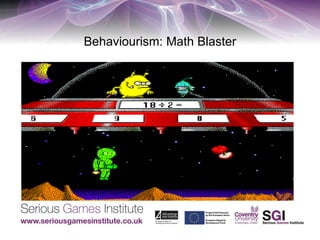
Serious Games and Pedagogy: behaviourism Behaviourism: learning occurred through conditioning with the game element typically being a reward for the correct response to the stimuli. these games are often called edutainment.   For example, in Mathblaster! the player’s reward is to shoot balloons if getting a sum correct – the sum itself is separate from the reward. Brain training games would fall into this category. Edutainment games tend to be based on tests, formats can include: −  an objective test game −  a subjective test game −  a selective test game −  a drag-and-drop test game −  a memory-like game −  an arcade game
Behaviourism: Math Blaster
Serious Games and Pedagogy: cognitivism Cognitivism: The learner became the centre of attention  and acquires knowledge through a variety of different modalities (e.g. text, pictures, sounds). these enable the player to identify and analyse problems and apply past learning. learning is the process of connecting symbols in a meaningful and memorable way.  the player is immersed in a world that enables them to include feelings and emotions with the social, the player can interact with fellow participants in the virtual environment as well as acquiring and using knowledge gained.
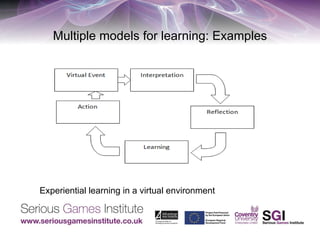
Serious Games and Pedagogy: multiple models for learning Multiple models for learning: Constructivism became  constructionism  – where learning is reinforced by having to explain it. learners construct mental models to understand the world around them. Others used the  experiential  learning theory, where one learns by doing (as well as seeing and hearing).  Kolb’s learning cycle relates to experiential learning as it consists of:  concrete learning,  reflective observation,  abstract conceptualisation (forming a theory based experience) and  active experimentation – the decision and problem solving stage. this can be illustrated by games such as ventureSim  and Global Conflict: Palestine .
Multiple models for learning: Examples Experiential learning in a virtual environment
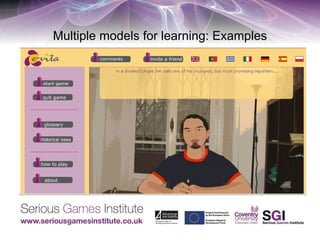
Multiple models for learning: Examples
Serious Games and Pedagogy: multiple models for learning experience-based learning  is well-suited to games.  Situated learning  has been incorporated, that is, information used in context through a creation of a setting close to reality can easily be transferred to the real world.  Simulations such as that used by the military often use this model.  Socio-cultural theory  describes how games can be used as tools to mediate learning through discussion, reflection and analysis – with learning facilitated by the culture and identity of the learner.
Serious Games and Pedagogy: multiple models for learning the final model is the  full-learning cycle . learning starts with an initial understanding, that knowledge is tested, and the feedback results in a refined model (binSubaih et al. 2009).
Assessment “ Designing ways to collect data on learning in simulation and gaming is particularly difficult because of the open-ended nature of these activities” (Chin et al. 2009). Some pedagogies incorporate testing. there are explicit scoring mechanisms that can be used in edutainment; the number of correct answers, and possibly time taken to complete a game are measures.
Assessment James Gee and David Shaffer argue that games are good assessment engines, which is why they are good learning engines. Gee and Shaffer focus on skills such as the ability to innovate, collaborate, think critically, produce digital media, perform system thinking (i.e. to recognise the relationship between elements) and enhance civic engagement.
Assessment Measuring how well these skills are demonstrated is complex, multiple choice tests are an inappropriate measurement. Their conclusion is that there needs to be a rethink about what is assessed, a shift from the factual to the process. assessment could be informal, where the attitude and appreciation of others indicates achievement.
Assessment Progress can be assessed through mechanisms such as high scores, leader boards, winning and losing a scenario, or completing a boss level. Although in formal education good work may be rewarded by a star, and is frequently assessed numerically, the idea of comparing scores and creating league tables of students is not commonly advocated. However, it is interesting to note that young people respond to such measures. Most existing assessment systems are bespoke to the game.
Examples thus games need to address these areas. Games that align to the curriculum appear to have a wider take up than those that are pedagogically sound and engaging but have no clear relationship.
Climate Health Impact
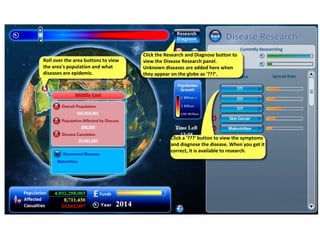
Roll over the area buttons to view the area's population and what diseases are epidemic. Click the Research and Diagnose button to view the Disease Research panel. Unknown diseases are added here when they appear on the globe as '???'. Click a '???' button to view the symptoms and diagnose the disease. When you get it correct, it is available to research.
When the time runs out you are given a breakdown of your score, including the amount of people you saved (or didn’t save), your diagnosis ability, the policies you chose, and the diseases you successfully researched. All you need to do now is play again and try and beat that score.
the real promise of games as educational and tools is in their ability to demonstrate the complexity and interconnectedness of issues. Games, like all media, can’t ever really change behaviour;  a game about nutrition won’t magically turn a player healthy,  just as a game about criminality won’t magically turn a player criminal.
Thank you Any questions?

Learning theories and Serious Games

  • 1.
    Learning Theories andSerious Games Dr Aristidis Protopsaltis Serious Games Institute [email_address]
  • 2.
    Overview History Background Serious Games and Pedagogy Assessment Examples
  • 3.
    History Applied ResearchGroup 5 researchers Erasmus students / placement students 19 funded projects MSc in Serious Games and Digital Content
  • 4.
  • 5.
    Background: definitions Seriousgames as a term has been around for over 40 years. in 1968 Clark Abt called his book “Serious Games”. His definition of such games was that they: “ have an explicit and carefully thought-out educational purpose and are not intended to be played primarily for amusement. This does not mean that serious games are not, or should not be, entertaining.” (Abt 1970, p9). Serious game: a mental contest, played with a computer in accordance with specific rules, that uses entertainment to further government or corporate training, education, health, public policy, and strategic communication objectives” (Zyda, 2005, p.25).
  • 6.
    Background: definitions SeriousGames are defined as digital games and equipment with an agenda of educational design and beyond entertainment (Sorensen & Meyer 2007, p.559). “ there is no one single definition of the term “serious games”, although it is widely accepted that they are games “with a purpose”. in other words, they move beyond entertainment per se to deliver engaging interactive media to support learning in its broadest sense.” (Stone 2008, p.9). there is no agreement in definition. However, there is a consensus around serious games: having a learning objective (whether explicit or not), being an engaging interactive media, having some game element.
  • 7.
    Background it isargued that digital games, including simulations and virtual worlds, have the potential to be an important teaching tool because they are: interactive, engaging and immersive activities
  • 8.
  • 9.
    Serious Games andPedagogy there is no uniform pedagogy within serious games; earlier games tended to be based on a behaviourist model. later games try and incorporate experiential, situated and socio-cultural pedagogical models.
  • 10.
    Serious Games andPedagogy: behaviourism Behaviourism: learning occurred through conditioning with the game element typically being a reward for the correct response to the stimuli. these games are often called edutainment. For example, in Mathblaster! the player’s reward is to shoot balloons if getting a sum correct – the sum itself is separate from the reward. Brain training games would fall into this category. Edutainment games tend to be based on tests, formats can include: − an objective test game − a subjective test game − a selective test game − a drag-and-drop test game − a memory-like game − an arcade game
  • 11.
  • 12.
    Serious Games andPedagogy: cognitivism Cognitivism: The learner became the centre of attention and acquires knowledge through a variety of different modalities (e.g. text, pictures, sounds). these enable the player to identify and analyse problems and apply past learning. learning is the process of connecting symbols in a meaningful and memorable way. the player is immersed in a world that enables them to include feelings and emotions with the social, the player can interact with fellow participants in the virtual environment as well as acquiring and using knowledge gained.
  • 13.
    Serious Games andPedagogy: multiple models for learning Multiple models for learning: Constructivism became constructionism – where learning is reinforced by having to explain it. learners construct mental models to understand the world around them. Others used the experiential learning theory, where one learns by doing (as well as seeing and hearing). Kolb’s learning cycle relates to experiential learning as it consists of: concrete learning, reflective observation, abstract conceptualisation (forming a theory based experience) and active experimentation – the decision and problem solving stage. this can be illustrated by games such as ventureSim and Global Conflict: Palestine .
  • 14.
    Multiple models forlearning: Examples Experiential learning in a virtual environment
  • 15.
    Multiple models forlearning: Examples
  • 16.
    Serious Games andPedagogy: multiple models for learning experience-based learning is well-suited to games. Situated learning has been incorporated, that is, information used in context through a creation of a setting close to reality can easily be transferred to the real world. Simulations such as that used by the military often use this model. Socio-cultural theory describes how games can be used as tools to mediate learning through discussion, reflection and analysis – with learning facilitated by the culture and identity of the learner.
  • 17.
    Serious Games andPedagogy: multiple models for learning the final model is the full-learning cycle . learning starts with an initial understanding, that knowledge is tested, and the feedback results in a refined model (binSubaih et al. 2009).
  • 18.
    Assessment “ Designingways to collect data on learning in simulation and gaming is particularly difficult because of the open-ended nature of these activities” (Chin et al. 2009). Some pedagogies incorporate testing. there are explicit scoring mechanisms that can be used in edutainment; the number of correct answers, and possibly time taken to complete a game are measures.
  • 19.
    Assessment James Geeand David Shaffer argue that games are good assessment engines, which is why they are good learning engines. Gee and Shaffer focus on skills such as the ability to innovate, collaborate, think critically, produce digital media, perform system thinking (i.e. to recognise the relationship between elements) and enhance civic engagement.
  • 20.
    Assessment Measuring howwell these skills are demonstrated is complex, multiple choice tests are an inappropriate measurement. Their conclusion is that there needs to be a rethink about what is assessed, a shift from the factual to the process. assessment could be informal, where the attitude and appreciation of others indicates achievement.
  • 21.
    Assessment Progress canbe assessed through mechanisms such as high scores, leader boards, winning and losing a scenario, or completing a boss level. Although in formal education good work may be rewarded by a star, and is frequently assessed numerically, the idea of comparing scores and creating league tables of students is not commonly advocated. However, it is interesting to note that young people respond to such measures. Most existing assessment systems are bespoke to the game.
  • 22.
    Examples thus gamesneed to address these areas. Games that align to the curriculum appear to have a wider take up than those that are pedagogically sound and engaging but have no clear relationship.
  • 23.
  • 24.
    Roll over thearea buttons to view the area's population and what diseases are epidemic. Click the Research and Diagnose button to view the Disease Research panel. Unknown diseases are added here when they appear on the globe as '???'. Click a '???' button to view the symptoms and diagnose the disease. When you get it correct, it is available to research.
  • 25.
    When the timeruns out you are given a breakdown of your score, including the amount of people you saved (or didn’t save), your diagnosis ability, the policies you chose, and the diseases you successfully researched. All you need to do now is play again and try and beat that score.
  • 26.
    the real promiseof games as educational and tools is in their ability to demonstrate the complexity and interconnectedness of issues. Games, like all media, can’t ever really change behaviour; a game about nutrition won’t magically turn a player healthy, just as a game about criminality won’t magically turn a player criminal.
  • 27.
    Thank you Anyquestions?

Editor's Notes

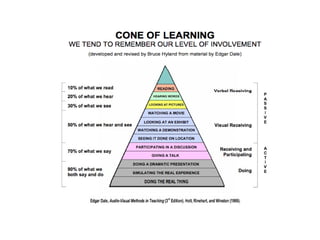
  • #9 When we compare those results with Edgar Dale’s cone of learning (1969), we can see a direct correlation. With most effective methods of learning constitute by doing the real thing. Using multimodes supports learning as it uses different sensory inputs(e.g. Audio and visual inputs). Active learning can be most effective for behavioural changes.
  • #12 Davison's Math Blaster has been around for over a decade. In its newest incarnation, the Trash Alien has stolen Blasternaut’s pal Spot and our hero is off on a loosely scripted mission to save him. To rescue Spot, the user must solve math problems to complete four steps: collect the trash that the Trash Alien dumped in space, turn the trash to fuel, follow the alien to his home planet, and finally rescue Spot.
  • #15 An experiential game, in which the learner is transplanted into the situations faced by the storyteller, and as such drawing heavily in situative pedagogy;
  • #16 An experiential game, where the player is transferred into the state of affairs faced by the narrator, and as such influenced by situative pedagogy;