Second Language Acquisition
Presented to Dr. Tahir Ghafoor
Presented by Shazaib Alam
BS English 3rd Semester
• The Acquisition-Learning Hypothesis
• The Monitor Hypothesis
• The Natural Order Hypothesis
• The Input Hypothesis
• The Affective Filter Hypothesis
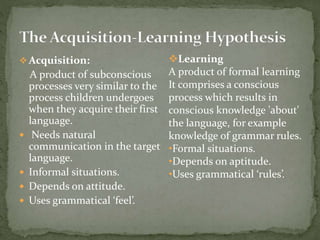
 Acquisition:
A product of subconscious
processes very similar to the
process children undergoes
when they acquire their first
language.
 Needs natural
communication in the target
language.
 Informal situations.
 Depends on attitude.
 Uses grammatical ‘feel’.
Learning
A product of formal learning
It comprises a conscious
process which results in
conscious knowledge 'about'
the language, for example
knowledge of grammar rules.
•Formal situations.
•Depends on aptitude.
•Uses grammatical ‘rules’.
 Explain the relationship between acquisition and
learning.
 The acquisition is the utterance initiator, while the
learning system performs the role of the „monitor‟ or
the ‘editor’
 Krashen said that grammatical morphemes seem to be
acquired in natural order. Some structures are
acquired earlier and some later.
 Natural order is found in both language acquisition by
children and adults alike. In case of ‘L2’, natural order
exists regardless of the acquirers ‘L1’. Later findings
show that this hypothesis is valid for other language
acquisition as well.
 Speaking is a result of acquisition & not its cause.
 If input is understood, and there is enough of it, the
necessary grammar is automatically provided.
 Learners with a low affective filter: high motivation,
self-confidence, a good image, and a low level of
anxiety
 Are better equipped for success in SLA Learners with
a high affective filter: low self esteem and a high level
of anxiety
 Form a mental block
 When the filter is high, it blocks language acquisition.
 The low affective filter is desirable

Krashen Five Hypothesis-Second language aquisition- Shaim Chaudry

  • 1.
    Second Language Acquisition Presentedto Dr. Tahir Ghafoor Presented by Shazaib Alam BS English 3rd Semester
  • 2.
    • The Acquisition-LearningHypothesis • The Monitor Hypothesis • The Natural Order Hypothesis • The Input Hypothesis • The Affective Filter Hypothesis
  • 3.
     Acquisition: A productof subconscious processes very similar to the process children undergoes when they acquire their first language.  Needs natural communication in the target language.  Informal situations.  Depends on attitude.  Uses grammatical ‘feel’. Learning A product of formal learning It comprises a conscious process which results in conscious knowledge 'about' the language, for example knowledge of grammar rules. •Formal situations. •Depends on aptitude. •Uses grammatical ‘rules’.
  • 4.
     Explain therelationship between acquisition and learning.  The acquisition is the utterance initiator, while the learning system performs the role of the „monitor‟ or the ‘editor’
  • 5.
     Krashen saidthat grammatical morphemes seem to be acquired in natural order. Some structures are acquired earlier and some later.  Natural order is found in both language acquisition by children and adults alike. In case of ‘L2’, natural order exists regardless of the acquirers ‘L1’. Later findings show that this hypothesis is valid for other language acquisition as well.
  • 6.
     Speaking isa result of acquisition & not its cause.  If input is understood, and there is enough of it, the necessary grammar is automatically provided.
  • 7.
     Learners witha low affective filter: high motivation, self-confidence, a good image, and a low level of anxiety  Are better equipped for success in SLA Learners with a high affective filter: low self esteem and a high level of anxiety  Form a mental block  When the filter is high, it blocks language acquisition.  The low affective filter is desirable