TESOL 510
Principles of Language
Learning & Teaching
Stephen Krashen’s
5 Hypotheses
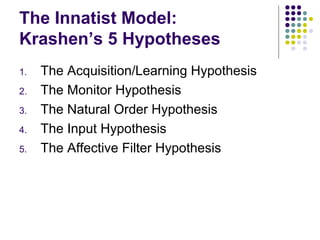
The Innatist Model:
Krashen’s 5 Hypotheses
1. The Acquisition/Learning Hypothesis
2. The Monitor Hypothesis
3. The Natural Order Hypothesis
4. The Input Hypothesis
5. The Affective Filter Hypothesis
#1: The Acquisition-Learning
Hypothesis
 According to Krashen, acquisition and
learning are not the same.
 Acquisition = implicit, subconscious, learned
through natural communication and
interaction
 Learning = explicit, conscious, learned
through formal language study
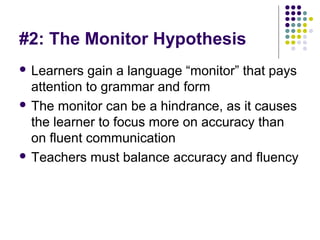
#2: The Monitor Hypothesis
 Learners gain a language “monitor” that pays
attention to grammar and form
 The monitor can be a hindrance, as it causes
the learner to focus more on accuracy than
on fluent communication
 Teachers must balance accuracy and fluency
#3: The Natural Order Hypothesis
 Grammatical forms are aquired in a specific
order
#4: The Input Hypothesis
 Acquisition occurs when learners receive
input that is one step beyond their current
language development ( i + 1)
 Krashen argues that authentic
communication naturally provides
comprehensible input at i + 1
#5: The Affective Filter Hypothesis
 Affective factors such as stress, self-
consciousness, and low motivation can
prevent input from being processed by the
brain, and prevent acquisition
 The implication is that teachers need to
“lower the affective filter” by providing a low-
stress environment for language practice.

TESOL 510 - Krashen 5 Hypotheses

  • 1.
    TESOL 510 Principles ofLanguage Learning & Teaching Stephen Krashen’s 5 Hypotheses
  • 2.
    The Innatist Model: Krashen’s5 Hypotheses 1. The Acquisition/Learning Hypothesis 2. The Monitor Hypothesis 3. The Natural Order Hypothesis 4. The Input Hypothesis 5. The Affective Filter Hypothesis
  • 3.
    #1: The Acquisition-Learning Hypothesis According to Krashen, acquisition and learning are not the same.  Acquisition = implicit, subconscious, learned through natural communication and interaction  Learning = explicit, conscious, learned through formal language study
  • 4.
    #2: The MonitorHypothesis  Learners gain a language “monitor” that pays attention to grammar and form  The monitor can be a hindrance, as it causes the learner to focus more on accuracy than on fluent communication  Teachers must balance accuracy and fluency
  • 5.
    #3: The NaturalOrder Hypothesis  Grammatical forms are aquired in a specific order
  • 6.
    #4: The InputHypothesis  Acquisition occurs when learners receive input that is one step beyond their current language development ( i + 1)  Krashen argues that authentic communication naturally provides comprehensible input at i + 1
  • 7.
    #5: The AffectiveFilter Hypothesis  Affective factors such as stress, self- consciousness, and low motivation can prevent input from being processed by the brain, and prevent acquisition  The implication is that teachers need to “lower the affective filter” by providing a low- stress environment for language practice.

Editor's Notes

  • #6 Copula—is, are, were