Social media behind the firewall...


                    Eric Reiss
              Intrateam Event
                March 3, 2010
         Copenhagen, Denmark
“Web 2.0 is the business revolution
 in the computer industry caused by
 the move to the Internet as platform,
 and an attempt to understand the
 rules for success on that new platform.”

                          Tim O’Reilly
(We didn’t understand it either)
Growth of the web
 Static sites = 1-way communication
 Web apps = 2-way communication
 Social apps = many-way communication
Social media is...well...social
Today’s topics
  What are the advantages?
  What are the pain points?
  How mature does an intranet need to be before
  social media becomes viable?
  Will social media change the way we develop
  intranets in the future?
Four questions to kick things off...
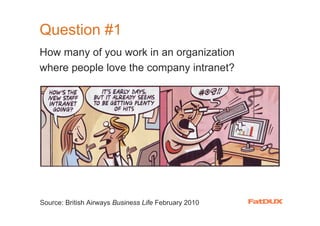
Question #1
How many of you work in an organization
where people love the company intranet?


Source: British Airways Business Life February 2010
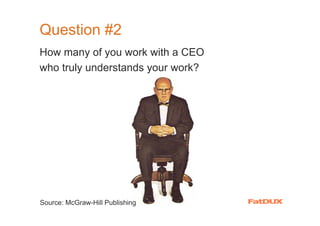
Question #2
How many of you work with a CEO
who truly understands your work?


Source: McGraw-Hill Publishing
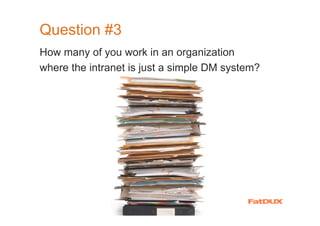
Question #3
How many of you work in an organization
where the intranet is just a simple DM system?
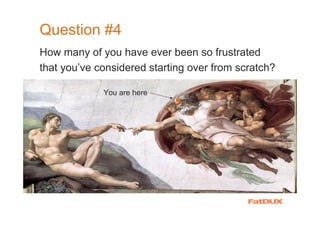
Question #4
How many of you have ever been so frustrated
that you’ve considered starting over from scratch?

             You are here
So let’s start from scratch!

     Here’s the brief...
“Build an enterprise version of the
 Internet, contained within the
 boundaries of our organization.”
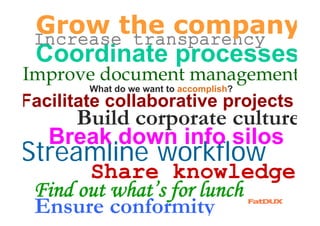
Grow the company
 Increase transparency
 Coordinate processes
Improve document management
         What do we want to accomplish?
Facilitate collaborative projects
      Build corporate culture
  Break down info silos
Streamline workflow
       Share knowledge
 Find out what’s for lunch
 Ensure conformity
What tools would you useIxDG
              Birth of the to build this thing?
Should social media be part of your mix?

                 Why?
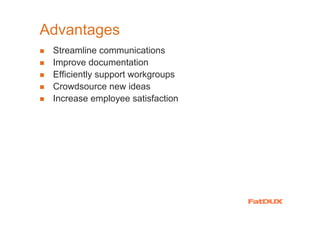
Advantages
 Streamline communications
 Improve documentation
 Efficiently support workgroups
 Crowdsource new ideas
 Increase employee satisfaction

 Fact: 39% of 18-24 year-old employees would consider
 leaving their employer if they were not allowed access
 to sites like Facebook and YouTube.

 (2009 Telindus study of 1,000 European employees)
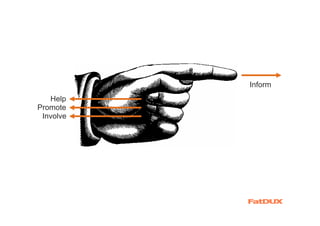
Inform
   Help
Promote
 Involve
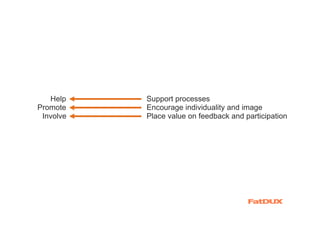
Help    Support processes
Promote    Encourage individuality and image
 Involve   Place value on feedback and participation
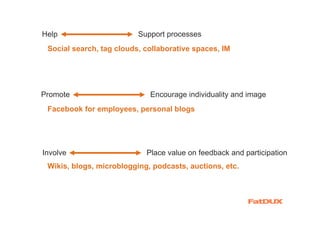
Help                      Support processes
 Social search, tag clouds, collaborative spaces, IM, (lunch menu)


Promote                      Encourage individuality and image
 Facebook for employees, personal blogs


Involve                     Place value on feedback and participation
 Wikis, blogs, microblogging, podcasts, auctions, etc.
The secret to success:

      Keep “why” in focus.
Work backwards to identify “what”
Fundamentals of change management
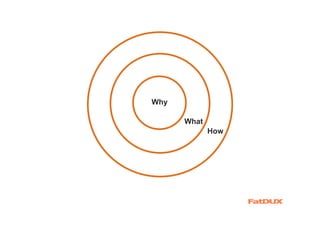
Why

      What
             How
Fact of life: change management takes time
Let’s move on to pain points...
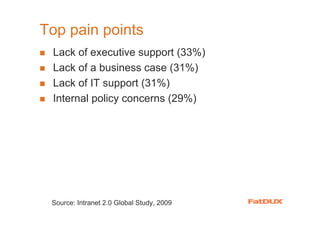
Top pain points
 Lack of executive support (33%)
 Lack of a business case (31%)
 Lack of IT support (31%)
 Internal policy concerns (29%)


 Source: Intranet 2.0 Global Study, 2009
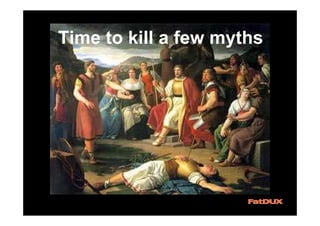
Time to kill a few myths
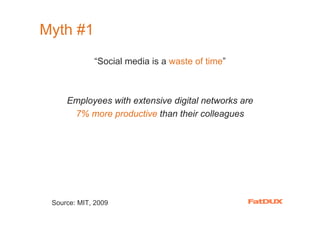
Myth #1
             “Social media is a waste of time”


     Employees with extensive digital networks are
      7% more productive than their colleagues


 Source: MIT, 2009
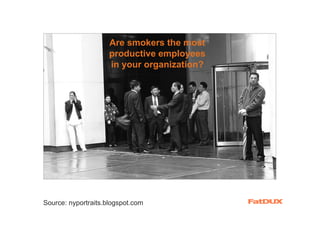
Are smokers the most
                     productive employees
                     in your organization?


                       commons.wikimedia.org


Source: nyportraits.blogspot.com
Game plan to combat Myth #1
 Find a champion – a “linchpin”
 Build a real business case.
 Show the value. Show the “why”.
 Use business metrics, not popularity ratings.
 Keep it small. Don’t start 15 projects at once.
 Keep it simple. Don’t scare the boss.
   Microblogging is easier to understand than a wiki
Myth #2
 “Social media gives everyone a chance to complain.”


   Yes. But wouldn’t you rather have them do this
   behind the firewall instead of in a public forum?
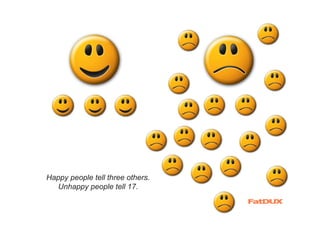
Happy people tell three others.
  Unhappy people tell 17.
Have authentic conversations

    Think of technology like blogs, forums, and
discussion boards as amplifying customer opinion
              rather than improving it.
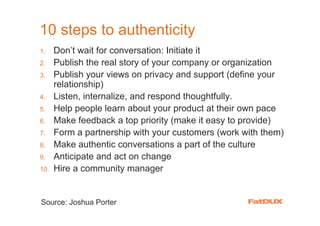
10 steps to authenticity
1.    Don’t wait for conversation: Initiate it
2.    Publish the real story of your company or organization
3.    Publish your views on privacy and support (define your
      relationship)
4.    Listen, internalize, and respond thoughtfully.
5.    Help people learn about your product at their own pace
6.    Make feedback a top priority (make it easy to provide)
7.    Form a partnership with your customers (work with them)
8.    Make authentic conversations a part of the culture
9.    Anticipate and act on change
10.   Hire a community manager


Source: Joshua Porter
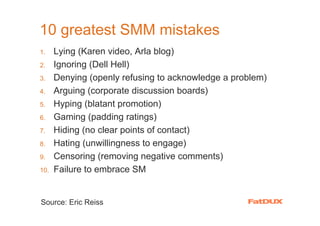
10 greatest SMM mistakes
1.    Lying (Karen video, Arla blog)
2.    Ignoring (Dell Hell)
3.    Denying (openly refusing to acknowledge a problem)
4.    Arguing (corporate discussion boards)
5.    Hyping (blatant promotion)
6.    Gaming (padding ratings)
7.    Hiding (no clear points of contact)
8.    Hating (unwillingness to engage)
9.    Censoring (removing negative comments)
10.   Failure to embrace SM


Source: Eric Reiss
Game plan to combat Fact #2
 Don’t be defensive
 Start a conversation
 Apologize if you were wrong
 Turn your enemies into friends
Myth #3
     “Social media causes information overload”


  No. Information overload is caused by information
   that is pushed. Socialized information is pulled.
Inform
   Help
Promote
 Involve


           Pull   Push
Myth #4
     “Social media poses a huge security problem.”


                Not behind the firewall.
      The true danger of social media is addiction.

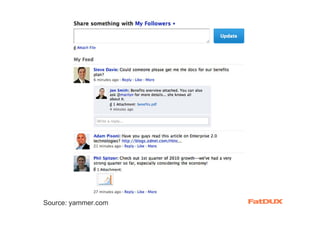
  (E-mail is a bigger security problem than Yammer.)


 Source: me
Source: yammer.com
Game plan to combat Myth #4
 Understand that SM threatens your IT folks.
 Talk to them. Understand their concerns.
   The intranet may be their last bastion
 Make sure SM will not destabilize existing apps.
 Help IT identify suitable strategic technologies.
   Could a third-party hosted solution be the answer?
 Help them understand the “why”
Myth #5
          “Social media can’t be documented.”


    Yes it can. More importantly, do you really need
   documentation for everything? How are you currently
    documenting e-mail? How many mails do you lose?


 Source: me
What’s the communication goal?
 Need to know?
 “I’ll be 10 minutes late to our meeting”
 Need documentation?
 “Jack has signed off on the production budget. We can
 now move forward.”
 Need both?
 “UK sales figures are down 7%. This could be relevant
 for the report you’re working on.”
Game plan to combat Myth #5
 Differentiate between “need to know” and “need
 to save”
 Only archive the important stuff
 Embrace “one message per message”
 Choose the right tools for the job
Myth #6
              “Social media isn’t real work.”


  Well, it often is real work – sharing information with
  colleagues, keeping them informed, helping them
                   make better decisions.

        And it is usually a better use of their time
           than attending endless meetings.


 Source: me
Typical meeting
 5-10 people
 All are 5-10 minutes late
 About half of these folks have no need to attend
 No agenda
 No record of decisions
 At least one irrelevant PPT presentation
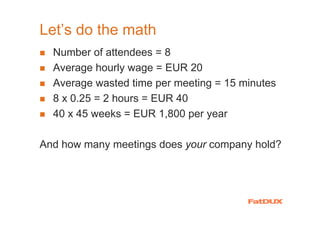
Let’s do the math
  Number of attendees = 8
  Average hourly wage = EUR 20
  Average wasted time per meeting = 15 minutes
  8 x 0.25 = 2 hours = EUR 40
  40 x 45 weeks = EUR 1,800 per year

And how many meetings does your company hold?
Game plan to combat Myth #6
 Identify existing communications problems
 Show how SM can help effectivize meetings
 Show how SM can actually eliminate meetings
 Redefine “real” work
Just a spoonful of sugar…
See the original clip at http://www.youtube.com/watch?v=HrnoR9cBP3o
             Pay particular attention to the opening dialog.
Game plan to combat Myth #6
  Identify existing communications problems
  Show how SM can help effectivize meetings
  Show how SM can actually eliminate meetings
  Redefine “real” work


Maybe social media is our spoonful of sugar…
Grow the company
 Increase transparency
 Coordinate processes
   Loyalty
Improve document management
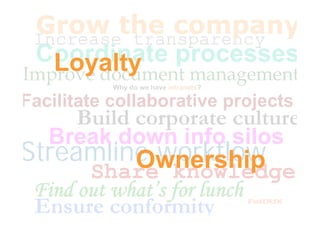
           Why do we have intranets?

Facilitate collaborative projects
      Build corporate culture
  Break down info silos
Streamline workflow
            Ownership
       Share knowledge
 Find out what’s for lunch
 Ensure conformity
“The first responsibility of a leader
 is to define reality.”

                    Max de Pree
              CEO, Herman Miller, 1989
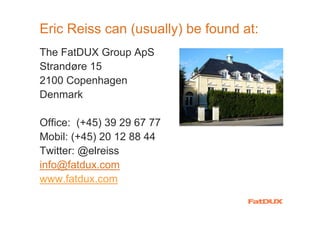
Eric Reiss can (usually) be found at:
The FatDUX Group ApS
Strandøre 15
2100 Copenhagen
Denmark

Office: (+45) 39 29 67 77
Mobil: (+45) 20 12 88 44
Twitter: @elreiss
info@fatdux.com
www.fatdux.com

Social Media Behind The Firewall

  • 1.
    Social media behindthe firewall... Eric Reiss Intrateam Event March 3, 2010 Copenhagen, Denmark
  • 2.
    “Web 2.0 isthe business revolution in the computer industry caused by the move to the Internet as platform, and an attempt to understand the rules for success on that new platform.” Tim O’Reilly
  • 3.
  • 4.
    Growth of theweb Static sites = 1-way communication Web apps = 2-way communication Social apps = many-way communication
  • 5.
  • 6.
    Today’s topics What are the advantages? What are the pain points? How mature does an intranet need to be before social media becomes viable? Will social media change the way we develop intranets in the future?
  • 7.
    Four questions tokick things off...
  • 8.
    Question #1 How manyof you work in an organization where people love the company intranet? Source: British Airways Business Life February 2010
  • 9.
    Question #2 How manyof you work with a CEO who truly understands your work? Source: McGraw-Hill Publishing
  • 10.
    Question #3 How manyof you work in an organization where the intranet is just a simple DM system?
  • 11.
    Question #4 How manyof you have ever been so frustrated that you’ve considered starting over from scratch? You are here
  • 12.
    So let’s startfrom scratch! Here’s the brief...
  • 13.
    “Build an enterpriseversion of the Internet, contained within the boundaries of our organization.”
  • 14.
    Grow the company Increase transparency Coordinate processes Improve document management What do we want to accomplish? Facilitate collaborative projects Build corporate culture Break down info silos Streamline workflow Share knowledge Find out what’s for lunch Ensure conformity
  • 15.
    What tools wouldyou useIxDG Birth of the to build this thing?
  • 16.
    Should social mediabe part of your mix? Why?
  • 17.
    Advantages Streamline communications Improve documentation Efficiently support workgroups Crowdsource new ideas Increase employee satisfaction Fact: 39% of 18-24 year-old employees would consider leaving their employer if they were not allowed access to sites like Facebook and YouTube. (2009 Telindus study of 1,000 European employees)
  • 19.
    Inform Help Promote Involve
  • 20.
    Help Support processes Promote Encourage individuality and image Involve Place value on feedback and participation
  • 21.
    Help Support processes Social search, tag clouds, collaborative spaces, IM, (lunch menu) Promote Encourage individuality and image Facebook for employees, personal blogs Involve Place value on feedback and participation Wikis, blogs, microblogging, podcasts, auctions, etc.
  • 22.
    The secret tosuccess: Keep “why” in focus. Work backwards to identify “what”
  • 23.
  • 25.
    Why What How
  • 26.
    Fact of life:change management takes time
  • 27.
    Let’s move onto pain points...
  • 28.
    Top pain points Lack of executive support (33%) Lack of a business case (31%) Lack of IT support (31%) Internal policy concerns (29%) Source: Intranet 2.0 Global Study, 2009
  • 29.
    Time to killa few myths
  • 30.
    Myth #1 “Social media is a waste of time” Employees with extensive digital networks are 7% more productive than their colleagues Source: MIT, 2009
  • 31.
    Are smokers themost productive employees in your organization? commons.wikimedia.org Source: nyportraits.blogspot.com
  • 32.
    Game plan tocombat Myth #1 Find a champion – a “linchpin” Build a real business case. Show the value. Show the “why”. Use business metrics, not popularity ratings. Keep it small. Don’t start 15 projects at once. Keep it simple. Don’t scare the boss. Microblogging is easier to understand than a wiki
  • 33.
    Myth #2 “Socialmedia gives everyone a chance to complain.” Yes. But wouldn’t you rather have them do this behind the firewall instead of in a public forum?
  • 34.
    Happy people tellthree others. Unhappy people tell 17.
  • 35.
    Have authentic conversations Think of technology like blogs, forums, and discussion boards as amplifying customer opinion rather than improving it.
  • 36.
    10 steps toauthenticity 1. Don’t wait for conversation: Initiate it 2. Publish the real story of your company or organization 3. Publish your views on privacy and support (define your relationship) 4. Listen, internalize, and respond thoughtfully. 5. Help people learn about your product at their own pace 6. Make feedback a top priority (make it easy to provide) 7. Form a partnership with your customers (work with them) 8. Make authentic conversations a part of the culture 9. Anticipate and act on change 10. Hire a community manager Source: Joshua Porter
  • 37.
    10 greatest SMMmistakes 1. Lying (Karen video, Arla blog) 2. Ignoring (Dell Hell) 3. Denying (openly refusing to acknowledge a problem) 4. Arguing (corporate discussion boards) 5. Hyping (blatant promotion) 6. Gaming (padding ratings) 7. Hiding (no clear points of contact) 8. Hating (unwillingness to engage) 9. Censoring (removing negative comments) 10. Failure to embrace SM Source: Eric Reiss
  • 38.
    Game plan tocombat Fact #2 Don’t be defensive Start a conversation Apologize if you were wrong Turn your enemies into friends
  • 39.
    Myth #3 “Social media causes information overload” No. Information overload is caused by information that is pushed. Socialized information is pulled.
  • 40.
    Inform Help Promote Involve Pull Push
  • 41.
    Myth #4 “Social media poses a huge security problem.” Not behind the firewall. The true danger of social media is addiction. (E-mail is a bigger security problem than Yammer.) Source: me
  • 42.
  • 43.
    Game plan tocombat Myth #4 Understand that SM threatens your IT folks. Talk to them. Understand their concerns. The intranet may be their last bastion Make sure SM will not destabilize existing apps. Help IT identify suitable strategic technologies. Could a third-party hosted solution be the answer? Help them understand the “why”
  • 44.
    Myth #5 “Social media can’t be documented.” Yes it can. More importantly, do you really need documentation for everything? How are you currently documenting e-mail? How many mails do you lose? Source: me
  • 45.
    What’s the communicationgoal? Need to know? “I’ll be 10 minutes late to our meeting” Need documentation? “Jack has signed off on the production budget. We can now move forward.” Need both? “UK sales figures are down 7%. This could be relevant for the report you’re working on.”
  • 46.
    Game plan tocombat Myth #5 Differentiate between “need to know” and “need to save” Only archive the important stuff Embrace “one message per message” Choose the right tools for the job
  • 48.
    Myth #6 “Social media isn’t real work.” Well, it often is real work – sharing information with colleagues, keeping them informed, helping them make better decisions. And it is usually a better use of their time than attending endless meetings. Source: me
  • 49.
    Typical meeting 5-10people All are 5-10 minutes late About half of these folks have no need to attend No agenda No record of decisions At least one irrelevant PPT presentation
  • 50.
    Let’s do themath Number of attendees = 8 Average hourly wage = EUR 20 Average wasted time per meeting = 15 minutes 8 x 0.25 = 2 hours = EUR 40 40 x 45 weeks = EUR 1,800 per year And how many meetings does your company hold?
  • 51.
    Game plan tocombat Myth #6 Identify existing communications problems Show how SM can help effectivize meetings Show how SM can actually eliminate meetings Redefine “real” work
  • 52.
    Just a spoonfulof sugar… See the original clip at http://www.youtube.com/watch?v=HrnoR9cBP3o Pay particular attention to the opening dialog.
  • 53.
    Game plan tocombat Myth #6 Identify existing communications problems Show how SM can help effectivize meetings Show how SM can actually eliminate meetings Redefine “real” work Maybe social media is our spoonful of sugar…
  • 54.
    Grow the company Increase transparency Coordinate processes Loyalty Improve document management Why do we have intranets? Facilitate collaborative projects Build corporate culture Break down info silos Streamline workflow Ownership Share knowledge Find out what’s for lunch Ensure conformity
  • 55.
    “The first responsibilityof a leader is to define reality.” Max de Pree CEO, Herman Miller, 1989
  • 56.
    Eric Reiss can(usually) be found at: The FatDUX Group ApS Strandøre 15 2100 Copenhagen Denmark Office: (+45) 39 29 67 77 Mobil: (+45) 20 12 88 44 Twitter: @elreiss info@fatdux.com www.fatdux.com