NEGOTIATIONPOWER
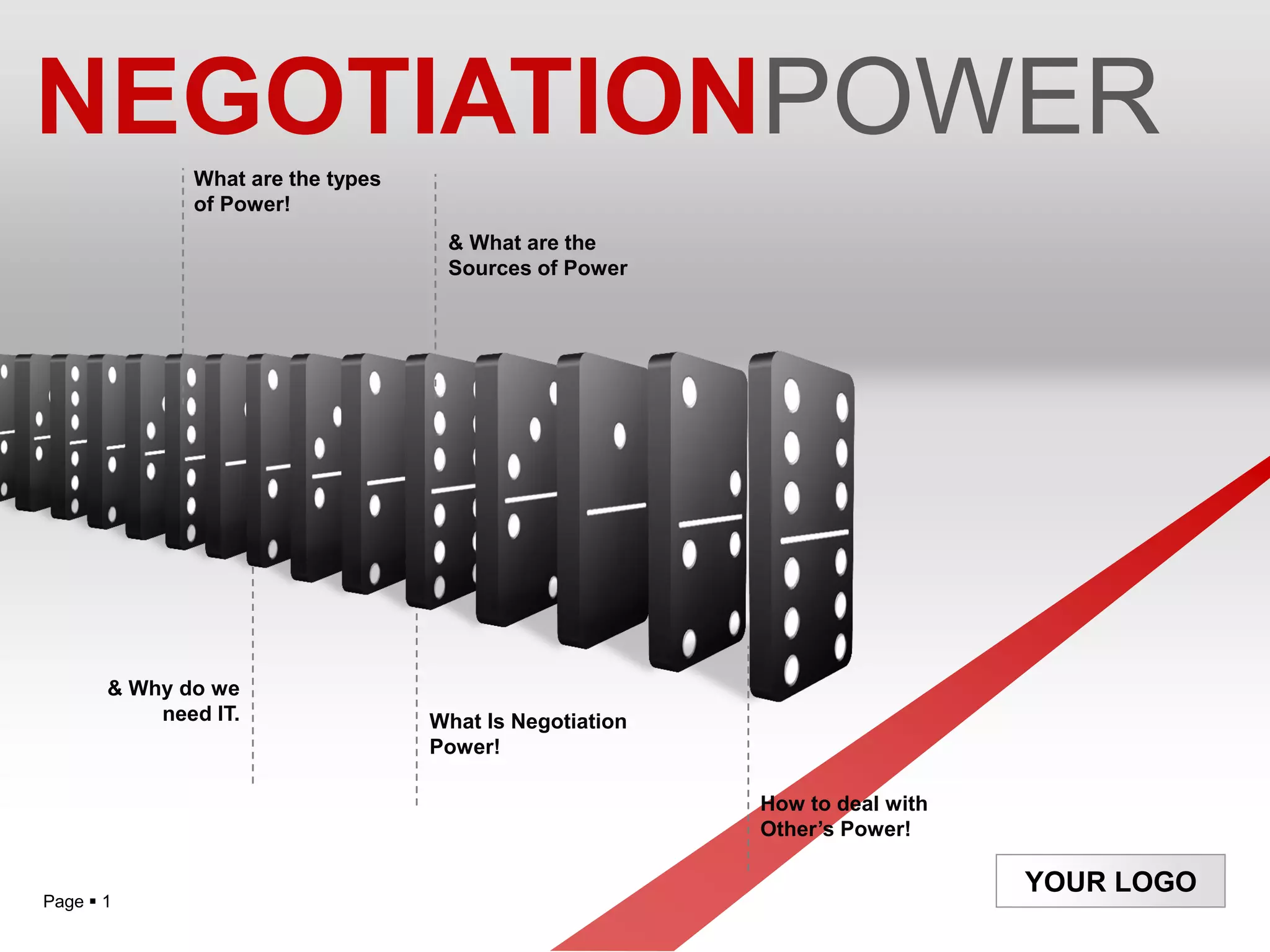
              What are the types
              of Power!
                                    & What are the
                                    Sources of Power


       & Why do we
           need IT.                What Is Negotiation
                                   Power!

                                                         How to deal with
                                                         Other’s Power!

                                                                            YOUR LOGO
Page  1
NEGOTIATION POWER


                    YOUR LOGO
Page  2
Importance of Negotiation Power


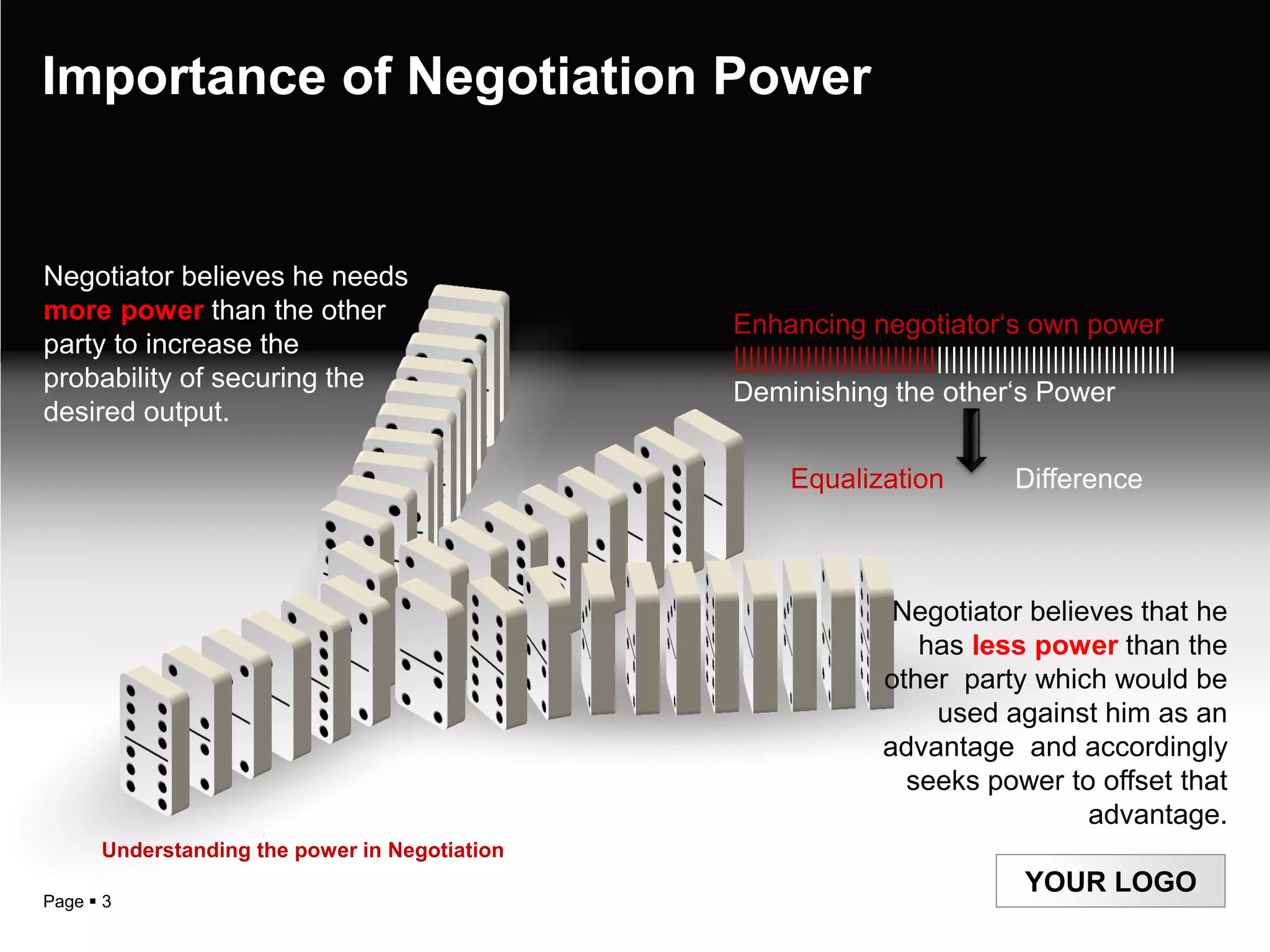
Negotiator believes he needs
more power than the other
                                               Enhancing negotiator„s own power
party to increase the
                                               |||||||||||||||||||||||||||||||||||||||||||||||||||||||||||||
probability of securing the
                                               Deminishing the other„s Power
desired output.

                                                      Equalization                   Difference


                                                                    Negotiator believes that he
                                                                      has less power than the
                                                                   other party which would be
                                                                       used against him as an
                                                                   advantage and accordingly
                                                                     seeks power to offset that
                                                                                    advantage.
      Understanding the power in Negotiation
                                                                                       YOUR LOGO
Page  3
NEGOTIATION POWER
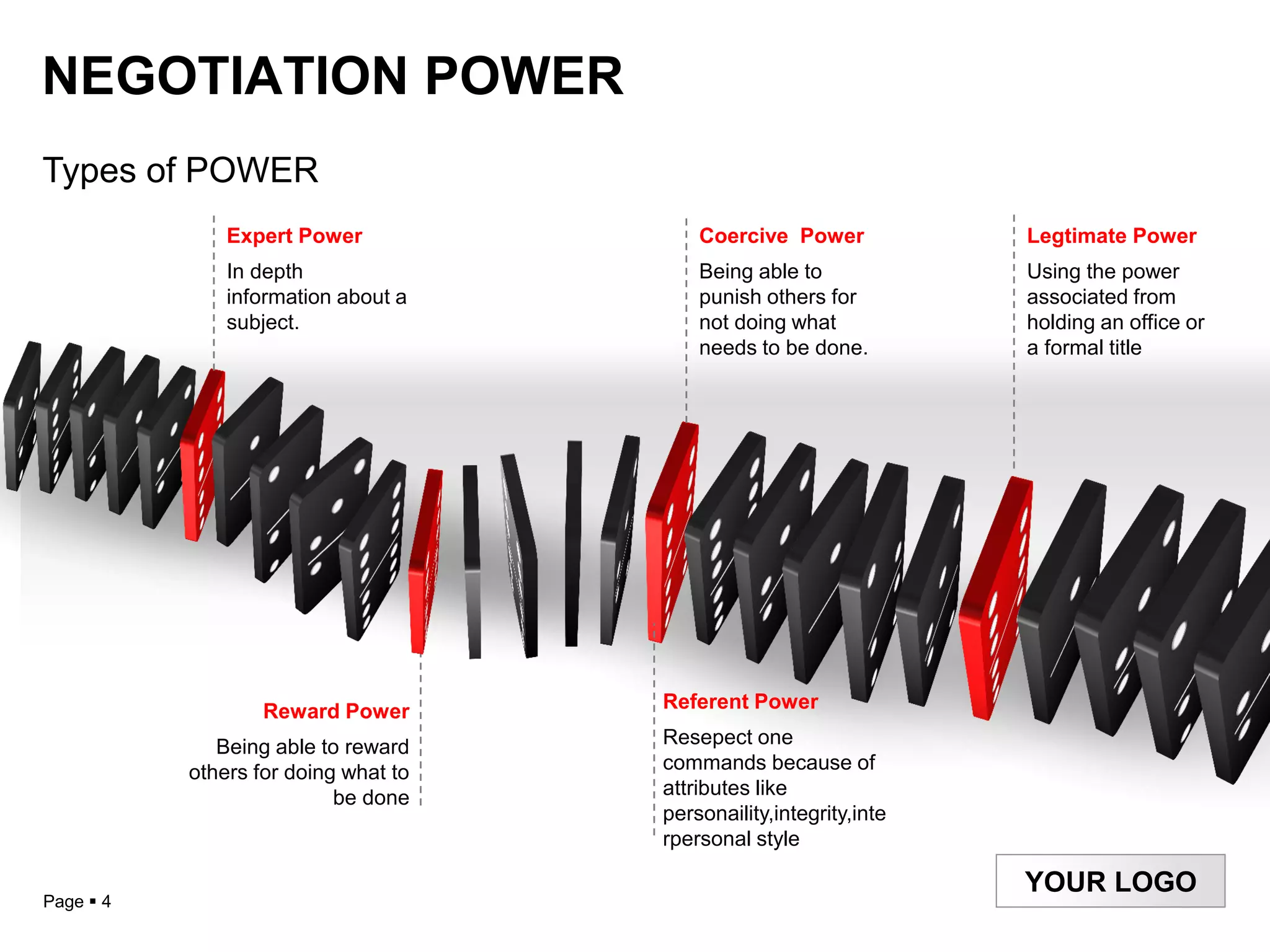
Types of POWER
               Expert Power               Coercive Power            Legtimate Power
               In depth                   Being able to             Using the power
               information about a        punish others for         associated from
               subject.                   not doing what            holding an office or
                                          needs to be done.         a formal title


                   Reward Power       Referent Power

              Being able to reward    Resepect one
           others for doing what to   commands because of
                           be done    attributes like
                                      personaility,integrity,inte
                                      rpersonal style

                                                                    YOUR LOGO
Page  4
NEGOTIATION POWER


                    YOUR LOGO
Page  5
NEGOTIATION POWER


                    YOUR LOGO
Page  6
NEGOTIATION POWER
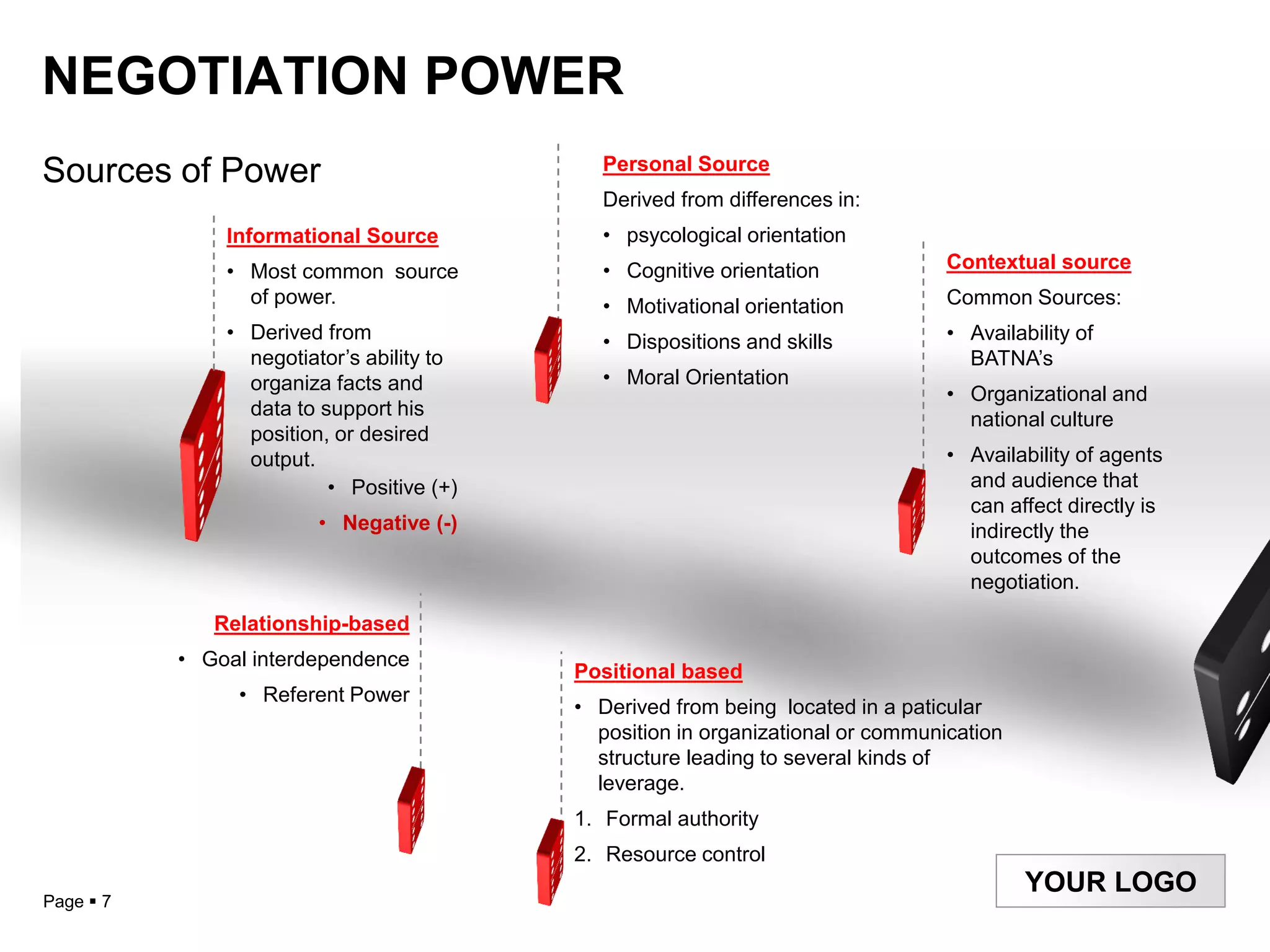
                                              Personal Source
Sources of Power
                                              Derived from differences in:
               Informational Source           • psycological orientation
               • Most common source           • Cognitive orientation             Contextual source
                 of power.                    • Motivational orientation          Common Sources:
               • Derived from                 • Dispositions and skills           • Availability of
                 negotiator‟s ability to                                            BATNA‟s
                 organiza facts and           • Moral Orientation
                                                                                  • Organizational and
                 data to support his
                                                                                    national culture
                 position, or desired
                 output.                                                          • Availability of agents
                          • Positive (+)                                            and audience that
                                                                                    can affect directly is
                        • Negative (-)                                              indirectly the
                                                                                    outcomes of the
                                                                                    negotiation.
              Relationship-based
           • Goal interdependence
                                           Positional based
                • Referent Power
                                           • Derived from being located in a paticular
                                             position in organizational or communication
                                             structure leading to several kinds of
                                             leverage.
                                           1. Formal authority
                                           2. Resource control
                                                                                           YOUR LOGO
Page  7
Sources of POWERS


           • THE SOURCES OF POWERS IN DETAILS


                                                YOUR LOGO
Page  8
Informational Source of POWER

 Information Power
 • Derived from the negotiator's ability to assemble and organize facts to
   support t his or her positions, arguments, and outcomes.
 • The exchange of information is the heart of the concession making process
 • This also allows the negotiators to drive a common picture of the current
   situation
                                                                               Expertise power can
                                                                               be Positive or
                                                                               Negative:
                                                                               • We believe the other
                                                                                 because of their
                                                                                 acknowledged
                                                                                 expertise.
                                                                               • This will lead to
  Expertise Power                                                                pursue a course of
  It‟s a special form of information power.                                      action opposite to
  A lot of people have information but expert power is accorded to those who     the one they
                                                                                 advocate
  are seen as having achieved some levels and mastery of body of
  information.


                                                                                        YOUR LOGO
Page  9
Personal-Based Source of POWER
 Individuals have different psychological orientation to special situations

 Cognitive orientation
 There are 3 types of ideological frames:

 The unitary: Characterized by beliefs that society is an integrated whole and that the interests of
 individuals and society are one, such power can be ignored or used to benefit the good of all.

 The radical: Characterized by beliefs that society is in a continual clash of social, political and class
 interests. That power is structurally imbalanced.

 The pluralist: Characterized by beliefs that power is distributed relatively equally across various groups
 which compete and bargain for a share of the continually evolving balance of power


 Motivational Orientation
 •    Focuses on the different in individual motivations

 •    Differences rooted more in needs and "energizing elements" of the personality.

 •    Individuals differ in the "power motive" or the disposition of some people to have high needs to
      influence and control others and to seek out positions of power and authority.

                                                                                              YOUR LOGO
Page  10
Personal-Based Source of POWER (Cont.)
 Individuals have different psychological orientation to special situations

 Dispositions and skills

 •   Skills such as high expertise, self confidence and high tolerance for conflict

 •   Emphasizing skills such as sensitivity to others, flexibility, and ability to consider and incorporate the
     views of others into agreements.


 Moral Orientation
 •    There is a significant positive relationship between people's implicit ideas regarding egalitarianism
      and their willingness to share power with low power parties.


                                                                                               YOUR LOGO
Page  11
Relationship based Source of POWER

 Goal Interdependence
 • How the parties view their goals – and how much achievement of their goal depends on the
   behavior of the other party – has a strong impact on how likely Parties will be to constructively use
   power.


 Referent Power:
 • As defined earlier, referent power is derived from the respect or admiration one Commands
    because of attributes like personality, integrity.
 •   Referent power is often based on an appeal to common experiences, common fate, or
    membership in the same groups.
 • Thus, a negotiator might start getting to know the other in order to discover Commonalities (home
    town, college, favorite sports team, political perspective) that, when discovered, will hopefully
    create a bond between the parties that will facilitate agreement. Negative referent power is often
    used, particularly when parties seek to create distance or division between themselves and others
    or to label the other.


                                                                                           YOUR LOGO
Page  12
Relationship based Source of POWER (Cont.)
  3-Networks:
 •    Understanding power in this way is derived from conceptualizing organizations and their
     functioning not as a hierarchy, but as a network of interrelationships.
 Tie strength
 • This is an indication of the strength or quality of relationships with other.
 • Quality might be measured by how close you are how much personal information you share with
     the other. Strength of ties can be determined by how often the parties interact, how long they have
     known each other, how intimate one is with the other.
 Tie content
 • Content is the resource that passes along the tie with the other person.
 Network structure: Refers to the overall set of relationships within a social system ( e.g.a workplace,
  Department, school, or other social environment)


                                                                                           YOUR LOGO
Page  13
Positional Based Source of POWER

 Legtimate Power                                                                         Legitimate power
 It is derived from occupying a particular position in an organization                   can be acquired by
                                                                                         several ways:
 There are times when people respond to directions from another , even
                                                                                         At birth :
 directions they don‟t like it, because they feel it is proper for the other to direct   Like queen Elizabeth
 them .This is the effect of Legitimate power.                                           II
                                                                                         By election:
 Legitimate power is at the foundation of our social structure.                          Like President
 People must elect a leader and introduce some formal rules about decision               Obama
                                                                                         By promotion:
 making, work divisions, responsibilities and conflict management.
                                                                                         Appointment or
                                                                                         promotion to some
                                                                                         organizational
  It is also possible to apply the notion of legitimacy to certain social                position.
  norms that exerts strong control over people such as:                                  By respect:
                                                                                         Derived from social
  The legitimate power of reciprocity: "I did you a favor; I expect you to do            good or important
                                                                                         social values like
  one for me"                                                                            college members
  The legitimate power of equity: "I went out of my way for you; this is the
  least you could do for me"
  The legitimate power of responsibility or dependence: a strong social
  norm that we have an obligation to help others who can't help themselves


                                                                                                YOUR LOGO
Page  14
Positional Based Source of POWER (Cont.)

 Resource Control                                                              Most important types of
 People who control resources have the capacity to give them to someone        resources are:
                                                                               Money: cash, salary,
 who will do what they want and withhold them from someone who doesn‟t do
                                                                               budget allocation,
 what they want.                                                               bonus...etc.
 Particular resources are more useful as instruments of power and are highly   Supplies: Raw material
 valued in the negotiation.                                                    Human capital: available
                                                                               labor supply
                                                                               Time: free time , ability to
                                                                               meet dead line , time
                                                                               pressure
                                                                               Equipment: machines,
                 “To make a successful                                         tools, technology,
                                                                               vehicles.
                 control over resources;                                       Critical services:
                                                                               maintenance, technical
                 negotiators must maintain                                     support, transportation.
                 control over desirable                                        Interpersonal support:
                                                                               verbal praise ,
                 reward that the other party                                   encouragement for good
                                                                               performance or criticism
                 wants or punishment the                                       for bad performance.
                 other seeks to avoid”


                                                                                       YOUR LOGO
Page  15
Contextual Source of POWER

 BATNA:                                                                           Based on:
 Best Alternative to negotiated agreement.                                        • Context
                                                                                  • Situation
 More backup plans and more alternatives LEADING TO more negotiation
                                                                                  • Environment
 power.

 CULTURE:
 Determined by the social environments.
 National cultures differs in degree of power over, power with orientations are
 supported or encourage.
 Culture both organizational and national often translated into deeply
 embedded structural inequalities in society, degree to which women, religious
 groups, social classes, other interests

 Agents, Constitutions and External Audiences:
 One –to-one negotiation may be not complex, representing other parties‟ view
 make in more complexly.
 Public Media, Audience presents to observe, critique, and evaluate the
 negotiation, all can make pleasure to the negotiation parties as a part of
 negotiation process.


                                                                                        YOUR LOGO
Page  16
CASESTUDY


            • CASE STUDY


                           YOUR LOGO
Page  17
CASESTUDY
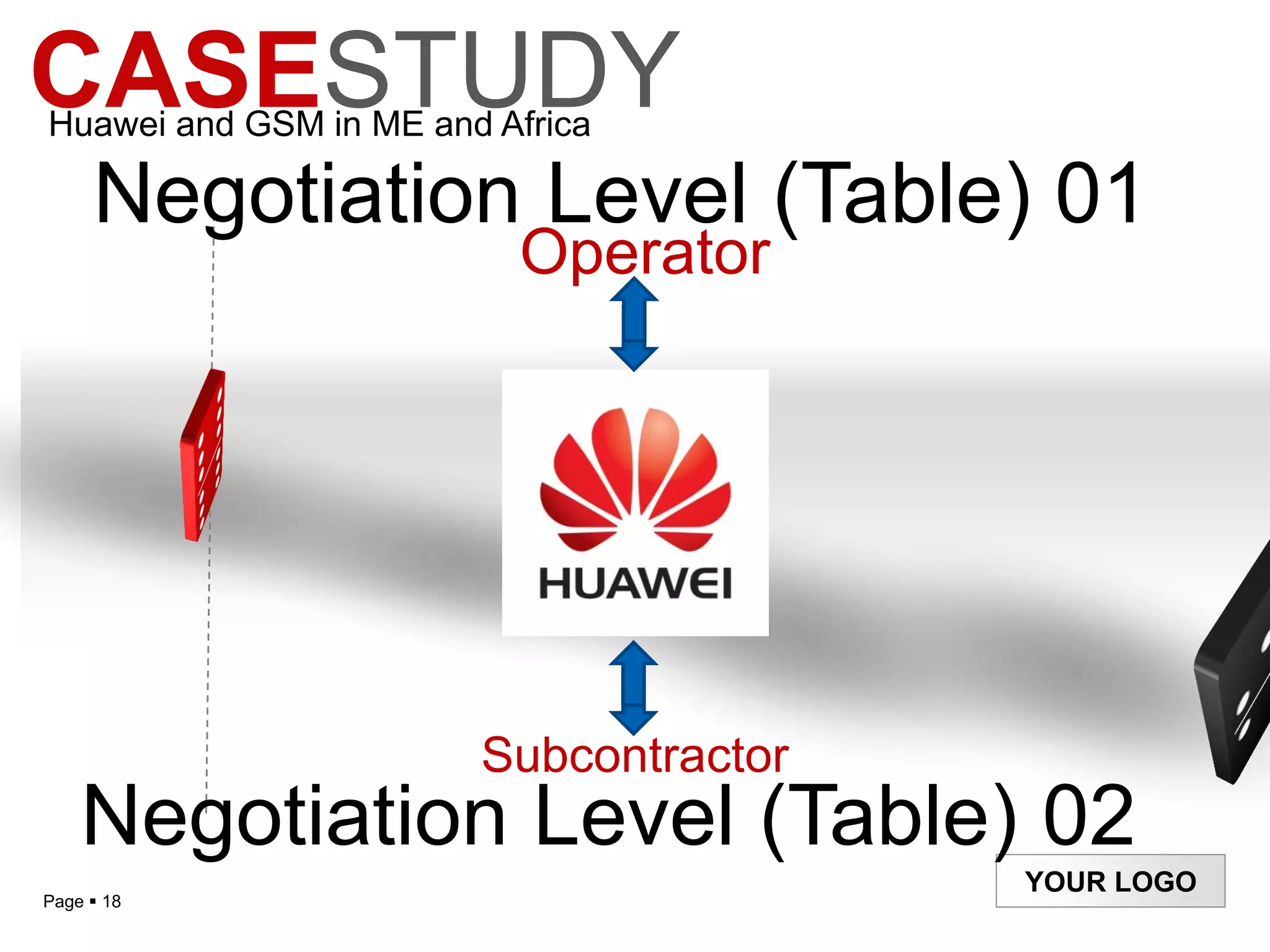
Huawei and GSM in ME and Africa

     Negotiation Level (Table) 01
                          Operator


                        Subcontractor
    Negotiation Level (Table) 02
                                        YOUR LOGO
Page  18
CASESTUDY
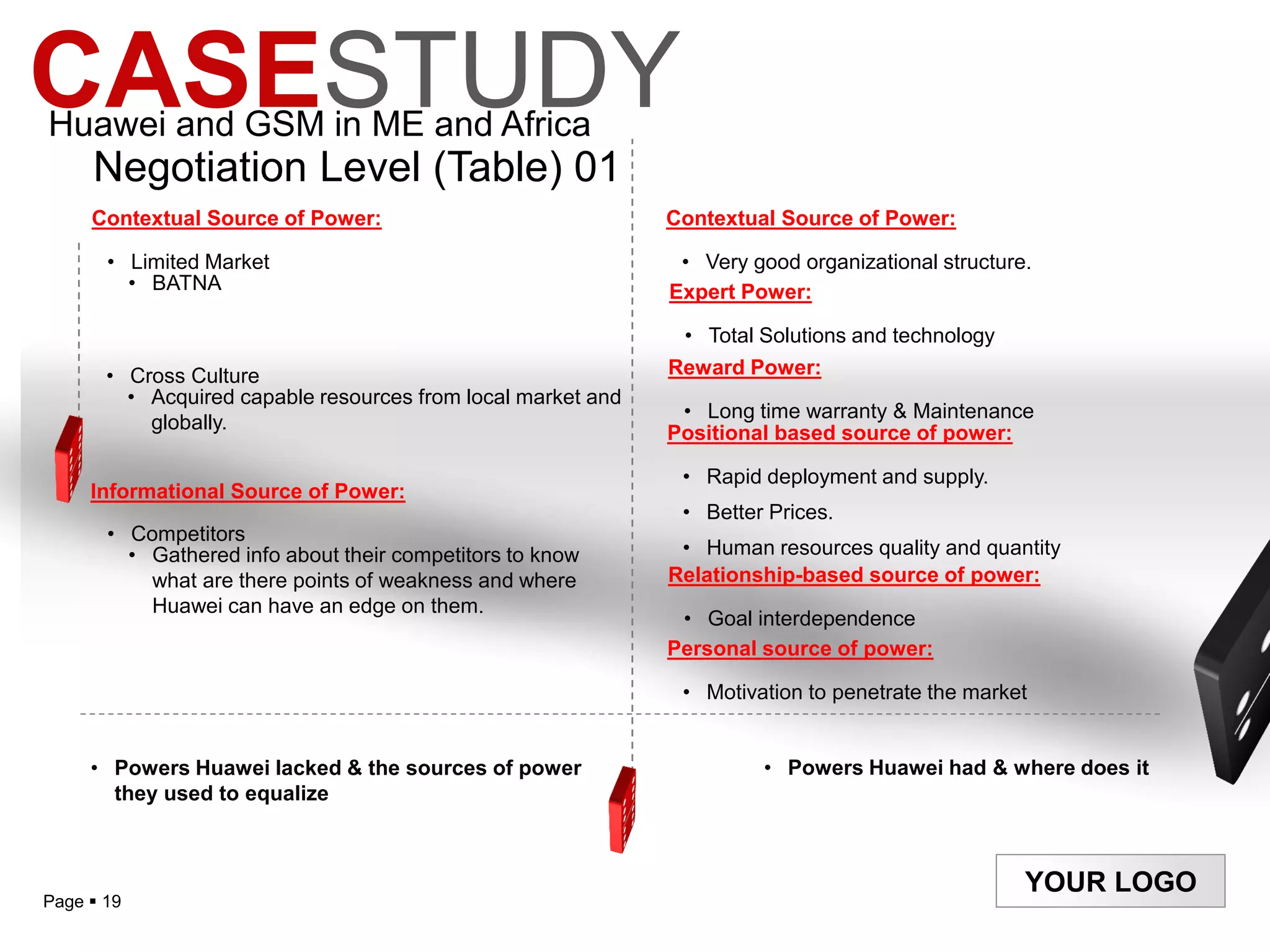
Huawei and GSM in ME and Africa
     Negotiation Level (Table) 01
     Contextual Source of Power:                              Contextual Source of Power:

       • Limited Market                                        • Very good organizational structure.
         • BATNA                                              Expert Power:

                                                               • Total Solutions and technology
       • Cross Culture                                        Reward Power:
         • Acquired capable resources from local market and
                                                               • Long time warranty & Maintenance
           globally.                                          Positional based source of power:

                                                               • Rapid deployment and supply.
     Informational Source of Power:
                                                               • Better Prices.
       • Competitors
         • Gathered info about their competitors to know       • Human resources quality and quantity
           what are there points of weakness and where        Relationship-based source of power:
           Huawei can have an edge on them.
                                                               • Goal interdependence
                                                              Personal source of power:

                                                               • Motivation to penetrate the market


     • Powers Huawei lacked & the sources of power                     • Powers Huawei had & where does it
       they used to equalize


                                                                                                   YOUR LOGO
Page  19
CASESTUDY
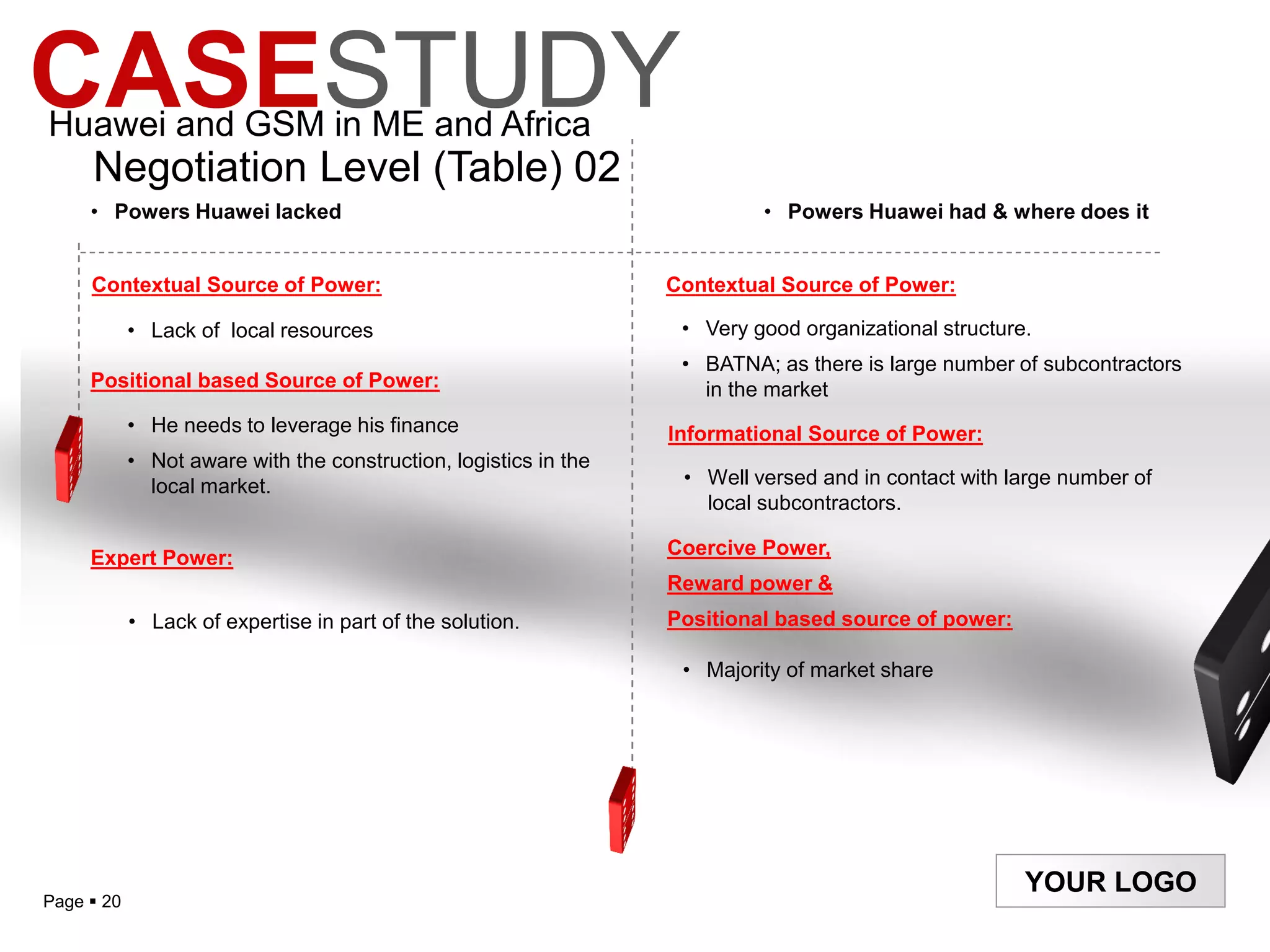
Huawei and GSM in ME and Africa
     Negotiation Level (Table) 02
     • Powers Huawei lacked                                                • Powers Huawei had & where does it


     Contextual Source of Power:                                  Contextual Source of Power:

            • Lack of local resources                              • Very good organizational structure.
                                                                   • BATNA; as there is large number of subcontractors
     Positional based Source of Power:                               in the market
            • He needs to leverage his finance                    Informational Source of Power:
            • Not aware with the construction, logistics in the
              local market.                                        • Well versed and in contact with large number of
                                                                     local subcontractors.

     Expert Power:                                                Coercive Power,
                                                                  Reward power &
            • Lack of expertise in part of the solution.          Positional based source of power:

                                                                   • Majority of market share


                                                                                                       YOUR LOGO
Page  20
CASESTUDY
Huawei and GSM in ME and Africa


            • Huawei has managed to equalize the points of weakness infront of both the
              Operator and the subcontractor
            • Maximizing their benefits (Market share and profit) using the powers they have.


                                                                                    YOUR LOGO
Page  21
NEGOTIATIONPOWER
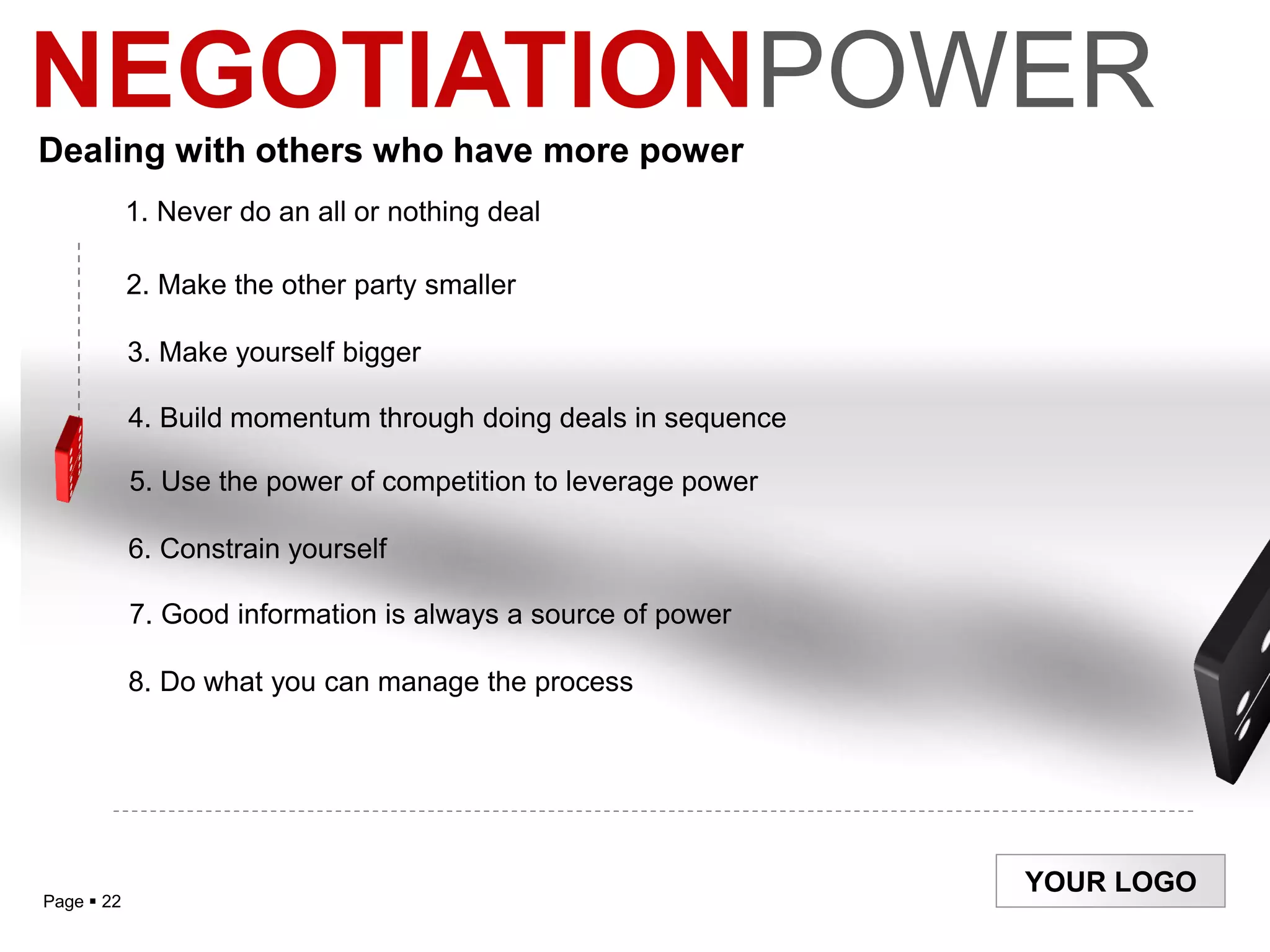
Dealing with others who have more power
            1. Never do an all or nothing deal

            2. Make the other party smaller

            3. Make yourself bigger

            4. Build momentum through doing deals in sequence

            5. Use the power of competition to leverage power

            6. Constrain yourself

            7. Good information is always a source of power

            8. Do what you can manage the process


                                                                YOUR LOGO
Page  22
NegotiationPOWER
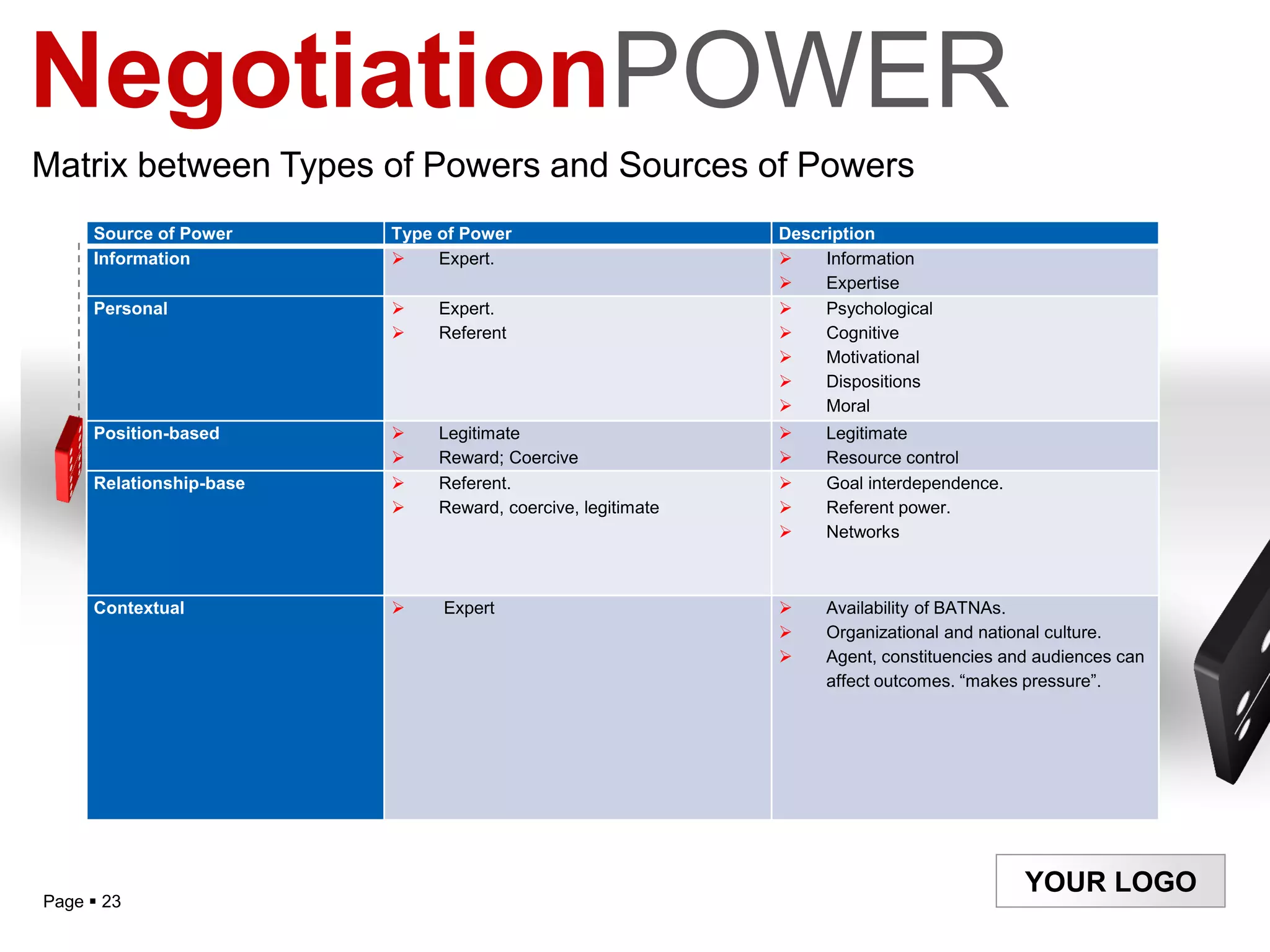
Matrix between Types of Powers and Sources of Powers
     Source of Power     Type of Power                       Description
     Information             Expert.                            Information
                                                                 Expertise
     Personal                Expert.                            Psychological
                             Referent                           Cognitive
                                                                 Motivational
                                                                 Dispositions
                                                                 Moral
     Position-based          Legitimate                         Legitimate
                             Reward; Coercive                   Resource control
     Relationship-base       Referent.                          Goal interdependence.
                             Reward, coercive, legitimate       Referent power.
                                                                 Networks


     Contextual              Expert                             Availability of BATNAs.
                                                                 Organizational and national culture.
                                                                 Agent, constituencies and audiences can
                                                                  affect outcomes. “makes pressure”.


                                                                                          YOUR LOGO
Page  23
THANK YOU


                        YOUR LOGO
Page  24

Power of Negotiation (Negotiation Power)

  • 1.
    NEGOTIATIONPOWER What are the types of Power! & What are the Sources of Power & Why do we need IT. What Is Negotiation Power! How to deal with Other’s Power! YOUR LOGO Page  1
  • 2.
    NEGOTIATION POWER YOUR LOGO Page  2
  • 3.
    Importance of NegotiationPower Negotiator believes he needs more power than the other Enhancing negotiator„s own power party to increase the ||||||||||||||||||||||||||||||||||||||||||||||||||||||||||||| probability of securing the Deminishing the other„s Power desired output. Equalization Difference Negotiator believes that he has less power than the other party which would be used against him as an advantage and accordingly seeks power to offset that advantage. Understanding the power in Negotiation YOUR LOGO Page  3
  • 4.
    NEGOTIATION POWER Types ofPOWER Expert Power Coercive Power Legtimate Power In depth Being able to Using the power information about a punish others for associated from subject. not doing what holding an office or needs to be done. a formal title Reward Power Referent Power Being able to reward Resepect one others for doing what to commands because of be done attributes like personaility,integrity,inte rpersonal style YOUR LOGO Page  4
  • 5.
    NEGOTIATION POWER YOUR LOGO Page  5
  • 6.
    NEGOTIATION POWER YOUR LOGO Page  6
  • 7.
    NEGOTIATION POWER Personal Source Sources of Power Derived from differences in: Informational Source • psycological orientation • Most common source • Cognitive orientation Contextual source of power. • Motivational orientation Common Sources: • Derived from • Dispositions and skills • Availability of negotiator‟s ability to BATNA‟s organiza facts and • Moral Orientation • Organizational and data to support his national culture position, or desired output. • Availability of agents • Positive (+) and audience that can affect directly is • Negative (-) indirectly the outcomes of the negotiation. Relationship-based • Goal interdependence Positional based • Referent Power • Derived from being located in a paticular position in organizational or communication structure leading to several kinds of leverage. 1. Formal authority 2. Resource control YOUR LOGO Page  7
  • 8.
    Sources of POWERS • THE SOURCES OF POWERS IN DETAILS YOUR LOGO Page  8
  • 9.
    Informational Source ofPOWER Information Power • Derived from the negotiator's ability to assemble and organize facts to support t his or her positions, arguments, and outcomes. • The exchange of information is the heart of the concession making process • This also allows the negotiators to drive a common picture of the current situation Expertise power can be Positive or Negative: • We believe the other because of their acknowledged expertise. • This will lead to Expertise Power pursue a course of It‟s a special form of information power. action opposite to A lot of people have information but expert power is accorded to those who the one they advocate are seen as having achieved some levels and mastery of body of information. YOUR LOGO Page  9
  • 10.
    Personal-Based Source ofPOWER Individuals have different psychological orientation to special situations Cognitive orientation There are 3 types of ideological frames: The unitary: Characterized by beliefs that society is an integrated whole and that the interests of individuals and society are one, such power can be ignored or used to benefit the good of all. The radical: Characterized by beliefs that society is in a continual clash of social, political and class interests. That power is structurally imbalanced. The pluralist: Characterized by beliefs that power is distributed relatively equally across various groups which compete and bargain for a share of the continually evolving balance of power Motivational Orientation • Focuses on the different in individual motivations • Differences rooted more in needs and "energizing elements" of the personality. • Individuals differ in the "power motive" or the disposition of some people to have high needs to influence and control others and to seek out positions of power and authority. YOUR LOGO Page  10
  • 11.
    Personal-Based Source ofPOWER (Cont.) Individuals have different psychological orientation to special situations Dispositions and skills • Skills such as high expertise, self confidence and high tolerance for conflict • Emphasizing skills such as sensitivity to others, flexibility, and ability to consider and incorporate the views of others into agreements. Moral Orientation • There is a significant positive relationship between people's implicit ideas regarding egalitarianism and their willingness to share power with low power parties. YOUR LOGO Page  11
  • 12.
    Relationship based Sourceof POWER Goal Interdependence • How the parties view their goals – and how much achievement of their goal depends on the behavior of the other party – has a strong impact on how likely Parties will be to constructively use power. Referent Power: • As defined earlier, referent power is derived from the respect or admiration one Commands because of attributes like personality, integrity. • Referent power is often based on an appeal to common experiences, common fate, or membership in the same groups. • Thus, a negotiator might start getting to know the other in order to discover Commonalities (home town, college, favorite sports team, political perspective) that, when discovered, will hopefully create a bond between the parties that will facilitate agreement. Negative referent power is often used, particularly when parties seek to create distance or division between themselves and others or to label the other. YOUR LOGO Page  12
  • 13.
    Relationship based Sourceof POWER (Cont.) 3-Networks: • Understanding power in this way is derived from conceptualizing organizations and their functioning not as a hierarchy, but as a network of interrelationships. Tie strength • This is an indication of the strength or quality of relationships with other. • Quality might be measured by how close you are how much personal information you share with the other. Strength of ties can be determined by how often the parties interact, how long they have known each other, how intimate one is with the other. Tie content • Content is the resource that passes along the tie with the other person. Network structure: Refers to the overall set of relationships within a social system ( e.g.a workplace, Department, school, or other social environment) YOUR LOGO Page  13
  • 14.
    Positional Based Sourceof POWER Legtimate Power Legitimate power It is derived from occupying a particular position in an organization can be acquired by several ways: There are times when people respond to directions from another , even At birth : directions they don‟t like it, because they feel it is proper for the other to direct Like queen Elizabeth them .This is the effect of Legitimate power. II By election: Legitimate power is at the foundation of our social structure. Like President People must elect a leader and introduce some formal rules about decision Obama By promotion: making, work divisions, responsibilities and conflict management. Appointment or promotion to some organizational It is also possible to apply the notion of legitimacy to certain social position. norms that exerts strong control over people such as: By respect: Derived from social The legitimate power of reciprocity: "I did you a favor; I expect you to do good or important social values like one for me" college members The legitimate power of equity: "I went out of my way for you; this is the least you could do for me" The legitimate power of responsibility or dependence: a strong social norm that we have an obligation to help others who can't help themselves YOUR LOGO Page  14
  • 15.
    Positional Based Sourceof POWER (Cont.) Resource Control Most important types of People who control resources have the capacity to give them to someone resources are: Money: cash, salary, who will do what they want and withhold them from someone who doesn‟t do budget allocation, what they want. bonus...etc. Particular resources are more useful as instruments of power and are highly Supplies: Raw material valued in the negotiation. Human capital: available labor supply Time: free time , ability to meet dead line , time pressure Equipment: machines, “To make a successful tools, technology, vehicles. control over resources; Critical services: maintenance, technical negotiators must maintain support, transportation. control over desirable Interpersonal support: verbal praise , reward that the other party encouragement for good performance or criticism wants or punishment the for bad performance. other seeks to avoid” YOUR LOGO Page  15
  • 16.
    Contextual Source ofPOWER BATNA: Based on: Best Alternative to negotiated agreement. • Context • Situation More backup plans and more alternatives LEADING TO more negotiation • Environment power. CULTURE: Determined by the social environments. National cultures differs in degree of power over, power with orientations are supported or encourage. Culture both organizational and national often translated into deeply embedded structural inequalities in society, degree to which women, religious groups, social classes, other interests Agents, Constitutions and External Audiences: One –to-one negotiation may be not complex, representing other parties‟ view make in more complexly. Public Media, Audience presents to observe, critique, and evaluate the negotiation, all can make pleasure to the negotiation parties as a part of negotiation process. YOUR LOGO Page  16
  • 17.
    CASESTUDY • CASE STUDY YOUR LOGO Page  17
  • 18.
    CASESTUDY Huawei and GSMin ME and Africa Negotiation Level (Table) 01 Operator Subcontractor Negotiation Level (Table) 02 YOUR LOGO Page  18
  • 19.
    CASESTUDY Huawei and GSMin ME and Africa Negotiation Level (Table) 01 Contextual Source of Power: Contextual Source of Power: • Limited Market • Very good organizational structure. • BATNA Expert Power: • Total Solutions and technology • Cross Culture Reward Power: • Acquired capable resources from local market and • Long time warranty & Maintenance globally. Positional based source of power: • Rapid deployment and supply. Informational Source of Power: • Better Prices. • Competitors • Gathered info about their competitors to know • Human resources quality and quantity what are there points of weakness and where Relationship-based source of power: Huawei can have an edge on them. • Goal interdependence Personal source of power: • Motivation to penetrate the market • Powers Huawei lacked & the sources of power • Powers Huawei had & where does it they used to equalize YOUR LOGO Page  19
  • 20.
    CASESTUDY Huawei and GSMin ME and Africa Negotiation Level (Table) 02 • Powers Huawei lacked • Powers Huawei had & where does it Contextual Source of Power: Contextual Source of Power: • Lack of local resources • Very good organizational structure. • BATNA; as there is large number of subcontractors Positional based Source of Power: in the market • He needs to leverage his finance Informational Source of Power: • Not aware with the construction, logistics in the local market. • Well versed and in contact with large number of local subcontractors. Expert Power: Coercive Power, Reward power & • Lack of expertise in part of the solution. Positional based source of power: • Majority of market share YOUR LOGO Page  20
  • 21.
    CASESTUDY Huawei and GSMin ME and Africa • Huawei has managed to equalize the points of weakness infront of both the Operator and the subcontractor • Maximizing their benefits (Market share and profit) using the powers they have. YOUR LOGO Page  21
  • 22.
    NEGOTIATIONPOWER Dealing with otherswho have more power 1. Never do an all or nothing deal 2. Make the other party smaller 3. Make yourself bigger 4. Build momentum through doing deals in sequence 5. Use the power of competition to leverage power 6. Constrain yourself 7. Good information is always a source of power 8. Do what you can manage the process YOUR LOGO Page  22
  • 23.
    NegotiationPOWER Matrix between Typesof Powers and Sources of Powers Source of Power Type of Power Description Information  Expert.  Information  Expertise Personal  Expert.  Psychological  Referent  Cognitive  Motivational  Dispositions  Moral Position-based  Legitimate  Legitimate  Reward; Coercive  Resource control Relationship-base  Referent.  Goal interdependence.  Reward, coercive, legitimate  Referent power.  Networks Contextual  Expert  Availability of BATNAs.  Organizational and national culture.  Agent, constituencies and audiences can affect outcomes. “makes pressure”. YOUR LOGO Page  23
  • 24.
    THANK YOU YOUR LOGO Page  24