P olitical Risks & Management Assessment


                                       Political risk is the hazard that
                                       political decisions or events will
                                       have a negative effect on your
                                       business.

By:
Ahmed Hassan ElMasry
Ahmed Mohamed Adel
Haytham Nadim
Hazem Saied
Mohamed El Demerdash
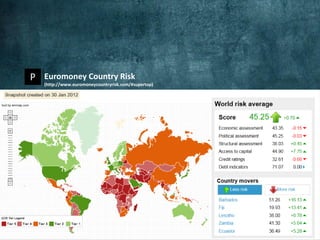
P Euromoney Country Risk
   (http://www.euromoneycountryrisk.com/#supertop)


                                                     Political risk is the hazard that
                                                     political decisions or events will
                                                     have a negative effect on your
                                                     business.
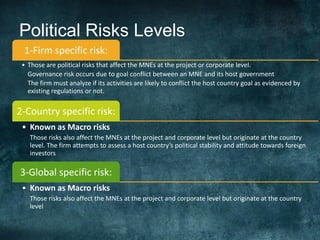
Political Risks Levels
 1-Firm specific risk:,
 • Those are political risks that affect the MNEs at the project or corporate level.
   Governance risk occurs due to goal conflict between an MNE and its host government
   The firm must analyze if its activities are likely to conflict the host country goal as evidenced by
   existing regulations or not.


                      ,
2-Country specific risk:
 • Known as Macro risks
    Those risks also affect the MNEs at the project and corporate level but originate at the country
    level. The firm attempts to assess a host country’s political stability and attitude towards foreign
    investors

                     ,
3-Global specific risk:
 • Known as Macro risks
    Those risks also affect the MNEs at the project and corporate level but originate at the country
    level
Predicting the Risk
Firm Specific Risk
 • The need for the firm to analyze political risk had led to a demand for tailor-made studies
   undertaken in-house by professional political risk analysts.
 • This demand is heightened by the observation that outside risk analysts rarely even agree on
   the degree of macro-political risk that exists in a set of countries.
 • Thus, it is necessary to plan protective steps in advance to minimize the risk of damage from
   unanticipated changes.

Macro Risk
 • Political risk studies usually include an analysis of the historical stability of the country in
   indications of economic stability and trends in cultural and religious activities.
 • Data are usually assembled by reading local newspaper , monitoring radio and television
   broadcasting , tapping the knowledge of outstanding expert consultants and contacting other
   business persons who had business experience in the host country.
 • Despite the difficulty of predicting the country risk , the MNE must still attempt to do it in
   order to prepare itself for the unknown.
Predicting the Risk
Global Specific Risk
 • It is even more difficult than the other two types of risks.
 • Nobody can predict the world trade center attack on September 11 , 2001.
 • Since there is a great need to predict terrorism , we can expect to see a number of new
   indices , similar to country-specific indices , but devoted to ranking different types of terrorist
   threats , their locations , and potential targets.
Risks
Firm Specific Risk
A- Governance risk:
   • It is defined as the ability to excersie control ovr and MNE‘s operations within a
   country legal and political enviroment.

   •Historically , conflicts between objectives of MNE‘s and host governments have arisen
   over as the firm‘s impact on economic development , percieved infringement on
   national sovereignty , foreign control of key industries , influence on the foreign
   exchange of its currency.

   •The attitude of conflicts are often colored by views about free enterprise versus state
   socialism , the degree of nationalism or internationalism.

   •The best approcah to goal conflict management is to anticipate problems and
   negotiate understanding ahead of time.

   •Prenegotiation of all possible areas of conflict provides a better basis for a successful
   future for both parties.
Firm Specific Risk                          Cont

B- Negotiating investment agreements:
•An investment agreemnet should define policies on financial and managerial issues
including the following:

    •The basis on which fund flows such as dividends , management fees , royalties , patent
    fees and loan repaymnets
    •The basis of setting transfer prices.
    •The right to export to a thrid world country markets.
    •Methods of taxiation.
    •Permission for a 100% foreign ownership versus local ownership participation.
    •Price controls.
    •Requirements for local sourcing versus import of raw materials and components.
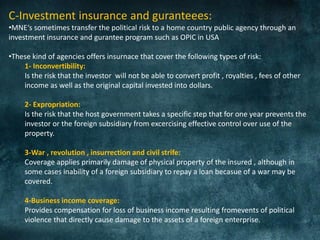
C-Investment insurance and guranteees:
•MNE‘s sometimes transfer the political risk to a home country public agency through an
investment insurance and gurantee program such as OPIC in USA

•These kind of agencies offers insurnace that cover the following types of risk:
    1- Inconvertibility:
    Is the risk that the investor will not be able to convert profit , royalties , fees of other
    income as well as the original capital invested into dollars.

     2- Expropriation:
     Is the risk that the host government takes a specific step that for one year prevents the
     investor or the foreign subsidiary from excercising effective control over use of the
     property.

     3-War , revolution , insurrection and civil strife:
     Coverage applies primarily damage of physical property of the insured , although in
     some cases inability of a foreign subsidiary to repay a loan becasue of a war may be
     covered.

     4-Business income coverage:
     Provides compensation for loss of business income resulting fromevents of political
     violence that directly cause damage to the assets of a foreign enterprise.
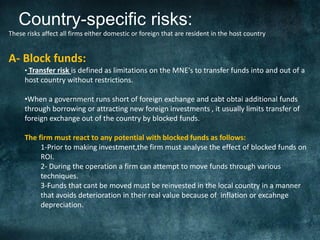
Country-specific risks:
These risks affect all firms either domestic or foreign that are resident in the host country


A- Block funds:
     • Transfer risk is defined as limitations on the MNE‘s to transfer funds into and out of a
     host country without restrictions.

     •When a government runs short of foreign exchange and cabt obtai additional funds
     through borrowing or attracting new foreign investments , it usually limits transfer of
     foreign exchange out of the country by blocked funds.

     The firm must react to any potential with blocked funds as follows:
          1-Prior to making investment,the firm must analyse the effect of blocked funds on
          ROI.
          2- During the operation a firm can attempt to move funds through various
          techniques.
          3-Funds that cant be moved must be reinvested in the local country in a manner
          that avoids deterioration in their real value because of inflation or excahnge
          depreciation.
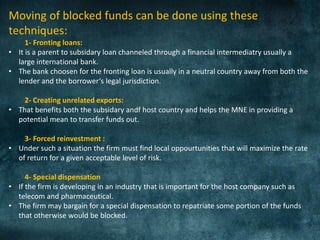
Moving of blocked funds can be done using these
techniques:
     1- Fronting loans:
• It is a parent to subsidary loan channeled through a financial intermediatry usually a
  large international bank.
• The bank choosen for the fronting loan is usually in a neutral country away from both the
  lender and the borrower‘s legal jurisdiction.

   2- Creating unrelated exports:
• That benefits both the subsidary andf host country and helps the MNE in providing a
  potential mean to transfer funds out.

    3- Forced reinvestment :
• Under such a situation the firm must find local oppourtunities that will maximize the rate
  of return for a given acceptable level of risk.

     4- Special dispensation
• If the firm is developing in an industry that is important for the host company such as
  telecom and pharmaceutical.
• The firm may bargain for a special dispensation to repatriate some portion of the funds
  that otherwise would be blocked.
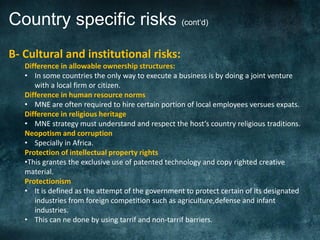
Country specific risks (cont‘d)
B- Cultural and institutional risks:
   Difference in allowable ownership structures:
   • In some countries the only way to execute a business is by doing a joint venture
      with a local firm or citizen.
   Difference in human resource norms
   • MNE are often required to hire certain portion of local employees versues expats.
   Difference in religious heritage
   • MNE strategy must understand and respect the host‘s country religious traditions.
   Neopotism and corruption
   • Specially in Africa.
   Protection of intellectual property rights
   •This grantes the exclusive use of patented technology and copy righted creative
   material.
   Protectionism
   • It is defined as the attempt of the government to protect certain of its designated
      industries from foreign competition such as agriculture,defense and infant
      industries.
   • This can ne done by using tarrif and non-tarrif barriers.
Global-specific risks
1-Terrorism and war
• Althought the world trade center attack and its aftermath,the war in afghanistan and
   iraq,have affected nearly everyone in the world,many other acts of terrorism have been
   committed in recent years.
• More terrorist acts are expected to occur in the future.
• Practically exposed are the foreign subsidiaries of MNEs and their employees.
• No MNE has the tools to avoid terrorism thats hy they must depned on the governments.
• Inreturn governments expect finanicial , verbal and matterial support from MNE that
   must be taking into consideration.
2-Crisis planning
• Crisis planning has become a major activity for MNEs at both the foreign subsidary and
   parent level firm.
• Crisis planning means educating management and other employees to react to various
   scenarios of violence.
3-Antiglobalization movement:
• During the past decades there has been a growing negative reaction by some groups to
   reduced trade barriers and efforts to create regional markets such as NAFTA and
   european union.
• MNEs dont have the tools to combat antiglobalization movemnet but they are blamed
   for fostering the problem in first place.
• MNE must rely on governments and crisis planning to manage these risks.
Global-specific risks (Cont‘d)
4-Enviromental concerns
• MNEs has been accused of exporting their enviromental problems to other countries.
• The accusation is that MNEs frustrated by pollution controls in home country have
   relocated their activities to countries with weaker controls.
• This is a main reason for global warming.

5-Poverty
• MNEs have located foreign subsidiaries in some countries with extremely uneven income
   distribution.
• Most of the population suffers from lack of education,social and eonomic infrastructure
   and political power.
• MNE are contributing in this issue by hiring the elite class to manage their operations.
• On the other hand MNEs are creating relatively stable and well paying jobs for those who
   were otherwise unemployed and living below the poverty level.

6-Cyber attacks:
• The rapid growth of the internet has fostered a whole new generation of scam artists
   who disrupt the usefulness of the world wide web.
• MNEs can face costely cyber attacks because of their visibility and the complexity of their
   internal information systems.
.
Global-specific risks (Cont‘d)
6-Corporate social responsibilty
• The first years of the twenty first century have been a rebirth in soceity‘s refelctions on
   business.
• One of the most audible debates that regarding sustainable development , the principle
   that economic development today should not compromise the ability of future
   generations to acheive and enjoy similar standards of living.
• Althought the sustainable development intially focused on enviromental concerns , it has
   evolved to include equal concerns that „incorporate the ambition for a just and caring
   society“.
.

Political risks and management assesment

  • 1.
    P olitical Risks& Management Assessment Political risk is the hazard that political decisions or events will have a negative effect on your business. By: Ahmed Hassan ElMasry Ahmed Mohamed Adel Haytham Nadim Hazem Saied Mohamed El Demerdash
  • 2.
    P Euromoney CountryRisk (http://www.euromoneycountryrisk.com/#supertop) Political risk is the hazard that political decisions or events will have a negative effect on your business.
  • 3.
    Political Risks Levels 1-Firm specific risk:, • Those are political risks that affect the MNEs at the project or corporate level. Governance risk occurs due to goal conflict between an MNE and its host government The firm must analyze if its activities are likely to conflict the host country goal as evidenced by existing regulations or not. , 2-Country specific risk: • Known as Macro risks Those risks also affect the MNEs at the project and corporate level but originate at the country level. The firm attempts to assess a host country’s political stability and attitude towards foreign investors , 3-Global specific risk: • Known as Macro risks Those risks also affect the MNEs at the project and corporate level but originate at the country level
  • 4.
    Predicting the Risk FirmSpecific Risk • The need for the firm to analyze political risk had led to a demand for tailor-made studies undertaken in-house by professional political risk analysts. • This demand is heightened by the observation that outside risk analysts rarely even agree on the degree of macro-political risk that exists in a set of countries. • Thus, it is necessary to plan protective steps in advance to minimize the risk of damage from unanticipated changes. Macro Risk • Political risk studies usually include an analysis of the historical stability of the country in indications of economic stability and trends in cultural and religious activities. • Data are usually assembled by reading local newspaper , monitoring radio and television broadcasting , tapping the knowledge of outstanding expert consultants and contacting other business persons who had business experience in the host country. • Despite the difficulty of predicting the country risk , the MNE must still attempt to do it in order to prepare itself for the unknown.
  • 5.
    Predicting the Risk GlobalSpecific Risk • It is even more difficult than the other two types of risks. • Nobody can predict the world trade center attack on September 11 , 2001. • Since there is a great need to predict terrorism , we can expect to see a number of new indices , similar to country-specific indices , but devoted to ranking different types of terrorist threats , their locations , and potential targets.
  • 6.
  • 7.
    Firm Specific Risk A-Governance risk: • It is defined as the ability to excersie control ovr and MNE‘s operations within a country legal and political enviroment. •Historically , conflicts between objectives of MNE‘s and host governments have arisen over as the firm‘s impact on economic development , percieved infringement on national sovereignty , foreign control of key industries , influence on the foreign exchange of its currency. •The attitude of conflicts are often colored by views about free enterprise versus state socialism , the degree of nationalism or internationalism. •The best approcah to goal conflict management is to anticipate problems and negotiate understanding ahead of time. •Prenegotiation of all possible areas of conflict provides a better basis for a successful future for both parties.
  • 8.
    Firm Specific Risk Cont B- Negotiating investment agreements: •An investment agreemnet should define policies on financial and managerial issues including the following: •The basis on which fund flows such as dividends , management fees , royalties , patent fees and loan repaymnets •The basis of setting transfer prices. •The right to export to a thrid world country markets. •Methods of taxiation. •Permission for a 100% foreign ownership versus local ownership participation. •Price controls. •Requirements for local sourcing versus import of raw materials and components.
  • 9.
    C-Investment insurance andguranteees: •MNE‘s sometimes transfer the political risk to a home country public agency through an investment insurance and gurantee program such as OPIC in USA •These kind of agencies offers insurnace that cover the following types of risk: 1- Inconvertibility: Is the risk that the investor will not be able to convert profit , royalties , fees of other income as well as the original capital invested into dollars. 2- Expropriation: Is the risk that the host government takes a specific step that for one year prevents the investor or the foreign subsidiary from excercising effective control over use of the property. 3-War , revolution , insurrection and civil strife: Coverage applies primarily damage of physical property of the insured , although in some cases inability of a foreign subsidiary to repay a loan becasue of a war may be covered. 4-Business income coverage: Provides compensation for loss of business income resulting fromevents of political violence that directly cause damage to the assets of a foreign enterprise.
  • 10.
    Country-specific risks: These risksaffect all firms either domestic or foreign that are resident in the host country A- Block funds: • Transfer risk is defined as limitations on the MNE‘s to transfer funds into and out of a host country without restrictions. •When a government runs short of foreign exchange and cabt obtai additional funds through borrowing or attracting new foreign investments , it usually limits transfer of foreign exchange out of the country by blocked funds. The firm must react to any potential with blocked funds as follows: 1-Prior to making investment,the firm must analyse the effect of blocked funds on ROI. 2- During the operation a firm can attempt to move funds through various techniques. 3-Funds that cant be moved must be reinvested in the local country in a manner that avoids deterioration in their real value because of inflation or excahnge depreciation.
  • 11.
    Moving of blockedfunds can be done using these techniques: 1- Fronting loans: • It is a parent to subsidary loan channeled through a financial intermediatry usually a large international bank. • The bank choosen for the fronting loan is usually in a neutral country away from both the lender and the borrower‘s legal jurisdiction. 2- Creating unrelated exports: • That benefits both the subsidary andf host country and helps the MNE in providing a potential mean to transfer funds out. 3- Forced reinvestment : • Under such a situation the firm must find local oppourtunities that will maximize the rate of return for a given acceptable level of risk. 4- Special dispensation • If the firm is developing in an industry that is important for the host company such as telecom and pharmaceutical. • The firm may bargain for a special dispensation to repatriate some portion of the funds that otherwise would be blocked.
  • 12.
    Country specific risks(cont‘d) B- Cultural and institutional risks: Difference in allowable ownership structures: • In some countries the only way to execute a business is by doing a joint venture with a local firm or citizen. Difference in human resource norms • MNE are often required to hire certain portion of local employees versues expats. Difference in religious heritage • MNE strategy must understand and respect the host‘s country religious traditions. Neopotism and corruption • Specially in Africa. Protection of intellectual property rights •This grantes the exclusive use of patented technology and copy righted creative material. Protectionism • It is defined as the attempt of the government to protect certain of its designated industries from foreign competition such as agriculture,defense and infant industries. • This can ne done by using tarrif and non-tarrif barriers.
  • 13.
    Global-specific risks 1-Terrorism andwar • Althought the world trade center attack and its aftermath,the war in afghanistan and iraq,have affected nearly everyone in the world,many other acts of terrorism have been committed in recent years. • More terrorist acts are expected to occur in the future. • Practically exposed are the foreign subsidiaries of MNEs and their employees. • No MNE has the tools to avoid terrorism thats hy they must depned on the governments. • Inreturn governments expect finanicial , verbal and matterial support from MNE that must be taking into consideration. 2-Crisis planning • Crisis planning has become a major activity for MNEs at both the foreign subsidary and parent level firm. • Crisis planning means educating management and other employees to react to various scenarios of violence. 3-Antiglobalization movement: • During the past decades there has been a growing negative reaction by some groups to reduced trade barriers and efforts to create regional markets such as NAFTA and european union. • MNEs dont have the tools to combat antiglobalization movemnet but they are blamed for fostering the problem in first place. • MNE must rely on governments and crisis planning to manage these risks.
  • 14.
    Global-specific risks (Cont‘d) 4-Enviromentalconcerns • MNEs has been accused of exporting their enviromental problems to other countries. • The accusation is that MNEs frustrated by pollution controls in home country have relocated their activities to countries with weaker controls. • This is a main reason for global warming. 5-Poverty • MNEs have located foreign subsidiaries in some countries with extremely uneven income distribution. • Most of the population suffers from lack of education,social and eonomic infrastructure and political power. • MNE are contributing in this issue by hiring the elite class to manage their operations. • On the other hand MNEs are creating relatively stable and well paying jobs for those who were otherwise unemployed and living below the poverty level. 6-Cyber attacks: • The rapid growth of the internet has fostered a whole new generation of scam artists who disrupt the usefulness of the world wide web. • MNEs can face costely cyber attacks because of their visibility and the complexity of their internal information systems. .
  • 15.
    Global-specific risks (Cont‘d) 6-Corporatesocial responsibilty • The first years of the twenty first century have been a rebirth in soceity‘s refelctions on business. • One of the most audible debates that regarding sustainable development , the principle that economic development today should not compromise the ability of future generations to acheive and enjoy similar standards of living. • Althought the sustainable development intially focused on enviromental concerns , it has evolved to include equal concerns that „incorporate the ambition for a just and caring society“. .