
How can a manager introduce
 Knowledge Management?


          Topic 5 – ORG33
        AKAD Stuttgart 9/2009
           Nico Schuster
Overview


    • Knowledge Management?
    • Implementation based on Project Management
        – Concept by Fraunhofer
        – Concept by Bullinger/Wörner/Prieto
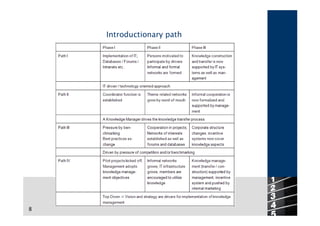
    •   Introductionary path
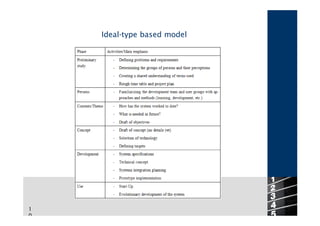
    •   Ideal-type based model
    •   Obstacles
    •   Conclusion


2
Knowledge Management?


    •   Knowledge Management (KM) comprises a range of
        practices used in an organization to identify,
        create, represent, distribute and enable adoption
        of insights and experiences.
        Such insights and experiences comprise
        knowledge, either embodied in individuals or
        embedded in organizational processes or practice.
    •   KM System refers to a (generally IT based) system
        for managing knowledge in organizations for
        supporting creation, capture, storage and
        dissemination of information.


                                                            3
3
Implementation based on Project Management


    •     Fraunhofer

    • Assumption:

        KM projects are unique and have individual elements


    àImplementation as to follow principles of project management


                                                                    4
4
Implementation based on Project Management


    •   Fraunhofer

    • Phases:

         •Analysis phase
          focus on organizational processes, information flow
          performance indicators
          à What is needed, how should our KM look like

         •Planning phase
           how should the concept look like?
           What instruments of KM should be utilized?
           à Find the right people, technology and organizational surrounding
             drafts of “how” and “what” are refined in several stages
         •Implementation phase
           decisions on systems and solutions; pilot-like project kicked off
           using “domino principle”


                                                                                5
5
Implementation based on Project Management


    •     Bullinger/Wörner/Prieto

    • Assumption:

        KM projects are unique and have individual elements

        AND

        focus on involvement of stakeholders


    àImplementation has to follow principles of project management
    àDrivers are Power Promoters and Technical Promoters


                                                                     6
6
Introductionary path


    •   Path I
        Technology oriented
        First IT preconditions are developed afterwards
        they are adjusted to feed the needs of KM
        e.g. Best Practices sharing, DBs etc.
    •   Path II
        Driven by one Knowledge Manager who
        encourages others to participate
    •   Path III
        Driven by pressure to benchmark / competition
        IT solutions are adjusted for KM
    •   Path IV
        Management decision „Top Down“ approach
        Incentive systems established
                                                          7
7
Introductionary path


                           8
8
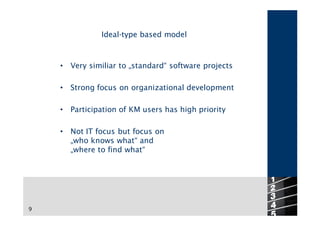
Ideal-type based model


    •   Very similiar to „standard“ software projects

    •   Strong focus on organizational development

    •   Participation of KM users has high priority

    •   Not IT focus but focus on
        „who knows what“ and
        „where to find what“


                                                        9
9
Ideal-type based model


                             10
1
0
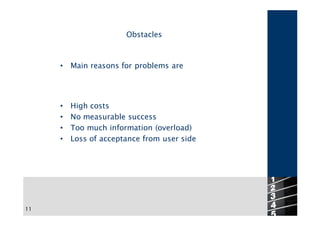
Obstacles


     •   Main reasons for problems are


     •   High costs
     •   No measurable success
     •   Too much information (overload)
     •   Loss of acceptance from user side


                                             11
11
Conclusion


     •   No „one fits all“ solution
     •   Project characteristic; but focus has to be on users
         NOT Information technology
     •   Change Management


     „The learning and knowledge that we have, is, at the most, but little compared
                                             with that of which we are ignorant.“
                                                                               Plato


                                                                                       12
12
Thank you very much for
     your attention!


                           Nico Schuster
                                           13
13

Transition Management Topic5 How Can A Manager Introduce Knowledge Management

  • 1.
    How can amanager introduce Knowledge Management? Topic 5 – ORG33 AKAD Stuttgart 9/2009 Nico Schuster
  • 2.
    Overview • Knowledge Management? • Implementation based on Project Management – Concept by Fraunhofer – Concept by Bullinger/Wörner/Prieto • Introductionary path • Ideal-type based model • Obstacles • Conclusion 2
  • 3.
    Knowledge Management? • Knowledge Management (KM) comprises a range of practices used in an organization to identify, create, represent, distribute and enable adoption of insights and experiences. Such insights and experiences comprise knowledge, either embodied in individuals or embedded in organizational processes or practice. • KM System refers to a (generally IT based) system for managing knowledge in organizations for supporting creation, capture, storage and dissemination of information. 3 3
  • 4.
    Implementation based onProject Management • Fraunhofer • Assumption: KM projects are unique and have individual elements àImplementation as to follow principles of project management 4 4
  • 5.
    Implementation based onProject Management • Fraunhofer • Phases: •Analysis phase focus on organizational processes, information flow performance indicators à What is needed, how should our KM look like •Planning phase how should the concept look like? What instruments of KM should be utilized? à Find the right people, technology and organizational surrounding drafts of “how” and “what” are refined in several stages •Implementation phase decisions on systems and solutions; pilot-like project kicked off using “domino principle” 5 5
  • 6.
    Implementation based onProject Management • Bullinger/Wörner/Prieto • Assumption: KM projects are unique and have individual elements AND focus on involvement of stakeholders àImplementation has to follow principles of project management àDrivers are Power Promoters and Technical Promoters 6 6
  • 7.
    Introductionary path • Path I Technology oriented First IT preconditions are developed afterwards they are adjusted to feed the needs of KM e.g. Best Practices sharing, DBs etc. • Path II Driven by one Knowledge Manager who encourages others to participate • Path III Driven by pressure to benchmark / competition IT solutions are adjusted for KM • Path IV Management decision „Top Down“ approach Incentive systems established 7 7
  • 8.
  • 9.
    Ideal-type based model • Very similiar to „standard“ software projects • Strong focus on organizational development • Participation of KM users has high priority • Not IT focus but focus on „who knows what“ and „where to find what“ 9 9
  • 10.
  • 11.
    Obstacles • Main reasons for problems are • High costs • No measurable success • Too much information (overload) • Loss of acceptance from user side 11 11
  • 12.
    Conclusion • No „one fits all“ solution • Project characteristic; but focus has to be on users NOT Information technology • Change Management „The learning and knowledge that we have, is, at the most, but little compared with that of which we are ignorant.“ Plato 12 12
  • 13.
    Thank you verymuch for your attention! Nico Schuster 13 13