orthodontic | TECHNIQUES


Lab procedures for
lingual orthodontics - Part 1
By Terry Whitty


                              ost of us are surely familiar with Ortho-

                    M         dontic braces. They’ve been around for a
                              long time, in fact since the late 1800’s.
                    We’ve either had the experience as a patient or
                    know someone who has. Simply put, they are com-
                    prised of brackets and/or bands bonded to the teeth
                    with an archwire interconnecting these brackets to
                    move the teeth in three dimensions. They are very
                    efficient but in today’s fashion conscious world, for
       “These       some, they are just plain ugly, especially for adults.
                    There are alternatives to standard metal labial
   days, there                                                                Figure 1. Standard labial-bonded brackets (braces).
                    bonded braces and these include clear ceramic or
      are many      plastic brackets or a series of invisible aligners such
 different types    as Tru-Line™, but these articles will focus on the
      of lingual    development of and some of the laboratory proce-
   brackets on      dures of lingual orthodontics.
                       Lingual orthodontics is exactly as the name sug-
    the market
                    gests - orthodontic brackets placed on the lingual
       but the      surfaces of the teeth and connected by special arch-
  positioning of    wires. The advantages aesthetically are immediately
 these brackets     evident, but other advantages include the labial
     in relation    enamel is not etched, bonded or scarred during
                    debonding. Braces do not have to be removed early
   to the teeth                                                               Figure 2. Ceramic brackets (braces).
                    for social events and people with highly visible social
       is really    jobs can still continue without embarrassment.
    the critical       The disadvantages of lingual Orthodontics
factor common       include speech interference and patient adaptation
       to all...”   is not always predictable. Tongue irritation is
                    common and patients with narrow arches or tongue
                    thrust may not adapt well. The technique is clini-
                    cally more time consuming and patients tend to be
                    more demanding. Some traditional labial
                    mechanics cannot be used due to the smaller inter-
                    bracket distances and smaller arch radius. Delving
                    into the details of most of this is beyond the scope
                    of the article but suffice to say there are differences
                    between the two modalities.
                       The lingual bracket had to be specifically
                    designed for the lingual surface of the teeth and a       Figure 3. Lingual braces.


24 eLABORATE                                                                                      November/December 2007
orthodontic | TECHNIQUES


Figure 4. The original TARG           Figure 5. TARG with Dial       Figure 6. Various bracket placement-measuring devices.
with wooden base.                     Test Indicator.


Figure 7. The lingual bracket jig.

method of positioning these brackets had             Over the years, various improvements to
to be invented as direct bonding of lingual       the TARG device were made. Adding thick-
brackets is virtually impossible, hence an        ness compensation and height determination
indirect method had to be developed.              in a digital measuring environment were
   These days, there are many different           some of the advances.
types of lingual brackets on the market but          In 1997, a new TARG Professional by Dr
the positioning of these brackets in rela-        Weichmann from Germany - the Transfer            Figure 8. Later from Korea came the Mini
tion to the teeth is really the critical factor   Optimised Positioning System (TOPS) was          TARG which was almost impossible to
common to all. So the real trick to get lin-      released, but still used the Torque blades of    use, lacking in precision and ease of use.
gual orthodontics to work in the real world       the TARG. He also invented the first
was to devise a method so the brackets            CAD/CAM Incognito system, which uses                The laboratory uses it in the opposite
could be placed onto the tooth with the           customized gold brackets. Various other          way by pre-setting the angulation and
correct torque and angulation in relation         inventions were introduced over the years        torque then orientating the survey base to
to the tooth already determined. This is          but none with significant merit.                 the best fit, thus giving a reference to
much easier to do with labial braces but a           In 2004, a real breakthrough in lingual       transfer the work over and allow correct
real challenge for lingual braces.                orthodontics arrived. The Torque Angula-         bracket placement. The invention of the
   Lingual braces were invented in the            tion Device (TAD) prototype was first            TAD finally provided the orthodontist
1970’s when a Playboy model wanted to             introduced. This device was unique as it had     with the tools to accurately measure
know if she could have some type of               the ability to survey and measure the torque     existing torque and angulation on models
“invisible” orthodontic treament so she           and angulation of individual teeth in a dif-     of mal-occluded teeth. After the
could keep working. The first attempts            ferent way than previous devices and with        prototype TAD was finished, intensive
were crude but lead to more interest in lin-      great accuracy. With the prepared study          lab work was carried out testing and
gual orthodontics. In 1984, the Ormco             model in position, the surveyor base is set to   cross-referencing with the old TARG to
company devised the TARG (Torque                  horizontal and then the TAD is adjusted to       find the differences in Angulation and
Angulation Reference Guide) device for            give the best fit for angulation and torque.     Torque given. The Torque differences
more precise bracket positioning, espe-           The operator thereby receives precise dig-       were significant, leading the researchers
cially for the lingual technique. The first       ital measurement data for the mal-occluded       to believe the old TARG had an
of these machines had a wooden base               teeth in the mouth so that you can make a        inaccuracy of + or - 3 degrees! Again the
which proved to impede precision.                 suitable prescription for treatment.             inventors concentrated one ease-of-use


November/December 2007                                                                                                   eLABORATE 25
orthodontic | TECHNIQUES


Figure 9. The prototype TAD.                 Figure 10. Measuring torque and angulation.   Figure 11. TAD Device with key elements
                                                                                           explained.


Figure 12. Production TAD.                   Figure 13. Bracket Placement Device (BPD).    Figure 14. Bracket Placement Device key
                                                                                           - elements explained.

                                                                                           maintenance. Increased accuracy in con-
                                                                                           trolled bracket placement allows the
                                                                                           operator to work faster and smarter. After
                                                                                           the model is measured with the TAD,
                                                                                           these measurements are transferred to the
                                                                                           BPD and the brackets are placed onto the
                                                                                           model before a custom tray is fabricated.
                                                                                           This process will be fully detailed in part 2
                                                                                           of this article.

                                                                                           Acknowledgement
                                                                                           The author wishes to thank Peter Sheffield
                                                                                           from Hexa Ceram Dental Laboratory for
                                                                                           his assistance with tis article.

                                                                                           About the author
                                                                                           Terry Whitty is the technical editor of
                                                                                           eLABORATE and also runs a successful
Figure 15. Brackets are accurately placed on the model using the TAD and BPD.              orthodontic laboratory in Sydney’s
                                                                                           eastern suburbs where he produces inno-
and speed for the technician. The accu-        To make bracket placement easy, the         vative appliances using the latest
racy was already there. In 2006, the first   Bracket Placement Device BPD was              techniques and technologies including
production TAD is finished and the world     devised and is used in conjunction with       laser welding. He has also lectured
had the first digital TARG accurate          the TAD. It is reliable, strong, compact      throughout Australia and New Zealand on
to 0.1 degrees!                              and easy to use, as well as being very low    a variety of subjects.


26 eLABORATE                                                                                           November/December 2007

Lingual Orthodontics

  • 1.
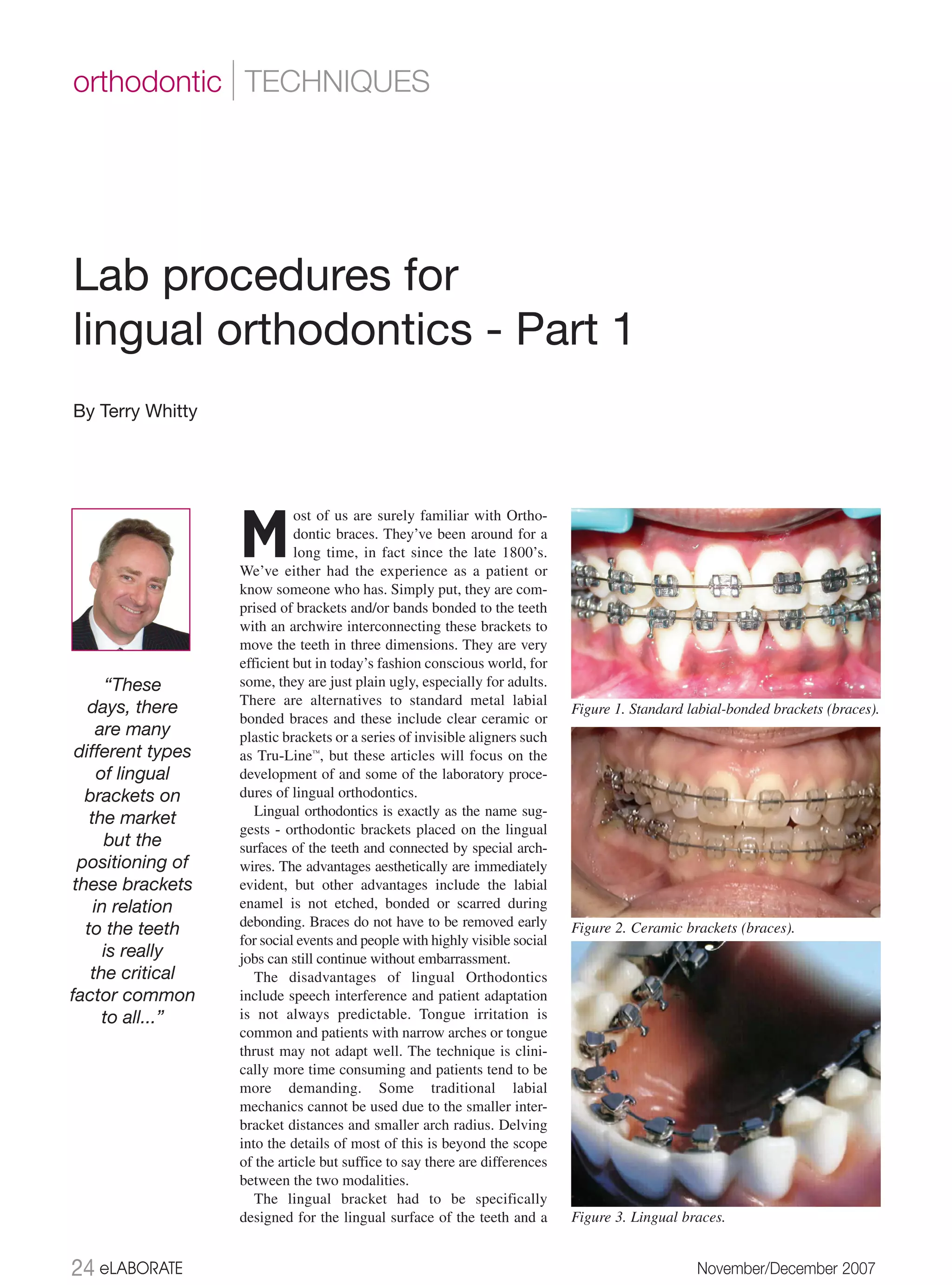
    orthodontic | TECHNIQUES Labprocedures for lingual orthodontics - Part 1 By Terry Whitty ost of us are surely familiar with Ortho- M dontic braces. They’ve been around for a long time, in fact since the late 1800’s. We’ve either had the experience as a patient or know someone who has. Simply put, they are com- prised of brackets and/or bands bonded to the teeth with an archwire interconnecting these brackets to move the teeth in three dimensions. They are very efficient but in today’s fashion conscious world, for “These some, they are just plain ugly, especially for adults. There are alternatives to standard metal labial days, there Figure 1. Standard labial-bonded brackets (braces). bonded braces and these include clear ceramic or are many plastic brackets or a series of invisible aligners such different types as Tru-Line™, but these articles will focus on the of lingual development of and some of the laboratory proce- brackets on dures of lingual orthodontics. Lingual orthodontics is exactly as the name sug- the market gests - orthodontic brackets placed on the lingual but the surfaces of the teeth and connected by special arch- positioning of wires. The advantages aesthetically are immediately these brackets evident, but other advantages include the labial in relation enamel is not etched, bonded or scarred during debonding. Braces do not have to be removed early to the teeth Figure 2. Ceramic brackets (braces). for social events and people with highly visible social is really jobs can still continue without embarrassment. the critical The disadvantages of lingual Orthodontics factor common include speech interference and patient adaptation to all...” is not always predictable. Tongue irritation is common and patients with narrow arches or tongue thrust may not adapt well. The technique is clini- cally more time consuming and patients tend to be more demanding. Some traditional labial mechanics cannot be used due to the smaller inter- bracket distances and smaller arch radius. Delving into the details of most of this is beyond the scope of the article but suffice to say there are differences between the two modalities. The lingual bracket had to be specifically designed for the lingual surface of the teeth and a Figure 3. Lingual braces. 24 eLABORATE November/December 2007
  • 2.
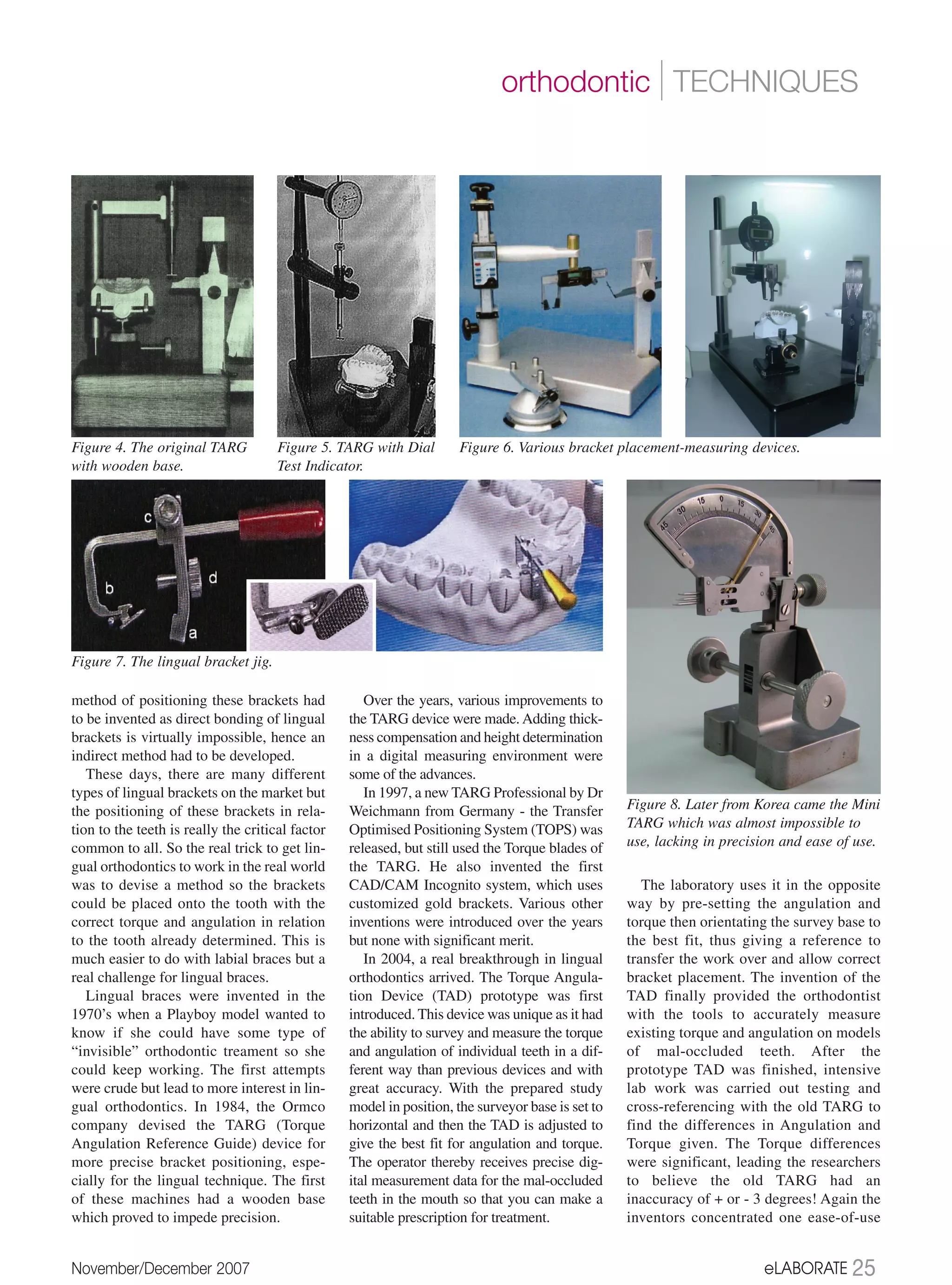
    orthodontic | TECHNIQUES Figure4. The original TARG Figure 5. TARG with Dial Figure 6. Various bracket placement-measuring devices. with wooden base. Test Indicator. Figure 7. The lingual bracket jig. method of positioning these brackets had Over the years, various improvements to to be invented as direct bonding of lingual the TARG device were made. Adding thick- brackets is virtually impossible, hence an ness compensation and height determination indirect method had to be developed. in a digital measuring environment were These days, there are many different some of the advances. types of lingual brackets on the market but In 1997, a new TARG Professional by Dr the positioning of these brackets in rela- Weichmann from Germany - the Transfer Figure 8. Later from Korea came the Mini tion to the teeth is really the critical factor Optimised Positioning System (TOPS) was TARG which was almost impossible to common to all. So the real trick to get lin- released, but still used the Torque blades of use, lacking in precision and ease of use. gual orthodontics to work in the real world the TARG. He also invented the first was to devise a method so the brackets CAD/CAM Incognito system, which uses The laboratory uses it in the opposite could be placed onto the tooth with the customized gold brackets. Various other way by pre-setting the angulation and correct torque and angulation in relation inventions were introduced over the years torque then orientating the survey base to to the tooth already determined. This is but none with significant merit. the best fit, thus giving a reference to much easier to do with labial braces but a In 2004, a real breakthrough in lingual transfer the work over and allow correct real challenge for lingual braces. orthodontics arrived. The Torque Angula- bracket placement. The invention of the Lingual braces were invented in the tion Device (TAD) prototype was first TAD finally provided the orthodontist 1970’s when a Playboy model wanted to introduced. This device was unique as it had with the tools to accurately measure know if she could have some type of the ability to survey and measure the torque existing torque and angulation on models “invisible” orthodontic treament so she and angulation of individual teeth in a dif- of mal-occluded teeth. After the could keep working. The first attempts ferent way than previous devices and with prototype TAD was finished, intensive were crude but lead to more interest in lin- great accuracy. With the prepared study lab work was carried out testing and gual orthodontics. In 1984, the Ormco model in position, the surveyor base is set to cross-referencing with the old TARG to company devised the TARG (Torque horizontal and then the TAD is adjusted to find the differences in Angulation and Angulation Reference Guide) device for give the best fit for angulation and torque. Torque given. The Torque differences more precise bracket positioning, espe- The operator thereby receives precise dig- were significant, leading the researchers cially for the lingual technique. The first ital measurement data for the mal-occluded to believe the old TARG had an of these machines had a wooden base teeth in the mouth so that you can make a inaccuracy of + or - 3 degrees! Again the which proved to impede precision. suitable prescription for treatment. inventors concentrated one ease-of-use November/December 2007 eLABORATE 25
  • 3.
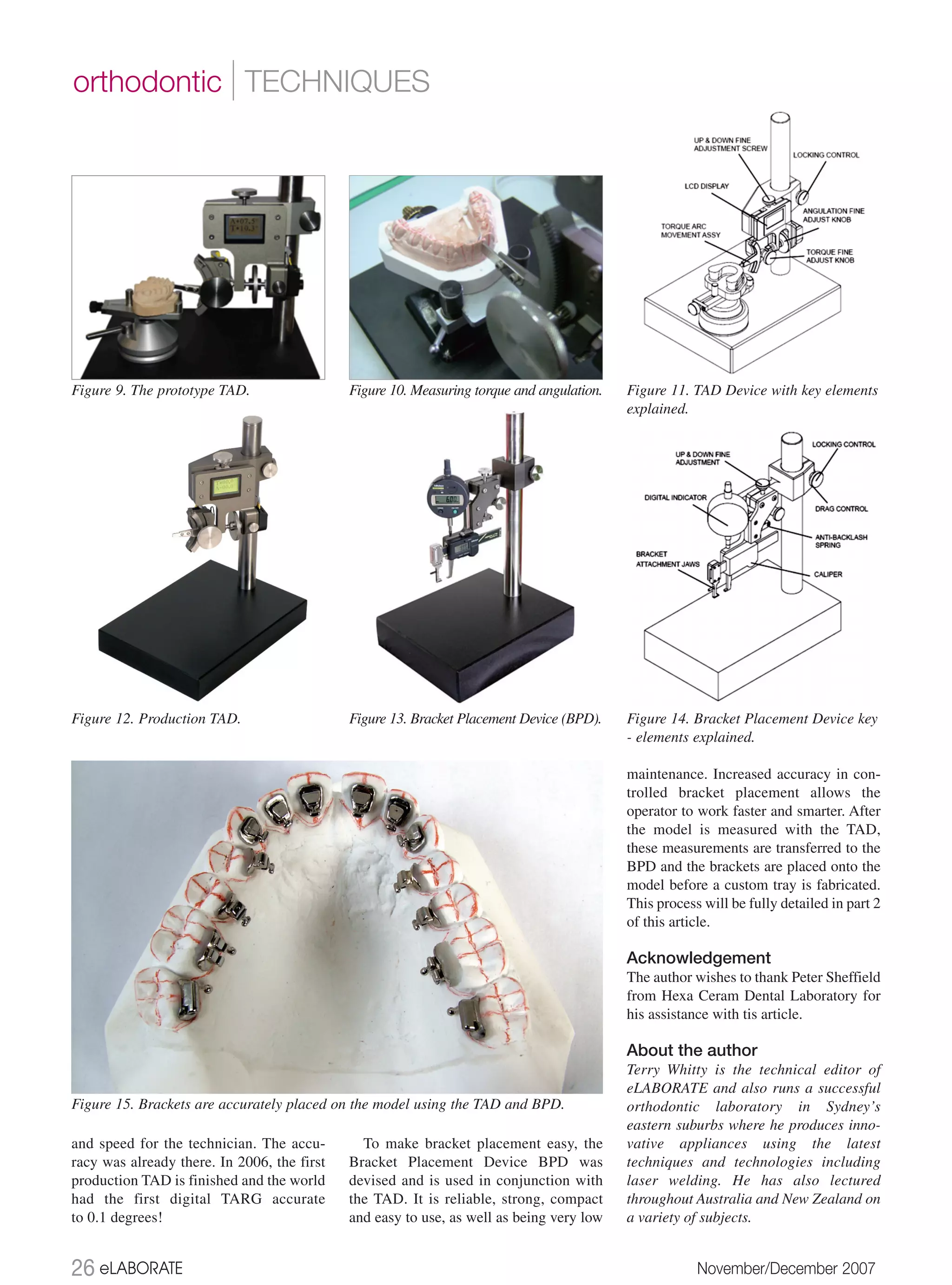
    orthodontic | TECHNIQUES Figure9. The prototype TAD. Figure 10. Measuring torque and angulation. Figure 11. TAD Device with key elements explained. Figure 12. Production TAD. Figure 13. Bracket Placement Device (BPD). Figure 14. Bracket Placement Device key - elements explained. maintenance. Increased accuracy in con- trolled bracket placement allows the operator to work faster and smarter. After the model is measured with the TAD, these measurements are transferred to the BPD and the brackets are placed onto the model before a custom tray is fabricated. This process will be fully detailed in part 2 of this article. Acknowledgement The author wishes to thank Peter Sheffield from Hexa Ceram Dental Laboratory for his assistance with tis article. About the author Terry Whitty is the technical editor of eLABORATE and also runs a successful Figure 15. Brackets are accurately placed on the model using the TAD and BPD. orthodontic laboratory in Sydney’s eastern suburbs where he produces inno- and speed for the technician. The accu- To make bracket placement easy, the vative appliances using the latest racy was already there. In 2006, the first Bracket Placement Device BPD was techniques and technologies including production TAD is finished and the world devised and is used in conjunction with laser welding. He has also lectured had the first digital TARG accurate the TAD. It is reliable, strong, compact throughout Australia and New Zealand on to 0.1 degrees! and easy to use, as well as being very low a variety of subjects. 26 eLABORATE November/December 2007