PRODUCTION OF
KIT KAT
P R E S E N T E D BY :
RAUNAK
BISWAS
CONTENT
• INTRODUCTION
• ABOUT KIT KAT
• LIFE CYCLE OF KIT KAT
• RAW MATERIAL SOURCING
• MANUFACTURING
• PACKAGING
• DISTRIBUTION
• STORAGE & CONSUMPTION
2
INTRODUCTION
• Kit Kat is globally produced by Nestle.
• It was founded in 1867 by HENRI NESTLE.
• Nestle was listed no. 1 fortune global 500 as the
world’s most profitable corporation.
• Nestle has 449 factories in 86 countries & employs
more than 328000 people.
• Factories in India:
-Moga (Punjab)
-Choladi (Tamilnadu)
-Nanjagud (Karnataka)
-Samalakaha (Haryana)
-Ponda (Goa) 3
ABOUT KIT KAT
Kit Kat is the US best –selling chocolate
bar. The history of Kit Kat emphasize the
importance of successfully managed brand
names to the company that owns them.
Internationally Kit kat is now manufactured in
Canada, Germany, India, China, Japan,
Australia, South Africa, Malaysia and the Us.
It is available in more than 100 countries
throughout the world.
4
LIFE CYCLE OF KIT KAT
KIT KAT
• Raw material sourcing
• Manufacturing
• Packaging
• Distribution
• Consumption
5
STAGE-1: (RAW MATERIAL
SOURCING)
The main ingredients in KIT KAT are Sugar,
Hydrogenated vegetable fats (Palm based), Milk solids,
Wheat Flour and Cocoa Solids, Soya Lecithin, Leavening
agent, Yeast, Salt, Nutrient (calcium Sulphate) and
Improver (enzyme), Artificial Vanilla Flavouring
substance which are sourced from our certified vendors.
6
STAGE-2: (MANUFACTURING)
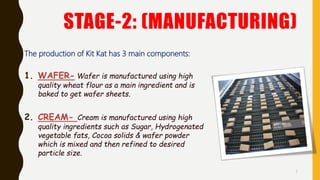
The production of Kit Kat has 3 main components:
1. WAFER- Wafer is manufactured using high
quality wheat flour as a main ingredient and is
baked to get wafer sheets.
2. CREAM- Cream is manufactured using high
quality ingredients such as Sugar, Hydrogenated
vegetable fats, Cocoa solids & wafer powder
which is mixed and then refined to desired
particle size.
7
STAGE-2: MANUFACTURING
(CONTD.)3. CHOCOLAYER-
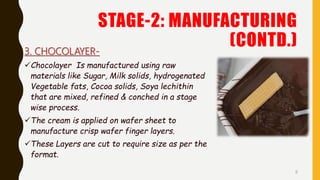
Chocolayer Is manufactured using raw
materials like Sugar, Milk solids, hydrogenated
Vegetable fats, Cocoa solids, Soya lechithin
that are mixed, refined & conched in a stage
wise process.
The cream is applied on wafer sheet to
manufacture crisp wafer finger layers.
These Layers are cut to require size as per the
format.
8
STAGE-3: PACKAGING
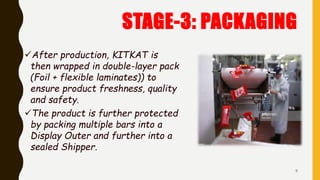
After production, KITKAT is
then wrapped in double-layer pack
(Foil + flexible laminates)) to
ensure product freshness, quality
and safety.
The product is further protected
by packing multiple bars into a
Display Outer and further into a
sealed Shipper.
9
STAGE-4: (DISTRIBUTION)
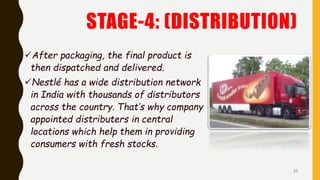
After packaging, the final product is
then dispatched and delivered.
Nestlé has a wide distribution network
in India with thousands of distributors
across the country. That’s why company
appointed distributers in central
locations which help them in providing
consumers with fresh stocks.
10
STAGE-5: (STORAGE &
CONSUMPTION)
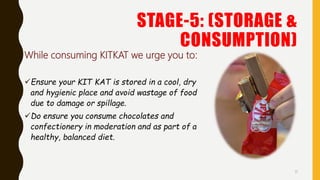
While consuming KITKAT we urge you to:
Ensure your KIT KAT is stored in a cool, dry
and hygienic place and avoid wastage of food
due to damage or spillage.
Do ensure you consume chocolates and
confectionery in moderation and as part of a
healthy, balanced diet.
11
THANK YOU
12

Kit kat ppt

  • 1.
    PRODUCTION OF KIT KAT PR E S E N T E D BY : RAUNAK BISWAS
  • 2.
    CONTENT • INTRODUCTION • ABOUTKIT KAT • LIFE CYCLE OF KIT KAT • RAW MATERIAL SOURCING • MANUFACTURING • PACKAGING • DISTRIBUTION • STORAGE & CONSUMPTION 2
  • 3.
    INTRODUCTION • Kit Katis globally produced by Nestle. • It was founded in 1867 by HENRI NESTLE. • Nestle was listed no. 1 fortune global 500 as the world’s most profitable corporation. • Nestle has 449 factories in 86 countries & employs more than 328000 people. • Factories in India: -Moga (Punjab) -Choladi (Tamilnadu) -Nanjagud (Karnataka) -Samalakaha (Haryana) -Ponda (Goa) 3
  • 4.
    ABOUT KIT KAT KitKat is the US best –selling chocolate bar. The history of Kit Kat emphasize the importance of successfully managed brand names to the company that owns them. Internationally Kit kat is now manufactured in Canada, Germany, India, China, Japan, Australia, South Africa, Malaysia and the Us. It is available in more than 100 countries throughout the world. 4
  • 5.
    LIFE CYCLE OFKIT KAT KIT KAT • Raw material sourcing • Manufacturing • Packaging • Distribution • Consumption 5
  • 6.
    STAGE-1: (RAW MATERIAL SOURCING) Themain ingredients in KIT KAT are Sugar, Hydrogenated vegetable fats (Palm based), Milk solids, Wheat Flour and Cocoa Solids, Soya Lecithin, Leavening agent, Yeast, Salt, Nutrient (calcium Sulphate) and Improver (enzyme), Artificial Vanilla Flavouring substance which are sourced from our certified vendors. 6
  • 7.
    STAGE-2: (MANUFACTURING) The productionof Kit Kat has 3 main components: 1. WAFER- Wafer is manufactured using high quality wheat flour as a main ingredient and is baked to get wafer sheets. 2. CREAM- Cream is manufactured using high quality ingredients such as Sugar, Hydrogenated vegetable fats, Cocoa solids & wafer powder which is mixed and then refined to desired particle size. 7
  • 8.
    STAGE-2: MANUFACTURING (CONTD.)3. CHOCOLAYER- ChocolayerIs manufactured using raw materials like Sugar, Milk solids, hydrogenated Vegetable fats, Cocoa solids, Soya lechithin that are mixed, refined & conched in a stage wise process. The cream is applied on wafer sheet to manufacture crisp wafer finger layers. These Layers are cut to require size as per the format. 8
  • 9.
    STAGE-3: PACKAGING After production,KITKAT is then wrapped in double-layer pack (Foil + flexible laminates)) to ensure product freshness, quality and safety. The product is further protected by packing multiple bars into a Display Outer and further into a sealed Shipper. 9
  • 10.
    STAGE-4: (DISTRIBUTION) After packaging,the final product is then dispatched and delivered. Nestlé has a wide distribution network in India with thousands of distributors across the country. That’s why company appointed distributers in central locations which help them in providing consumers with fresh stocks. 10
  • 11.
    STAGE-5: (STORAGE & CONSUMPTION) Whileconsuming KITKAT we urge you to: Ensure your KIT KAT is stored in a cool, dry and hygienic place and avoid wastage of food due to damage or spillage. Do ensure you consume chocolates and confectionery in moderation and as part of a healthy, balanced diet. 11
  • 12.