Topic: Manufacturing Process of Nestle Coffee and Chocolate
 Introduction
 History
 Key Dates
 Nestle India
 Product Brands
 Mission & Vision
 Manufacturing Process of Coffee
 Manufacturing Process of Chocolate
Contents.
INTRODUCTION
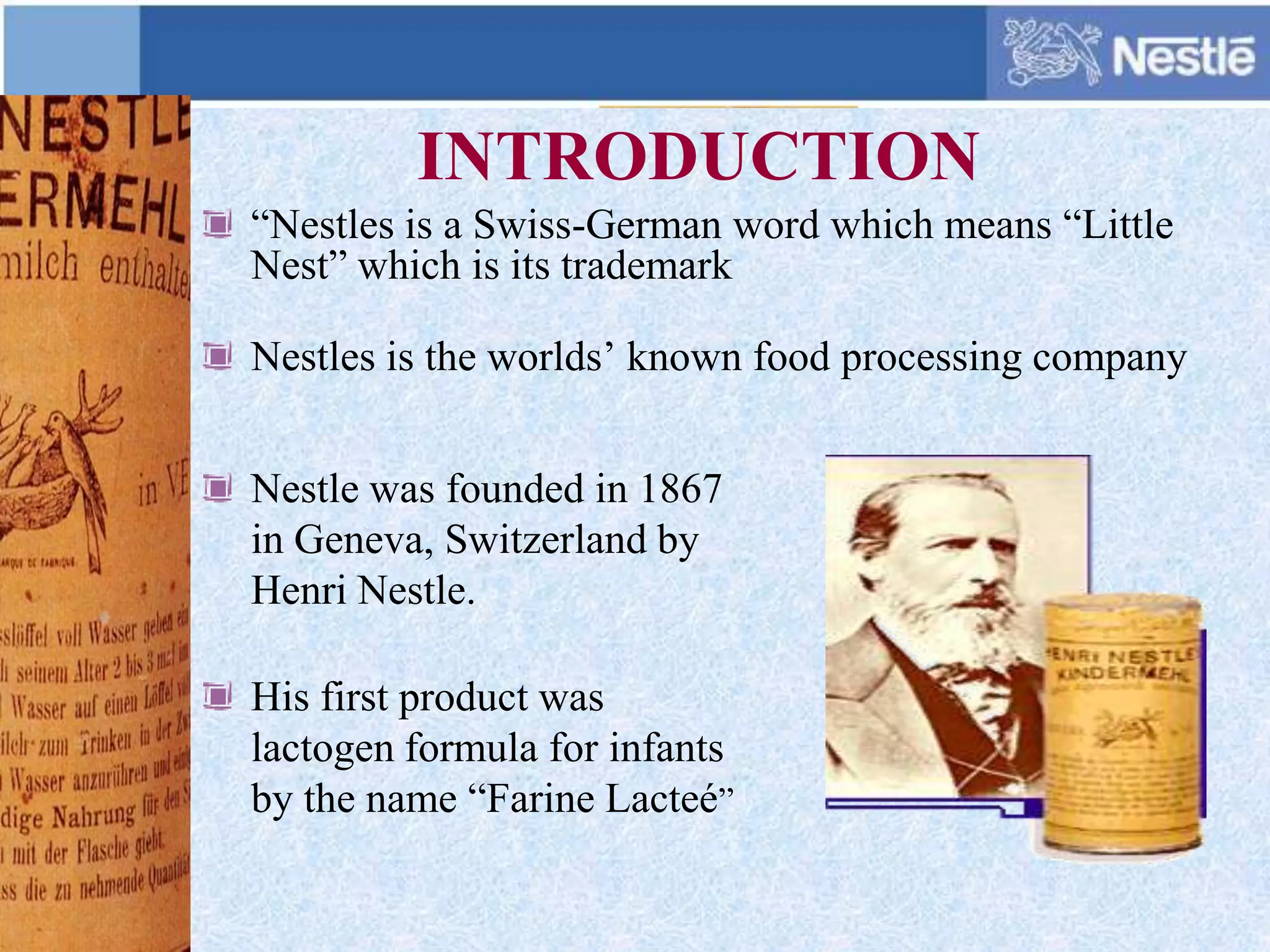
“Nestles is a Swiss-German word which means “Little
Nest” which is its trademark
Nestles is the worlds’ known food processing company
Nestle was founded in 1867
in Geneva, Switzerland by
Henri Nestle.
His first product was
lactogen formula for infants
by the name “Farine Lacteé”
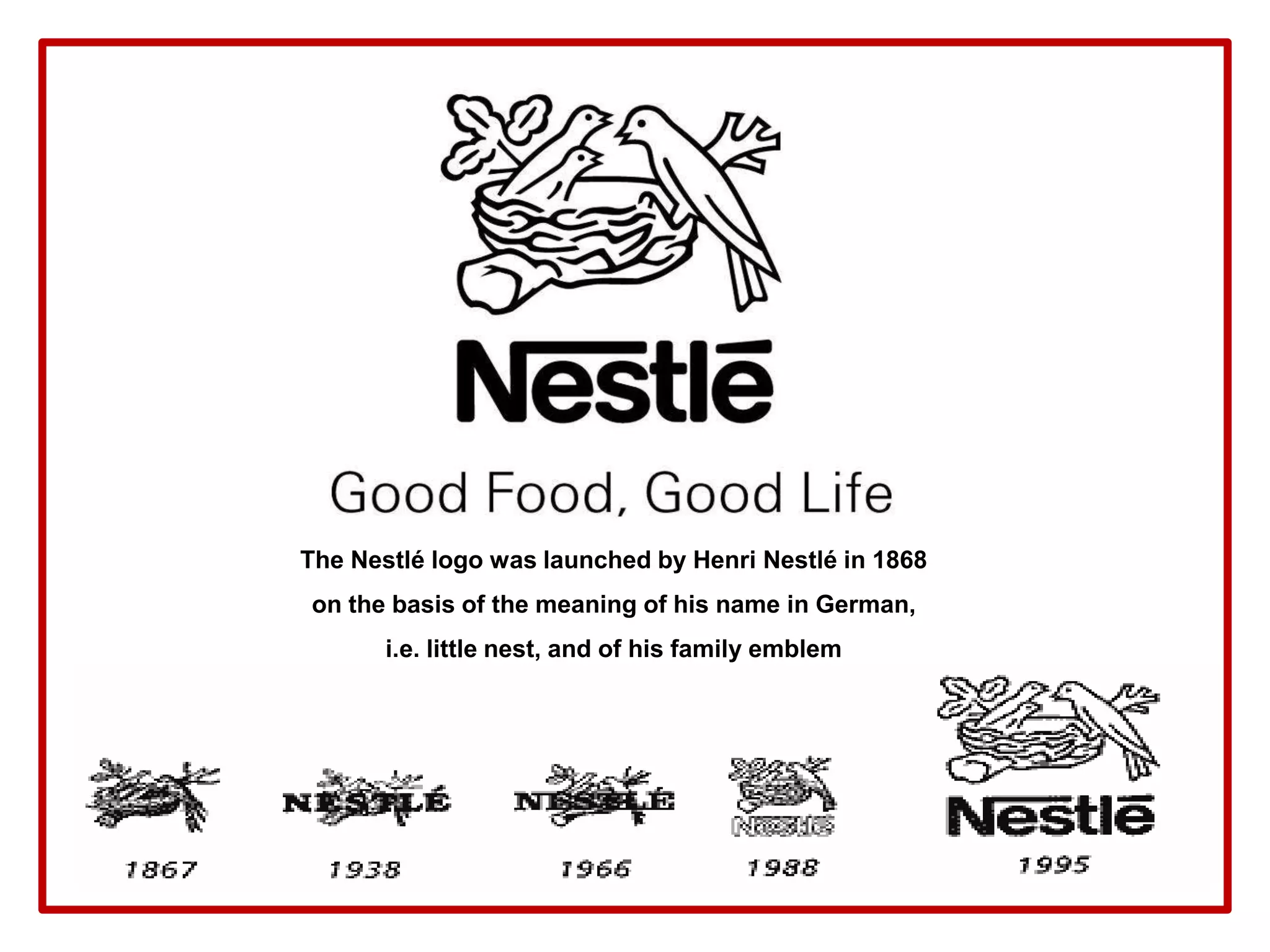
The Nestlé logo was launched by Henri Nestlé in 1868
on the basis of the meaning of his name in German,
i.e. little nest, and of his family emblem
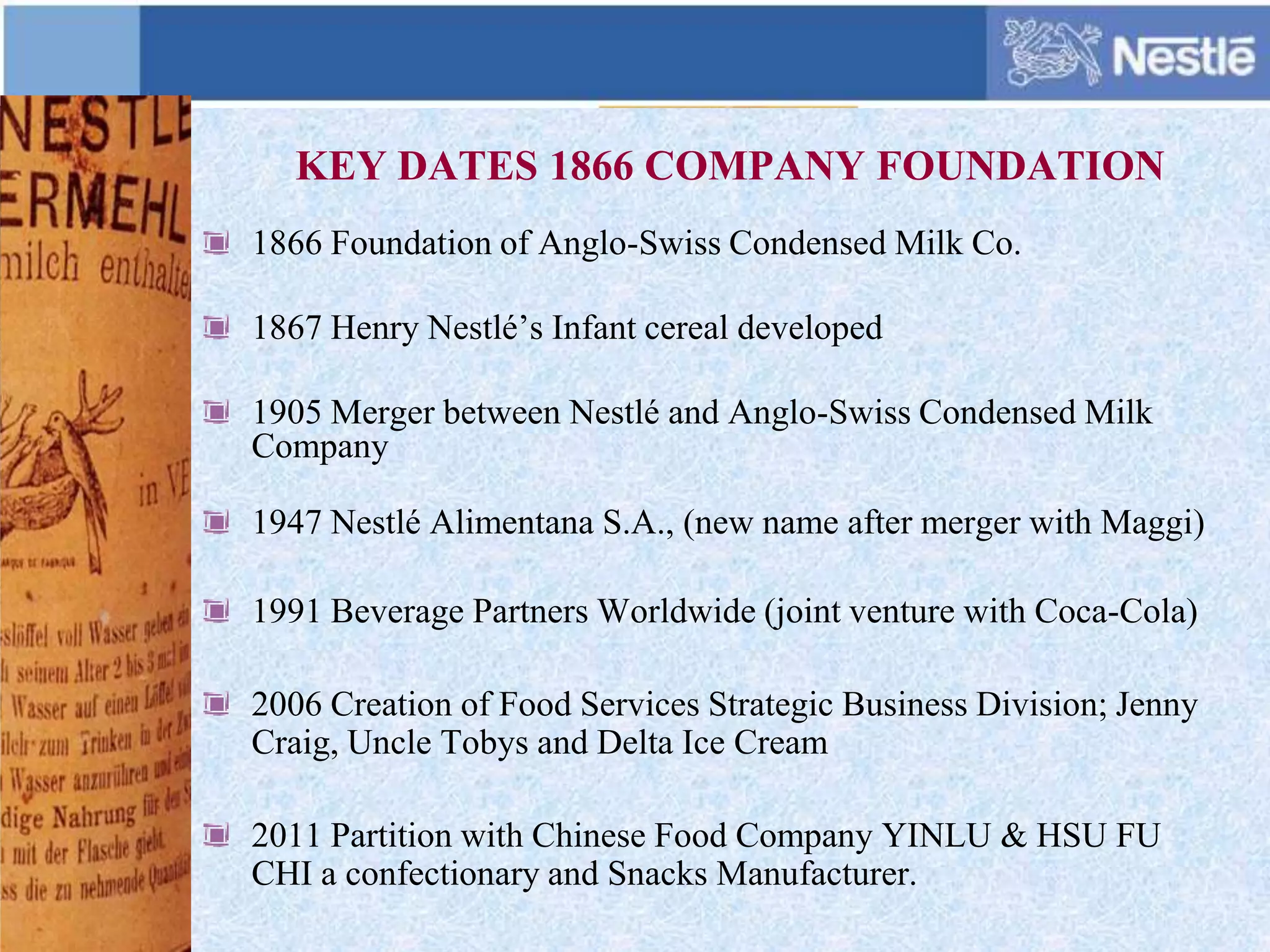
KEY DATES 1866 COMPANY FOUNDATION
1866 Foundation of Anglo-Swiss Condensed Milk Co.
1867 Henry Nestlé’s Infant cereal developed
1905 Merger between Nestlé and Anglo-Swiss Condensed Milk
Company
1947 Nestlé Alimentana S.A., (new name after merger with Maggi)
1991 Beverage Partners Worldwide (joint venture with Coca-Cola)
2006 Creation of Food Services Strategic Business Division; Jenny
Craig, Uncle Tobys and Delta Ice Cream
2011 Partition with Chinese Food Company YINLU & HSU FU
CHI a confectionary and Snacks Manufacturer.
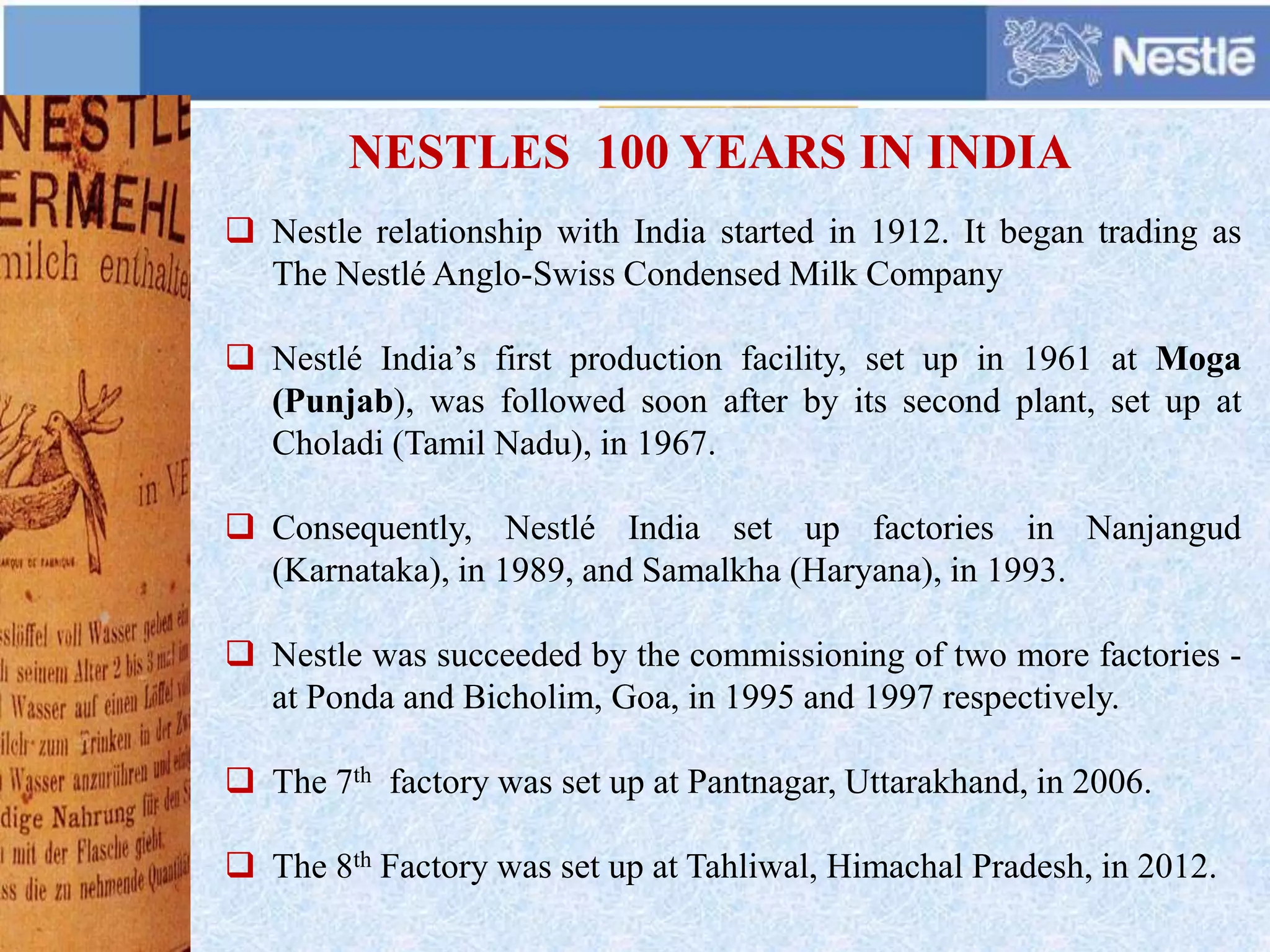
 Nestle relationship with India started in 1912. It began trading as
The Nestlé Anglo-Swiss Condensed Milk Company
 Nestlé India’s first production facility, set up in 1961 at Moga
(Punjab), was followed soon after by its second plant, set up at
Choladi (Tamil Nadu), in 1967.
 Consequently, Nestlé India set up factories in Nanjangud
(Karnataka), in 1989, and Samalkha (Haryana), in 1993.
 Nestle was succeeded by the commissioning of two more factories -
at Ponda and Bicholim, Goa, in 1995 and 1997 respectively.
 The 7th factory was set up at Pantnagar, Uttarakhand, in 2006.
 The 8th Factory was set up at Tahliwal, Himachal Pradesh, in 2012.
NESTLES 100 YEARS IN INDIA
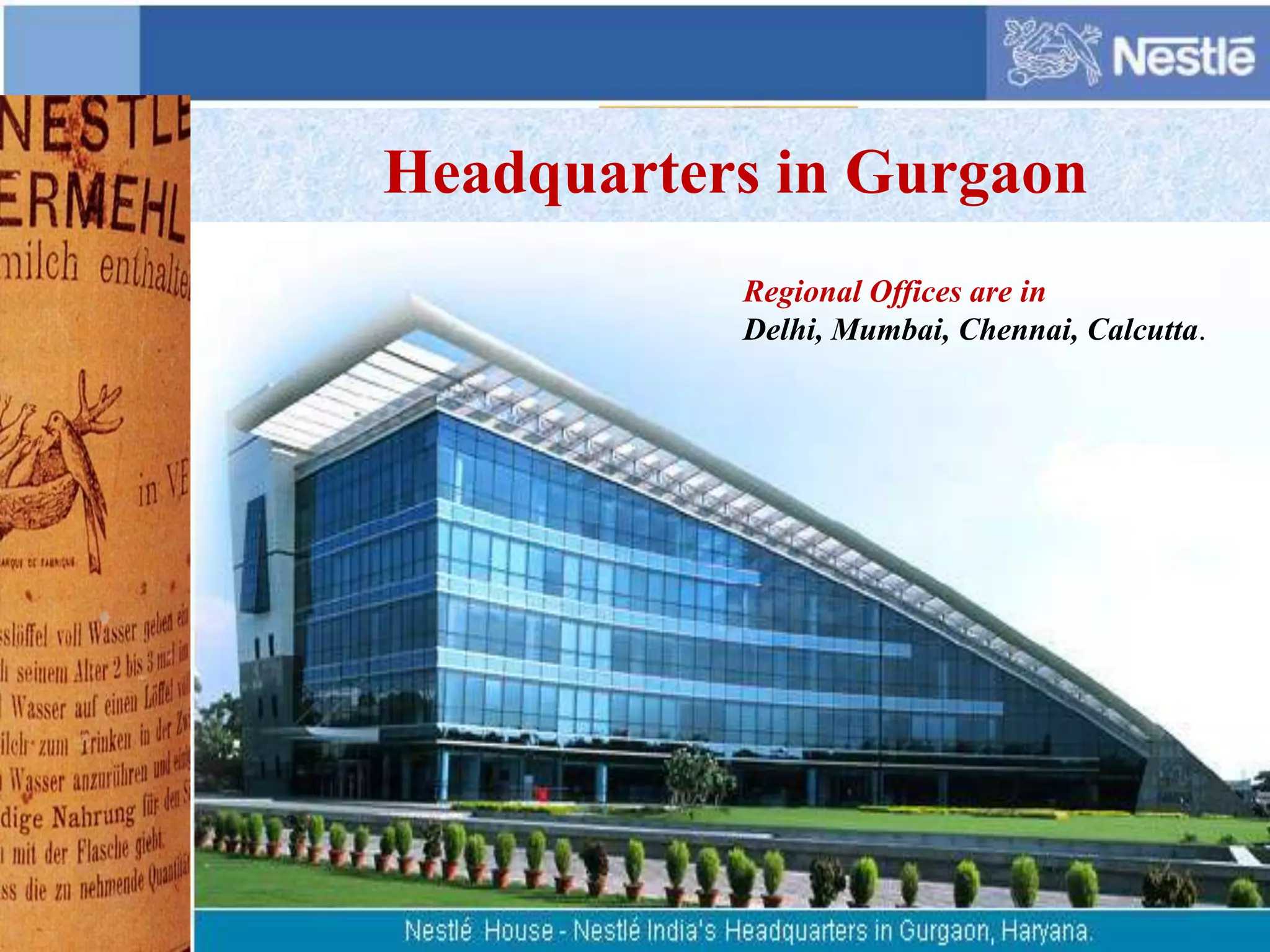
Headquarters in Gurgaon
Regional Offices are in
Delhi, Mumbai, Chennai, Calcutta.
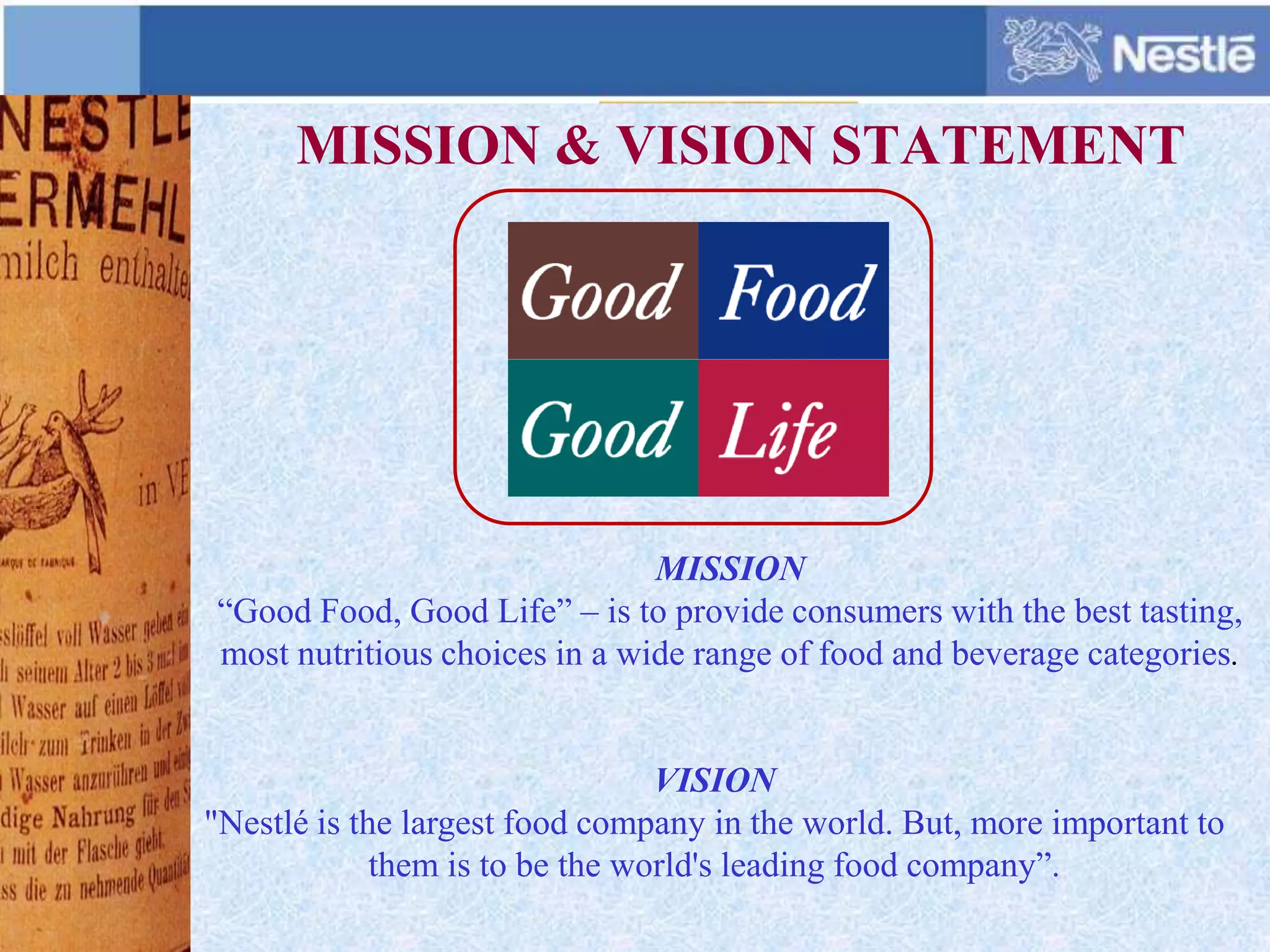
MISSION & VISION STATEMENT
VISION
"Nestlé is the largest food company in the world. But, more important to
them is to be the world's leading food company”.
MISSION
“Good Food, Good Life” – is to provide consumers with the best tasting,
most nutritious choices in a wide range of food and beverage categories.
BRANDS
Quality and nutritional value are the essential ingredients in all
of its brands.
Millions of people prefer Nestlé products every day, happy with
the addition to their wellness that they bring.
Nestle, a multinational company has acquired & merged with
various companies.
Factors behind its success are quality, improved technology,
innovation which have created brand loyalty amongst its
customers.
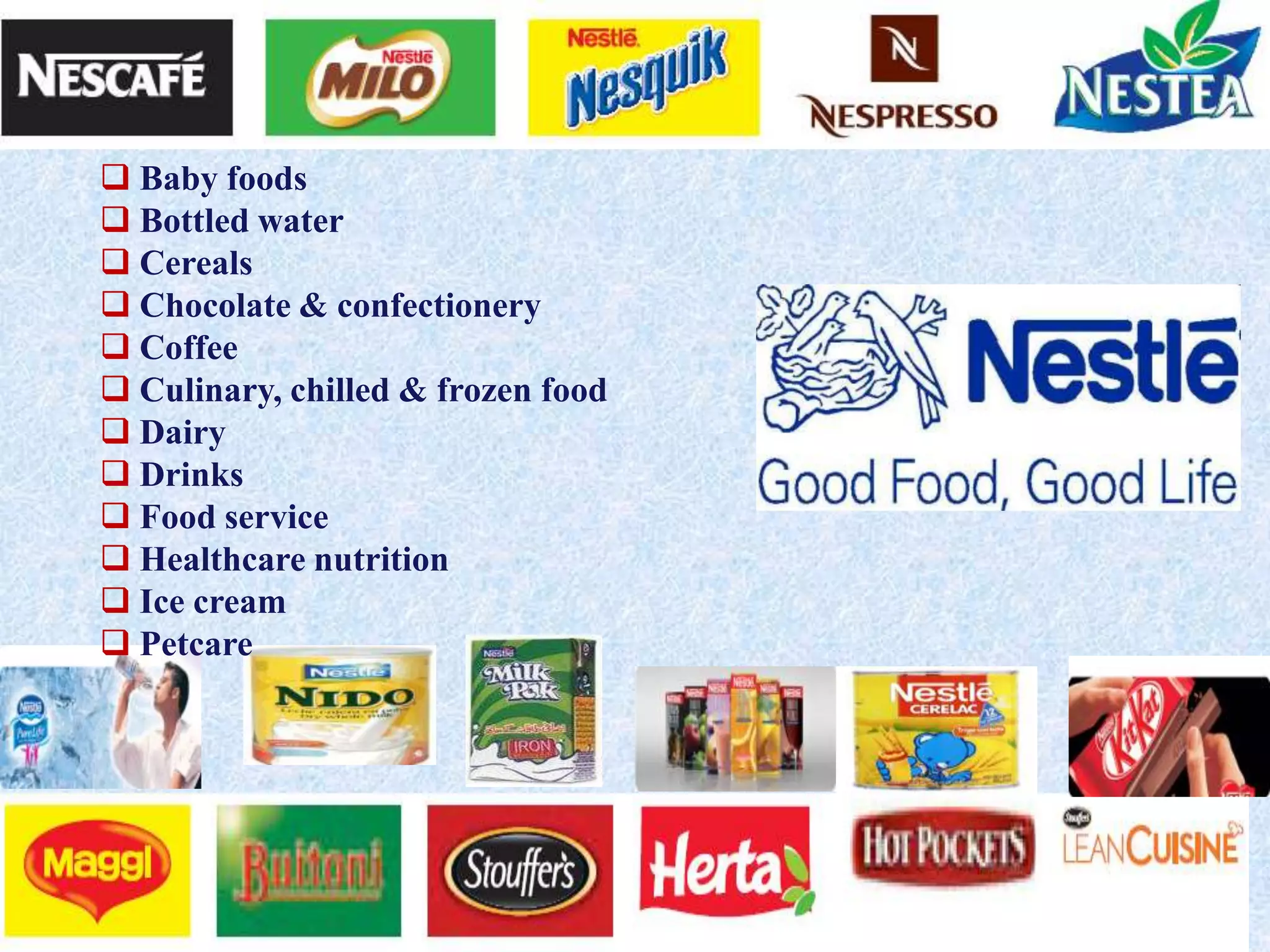
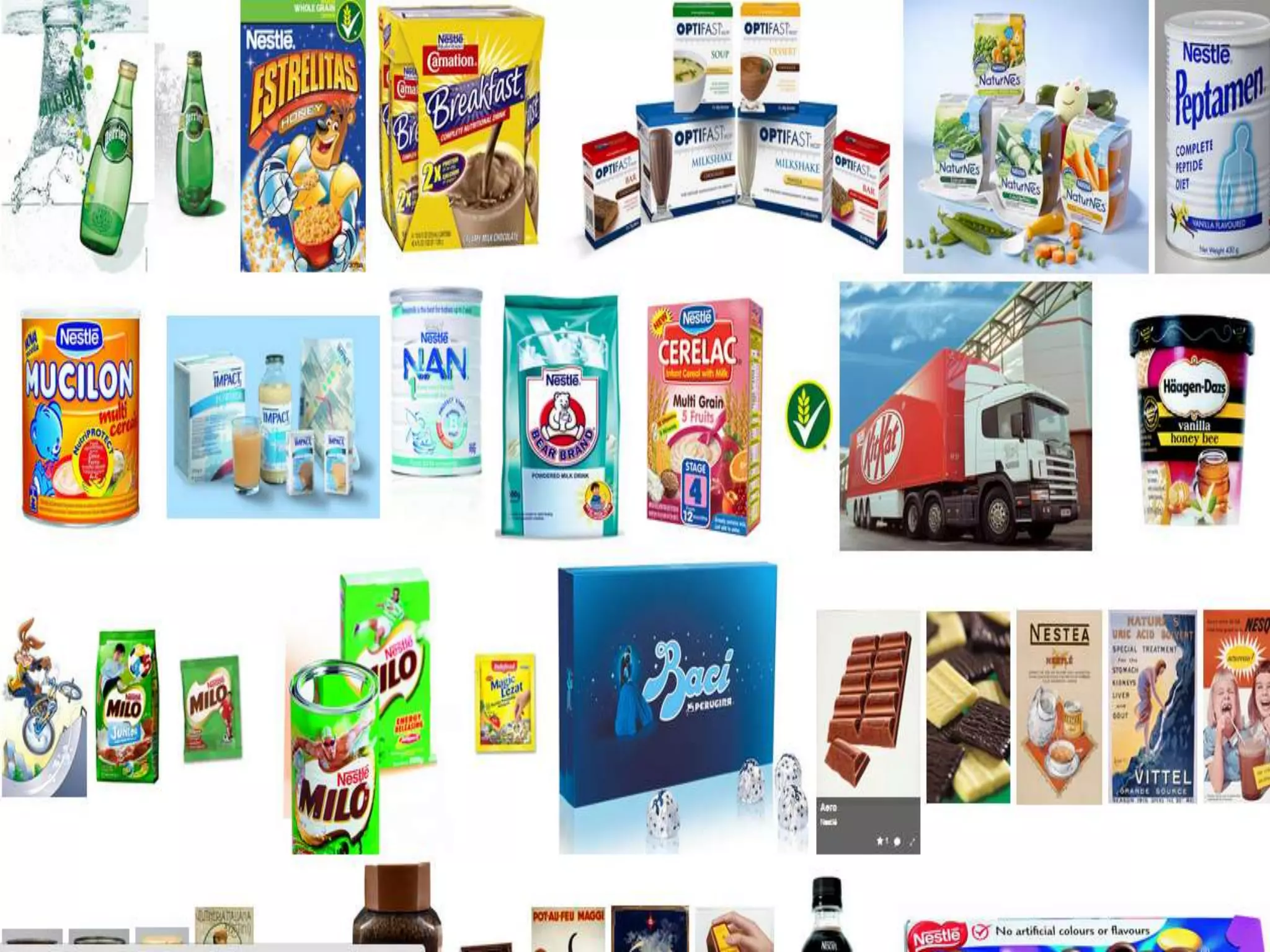
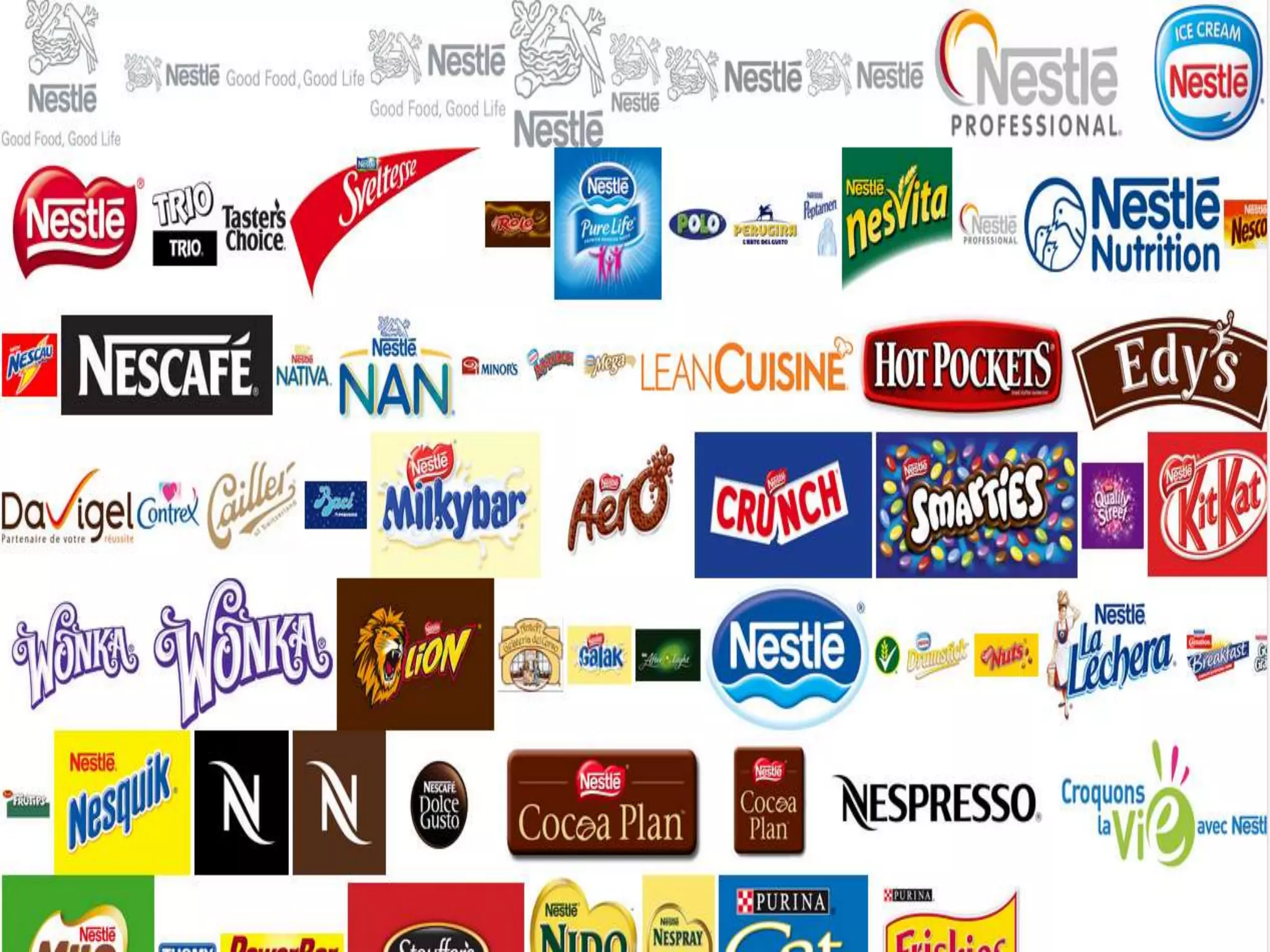
Today Nestle is present in different markets with the following
main brands:-
 Baby foods
 Bottled water
 Cereals
 Chocolate & confectionery
 Coffee
 Culinary, chilled & frozen food
 Dairy
 Drinks
 Food service
 Healthcare nutrition
 Ice cream
 Petcare
Manufacturing Process of Nestle
Coffee and Chocolate.
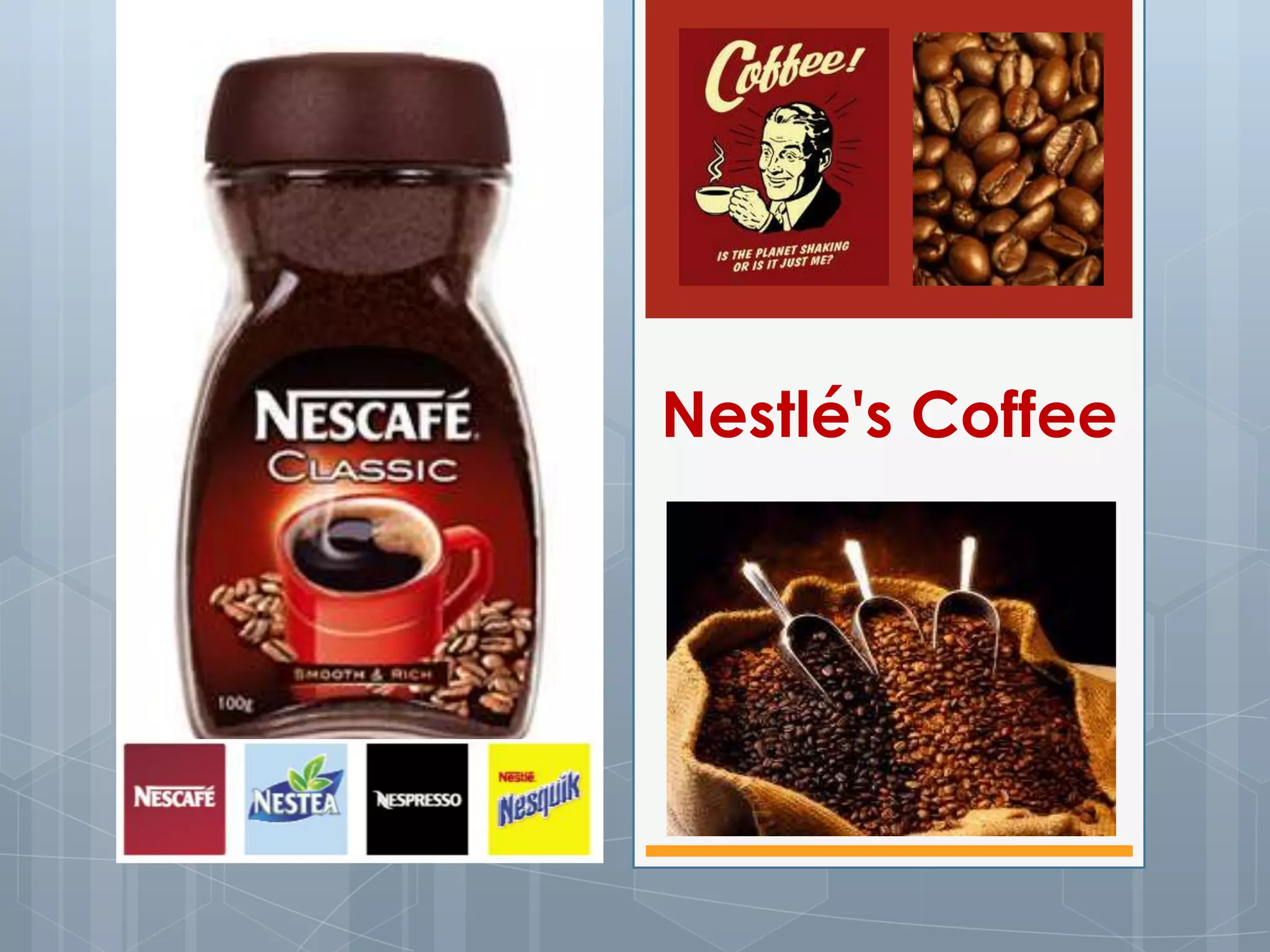
Nestlé's Coffee
 Coffee is a brewed beverage prepared from the roasted seeds of
several species of an evergreen shrub of the genus Coffea.
 The two most common sources of coffee beans are the highly
regarded Coffea arabica, and the Robusta.
 Coffee is the second-most traded commodity in the world after
crude oil, and is cultivated across 80 nations spanning Central
and South America, Africa, and Asia.
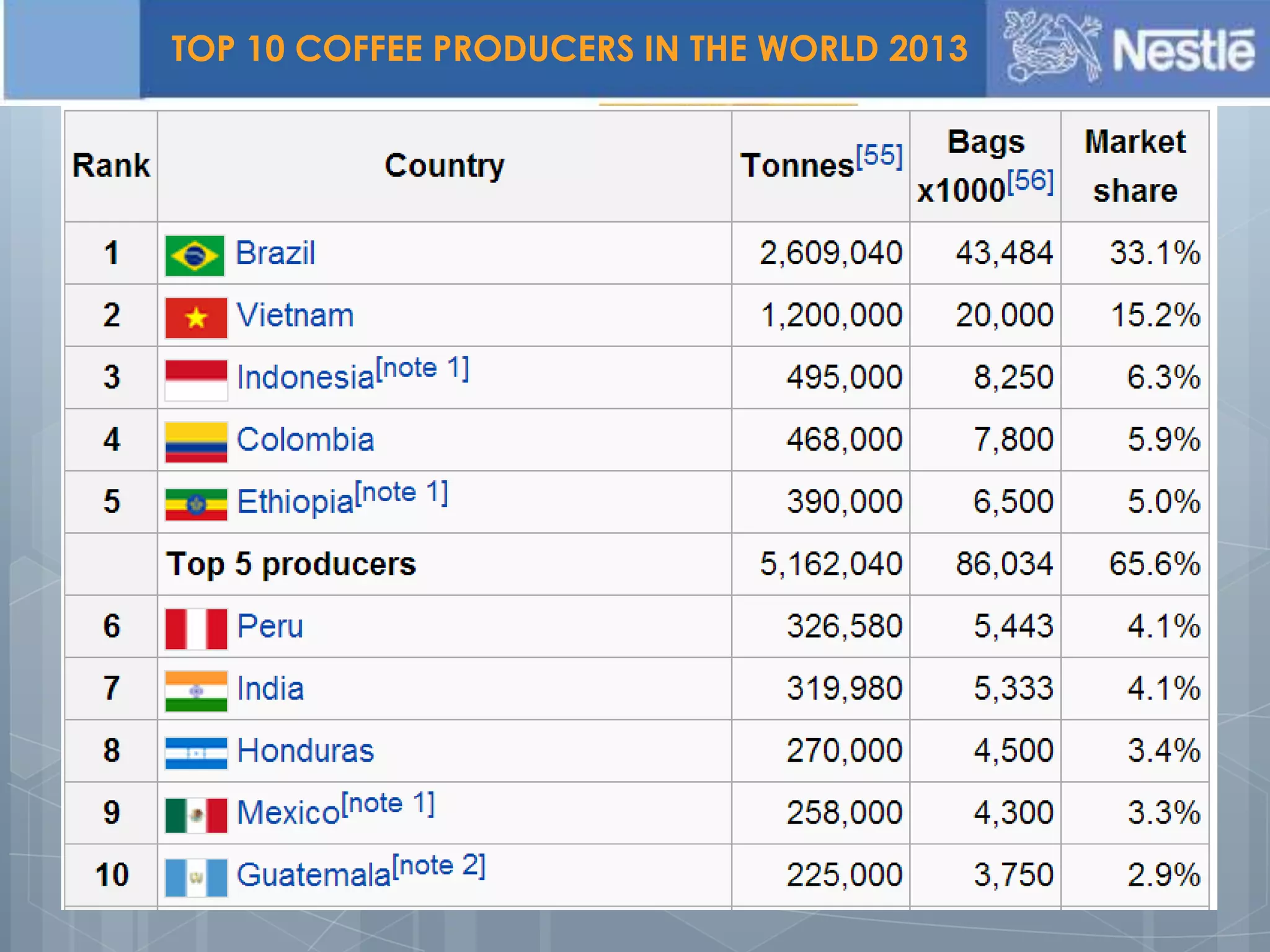
 The key coffee producing and exporting nations are Brazil,
Vietnam, Columbia, Indonesia, Ethiopia, and India.
 Brazil is the world’s largest producer, exporter and consumer of
coffee, while USA and European nations constitute key
importing markets for coffee.
Overview
TOP 10 COFFEE PRODUCERS IN THE WORLD 2013
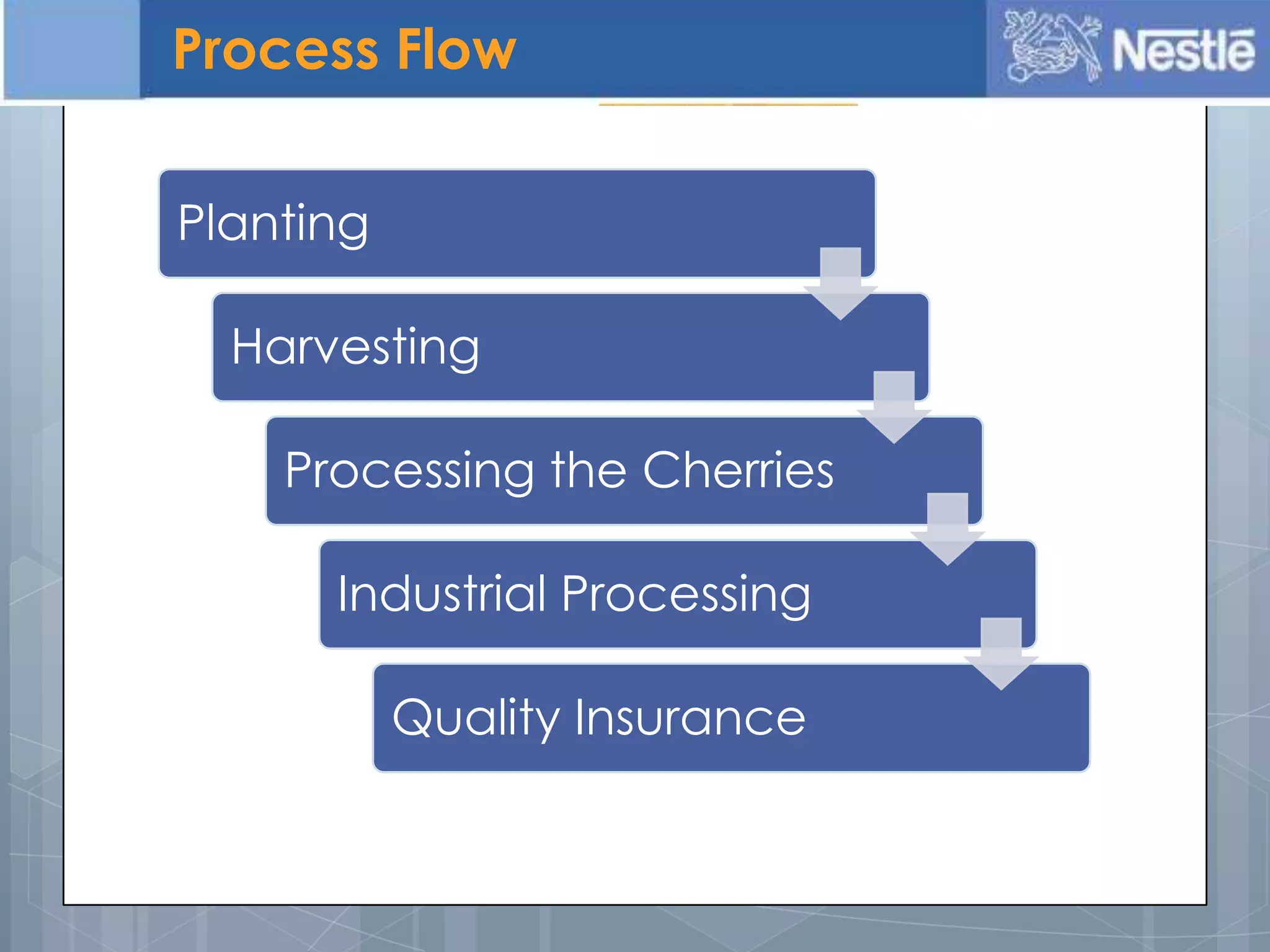
Process Flow
Planting
Harvesting
Processing the Cherries
Industrial Processing
Quality Insurance
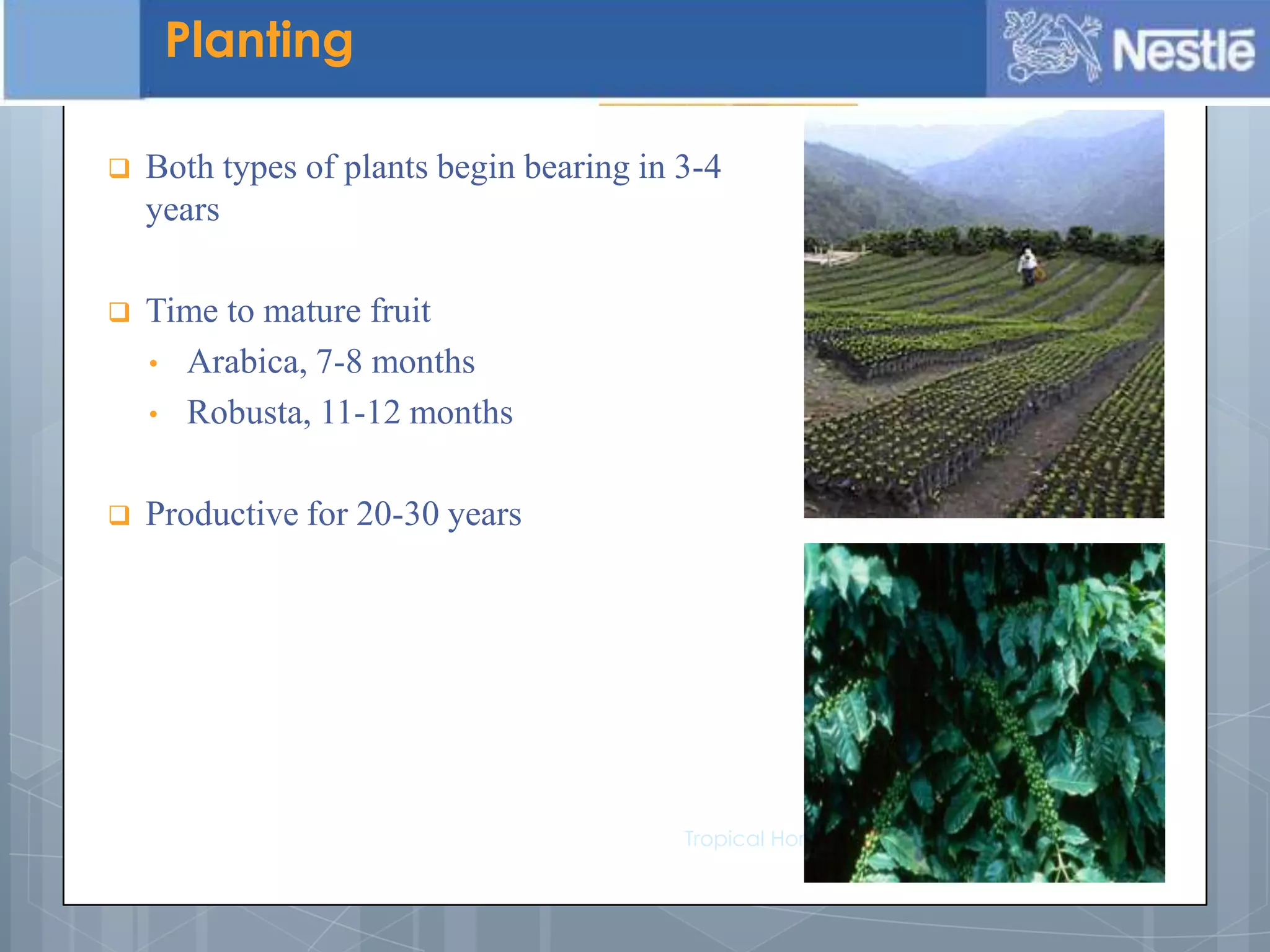
 Both types of plants begin bearing in 3-4
years
 Time to mature fruit
• Arabica, 7-8 months
• Robusta, 11-12 months
 Productive for 20-30 years
Tropical Horticulture - Texas A&M University
Planting
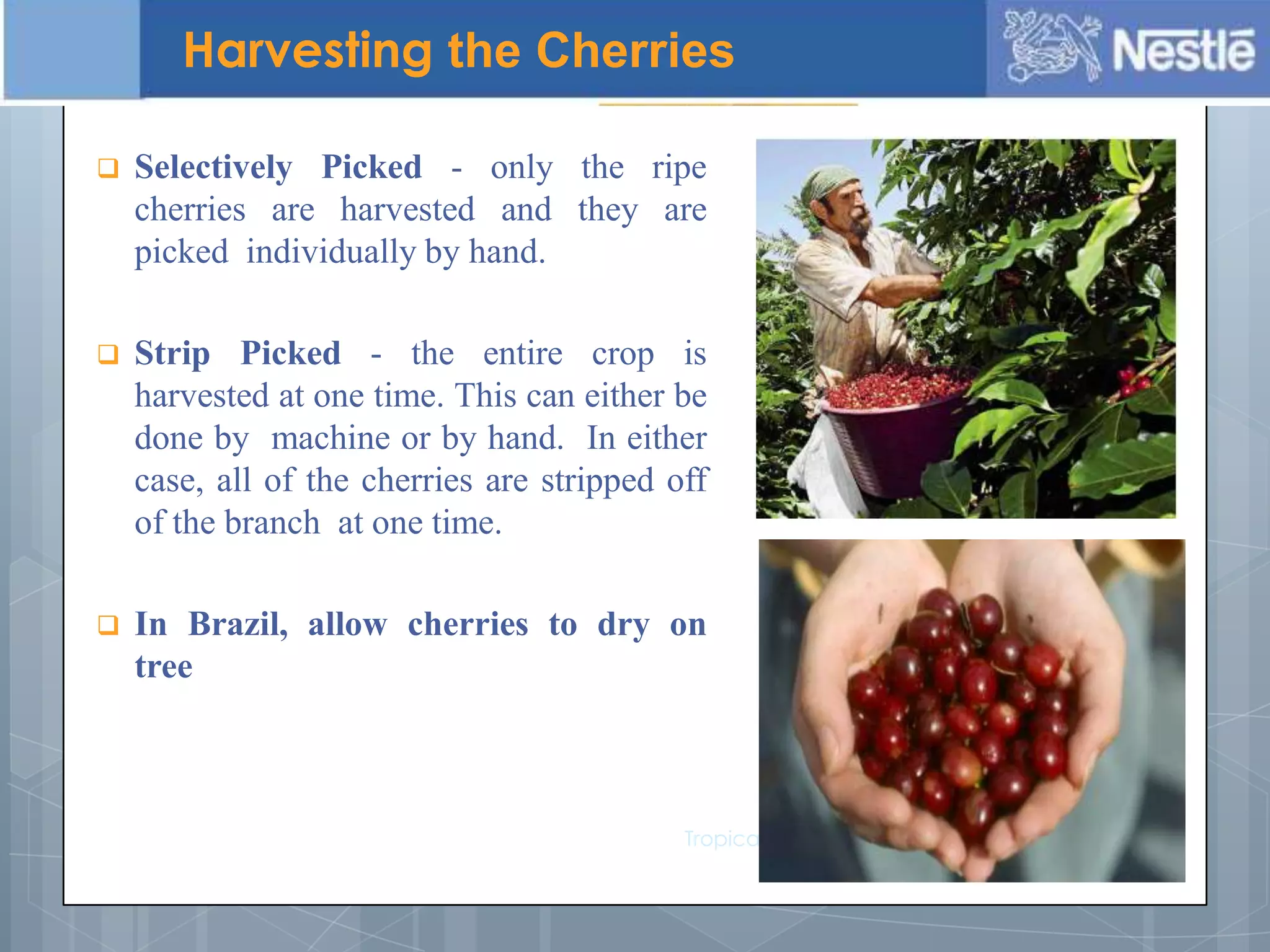
 Selectively Picked - only the ripe
cherries are harvested and they are
picked individually by hand.
 Strip Picked - the entire crop is
harvested at one time. This can either be
done by machine or by hand. In either
case, all of the cherries are stripped off
of the branch at one time.
 In Brazil, allow cherries to dry on
tree
Tropical Horticulture - Texas A&M University
Harvesting the Cherries
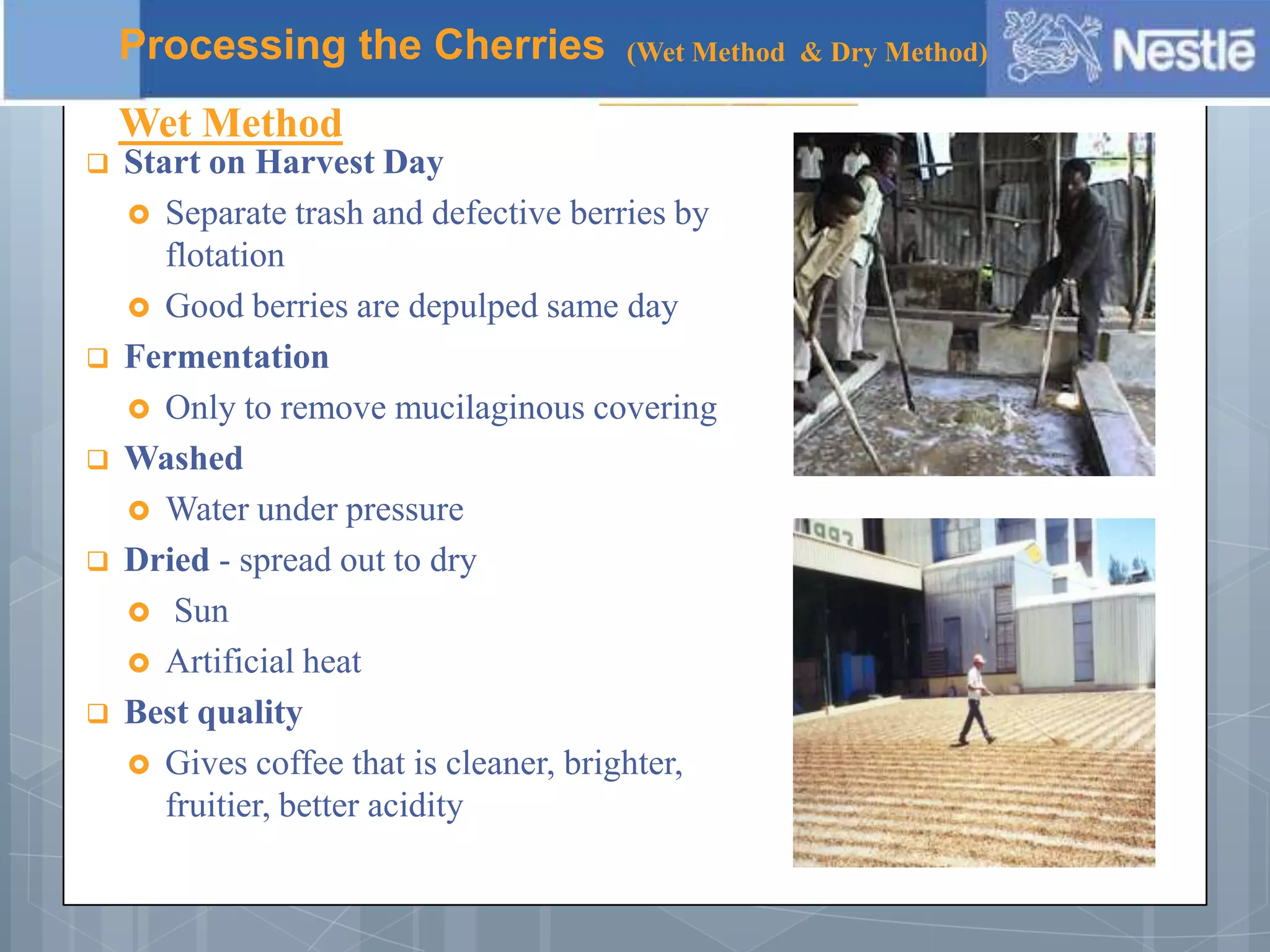
 Start on Harvest Day
 Separate trash and defective berries by
flotation
 Good berries are depulped same day
 Fermentation
 Only to remove mucilaginous covering
 Washed
 Water under pressure
 Dried - spread out to dry
 Sun
 Artificial heat
 Best quality
 Gives coffee that is cleaner, brighter,
fruitier, better acidity
Processing the Cherries (Wet Method & Dry Method)
Wet Method
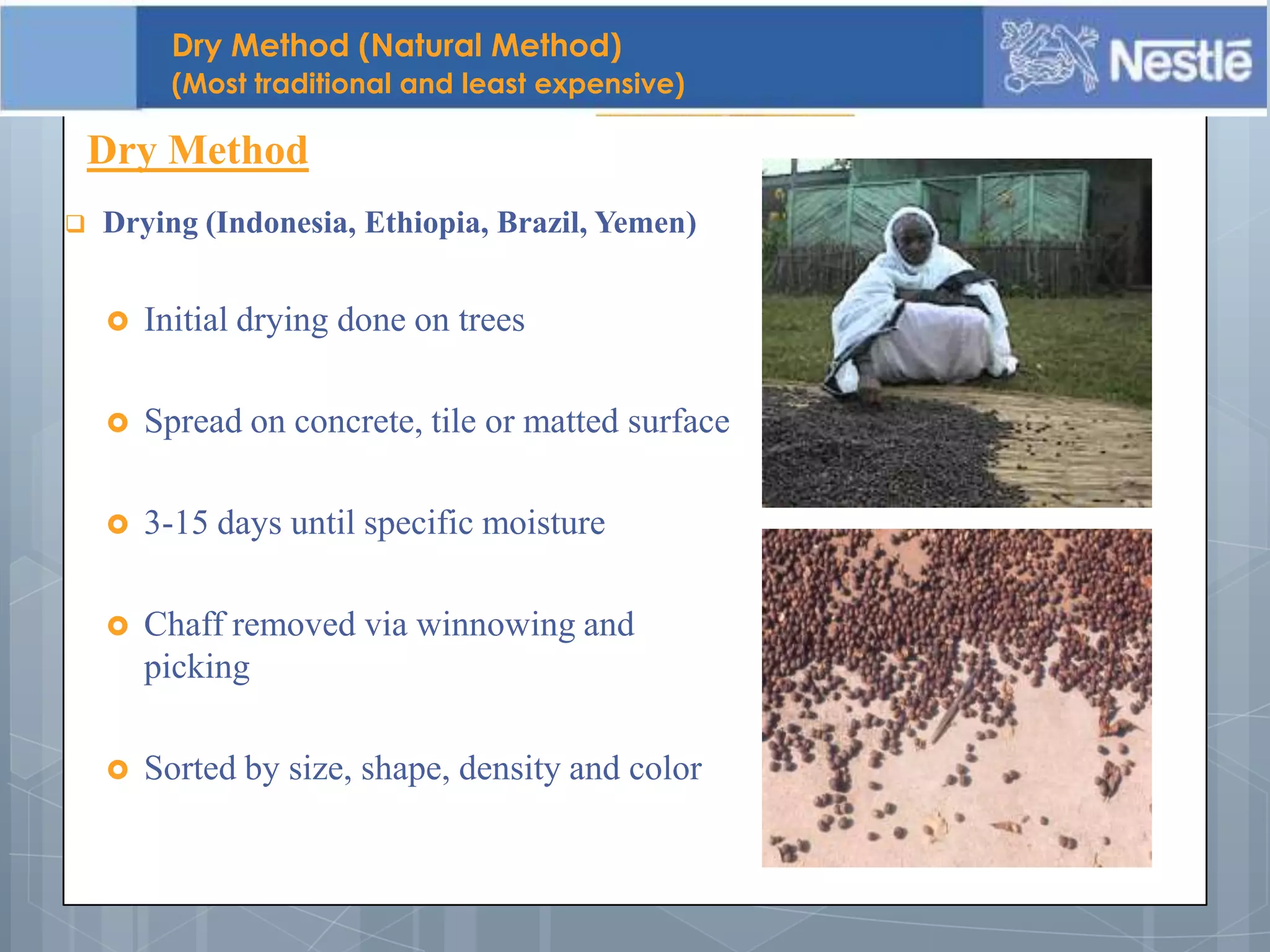
 Drying (Indonesia, Ethiopia, Brazil, Yemen)
 Initial drying done on trees
 Spread on concrete, tile or matted surface
 3-15 days until specific moisture
 Chaff removed via winnowing and
picking
 Sorted by size, shape, density and color
Dry Method
Dry Method (Natural Method)
(Most traditional and least expensive)
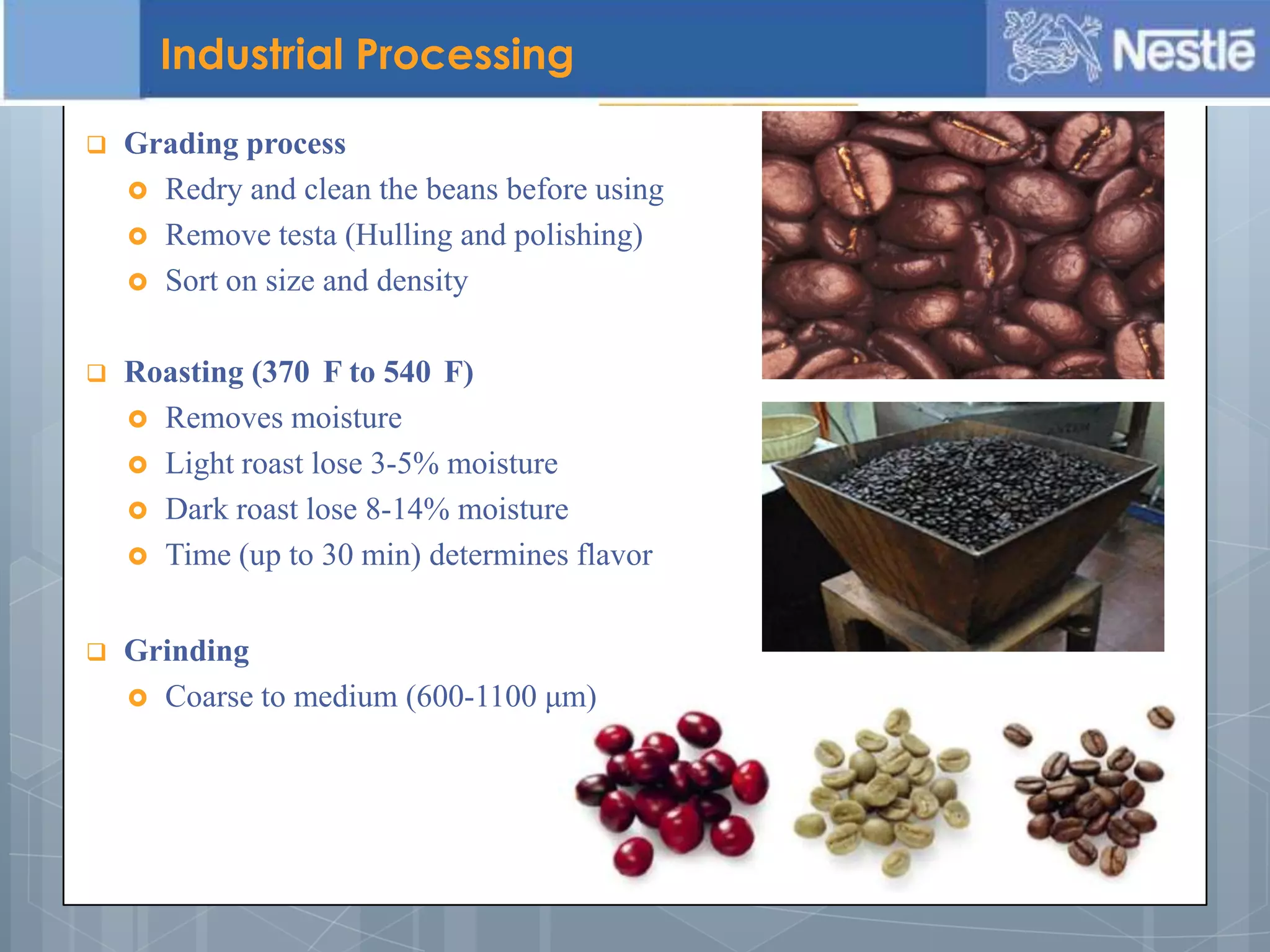
 Grading process
 Redry and clean the beans before using
 Remove testa (Hulling and polishing)
 Sort on size and density
 Roasting (370 F to 540 F)
 Removes moisture
 Light roast lose 3-5% moisture
 Dark roast lose 8-14% moisture
 Time (up to 30 min) determines flavor
Industrial Processing
 Grinding
 Coarse to medium (600-1100 μm)
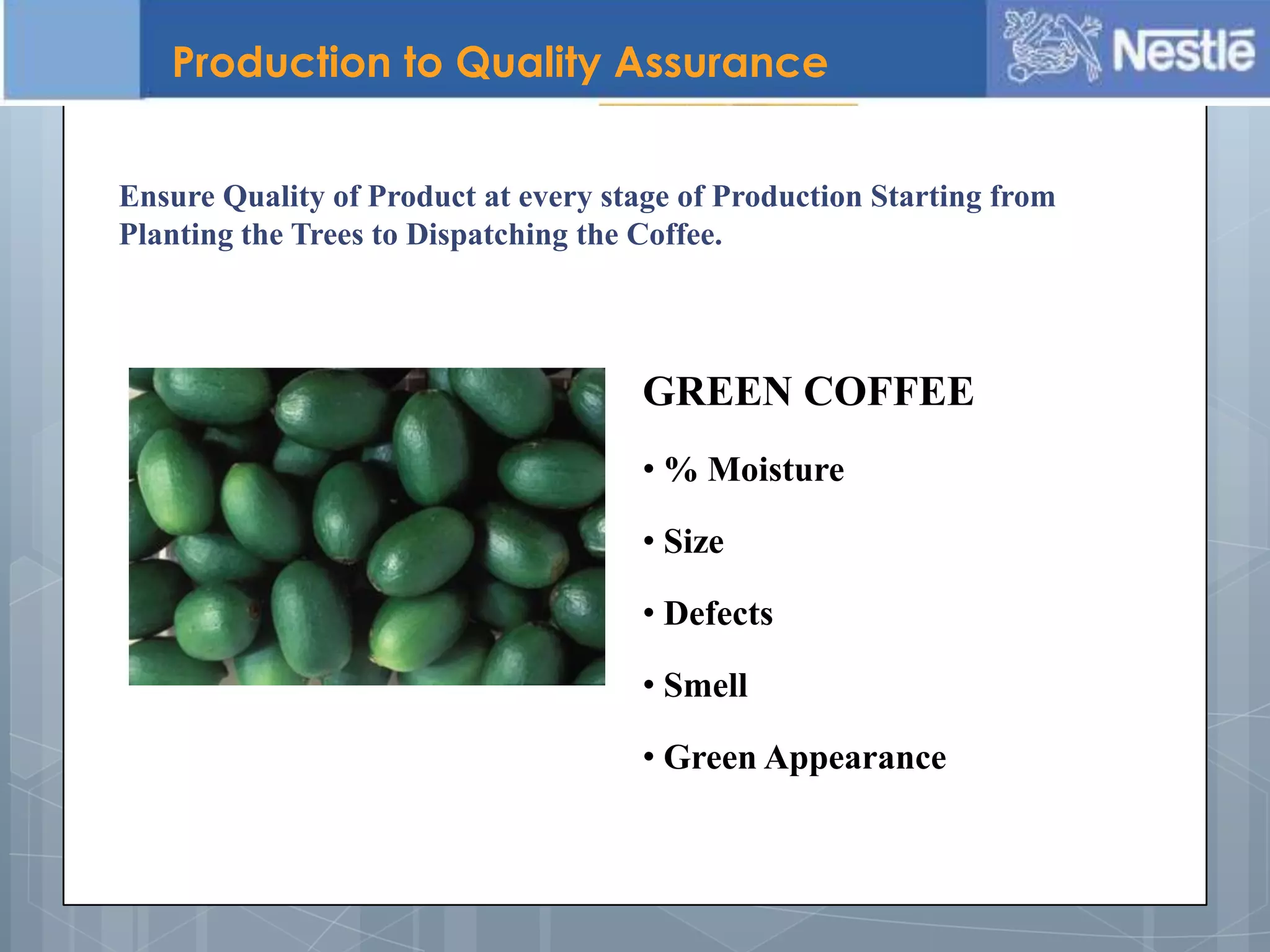
GREEN COFFEE
• % Moisture
• Size
• Defects
• Smell
• Green Appearance
Production to Quality Assurance
Ensure Quality of Product at every stage of Production Starting from
Planting the Trees to Dispatching the Coffee.
Equal Exchange uses the standards of the Specialty Coffee
Association of America
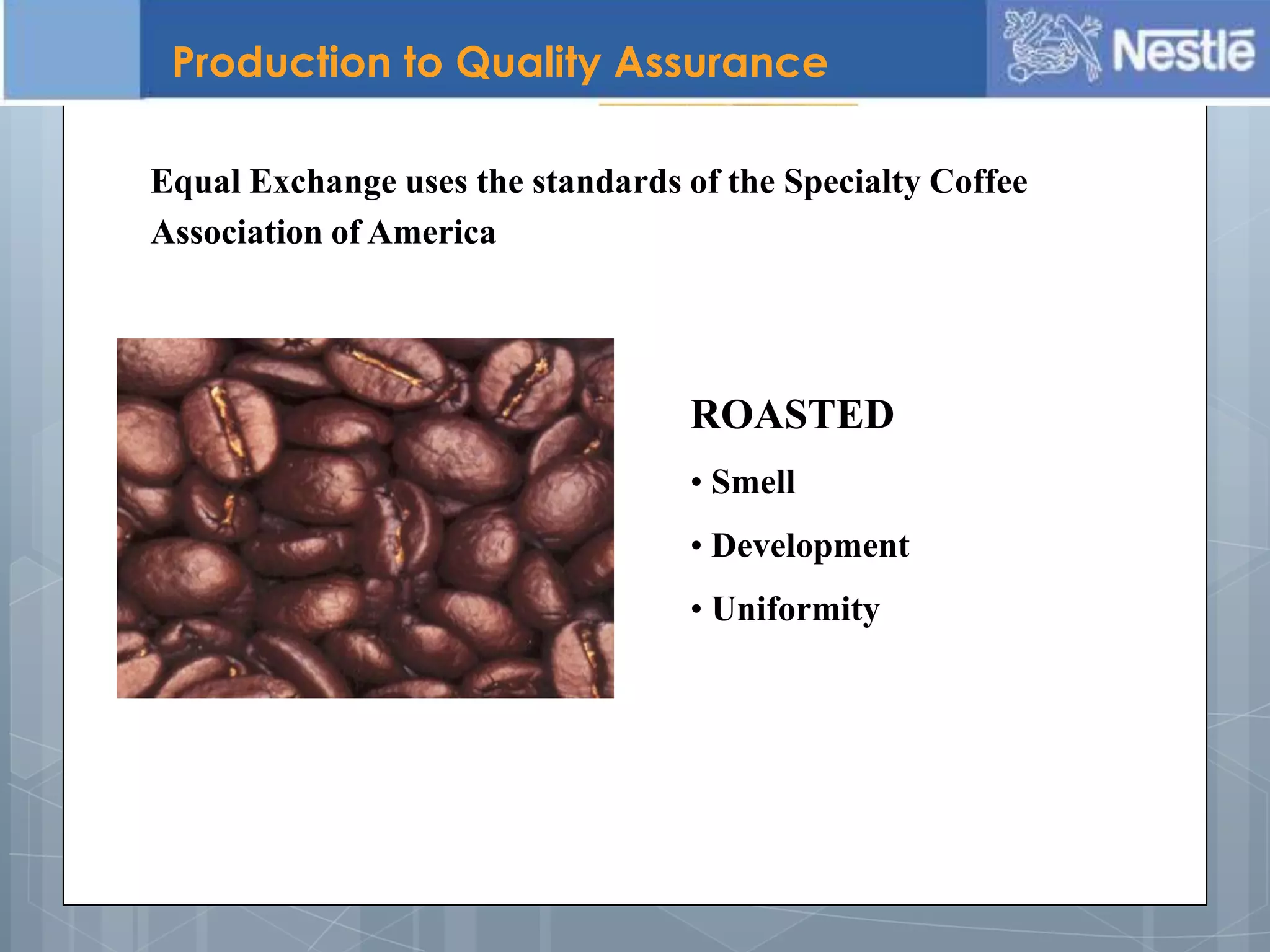
ROASTED
• Smell
• Development
• Uniformity
Production to Quality Assurance
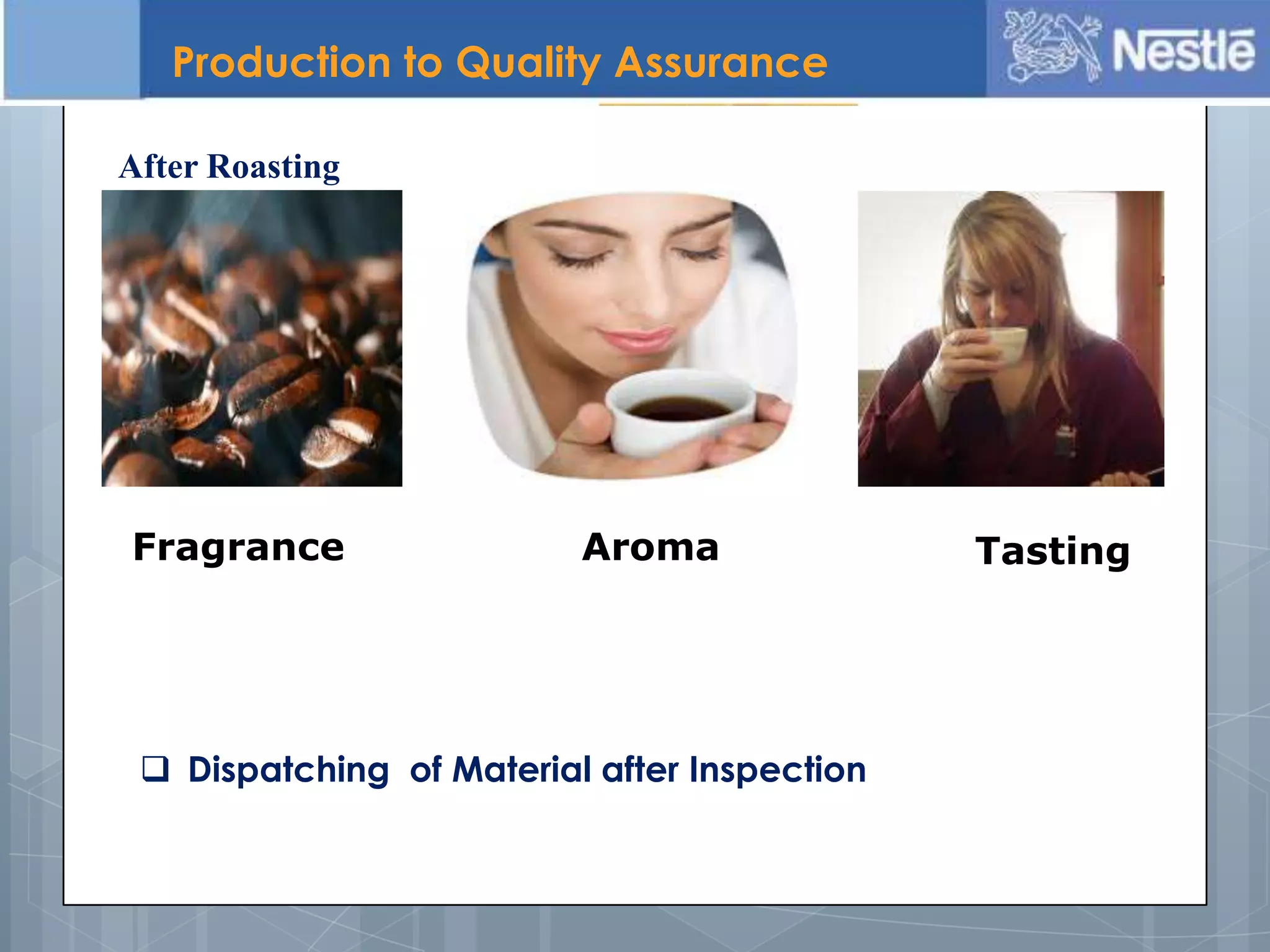
Fragrance Aroma Tasting
Production to Quality Assurance
After Roasting
 Dispatching of Material after Inspection
Manufacturing Process of Nestle Chocolate
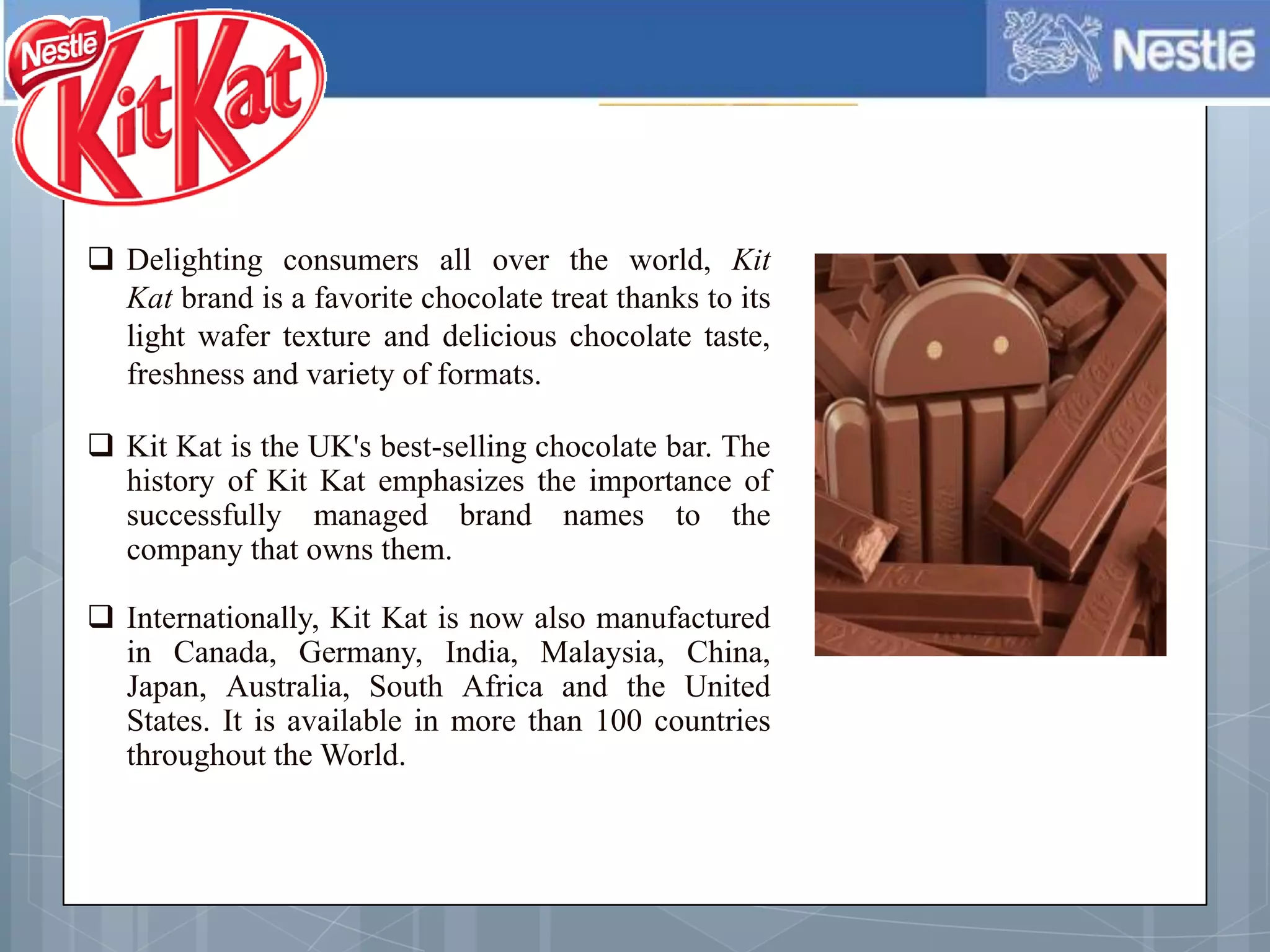
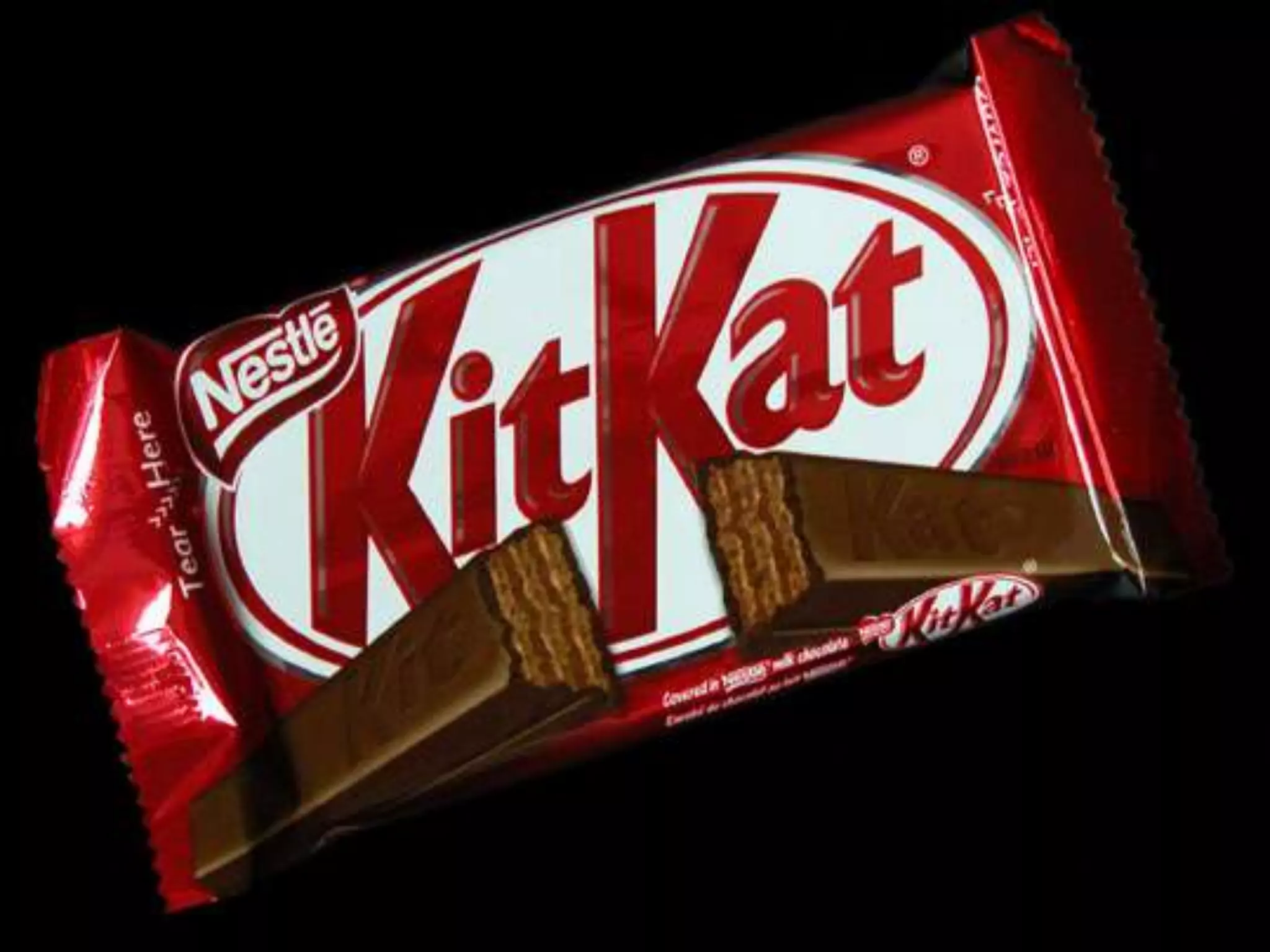
 Delighting consumers all over the world, Kit
Kat brand is a favorite chocolate treat thanks to its
light wafer texture and delicious chocolate taste,
freshness and variety of formats.
 Kit Kat is the UK's best-selling chocolate bar. The
history of Kit Kat emphasizes the importance of
successfully managed brand names to the
company that owns them.
 Internationally, Kit Kat is now also manufactured
in Canada, Germany, India, Malaysia, China,
Japan, Australia, South Africa and the United
States. It is available in more than 100 countries
throughout the World.
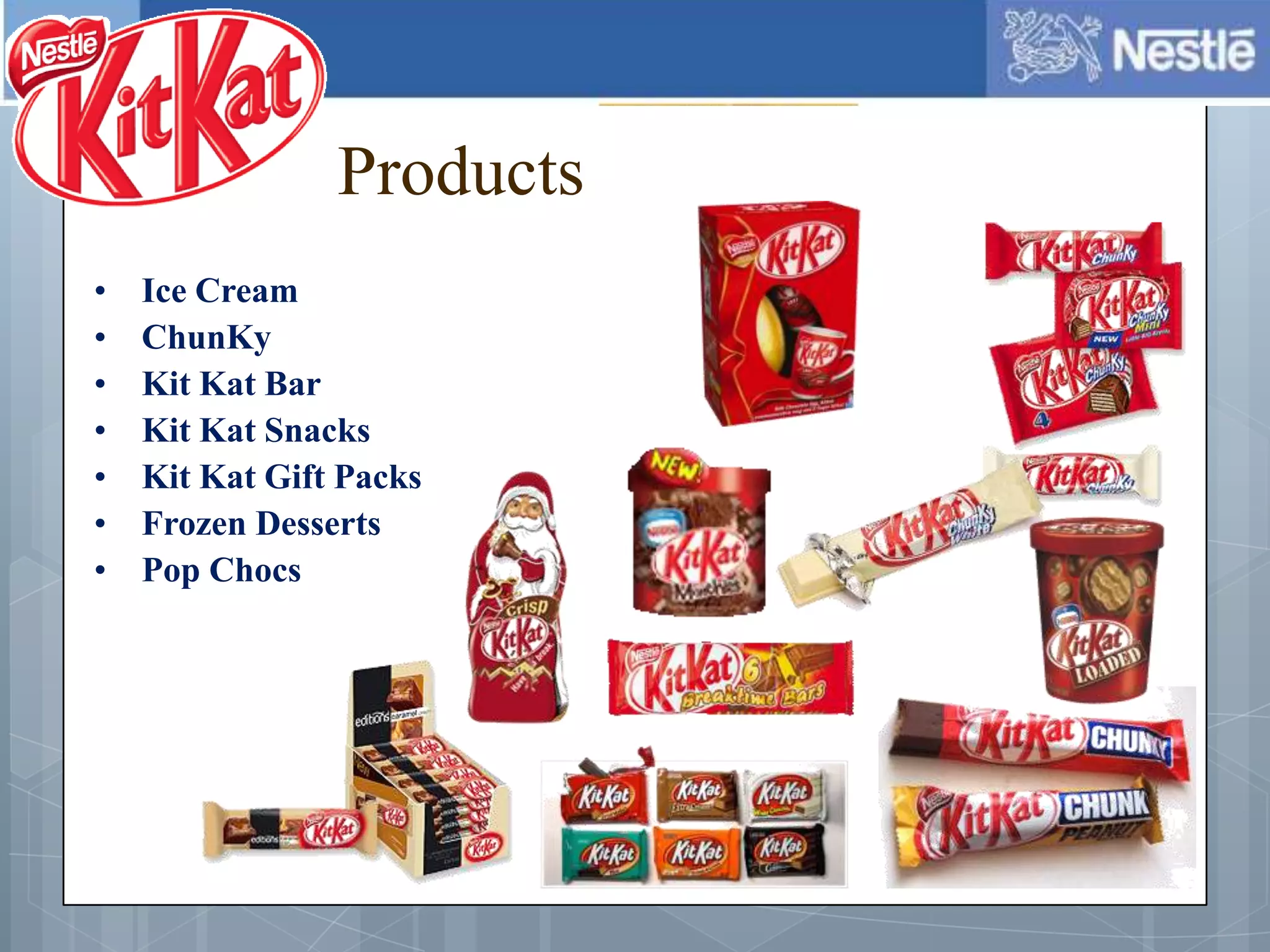
Products
• Ice Cream
• ChunKy
• Kit Kat Bar
• Kit Kat Snacks
• Kit Kat Gift Packs
• Frozen Desserts
• Pop Chocs
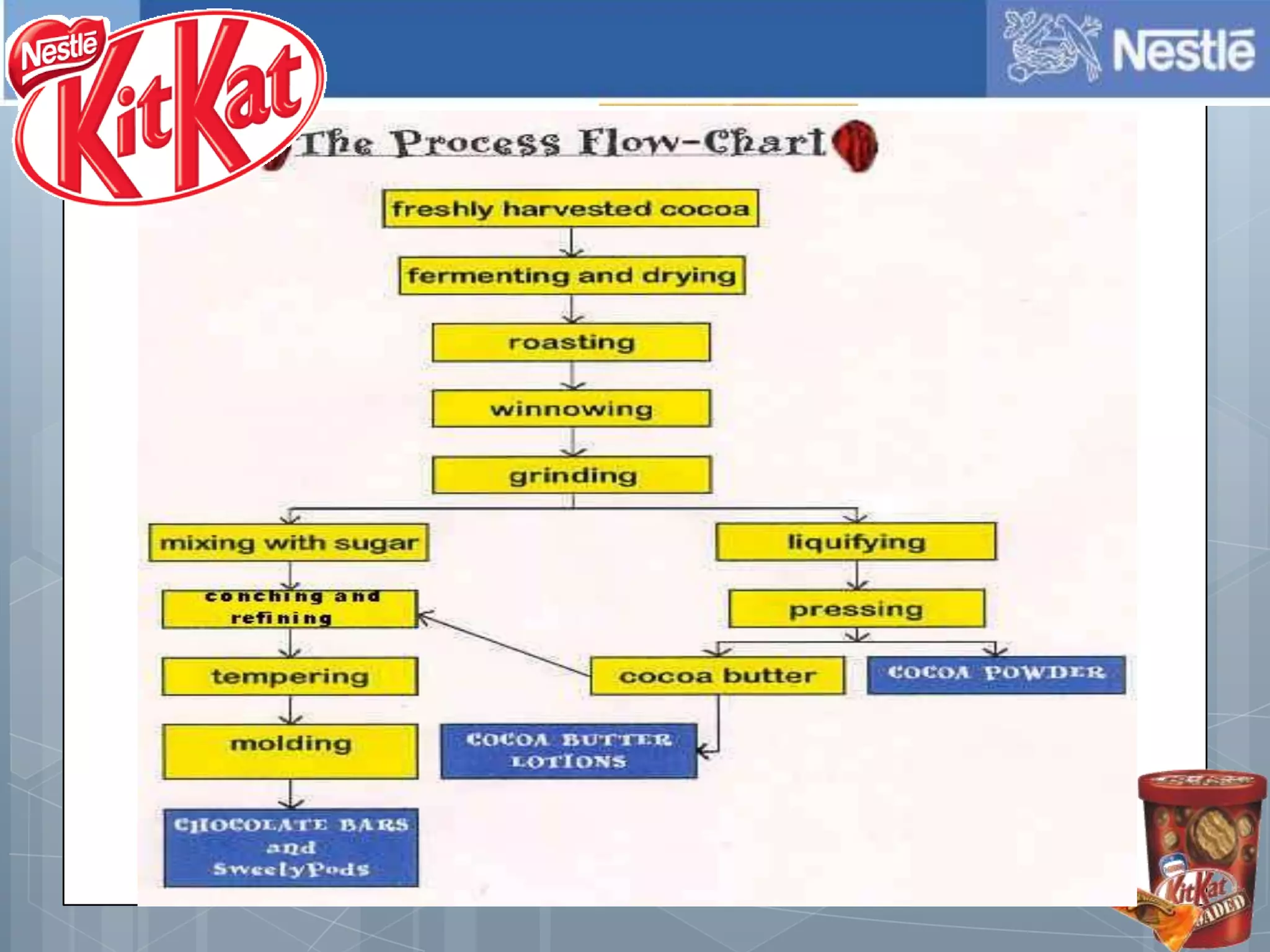
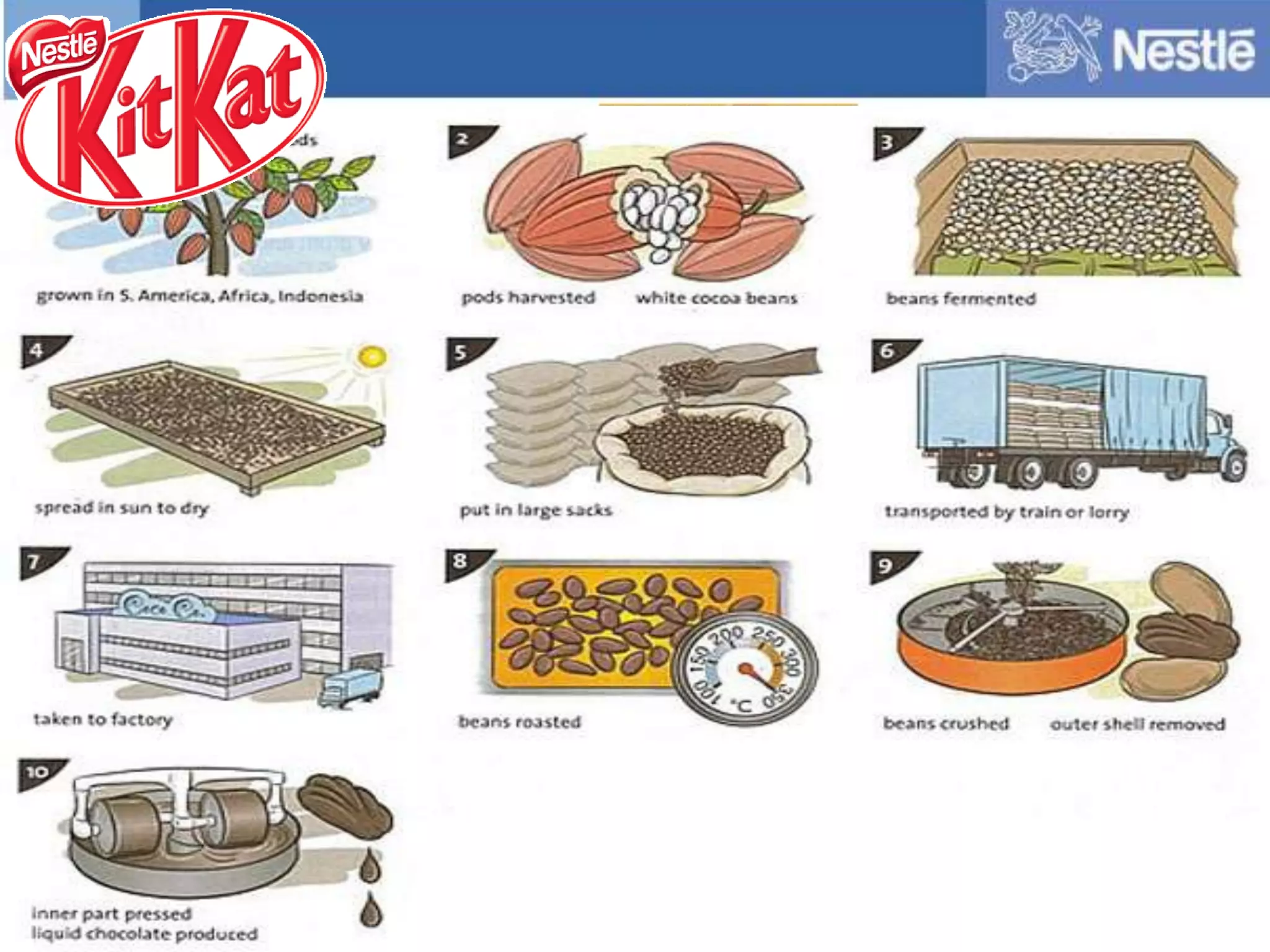
Process of Nestle Coffee and Chocolate

Process of Nestle Coffee and Chocolate

  • 1.
    Topic: Manufacturing Processof Nestle Coffee and Chocolate
  • 2.
     Introduction  History Key Dates  Nestle India  Product Brands  Mission & Vision  Manufacturing Process of Coffee  Manufacturing Process of Chocolate Contents.
  • 3.
    INTRODUCTION “Nestles is aSwiss-German word which means “Little Nest” which is its trademark Nestles is the worlds’ known food processing company Nestle was founded in 1867 in Geneva, Switzerland by Henri Nestle. His first product was lactogen formula for infants by the name “Farine Lacteé”
  • 4.
    The Nestlé logowas launched by Henri Nestlé in 1868 on the basis of the meaning of his name in German, i.e. little nest, and of his family emblem
  • 5.
    KEY DATES 1866COMPANY FOUNDATION 1866 Foundation of Anglo-Swiss Condensed Milk Co. 1867 Henry Nestlé’s Infant cereal developed 1905 Merger between Nestlé and Anglo-Swiss Condensed Milk Company 1947 Nestlé Alimentana S.A., (new name after merger with Maggi) 1991 Beverage Partners Worldwide (joint venture with Coca-Cola) 2006 Creation of Food Services Strategic Business Division; Jenny Craig, Uncle Tobys and Delta Ice Cream 2011 Partition with Chinese Food Company YINLU & HSU FU CHI a confectionary and Snacks Manufacturer.
  • 6.
     Nestle relationshipwith India started in 1912. It began trading as The Nestlé Anglo-Swiss Condensed Milk Company  Nestlé India’s first production facility, set up in 1961 at Moga (Punjab), was followed soon after by its second plant, set up at Choladi (Tamil Nadu), in 1967.  Consequently, Nestlé India set up factories in Nanjangud (Karnataka), in 1989, and Samalkha (Haryana), in 1993.  Nestle was succeeded by the commissioning of two more factories - at Ponda and Bicholim, Goa, in 1995 and 1997 respectively.  The 7th factory was set up at Pantnagar, Uttarakhand, in 2006.  The 8th Factory was set up at Tahliwal, Himachal Pradesh, in 2012. NESTLES 100 YEARS IN INDIA
  • 7.
    Headquarters in Gurgaon RegionalOffices are in Delhi, Mumbai, Chennai, Calcutta.
  • 8.
    MISSION & VISIONSTATEMENT VISION "Nestlé is the largest food company in the world. But, more important to them is to be the world's leading food company”. MISSION “Good Food, Good Life” – is to provide consumers with the best tasting, most nutritious choices in a wide range of food and beverage categories.
  • 9.
    BRANDS Quality and nutritionalvalue are the essential ingredients in all of its brands. Millions of people prefer Nestlé products every day, happy with the addition to their wellness that they bring. Nestle, a multinational company has acquired & merged with various companies. Factors behind its success are quality, improved technology, innovation which have created brand loyalty amongst its customers. Today Nestle is present in different markets with the following main brands:-
  • 10.
     Baby foods Bottled water  Cereals  Chocolate & confectionery  Coffee  Culinary, chilled & frozen food  Dairy  Drinks  Food service  Healthcare nutrition  Ice cream  Petcare
  • 13.
    Manufacturing Process ofNestle Coffee and Chocolate.
  • 14.
  • 15.
     Coffee isa brewed beverage prepared from the roasted seeds of several species of an evergreen shrub of the genus Coffea.  The two most common sources of coffee beans are the highly regarded Coffea arabica, and the Robusta.  Coffee is the second-most traded commodity in the world after crude oil, and is cultivated across 80 nations spanning Central and South America, Africa, and Asia.  The key coffee producing and exporting nations are Brazil, Vietnam, Columbia, Indonesia, Ethiopia, and India.  Brazil is the world’s largest producer, exporter and consumer of coffee, while USA and European nations constitute key importing markets for coffee. Overview
  • 16.
    TOP 10 COFFEEPRODUCERS IN THE WORLD 2013
  • 17.
    Process Flow Planting Harvesting Processing theCherries Industrial Processing Quality Insurance
  • 18.
     Both typesof plants begin bearing in 3-4 years  Time to mature fruit • Arabica, 7-8 months • Robusta, 11-12 months  Productive for 20-30 years Tropical Horticulture - Texas A&M University Planting
  • 19.
     Selectively Picked- only the ripe cherries are harvested and they are picked individually by hand.  Strip Picked - the entire crop is harvested at one time. This can either be done by machine or by hand. In either case, all of the cherries are stripped off of the branch at one time.  In Brazil, allow cherries to dry on tree Tropical Horticulture - Texas A&M University Harvesting the Cherries
  • 20.
     Start onHarvest Day  Separate trash and defective berries by flotation  Good berries are depulped same day  Fermentation  Only to remove mucilaginous covering  Washed  Water under pressure  Dried - spread out to dry  Sun  Artificial heat  Best quality  Gives coffee that is cleaner, brighter, fruitier, better acidity Processing the Cherries (Wet Method & Dry Method) Wet Method
  • 21.
     Drying (Indonesia,Ethiopia, Brazil, Yemen)  Initial drying done on trees  Spread on concrete, tile or matted surface  3-15 days until specific moisture  Chaff removed via winnowing and picking  Sorted by size, shape, density and color Dry Method Dry Method (Natural Method) (Most traditional and least expensive)
  • 22.
     Grading process Redry and clean the beans before using  Remove testa (Hulling and polishing)  Sort on size and density  Roasting (370 F to 540 F)  Removes moisture  Light roast lose 3-5% moisture  Dark roast lose 8-14% moisture  Time (up to 30 min) determines flavor Industrial Processing  Grinding  Coarse to medium (600-1100 μm)
  • 23.
    GREEN COFFEE • %Moisture • Size • Defects • Smell • Green Appearance Production to Quality Assurance Ensure Quality of Product at every stage of Production Starting from Planting the Trees to Dispatching the Coffee.
  • 24.
    Equal Exchange usesthe standards of the Specialty Coffee Association of America ROASTED • Smell • Development • Uniformity Production to Quality Assurance
  • 25.
    Fragrance Aroma Tasting Productionto Quality Assurance After Roasting  Dispatching of Material after Inspection
  • 26.
    Manufacturing Process ofNestle Chocolate
  • 27.
     Delighting consumersall over the world, Kit Kat brand is a favorite chocolate treat thanks to its light wafer texture and delicious chocolate taste, freshness and variety of formats.  Kit Kat is the UK's best-selling chocolate bar. The history of Kit Kat emphasizes the importance of successfully managed brand names to the company that owns them.  Internationally, Kit Kat is now also manufactured in Canada, Germany, India, Malaysia, China, Japan, Australia, South Africa and the United States. It is available in more than 100 countries throughout the World.
  • 29.
    Products • Ice Cream •ChunKy • Kit Kat Bar • Kit Kat Snacks • Kit Kat Gift Packs • Frozen Desserts • Pop Chocs