Marketing Presentation
Presented by : Kabriti Karam
Intoduction
Kit Kat was launched in 1937. Since then, it has consistently been one of the best
selling chocolate bars on the market and has acquired an instantly recognizable
brand name and identity. In 1997, British sales of Kit Kat amounted to some £227
million,which made it easily the most popular confectionery product on the
market.Forty four Kit Kats are consumed every second in the UK
Objectives
Nestlé's corporate objective is
to be the world's largest and
best branded food
manufacturer,whilst ensuring
thatthe Nestlé name is
synonymous with products of
the highest quality. In recent
years, the company has
pursued a policy of expansion
and diversification through
acquisition and divestment to
achieve a more balanced
structure to the business.
The primary objective for Kit Kat
is to maintain its position as the
UK's number one selling
confectionery brand. In order to
achieve this, Nestlé has to
develop a marketing strategy
thatwill take into account all
the elements of the marketing
mix. This will involve individual
strategies for pricing, product
development, promotion and
distribution.
Corporate objectives
Marketing objectives
The marketing mix
No matter how effective the promotion and packaging, a firm will find it very
difficultto market a product which fails to satisfy a consumer need. Kit Kat owes
much of its success to a unique dual appeal - as a four-finger chocolate bar,
(known in the confectionery trade as a countline), sold at corner shops and
newsagents, but also as a two-finger biscuit sold in supermarkets. It is a product
thathas endured because of its wide appeal across the age ranges and to both
sexes.
Product strategy
Pricing strategy
A key advantage of maintaining astrong brand image in a competitive
market is a degree of flexibilityin the pricing strategy. It is a common
characteristicof imperfectlycompetitive marketsforproducers to
concentrate on non-price competition. When looking at the pricing
strategyfor Kit Kat, it can be seen from the figures that the real price has
remained remarkablystable over the last sixty years.
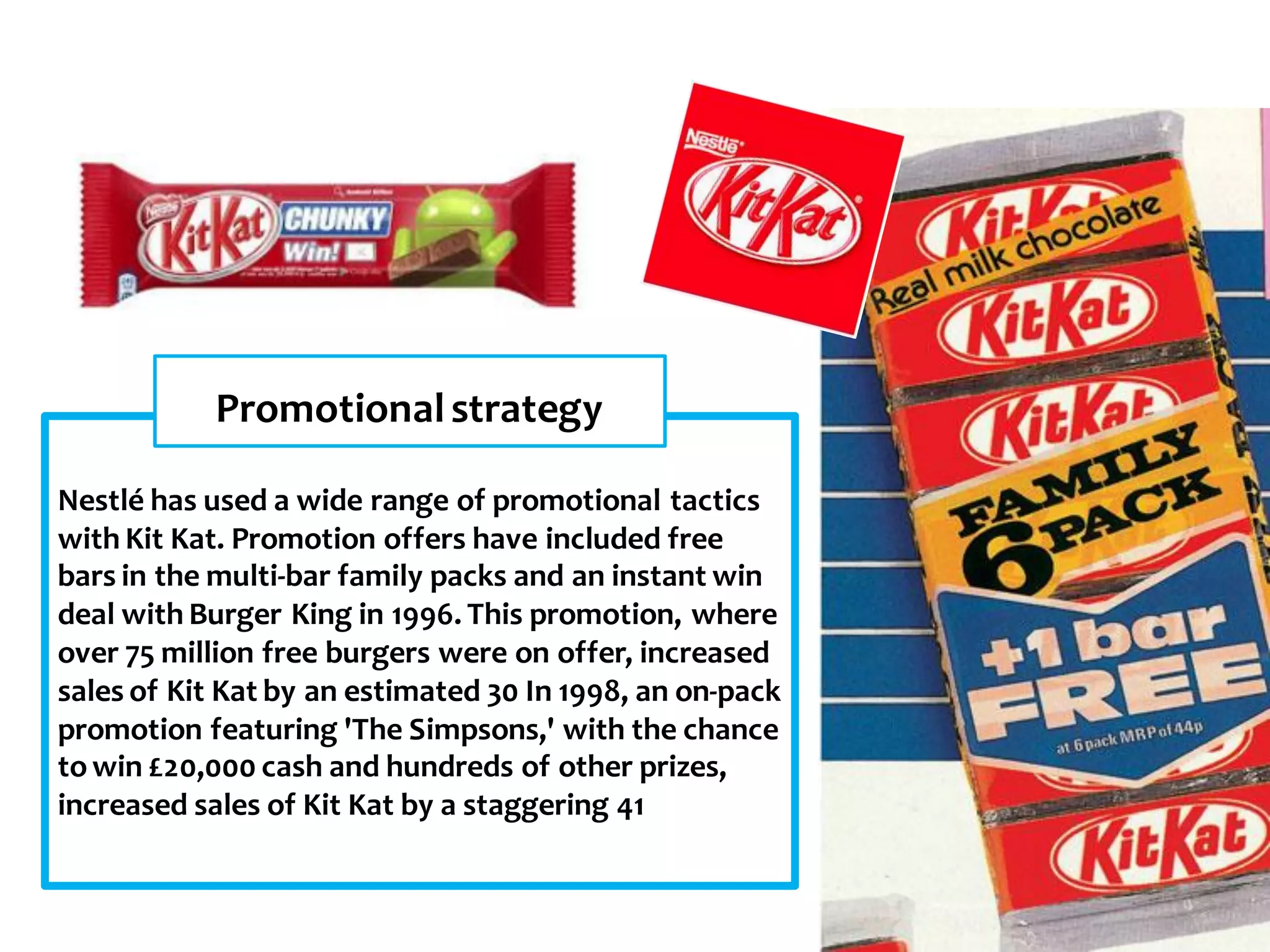
Nestlé has used a wide range of promotional tactics
with Kit Kat. Promotion offers have included free
bars in the multi-bar family packs and an instant win
deal with Burger King in 1996. This promotion, where
over 75 million free burgers were on offer, increased
sales of Kit Kat by an estimated 30 In 1998, an on-pack
promotion featuring 'The Simpsons,' with the chance
towin £20,000 cash and hundreds of other prizes,
increased sales of Kit Kat by a staggering 41
Promotionalstrategy
Nestlé has developed distribution channels which ensure the availability of Kit Kat
to buy wherever and whenever the consumer wishes to purchase it. Sales of
confectionery depend heavily on its availability, with market research showing
thatwell over 60of all purchases are made on impulse. Consequently, Nestlé tries
to supply as many outlets as possible - both wholesaler and retailer channels.
Distribution strategy
Advertising plays an extremelyimportant part in the confectionery
industry, with spend approaching £114 million in 1996. The Have a
Break, Have a Kit Kat theme appeared briefly in 1939, but has been the
on-going Kit Kat slogan, or strapline, since the mid 1950s. Kit Kat's
advertising is concentrated in two media:
- Television commercials
- which followthe well-known Have a Break tradition
posters
- where the powerful colours of the pack and product are used to
dramatise the message
Advertising

Kitkat marketing strategie

  • 1.
  • 2.
    Intoduction Kit Kat waslaunched in 1937. Since then, it has consistently been one of the best selling chocolate bars on the market and has acquired an instantly recognizable brand name and identity. In 1997, British sales of Kit Kat amounted to some £227 million,which made it easily the most popular confectionery product on the market.Forty four Kit Kats are consumed every second in the UK
  • 3.
    Objectives Nestlé's corporate objectiveis to be the world's largest and best branded food manufacturer,whilst ensuring thatthe Nestlé name is synonymous with products of the highest quality. In recent years, the company has pursued a policy of expansion and diversification through acquisition and divestment to achieve a more balanced structure to the business. The primary objective for Kit Kat is to maintain its position as the UK's number one selling confectionery brand. In order to achieve this, Nestlé has to develop a marketing strategy thatwill take into account all the elements of the marketing mix. This will involve individual strategies for pricing, product development, promotion and distribution. Corporate objectives Marketing objectives
  • 4.
    The marketing mix Nomatter how effective the promotion and packaging, a firm will find it very difficultto market a product which fails to satisfy a consumer need. Kit Kat owes much of its success to a unique dual appeal - as a four-finger chocolate bar, (known in the confectionery trade as a countline), sold at corner shops and newsagents, but also as a two-finger biscuit sold in supermarkets. It is a product thathas endured because of its wide appeal across the age ranges and to both sexes. Product strategy
  • 5.
    Pricing strategy A keyadvantage of maintaining astrong brand image in a competitive market is a degree of flexibilityin the pricing strategy. It is a common characteristicof imperfectlycompetitive marketsforproducers to concentrate on non-price competition. When looking at the pricing strategyfor Kit Kat, it can be seen from the figures that the real price has remained remarkablystable over the last sixty years.
  • 6.
    Nestlé has useda wide range of promotional tactics with Kit Kat. Promotion offers have included free bars in the multi-bar family packs and an instant win deal with Burger King in 1996. This promotion, where over 75 million free burgers were on offer, increased sales of Kit Kat by an estimated 30 In 1998, an on-pack promotion featuring 'The Simpsons,' with the chance towin £20,000 cash and hundreds of other prizes, increased sales of Kit Kat by a staggering 41 Promotionalstrategy
  • 7.
    Nestlé has developeddistribution channels which ensure the availability of Kit Kat to buy wherever and whenever the consumer wishes to purchase it. Sales of confectionery depend heavily on its availability, with market research showing thatwell over 60of all purchases are made on impulse. Consequently, Nestlé tries to supply as many outlets as possible - both wholesaler and retailer channels. Distribution strategy
  • 8.
    Advertising plays anextremelyimportant part in the confectionery industry, with spend approaching £114 million in 1996. The Have a Break, Have a Kit Kat theme appeared briefly in 1939, but has been the on-going Kit Kat slogan, or strapline, since the mid 1950s. Kit Kat's advertising is concentrated in two media: - Television commercials - which followthe well-known Have a Break tradition posters - where the powerful colours of the pack and product are used to dramatise the message Advertising