Kirkpatrick's Four Levels of Training Evaluation in Detail
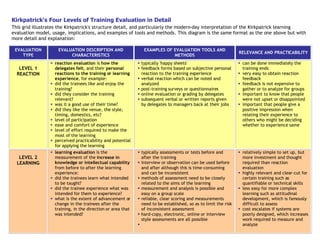
This grid illustrates the Kirkpatrick's structure detail, and particularly the modern-day interpretation of the Kirkpatrick learning
evaluation model, usage, implications, and examples of tools and methods. This diagram is the same format as the one above but with
more detail and explanation:
EVALUATION
TYPE
EVALUATION DESCRIPTION AND
CHARACTERISTICS
EXAMPLES OF EVALUATION TOOLS AND
METHODS
RELEVANCE AND PRACTICABILITY
LEVEL 1
REACTION
§ reaction evaluation is how the
delegates felt, and their personal
reactions to the training or learning
experience, for example:
§ did the trainees like and enjoy the
training?
§ did they consider the training
relevant?
§ was it a good use of their time?
§ did they like the venue, the style,
timing, domestics, etc?
§ level of participation
§ ease and comfort of experience
§ level of effort required to make the
most of the learning
§ perceived practicability and potential
for applying the learning
§ typically 'happy sheets'
§ feedback forms based on subjective personal
reaction to the training experience
§ verbal reaction which can be noted and
analyzed
§ post-training surveys or questionnaires
§ online evaluation or grading by delegates
§ subsequent verbal or written reports given
by delegates to managers back at their jobs
§ can be done immediately the
training ends
§ very easy to obtain reaction
feedback
§ feedback is not expensive to
gather or to analyze for groups
§ important to know that people
were not upset or disappointed
§ important that people give a
positive impression when
relating their experience to
others who might be deciding
whether to experience same
LEVEL 2
LEARNING
§ learning evaluation is the
measurement of the increase in
knowledge or intellectual capability
from before to after the learning
experience:
§ did the trainees learn what intended
to be taught?
§ did the trainee experience what was
intended for them to experience?
§ what is the extent of advancement or
change in the trainees after the
training, in the direction or area that
was intended?
§ typically assessments or tests before and
after the training
§ interview or observation can be used before
and after although this is time-consuming
and can be inconsistent
§ methods of assessment need to be closely
related to the aims of the learning
§ measurement and analysis is possible and
easy on a group scale
§ reliable, clear scoring and measurements
need to be established, so as to limit the risk
of inconsistent assessment
§ hard-copy, electronic, online or interview
style assessments are all possible
§
§ relatively simple to set up, but
more investment and thought
required than reaction
evaluation
§ highly relevant and clear-cut for
certain training such as
quantifiable or technical skills
§ less easy for more complex
learning such as attitudinal
development, which is famously
difficult to assess
§ cost escalates if systems are
poorly designed, which increases
work required to measure and
analyze
EVALUATION
TYPE
EVALUATION DESCRIPTION AND
CHARACTERISTICS
EXAMPLES OF EVALUATION TOOLS AND
METHODS
RELEVANCE AND PRACTICABILITY
LEVEL 3
BEHAVIOR
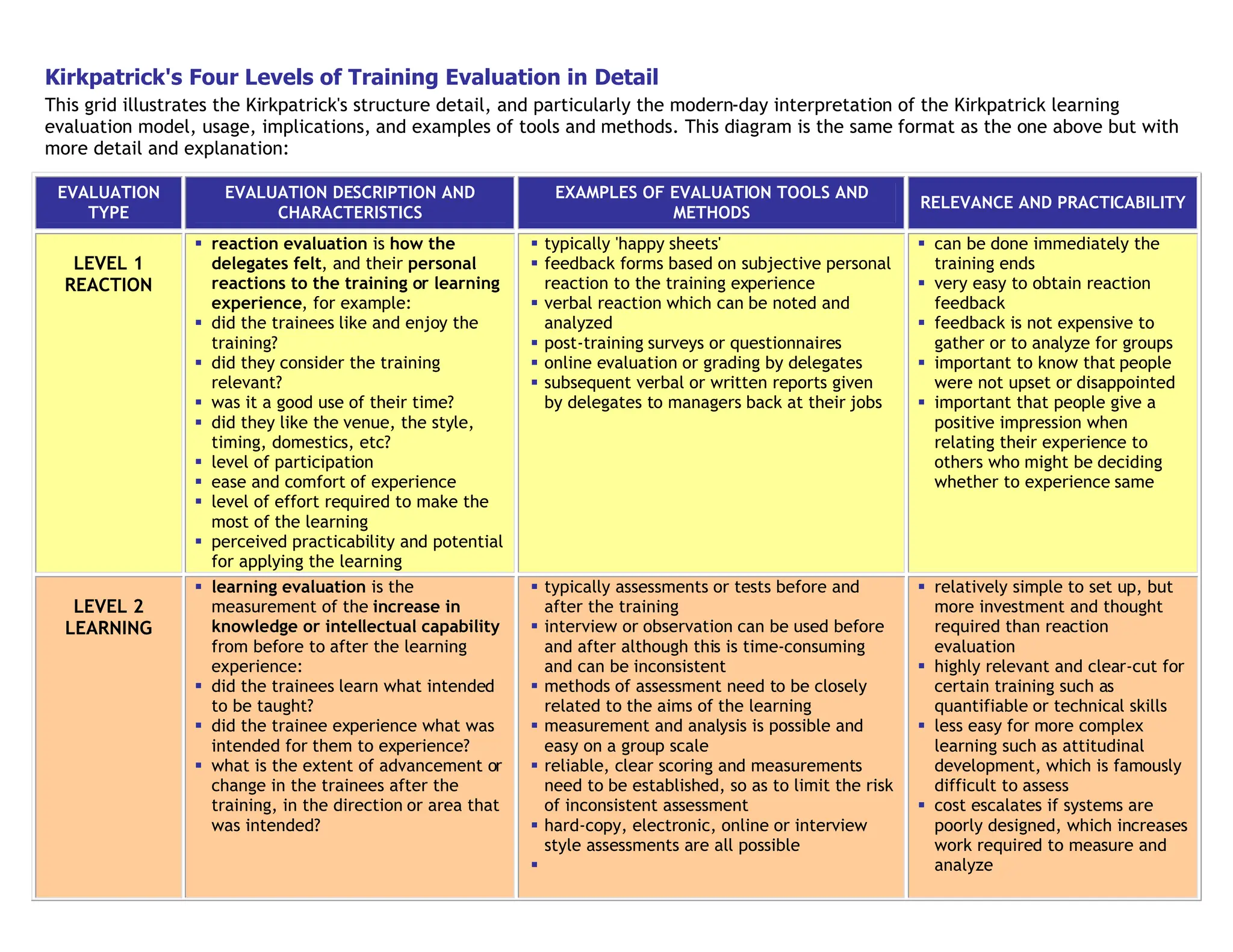
§ behavior evaluation is the extent to
which the trainees applied the
learning and changed their
behavior, and this can be
immediately and several months after
the training, depending on the
situation:
§ did the trainees put their learning
into effect when back on the job?
§ were the relevant skills and
knowledge used
§ was there noticeable and measurable
change in the activity and
performance of the trainees when
back in their roles?
§ was the change in behavior and new
level of knowledge sustained?
§ would the trainee be able to transfer
their learning to another person?
is the trainee aware of their change in
behavior, knowledge, skill level?
§ observation and interview over time are
required to assess change, relevance of
change, and sustainability of change
§ arbitrary snapshot assessments are not
reliable because people change in different
ways at different times
§ assessments need to be subtle and ongoing,
and then transferred to a suitable analysis
tool
§ assessments need to be designed to reduce
subjective judgment of the observer or
interviewer, which is a variable factor that
can affect reliability and consistency of
measurements
§ the opinion of the trainee, which is a
relevant indicator, is also subjective and
unreliable, and so needs to be measured in a
consistent defined way
§ 360-degree feedback is useful method and
need not be used before training, because
respondents can make a judgment as to
change after training, and this can be
analyzed for groups of respondents and
trainees
§ assessments can be designed around relevant
performance scenarios, and specific key
performance indicators or criteria
§ online and electronic assessments are more
difficult to incorporate - assessments tend to
be more successful when integrated within
existing management and coaching protocols
§ self-assessment can be useful, using
carefully designed criteria and
measurements
§ measurement of behavior
change is less easy to quantify
and interpret than reaction and
learning evaluation
§ simple quick response systems
unlikely to be adequate
§ cooperation and skill of
observers, typically line-
managers, are important
factors, and difficult to control
§ management and analysis of
ongoing subtle assessments are
difficult, and virtually
impossible without a well-
designed system from the
beginning
§ evaluation of implementation
and application is an extremely
important assessment - there is
little point in a good reaction
and good increase in capability
if nothing changes back in the
job, therefore evaluation in this
area is vital, albeit challenging
§ behavior change evaluation is
possible given good support and
involvement from line managers
or trainees, so it is helpful to
involve them from the start, and
to identify benefits for them,
which links to the level 4
evaluation below
EVALUATION
TYPE
EVALUATION DESCRIPTION AND
CHARACTERISTICS
EXAMPLES OF EVALUATION TOOLS AND
METHODS
RELEVANCE AND PRACTICABILITY
LEVEL 4
RESULTS
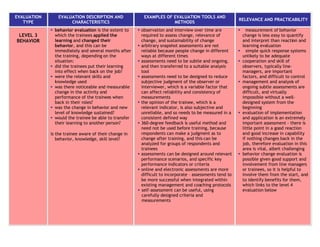
§ results evaluation is the effect on
the business or environment
resulting from the improved
performance of the trainee - it is the
acid test
§ measures would typically be business
or organizational key performance
indicators, such as:
§ volumes, values, percentages,
timescales, return on investment,
and other quantifiable aspects of
organizational performance, for
instance; numbers of complaints,
staff turnover, attrition, failures,
wastage, non-compliance, quality
ratings, achievement of standards
and accreditations, growth,
retention, etc.
§ it is possible that many of these measures
are already in place via normal
management systems and reporting
§ the challenge is to identify which and how
relate to the trainee's input and influence
§ therefore it is important to identify and
agree accountability and relevance with
the trainee at the start of the training, so
they understand what is to be measured
§ this process overlays normal good
management practice - it simply needs
linking to the training input
§ failure to link to training input type and
timing will greatly reduce the ease by
which results can be attributed to the
training
§ for senior people particularly, annual
appraisals and ongoing agreement of key
business objectives are integral to
measuring business results derived from
training
§ individually, results evaluation is
not particularly difficult; across
an entire organization it
becomes very much more
challenging, not least because
of the reliance on line-
management, and the frequency
and scale of changing
structures, responsibilities and
roles, which complicates the
process of attributing clear
accountability
§ also, external factors greatly
affect organizational and
business performance, which
cloud the true cause of good or
poor results
Since Kirkpatrick established his original model, other theorists (for example Jack Phillips), and indeed Kirkpatrick himself, have
referred to a possible fifth level, namely ROI (Return On Investment). In my view ROI can easily be included in Kirkpatrick's original
fourth level 'Results'. The inclusion and relevance of a fifth level is therefore arguably only relevant if the assessment of Return On
Investment might otherwise be ignored or forgotten when referring simply to the 'Results' level.
Learning evaluation is a widely researched area. This is understandable since the subject is fundamental to the existence and
performance of education around the world, not least universities, which of course contain most of the researchers and writers.
While Kirkpatrick's model is not the only one of its type, for most industrial and commercial applications it suffices; indeed most
organizations would be absolutely thrilled if their training and learning evaluation, and thereby their ongoing people-development,
were planned and managed according to Kirkpatrick's model.
The use of this material is free provided copyright (see below) is acknowledged and reference or link is made to the www.businessballs.com website. This material
may not be sold, or published in any form. Disclaimer: Reliance on information, material, advice, or other linked or recommended resources, received from Alan
Chapman, shall be at your sole risk, and Alan Chapman assumes no responsibility for any errors, omissions, or damages arising. Users of this website are encouraged
to confirm information received with other sources, and to seek local qualified advice if embarking on any actions that could carry personal or organizational liabilities.
Managing people and relationships are sensitive activities; the free material and advice available via this website do not provide all necessary safeguards and checks.
Please retain this notice on all copies.
© Donald Kirkpatrick's Learning Evaluation Model 1959; review and contextual material Alan Chapman 1995-2007
Level One Evaluation: Reaction
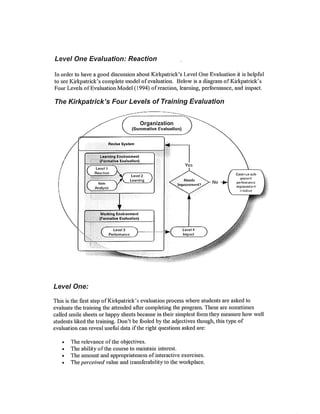
In order to have a good discussion about Kirkpatrick's Level One Evaluation it is helpful
to see Kirkpatrick's complete model ofevaluation. Below is a diagram ofKirkpatrick's
Four Levels ofEvaluation Model (1994) ofreaction, learning, performance, and impact.
The Kirkpatrick's Four Levels of Training Evaluation
-No ....
Needs
Improvemenl?
Level One:
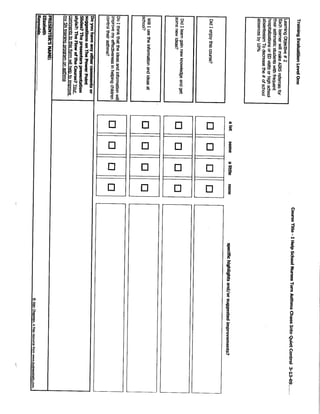
This is the first step ofKirkpatrick's evaluation process where students are asked to
evaluate the training the attended after completing the program. These are sometimes
called smile sheets or happy sheets because in their simplest form they measure how well
students liked the training. Don't be fooled by the adjectives though, this type of
evaluation can reveal useful data if the right questions asked are:
• The relevance of the objectives.
• The ability 0 f the course to maintain interest.
• The amount and appropriateness of interactive exercises.
• The perceived value and transferability to the workplace.
The evaluation is generally handed out right at the completion ofan instructor led class.
With the increase ofon-line and web based trainings the evaluations can also be delivered
and completed online, and then printed or e-mailed to a training manager.
What is reaction ill training evalnation? Simply put, it reports if participants liked or
disliked the training. This would resemble a customer satisfaction questionnaire in a retail
outlet. At the First Level ofevaluation, the goal is to find out the reaction of the trainees
to the instructor, course and learning environment. This can be useful for demonstrating
that the opinions ofthose taking part in the training matter. A Level One evaluation is
also a vehicle to provide feedback and allows for the quantification of the information
received about the trainee's reactions.
The intent ofgathering this information is not to measure what the trainee has learned,
but whether the delivery method was effective and appreciated. Non-training items may
have a deep impact on the training session and need to be considered. These items
include, but are not limited to environmental and other conditions surrounding the learner
at the time of training. Level One qnestions might include the following:
• Did the learner feel comfortable in the surroundings?
• Was it too cold or too warm in the room?
• Were there distractions?
• Was the time the training was conducted good for you?
• Was this an easy experience?
In gathering the data for this first step, it is important to do so soon after the training is
completed. It is most presented as a form to be filled out by the learner. The following are
some methods used to collect the data for Level One:
• Feedback forms - have the trainee relate their personal feelings about the training
• Conduct an Exit Interview - get the learner to express their opinions inunediately
• Surveys and Questionnaires - gather the information some time after the training
is conducted
• Online Evaluations - this might allow for more anonymous submissions and
quicker evaluation ofdata
• On-the-job verbal or written reports - given by managers when trainees are back
at work
The benefits of gathering Level One information are far-reaching. For example, the
trainer or instructional designer may be misled into believing there is a shortcoming in
the material presented, when it may have simply been an enviromnental issue. The data
can be gathered immediately and most trainees participate readily because the
information gathered is non-threatening and shows concern for their feelings. The
information, in addition to ease of gathering, is not difficult to analyze. Finally, when a
current group is relating a positive experience, other potential trainees are more at ease
with a decision to learn.
There are those who dislike the Level One Evalnation and scoffat its results being
scientific and controlled. Some suggest that just one question need be answered: "Would
you recommend this course to a friend or colleague? Why or why not?"
Every training intervention needs some kind of feedback loop, to make sure that within
the context of the learning objectives it is relevant, appropriately designed, and
competent Iy executed.
At Level I the intention is not to measure if, or to what extent, learning took place (that's
Level 2); nor is it intended to examine the learner's ability to transfer the skills or
knowledge from the classroom to the workplace (Level 3); nor does it attempt to judge
the ultimate impact of the learning on thc business (LcveI4). Level I of Kirkpatrick's
model is intended simply to gauge learner satisfaction.
The concern or disdain of the Level One Evaluation in many cases comes from poorly
designed evaluations that may "steer" respondents. Too many close ended questions
without room for comment limit attendee's comments. Thc type ofquestions asked can
limit thc areas thc student is "allowed" to evaluate. Opcn ended questions while tedious
may provide fuller feedback,
Trainers also nccd to understand that sound analytical evaluations often require multi-
stage studies. Your end-of-course feedback may indicate a problem area, but will not tell
you specifically what the problem is. A follow-up survey, by questionnaire, by informal
conversation, or by holding a brief focus group, will tell you a great deal more than you
could possibly find out under end-of-course conditions.
The level one evaluation none-the-less is an important first step. We need to remember
the word level one does indeed imply there are more levels ofevaluation. These
successive evaluations will help dig deeper into the training experience and assist with
identifying that your training programs helped move the organization toward realizing
business outcomes. Understanding the objectives/outcomes ofany training goal prior to
class design will always be the key measure ofa successful training program. Without
precise and clear objectives the ultimate success ofa training program can not be
measured.
The good news about the level one evaluation is that learners are keenly aware ofwhat
they need to know to accomplish a task. Ifthe training program fails to satisfy their
needs, a thoughtful evaluation will allow the opportunity to determine whether it's the
fault ofthe program design or delivery.
References:
Brown, Frederick G (1971). Mea Sit r e111 e II t a 11d E val ua t i 0 n. Itasca, Illinois: F.E. Peacock.
Gilbcrt,T.(1998).ALcisurelyLookatWorthyPcrfomlancc.The 1998 ASTD Training and
P e rfo rm a nc e Yca r boo k. Woods,1. & Gortada,1. (editors).New York McGmw-Hill.
Hayes, M. (2003, Feb 3). Just Who's Talking ROJ?Inform a I i on Wee k. p. 18.
Kelly, T. L. (1939).The Selection of Upper and LowerGroups for the Validationof Test Items.J 0/1 r 11a I of
Educational Psychology. Vol. 30, p.p. 17-24.
Kirkpatrick, Donald,(1994). Eva l u a ti 11g Tr a i 11i ng Pro gr a III s. San Francisco, CA: Berrett-Koehler
Publishers, Inc.(NOTE: Donald L. Kirkpatrickis a HRD Hall of Fame member.)
Markus, H. & Ruvulo, A. (1990). "Possibleselves. Personalizedrepresentationsof goals." Goa leo 11c eP tsill
PS Y clio logy. Pervin, L. (Editor). Hillsdale,NJ: Lawrence Erlbaum. Pp. 211-24J.
Tovey, Michael (1997). Tr a i II i f1 gill A II S t r a Iia. Sydney:Prentice Hall Australia.
Kruse, Kevin, Evaluating e-Learning: Introduction to the Kirkpatrick Model
Parkin, Godfrey, marketer, consultant, trainer, conferencespeaker, Revisiting Kirkpatrick's Le'el One
Tool-1A: Example for Agriculture (Crop): Retrospective pre- and post-evaluation for short
training workshops presented to adult audiences
CONSERVATION TILLAGE
End of Training Workshop Evaluation
Date: ______________
Cooperative Extension is always looking for ways to serve you better. Please take a moment to complete this short survey. It will
help us know how we’re doing, and how we can better meet your needs in the future.
Satisfaction
Please circle the appropriate number for your level of response.
How satisfied are you with: Not Satisfied Somewhat Satisfied Satisfied Very Satisfied
The relevance of information to your needs? 1 2 3 4
Presentation quality of instructor(s)? 1 2 3 4
Subject matter knowledge of instructor(s)? 1 2 3 4
Training facilities? 1 2 3 4
The overall quality of the training workshop? 1 2 3 4
Was the information easy to understand? 1. Yes 2. No
Knowledge:
Please circle the appropriate number to indicate your level of knowledge about the following topics before and after completing the
program. Please use the following key for rating:
1. Very Low = Don’t know anything about this topic.
2. Low = Know very little about this topic
3. Moderate = Know about this topic but there are more things to learn
4. High = Have good knowledge but there are things to learn
5. Very High = Know almost everything about this topic
How do you rate your
knowledge about:
BEFORE THIS WORKSHOP AFTER THIS WORKSHOP
Very
Low
Low Moderate High Very
High
Very
Low
Low Moderate High Very
High
Conservation tillage
systems.
1 2 3 4 5 1 2 3 4 5
Crop rotations. 1 2 3 4 5 1 2 3 4 5
Weed management under
conservation tillage.
1 2 3 4 5 1 2 3 4 5
Benefits of conservation
tillage.
1 2 3 4 5 1 2 3 4 5
Cover crops. 1 2 3 4 5 1 2 3 4 5
Pest and disease control. 1 2 3 4 5 1 2 3 4 5
Nutrient management. 1 2 3 4 5 1 2 3 4 5
Please see next page
Tool-1A: Example for Agriculture (Crop):
Taking Charge
Please circle the number that best describes your answer.
As a result of this program, do you intend to: No Maybe Yes
Already
doing this
1. Apply conservation tillage practices? 1 2 3 4
2. Follow a crop rotation? 1 2 3 4
3. Follow minimum tillage practices? 1 2 3 4
4. Use crop residue as a ground cover? 1 2 3 4
5. Use cover crops? 1 2 3 4
Did the training workshop meet your expectation? 1. Yes 2. No
Would you recommend this training workshop to others? 1. Yes 2. No
If not, why:________________________________________________________________________________________________
What did you like the most about this training workshop?
What did you like the least about this training workshop?
How could this training be further improved?
Demographics
What is your gender? 1. Male
2. Female
How do you identify yourself?
1. African American 5. White
2. American Indian/Alaskan 6. Native Hawaiian/Pacific Islander
3. Asian 7. Other
4. Hispanic/Latino
Share your name/address/phone number, if you are willing to allow us to contact you for follow-up comments (Optional).
Name: ________________________________ Phone Number: ______________________________
Address: ___________________________________________________________________________
Thank you for completing this evaluation.
We appreciate your input as we make every effort to improve Extension programs.

Kirkpatrik Evaluation Questions samples.pdf

  • 1.
    Kirkpatrick's Four Levelsof Training Evaluation in Detail This grid illustrates the Kirkpatrick's structure detail, and particularly the modern-day interpretation of the Kirkpatrick learning evaluation model, usage, implications, and examples of tools and methods. This diagram is the same format as the one above but with more detail and explanation: EVALUATION TYPE EVALUATION DESCRIPTION AND CHARACTERISTICS EXAMPLES OF EVALUATION TOOLS AND METHODS RELEVANCE AND PRACTICABILITY LEVEL 1 REACTION § reaction evaluation is how the delegates felt, and their personal reactions to the training or learning experience, for example: § did the trainees like and enjoy the training? § did they consider the training relevant? § was it a good use of their time? § did they like the venue, the style, timing, domestics, etc? § level of participation § ease and comfort of experience § level of effort required to make the most of the learning § perceived practicability and potential for applying the learning § typically 'happy sheets' § feedback forms based on subjective personal reaction to the training experience § verbal reaction which can be noted and analyzed § post-training surveys or questionnaires § online evaluation or grading by delegates § subsequent verbal or written reports given by delegates to managers back at their jobs § can be done immediately the training ends § very easy to obtain reaction feedback § feedback is not expensive to gather or to analyze for groups § important to know that people were not upset or disappointed § important that people give a positive impression when relating their experience to others who might be deciding whether to experience same LEVEL 2 LEARNING § learning evaluation is the measurement of the increase in knowledge or intellectual capability from before to after the learning experience: § did the trainees learn what intended to be taught? § did the trainee experience what was intended for them to experience? § what is the extent of advancement or change in the trainees after the training, in the direction or area that was intended? § typically assessments or tests before and after the training § interview or observation can be used before and after although this is time-consuming and can be inconsistent § methods of assessment need to be closely related to the aims of the learning § measurement and analysis is possible and easy on a group scale § reliable, clear scoring and measurements need to be established, so as to limit the risk of inconsistent assessment § hard-copy, electronic, online or interview style assessments are all possible § § relatively simple to set up, but more investment and thought required than reaction evaluation § highly relevant and clear-cut for certain training such as quantifiable or technical skills § less easy for more complex learning such as attitudinal development, which is famously difficult to assess § cost escalates if systems are poorly designed, which increases work required to measure and analyze
  • 2.
    EVALUATION TYPE EVALUATION DESCRIPTION AND CHARACTERISTICS EXAMPLESOF EVALUATION TOOLS AND METHODS RELEVANCE AND PRACTICABILITY LEVEL 3 BEHAVIOR § behavior evaluation is the extent to which the trainees applied the learning and changed their behavior, and this can be immediately and several months after the training, depending on the situation: § did the trainees put their learning into effect when back on the job? § were the relevant skills and knowledge used § was there noticeable and measurable change in the activity and performance of the trainees when back in their roles? § was the change in behavior and new level of knowledge sustained? § would the trainee be able to transfer their learning to another person? is the trainee aware of their change in behavior, knowledge, skill level? § observation and interview over time are required to assess change, relevance of change, and sustainability of change § arbitrary snapshot assessments are not reliable because people change in different ways at different times § assessments need to be subtle and ongoing, and then transferred to a suitable analysis tool § assessments need to be designed to reduce subjective judgment of the observer or interviewer, which is a variable factor that can affect reliability and consistency of measurements § the opinion of the trainee, which is a relevant indicator, is also subjective and unreliable, and so needs to be measured in a consistent defined way § 360-degree feedback is useful method and need not be used before training, because respondents can make a judgment as to change after training, and this can be analyzed for groups of respondents and trainees § assessments can be designed around relevant performance scenarios, and specific key performance indicators or criteria § online and electronic assessments are more difficult to incorporate - assessments tend to be more successful when integrated within existing management and coaching protocols § self-assessment can be useful, using carefully designed criteria and measurements § measurement of behavior change is less easy to quantify and interpret than reaction and learning evaluation § simple quick response systems unlikely to be adequate § cooperation and skill of observers, typically line- managers, are important factors, and difficult to control § management and analysis of ongoing subtle assessments are difficult, and virtually impossible without a well- designed system from the beginning § evaluation of implementation and application is an extremely important assessment - there is little point in a good reaction and good increase in capability if nothing changes back in the job, therefore evaluation in this area is vital, albeit challenging § behavior change evaluation is possible given good support and involvement from line managers or trainees, so it is helpful to involve them from the start, and to identify benefits for them, which links to the level 4 evaluation below
  • 3.
    EVALUATION TYPE EVALUATION DESCRIPTION AND CHARACTERISTICS EXAMPLESOF EVALUATION TOOLS AND METHODS RELEVANCE AND PRACTICABILITY LEVEL 4 RESULTS § results evaluation is the effect on the business or environment resulting from the improved performance of the trainee - it is the acid test § measures would typically be business or organizational key performance indicators, such as: § volumes, values, percentages, timescales, return on investment, and other quantifiable aspects of organizational performance, for instance; numbers of complaints, staff turnover, attrition, failures, wastage, non-compliance, quality ratings, achievement of standards and accreditations, growth, retention, etc. § it is possible that many of these measures are already in place via normal management systems and reporting § the challenge is to identify which and how relate to the trainee's input and influence § therefore it is important to identify and agree accountability and relevance with the trainee at the start of the training, so they understand what is to be measured § this process overlays normal good management practice - it simply needs linking to the training input § failure to link to training input type and timing will greatly reduce the ease by which results can be attributed to the training § for senior people particularly, annual appraisals and ongoing agreement of key business objectives are integral to measuring business results derived from training § individually, results evaluation is not particularly difficult; across an entire organization it becomes very much more challenging, not least because of the reliance on line- management, and the frequency and scale of changing structures, responsibilities and roles, which complicates the process of attributing clear accountability § also, external factors greatly affect organizational and business performance, which cloud the true cause of good or poor results Since Kirkpatrick established his original model, other theorists (for example Jack Phillips), and indeed Kirkpatrick himself, have referred to a possible fifth level, namely ROI (Return On Investment). In my view ROI can easily be included in Kirkpatrick's original fourth level 'Results'. The inclusion and relevance of a fifth level is therefore arguably only relevant if the assessment of Return On Investment might otherwise be ignored or forgotten when referring simply to the 'Results' level. Learning evaluation is a widely researched area. This is understandable since the subject is fundamental to the existence and performance of education around the world, not least universities, which of course contain most of the researchers and writers. While Kirkpatrick's model is not the only one of its type, for most industrial and commercial applications it suffices; indeed most organizations would be absolutely thrilled if their training and learning evaluation, and thereby their ongoing people-development, were planned and managed according to Kirkpatrick's model. The use of this material is free provided copyright (see below) is acknowledged and reference or link is made to the www.businessballs.com website. This material may not be sold, or published in any form. Disclaimer: Reliance on information, material, advice, or other linked or recommended resources, received from Alan Chapman, shall be at your sole risk, and Alan Chapman assumes no responsibility for any errors, omissions, or damages arising. Users of this website are encouraged to confirm information received with other sources, and to seek local qualified advice if embarking on any actions that could carry personal or organizational liabilities. Managing people and relationships are sensitive activities; the free material and advice available via this website do not provide all necessary safeguards and checks. Please retain this notice on all copies. © Donald Kirkpatrick's Learning Evaluation Model 1959; review and contextual material Alan Chapman 1995-2007
  • 13.
    Level One Evaluation:Reaction In order to have a good discussion about Kirkpatrick's Level One Evaluation it is helpful to see Kirkpatrick's complete model ofevaluation. Below is a diagram ofKirkpatrick's Four Levels ofEvaluation Model (1994) ofreaction, learning, performance, and impact. The Kirkpatrick's Four Levels of Training Evaluation -No .... Needs Improvemenl? Level One: This is the first step ofKirkpatrick's evaluation process where students are asked to evaluate the training the attended after completing the program. These are sometimes called smile sheets or happy sheets because in their simplest form they measure how well students liked the training. Don't be fooled by the adjectives though, this type of evaluation can reveal useful data if the right questions asked are: • The relevance of the objectives. • The ability 0 f the course to maintain interest. • The amount and appropriateness of interactive exercises. • The perceived value and transferability to the workplace.
  • 14.
    The evaluation isgenerally handed out right at the completion ofan instructor led class. With the increase ofon-line and web based trainings the evaluations can also be delivered and completed online, and then printed or e-mailed to a training manager. What is reaction ill training evalnation? Simply put, it reports if participants liked or disliked the training. This would resemble a customer satisfaction questionnaire in a retail outlet. At the First Level ofevaluation, the goal is to find out the reaction of the trainees to the instructor, course and learning environment. This can be useful for demonstrating that the opinions ofthose taking part in the training matter. A Level One evaluation is also a vehicle to provide feedback and allows for the quantification of the information received about the trainee's reactions. The intent ofgathering this information is not to measure what the trainee has learned, but whether the delivery method was effective and appreciated. Non-training items may have a deep impact on the training session and need to be considered. These items include, but are not limited to environmental and other conditions surrounding the learner at the time of training. Level One qnestions might include the following: • Did the learner feel comfortable in the surroundings? • Was it too cold or too warm in the room? • Were there distractions? • Was the time the training was conducted good for you? • Was this an easy experience? In gathering the data for this first step, it is important to do so soon after the training is completed. It is most presented as a form to be filled out by the learner. The following are some methods used to collect the data for Level One: • Feedback forms - have the trainee relate their personal feelings about the training • Conduct an Exit Interview - get the learner to express their opinions inunediately • Surveys and Questionnaires - gather the information some time after the training is conducted • Online Evaluations - this might allow for more anonymous submissions and quicker evaluation ofdata • On-the-job verbal or written reports - given by managers when trainees are back at work The benefits of gathering Level One information are far-reaching. For example, the trainer or instructional designer may be misled into believing there is a shortcoming in the material presented, when it may have simply been an enviromnental issue. The data can be gathered immediately and most trainees participate readily because the information gathered is non-threatening and shows concern for their feelings. The information, in addition to ease of gathering, is not difficult to analyze. Finally, when a current group is relating a positive experience, other potential trainees are more at ease with a decision to learn.
  • 15.
    There are thosewho dislike the Level One Evalnation and scoffat its results being scientific and controlled. Some suggest that just one question need be answered: "Would you recommend this course to a friend or colleague? Why or why not?" Every training intervention needs some kind of feedback loop, to make sure that within the context of the learning objectives it is relevant, appropriately designed, and competent Iy executed. At Level I the intention is not to measure if, or to what extent, learning took place (that's Level 2); nor is it intended to examine the learner's ability to transfer the skills or knowledge from the classroom to the workplace (Level 3); nor does it attempt to judge the ultimate impact of the learning on thc business (LcveI4). Level I of Kirkpatrick's model is intended simply to gauge learner satisfaction. The concern or disdain of the Level One Evaluation in many cases comes from poorly designed evaluations that may "steer" respondents. Too many close ended questions without room for comment limit attendee's comments. Thc type ofquestions asked can limit thc areas thc student is "allowed" to evaluate. Opcn ended questions while tedious may provide fuller feedback, Trainers also nccd to understand that sound analytical evaluations often require multi- stage studies. Your end-of-course feedback may indicate a problem area, but will not tell you specifically what the problem is. A follow-up survey, by questionnaire, by informal conversation, or by holding a brief focus group, will tell you a great deal more than you could possibly find out under end-of-course conditions. The level one evaluation none-the-less is an important first step. We need to remember the word level one does indeed imply there are more levels ofevaluation. These successive evaluations will help dig deeper into the training experience and assist with identifying that your training programs helped move the organization toward realizing business outcomes. Understanding the objectives/outcomes ofany training goal prior to class design will always be the key measure ofa successful training program. Without precise and clear objectives the ultimate success ofa training program can not be measured. The good news about the level one evaluation is that learners are keenly aware ofwhat they need to know to accomplish a task. Ifthe training program fails to satisfy their needs, a thoughtful evaluation will allow the opportunity to determine whether it's the fault ofthe program design or delivery. References: Brown, Frederick G (1971). Mea Sit r e111 e II t a 11d E val ua t i 0 n. Itasca, Illinois: F.E. Peacock. Gilbcrt,T.(1998).ALcisurelyLookatWorthyPcrfomlancc.The 1998 ASTD Training and P e rfo rm a nc e Yca r boo k. Woods,1. & Gortada,1. (editors).New York McGmw-Hill. Hayes, M. (2003, Feb 3). Just Who's Talking ROJ?Inform a I i on Wee k. p. 18.
  • 16.
    Kelly, T. L.(1939).The Selection of Upper and LowerGroups for the Validationof Test Items.J 0/1 r 11a I of Educational Psychology. Vol. 30, p.p. 17-24. Kirkpatrick, Donald,(1994). Eva l u a ti 11g Tr a i 11i ng Pro gr a III s. San Francisco, CA: Berrett-Koehler Publishers, Inc.(NOTE: Donald L. Kirkpatrickis a HRD Hall of Fame member.) Markus, H. & Ruvulo, A. (1990). "Possibleselves. Personalizedrepresentationsof goals." Goa leo 11c eP tsill PS Y clio logy. Pervin, L. (Editor). Hillsdale,NJ: Lawrence Erlbaum. Pp. 211-24J. Tovey, Michael (1997). Tr a i II i f1 gill A II S t r a Iia. Sydney:Prentice Hall Australia. Kruse, Kevin, Evaluating e-Learning: Introduction to the Kirkpatrick Model Parkin, Godfrey, marketer, consultant, trainer, conferencespeaker, Revisiting Kirkpatrick's Le'el One
  • 17.
    Tool-1A: Example forAgriculture (Crop): Retrospective pre- and post-evaluation for short training workshops presented to adult audiences CONSERVATION TILLAGE End of Training Workshop Evaluation Date: ______________ Cooperative Extension is always looking for ways to serve you better. Please take a moment to complete this short survey. It will help us know how we’re doing, and how we can better meet your needs in the future. Satisfaction Please circle the appropriate number for your level of response. How satisfied are you with: Not Satisfied Somewhat Satisfied Satisfied Very Satisfied The relevance of information to your needs? 1 2 3 4 Presentation quality of instructor(s)? 1 2 3 4 Subject matter knowledge of instructor(s)? 1 2 3 4 Training facilities? 1 2 3 4 The overall quality of the training workshop? 1 2 3 4 Was the information easy to understand? 1. Yes 2. No Knowledge: Please circle the appropriate number to indicate your level of knowledge about the following topics before and after completing the program. Please use the following key for rating: 1. Very Low = Don’t know anything about this topic. 2. Low = Know very little about this topic 3. Moderate = Know about this topic but there are more things to learn 4. High = Have good knowledge but there are things to learn 5. Very High = Know almost everything about this topic How do you rate your knowledge about: BEFORE THIS WORKSHOP AFTER THIS WORKSHOP Very Low Low Moderate High Very High Very Low Low Moderate High Very High Conservation tillage systems. 1 2 3 4 5 1 2 3 4 5 Crop rotations. 1 2 3 4 5 1 2 3 4 5 Weed management under conservation tillage. 1 2 3 4 5 1 2 3 4 5 Benefits of conservation tillage. 1 2 3 4 5 1 2 3 4 5 Cover crops. 1 2 3 4 5 1 2 3 4 5 Pest and disease control. 1 2 3 4 5 1 2 3 4 5 Nutrient management. 1 2 3 4 5 1 2 3 4 5 Please see next page
  • 18.
    Tool-1A: Example forAgriculture (Crop): Taking Charge Please circle the number that best describes your answer. As a result of this program, do you intend to: No Maybe Yes Already doing this 1. Apply conservation tillage practices? 1 2 3 4 2. Follow a crop rotation? 1 2 3 4 3. Follow minimum tillage practices? 1 2 3 4 4. Use crop residue as a ground cover? 1 2 3 4 5. Use cover crops? 1 2 3 4 Did the training workshop meet your expectation? 1. Yes 2. No Would you recommend this training workshop to others? 1. Yes 2. No If not, why:________________________________________________________________________________________________ What did you like the most about this training workshop? What did you like the least about this training workshop? How could this training be further improved? Demographics What is your gender? 1. Male 2. Female How do you identify yourself? 1. African American 5. White 2. American Indian/Alaskan 6. Native Hawaiian/Pacific Islander 3. Asian 7. Other 4. Hispanic/Latino Share your name/address/phone number, if you are willing to allow us to contact you for follow-up comments (Optional). Name: ________________________________ Phone Number: ______________________________ Address: ___________________________________________________________________________ Thank you for completing this evaluation. We appreciate your input as we make every effort to improve Extension programs.