

SIMPLISTIC APPROACH OF KIRK PATRICK
                        Presented by,
                      RHIMY C. RAJAN
                         MACFAST
Dr. Donald L Kirkpatrick

 Born on 15 March 1924- Richland Center, USA.
 Education: University of Wisconsin-Madison,
    B.B.A., 1948, M.B.A., 1949, Ph.D., 1954
 Career status : Professor Emeritus
  of the University of Wisconsin in
  the United States.
 Kirkpatrick developed a model of training evaluation in 1959.
 Donald Kirkpatrick's 1975 book “Evaluating Training Programs” defined
  his originally published ideas of 1959.
 The most widely used approach.
 Simple
 4-level model
Four Levels
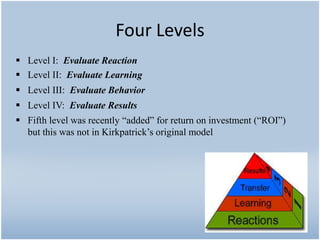
 Level I: Evaluate Reaction
 Level II: Evaluate Learning
 Level III: Evaluate Behavior
 Level IV: Evaluate Results
 Fifth level was recently “added” for return on investment (“ROI”)
  but this was not in Kirkpatrick’s original model
Level 1: Reactions

 Assesses the reaction of the trainees to the training experience.
 Focuses on the trainees’ immediate response to training
  programmes.
 The purpose of measuring reaction is to ensure that learners
  are motivated and interested in learning.
 Measurement of participants’ reactions or attitudes toward
  specific components of the program, such as the instructor,
  topics, presentation style, schedule, audiovisuals, etc
Level 2: Learning
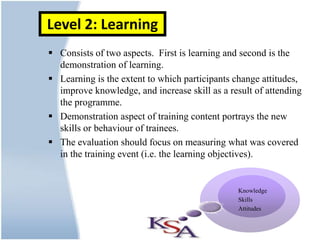
 Consists of two aspects. First is learning and second is the
  demonstration of learning.
 Learning is the extent to which participants change
  attitudes, improve knowledge, and increase skill as a result of
  attending the programme.
 Demonstration aspect of training content portrays the new
  skills or behaviour of trainees.
 The evaluation should focus on measuring what was covered
  in the training event (i.e. the learning objectives).


                                                Knowledge
                                                Skills
                                                Attitudes
Level 3: Behaviour
• Behavior is the action that is
  performed.
• Behavior will only change if
  conditions are favorable.
• Level three evaluation specifically
  involves measuring the transfer of
  knowledge, skills, and attitudes from
  the training context to the workplace.
• The goal is to find out if training
  program participants change their on-
  the-job-behavior (OJB) as a result of
  the training programme.
Level 4: Results
• Measures the result of training as it relates to
  factors such as sales, productivity, profit,
  costs, employee turnover, and product/service
  quality.

• Level four assess results that include both the
  impact of training on an organization and the
  return on investment (ROI).

• Stage when the evaluation process enters into
  the business metrices.

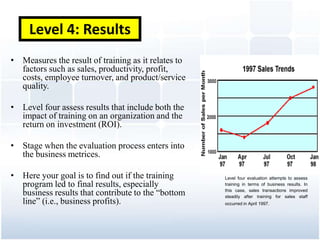
• Here your goal is to find out if the training      Level four evaluation attempts to assess
  program led to final results, especially           training in terms of business results. In

  business results that contribute to the “bottom    this case, sales transactions improved
                                                     steadily after training for sales staff
  line” (i.e., business profits).                    occurred in April 1997.
CONCLUSION
 BENEFITS
• Fairly simplified model
• Easier to conceptualize
• Established, familiar and popular


 CRITICISMS
• Too simplistic
• The model is incomplete.
• Evidence does not support that the levels
  have a casual relationship.
• Incremental importance of information.
Simplistic approach of krik patrick

Simplistic approach of krik patrick

  • 1.
    SIMPLISTIC APPROACH OFKIRK PATRICK Presented by, RHIMY C. RAJAN MACFAST
  • 2.
    Dr. Donald LKirkpatrick  Born on 15 March 1924- Richland Center, USA.  Education: University of Wisconsin-Madison, B.B.A., 1948, M.B.A., 1949, Ph.D., 1954  Career status : Professor Emeritus of the University of Wisconsin in the United States.  Kirkpatrick developed a model of training evaluation in 1959.  Donald Kirkpatrick's 1975 book “Evaluating Training Programs” defined his originally published ideas of 1959.  The most widely used approach.  Simple  4-level model
  • 3.
    Four Levels  LevelI: Evaluate Reaction  Level II: Evaluate Learning  Level III: Evaluate Behavior  Level IV: Evaluate Results  Fifth level was recently “added” for return on investment (“ROI”) but this was not in Kirkpatrick’s original model
  • 4.
    Level 1: Reactions Assesses the reaction of the trainees to the training experience.  Focuses on the trainees’ immediate response to training programmes.  The purpose of measuring reaction is to ensure that learners are motivated and interested in learning.  Measurement of participants’ reactions or attitudes toward specific components of the program, such as the instructor, topics, presentation style, schedule, audiovisuals, etc
  • 5.
    Level 2: Learning Consists of two aspects. First is learning and second is the demonstration of learning.  Learning is the extent to which participants change attitudes, improve knowledge, and increase skill as a result of attending the programme.  Demonstration aspect of training content portrays the new skills or behaviour of trainees.  The evaluation should focus on measuring what was covered in the training event (i.e. the learning objectives). Knowledge Skills Attitudes
  • 6.
    Level 3: Behaviour •Behavior is the action that is performed. • Behavior will only change if conditions are favorable. • Level three evaluation specifically involves measuring the transfer of knowledge, skills, and attitudes from the training context to the workplace. • The goal is to find out if training program participants change their on- the-job-behavior (OJB) as a result of the training programme.
  • 7.
    Level 4: Results •Measures the result of training as it relates to factors such as sales, productivity, profit, costs, employee turnover, and product/service quality. • Level four assess results that include both the impact of training on an organization and the return on investment (ROI). • Stage when the evaluation process enters into the business metrices. • Here your goal is to find out if the training Level four evaluation attempts to assess program led to final results, especially training in terms of business results. In business results that contribute to the “bottom this case, sales transactions improved steadily after training for sales staff line” (i.e., business profits). occurred in April 1997.
  • 8.
    CONCLUSION  BENEFITS • Fairlysimplified model • Easier to conceptualize • Established, familiar and popular  CRITICISMS • Too simplistic • The model is incomplete. • Evidence does not support that the levels have a casual relationship. • Incremental importance of information.